

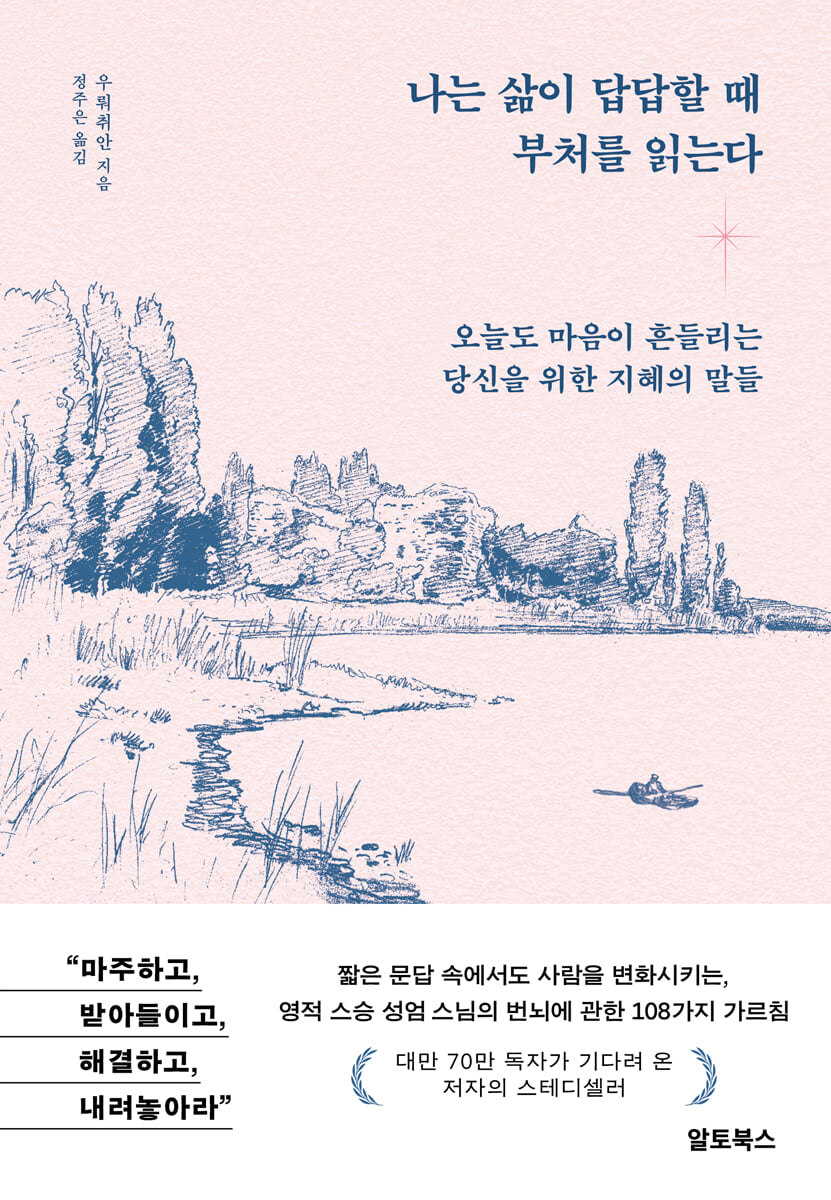
When life gets frustrating, I read Buddha.
 |
Description
Book Introduction
Loneliness, obsession, anxiety, hurt…
Finding the way in the midst of suffering,
108 Questions and Answers with Monk Seong-eom
“Monk, why is my heart so heavy?”
“The moment you let go of that weight, you are already free.”
Mind training taught by a monk
Everyone lives with big and small waves in their hearts.
We live each day fearing loneliness, hurting in relationships, and carrying regrets from yesterday and anxieties about tomorrow.
No matter how hard you try to shake it off, thoughts keep coming back and the worries come back like habits.
The author of this book was no exception.
Wu Luoquan, considered one of Taiwan's top ten writers, has met many people as a writer and broadcaster, but deep down inside he still carries unresolved questions and weight.
At that time, I met Monk Seong-eom, a great teacher of Taiwanese Buddhism and the founder of Beopgosan.
That relationship completely changed the author's life and perspective.
Seong-eom Seunim's teachings were simple.
"Face it, accept it, resolve it, and let it go." These four words, which unravel the profound truths of Buddhism in everyday language, helped untie the knots in the author's troubles, one by one.
What was important was not the flashy practice, but the practice of turning the mind and letting go of attachments every moment of every day.
The power to transform fear, hatred, desire and greed into positive energy rather than suppressing or avoiding them.
Monk Seong-eom said that this is the way to lighten and free life.
The author did not keep this realization to himself.
I wanted to provide a concrete and practical path to those who, like me, are feeling heavy-hearted and wavering.
So, based on the conversation I had with Monk Seong-eom, I compiled 108 questions and answers.
It contains the truth that solitude is the power of silence, the true meaning of freedom and liberty, the process of becoming kind to oneself through repentance and forgiveness, and how to cultivate compassion through loving and being loved.
All the questions and answers are not difficult, but they are deep and approachable.
As if an old friend were patting me on the shoulder and saying something.
This book is a life guide based on the enlightenment and wisdom of Monk Seong-eom, showing how to find your center when your mind wavers and how to deal with and let go of your afflictions.
As you read, you will find yourself asking the monk questions without even realizing it, and discovering your own path in the answers.
If you are having trouble sleeping today because your mind is heavy and your thoughts are full of worries, the 108 dialogues in this book will be the first step toward releasing your worries.
And someday, you too may quietly nod and whisper as Venerable Seong-eom said.
“When I changed my mind, the world changed.”
Finding the way in the midst of suffering,
108 Questions and Answers with Monk Seong-eom
“Monk, why is my heart so heavy?”
“The moment you let go of that weight, you are already free.”
Mind training taught by a monk
Everyone lives with big and small waves in their hearts.
We live each day fearing loneliness, hurting in relationships, and carrying regrets from yesterday and anxieties about tomorrow.
No matter how hard you try to shake it off, thoughts keep coming back and the worries come back like habits.
The author of this book was no exception.
Wu Luoquan, considered one of Taiwan's top ten writers, has met many people as a writer and broadcaster, but deep down inside he still carries unresolved questions and weight.
At that time, I met Monk Seong-eom, a great teacher of Taiwanese Buddhism and the founder of Beopgosan.
That relationship completely changed the author's life and perspective.
Seong-eom Seunim's teachings were simple.
"Face it, accept it, resolve it, and let it go." These four words, which unravel the profound truths of Buddhism in everyday language, helped untie the knots in the author's troubles, one by one.
What was important was not the flashy practice, but the practice of turning the mind and letting go of attachments every moment of every day.
The power to transform fear, hatred, desire and greed into positive energy rather than suppressing or avoiding them.
Monk Seong-eom said that this is the way to lighten and free life.
The author did not keep this realization to himself.
I wanted to provide a concrete and practical path to those who, like me, are feeling heavy-hearted and wavering.
So, based on the conversation I had with Monk Seong-eom, I compiled 108 questions and answers.
It contains the truth that solitude is the power of silence, the true meaning of freedom and liberty, the process of becoming kind to oneself through repentance and forgiveness, and how to cultivate compassion through loving and being loved.
All the questions and answers are not difficult, but they are deep and approachable.
As if an old friend were patting me on the shoulder and saying something.
This book is a life guide based on the enlightenment and wisdom of Monk Seong-eom, showing how to find your center when your mind wavers and how to deal with and let go of your afflictions.
As you read, you will find yourself asking the monk questions without even realizing it, and discovering your own path in the answers.
If you are having trouble sleeping today because your mind is heavy and your thoughts are full of worries, the 108 dialogues in this book will be the first step toward releasing your worries.
And someday, you too may quietly nod and whisper as Venerable Seong-eom said.
“When I changed my mind, the world changed.”
- You can preview some of the book's contents.
Preview
index
Introduction | When you let go of your mind, life becomes simpler and your burdens become lighter.
CHAPTER 1.
The power of silence brought by solitude
01 What does solitude tell us?
02 Can I be fulfilled even when I'm alone?
03 Can you be 'lonely' without being 'eccentric'?
04 Is there a way to help lonely children?
05 Is loneliness physical or psychological?
06 Can deep solitude be the foundation for growth?
07 Is there a way to feel my own silence?
08 What state of mind and body can we reach through active solitude?
09 What does solitude, enjoyed as one pleases, look like?
10 When faced with opposition, will you stick to your guns or compromise?
11 How to overcome the despair of being abandoned
12 What to do when others don't understand
13 How to avoid falling into dogmatism
14 Do I really need to be lonely even if I have someone to be with?
15. Do I really need to be with someone who doesn't share my same wavelength?
16 What to do when you feel lonely and helpless
CHAPTER 2.
Resources are more important than freedom.
17 Can Autonomy Bring Freedom?
18 How to avoid pushing yourself too hard
19 Is freedom to do whatever you want without restrictions?
20 If inner freedom and external expectations clash
21 Can one be free while fulfilling one's responsibilities and mission?
22 If you try to fulfill your desires, will you move away from freedom?
23 How can I break free when I feel trapped?
24 Can we be free even when bound by norms?
25 What is the true meaning of 'freedom'?
26 What is enlightenment, and can I attain it?
27 If the afflictions do not diminish, what is the use of practicing?
28 How much practice is needed to achieve true liberation?
29 Can you be free even when confined in a small room?
30 How to practice diligently in daily life
31 What should I do when I don't feel like practicing?
32 Isn't a life that follows rules in everything unfree?
33 How to Stay Centered in an Unstable World
CHAPTER 3.
Moving towards the true self, selflessness
34 Why do we live?
35 Is it really beneficial to have mental idols?
36 How to affirm your own worth
37 Can we create a better world through our own efforts?
38 How can I find my self when I can't see the path?
39 How to live a different life
40 How can I find my own talent?
41 When you reach a dead end, should you change direction?
42 Am I a valuable person even though I am less capable than others?
43 How to Change Your Thinking When You're in Trouble
44 Can we overcome temptation at the crossroads of good and evil?
45 Should I persevere even when the future is uncertain?
CHAPTER 4.
Learn to turn your mind and let go
46 Why is it that I don't feel happy even though I'm working hard to help others?
47 What to do when you do good things but are not treated well
48 Can Ignorance Bring Fear?
49 Could 'hatred' also be arrogance?
50 How to overcome fear
51 Are all desires bad?
52 How to deal with selfish desires
53 How to Be Altruistic
54 How do people start living completely different lives?
55 If I change, what will change?
56 How to Distinguish Between 'Wants' and 'Needs'
57 How do I shed the superficiality and reveal my true self?
58 What to do when lust grows
59 Is it also greed to desire peace of mind?
60 How to break free from the vicious cycle of endless competition
61 How to become generous and strong
CHAPTER 5.
Be kind to yourself through repentance and forgiveness
62 How can we find the courage to overcome hardship?
63 What kind of mindset should we have in the face of frustration and adversity?
64 Which problem should be solved first, the present or the past?
If you find it difficult to achieve your goal, will you continue or give up?
66 Is sacrifice for others foolish or courageous?
67 How to Grow Yourself in Chaotic Times
68 Should I repent for mistakes I made unintentionally?
69 What is true repentance?
70 What changes will occur if we repent our mistakes?
71 If you hurt someone, how should you compensate them?
72 What to do if the other person doesn't forgive
73 If we forgive easily, wouldn't that be tantamount to turning a blind eye to wrongdoing?
74 Should I forgive someone even though they have left an indelible scar?
75 How to Heal the Wounds of Betrayal by Someone Close to You
76 What is the difference between being strong and pretending to be strong?
77 What power does courage exert in the ups and downs of life?
CHAPTER 6.
Loving and being loved
78 Is it selfish to take care of yourself first?
79 Is 'letting go' another word for 'giving up'?
80 How can even a breakup be beautiful?
81 What is the highest level of love?
82 What is the difference between worldly love and Buddhist love?
83 Is it impossible to move from love to mercy?
84 Why do we hurt each other even though we love each other?
How long should I support my 85 children's future?
86 What to do when you feel anxious
87 How to build an intimate relationship with your spouse
88 Should I still be devoted to my partner even if he or she no longer loves me?
89 How can I protect myself amidst so many relationships?
How can we prevent conflicts from occurring around the world?
91 If you know everything, won't you be extremely disappointed in this world?
92 Can I take other people's kindness lightly?
CHAPTER 7.
The first thing that comes to mind is the end of life.
93 Will the spirits of the dead continue to stay with us?
94 Beyond Life and Death, What Should We Believe?
95 Will my longing be conveyed to those who have passed away?
96 Does Paradise Really Exist?
Will the day ever come when the sorrow of sending off family members will be over?
98 How did the Buddhist forty-nine-day ritual begin?
99 How should we accept the pain of life?
100 Should I take responsibility for parents who never loved me?
101 Can the emptiness of the heart be filled with the power of faith?
102 What if I want to practice but have doubts?
103 Where does all life ultimately return?
104 Can we overcome the fear of death?
105 What Life and Death Tell Us
106 How to teach life at home
107 What will you leave for your children?
108 How can we preserve the value of life?
supplement
Preface by Monk Seong-eom | If you turn your mind, the path will appear.
About Monk Seong-eom
CHAPTER 1.
The power of silence brought by solitude
01 What does solitude tell us?
02 Can I be fulfilled even when I'm alone?
03 Can you be 'lonely' without being 'eccentric'?
04 Is there a way to help lonely children?
05 Is loneliness physical or psychological?
06 Can deep solitude be the foundation for growth?
07 Is there a way to feel my own silence?
08 What state of mind and body can we reach through active solitude?
09 What does solitude, enjoyed as one pleases, look like?
10 When faced with opposition, will you stick to your guns or compromise?
11 How to overcome the despair of being abandoned
12 What to do when others don't understand
13 How to avoid falling into dogmatism
14 Do I really need to be lonely even if I have someone to be with?
15. Do I really need to be with someone who doesn't share my same wavelength?
16 What to do when you feel lonely and helpless
CHAPTER 2.
Resources are more important than freedom.
17 Can Autonomy Bring Freedom?
18 How to avoid pushing yourself too hard
19 Is freedom to do whatever you want without restrictions?
20 If inner freedom and external expectations clash
21 Can one be free while fulfilling one's responsibilities and mission?
22 If you try to fulfill your desires, will you move away from freedom?
23 How can I break free when I feel trapped?
24 Can we be free even when bound by norms?
25 What is the true meaning of 'freedom'?
26 What is enlightenment, and can I attain it?
27 If the afflictions do not diminish, what is the use of practicing?
28 How much practice is needed to achieve true liberation?
29 Can you be free even when confined in a small room?
30 How to practice diligently in daily life
31 What should I do when I don't feel like practicing?
32 Isn't a life that follows rules in everything unfree?
33 How to Stay Centered in an Unstable World
CHAPTER 3.
Moving towards the true self, selflessness
34 Why do we live?
35 Is it really beneficial to have mental idols?
36 How to affirm your own worth
37 Can we create a better world through our own efforts?
38 How can I find my self when I can't see the path?
39 How to live a different life
40 How can I find my own talent?
41 When you reach a dead end, should you change direction?
42 Am I a valuable person even though I am less capable than others?
43 How to Change Your Thinking When You're in Trouble
44 Can we overcome temptation at the crossroads of good and evil?
45 Should I persevere even when the future is uncertain?
CHAPTER 4.
Learn to turn your mind and let go
46 Why is it that I don't feel happy even though I'm working hard to help others?
47 What to do when you do good things but are not treated well
48 Can Ignorance Bring Fear?
49 Could 'hatred' also be arrogance?
50 How to overcome fear
51 Are all desires bad?
52 How to deal with selfish desires
53 How to Be Altruistic
54 How do people start living completely different lives?
55 If I change, what will change?
56 How to Distinguish Between 'Wants' and 'Needs'
57 How do I shed the superficiality and reveal my true self?
58 What to do when lust grows
59 Is it also greed to desire peace of mind?
60 How to break free from the vicious cycle of endless competition
61 How to become generous and strong
CHAPTER 5.
Be kind to yourself through repentance and forgiveness
62 How can we find the courage to overcome hardship?
63 What kind of mindset should we have in the face of frustration and adversity?
64 Which problem should be solved first, the present or the past?
If you find it difficult to achieve your goal, will you continue or give up?
66 Is sacrifice for others foolish or courageous?
67 How to Grow Yourself in Chaotic Times
68 Should I repent for mistakes I made unintentionally?
69 What is true repentance?
70 What changes will occur if we repent our mistakes?
71 If you hurt someone, how should you compensate them?
72 What to do if the other person doesn't forgive
73 If we forgive easily, wouldn't that be tantamount to turning a blind eye to wrongdoing?
74 Should I forgive someone even though they have left an indelible scar?
75 How to Heal the Wounds of Betrayal by Someone Close to You
76 What is the difference between being strong and pretending to be strong?
77 What power does courage exert in the ups and downs of life?
CHAPTER 6.
Loving and being loved
78 Is it selfish to take care of yourself first?
79 Is 'letting go' another word for 'giving up'?
80 How can even a breakup be beautiful?
81 What is the highest level of love?
82 What is the difference between worldly love and Buddhist love?
83 Is it impossible to move from love to mercy?
84 Why do we hurt each other even though we love each other?
How long should I support my 85 children's future?
86 What to do when you feel anxious
87 How to build an intimate relationship with your spouse
88 Should I still be devoted to my partner even if he or she no longer loves me?
89 How can I protect myself amidst so many relationships?
How can we prevent conflicts from occurring around the world?
91 If you know everything, won't you be extremely disappointed in this world?
92 Can I take other people's kindness lightly?
CHAPTER 7.
The first thing that comes to mind is the end of life.
93 Will the spirits of the dead continue to stay with us?
94 Beyond Life and Death, What Should We Believe?
95 Will my longing be conveyed to those who have passed away?
96 Does Paradise Really Exist?
Will the day ever come when the sorrow of sending off family members will be over?
98 How did the Buddhist forty-nine-day ritual begin?
99 How should we accept the pain of life?
100 Should I take responsibility for parents who never loved me?
101 Can the emptiness of the heart be filled with the power of faith?
102 What if I want to practice but have doubts?
103 Where does all life ultimately return?
104 Can we overcome the fear of death?
105 What Life and Death Tell Us
106 How to teach life at home
107 What will you leave for your children?
108 How can we preserve the value of life?
supplement
Preface by Monk Seong-eom | If you turn your mind, the path will appear.
About Monk Seong-eom
Detailed image
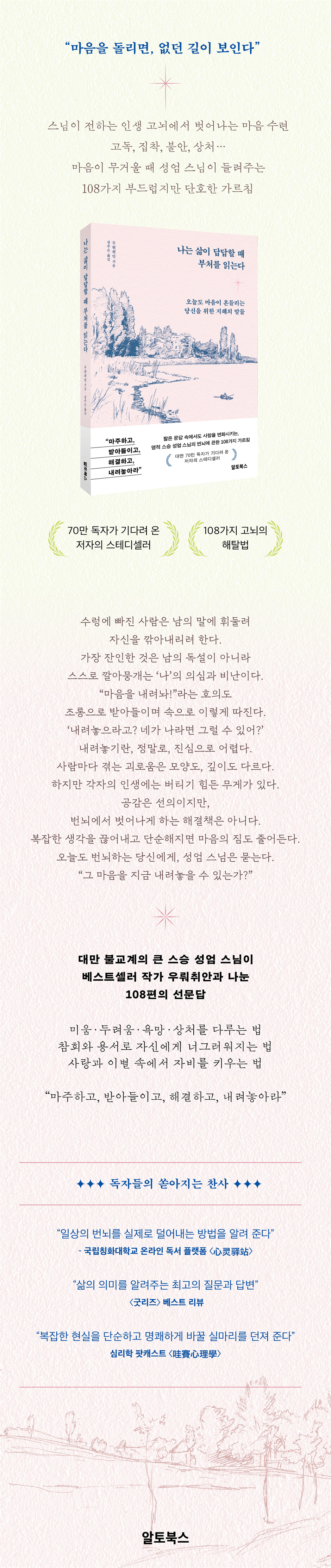
Into the book
*** The reason we cannot escape from suffering and fear is because in moments of suffering, we too easily judge ourselves by the world's evaluation.
The most poisonous words in the world do not come from someone else's mouth or keyboard, but from the mind that doubts, criticizes, and distrusts itself.
Even the words "Calm down!" spoken with genuine concern are often taken as malicious ridicule.
And then, I feel like asking myself this question:
'You want me to put it down? If it's that easy, why don't you suffer for me instead!
*** There is a saying, ‘A bear’s palm and a fish’.
It is an idiom that means a bear's paw and a fish, and is used when two things cannot be combined or when it is difficult to choose between the two.
Modern people are greedy and try to have everything they cannot have at the same time.
Moreover, if the two are inherently contradictory, then you can never be free unless you make a clear choice.
*** “What is the difference between the ‘freedom’ of Buddhism and Confucius’s saying, ‘Follow your heart’s desires without breaking the rules of the world’?” Monk Seong-eom answered with a compassionate face.
“It is subjective to say that doing what your heart desires does not violate the laws of the world.
I'm doing what I want to do, but without going overboard.
However, the freedom that is spoken of in Buddhism is letting go of the ego.
“Everything is for the sake of sentient beings, and everything moves and strives to fulfill the wishes of sentient beings.”
*** “I’ve always been like that too.
I asked myself what I could do.
But if you stop midway, you won't be able to feel it.
They say that everyone in the world is drunk, but I am the only one awake.
This should not be taken at face value.
It's not that everyone is drunk, it's just that there's no one to wake them up.
In fact, people are easily influenced by their surroundings.
If someone consistently influences one, two, three, four people, and so on, those people who have been influenced in this way will in turn influence others.
Then, there is still hope for our society.”
*** Among the outstanding people, there are those who, in the eyes of others, are already very good, but in reality, they think that they are bound by something.
For example, they set high ideals and try to achieve their goals, but are frustrated when things don't go as planned, and even blame fate and seek out fortune tellers or geomancers to try to change their fate.
Monk Seong-eom said this:
“Blaming frustration on fate is a fatalistic attitude.
Buddhism advocates the theory of causality.
The theory of fate tells us to constantly strive.
“We experience frustration and failure because we didn’t try hard enough, or because we tried hard in the wrong way.”
*** The saying, 'what you give up is what you gain' implies both giving up and gaining.
A person who is truly free from defilements only discards and does not seek to gain.
Only when there is no desire to gain can one be free from suffering.
*** If you have committed a mistake, you must repent.
Even if you have suffered harm, you must be able to forgive generously.
Whether it's repentance or forgiveness, it all comes from courage.
Between repentance and forgiveness, we must bridge the gap between the victim and the perpetrator by making amends for the wrongdoing, and not try to engage in a one-on-one, "an eye for an eye, a tooth for a tooth" response.
*** In Buddhism, love can be roughly divided into three stages.
If we could peel love away like an onion, layer by layer, there would be no more tears.
Because compassion is like boundless, clear, and vast water.
The most poisonous words in the world do not come from someone else's mouth or keyboard, but from the mind that doubts, criticizes, and distrusts itself.
Even the words "Calm down!" spoken with genuine concern are often taken as malicious ridicule.
And then, I feel like asking myself this question:
'You want me to put it down? If it's that easy, why don't you suffer for me instead!
*** There is a saying, ‘A bear’s palm and a fish’.
It is an idiom that means a bear's paw and a fish, and is used when two things cannot be combined or when it is difficult to choose between the two.
Modern people are greedy and try to have everything they cannot have at the same time.
Moreover, if the two are inherently contradictory, then you can never be free unless you make a clear choice.
*** “What is the difference between the ‘freedom’ of Buddhism and Confucius’s saying, ‘Follow your heart’s desires without breaking the rules of the world’?” Monk Seong-eom answered with a compassionate face.
“It is subjective to say that doing what your heart desires does not violate the laws of the world.
I'm doing what I want to do, but without going overboard.
However, the freedom that is spoken of in Buddhism is letting go of the ego.
“Everything is for the sake of sentient beings, and everything moves and strives to fulfill the wishes of sentient beings.”
*** “I’ve always been like that too.
I asked myself what I could do.
But if you stop midway, you won't be able to feel it.
They say that everyone in the world is drunk, but I am the only one awake.
This should not be taken at face value.
It's not that everyone is drunk, it's just that there's no one to wake them up.
In fact, people are easily influenced by their surroundings.
If someone consistently influences one, two, three, four people, and so on, those people who have been influenced in this way will in turn influence others.
Then, there is still hope for our society.”
*** Among the outstanding people, there are those who, in the eyes of others, are already very good, but in reality, they think that they are bound by something.
For example, they set high ideals and try to achieve their goals, but are frustrated when things don't go as planned, and even blame fate and seek out fortune tellers or geomancers to try to change their fate.
Monk Seong-eom said this:
“Blaming frustration on fate is a fatalistic attitude.
Buddhism advocates the theory of causality.
The theory of fate tells us to constantly strive.
“We experience frustration and failure because we didn’t try hard enough, or because we tried hard in the wrong way.”
*** The saying, 'what you give up is what you gain' implies both giving up and gaining.
A person who is truly free from defilements only discards and does not seek to gain.
Only when there is no desire to gain can one be free from suffering.
*** If you have committed a mistake, you must repent.
Even if you have suffered harm, you must be able to forgive generously.
Whether it's repentance or forgiveness, it all comes from courage.
Between repentance and forgiveness, we must bridge the gap between the victim and the perpetrator by making amends for the wrongdoing, and not try to engage in a one-on-one, "an eye for an eye, a tooth for a tooth" response.
*** In Buddhism, love can be roughly divided into three stages.
If we could peel love away like an onion, layer by layer, there would be no more tears.
Because compassion is like boundless, clear, and vast water.
--- From the text
Publisher's Review
“Only when you let go of your mind can you find freedom.”
Even in a short conversation, it changes people.
108 Teachings of the Spiritual Master Seong-eom
These days, people's footsteps are always busy.
I can't take my eyes off the stock market, and my heart races as the price of international flights fluctuates by the minute.
They line up from dawn to get limited edition sneakers and are anxious to be the first to post about new cafe menus on social media.
The desire to pursue more, faster, and earlier may give us momentary excitement, but it soon leads to anxiety and fatigue.
A life of worrying about losing what you have, regretting what you've missed, and constantly comparing.
We are consuming our own suffering without even knowing it.
Monk Seong-eom preaches how we can break free from this attachment and anxiety.
The monk was called 'Sangjin' at the temple where he became a monk as a child.
Believing that the truth of life lies in the teachings of Buddha, he continued his practice wearing only one set of monk's robes, even in times of war and poverty.
He dreamed of entering one of Taiwan's two major Buddhist academies, keeping the fire burning in his heart, but the outbreak of war cut off his path.
His dream was shattered, but he chose to accept it instead of being frustrated.
And while the external environment can change and collapse at any time, those who have learned to turn and let go of their minds can remain unshaken within it and have personally proven that they can reach the desired state of mind.
While embracing traditional Zen and modern scholarship in the United States and Japan, the monk founded the Beopgosan Order, one of the four major orders of Taiwanese Buddhism, and worked to spread the message of “purify your mind and purify the world” to the world.
The monk speaks to those who are suffering from afflictions.
“If you turn your mind, you will see a path that wasn’t there before.”
This book is based on 108 long-term dialogues between the author and the gentle yet firm spiritual master, Venerable Seong-eom. It offers advice and famous quotes on all the struggles of life, as well as 108 mind-changing methods to relieve suffering.
It guides you so that enlightenment can be put into practice in your life.
A monk's question class that answers life's troubles
Letting go of obsession and anxiety
● Be filled with solitude
● The meaning of freedom and liberty
Forgiveness that heals wounds and betrayal
How to deal with love and separation
When you've been preparing for a long time but aren't seeing results, it's a struggle we all face: wondering whether to continue or give up.
In this regard, the author explains the teachings of Monk Seong-eom to readers using everyday examples such as the ‘dumpling theory.’
One day, the line looked short, so I stood in front of it.
But when I actually waited for my turn, the person in front of me ordered a large quantity, so I ended up standing for much longer than I expected.
We often get so caught up in the immediate benefits that we don't look deeply into the situation, and end up wasting more time and energy.
The monk says:
“Sometimes, it is not a loss to cut off your attachment and take a different path, but rather a way to protect your heart.”
To break free from the chains of attachment, we must first reflect on whether our mind is blindly attached to something.
This book, through seven chapters, examines the causes of suffering and guides us step-by-step on how to change our minds.
Chapter 1 deals with the state of mind and body that can be reached through 'closing', and suggests ways to become fulfilled even when alone.
Chapter 2 distinguishes between freedom and liberty to do as one pleases, and reflects on the relationship between desire and freedom.
Chapter 3 deals with how to use the state of anatta (無我), the true self, as a nutrient for growth, and the power of 'Taekseon Gojip', which protects one's beliefs.
Chapter 4 explains the practice of controlling the knots of the mind such as hatred, fear, and desire, and letting go of attachments.
Chapter 5 deals with repentance and forgiveness, showing how generosity toward oneself and others can heal wounds.
Chapter 6 covers the differences between loving and being loved, letting go and giving up, and guides us in practicing compassion in our relationships.
The final seven chapters reflect on life and death, fate and resentment, and convey the realization that we must live meaningfully in every moment of our lives, right now.
Each chapter is structured in a question-and-answer format with specific examples, helping readers apply the knowledge directly to everyday problems.
The four principles of 'facing, accepting, resolving, and letting go', which are the core messages the monks convey to us, are simple yet powerful.
As you read, your worries will become lighter, even if they don't disappear.
And when it's time to close the bookcase, you might whisper:
“When I changed my mind, the world changed.”
Even in a short conversation, it changes people.
108 Teachings of the Spiritual Master Seong-eom
These days, people's footsteps are always busy.
I can't take my eyes off the stock market, and my heart races as the price of international flights fluctuates by the minute.
They line up from dawn to get limited edition sneakers and are anxious to be the first to post about new cafe menus on social media.
The desire to pursue more, faster, and earlier may give us momentary excitement, but it soon leads to anxiety and fatigue.
A life of worrying about losing what you have, regretting what you've missed, and constantly comparing.
We are consuming our own suffering without even knowing it.
Monk Seong-eom preaches how we can break free from this attachment and anxiety.
The monk was called 'Sangjin' at the temple where he became a monk as a child.
Believing that the truth of life lies in the teachings of Buddha, he continued his practice wearing only one set of monk's robes, even in times of war and poverty.
He dreamed of entering one of Taiwan's two major Buddhist academies, keeping the fire burning in his heart, but the outbreak of war cut off his path.
His dream was shattered, but he chose to accept it instead of being frustrated.
And while the external environment can change and collapse at any time, those who have learned to turn and let go of their minds can remain unshaken within it and have personally proven that they can reach the desired state of mind.
While embracing traditional Zen and modern scholarship in the United States and Japan, the monk founded the Beopgosan Order, one of the four major orders of Taiwanese Buddhism, and worked to spread the message of “purify your mind and purify the world” to the world.
The monk speaks to those who are suffering from afflictions.
“If you turn your mind, you will see a path that wasn’t there before.”
This book is based on 108 long-term dialogues between the author and the gentle yet firm spiritual master, Venerable Seong-eom. It offers advice and famous quotes on all the struggles of life, as well as 108 mind-changing methods to relieve suffering.
It guides you so that enlightenment can be put into practice in your life.
A monk's question class that answers life's troubles
Letting go of obsession and anxiety
● Be filled with solitude
● The meaning of freedom and liberty
Forgiveness that heals wounds and betrayal
How to deal with love and separation
When you've been preparing for a long time but aren't seeing results, it's a struggle we all face: wondering whether to continue or give up.
In this regard, the author explains the teachings of Monk Seong-eom to readers using everyday examples such as the ‘dumpling theory.’
One day, the line looked short, so I stood in front of it.
But when I actually waited for my turn, the person in front of me ordered a large quantity, so I ended up standing for much longer than I expected.
We often get so caught up in the immediate benefits that we don't look deeply into the situation, and end up wasting more time and energy.
The monk says:
“Sometimes, it is not a loss to cut off your attachment and take a different path, but rather a way to protect your heart.”
To break free from the chains of attachment, we must first reflect on whether our mind is blindly attached to something.
This book, through seven chapters, examines the causes of suffering and guides us step-by-step on how to change our minds.
Chapter 1 deals with the state of mind and body that can be reached through 'closing', and suggests ways to become fulfilled even when alone.
Chapter 2 distinguishes between freedom and liberty to do as one pleases, and reflects on the relationship between desire and freedom.
Chapter 3 deals with how to use the state of anatta (無我), the true self, as a nutrient for growth, and the power of 'Taekseon Gojip', which protects one's beliefs.
Chapter 4 explains the practice of controlling the knots of the mind such as hatred, fear, and desire, and letting go of attachments.
Chapter 5 deals with repentance and forgiveness, showing how generosity toward oneself and others can heal wounds.
Chapter 6 covers the differences between loving and being loved, letting go and giving up, and guides us in practicing compassion in our relationships.
The final seven chapters reflect on life and death, fate and resentment, and convey the realization that we must live meaningfully in every moment of our lives, right now.
Each chapter is structured in a question-and-answer format with specific examples, helping readers apply the knowledge directly to everyday problems.
The four principles of 'facing, accepting, resolving, and letting go', which are the core messages the monks convey to us, are simple yet powerful.
As you read, your worries will become lighter, even if they don't disappear.
And when it's time to close the bookcase, you might whisper:
“When I changed my mind, the world changed.”
GOODS SPECIFICS
- Date of issue: October 15, 2025
- Page count, weight, size: 288 pages | 147*212*20mm
- ISBN13: 9791194655152
- ISBN10: 1194655157
You may also like
카테고리
korean


korean

![GQ KOREA Mark (Monthly): December [2025]](http://librairie.coreenne.fr/cdn/shop/files/8ef265dbbfbf186523ed75ba7319009d.jpg?v=1765340328&width=3840)


