

controlled human
 |
Description
Book Introduction
Uncover the root of recurring mistakes, addictions, and unbreakable habits!
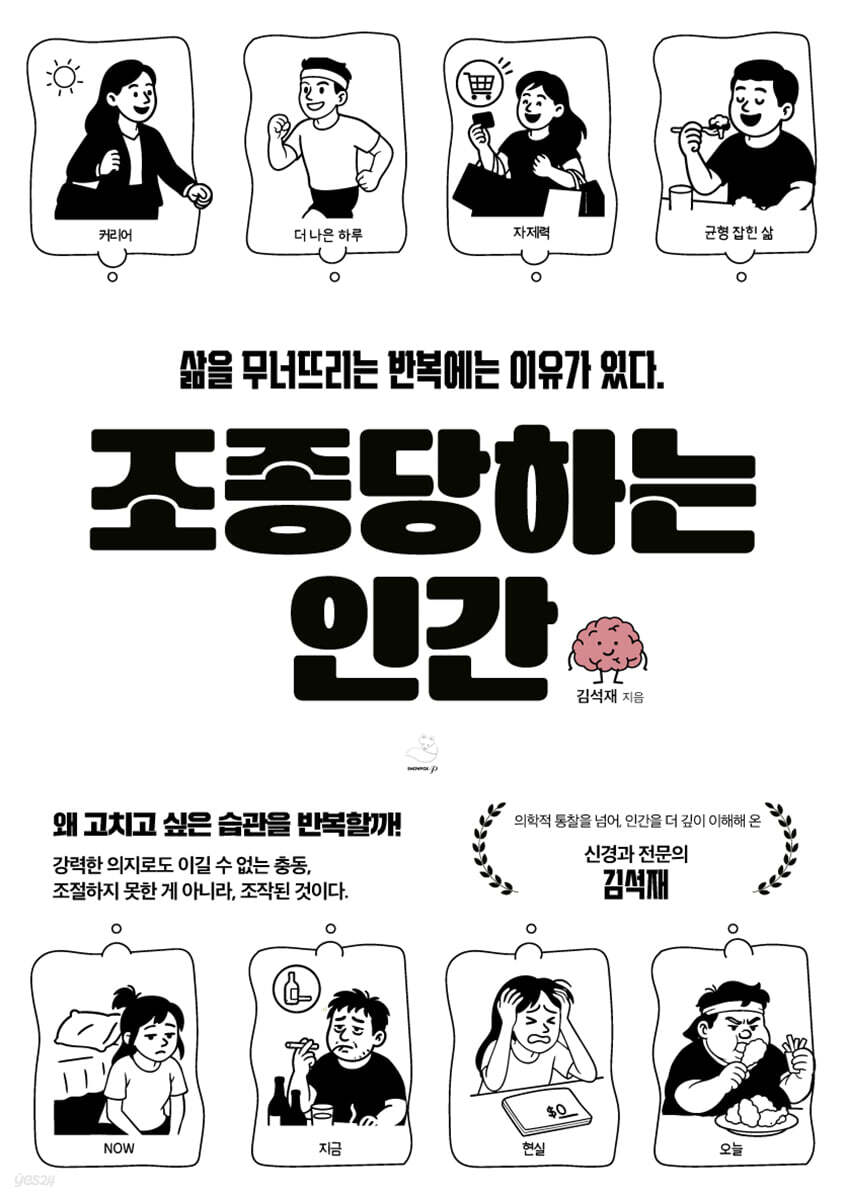
"Manipulated Humans" is a book that scientifically and psychologically reveals the limits of the brain's automatic reactions and self-control.
In the midst of recurring impulses, constant regrets, and unstoppable habits, it provides tangible answers to the questions, “Why can’t I control myself?” and “Why do I keep making the same mistakes?”
This book directly addresses why we habitually look at our smartphones and can't stop eating spicy foods, and it also addresses the root causes of almost every behavior we think we need to change but end up repeating again.
The author is an authority in the field of brain science who has studied the brain for a long time and published more than 60 papers in international SCI academic journals.
This book, based on the author's latest brain science research and clinical experience, explains the connection between the brain and behavior in a persuasive and easily understandable way.
It also reveals the limitations of self-control that cannot be resolved through willpower alone, and suggests ways to break free from automatic reactions in everyday life and regain control of your life.
The author draws the reader's attention, in particular, to the fact that the brain automates repeated experiences for efficiency, making humans "beings that react according to habit."
In this part, the author's unique identity is revealed.
Beyond medical insight, he has deeply contemplated human nature, and he wrote this book to help people avoid falling into repetitive self-destruction due to impulses.
“Why do I always make the same mistakes?”
“Why won’t I get better?”
“How long must I be dragged into unwanted behavior?”
The author's most important suggestion is to break the pattern, as these deeply intimate and personal questions can push a person into a deep pit of frustration.
Beyond scientific analysis, this book shows how to break the vicious cycle of repetitive addiction and compulsion, how to break free from the brain's automatic responses and control, and how to live fully executing actions of your own choosing.
The starting point of training to understand and surpass oneself.
It contains practical training methods to stop the brain from autopiloting and restore free choice.
"Manipulated Humans" is a book that scientifically and psychologically reveals the limits of the brain's automatic reactions and self-control.
In the midst of recurring impulses, constant regrets, and unstoppable habits, it provides tangible answers to the questions, “Why can’t I control myself?” and “Why do I keep making the same mistakes?”
This book directly addresses why we habitually look at our smartphones and can't stop eating spicy foods, and it also addresses the root causes of almost every behavior we think we need to change but end up repeating again.
The author is an authority in the field of brain science who has studied the brain for a long time and published more than 60 papers in international SCI academic journals.
This book, based on the author's latest brain science research and clinical experience, explains the connection between the brain and behavior in a persuasive and easily understandable way.
It also reveals the limitations of self-control that cannot be resolved through willpower alone, and suggests ways to break free from automatic reactions in everyday life and regain control of your life.
The author draws the reader's attention, in particular, to the fact that the brain automates repeated experiences for efficiency, making humans "beings that react according to habit."
In this part, the author's unique identity is revealed.
Beyond medical insight, he has deeply contemplated human nature, and he wrote this book to help people avoid falling into repetitive self-destruction due to impulses.
“Why do I always make the same mistakes?”
“Why won’t I get better?”
“How long must I be dragged into unwanted behavior?”
The author's most important suggestion is to break the pattern, as these deeply intimate and personal questions can push a person into a deep pit of frustration.
Beyond scientific analysis, this book shows how to break the vicious cycle of repetitive addiction and compulsion, how to break free from the brain's automatic responses and control, and how to live fully executing actions of your own choosing.
The starting point of training to understand and surpass oneself.
It contains practical training methods to stop the brain from autopiloting and restore free choice.
- You can preview some of the book's contents.
Preview
index
Prologue_ It's not weakness, it's just how the brain works /5
Chapter 1.
Even though I know, why do I keep repeating the same regrets?
[1] Why do I make that choice even though I know it? /15
[2] How would philosophers view me, swayed by desire? /17
[3] The actors in my brain that make decisions for me /32
[4] Where my true choices begin /41
[5] When you can't stop, make a way back /48
[6] To change myself, I need to redesign my brain! /58
[7] I need my own way of living with impulses /67
Chapter 2.
Why does the three-day resolution keep repeating itself?
[1] It's easy to make a resolution, but why is it so difficult to act on it? /73
[2] Is willpower a trainable ability? /75
[3] The brain circuit that keeps betraying me /81
[4] Failures are repeated, and the reasons are always similar /88
[5] Negotiation comes before resolution in self-management /95
[6] Small, specific changes began to change my life /106
[7] A Life of Negotiating with the Brain and Regaining Balance /113
Chapter 3.
Why do I buy something I don't need to buy?
[1] Why is impulse buying so common? /119
[2] The Choices of Philosophers Who Chose a Life of Less /121
[3] Opening your wallet is ultimately a brain circuit /129
[4] My shopping cart is full, but my heart is empty /136
[5] Brain Training to Deal with the Consumer Instinct /144
[6] There are emotions hidden behind the slogan /154
[7] Changing the direction of your life through conscious consumption /160
Chapter 4.
Why the more you try to quit, the deeper you fall
[1] Addiction is not a matter of will /165
[2] Philosophical and Scientific Perspectives on Addiction / 167
[3] The Stage of Addiction, the Brain That Moves According to the Script /176
[4] It's not the brain that's collapsing, it's the heart /183
[5] Strategies for Redesigning Dopamine Circuits /190
[6] Recovery is not a straight line, but a spiral /204
[7] What was different about those who successfully recovered? /211
Chapter 5.
Why does love eventually return as hurt?
[1] Why Love Becomes a Dilemma /217
[2] The Perspectives of Philosophers Who Interpreted Love /220
[3] The brain's mechanism for responding to love /228
[4] The confusion of relationships where emotions and illusions are mixed /237
[5] The Art of Emotional Regulation to Maintain Love /244
[6] The Secret of Those Who Fight Yet Last /255
[7] The Dance of Love, the Stage of the Brain /261
Chapter 6.
Why don't children grow up the way we want them to?
[1] A child is not a parent's second life /267
[2] A Philosophical Perspective on Parenting /269
[3] Understanding the Brain of a Child Under Construction /277
[4] A Psychological Look into Parental Conflict / 286
[5] Parenting Strategies That Don't Get Swayed by Emotions /296
[6] Cases of Transforming Conflict into Growth /310
[7] Understanding Myself Again While Raising a Child / 317
Epilogue_ The Switch That Turned Off Longing /320
References /322
Chapter 1.
Even though I know, why do I keep repeating the same regrets?
[1] Why do I make that choice even though I know it? /15
[2] How would philosophers view me, swayed by desire? /17
[3] The actors in my brain that make decisions for me /32
[4] Where my true choices begin /41
[5] When you can't stop, make a way back /48
[6] To change myself, I need to redesign my brain! /58
[7] I need my own way of living with impulses /67
Chapter 2.
Why does the three-day resolution keep repeating itself?
[1] It's easy to make a resolution, but why is it so difficult to act on it? /73
[2] Is willpower a trainable ability? /75
[3] The brain circuit that keeps betraying me /81
[4] Failures are repeated, and the reasons are always similar /88
[5] Negotiation comes before resolution in self-management /95
[6] Small, specific changes began to change my life /106
[7] A Life of Negotiating with the Brain and Regaining Balance /113
Chapter 3.
Why do I buy something I don't need to buy?
[1] Why is impulse buying so common? /119
[2] The Choices of Philosophers Who Chose a Life of Less /121
[3] Opening your wallet is ultimately a brain circuit /129
[4] My shopping cart is full, but my heart is empty /136
[5] Brain Training to Deal with the Consumer Instinct /144
[6] There are emotions hidden behind the slogan /154
[7] Changing the direction of your life through conscious consumption /160
Chapter 4.
Why the more you try to quit, the deeper you fall
[1] Addiction is not a matter of will /165
[2] Philosophical and Scientific Perspectives on Addiction / 167
[3] The Stage of Addiction, the Brain That Moves According to the Script /176
[4] It's not the brain that's collapsing, it's the heart /183
[5] Strategies for Redesigning Dopamine Circuits /190
[6] Recovery is not a straight line, but a spiral /204
[7] What was different about those who successfully recovered? /211
Chapter 5.
Why does love eventually return as hurt?
[1] Why Love Becomes a Dilemma /217
[2] The Perspectives of Philosophers Who Interpreted Love /220
[3] The brain's mechanism for responding to love /228
[4] The confusion of relationships where emotions and illusions are mixed /237
[5] The Art of Emotional Regulation to Maintain Love /244
[6] The Secret of Those Who Fight Yet Last /255
[7] The Dance of Love, the Stage of the Brain /261
Chapter 6.
Why don't children grow up the way we want them to?
[1] A child is not a parent's second life /267
[2] A Philosophical Perspective on Parenting /269
[3] Understanding the Brain of a Child Under Construction /277
[4] A Psychological Look into Parental Conflict / 286
[5] Parenting Strategies That Don't Get Swayed by Emotions /296
[6] Cases of Transforming Conflict into Growth /310
[7] Understanding Myself Again While Raising a Child / 317
Epilogue_ The Switch That Turned Off Longing /320
References /322
Detailed image
.jpg)
Into the book
Rather than eliminating impulses, it is important to create an environment in the brain where various desires and tendencies can coexist.
As Nietzsche said, impulses are not problems to be suppressed, but rather energies that can be refined and redirected.
So rather than fighting your impulses, learn to negotiate their power.
True freedom begins not with perfect self-control, but with understanding the brain's design and creating a rhythm that suits you.
--- p.68
With resolutions constantly being put off, is there really no way to control myself without being swayed by impulses? Drawing on the wisdom of philosophy and brain science, we explore how to understand and control impulses and create a self-management system that can be consistently implemented.
From designing routines to regulating dopamine, becoming comfortable with solitude, dealing with stress, and even cutting out unnecessary commitments.
All of these strategies are practical tools that you can apply right away in your daily life.
Now, shall we begin this exciting negotiation with my brain?
--- p.74
People who frequently feel lonely spend significantly more time on online shopping sites than those who don't.
This psychology reaches its peak with the combination of social media and shopping.
A structure where people feel a relative lack by observing the daily lives of others, and immediately fill that lack with shopping.
The moment our "desire for connection" turns into "clicking the buy button," we become more and more isolated and buy more.
--- p.141
Addiction is not a 'bad habit' that can be easily broken.
It is an imprint engraved in the brain's reward circuit for a long time, a survival method to endure emotions, and an automatic response formed to forget pain.
So, simply deciding to ‘quit’ is not enough.
Quitting an addiction isn't just about stopping; it's about restructuring your life.
--- p.211
If love is a complex dance, our brains are the dancers.
Dopamine creates a passionate tango, oxytocin a gentle waltz, serotonin a relaxing blues, and the amygdala and prefrontal cortex work to coordinate the steps of emotion and reason.
Now we understand the rhythm of this dance.
Sometimes we let ourselves go to the music, sometimes we consciously change our steps, and we are learning to dance until the end without letting go of each other's hands, even if it is not perfect.
--- p.262
Ultimately, we do not fall prey to impulses and addictions because we are weak or lack willpower.
We just didn't really understand how the brain worked.
Our job is not to have a stronger will, but to understand and properly design our brains.
As Nietzsche said, impulses are not problems to be suppressed, but rather energies that can be refined and redirected.
So rather than fighting your impulses, learn to negotiate their power.
True freedom begins not with perfect self-control, but with understanding the brain's design and creating a rhythm that suits you.
--- p.68
With resolutions constantly being put off, is there really no way to control myself without being swayed by impulses? Drawing on the wisdom of philosophy and brain science, we explore how to understand and control impulses and create a self-management system that can be consistently implemented.
From designing routines to regulating dopamine, becoming comfortable with solitude, dealing with stress, and even cutting out unnecessary commitments.
All of these strategies are practical tools that you can apply right away in your daily life.
Now, shall we begin this exciting negotiation with my brain?
--- p.74
People who frequently feel lonely spend significantly more time on online shopping sites than those who don't.
This psychology reaches its peak with the combination of social media and shopping.
A structure where people feel a relative lack by observing the daily lives of others, and immediately fill that lack with shopping.
The moment our "desire for connection" turns into "clicking the buy button," we become more and more isolated and buy more.
--- p.141
Addiction is not a 'bad habit' that can be easily broken.
It is an imprint engraved in the brain's reward circuit for a long time, a survival method to endure emotions, and an automatic response formed to forget pain.
So, simply deciding to ‘quit’ is not enough.
Quitting an addiction isn't just about stopping; it's about restructuring your life.
--- p.211
If love is a complex dance, our brains are the dancers.
Dopamine creates a passionate tango, oxytocin a gentle waltz, serotonin a relaxing blues, and the amygdala and prefrontal cortex work to coordinate the steps of emotion and reason.
Now we understand the rhythm of this dance.
Sometimes we let ourselves go to the music, sometimes we consciously change our steps, and we are learning to dance until the end without letting go of each other's hands, even if it is not perfect.
--- p.262
Ultimately, we do not fall prey to impulses and addictions because we are weak or lack willpower.
We just didn't really understand how the brain worked.
Our job is not to have a stronger will, but to understand and properly design our brains.
--- p.321
Publisher's Review
"Why do we repeat things even though we know it? It's not a matter of will."
“Let’s really break up this time.”
“Let’s start saving and taking care of our health today.”
“Let me hold back my feelings for just one day.”
We make resolutions countless times, but strangely enough, we always end up failing in the same place.
Every night, you open the delivery app, fill your shopping cart with the thought of "just one thing," and then regret it later after getting upset over someone's comment.
That's when we ask ourselves:
“Why do I do it even though I know it?”
This book, "Manipulated Humans," begins with this very question.
Neurologist Seokjae Kim's deep insights gained from his own personal experience of countless frustrations and encounters with thousands of patients.
The conclusion is unequivocal.
“This is not a question of will.
“It’s a brain circuit problem.”
The cycle of impulse and regret operates in an elaborate loop in the brain that leads to emotion, action, reward, and regret.
This loop is fixed based on the way we react emotionally in childhood, and becomes structured so that the emotional center reacts before the rational judgment of the prefrontal cortex.
In other words, we are 'reacting before thinking'.
Beyond the scientific facts, this book also interprets this loop philosophically.
The wisdom of the ancient philosophers Stoicism, self-control of Epictetus, and the theory of habits of Aristotle.
The profound reflection on self-awareness, self-control, and humanity as a being beyond instinct, when combined with modern brain science, is remarkably persuasive.
“Humans are beings who can govern themselves.
But to do that, you must first know yourself.”
This book doesn't simply address the issues of quitting smoking, dieting, or saving money.
We explain 'why we repeat the same mistakes' in the language of philosophy and science.
Dissecting the essence of emotions and impulses, addictions and avoidance—all those patterns.
And it poses a new question to the reader.
“Am I being led around by my brain right now? Or am I living in cooperation with my brain?”
This question changes the direction of our lives.
Not with stronger will, but with deeper understanding.
Not by blaming yourself, but by understanding yourself.
"The Manipulated Man" speaks in a quiet but firm voice to those who are tired of repeated failure.
“This is not your fault.
“You’re already trying hard enough.”
“Now, stop blaming your brain and stop hating yourself.
Instead, we must understand the system and live ‘with it.’”
Why do we always fall apart? How can we break free from this loop?
"Manipulated Humans" provides the most humane and scientific answer to that question.
And along with philosophical comfort, it will give you the strength to get back on your feet.
“Let’s really break up this time.”
“Let’s start saving and taking care of our health today.”
“Let me hold back my feelings for just one day.”
We make resolutions countless times, but strangely enough, we always end up failing in the same place.
Every night, you open the delivery app, fill your shopping cart with the thought of "just one thing," and then regret it later after getting upset over someone's comment.
That's when we ask ourselves:
“Why do I do it even though I know it?”
This book, "Manipulated Humans," begins with this very question.
Neurologist Seokjae Kim's deep insights gained from his own personal experience of countless frustrations and encounters with thousands of patients.
The conclusion is unequivocal.
“This is not a question of will.
“It’s a brain circuit problem.”
The cycle of impulse and regret operates in an elaborate loop in the brain that leads to emotion, action, reward, and regret.
This loop is fixed based on the way we react emotionally in childhood, and becomes structured so that the emotional center reacts before the rational judgment of the prefrontal cortex.
In other words, we are 'reacting before thinking'.
Beyond the scientific facts, this book also interprets this loop philosophically.
The wisdom of the ancient philosophers Stoicism, self-control of Epictetus, and the theory of habits of Aristotle.
The profound reflection on self-awareness, self-control, and humanity as a being beyond instinct, when combined with modern brain science, is remarkably persuasive.
“Humans are beings who can govern themselves.
But to do that, you must first know yourself.”
This book doesn't simply address the issues of quitting smoking, dieting, or saving money.
We explain 'why we repeat the same mistakes' in the language of philosophy and science.
Dissecting the essence of emotions and impulses, addictions and avoidance—all those patterns.
And it poses a new question to the reader.
“Am I being led around by my brain right now? Or am I living in cooperation with my brain?”
This question changes the direction of our lives.
Not with stronger will, but with deeper understanding.
Not by blaming yourself, but by understanding yourself.
"The Manipulated Man" speaks in a quiet but firm voice to those who are tired of repeated failure.
“This is not your fault.
“You’re already trying hard enough.”
“Now, stop blaming your brain and stop hating yourself.
Instead, we must understand the system and live ‘with it.’”
Why do we always fall apart? How can we break free from this loop?
"Manipulated Humans" provides the most humane and scientific answer to that question.
And along with philosophical comfort, it will give you the strength to get back on your feet.
GOODS SPECIFICS
- Date of issue: July 23, 2025
- Page count, weight, size: 332 pages | 470g | 148*210*21mm
- ISBN13: 9791194966036
- ISBN10: 1194966039
You may also like
카테고리
korean


korean

![ELLE 엘르 스페셜 에디션 A형 : 12월 [2025]](http://librairie.coreenne.fr/cdn/shop/files/b8e27a3de6c9538896439686c6b0e8fb.jpg?v=1766436872&width=3840)


