

How to talk without hurting anyone
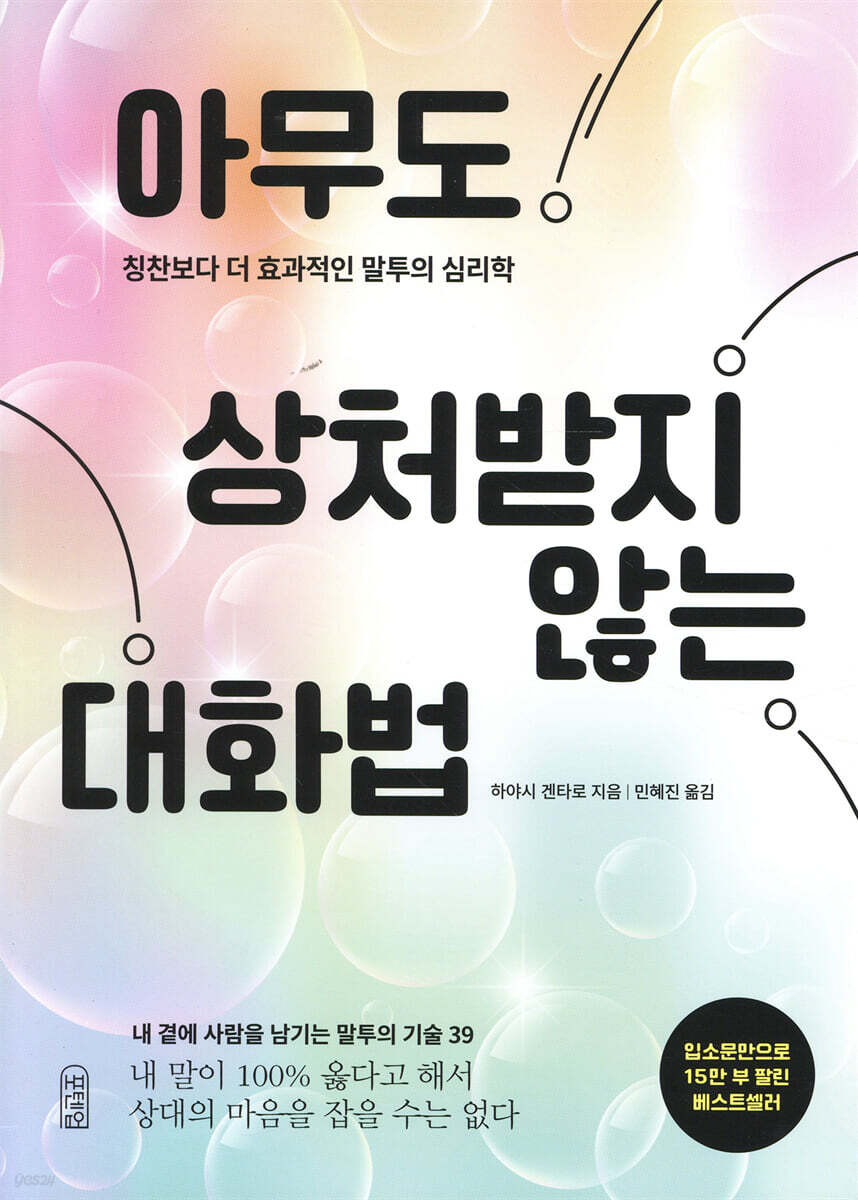 |
Description
Book Introduction
"If the other person is hurt, my words are no longer effective."
At least 90% of conflicts can be eliminated with just a simple "non-negative tone."
*****A hit that consistently sold 150,000 copies through word of mouth alone*****
· Many people think of 'debate' as a fight to win.
One of the two wins and the other loses.
Especially in the political world where opinions are extremely polarized, this culture is so common that people criticize, criticize, and sneer at each other, dominating our society as if it were the air we breathe every day.
The fact that dialogue between the medical community and the government, and between the ruling and opposition parties, fails to progress beyond this pattern of dialogue is arguably the greatest challenge facing our society.
But this is not just a problem for the political world.
The same is true in the countless conversations we have in our personal and social relationships, such as between parents and children, superiors and subordinates, CEOs and employees, and coworkers and friends.
Because the standard for conversation is who is right and who is wrong, people end up talking in a competitive manner, and it is not uncommon for one side to end up feeling offended.
So how can we really have a conversation where we can say what we want to say without hurting each other?
· Kentaro Hayashi, a conversation coaching expert, presents a solution to this very problem in his book, “How to Converse Without Getting Hurt.”
In this book, the author says that more important than praise or positive speech is 'a tone of speech that does not criticize the other person.'
It is said that 90% of conflicts can be resolved simply by dropping negative language, rather than deliberately flattering the other person or making positive remarks out of the situation.
The author says that many people unconsciously utter negative words without even realizing that they are denying someone, mistakenly believing that doing so is the way to help the other person.
Also, as we often think, refusing what the other person says by saying things like “No, that’s not it,” “But,” or “However,” is not the only way to be negative. He explains in detail that all meta-messages such as indifference, cold treatment, indifference, frowning, sighing, and ignoring are also considered negative.
Additionally, the author presents 39 specific methods and strategies for conversations that neither cause nor receive hurt, and its greatest strength is that it is rich in examples that can be applied directly in real life.
· This book, which is full of the author's experience of providing conversation coaching to over 800 executives and employees at major corporations, foreign companies, venture companies, and family-run businesses for 15 years, and also working as a corporate training instructor, is a bestseller that has sold 150,000 copies through word of mouth among readers for about two years since its publication in 2022, and is still a 'hot' steady seller.
This book will undoubtedly provide great insight into Korean society, where conflict and confrontation are so commonplace that abusive language is a daily occurrence.
At least 90% of conflicts can be eliminated with just a simple "non-negative tone."
*****A hit that consistently sold 150,000 copies through word of mouth alone*****
· Many people think of 'debate' as a fight to win.
One of the two wins and the other loses.
Especially in the political world where opinions are extremely polarized, this culture is so common that people criticize, criticize, and sneer at each other, dominating our society as if it were the air we breathe every day.
The fact that dialogue between the medical community and the government, and between the ruling and opposition parties, fails to progress beyond this pattern of dialogue is arguably the greatest challenge facing our society.
But this is not just a problem for the political world.
The same is true in the countless conversations we have in our personal and social relationships, such as between parents and children, superiors and subordinates, CEOs and employees, and coworkers and friends.
Because the standard for conversation is who is right and who is wrong, people end up talking in a competitive manner, and it is not uncommon for one side to end up feeling offended.
So how can we really have a conversation where we can say what we want to say without hurting each other?
· Kentaro Hayashi, a conversation coaching expert, presents a solution to this very problem in his book, “How to Converse Without Getting Hurt.”
In this book, the author says that more important than praise or positive speech is 'a tone of speech that does not criticize the other person.'
It is said that 90% of conflicts can be resolved simply by dropping negative language, rather than deliberately flattering the other person or making positive remarks out of the situation.
The author says that many people unconsciously utter negative words without even realizing that they are denying someone, mistakenly believing that doing so is the way to help the other person.
Also, as we often think, refusing what the other person says by saying things like “No, that’s not it,” “But,” or “However,” is not the only way to be negative. He explains in detail that all meta-messages such as indifference, cold treatment, indifference, frowning, sighing, and ignoring are also considered negative.
Additionally, the author presents 39 specific methods and strategies for conversations that neither cause nor receive hurt, and its greatest strength is that it is rich in examples that can be applied directly in real life.
· This book, which is full of the author's experience of providing conversation coaching to over 800 executives and employees at major corporations, foreign companies, venture companies, and family-run businesses for 15 years, and also working as a corporate training instructor, is a bestseller that has sold 150,000 copies through word of mouth among readers for about two years since its publication in 2022, and is still a 'hot' steady seller.
This book will undoubtedly provide great insight into Korean society, where conflict and confrontation are so commonplace that abusive language is a daily occurrence.
- You can preview some of the book's contents.
Preview
index
Introduction: What's more important in relationships than compliments? 013
Chapter 1 Why do I end up denying things without even knowing it?
The unconsciousness of people who habitually deny
The Illusion of Speaking for the Other Person 027
What People Who Receive Support and Encouragement Realize 031
Why Being with That Person Makes Work Fun 036
Why can't I be aware that I'm in denial? 040
Negative energy is much scarier than you might imagine. 043
Why are we so easily offended by the word "no"? 049
Just changing your tone can change the mood. 056
Chapter 2: Let go of the idea that you're always right.
How to Equip a Mind That Doesn't Deny
Mindset is more important than conversation skills 065
What to Let Go of for a Conversation That Doesn't Deny ① The Idea That "It's Okay to Tell the Facts" 067
What to Let Go of for a Conversation Without Denial②: The Idea That "My Opinion Is Absolutely Right" 072
What to Let Go of for a Conversation Without Denial ③ 'Excessive Expectations' of the Other Person 077
You can't express all your emotions and still have good relationships. 083
The main culprit in ruining relationships: superiority complex 087
You can be funny without denying it 092
The broader your worldview, the less easily you can deny it. 097
Fact-checking is necessary in human relationships, too. 101
Should I cut ties with someone who's always negative? 107
Chapter 3: Conversation Skills That Leave People by My Side
11 Tips for Conversations That Don't Hurt
Yes Emotion Speech 115
How to Use Silence for Conversation 121
Captivate Your Opponent's Heart with Narration 130
136 Ways to Accept Even If You Don't Agree
Four Types of Acknowledging the Other Person 141
Refrigerator Talk 150
~maybe speech 157
Meta-messages transmitted without my knowledge 163
170 Ways to Recover from Negativity
174 Ways to Say No to Someone You Can't Hate
Magical Speech to Move Your Heart 182
Chapter 4: Changing your speech style changes your character.
Mind for non-negative language habits
Self-Coaching for People Who Inadvertently Speak Negatively 187
Six-Line Conversation Techniques to Improve Your Speech 196
On the Chair: A Psychological Experiment That Develops Metacognition 202
The greatest danger is to think you know everything. 211
Chapter 5: There's No Need to Make Enemies, Even If They're Not on Your Side
Conversation skills that build trust in interpersonal relationships
You can build a great relationship with just five sentences 219
225 Questions to Strengthen Relationships
The Best Time to Make Eye Contact with Someone 233
Relationship-Ruining Phrases: "Oh, I know that!" 236
Just asking permission builds trust 241
246 Reasons Why You Should Ask Permission to Speak Straight
How to effectively convey your anger to someone? 253
No matter what happens, you can start again today. 258
Chapter 1 Why do I end up denying things without even knowing it?
The unconsciousness of people who habitually deny
The Illusion of Speaking for the Other Person 027
What People Who Receive Support and Encouragement Realize 031
Why Being with That Person Makes Work Fun 036
Why can't I be aware that I'm in denial? 040
Negative energy is much scarier than you might imagine. 043
Why are we so easily offended by the word "no"? 049
Just changing your tone can change the mood. 056
Chapter 2: Let go of the idea that you're always right.
How to Equip a Mind That Doesn't Deny
Mindset is more important than conversation skills 065
What to Let Go of for a Conversation That Doesn't Deny ① The Idea That "It's Okay to Tell the Facts" 067
What to Let Go of for a Conversation Without Denial②: The Idea That "My Opinion Is Absolutely Right" 072
What to Let Go of for a Conversation Without Denial ③ 'Excessive Expectations' of the Other Person 077
You can't express all your emotions and still have good relationships. 083
The main culprit in ruining relationships: superiority complex 087
You can be funny without denying it 092
The broader your worldview, the less easily you can deny it. 097
Fact-checking is necessary in human relationships, too. 101
Should I cut ties with someone who's always negative? 107
Chapter 3: Conversation Skills That Leave People by My Side
11 Tips for Conversations That Don't Hurt
Yes Emotion Speech 115
How to Use Silence for Conversation 121
Captivate Your Opponent's Heart with Narration 130
136 Ways to Accept Even If You Don't Agree
Four Types of Acknowledging the Other Person 141
Refrigerator Talk 150
~maybe speech 157
Meta-messages transmitted without my knowledge 163
170 Ways to Recover from Negativity
174 Ways to Say No to Someone You Can't Hate
Magical Speech to Move Your Heart 182
Chapter 4: Changing your speech style changes your character.
Mind for non-negative language habits
Self-Coaching for People Who Inadvertently Speak Negatively 187
Six-Line Conversation Techniques to Improve Your Speech 196
On the Chair: A Psychological Experiment That Develops Metacognition 202
The greatest danger is to think you know everything. 211
Chapter 5: There's No Need to Make Enemies, Even If They're Not on Your Side
Conversation skills that build trust in interpersonal relationships
You can build a great relationship with just five sentences 219
225 Questions to Strengthen Relationships
The Best Time to Make Eye Contact with Someone 233
Relationship-Ruining Phrases: "Oh, I know that!" 236
Just asking permission builds trust 241
246 Reasons Why You Should Ask Permission to Speak Straight
How to effectively convey your anger to someone? 253
No matter what happens, you can start again today. 258
Detailed image

Into the book
· The key to good human relationships is not to be negative, but to praise and affirm.
--- p.18
· There is no malice in the original negation.
That's why it's more of a headache.
30
· When I was completely rejected, I felt really good, but when I actually received support and encouragement, I found myself not thinking specifically about what to do.
33
· There is a saying that 'content speaks louder than form', but there are often cases where form reveals content.
Always remember that how you say something is just as important as what you say.
--- p.154
· As you live, it is virtually impossible to be liked by everyone, no matter what group you belong to.
But at least becoming a person who is not hated is something that anyone can aim for.
Because if you just stop saying and doing negative things, you're halfway to success.
--- p.174
· However, there are surprisingly many team members who neither like nor dislike their superiors.
Rather, you may be the majority.
So, depending on how you communicate with those people, the team's performance can vary greatly.
--- p.179
· It is the realization that the other person does not need my opinion as much as I thought.
What does this mean? If you're someone of relatively higher status than the other person, your mere presence has already fulfilled your role.
--- p.18
· There is no malice in the original negation.
That's why it's more of a headache.
30
· When I was completely rejected, I felt really good, but when I actually received support and encouragement, I found myself not thinking specifically about what to do.
33
· There is a saying that 'content speaks louder than form', but there are often cases where form reveals content.
Always remember that how you say something is just as important as what you say.
--- p.154
· As you live, it is virtually impossible to be liked by everyone, no matter what group you belong to.
But at least becoming a person who is not hated is something that anyone can aim for.
Because if you just stop saying and doing negative things, you're halfway to success.
--- p.174
· However, there are surprisingly many team members who neither like nor dislike their superiors.
Rather, you may be the majority.
So, depending on how you communicate with those people, the team's performance can vary greatly.
--- p.179
· It is the realization that the other person does not need my opinion as much as I thought.
What does this mean? If you're someone of relatively higher status than the other person, your mere presence has already fulfilled your role.
--- p.193
Publisher's Review
"If the other person is hurt, my words are no longer effective."
39 Ways of Speaking That Leave People by Your Side
At least 90% of conflicts can be eliminated with just a simple "non-negative tone."
The Psychology of Speaking More Effectively Than Compliments
Many people think of 'debate' as a fight to win.
One of the two wins and the other loses.
Because I believe that if I don't get my point across, I will lose, I will engage in a war of nerves to avoid being pushed around in conversations, and as a result, I will focus on exploiting the other person's weaknesses.
Especially in the political world where opinions are extremely polarized, this culture is so common that people criticize, criticize, and sneer at each other, dominating our society as if it were the air we breathe every day.
The fact that dialogue between the medical community and the government, and between the ruling and opposition parties, fails to progress beyond this pattern of dialogue is arguably the greatest challenge facing our society.
But this is not just a problem for the political world.
The same is true in the countless conversations we have in our personal and social relationships, such as between parents and children, superiors and subordinates, CEOs and employees, and coworkers and friends.
Because the standard for conversation is who is right and who is wrong, people end up talking in a competitive manner, and it is not uncommon for one side to end up feeling offended.
So how can we truly have a conversation where we can express our opinions without hurting each other? It might be easy to say, "Don't insist on being right, just find tolerance and compromise." But when opinions are sharply divided, putting this into practice is far from easy.
Kentaro Hayashi, a conversation coaching expert, presents a solution to this very problem in his book, "How to Converse Without Getting Hurt."
In this book, the author says that more important than praise or positive speech is 'a tone of speech that does not criticize the other person.'
It is said that 90% of conflicts can be resolved simply by dropping negative language, rather than deliberately flattering the other person or making positive remarks out of the situation.
The author says that many people unconsciously utter negative words without even realizing that they are denying someone, mistakenly believing that doing so is the way to help the other person.
Also, as we often think, refusing what the other person says by saying things like “No, that’s not it,” “But,” or “However,” is not the only way to be negative. He explains in detail that all meta-messages such as indifference, cold treatment, indifference, frowning, sighing, and ignoring are also considered negative.
Additionally, the author presents 39 specific methods and strategies for conversations that neither cause nor receive hurt, and its greatest strength is that it is rich in examples that can be applied directly in real life.
For example, when you cannot agree with what the other person says, before you hastily throw in advice or counsel to convince them of your thoughts, you can use a narration style of speech where you simply repeat what the other person said, saying, “Oh, so what you are saying is that ○○ did ○○ so ○○”. This way, you can control the speed of the conversation and give the other person enough time to think while speaking.
And even when the other person makes a claim that you really can't accept, you can say, "Oh, really? I guess you could think that way.
I'll put that idea in the fridge for now.
By using the "refrigerator technique"—saying, "Are there any other thoughts?"—you can continue a constructive conversation without hurting each other.
This book, which is full of the author's experience of providing conversation coaching to over 800 executives and employees at major corporations, foreign companies, venture companies, and family-run businesses for 15 years, and also working as a corporate training instructor, is a bestseller that has sold 150,000 copies through word of mouth among readers for about two years since its publication in 2022, and is still a 'hot' steady seller.
This book will undoubtedly provide great insight into Korean society, where conflict and confrontation are so commonplace that abusive language is a daily occurrence.
Example of correcting speech for a non-hurtful conversation)
① “I absolutely love doing it this way!” → “I have a suggestion. Can I tell you?”
· Simply asking permission first and then making a suggestion builds trust.
② “I know how you feel.” → “I think I understand that feeling a little.”
· You can't fully understand someone's heart unless you really become that person, so don't assume you 'know' them.
③ “How could you think that?” → “Ah, so that’s what you think.”
· Even if opinions differ, first accept what the other person says at face value and then find a common goal.
④ “That’s absolutely not possible! Then what am I supposed to do?” → “I guess you could think that way.
“I’ll keep that opinion in mind for now.”
· When your opinions differ greatly from the other person's, instead of ignoring them, put them on hold (put them in the refrigerator).
If the other person is hurt, it doesn't matter whether what I say is right or wrong.
69% of problems have no clear answers.
A person who always says the right thing, but you don't feel affection for them.
He's a bit different, but he's a person I like.
Which side are you on? The author emphasizes that no matter how much I try to persuade someone with the righteous and just words, if that person is already emotionally wounded, it's useless.
He also adds that we must not overlook the fact that even an argument that seems 100% correct to me may not be correct because the other person may see it from a completely different perspective.
John M. Gottman, professor emeritus and psychologist at the University of Washington
Dr. Gottman said, "69% of the problems or challenges that arise among adults do not have clear answers."
The author says that making it a habit to say “That could be true” instead of “Absolutely not” in conversations can be a great help in making your thinking more flexible and accepting of diversity.
How to avoid becoming negative yourself without cutting ties with negative people
A Guide to Minimal Conversation for Lonely People
“No matter how hard I try not to say anything negative, when the other person says something negative, I can’t help it.” The author says he hears this a lot from people he coaches.
No matter how hard I try to have a conversation without getting hurt, if the other person hurts me first, I can't help but react negatively.
Of course, there is no royal road here either.
If there is someone who only picks out the bad things about you more than nine times out of ten, then the answer is to cut ties with them. If you can't cut ties right away, then you have no choice but to maintain minimal contact to maintain the relationship.
The author says that it takes a lot of study and effort to not become a negative person yourself, while not cutting ties with negative people.
No matter how many negative things the other person says, I should not be the first to say or do something negative, I should try to get the other person to say something positive before they say anything negative, and I should do activities together that the other person would really like.
In this age where cutting ties has become the norm and everyone is now shivering in loneliness in their own rooms, these are valuable pieces of advice worth listening to.
A book that has received endless praise from readers and spread by word of mouth!
· This is the best book I've read in years! I feel like this book has helped me grow as a person, and it's brought some relief to my heart, which had been suffering because of people.
平*****
· I would like to make the contents of this book the theme of this year.
磯*
· I usually throw away books as soon as I read them, but I'm keeping this book so I can take it out and read it again at any time.
き***
· I would really like people who say “That’s not it~” to read this book, but people like that probably won’t read this book, right?
Y***
· I felt hurt and had a hole in my heart because of my boss's negative tone, but after reading this book, I realized that it was I who spoke negatively.
I was able to learn so much.
加***
· Through this book, I learned clearly how to live from now on.
匿***
· I think my life has become much easier after reading this book.
た***
--- From Amazon reader reviews
39 Ways of Speaking That Leave People by Your Side
At least 90% of conflicts can be eliminated with just a simple "non-negative tone."
The Psychology of Speaking More Effectively Than Compliments
Many people think of 'debate' as a fight to win.
One of the two wins and the other loses.
Because I believe that if I don't get my point across, I will lose, I will engage in a war of nerves to avoid being pushed around in conversations, and as a result, I will focus on exploiting the other person's weaknesses.
Especially in the political world where opinions are extremely polarized, this culture is so common that people criticize, criticize, and sneer at each other, dominating our society as if it were the air we breathe every day.
The fact that dialogue between the medical community and the government, and between the ruling and opposition parties, fails to progress beyond this pattern of dialogue is arguably the greatest challenge facing our society.
But this is not just a problem for the political world.
The same is true in the countless conversations we have in our personal and social relationships, such as between parents and children, superiors and subordinates, CEOs and employees, and coworkers and friends.
Because the standard for conversation is who is right and who is wrong, people end up talking in a competitive manner, and it is not uncommon for one side to end up feeling offended.
So how can we truly have a conversation where we can express our opinions without hurting each other? It might be easy to say, "Don't insist on being right, just find tolerance and compromise." But when opinions are sharply divided, putting this into practice is far from easy.
Kentaro Hayashi, a conversation coaching expert, presents a solution to this very problem in his book, "How to Converse Without Getting Hurt."
In this book, the author says that more important than praise or positive speech is 'a tone of speech that does not criticize the other person.'
It is said that 90% of conflicts can be resolved simply by dropping negative language, rather than deliberately flattering the other person or making positive remarks out of the situation.
The author says that many people unconsciously utter negative words without even realizing that they are denying someone, mistakenly believing that doing so is the way to help the other person.
Also, as we often think, refusing what the other person says by saying things like “No, that’s not it,” “But,” or “However,” is not the only way to be negative. He explains in detail that all meta-messages such as indifference, cold treatment, indifference, frowning, sighing, and ignoring are also considered negative.
Additionally, the author presents 39 specific methods and strategies for conversations that neither cause nor receive hurt, and its greatest strength is that it is rich in examples that can be applied directly in real life.
For example, when you cannot agree with what the other person says, before you hastily throw in advice or counsel to convince them of your thoughts, you can use a narration style of speech where you simply repeat what the other person said, saying, “Oh, so what you are saying is that ○○ did ○○ so ○○”. This way, you can control the speed of the conversation and give the other person enough time to think while speaking.
And even when the other person makes a claim that you really can't accept, you can say, "Oh, really? I guess you could think that way.
I'll put that idea in the fridge for now.
By using the "refrigerator technique"—saying, "Are there any other thoughts?"—you can continue a constructive conversation without hurting each other.
This book, which is full of the author's experience of providing conversation coaching to over 800 executives and employees at major corporations, foreign companies, venture companies, and family-run businesses for 15 years, and also working as a corporate training instructor, is a bestseller that has sold 150,000 copies through word of mouth among readers for about two years since its publication in 2022, and is still a 'hot' steady seller.
This book will undoubtedly provide great insight into Korean society, where conflict and confrontation are so commonplace that abusive language is a daily occurrence.
Example of correcting speech for a non-hurtful conversation)
① “I absolutely love doing it this way!” → “I have a suggestion. Can I tell you?”
· Simply asking permission first and then making a suggestion builds trust.
② “I know how you feel.” → “I think I understand that feeling a little.”
· You can't fully understand someone's heart unless you really become that person, so don't assume you 'know' them.
③ “How could you think that?” → “Ah, so that’s what you think.”
· Even if opinions differ, first accept what the other person says at face value and then find a common goal.
④ “That’s absolutely not possible! Then what am I supposed to do?” → “I guess you could think that way.
“I’ll keep that opinion in mind for now.”
· When your opinions differ greatly from the other person's, instead of ignoring them, put them on hold (put them in the refrigerator).
If the other person is hurt, it doesn't matter whether what I say is right or wrong.
69% of problems have no clear answers.
A person who always says the right thing, but you don't feel affection for them.
He's a bit different, but he's a person I like.
Which side are you on? The author emphasizes that no matter how much I try to persuade someone with the righteous and just words, if that person is already emotionally wounded, it's useless.
He also adds that we must not overlook the fact that even an argument that seems 100% correct to me may not be correct because the other person may see it from a completely different perspective.
John M. Gottman, professor emeritus and psychologist at the University of Washington
Dr. Gottman said, "69% of the problems or challenges that arise among adults do not have clear answers."
The author says that making it a habit to say “That could be true” instead of “Absolutely not” in conversations can be a great help in making your thinking more flexible and accepting of diversity.
How to avoid becoming negative yourself without cutting ties with negative people
A Guide to Minimal Conversation for Lonely People
“No matter how hard I try not to say anything negative, when the other person says something negative, I can’t help it.” The author says he hears this a lot from people he coaches.
No matter how hard I try to have a conversation without getting hurt, if the other person hurts me first, I can't help but react negatively.
Of course, there is no royal road here either.
If there is someone who only picks out the bad things about you more than nine times out of ten, then the answer is to cut ties with them. If you can't cut ties right away, then you have no choice but to maintain minimal contact to maintain the relationship.
The author says that it takes a lot of study and effort to not become a negative person yourself, while not cutting ties with negative people.
No matter how many negative things the other person says, I should not be the first to say or do something negative, I should try to get the other person to say something positive before they say anything negative, and I should do activities together that the other person would really like.
In this age where cutting ties has become the norm and everyone is now shivering in loneliness in their own rooms, these are valuable pieces of advice worth listening to.
A book that has received endless praise from readers and spread by word of mouth!
· This is the best book I've read in years! I feel like this book has helped me grow as a person, and it's brought some relief to my heart, which had been suffering because of people.
平*****
· I would like to make the contents of this book the theme of this year.
磯*
· I usually throw away books as soon as I read them, but I'm keeping this book so I can take it out and read it again at any time.
き***
· I would really like people who say “That’s not it~” to read this book, but people like that probably won’t read this book, right?
Y***
· I felt hurt and had a hole in my heart because of my boss's negative tone, but after reading this book, I realized that it was I who spoke negatively.
I was able to learn so much.
加***
· Through this book, I learned clearly how to live from now on.
匿***
· I think my life has become much easier after reading this book.
た***
--- From Amazon reader reviews
GOODS SPECIFICS
- Date of issue: September 20, 2024
- Page count, weight, size: 264 pages | 394g | 152*210*17mm
- ISBN13: 9791198476494
- ISBN10: 1198476494
You may also like
카테고리
korean


korean

![ELLE 엘르 스페셜 에디션 A형 : 12월 [2025]](http://librairie.coreenne.fr/cdn/shop/files/b8e27a3de6c9538896439686c6b0e8fb.jpg?v=1766436872&width=3840)


