

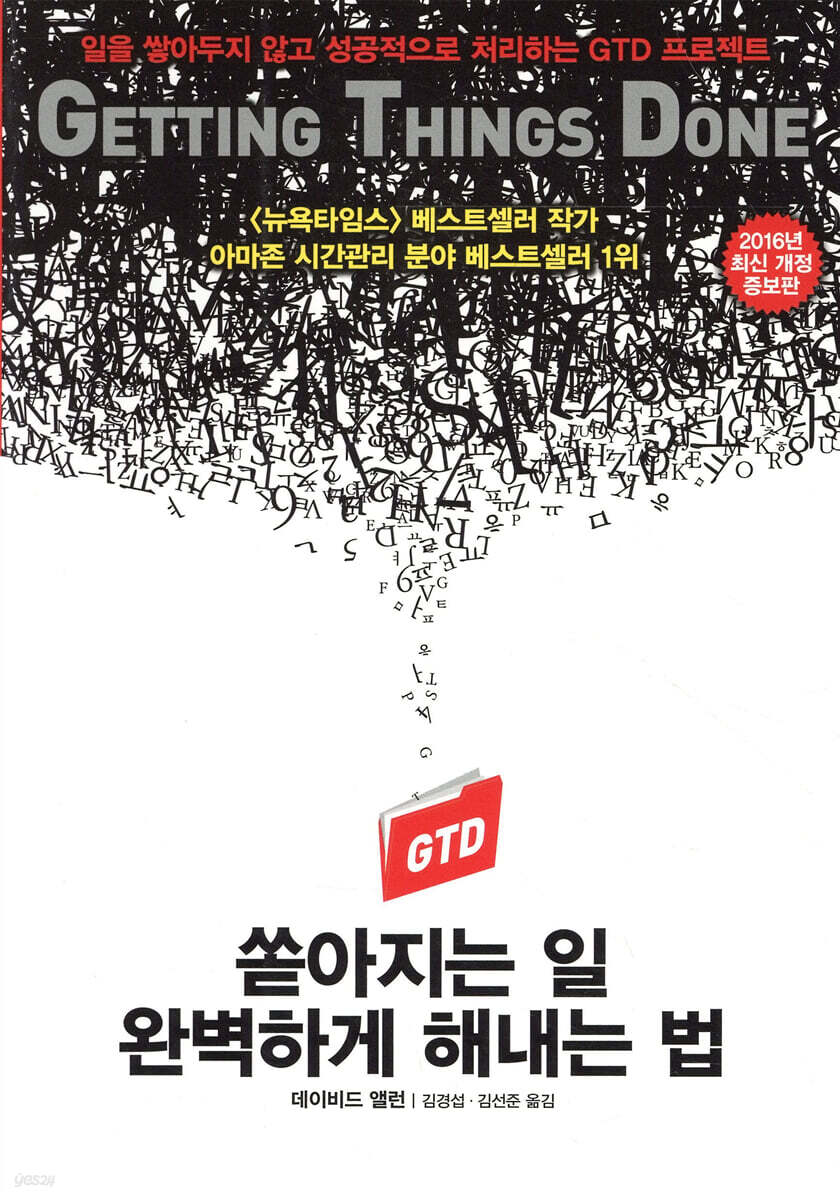
How to Perfectly Handle the Pour of Work
 |
Description
Book Introduction
“The Bible of Business and Personal Productivity” #1 Bestseller in Amazon's Time Management Category! [New York Times] The 2016 updated edition of the bestseller Getting Things Done. Why does work just pile up, no matter how much I try? Where and how should I start with work and household chores? The "5-Step Workflow Management Method" will help you seamlessly complete the seemingly endless stream of tasks. The core principles of simple, easy self-management that will maximize your personal productivity without stress. The world's leading veteran management consultant and bestselling author, David Allen, has rewritten the best self-help book of our time, drawing on his extensive field experience. A miracle project that allows you to handle work and life stress-free. Start the best work program to relieve anxiety and nervousness in one go! |
- You can preview some of the book's contents.
Preview
index
Recommendation | Preface to the Revised Edition | Introduction
Ⅰ.
The art of doing things neatly
Chapter 1: New Practices for a New Reality
Chapter 2: Taking Control of Your Life: Five Steps to Mastering Your Workflow
Chapter 3: Creatively Implementing Projects: 5 Steps to Developing a Project Plan
Ⅱ.
Achieving Productivity with Minimized Stress
Chapter 4: Getting Started: Setting Up Time, Space, and Tools
Chapter 5: Gathering: Gathering Your "Tasks" in One Place
Chapter 6: Clarifying: Emptying the Collection
Chapter 7: Summary: Building the Right System
Chapter 8: Review: Maintaining a Functional and Up-to-Date System
Chapter 9: Taking Action: Choosing the Best Action
Chapter 10: Controlling the Project
Ⅲ. The Power of GTD's Core Principles
Chapter 11: The Power of Collecting Habits
Chapter 12: The Power of Deciding What to Do Next
Chapter 13: The Power of Focusing on Results
Chapter 14: GTD and Cognitive Science
Chapter 15_GTD Mastery Path
Conclusion | Translator's Note | GTD Glossary | GTD Program Training Guide
Ⅰ.
The art of doing things neatly
Chapter 1: New Practices for a New Reality
Chapter 2: Taking Control of Your Life: Five Steps to Mastering Your Workflow
Chapter 3: Creatively Implementing Projects: 5 Steps to Developing a Project Plan
Ⅱ.
Achieving Productivity with Minimized Stress
Chapter 4: Getting Started: Setting Up Time, Space, and Tools
Chapter 5: Gathering: Gathering Your "Tasks" in One Place
Chapter 6: Clarifying: Emptying the Collection
Chapter 7: Summary: Building the Right System
Chapter 8: Review: Maintaining a Functional and Up-to-Date System
Chapter 9: Taking Action: Choosing the Best Action
Chapter 10: Controlling the Project
Ⅲ. The Power of GTD's Core Principles
Chapter 11: The Power of Collecting Habits
Chapter 12: The Power of Deciding What to Do Next
Chapter 13: The Power of Focusing on Results
Chapter 14: GTD and Cognitive Science
Chapter 15_GTD Mastery Path
Conclusion | Translator's Note | GTD Glossary | GTD Program Training Guide
Into the book
I've spent a lot more time identifying and refining ways to practice stress-free productivity. The actions that make up GTD are actually relatively simple and familiar to everyone.
It's not terribly difficult to write something down, decide what your next action will be to make progress on something, create an action reminder to remind you to take that action, and review your list.
While most people recognize the need to develop these habits, few are able to do so consistently enough to be satisfied with them.
--- p.21
Instead of trying to think through the options given, try to make intuitive choices based on those options.
To do this, you need to think through all the options in advance and document the results in a reliable way.
I don't want to waste time thinking about things more than once.
That's an inefficient use of creative energy and a source of frustration and stress.
--- p.69
I often tell people that the biggest takeaway from attending our seminars is the "2-Minute Rule."
The trick is that we need it because of the not-so-smart and not-so-conscious part of us.
Overall, the most accomplished people I know are those who have mastered the art of living.
Same goes for me.
The smart part of us sets the course of action, and the not-so-smart part reacts almost automatically to it and takes the actions that produce the best performance.
Make us do what we have to do to make ourselves happy.
--- p.157
Even if it's not a high priority, if it's something you'll have to do someday, do it now.
The rationale behind the two-minute rule is that holding an item and then checking it takes longer than processing it when it first comes into your possession.
That is, the time limit of 2 minutes was set for efficiency.
If it's not important enough to do, throw it away.
--- pp.228~229
I've heard from several senior executives that when they made the question, "What's the next move?" an operational standard for their organizations, they saw a dramatic shift in measurable performance.
This standard has significantly and permanently changed the culture of the organization for the better.
It's not terribly difficult to write something down, decide what your next action will be to make progress on something, create an action reminder to remind you to take that action, and review your list.
While most people recognize the need to develop these habits, few are able to do so consistently enough to be satisfied with them.
--- p.21
Instead of trying to think through the options given, try to make intuitive choices based on those options.
To do this, you need to think through all the options in advance and document the results in a reliable way.
I don't want to waste time thinking about things more than once.
That's an inefficient use of creative energy and a source of frustration and stress.
--- p.69
I often tell people that the biggest takeaway from attending our seminars is the "2-Minute Rule."
The trick is that we need it because of the not-so-smart and not-so-conscious part of us.
Overall, the most accomplished people I know are those who have mastered the art of living.
Same goes for me.
The smart part of us sets the course of action, and the not-so-smart part reacts almost automatically to it and takes the actions that produce the best performance.
Make us do what we have to do to make ourselves happy.
--- p.157
Even if it's not a high priority, if it's something you'll have to do someday, do it now.
The rationale behind the two-minute rule is that holding an item and then checking it takes longer than processing it when it first comes into your possession.
That is, the time limit of 2 minutes was set for efficiency.
If it's not important enough to do, throw it away.
--- pp.228~229
I've heard from several senior executives that when they made the question, "What's the next move?" an operational standard for their organizations, they saw a dramatic shift in measurable performance.
This standard has significantly and permanently changed the culture of the organization for the better.
--- p.413
Publisher's Review
It has changed the lifestyles of countless workers in 30 countries.
Best self-help books
“Korea’s annual working hours are among the longest among OECD countries.
South Korean salaried workers average 2,057 hours of annual work, the third-longest among the 26 OECD countries. This represents 351 hours more than the OECD average of 1,706 hours and 755 hours more than the 1,302 hours of German workers, the shortest working hours. ([Kyunghyang Shinmun] 2015.
12.
22)
So, what about the labor productivity of Korean workers who work such long hours?
“The labor productivity per capita of Korean workers was $62,000 in 2013, based on the PPP exchange rate, ranking 22nd out of 34 countries.
Low productivity in the service industry is analyzed as the main cause of the decline in labor productivity.
Manufacturing labor productivity was the third highest last year, after Ireland and the United States.
On the other hand, labor productivity in the service industry was only $47,000, ranking 21st among 26 OECD countries.” ([Kyunghyang Shinmun] same article)
Whether it's work for economic activity or personal matters, it's natural that you have to produce results.
In a work environment that changes rapidly every moment, this is something that every office worker must worry about.
For workers who must quickly process a never-ending stream of work, as if sitting in front of a conveyor belt, the ability to efficiently and perfectly complete tasks is true inner strength and true self-efficacy.
This book, "Getting Things Done," is the latest upgraded version of the 2015 version of the same-named "Getting Things Done" (hereinafter referred to as the "first edition"), which was first published in the United States in 2001 and has since been published in over 30 countries around the world, receiving much love from many people.
As soon as the first edition was published, the work organization method introduced in this book was called the "GTD method" and had a great impact on numerous office workers around the world. The author established subsidiaries in several countries that created and provided training programs based on the contents of this book, and has been working hard to educate about work organization and efficiency.
Additionally, those who have personally experienced the effectiveness of the GTD method have proven its effectiveness by summarizing or developing the program.
《How to Perfectly Do Anything》 is nearly twice as long as the first edition, and takes into account the rapidly evolving technological aspects, taking into account the 15-year gap in time.
First of all, “all references to specific software applications that appeared in the first edition have been removed from this edition.” (p. 14) Given the pace of development, any software is constantly being upgraded.
The authors essentially chose to present a “general model for evaluating the usefulness of any tool, regardless of the competition among digital tools” (p. 15).
The second change is that we have taken an approach that encompasses a wider range of readers and users.
While the first edition was aimed primarily at managers, executives, and high-ranking professionals who had been promoted quickly, as it “created a guide to the methodologies of creating, testing, and experimenting with programs primarily in the fields of corporate training and human resource development” (p. 17), this book focuses on improving stress-free productivity not only by quickly handling work tasks but also by encompassing all aspects of work (work, home, phone, email, organizing space, time management, etc.).
The main readership has been expanded to include housewives, students, office workers, and even retirees, so that it can be used not only for productivity improvement coaching but also for self-coaching to organize one's surroundings.
Finally, the third edition retains the same “detailed explanations and recommendations on how to fully implement this methodology in your life and work” (p. 20) as the first edition, while adding scientific data, including cognitive science, to substantiate the principles and practices described in this book.
If you haven't read the first edition or are unfamiliar with the GTD program, you can read it from the beginning, or you can skim the entire book and then focus on one or two paragraphs.
Even readers who have already read the first edition will be “surprised and impressed by the wealth of valuable information they may have overlooked and put into practice because of the other important issues they had to address in order to create the environment necessary for GTD” (p. 23).
Without any worries,
The 5-Step Workflow Management Method: Flowing Through the Workflow
《How to Perfectly Finish Pouring Work》 is largely divided into three parts.
Part 1 provides an overview of the GTD methodology, while Part 2 details how to implement each system.
Part 3 explains the expected effects of applying the methodologies and models of Part 2 to work and life.
The GTD methodology, which maximizes work and productivity, is divided into five steps.
These are the steps of collecting, clarifying, organizing, reviewing, and implementing the work.
Through this process, any heavy workload can be handled quickly, perfectly, and stress-free.
To work efficiently, you need the right amount of time, your own space, and your own tools.
The process of collecting work can take several hours, and while “you can collect and process tasks in chunks, it’s much easier to do this initial work all at once” (p. 160), so it’s a good idea to collect your backlog on weekends or holidays when there are fewer external distractions.
Even for those who commute to work, it is important to have a satellite system at home that is identical to the office system. (p. 163) Let's start the 5-step workflow organization method by always having basic tools such as a collection box, paper, pens, and post-its on hand.
1.
Collect: Gather your 'tasks' in one place.
Prepare a collection box and a notepad to collect unfinished tasks and potential actions.
And put them all in a collection box to be processed later.
First, start with the desk and move to cabinets → floor/wall/shelves → furniture → equipment, etc.
If your collection is physically too numerous or too large, write the items down on letter-sized pieces of paper and place them in a collection box.
The date is also entered at this time.
Empty your mind too.
Prepare a piece of paper, write down your thoughts or ideas, and put them in a collection box.
2.
Clarifying: Emptying the Collection
Whether it's a physical collection box or an email mailbox, process the items from the top down.
Tackle one item at a time, and don't put anything back in even if you feel decision fatigue.
When handling work, follow the '2-minute rule' and allow 2 minutes to handle one task.
If it takes more than two minutes, think again about whether you are the right person for the job and delegate or postpone the action.
3.
Getting organized: Building the right system
When handling work, it must be clearly distinguished.
Make a to-do list and intuitively prioritize it.
Then decide whether it is something that needs to be dealt with right away, something that needs to be done by a specific date, or something that needs to be discarded without any action.
At this stage, it is necessary to create a checklist.
4.
Review: Maintaining a functional and up-to-date system
As you progress through your work, you need to “regularly review your systems and keep them functional and up-to-date” (p. 312).
“For example, let’s say you have a list of phone numbers you need to call.
But if the contents of that list are not up to date, your mind will not trust the system and will not be able to feel secure about the low-level tasks it performs.” (p. 313)
To work with direction for 1-2 weeks, make a habit of conducting weekly reviews and checking a list of next actions.
5.
Taking Action: Choosing the Best Action
Choose your actions based on your circumstances, time, available energy, and priorities.
It tells you how to act, considering not only short-term tasks but also long-term goals of 1-2 years for career management and self-development.
As we enter an aging society and the working population continues to decline, the issue of productivity is becoming increasingly important.
Productivity cannot be increased simply by devoting body, mind, and time to work.
How efficiently you work is important, and how you manage your time is the key to productivity.
"How to Perfectly Handle a Pour of Work," a book by a world-renowned management consultant that guides us through the know-how of organizing work, is therefore a book of great significance to us today.
Recommendation
The best book of our time giving advice on work and life.
My favorite book about organizing your life.
"How to Get Things Done" helps you build new skills needed in an age of multitasking and work overload.
- The Wall Street Journal
The latest, revised, and expanded edition of the blockbuster bestseller written by the guru of personal productivity.
- Fast Company
Alan tackled the very specifics of time management with high-level philosophical thinking.
Take a moment to look through this book.
- Mark Henricks (economics and business columnist)
David Allen not only clearly explains the essential nature of effectiveness and comfort when purpose is clear, but also offers deceptively simple guidelines for getting things done perfectly.
Drawing on his extensive experience and personal history, he shares his secrets for getting things done simply, quickly, and enjoyably.
- Frances Hesselbein (founding president of the Leader to Leader Foundation)
Any reader of this book can apply the knowledge and techniques to their own lives and see immediate results.
- Stephen P.
Stephen P.
Magee (Professor of Business Economics, University of Texas)
How to Get Things Done: An incredibly practical guide to helping busy people regain control of their lives.
This book will help you achieve greater success.
But more importantly, it helps you live a happier life.
- Marshall Goldsmith (consulting expert)
Best self-help books
“Korea’s annual working hours are among the longest among OECD countries.
South Korean salaried workers average 2,057 hours of annual work, the third-longest among the 26 OECD countries. This represents 351 hours more than the OECD average of 1,706 hours and 755 hours more than the 1,302 hours of German workers, the shortest working hours. ([Kyunghyang Shinmun] 2015.
12.
22)
So, what about the labor productivity of Korean workers who work such long hours?
“The labor productivity per capita of Korean workers was $62,000 in 2013, based on the PPP exchange rate, ranking 22nd out of 34 countries.
Low productivity in the service industry is analyzed as the main cause of the decline in labor productivity.
Manufacturing labor productivity was the third highest last year, after Ireland and the United States.
On the other hand, labor productivity in the service industry was only $47,000, ranking 21st among 26 OECD countries.” ([Kyunghyang Shinmun] same article)
Whether it's work for economic activity or personal matters, it's natural that you have to produce results.
In a work environment that changes rapidly every moment, this is something that every office worker must worry about.
For workers who must quickly process a never-ending stream of work, as if sitting in front of a conveyor belt, the ability to efficiently and perfectly complete tasks is true inner strength and true self-efficacy.
This book, "Getting Things Done," is the latest upgraded version of the 2015 version of the same-named "Getting Things Done" (hereinafter referred to as the "first edition"), which was first published in the United States in 2001 and has since been published in over 30 countries around the world, receiving much love from many people.
As soon as the first edition was published, the work organization method introduced in this book was called the "GTD method" and had a great impact on numerous office workers around the world. The author established subsidiaries in several countries that created and provided training programs based on the contents of this book, and has been working hard to educate about work organization and efficiency.
Additionally, those who have personally experienced the effectiveness of the GTD method have proven its effectiveness by summarizing or developing the program.
《How to Perfectly Do Anything》 is nearly twice as long as the first edition, and takes into account the rapidly evolving technological aspects, taking into account the 15-year gap in time.
First of all, “all references to specific software applications that appeared in the first edition have been removed from this edition.” (p. 14) Given the pace of development, any software is constantly being upgraded.
The authors essentially chose to present a “general model for evaluating the usefulness of any tool, regardless of the competition among digital tools” (p. 15).
The second change is that we have taken an approach that encompasses a wider range of readers and users.
While the first edition was aimed primarily at managers, executives, and high-ranking professionals who had been promoted quickly, as it “created a guide to the methodologies of creating, testing, and experimenting with programs primarily in the fields of corporate training and human resource development” (p. 17), this book focuses on improving stress-free productivity not only by quickly handling work tasks but also by encompassing all aspects of work (work, home, phone, email, organizing space, time management, etc.).
The main readership has been expanded to include housewives, students, office workers, and even retirees, so that it can be used not only for productivity improvement coaching but also for self-coaching to organize one's surroundings.
Finally, the third edition retains the same “detailed explanations and recommendations on how to fully implement this methodology in your life and work” (p. 20) as the first edition, while adding scientific data, including cognitive science, to substantiate the principles and practices described in this book.
If you haven't read the first edition or are unfamiliar with the GTD program, you can read it from the beginning, or you can skim the entire book and then focus on one or two paragraphs.
Even readers who have already read the first edition will be “surprised and impressed by the wealth of valuable information they may have overlooked and put into practice because of the other important issues they had to address in order to create the environment necessary for GTD” (p. 23).
Without any worries,
The 5-Step Workflow Management Method: Flowing Through the Workflow
《How to Perfectly Finish Pouring Work》 is largely divided into three parts.
Part 1 provides an overview of the GTD methodology, while Part 2 details how to implement each system.
Part 3 explains the expected effects of applying the methodologies and models of Part 2 to work and life.
The GTD methodology, which maximizes work and productivity, is divided into five steps.
These are the steps of collecting, clarifying, organizing, reviewing, and implementing the work.
Through this process, any heavy workload can be handled quickly, perfectly, and stress-free.
To work efficiently, you need the right amount of time, your own space, and your own tools.
The process of collecting work can take several hours, and while “you can collect and process tasks in chunks, it’s much easier to do this initial work all at once” (p. 160), so it’s a good idea to collect your backlog on weekends or holidays when there are fewer external distractions.
Even for those who commute to work, it is important to have a satellite system at home that is identical to the office system. (p. 163) Let's start the 5-step workflow organization method by always having basic tools such as a collection box, paper, pens, and post-its on hand.
1.
Collect: Gather your 'tasks' in one place.
Prepare a collection box and a notepad to collect unfinished tasks and potential actions.
And put them all in a collection box to be processed later.
First, start with the desk and move to cabinets → floor/wall/shelves → furniture → equipment, etc.
If your collection is physically too numerous or too large, write the items down on letter-sized pieces of paper and place them in a collection box.
The date is also entered at this time.
Empty your mind too.
Prepare a piece of paper, write down your thoughts or ideas, and put them in a collection box.
2.
Clarifying: Emptying the Collection
Whether it's a physical collection box or an email mailbox, process the items from the top down.
Tackle one item at a time, and don't put anything back in even if you feel decision fatigue.
When handling work, follow the '2-minute rule' and allow 2 minutes to handle one task.
If it takes more than two minutes, think again about whether you are the right person for the job and delegate or postpone the action.
3.
Getting organized: Building the right system
When handling work, it must be clearly distinguished.
Make a to-do list and intuitively prioritize it.
Then decide whether it is something that needs to be dealt with right away, something that needs to be done by a specific date, or something that needs to be discarded without any action.
At this stage, it is necessary to create a checklist.
4.
Review: Maintaining a functional and up-to-date system
As you progress through your work, you need to “regularly review your systems and keep them functional and up-to-date” (p. 312).
“For example, let’s say you have a list of phone numbers you need to call.
But if the contents of that list are not up to date, your mind will not trust the system and will not be able to feel secure about the low-level tasks it performs.” (p. 313)
To work with direction for 1-2 weeks, make a habit of conducting weekly reviews and checking a list of next actions.
5.
Taking Action: Choosing the Best Action
Choose your actions based on your circumstances, time, available energy, and priorities.
It tells you how to act, considering not only short-term tasks but also long-term goals of 1-2 years for career management and self-development.
As we enter an aging society and the working population continues to decline, the issue of productivity is becoming increasingly important.
Productivity cannot be increased simply by devoting body, mind, and time to work.
How efficiently you work is important, and how you manage your time is the key to productivity.
"How to Perfectly Handle a Pour of Work," a book by a world-renowned management consultant that guides us through the know-how of organizing work, is therefore a book of great significance to us today.
Recommendation
The best book of our time giving advice on work and life.
My favorite book about organizing your life.
"How to Get Things Done" helps you build new skills needed in an age of multitasking and work overload.
- The Wall Street Journal
The latest, revised, and expanded edition of the blockbuster bestseller written by the guru of personal productivity.
- Fast Company
Alan tackled the very specifics of time management with high-level philosophical thinking.
Take a moment to look through this book.
- Mark Henricks (economics and business columnist)
David Allen not only clearly explains the essential nature of effectiveness and comfort when purpose is clear, but also offers deceptively simple guidelines for getting things done perfectly.
Drawing on his extensive experience and personal history, he shares his secrets for getting things done simply, quickly, and enjoyably.
- Frances Hesselbein (founding president of the Leader to Leader Foundation)
Any reader of this book can apply the knowledge and techniques to their own lives and see immediate results.
- Stephen P.
Stephen P.
Magee (Professor of Business Economics, University of Texas)
How to Get Things Done: An incredibly practical guide to helping busy people regain control of their lives.
This book will help you achieve greater success.
But more importantly, it helps you live a happier life.
- Marshall Goldsmith (consulting expert)
GOODS SPECIFICS
- Date of issue: July 4, 2016
- Page count, weight, size: 480 pages | 708g | 148*210*30mm
- ISBN13: 9788934975281
- ISBN10: 8934975288
You may also like
카테고리
korean


korean

![GQ KOREA Mark (Monthly): December [2025]](http://librairie.coreenne.fr/cdn/shop/files/8ef265dbbfbf186523ed75ba7319009d.jpg?v=1765340328&width=3840)


