

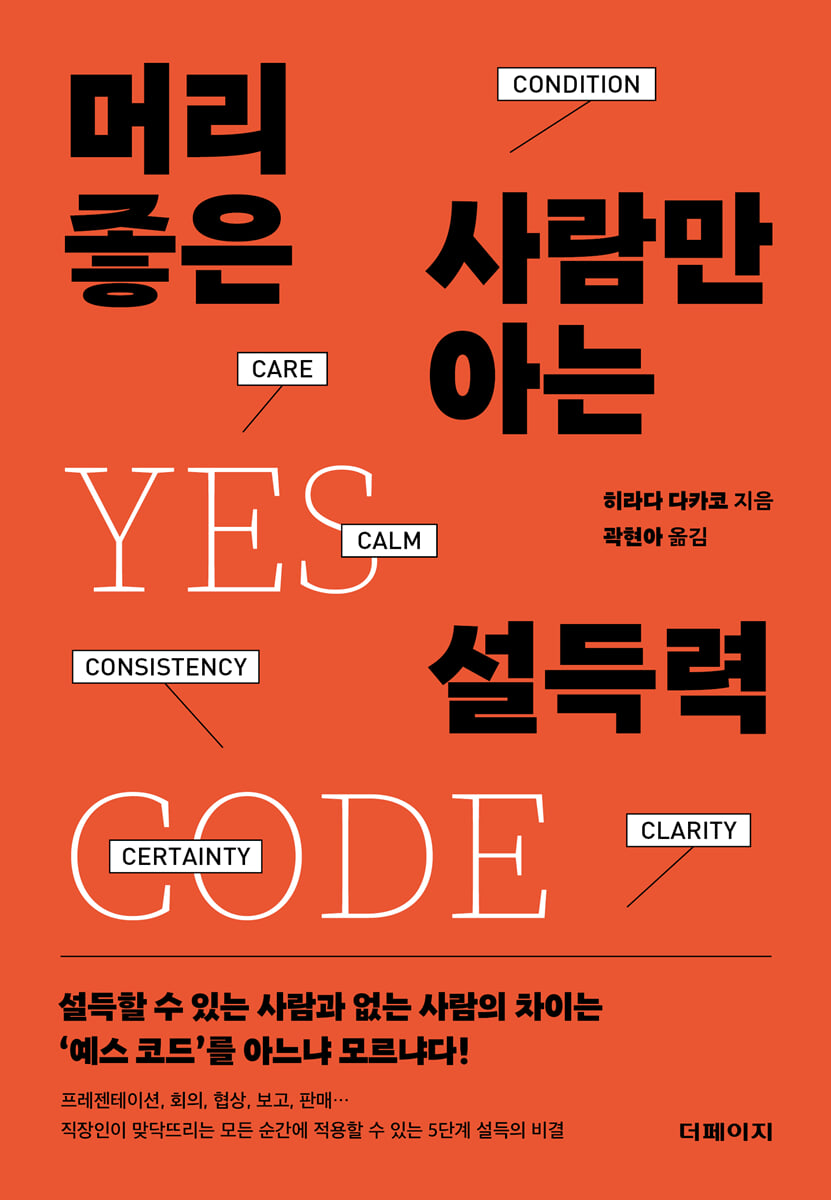
Persuasive power that only smart people know
 |
Description
Book Introduction
“Why can’t people be convinced even if I say the right thing?”
The moment you run the 'Yes Code'
The most powerful tool to instantly get a 'yes' from the other person!
"The difference between those who can persuade and those who can't is knowing the 'Yes Code.'"
- Global online media Lifehacker
No matter how right your words are in a meeting, your boss just shakes his head, and no matter how many times you submit a polished proposal, the client just says, “I’ll look into it,” and turns away.
Everyone has had this experience.
At times like these, we blame ourselves, asking, "Was my logic lacking?" or "Was I not prepared enough?" But the author of this book offers a completely different answer.
Persuasion starts from emotion, not logic.
He emphasizes that the moment you move the other person's heart, the answer 'yes' will follow.
The author of this book, Takako Hirata, is a business expert who has achieved success on the global stage using persuasion as a weapon.
At P&G, he developed 'Febreeze' and 'Lenoa' into global hit products, led the private brand 'TOPVALU' at Aeon Group, and is currently responsible for new business development at Rohto Pharmaceutical, working in Silicon Valley in the United States.
Her experience persuading numerous stakeholders in the competitive workplace of a global company led her to one clear conclusion.
The truth is that the success of persuasion depends not on logic but on whether one can appeal to emotions.
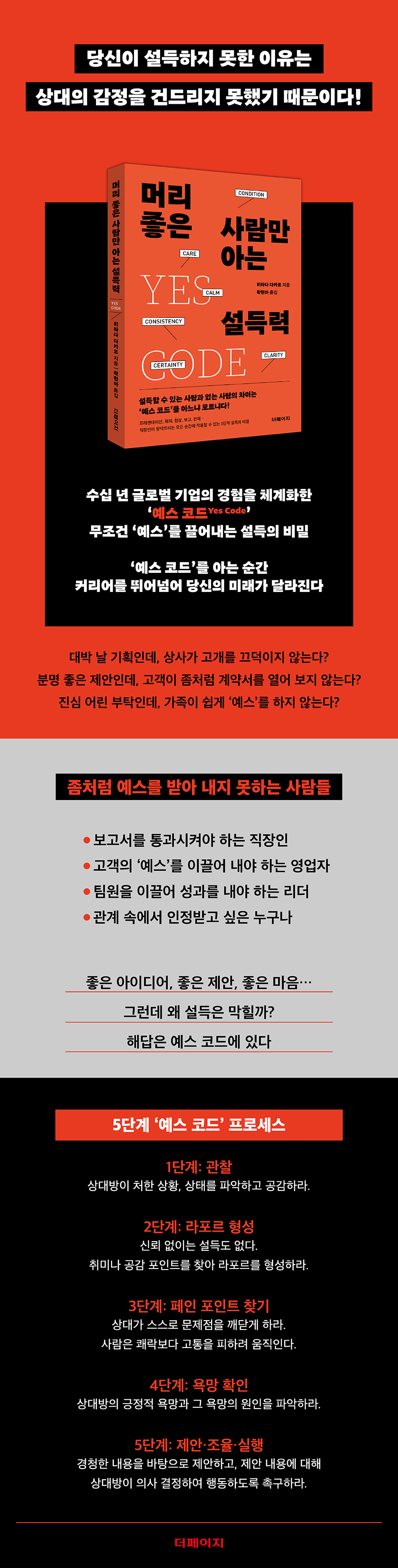
The secret to this persuasion, which she calls the "Yes Code," is summarized in five steps.
First, observe the other person's situation, empathize, set the stage, and then build trust and rapport.
Next, reveal the problem the other person has been avoiding, or the "pain point," and, conversely, show them the desires and benefits they truly desire.
Finally, it leads to action by linking specific proposals, coordination, and implementation.
Just as entering programming code executes the result, these five steps act as an execution procedure to elicit a 'yes' from the other person.
Of course, there are already many books that cover the art of persuasion.
There are also several classic theoretical books, such as Robert Cialdini, who revealed the principles of psychological persuasion, and Dale Carnegie, who revealed the secrets of human relationships.
But this book is different.
This is the first attempt to structure the process of moving emotions like code so that anyone can execute it.
So, unlike existing classics, it is not an abstract theory, but rather a practical weapon that office workers can immediately use in everyday situations such as meetings, negotiations, reports, and sales.
As you turn the pages of the book, you will realize.
Why didn't the other person budge even though I always said the right thing? Why didn't they open their heart no matter how many good things I listed?
The reason is that the other person's feelings were not taken into consideration.
The problem is now clear.
When you move your emotions, things change.
And the 'Yes Code' provides the solution.
Ultimately, the message this book delivers is simple.
There is no need to prepare any more logic.
There is no need to write more reports.
If you can move the other person's emotions and build trust, getting the "yes" you want will be easier than you think.
Persuasion can change your career and determine your performance.
The moment you realize the difference between logic and emotion, your persuasion has already begun.
The moment you run the 'Yes Code'
The most powerful tool to instantly get a 'yes' from the other person!
"The difference between those who can persuade and those who can't is knowing the 'Yes Code.'"
- Global online media Lifehacker
No matter how right your words are in a meeting, your boss just shakes his head, and no matter how many times you submit a polished proposal, the client just says, “I’ll look into it,” and turns away.
Everyone has had this experience.
At times like these, we blame ourselves, asking, "Was my logic lacking?" or "Was I not prepared enough?" But the author of this book offers a completely different answer.
Persuasion starts from emotion, not logic.
He emphasizes that the moment you move the other person's heart, the answer 'yes' will follow.
The author of this book, Takako Hirata, is a business expert who has achieved success on the global stage using persuasion as a weapon.
At P&G, he developed 'Febreeze' and 'Lenoa' into global hit products, led the private brand 'TOPVALU' at Aeon Group, and is currently responsible for new business development at Rohto Pharmaceutical, working in Silicon Valley in the United States.
Her experience persuading numerous stakeholders in the competitive workplace of a global company led her to one clear conclusion.
The truth is that the success of persuasion depends not on logic but on whether one can appeal to emotions.
The secret to this persuasion, which she calls the "Yes Code," is summarized in five steps.
First, observe the other person's situation, empathize, set the stage, and then build trust and rapport.
Next, reveal the problem the other person has been avoiding, or the "pain point," and, conversely, show them the desires and benefits they truly desire.
Finally, it leads to action by linking specific proposals, coordination, and implementation.
Just as entering programming code executes the result, these five steps act as an execution procedure to elicit a 'yes' from the other person.
Of course, there are already many books that cover the art of persuasion.
There are also several classic theoretical books, such as Robert Cialdini, who revealed the principles of psychological persuasion, and Dale Carnegie, who revealed the secrets of human relationships.
But this book is different.
This is the first attempt to structure the process of moving emotions like code so that anyone can execute it.
So, unlike existing classics, it is not an abstract theory, but rather a practical weapon that office workers can immediately use in everyday situations such as meetings, negotiations, reports, and sales.
As you turn the pages of the book, you will realize.
Why didn't the other person budge even though I always said the right thing? Why didn't they open their heart no matter how many good things I listed?
The reason is that the other person's feelings were not taken into consideration.
The problem is now clear.
When you move your emotions, things change.
And the 'Yes Code' provides the solution.
Ultimately, the message this book delivers is simple.
There is no need to prepare any more logic.
There is no need to write more reports.
If you can move the other person's emotions and build trust, getting the "yes" you want will be easier than you think.
Persuasion can change your career and determine your performance.
The moment you realize the difference between logic and emotion, your persuasion has already begun.
- You can preview some of the book's contents.
Preview
index
prolog
PART 1.
Three Misconceptions About Persuasion
Common sense of wrong persuasion
The right words touch the emotions
Humans make decisions based on emotions.
Emotions first, tactics later
PART 2.
You can't persuade without influence.
Influence and persuasiveness are proportional.
The influence of status
The power of passion
The influence of expertise
The influence of nonverbal elements
The influence of Elon Musk and Steve Jobs
Anne Hathaway eats oranges with the peel?
Why won't you listen to what I say?
Influence cultivated in everyday life
Three Mindsets to Increase Influence
PART 3.
Persuasion is determined by preparation.
Lazy preparation is preparation for failure.
Understanding the other person's benefits
Benefits from Two Perspectives
Fear affects decision making
Nine Questions to Identify Benefits
Find a breakthrough in nine questions
Let's ask people around us for answers to our questions.
Head, Heart, and Feet in the Persuasion Process
The success of a presentation is determined by the introduction.
Practice your presentation while walking your dog
PART 4.
Gain trust with the 6Cs
Who would listen to someone who is not trustworthy?
Care
Condition
Calm
Consistency
Clarity
Certainty
Let's practice the '6Cs' in our daily lives.
PART 5.
5 Steps to Persuasion
Avoid unnecessary arguments
Use the Yes Code
Step 1: Observe, Empathize
Step 2: Build rapport
Step 3: Finding Pain Points
Step 4: Identify Your Desire
Step 5: Propose, Coordinate, and Execute
The art of listening
Review
PART 6.
What should I do in this situation?
Q&A on Practical Persuasion Situations
Epilogue
PART 1.
Three Misconceptions About Persuasion
Common sense of wrong persuasion
The right words touch the emotions
Humans make decisions based on emotions.
Emotions first, tactics later
PART 2.
You can't persuade without influence.
Influence and persuasiveness are proportional.
The influence of status
The power of passion
The influence of expertise
The influence of nonverbal elements
The influence of Elon Musk and Steve Jobs
Anne Hathaway eats oranges with the peel?
Why won't you listen to what I say?
Influence cultivated in everyday life
Three Mindsets to Increase Influence
PART 3.
Persuasion is determined by preparation.
Lazy preparation is preparation for failure.
Understanding the other person's benefits
Benefits from Two Perspectives
Fear affects decision making
Nine Questions to Identify Benefits
Find a breakthrough in nine questions
Let's ask people around us for answers to our questions.
Head, Heart, and Feet in the Persuasion Process
The success of a presentation is determined by the introduction.
Practice your presentation while walking your dog
PART 4.
Gain trust with the 6Cs
Who would listen to someone who is not trustworthy?
Care
Condition
Calm
Consistency
Clarity
Certainty
Let's practice the '6Cs' in our daily lives.
PART 5.
5 Steps to Persuasion
Avoid unnecessary arguments
Use the Yes Code
Step 1: Observe, Empathize
Step 2: Build rapport
Step 3: Finding Pain Points
Step 4: Identify Your Desire
Step 5: Propose, Coordinate, and Execute
The art of listening
Review
PART 6.
What should I do in this situation?
Q&A on Practical Persuasion Situations
Epilogue
Detailed image
Into the book
Humans don't make decisions based solely on logic.
Rather, emotions play a greater role in decision-making.
This is also true in business.
For example, factors such as price or service content are not the only factors in choosing one business partner among multiple business partners.
We also take into considerable consideration factors such as the person in charge's attitude, personality, and passion.
This doesn't change when dealing with large corporations.
--- p.10
Before we delve into the details of the Yes Code, we need to look back at ourselves and realize that we have been persuading others in the wrong way.
And you must personally experience the fact that you have missed many opportunities to persuade people so far.
Because that's the starting point.
Only after waking up from the three illusions discussed in this book can we say that we are ready to stand on the sands of persuasion and fight.
--- p.34
Expertise is not limited to your main profession.
Not only the knowledge you learned at business school, but even your hobbies are highly valued if they can be of help to the company.
For example, when it comes to photography, if you are up to date with the latest technology and have professional equipment, you can be considered an expert in that field.
--- p.44
When it comes to speech, it's a little more complicated.
At first glance, a person who speaks with a loud voice and a smooth voice may seem trustworthy, but if the tone is too subtle, it can be difficult to trust them.
Rather, someone who expresses himself simply and in his own words, even if he seems a bit clumsy, may be more trustworthy.
--- p.47
The fourth question about needs is, “What do I need to believe to feel that emotion?”
Because you believe in something, you ultimately feel that emotion.
For example, a woman who wants to have whiter skin buys health supplements.
I believe that if you don't buy health supplements, you won't get white skin, and therefore won't be popular.
That's why you buy health supplements.
--- p.86
At this time, you should think about "What is the pain point?" and "Are there any suggestions to overcome it?" by asking questions that consider needs and suggestions.
The pain point for partners due to discontinuation is that 'work is lost and income decreases.'
However, if you make a suggestion that 'makes up for it', you can eliminate the pain points.
--- p.99
One thing to be careful about is that you must be very selective about who you ask for advice from.
You should definitely be wary of people who are overly critical, who try to sabotage your plans or projects by pretending to offer advice, or who, on the contrary, try to hijack your plans.
Let's ask someone who gives us courage.
--- p.102
Many people may worry about not being able to speak well when giving presentations.
People like that often ask me for my secret, but to be honest, I don't have any special secret.
The only thing I can say is that anyone who is not good at speaking in presentations is 'lacking practice'.
--- p.112
To like someone, I recommend finding three good things about them.
It's about finding things that make the other person feel good, like 'being punctual', 'dressing well in a suit, and always having clean shoes'.
If you make it a habit to discover the good in everyone you meet, even just one, and like them, you will always be a person who is considerate of others.
--- p.121
When I'm making presentation materials, I think about the content and improve it, and I feel like, 'This content will definitely work.'
Sometimes, the presentation material seems to shine so brightly that you think, 'I can persuade someone.'
Even as I practice my presentation and speak over and over again, I feel more and more confident.
Such a proposal would actually be easy to pass.
Rather, emotions play a greater role in decision-making.
This is also true in business.
For example, factors such as price or service content are not the only factors in choosing one business partner among multiple business partners.
We also take into considerable consideration factors such as the person in charge's attitude, personality, and passion.
This doesn't change when dealing with large corporations.
--- p.10
Before we delve into the details of the Yes Code, we need to look back at ourselves and realize that we have been persuading others in the wrong way.
And you must personally experience the fact that you have missed many opportunities to persuade people so far.
Because that's the starting point.
Only after waking up from the three illusions discussed in this book can we say that we are ready to stand on the sands of persuasion and fight.
--- p.34
Expertise is not limited to your main profession.
Not only the knowledge you learned at business school, but even your hobbies are highly valued if they can be of help to the company.
For example, when it comes to photography, if you are up to date with the latest technology and have professional equipment, you can be considered an expert in that field.
--- p.44
When it comes to speech, it's a little more complicated.
At first glance, a person who speaks with a loud voice and a smooth voice may seem trustworthy, but if the tone is too subtle, it can be difficult to trust them.
Rather, someone who expresses himself simply and in his own words, even if he seems a bit clumsy, may be more trustworthy.
--- p.47
The fourth question about needs is, “What do I need to believe to feel that emotion?”
Because you believe in something, you ultimately feel that emotion.
For example, a woman who wants to have whiter skin buys health supplements.
I believe that if you don't buy health supplements, you won't get white skin, and therefore won't be popular.
That's why you buy health supplements.
--- p.86
At this time, you should think about "What is the pain point?" and "Are there any suggestions to overcome it?" by asking questions that consider needs and suggestions.
The pain point for partners due to discontinuation is that 'work is lost and income decreases.'
However, if you make a suggestion that 'makes up for it', you can eliminate the pain points.
--- p.99
One thing to be careful about is that you must be very selective about who you ask for advice from.
You should definitely be wary of people who are overly critical, who try to sabotage your plans or projects by pretending to offer advice, or who, on the contrary, try to hijack your plans.
Let's ask someone who gives us courage.
--- p.102
Many people may worry about not being able to speak well when giving presentations.
People like that often ask me for my secret, but to be honest, I don't have any special secret.
The only thing I can say is that anyone who is not good at speaking in presentations is 'lacking practice'.
--- p.112
To like someone, I recommend finding three good things about them.
It's about finding things that make the other person feel good, like 'being punctual', 'dressing well in a suit, and always having clean shoes'.
If you make it a habit to discover the good in everyone you meet, even just one, and like them, you will always be a person who is considerate of others.
--- p.121
When I'm making presentation materials, I think about the content and improve it, and I feel like, 'This content will definitely work.'
Sometimes, the presentation material seems to shine so brightly that you think, 'I can persuade someone.'
Even as I practice my presentation and speak over and over again, I feel more and more confident.
Such a proposal would actually be easy to pass.
--- p.133
Publisher's Review
"Yes Code: Transforming Your Life Beyond Your Career"
Move your opponent with emotion, not logic!
I was on a business trip to Taiwan.
The author went to discuss collaboration with a local home shopping company, but instead of a calm atmosphere, an awkward silence hung over the table.
The reason was simple.
Even basic information about the opposing company was not prepared.
At that moment, she realized.
No matter how flowery the words, without proper preparation and context, persuasion cannot even begin.
This painful experience became the first step in creating her philosophy of persuasion.
For example, let's say a customer says, "I want to live in a high-rise apartment and I'm looking for a suitable property."
At first glance, this statement may seem like a simple desire, but if you look deeper, the hidden meaning behind it is the feeling of wanting to be recognized as someone who lives in a nice house.
In the end, the house is just a symbol, and the real key is the 'need for recognition'.
The author helps us realize that although people seem to make decisions based on reason, they are actually already making up their minds based on emotions.
What about the sight of people lining up overnight in front of stores that release new iPhones every time a new model is released?
The newly added features may not be that great.
But the moment you hold the latest iPhone in your hand, the feeling of pride that you are “riding the wave of the times” brings people out into the streets.
Ultimately, persuading customers through effective new product marketing requires appealing to their emotions.
What matters is not logic and numbers, but the power to touch the heart.
The 'Febreeze' advertisement, in which the author directly participated, is a representative example.
Instead of providing a functional explanation for eliminating household odors, the ad directly appealed to the anxiety of, "What if there's an odor when guests come over?"
The results were explosive.
Instead of reaching for a remote control, the consumer's hand reached for Febreze.
Persuasion leads to real-world action when it touches emotions like fear, anxiety, desire, and hope.
She combined all these experiences into her own persuasion strategy, which she named the "Yes Code."
Just as a program is executed and the result is displayed when it is entered, it means that it is an execution procedure that elicits a 'yes' from the other party.
You don't have to memorize all five steps.
The important thing is that there is an order, and above all, that emotions come first, not logic.
While classic works on persuasion teach us about basic human psychology and related theories, this book goes beyond the classics and teaches us persuasion strategies that we can immediately apply in real life.
This is a practical and real-world strategy, born from failure and frustration, and shaped by vivid examples from the global field.
Thanks to this, you have a weapon that can be used tomorrow, whether in a conference room, at the negotiating table, or even in a conversation with your family.
In the end, you realize that the reason why your words didn't get through even when you said the right thing, why the other person didn't nod no matter how many numbers and data you poured out, was because the answer was in the other person's mind.
And the moment that heart is moved, the stage of persuasion changes completely.
Like the people waiting in long lines for an iPhone, or the consumers picking up Febreze, the other person's 'yes' is already prepared.
As long as you touch the other person's feelings.
The 5-Step Yes Code Process, Refined in Global Business Fields
Step 1: Observe, Empathize
Step 2: Build rapport
Step 3: Finding Pain Points
Step 4: Identify Your Desire
Step 5: Propose, Coordinate, and Execute
Why can't we convince others even when we say the right thing?
No matter how logically you present the evidence, the listener shakes their head and sometimes even closes their heart.
The author firmly points out the reason.
Because persuasion starts from emotion, not logic.
No matter how plausible a theory is, it is useless if it cannot move emotions.
This book begins right at that point.
First, the author shatters a common misconception people have.
The expectation that if you say the right thing, the other person will agree, the belief that if you eliminate all objections, they will eventually accept you, and the idea that strategy and tactics come first.
But the reality is different.
Persuasion always works when it touches the emotions.
Correcting these misconceptions is the starting point.
So what does it take to move emotions?
The author brings up the word 'influence'.
The weight of persuasion ultimately depends on who is speaking.
The reason Elon Musk's bold visions get people excited, and the reason Steve Jobs could captivate audiences with simple presentations, is because of his influence.
Position, passion, expertise, and nonverbal messages: these four factors determine a speaker's credibility.
Once you have established your influence, you must now look deep into the hearts of your opponents.
The desires that are revealed on the surface are merely superficial.
Even people who say they want a high-rise apartment are actually trying to satisfy their desire for recognition.
Conversely, people have 'pain points' that they want to avoid.
Fear of losing money, fear of failure, anxiety about relationships going wrong.
Persuasion becomes powerful only when it touches these two axes: desire and fear.
However, just because you know their desires and pain points, it doesn't mean they will move right away.
The author systematizes this process like a program and calls it the 'Yes Code'.
First, observe and empathize with the other person and set the stage.
Next, you build a close relationship, or rapport, and build a psychological bridge that says, “I can trust this person.”
Then, by revealing and amplifying pain points and making people aware of the problem, we show them desires and benefits to help them envision a positive future.
Finally, we turn suggestions into action through coordination and execution.
When these five steps are performed in order, the word 'yes' will naturally flow from the other person's mouth.
But for persuasion to work, it needs a foundation above all else.
It's trust.
Trust, which begins with keeping small promises, grows over time and ultimately becomes the most solid foundation for persuasion.
Clarity of message must be added here.
The more you try to say, the less you have left.
Persuasion is powerful when one key point is conveyed clearly and powerfully.
Finally, the author presents various situations we may encounter.
When you encounter jealousy and envy from your boss, when you want to push for organizational change but face resistance, when you want to sell expensive products, when you want to achieve results quickly, when your emails aren't getting replies.
It vividly shows how the 'Yes Code' can be applied in these specific scenes.
It is not an abstract theory, but a tool that can be used in a conference room tomorrow to perfect persuasiveness.
Ultimately, this book boils down to one message.
Persuasion is the act of moving the other person's heart.
Logic that fails to touch the emotions always rings hollow.
But if you move your emotions, build trust, and follow the steps of the yes code, you can get the answers you want much easier than you think.
Persuasion creates results and determines careers.
And because it's code that anyone can learn and run, this book puts a powerful weapon in our hands.
Move your opponent with emotion, not logic!
I was on a business trip to Taiwan.
The author went to discuss collaboration with a local home shopping company, but instead of a calm atmosphere, an awkward silence hung over the table.
The reason was simple.
Even basic information about the opposing company was not prepared.
At that moment, she realized.
No matter how flowery the words, without proper preparation and context, persuasion cannot even begin.
This painful experience became the first step in creating her philosophy of persuasion.
For example, let's say a customer says, "I want to live in a high-rise apartment and I'm looking for a suitable property."
At first glance, this statement may seem like a simple desire, but if you look deeper, the hidden meaning behind it is the feeling of wanting to be recognized as someone who lives in a nice house.
In the end, the house is just a symbol, and the real key is the 'need for recognition'.
The author helps us realize that although people seem to make decisions based on reason, they are actually already making up their minds based on emotions.
What about the sight of people lining up overnight in front of stores that release new iPhones every time a new model is released?
The newly added features may not be that great.
But the moment you hold the latest iPhone in your hand, the feeling of pride that you are “riding the wave of the times” brings people out into the streets.
Ultimately, persuading customers through effective new product marketing requires appealing to their emotions.
What matters is not logic and numbers, but the power to touch the heart.
The 'Febreeze' advertisement, in which the author directly participated, is a representative example.
Instead of providing a functional explanation for eliminating household odors, the ad directly appealed to the anxiety of, "What if there's an odor when guests come over?"
The results were explosive.
Instead of reaching for a remote control, the consumer's hand reached for Febreze.
Persuasion leads to real-world action when it touches emotions like fear, anxiety, desire, and hope.
She combined all these experiences into her own persuasion strategy, which she named the "Yes Code."
Just as a program is executed and the result is displayed when it is entered, it means that it is an execution procedure that elicits a 'yes' from the other party.
You don't have to memorize all five steps.
The important thing is that there is an order, and above all, that emotions come first, not logic.
While classic works on persuasion teach us about basic human psychology and related theories, this book goes beyond the classics and teaches us persuasion strategies that we can immediately apply in real life.
This is a practical and real-world strategy, born from failure and frustration, and shaped by vivid examples from the global field.
Thanks to this, you have a weapon that can be used tomorrow, whether in a conference room, at the negotiating table, or even in a conversation with your family.
In the end, you realize that the reason why your words didn't get through even when you said the right thing, why the other person didn't nod no matter how many numbers and data you poured out, was because the answer was in the other person's mind.
And the moment that heart is moved, the stage of persuasion changes completely.
Like the people waiting in long lines for an iPhone, or the consumers picking up Febreze, the other person's 'yes' is already prepared.
As long as you touch the other person's feelings.
The 5-Step Yes Code Process, Refined in Global Business Fields
Step 1: Observe, Empathize
Step 2: Build rapport
Step 3: Finding Pain Points
Step 4: Identify Your Desire
Step 5: Propose, Coordinate, and Execute
Why can't we convince others even when we say the right thing?
No matter how logically you present the evidence, the listener shakes their head and sometimes even closes their heart.
The author firmly points out the reason.
Because persuasion starts from emotion, not logic.
No matter how plausible a theory is, it is useless if it cannot move emotions.
This book begins right at that point.
First, the author shatters a common misconception people have.
The expectation that if you say the right thing, the other person will agree, the belief that if you eliminate all objections, they will eventually accept you, and the idea that strategy and tactics come first.
But the reality is different.
Persuasion always works when it touches the emotions.
Correcting these misconceptions is the starting point.
So what does it take to move emotions?
The author brings up the word 'influence'.
The weight of persuasion ultimately depends on who is speaking.
The reason Elon Musk's bold visions get people excited, and the reason Steve Jobs could captivate audiences with simple presentations, is because of his influence.
Position, passion, expertise, and nonverbal messages: these four factors determine a speaker's credibility.
Once you have established your influence, you must now look deep into the hearts of your opponents.
The desires that are revealed on the surface are merely superficial.
Even people who say they want a high-rise apartment are actually trying to satisfy their desire for recognition.
Conversely, people have 'pain points' that they want to avoid.
Fear of losing money, fear of failure, anxiety about relationships going wrong.
Persuasion becomes powerful only when it touches these two axes: desire and fear.
However, just because you know their desires and pain points, it doesn't mean they will move right away.
The author systematizes this process like a program and calls it the 'Yes Code'.
First, observe and empathize with the other person and set the stage.
Next, you build a close relationship, or rapport, and build a psychological bridge that says, “I can trust this person.”
Then, by revealing and amplifying pain points and making people aware of the problem, we show them desires and benefits to help them envision a positive future.
Finally, we turn suggestions into action through coordination and execution.
When these five steps are performed in order, the word 'yes' will naturally flow from the other person's mouth.
But for persuasion to work, it needs a foundation above all else.
It's trust.
Trust, which begins with keeping small promises, grows over time and ultimately becomes the most solid foundation for persuasion.
Clarity of message must be added here.
The more you try to say, the less you have left.
Persuasion is powerful when one key point is conveyed clearly and powerfully.
Finally, the author presents various situations we may encounter.
When you encounter jealousy and envy from your boss, when you want to push for organizational change but face resistance, when you want to sell expensive products, when you want to achieve results quickly, when your emails aren't getting replies.
It vividly shows how the 'Yes Code' can be applied in these specific scenes.
It is not an abstract theory, but a tool that can be used in a conference room tomorrow to perfect persuasiveness.
Ultimately, this book boils down to one message.
Persuasion is the act of moving the other person's heart.
Logic that fails to touch the emotions always rings hollow.
But if you move your emotions, build trust, and follow the steps of the yes code, you can get the answers you want much easier than you think.
Persuasion creates results and determines careers.
And because it's code that anyone can learn and run, this book puts a powerful weapon in our hands.
GOODS SPECIFICS
- Date of issue: October 15, 2025
- Page count, weight, size: 200 pages | 147*212*20mm
- ISBN13: 9791194156284
- ISBN10: 1194156282
You may also like
카테고리
korean


korean

![GQ KOREA Mark (Monthly): December [2025]](http://librairie.coreenne.fr/cdn/shop/files/8ef265dbbfbf186523ed75ba7319009d.jpg?v=1765340328&width=3840)


