

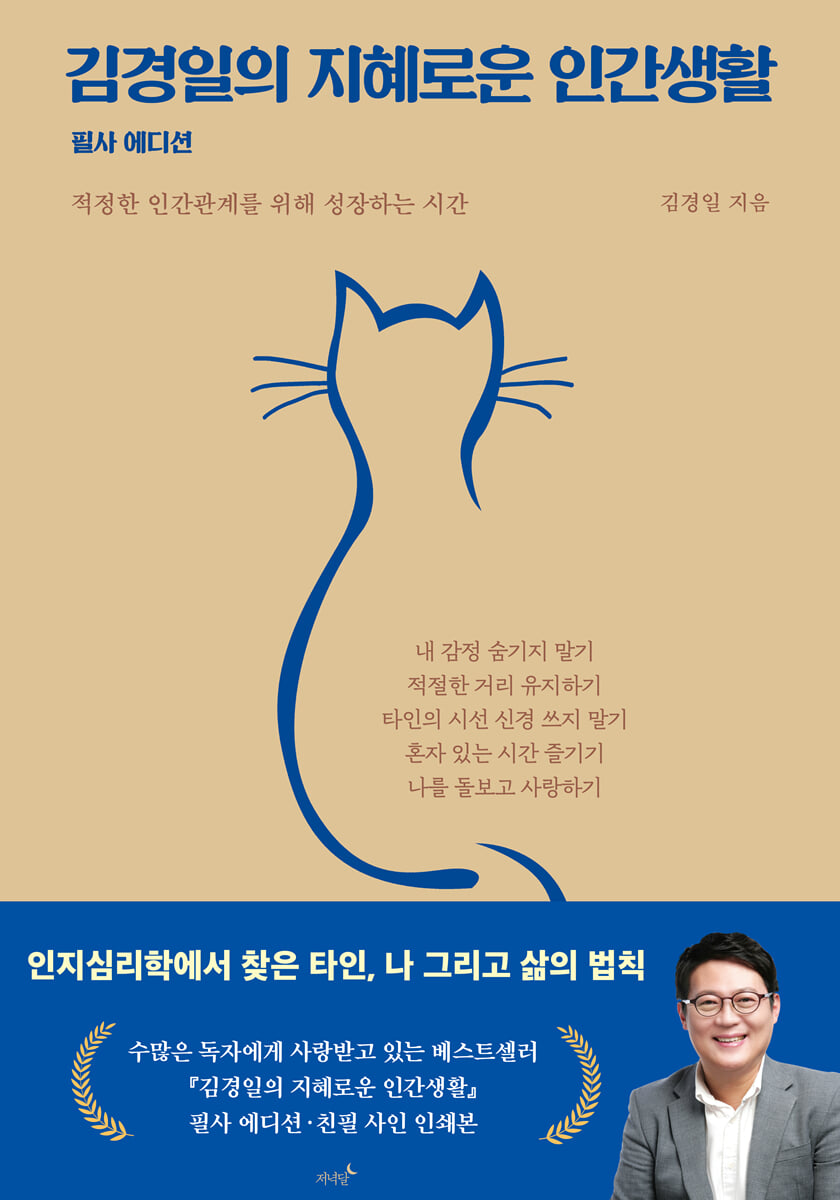
Kim Kyung-il's Wise Human Life Manual Edition
 |
Description
Book Introduction
It brought fresh insight and change to countless people.
Cognitive Psychologist Professor Kim Kyung-il's Human Relations Class
I'm always concerned about other people's gaze and words
A time of desperation and growth for you who have been hurt
A bestseller loved by countless readers
Kim Kyung-il's Wise Human Life
Handwritten edition/autographed print
Professor Kyung-il Kim of Ajou University, a leading cognitive psychologist in Korea and much loved by the public, has published his best-selling book, "Kim Kyung-il's Wise Human Life," in a handwritten edition that helps readers engage in deeper reflection.
This book, which offers fresh insight and practical change to modern people who are hurt by the gaze and words of others and who experience difficulties in relationships, is designed to help them more deeply embody the wisdom of Professor Kim Kyung-il through the active reading method of "Bilsa."
The original book, "Kim Kyung-il's Wise Human Life," sharply penetrates the essence of the suffering we experience in relationships through cognitive psychology, and since its publication, it has established itself as a steady seller in the field of human relationship psychology, conveying clear insights to countless readers.
This manuscript edition carefully selects key sentences from the original work, which have helped countless readers look into their hearts and restore relationships with loved ones.
Through the time spent transcribing sentences by hand, readers can experience caring for their own emotions without being swayed by the words of others.
Also, the most notable part of this edition of "Kim Kyung-il's Wise Human Life Handwritten Edition" is that it includes nine newly written lectures on human relationships by Professor Kim Kyung-il.
Professor Kim Kyung-il's new lecture will serve as a powerful psychological weapon for healing and recovery from the relationship difficulties and psychological disasters readers face in their daily lives.
Cognitive Psychologist Professor Kim Kyung-il's Human Relations Class
I'm always concerned about other people's gaze and words
A time of desperation and growth for you who have been hurt
A bestseller loved by countless readers
Kim Kyung-il's Wise Human Life
Handwritten edition/autographed print
Professor Kyung-il Kim of Ajou University, a leading cognitive psychologist in Korea and much loved by the public, has published his best-selling book, "Kim Kyung-il's Wise Human Life," in a handwritten edition that helps readers engage in deeper reflection.
This book, which offers fresh insight and practical change to modern people who are hurt by the gaze and words of others and who experience difficulties in relationships, is designed to help them more deeply embody the wisdom of Professor Kim Kyung-il through the active reading method of "Bilsa."
The original book, "Kim Kyung-il's Wise Human Life," sharply penetrates the essence of the suffering we experience in relationships through cognitive psychology, and since its publication, it has established itself as a steady seller in the field of human relationship psychology, conveying clear insights to countless readers.
This manuscript edition carefully selects key sentences from the original work, which have helped countless readers look into their hearts and restore relationships with loved ones.
Through the time spent transcribing sentences by hand, readers can experience caring for their own emotions without being swayed by the words of others.
Also, the most notable part of this edition of "Kim Kyung-il's Wise Human Life Handwritten Edition" is that it includes nine newly written lectures on human relationships by Professor Kim Kyung-il.
Professor Kim Kyung-il's new lecture will serve as a powerful psychological weapon for healing and recovery from the relationship difficulties and psychological disasters readers face in their daily lives.
- You can preview some of the book's contents.
Preview
index
Prologue: Time to Grow for Proper Relationships 006
Structure and Use of This Book 010
Part 1: Attitudes toward others
How to become mentally strong without being swayed by emotions
How many scales does my heart have? 024
Becoming mature is 026
Balancing Honesty and Humility 030
Life is ultimately a process of becoming a good person 032
The Only Way to Get Along with Someone with Your Opposite Personality 044
Gratitude Reduces Psychological Distress 046
Exercise 050: Expressing Gratitude
The Meaning of Asking for Help 052
Characteristics of People Who Repeat Other People's Words 064
Reading the atmosphere is also a great skill 070
How to Deal with Hypocritical People 072
If you have to work with a hypocritical person 074
Korea is a country with strong relationalism 078
080 To collaborate with someone who has different perspectives from you
Wise Human Life LECTURE 1: The Inappropriately Bright Person 034
Wise Human Life LECTURE 2: How to Be Respected Without Seeming Easy 054
Wise Human Life LECTURE 3: Facing Conflict and Turning It into Opportunity 084
Part 2: Standing as a complete me
_Focusing on myself frees me from interpersonal relationships.
Days When You Have the Right to Be Happy 104
Don't Think of Happiness as Too Grand 106
Ten small happinesses are better than one big one. 120
Happy People Are Creative 122
Happy people are altruistic 126
I must first acknowledge myself 138
The Secret of People Who Always Get Recognized 140
Admiring Myself 144
A day without dancing is a lost day 146
Senses Influence Thoughts 152
Laughing makes you happy 154
168 to convey your feelings
A Day of Comfort from a Warm Heart 174
People who ignore me 180
Sociopaths Who Reject Rejection 186
Knowledge is power vs.
Knowledge is a disease 188
Don't Make Decisions When You're Tired 202
Wise Human Life LECTURE 4: The Psychology of Loneliness 108
Wise Human Life LECTURE 5: The Art of Overcoming Anxiety 130
Wise Human Life LECTURE 6: How to Overcome Depression 156
Wise Human Life LECTURE 7: The Psychology of Love 192
Part 3: Going a Step Further
_How to add positive energy to your life
The Difference Between an Optimistic and an Optimistic Personality 218
If you want to become a respected leader, 220
238 Most Common Mistakes Made During a Job Change
Approach and avoidance motivations 246
Different generations move at different speeds. 248
It's natural not to want to think about anything 252
The Fast Thinking Trap 256
Black Proposal and Trust Relationship 274
Don't Be Fooled by Intuitive Optimism 276
Wise Human Life LECTURE 8: Cognitive Humility Necessary for Communication 226
Wise Human Life LECTURE 9: Becoming a Mature Human 262
Structure and Use of This Book 010
Part 1: Attitudes toward others
How to become mentally strong without being swayed by emotions
How many scales does my heart have? 024
Becoming mature is 026
Balancing Honesty and Humility 030
Life is ultimately a process of becoming a good person 032
The Only Way to Get Along with Someone with Your Opposite Personality 044
Gratitude Reduces Psychological Distress 046
Exercise 050: Expressing Gratitude
The Meaning of Asking for Help 052
Characteristics of People Who Repeat Other People's Words 064
Reading the atmosphere is also a great skill 070
How to Deal with Hypocritical People 072
If you have to work with a hypocritical person 074
Korea is a country with strong relationalism 078
080 To collaborate with someone who has different perspectives from you
Wise Human Life LECTURE 1: The Inappropriately Bright Person 034
Wise Human Life LECTURE 2: How to Be Respected Without Seeming Easy 054
Wise Human Life LECTURE 3: Facing Conflict and Turning It into Opportunity 084
Part 2: Standing as a complete me
_Focusing on myself frees me from interpersonal relationships.
Days When You Have the Right to Be Happy 104
Don't Think of Happiness as Too Grand 106
Ten small happinesses are better than one big one. 120
Happy People Are Creative 122
Happy people are altruistic 126
I must first acknowledge myself 138
The Secret of People Who Always Get Recognized 140
Admiring Myself 144
A day without dancing is a lost day 146
Senses Influence Thoughts 152
Laughing makes you happy 154
168 to convey your feelings
A Day of Comfort from a Warm Heart 174
People who ignore me 180
Sociopaths Who Reject Rejection 186
Knowledge is power vs.
Knowledge is a disease 188
Don't Make Decisions When You're Tired 202
Wise Human Life LECTURE 4: The Psychology of Loneliness 108
Wise Human Life LECTURE 5: The Art of Overcoming Anxiety 130
Wise Human Life LECTURE 6: How to Overcome Depression 156
Wise Human Life LECTURE 7: The Psychology of Love 192
Part 3: Going a Step Further
_How to add positive energy to your life
The Difference Between an Optimistic and an Optimistic Personality 218
If you want to become a respected leader, 220
238 Most Common Mistakes Made During a Job Change
Approach and avoidance motivations 246
Different generations move at different speeds. 248
It's natural not to want to think about anything 252
The Fast Thinking Trap 256
Black Proposal and Trust Relationship 274
Don't Be Fooled by Intuitive Optimism 276
Wise Human Life LECTURE 8: Cognitive Humility Necessary for Communication 226
Wise Human Life LECTURE 9: Becoming a Mature Human 262
Detailed image
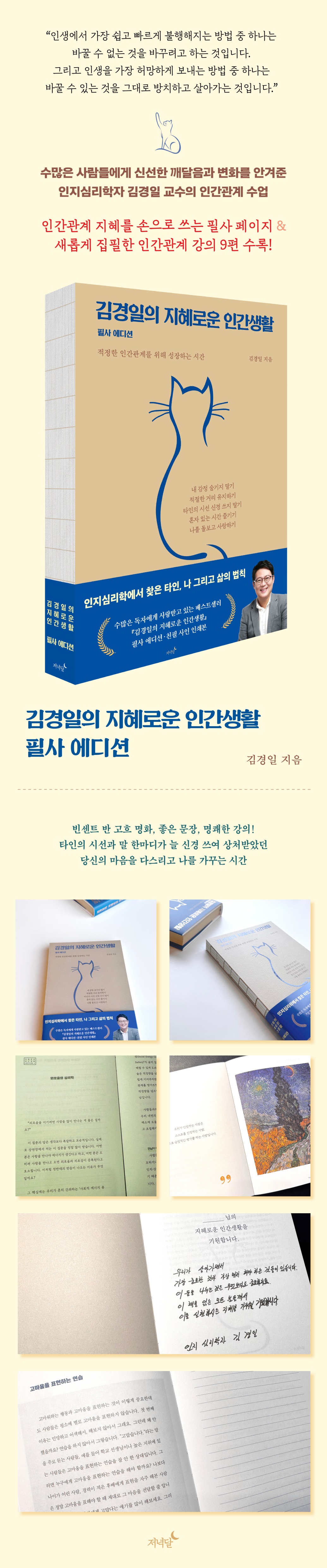
Into the book
“One of the easiest and fastest ways to become unhappy in life is to try to change the things you can’t change.
And one of the most vain ways to spend your life is to 'live without changing anything that can be changed.'
Cognitive psychology is the discipline that distinguishes between what can and cannot be changed.”
This is a phrase I often mention in my lectures and books, and it is also a phrase that is often overlooked but loved by readers.
It seems you agree with the fact that many of life's problems, including interpersonal relationships, ultimately stem from the standard of what can and cannot be changed.
After publishing "Kim Kyung-il's Wise Human Life," I received a lot of unexpected feedback through lectures and reviews.
Surprisingly, even people who had been in society for quite some time found interpersonal relationships inherently difficult, and many even suffered from types of interpersonal problems they had never experienced before.
I think we need to boldly let go of the vague expectation that "when I'm in my 40s or 50s, I'll gain experience and relationships will become easier."
I think human relationships should be seen as a lifelong task that requires constant learning and readjustment.
Human relationships are not resolved through experience alone.
As life deepens, we need more nuanced understanding and insight.
Otherwise, as you repeat the same conflicts, you will become more and more numb, or your mind will lean towards giving up on connecting with people in the first place.
If you are obsessed with the thoughts, “I don’t trust people well,” or “No one understands my heart,” relationships will become distant and isolation will deepen.
But let's change our perspective here. I can't change others, but I can always choose to become a more mature person.
As we become mature, we realize that the center of our relationships is not others, but ourselves.
--- p.6-7, from “Prologue - Time to Grow Myself for Appropriate Human Relationships”
Are negative emotions bad, folks? There's no need to be so critical of them.
Signals like 'I'm angry', 'I'm annoyed', and 'I'm in pain' are survival signals our body sends us.
These signals are like warning lights that tell us that 'this situation is threatening to me' or 'my boundaries are being violated.'
The emotions that trigger these warning lights must be expressed appropriately to maintain our psychological health.
If you suppress your child's emotional expression by saying things like, "Boys shouldn't do that," or "You shouldn't do this," your child may lose not only the ability to trust his or her own emotions, but also the ability to judge emotions themselves.
We all need to recognize that being appropriately angry is a perfectly valid way to protect our rights and boundaries.
If you keep suppressing your emotions, the 'scale' for those emotions will not develop, and eventually you will not even be able to know why you are having a hard time.
--- p.34-35, from 「Wise Human Life LECTURE 1 - Inappropriately Bright People」
Most of us act kindly because we want to be seen as good people and be respected.
But unfortunately, kindness doesn't always lead to respect.
It's common for good people to be ignored or treated lightly.
Because most good people can't refuse requests from others, or they can even endure insulting words.
They try to maintain a positive self-image by thinking, "I'm a good person, so I don't want to use harsh language or bad behavior," but they end up getting hurt.
However, avoiding conflict unconditionally like this is a dangerous behavior that does not let the other person know my boundaries.
The other person will not be able to determine the boundary between 'how much is it okay to ask of this person' and will continue to cross the line.
--- p.54-55, from 「Wise Human Life LECTURE 2 - How to be respected without appearing easy」
Psychology is a discipline that cannot advance even one step without addressing the topic of anxiety.
Anxiety is so deeply rooted in human existence and behavior.
But why do we hate this anxiety so much? Anxiety is painful in itself, but the bigger problem is that it exacerbates the pain of other negative emotions.
When you experience physical pain from something while you are anxious, it feels much more painful than usual.
The same goes for when you feel lonely.
Loneliness in a state of extreme anxiety can feel like extreme pain, as if you were left alone on this earth.
Even when we are bored with nothing to do, anxiety leaves us feeling helpless.
Anxiety serves to amplify the pain felt from all the negative emotions experienced afterwards.
What humans hate the most is a situation where this anxiety is maximized.
What is that situation? It's uncertain and ambiguous.
Our brains are inherently wired to prefer certainty and concreteness.
The brain finds peace only when it can clearly answer the questions 'when, where, and how.'
--- p.131-132, from 「Wise Human Life LECTURE 3 - Techniques for Overcoming Anxiety」
There are three pillars that are necessary for growing into a warm and mature human being.
It is a kind heart, a mature personality, and a positive outlook on life.
These three may seem like different virtues, but in fact they are like trees growing in one integrated stream.
Kindness becomes the soil that holds the ground together, a mature personality becomes a thick trunk, and a positive mind becomes the leaves that welcome the sunlight and wind.
When I do something good for someone, but a corner of my heart feels strangely empty.
Or when you firmly resolve to be a good person, but you keep getting swayed by emotions, or when you feel trapped in negative thoughts, or when you think, "Why is life so hard?"
This is the time for us to move towards maturity.
Finally, there is something to always remember.
“Let’s not expect perfect kindness, a completely mature personality, or a constant, bright positivity.”
Because we are human, we waver and get tired.
What's important in such times is the will to get back up again and the attitude to keep going one step at a time.
As we practice kindness, reflect on the depth of our emotions, and plant seeds of positivity in our lives, we will soon find ourselves as warm, relaxed, and mature adults.
And one of the most vain ways to spend your life is to 'live without changing anything that can be changed.'
Cognitive psychology is the discipline that distinguishes between what can and cannot be changed.”
This is a phrase I often mention in my lectures and books, and it is also a phrase that is often overlooked but loved by readers.
It seems you agree with the fact that many of life's problems, including interpersonal relationships, ultimately stem from the standard of what can and cannot be changed.
After publishing "Kim Kyung-il's Wise Human Life," I received a lot of unexpected feedback through lectures and reviews.
Surprisingly, even people who had been in society for quite some time found interpersonal relationships inherently difficult, and many even suffered from types of interpersonal problems they had never experienced before.
I think we need to boldly let go of the vague expectation that "when I'm in my 40s or 50s, I'll gain experience and relationships will become easier."
I think human relationships should be seen as a lifelong task that requires constant learning and readjustment.
Human relationships are not resolved through experience alone.
As life deepens, we need more nuanced understanding and insight.
Otherwise, as you repeat the same conflicts, you will become more and more numb, or your mind will lean towards giving up on connecting with people in the first place.
If you are obsessed with the thoughts, “I don’t trust people well,” or “No one understands my heart,” relationships will become distant and isolation will deepen.
But let's change our perspective here. I can't change others, but I can always choose to become a more mature person.
As we become mature, we realize that the center of our relationships is not others, but ourselves.
--- p.6-7, from “Prologue - Time to Grow Myself for Appropriate Human Relationships”
Are negative emotions bad, folks? There's no need to be so critical of them.
Signals like 'I'm angry', 'I'm annoyed', and 'I'm in pain' are survival signals our body sends us.
These signals are like warning lights that tell us that 'this situation is threatening to me' or 'my boundaries are being violated.'
The emotions that trigger these warning lights must be expressed appropriately to maintain our psychological health.
If you suppress your child's emotional expression by saying things like, "Boys shouldn't do that," or "You shouldn't do this," your child may lose not only the ability to trust his or her own emotions, but also the ability to judge emotions themselves.
We all need to recognize that being appropriately angry is a perfectly valid way to protect our rights and boundaries.
If you keep suppressing your emotions, the 'scale' for those emotions will not develop, and eventually you will not even be able to know why you are having a hard time.
--- p.34-35, from 「Wise Human Life LECTURE 1 - Inappropriately Bright People」
Most of us act kindly because we want to be seen as good people and be respected.
But unfortunately, kindness doesn't always lead to respect.
It's common for good people to be ignored or treated lightly.
Because most good people can't refuse requests from others, or they can even endure insulting words.
They try to maintain a positive self-image by thinking, "I'm a good person, so I don't want to use harsh language or bad behavior," but they end up getting hurt.
However, avoiding conflict unconditionally like this is a dangerous behavior that does not let the other person know my boundaries.
The other person will not be able to determine the boundary between 'how much is it okay to ask of this person' and will continue to cross the line.
--- p.54-55, from 「Wise Human Life LECTURE 2 - How to be respected without appearing easy」
Psychology is a discipline that cannot advance even one step without addressing the topic of anxiety.
Anxiety is so deeply rooted in human existence and behavior.
But why do we hate this anxiety so much? Anxiety is painful in itself, but the bigger problem is that it exacerbates the pain of other negative emotions.
When you experience physical pain from something while you are anxious, it feels much more painful than usual.
The same goes for when you feel lonely.
Loneliness in a state of extreme anxiety can feel like extreme pain, as if you were left alone on this earth.
Even when we are bored with nothing to do, anxiety leaves us feeling helpless.
Anxiety serves to amplify the pain felt from all the negative emotions experienced afterwards.
What humans hate the most is a situation where this anxiety is maximized.
What is that situation? It's uncertain and ambiguous.
Our brains are inherently wired to prefer certainty and concreteness.
The brain finds peace only when it can clearly answer the questions 'when, where, and how.'
--- p.131-132, from 「Wise Human Life LECTURE 3 - Techniques for Overcoming Anxiety」
There are three pillars that are necessary for growing into a warm and mature human being.
It is a kind heart, a mature personality, and a positive outlook on life.
These three may seem like different virtues, but in fact they are like trees growing in one integrated stream.
Kindness becomes the soil that holds the ground together, a mature personality becomes a thick trunk, and a positive mind becomes the leaves that welcome the sunlight and wind.
When I do something good for someone, but a corner of my heart feels strangely empty.
Or when you firmly resolve to be a good person, but you keep getting swayed by emotions, or when you feel trapped in negative thoughts, or when you think, "Why is life so hard?"
This is the time for us to move towards maturity.
Finally, there is something to always remember.
“Let’s not expect perfect kindness, a completely mature personality, or a constant, bright positivity.”
Because we are human, we waver and get tired.
What's important in such times is the will to get back up again and the attitude to keep going one step at a time.
As we practice kindness, reflect on the depth of our emotions, and plant seeds of positivity in our lives, we will soon find ourselves as warm, relaxed, and mature adults.
--- p.262-263,271, from 「Wise Human Life LECTURE 9 - To Become a Mature Human」
Publisher's Review
It brought fresh insight and change to countless people.
Cognitive Psychologist Professor Kim Kyung-il's Human Relations Class
Recently, our society has been experiencing unprecedented psychological fatigue due to rapid changes and complex issues.
The environment surrounding us, the unpredictable behavior of people, and the harsh evaluations online are driving many people into relationship anxiety.
In the midst of the frustration of “Am I the only one having a hard time?” and “Why am I so sensitive?”, we are greatly swayed by a single word from others and suffer from not being able to control our own emotions.
In this desperate situation, Professor Kim Kyung-il, a leading cognitive psychologist in Korea, presents readers with clear answers and strong mental muscles in his book, "Kim Kyung-il's Wise Human Life: A Handwritten Edition," filled with his wisdom.
“In order for us not to get tired,
“In life and in relationships, we need ‘moderation.’”
“One of the easiest and quickest ways to become unhappy in life is to
It's trying to change what can't be changed.
And one of the most vain ways to spend your life is
“It’s about living without changing what can be changed.”
Since its publication, the original book, "Kim Kyung-il's Wise Human Life," has become a bestseller in the field of human relations psychology, spreading the laws of "wise human life" that can be applied directly to daily life to countless readers.
Instead of offering vague consolation, Professor Kim Kyung-il uses the scientific analytical tool of cognitive psychology to sharply penetrate the essence of the pain we experience in relationships.
This manuscript edition carefully selects key sentences from the original work that resonated with countless readers and inspired them to reflect on their own lives. Through the process of transcribing these sentences by hand, readers can train themselves to objectify their own emotions and avoid being easily swayed by others.
As he put it, “Personality doesn’t change much, but character continually evolves.” The time of desperation can become a powerful opportunity for a shift in thinking, transforming the pain of relationships into the foundation for permanent wisdom and growth.
I'm always concerned about other people's gaze and words
A time of desperation and growth for you who have been hurt
Includes 9 newly written human relations lectures!
The most notable part of this edition of "Kim Kyung-il's Wise Human Life Handwritten Edition" is the special inclusion of nine lectures on in-depth human relationships newly written by Professor Kim Kyung-il.
These lectures help you gain a deeper understanding of the complex and nuanced human relationships that are not covered in existing books.
It contains practical and in-depth insights readers need to lead wise lives, including the cognitive mechanisms of conflict in relationships and the reasons why "good people" are more likely to become targets of evildoers.
Readers who have established a foundation of mind through writing will expand their relationship wisdom to a new level through these nine new lectures, equipping them with the ability to build stable and appropriate relationships in a rapidly changing society.
The definitive psychological insight that adds clarity to a stifling reality.
For those who have suffered from relationship frustration, communication difficulties, and the incomprehensible behavior of others, this book will empower them to no longer break down emotionally, but to analyze and cope rationally with situations.
Professor Kim Kyung-il's cognitive psychology solutions will provide a solid framework for organizing complex human relationships and leading your own life proactively.
“Others will acknowledge me only if I acknowledge myself first.”
As Professor Kim Kyung-il says, this book guides readers to take care of their own minds, wisely manage relationships, and ultimately achieve a peaceful and wise human life.
This special manuscript edition will help readers regain confidence in a chaotic world and transform the pain of relationships into an opportunity for intellectual growth.
Cognitive Psychologist Professor Kim Kyung-il's Human Relations Class
Recently, our society has been experiencing unprecedented psychological fatigue due to rapid changes and complex issues.
The environment surrounding us, the unpredictable behavior of people, and the harsh evaluations online are driving many people into relationship anxiety.
In the midst of the frustration of “Am I the only one having a hard time?” and “Why am I so sensitive?”, we are greatly swayed by a single word from others and suffer from not being able to control our own emotions.
In this desperate situation, Professor Kim Kyung-il, a leading cognitive psychologist in Korea, presents readers with clear answers and strong mental muscles in his book, "Kim Kyung-il's Wise Human Life: A Handwritten Edition," filled with his wisdom.
“In order for us not to get tired,
“In life and in relationships, we need ‘moderation.’”
“One of the easiest and quickest ways to become unhappy in life is to
It's trying to change what can't be changed.
And one of the most vain ways to spend your life is
“It’s about living without changing what can be changed.”
Since its publication, the original book, "Kim Kyung-il's Wise Human Life," has become a bestseller in the field of human relations psychology, spreading the laws of "wise human life" that can be applied directly to daily life to countless readers.
Instead of offering vague consolation, Professor Kim Kyung-il uses the scientific analytical tool of cognitive psychology to sharply penetrate the essence of the pain we experience in relationships.
This manuscript edition carefully selects key sentences from the original work that resonated with countless readers and inspired them to reflect on their own lives. Through the process of transcribing these sentences by hand, readers can train themselves to objectify their own emotions and avoid being easily swayed by others.
As he put it, “Personality doesn’t change much, but character continually evolves.” The time of desperation can become a powerful opportunity for a shift in thinking, transforming the pain of relationships into the foundation for permanent wisdom and growth.
I'm always concerned about other people's gaze and words
A time of desperation and growth for you who have been hurt
Includes 9 newly written human relations lectures!
The most notable part of this edition of "Kim Kyung-il's Wise Human Life Handwritten Edition" is the special inclusion of nine lectures on in-depth human relationships newly written by Professor Kim Kyung-il.
These lectures help you gain a deeper understanding of the complex and nuanced human relationships that are not covered in existing books.
It contains practical and in-depth insights readers need to lead wise lives, including the cognitive mechanisms of conflict in relationships and the reasons why "good people" are more likely to become targets of evildoers.
Readers who have established a foundation of mind through writing will expand their relationship wisdom to a new level through these nine new lectures, equipping them with the ability to build stable and appropriate relationships in a rapidly changing society.
The definitive psychological insight that adds clarity to a stifling reality.
For those who have suffered from relationship frustration, communication difficulties, and the incomprehensible behavior of others, this book will empower them to no longer break down emotionally, but to analyze and cope rationally with situations.
Professor Kim Kyung-il's cognitive psychology solutions will provide a solid framework for organizing complex human relationships and leading your own life proactively.
“Others will acknowledge me only if I acknowledge myself first.”
As Professor Kim Kyung-il says, this book guides readers to take care of their own minds, wisely manage relationships, and ultimately achieve a peaceful and wise human life.
This special manuscript edition will help readers regain confidence in a chaotic world and transform the pain of relationships into an opportunity for intellectual growth.
GOODS SPECIFICS
- Date of issue: November 15, 2025
- Format: Guide to book binding methods for four-sided binding
- Page count, weight, size: 288 pages | 366g | 140*200*18mm
- ISBN13: 9791189217853
- ISBN10: 1189217856
You may also like
카테고리
korean


korean

![GQ KOREA Mark (Monthly): December [2025]](http://librairie.coreenne.fr/cdn/shop/files/8ef265dbbfbf186523ed75ba7319009d.jpg?v=1765340328&width=3840)


