

I want to record a good day today
 |
Description
Book Introduction
For those of you who are at a loss as to what to write,
A small but somewhat special story about 'records'
“I write every day.”
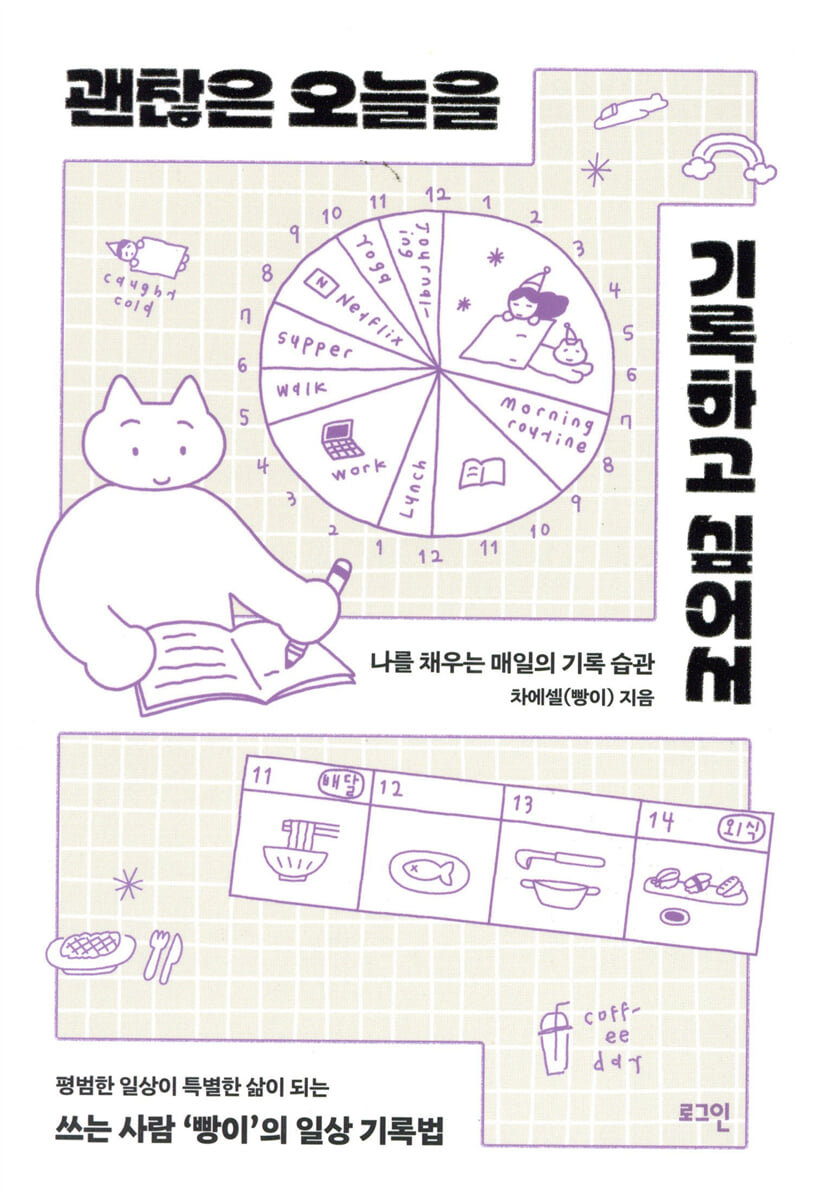
This book contains stories about the records of the writer, 'Bbangi'.
Bbang, who has been recording 'my day' in various forms such as text, drawings, and photos in over 100 notebooks, reveals his unique method of recording and his know-how on how to continue recording.
Additionally, it includes various templates created by the author, providing the experience of writing your own notes.
'If checklists are difficult, start with a mind map', 'On days when everything feels like a hassle, draw a pizza chart', 'How to use masking tape', 'How to choose a diary you like', 'Find the best correction tape', etc.
If you follow the author's unique recording tips, you will soon find yourself writing every day.
A small but somewhat special story about 'records'
“I write every day.”
This book contains stories about the records of the writer, 'Bbangi'.
Bbang, who has been recording 'my day' in various forms such as text, drawings, and photos in over 100 notebooks, reveals his unique method of recording and his know-how on how to continue recording.
Additionally, it includes various templates created by the author, providing the experience of writing your own notes.
'If checklists are difficult, start with a mind map', 'On days when everything feels like a hassle, draw a pizza chart', 'How to use masking tape', 'How to choose a diary you like', 'Find the best correction tape', etc.
If you follow the author's unique recording tips, you will soon find yourself writing every day.
- You can preview some of the book's contents.
Preview
index
prolog
Are you a beginner? A flowchart for beginner record keepers
Warming Up Write down anything, anywhere
CHAPTER 1 Today, I Write a Book
Checklist of things to do today
Time Table A timetable to organize your day
Morning Page Morning Page to start the morning
Routine Tracker For a better me than yesterday
Icon Diary If you want to write a special diary
Monthly Schedule Diary First Page, Monthly Recording Method
How to use Bbangi's special monthly
CHAPTER 2 If Recording Becomes a Hobby
Travel diary
Collection A collection that becomes a record
If you follow the map's footprints
Review My Own Travel Guidebook
Food diary
Monthly Meal Is it filling me up?
Daily Meal I ate well today too
Consumption Diary
Wish List vs. Needs
Things I want to buy
Shopping Use a pen for shopping
Taste Diary
Monthly Playlist My own playlist
OOTD Let's draw what I'm wearing today
Bbangi's Special Monthly Awards
CHAPTER 3 Where should I write?
Record in Analogue Notes
Recording in a digital smartphone memo app
Recording on Digital Blog
Recording on Digital Instagram
Recording in Digital GoodNotes
CHAPTER 4 If you want to develop a writing habit
Turn one page a day
Leave it as is
Write it in a fun way, no matter what
Find your own recording method
How to keep a diary
If the weather is delayed
I recommend this notebook and pen
I want to record it neatly
What would be a good challenge reward?
Bbangi's special Bbangi pick recording method
Epilogue
Are you a beginner? A flowchart for beginner record keepers
Warming Up Write down anything, anywhere
CHAPTER 1 Today, I Write a Book
Checklist of things to do today
Time Table A timetable to organize your day
Morning Page Morning Page to start the morning
Routine Tracker For a better me than yesterday
Icon Diary If you want to write a special diary
Monthly Schedule Diary First Page, Monthly Recording Method
How to use Bbangi's special monthly
CHAPTER 2 If Recording Becomes a Hobby
Travel diary
Collection A collection that becomes a record
If you follow the map's footprints
Review My Own Travel Guidebook
Food diary
Monthly Meal Is it filling me up?
Daily Meal I ate well today too
Consumption Diary
Wish List vs. Needs
Things I want to buy
Shopping Use a pen for shopping
Taste Diary
Monthly Playlist My own playlist
OOTD Let's draw what I'm wearing today
Bbangi's Special Monthly Awards
CHAPTER 3 Where should I write?
Record in Analogue Notes
Recording in a digital smartphone memo app
Recording on Digital Blog
Recording on Digital Instagram
Recording in Digital GoodNotes
CHAPTER 4 If you want to develop a writing habit
Turn one page a day
Leave it as is
Write it in a fun way, no matter what
Find your own recording method
How to keep a diary
If the weather is delayed
I recommend this notebook and pen
I want to record it neatly
What would be a good challenge reward?
Bbangi's special Bbangi pick recording method
Epilogue
Detailed image

Into the book
As I write, I feel that my life is not completely renewed, but it is gradually changing.
The person I am, the life I have chosen, the path I am walking are all slowly changing.
By facing myself squarely and understanding myself properly, I started to love myself a little more.
Looking back now, looking back a year from now, looking back in 10 years, it's all going to be completely different.
The records will prove it.
Because the records are traces left on the path I have walked.
--- p.7~8, from “Prologue”
Through the act of recording, I organize my day, set new goals, take on challenges, reflect, find my true self, and find ways to close the gap between who I want to be and who I actually am.
Here, 'finding' means finding myself hidden deep inside through records, like a hidden picture game.
By writing on paper, we discover things that we didn't know through just thinking about them, things that we didn't realize as we went through each day.
That's also why I started keeping records.
The records will help me get to know myself and take charge of my own life.
--- p.21~22, from “Chapter 1: Today, I Write a Book”
Everyone expresses themselves in their own way.
I draw, sculpt, write, and even dance.
As we age, the way we express ourselves goes through a variety of processes until we settle on the method that best suits us.
I loved anything done with my hands.
I drew pictures as a teenager, and wrote as an adult.
As I consistently recorded myself, I naturally realized that writing was the most fun and comfortable way for me to express myself.
I still draw and cut and paste paper, but I find myself at my most comfortable when I hold a pen in front of a blank sheet of paper.
But just as you may burn out one day after working hard or get tired of what you were doing, even if you love records, you need to take a break sometimes.
The way I found to do this is by keeping a hobby diary.
It's different from everyday records, but it's not completely different.
Perhaps it's a combination of the familiarity of the everyday and the specialness of the extraordinary? It's a time to give meaning to things we once considered trivial, and to focus our energies on and let go of things we once considered important.
--- p.103~104, from “Chapter 2: If Recording Becomes a Hobby”
Strangely, I can write well just by sitting in front of my laptop.
It feels like the typist is keeping up with the flow of my thoughts. I usually prefer to write by hand, but sometimes I worry that my writing speed is slower than my thoughts and I'll lose track of them.
When ideas come to mind or unfamiliar emotions swirl, writing speed is quite important for someone who writes down everything that fills them.
At times like that, I quickly open my smartphone notepad to keep my thoughts from running away.
Even when traveling, I carry around a notebook with me and write in my diary until the edges are worn out, but this is precisely why I need a laptop when I write about my travels on my blog.
--- p.179~180, from “Chapter 3: Where should I write it?”
In middle school, I made friends online by posting my daily life on a blog, and in high school, instead of keeping a diary, I took pictures and held a small photo exhibition on the first floor of the school.
My diary contains very personal things, but ironically, it also serves as a window for communication with others.
I hope this book can be of help to someone, just as I started writing with the help of someone else.
A diary isn't just a written record, so reflect on yourself in whatever way is most comfortable for you, whether it's through writing, drawing, or sometimes even photos.
That way, you can continue without getting tired.
The person I am, the life I have chosen, the path I am walking are all slowly changing.
By facing myself squarely and understanding myself properly, I started to love myself a little more.
Looking back now, looking back a year from now, looking back in 10 years, it's all going to be completely different.
The records will prove it.
Because the records are traces left on the path I have walked.
--- p.7~8, from “Prologue”
Through the act of recording, I organize my day, set new goals, take on challenges, reflect, find my true self, and find ways to close the gap between who I want to be and who I actually am.
Here, 'finding' means finding myself hidden deep inside through records, like a hidden picture game.
By writing on paper, we discover things that we didn't know through just thinking about them, things that we didn't realize as we went through each day.
That's also why I started keeping records.
The records will help me get to know myself and take charge of my own life.
--- p.21~22, from “Chapter 1: Today, I Write a Book”
Everyone expresses themselves in their own way.
I draw, sculpt, write, and even dance.
As we age, the way we express ourselves goes through a variety of processes until we settle on the method that best suits us.
I loved anything done with my hands.
I drew pictures as a teenager, and wrote as an adult.
As I consistently recorded myself, I naturally realized that writing was the most fun and comfortable way for me to express myself.
I still draw and cut and paste paper, but I find myself at my most comfortable when I hold a pen in front of a blank sheet of paper.
But just as you may burn out one day after working hard or get tired of what you were doing, even if you love records, you need to take a break sometimes.
The way I found to do this is by keeping a hobby diary.
It's different from everyday records, but it's not completely different.
Perhaps it's a combination of the familiarity of the everyday and the specialness of the extraordinary? It's a time to give meaning to things we once considered trivial, and to focus our energies on and let go of things we once considered important.
--- p.103~104, from “Chapter 2: If Recording Becomes a Hobby”
Strangely, I can write well just by sitting in front of my laptop.
It feels like the typist is keeping up with the flow of my thoughts. I usually prefer to write by hand, but sometimes I worry that my writing speed is slower than my thoughts and I'll lose track of them.
When ideas come to mind or unfamiliar emotions swirl, writing speed is quite important for someone who writes down everything that fills them.
At times like that, I quickly open my smartphone notepad to keep my thoughts from running away.
Even when traveling, I carry around a notebook with me and write in my diary until the edges are worn out, but this is precisely why I need a laptop when I write about my travels on my blog.
--- p.179~180, from “Chapter 3: Where should I write it?”
In middle school, I made friends online by posting my daily life on a blog, and in high school, instead of keeping a diary, I took pictures and held a small photo exhibition on the first floor of the school.
My diary contains very personal things, but ironically, it also serves as a window for communication with others.
I hope this book can be of help to someone, just as I started writing with the help of someone else.
A diary isn't just a written record, so reflect on yourself in whatever way is most comfortable for you, whether it's through writing, drawing, or sometimes even photos.
That way, you can continue without getting tired.
--- p.218, from “Chapter 4: If you want to develop a writing habit”
Publisher's Review
Write down anything
If you keep writing, you will see me
What did you eat yesterday? What did you do the day before yesterday? How many people can answer these questions instantly? I'm sure I ate something, I did something, but I can't remember.
I feel like I've been living hard, but I haven't accomplished anything.
It happened, but I was the one who made it seem like it never happened.
But, if you keep a record, the story is different.
I can check what I ate and was happy about, what I bought and regretted, what books I read and what I thought, and what happened at work today through records.
And by periodically reviewing these records, I can understand my current state and how I should live in the future.
The author says this about the record:
"Keeping a record is the best way to truly love myself as I am." Even if it doesn't seem like we're working hard, we're actually working hard every day.
Only I can give meaning to my today, which has passed by countless times.
So, let's start with a pen and a notebook.
In the records that fill me
There is no right answer
It is said that one in two Koreans exhibits perfectionist tendencies.
Maybe that's why, when we buy a new diary or notebook, we try to write neatly and tidy.
If I don't like my handwriting even a little bit, or if I make a mistake and leave traces of corrections, I tear up the page or don't feel like writing anymore.
So this time too, my resolution to keep a diary ended after only a few months.
This is precisely why recording is difficult.
If you want to keep a record, you have to feel the joy of writing first.
Just as a child must find learning Korean fun to continue, the same goes for writing.
The biggest obstacle to having fun is the stereotypes.
There is no right answer when it comes to recording myself, recording for myself.
It doesn't have to be neat or full of content.
There is no need to write a long story.
The author of this book shows how to make writing records, which everyone has probably done at least once, from monthly schedules to diaries, more fun and diverse.
Even with the same monthly template, if you record your meals, it becomes a food diary, and if you fill it with the music you listen to, it becomes a music diary.
The subject of the record does not necessarily have to be 'what was done'.
As you write, you can find your own topics and methods.
From checklists to correction tape
All About Records
If you buy a diary, there is a monthly schedule, checklist, timetable, and the author's own icon diary, wardrobe diary, music diary, etc. on the first page.
This book covers a variety of record-keeping methods, from daily journals to travel, food, consumption, and taste diaries on special topics.
Even within the same monthly calendar, we also present new record-keeping methods such as Monthly Challenge, Monthly Checkup, and Monthly Awards, which have different themes and methods.
In addition, we have collected all the questions you may have about record-keeping, such as where to record and how to develop the habit of recording.
Beginner record keepers who don't know what to write or how to write will learn how to write, record keepers who are losing interest in writing will find the fun of writing, and record keepers who have been writing for years will find new inspiration for writing.
A look at the author's notes reveals a mess of crooked handwriting, misaligned lines, and tiny icons.
It's quite different from the recording methods we've known so far, and while I wonder, "Is this a record?", I somehow feel like I can try to do something like this.
So, if you ambitiously bought a diary this time, but it feels like it will only last three months, try reading this book, "I Want to Record a Good Day."
If you keep writing, you will see me
What did you eat yesterday? What did you do the day before yesterday? How many people can answer these questions instantly? I'm sure I ate something, I did something, but I can't remember.
I feel like I've been living hard, but I haven't accomplished anything.
It happened, but I was the one who made it seem like it never happened.
But, if you keep a record, the story is different.
I can check what I ate and was happy about, what I bought and regretted, what books I read and what I thought, and what happened at work today through records.
And by periodically reviewing these records, I can understand my current state and how I should live in the future.
The author says this about the record:
"Keeping a record is the best way to truly love myself as I am." Even if it doesn't seem like we're working hard, we're actually working hard every day.
Only I can give meaning to my today, which has passed by countless times.
So, let's start with a pen and a notebook.
In the records that fill me
There is no right answer
It is said that one in two Koreans exhibits perfectionist tendencies.
Maybe that's why, when we buy a new diary or notebook, we try to write neatly and tidy.
If I don't like my handwriting even a little bit, or if I make a mistake and leave traces of corrections, I tear up the page or don't feel like writing anymore.
So this time too, my resolution to keep a diary ended after only a few months.
This is precisely why recording is difficult.
If you want to keep a record, you have to feel the joy of writing first.
Just as a child must find learning Korean fun to continue, the same goes for writing.
The biggest obstacle to having fun is the stereotypes.
There is no right answer when it comes to recording myself, recording for myself.
It doesn't have to be neat or full of content.
There is no need to write a long story.
The author of this book shows how to make writing records, which everyone has probably done at least once, from monthly schedules to diaries, more fun and diverse.
Even with the same monthly template, if you record your meals, it becomes a food diary, and if you fill it with the music you listen to, it becomes a music diary.
The subject of the record does not necessarily have to be 'what was done'.
As you write, you can find your own topics and methods.
From checklists to correction tape
All About Records
If you buy a diary, there is a monthly schedule, checklist, timetable, and the author's own icon diary, wardrobe diary, music diary, etc. on the first page.
This book covers a variety of record-keeping methods, from daily journals to travel, food, consumption, and taste diaries on special topics.
Even within the same monthly calendar, we also present new record-keeping methods such as Monthly Challenge, Monthly Checkup, and Monthly Awards, which have different themes and methods.
In addition, we have collected all the questions you may have about record-keeping, such as where to record and how to develop the habit of recording.
Beginner record keepers who don't know what to write or how to write will learn how to write, record keepers who are losing interest in writing will find the fun of writing, and record keepers who have been writing for years will find new inspiration for writing.
A look at the author's notes reveals a mess of crooked handwriting, misaligned lines, and tiny icons.
It's quite different from the recording methods we've known so far, and while I wonder, "Is this a record?", I somehow feel like I can try to do something like this.
So, if you ambitiously bought a diary this time, but it feels like it will only last three months, try reading this book, "I Want to Record a Good Day."
GOODS SPECIFICS
- Date of issue: March 20, 2024
- Page count, weight, size: 272 pages | 296g | 128*188*16mm
- ISBN13: 9791169518536
- ISBN10: 1169518532
You may also like
카테고리
korean


korean

![GQ KOREA Mark (Monthly): December [2025]](http://librairie.coreenne.fr/cdn/shop/files/8ef265dbbfbf186523ed75ba7319009d.jpg?v=1765340328&width=3840)


