

self-confidence
 |
Description
Book Introduction
Books that inspired Barack Obama, Nietzsche, Gandhi, and Michael Jackson
Emerson's representative lecture, "The Reformer," is included for the first time in Korea.
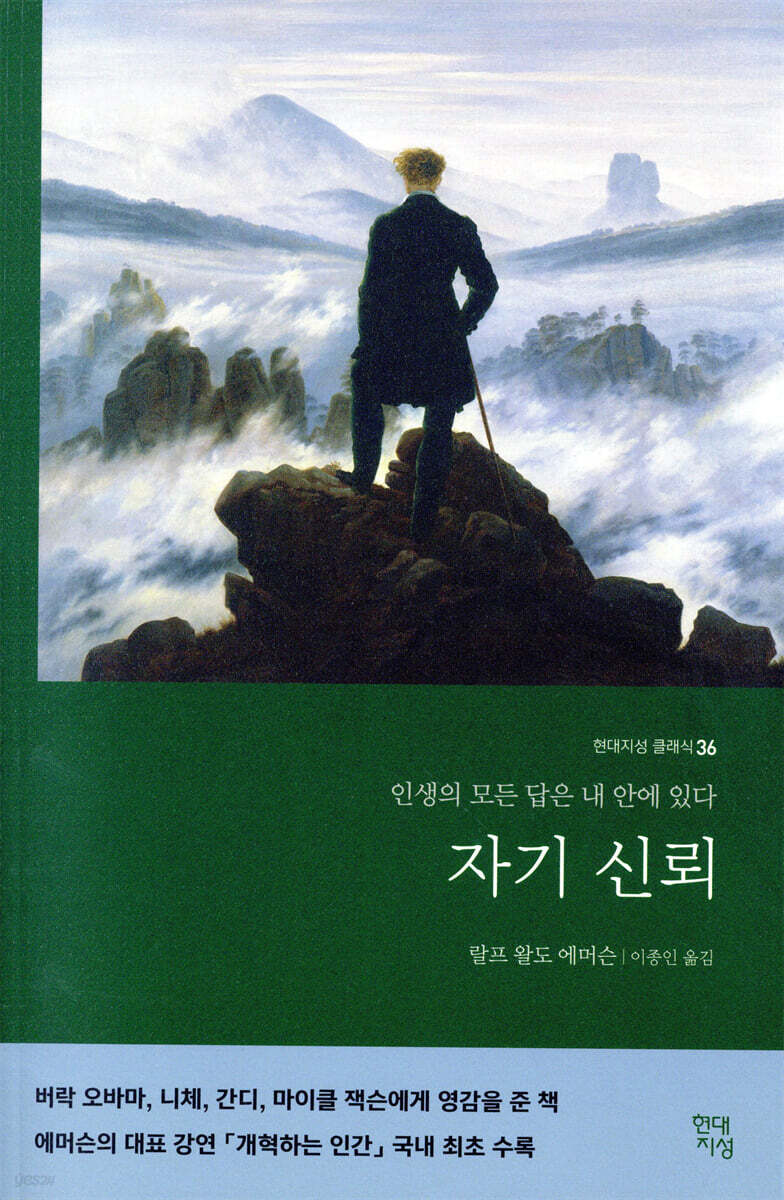
Emerson's three essays, which are the ideological roots of Nietzsche's superman and the cornerstone of America's pioneering and independent spirit, meet readers in the 36th volume of the Modern Intellectual Classics, "Self-Reliance," after meticulous commentary and highly readable complete translation.
Barack Obama has revealed that he enjoys reading "Self-Reliance" along with Herman Melville's "Moby Dick."
Friedrich Nietzsche always carried Emerson's book with him on his travels, and while reading "Self-Reliance," he conceived of "Thus Spoke Zarathustra."
Michael Jackson expressed Emerson's thoughts in his songs, and Henry David Thoreau, the author of Walden, was Emerson's disciple and ideological comrade.
Emerson's thought is famous for its transcendentalism, and the essay that best embodies this thought is "Self-Reliance."
"Destiny" is an essay that argues that life, nature, and divinity must be accepted without prejudice based on that self-confidence, and "Reforming Man" is an essay that recommends that humans can reform themselves toward infinite improvement based on the concept of "effluent."
Emerson entered Harvard University at the age of 14, studied theology, and became a pastor at the age of 23. However, he refused to conform to the existing religious system and live according to the form of worship, and began to live as a “man who believes in his own thoughts” as mentioned in “Self-Reliance.”
He emphasizes that if one lives with complete self-confidence without relying on vested interests, one's soul will soon become light and one can live self-sufficiently.
Emerson's essays, including "Reforming Man," which is being introduced for the first time in Korea, can only be accurately understood by comprehensively examining the economic, social, and religious background of the United States at the time, the Transcendentalist movement, his view of nature, and Eastern thought. This book, with its extensive and meticulous commentary and faithful translation of the original text, offers readers the pleasure of "reading Emerson."
Emerson's representative lecture, "The Reformer," is included for the first time in Korea.
Emerson's three essays, which are the ideological roots of Nietzsche's superman and the cornerstone of America's pioneering and independent spirit, meet readers in the 36th volume of the Modern Intellectual Classics, "Self-Reliance," after meticulous commentary and highly readable complete translation.
Barack Obama has revealed that he enjoys reading "Self-Reliance" along with Herman Melville's "Moby Dick."
Friedrich Nietzsche always carried Emerson's book with him on his travels, and while reading "Self-Reliance," he conceived of "Thus Spoke Zarathustra."
Michael Jackson expressed Emerson's thoughts in his songs, and Henry David Thoreau, the author of Walden, was Emerson's disciple and ideological comrade.
Emerson's thought is famous for its transcendentalism, and the essay that best embodies this thought is "Self-Reliance."
"Destiny" is an essay that argues that life, nature, and divinity must be accepted without prejudice based on that self-confidence, and "Reforming Man" is an essay that recommends that humans can reform themselves toward infinite improvement based on the concept of "effluent."
Emerson entered Harvard University at the age of 14, studied theology, and became a pastor at the age of 23. However, he refused to conform to the existing religious system and live according to the form of worship, and began to live as a “man who believes in his own thoughts” as mentioned in “Self-Reliance.”
He emphasizes that if one lives with complete self-confidence without relying on vested interests, one's soul will soon become light and one can live self-sufficiently.
Emerson's essays, including "Reforming Man," which is being introduced for the first time in Korea, can only be accurately understood by comprehensively examining the economic, social, and religious background of the United States at the time, the Transcendentalist movement, his view of nature, and Eastern thought. This book, with its extensive and meticulous commentary and faithful translation of the original text, offers readers the pleasure of "reading Emerson."
- You can preview some of the book's contents.
Preview
index
Self-Reliance
Envy comes from ignorance | Believe in yourself | Society abhors 'self-confidence' |
My life is my own | Conformity is the bluff of the blind | Don't insist on foolish consistency |
True actions speak for themselves | True men stand tall in the center of things | Drunk
A Fable of a Man | The Sense of Being is the Source of All Things | The Soul is Light | Poetry for a Rose
There is no liver | To stand tall with your own soul | Now do what your heart tells you | Of duty
Practice: Direct or Reflective | Four Practices of Self-Trust | Where Great People Don't Come From
The World | Self-Confidence is the Power to Defy Fate
Fate
Fate and Freedom: How We Should Live | Nature is Not Sentimental | Means and Ends,
Body and Mind | Will and Environment | Look at Nature and Read the Book of Destiny | Destiny: Filled with Nature
One Element | How to Use Destiny Properly | Truth is what we enter into |
Fusing insight and emotion to create will | Fate is an uninterpreted cause | Fate and freedom
A connected life | The link between people and events | Fate is the result of character | Fate is the fulfillment of wishes
Beware of Your Own Desires | Double Consciousness: The Key to Unraveling Life's Mysteries
Man the Reformer
The long-standing evils of the old system | The unjust ways of a selfish society | The importance of physical labor | Self
The side effects of wealth not gathered by hand | Labor is God's education | About the lack of labor
The Reward of the Universe | It's Important to Help Yourself | A Reformer is One Who Restores Truth
| Principles and Aspirations | Love is a Reforming Power | Sacrifice for a Better Life
Release | Lee Jong-in
Emerson Chronology
Envy comes from ignorance | Believe in yourself | Society abhors 'self-confidence' |
My life is my own | Conformity is the bluff of the blind | Don't insist on foolish consistency |
True actions speak for themselves | True men stand tall in the center of things | Drunk
A Fable of a Man | The Sense of Being is the Source of All Things | The Soul is Light | Poetry for a Rose
There is no liver | To stand tall with your own soul | Now do what your heart tells you | Of duty
Practice: Direct or Reflective | Four Practices of Self-Trust | Where Great People Don't Come From
The World | Self-Confidence is the Power to Defy Fate
Fate
Fate and Freedom: How We Should Live | Nature is Not Sentimental | Means and Ends,
Body and Mind | Will and Environment | Look at Nature and Read the Book of Destiny | Destiny: Filled with Nature
One Element | How to Use Destiny Properly | Truth is what we enter into |
Fusing insight and emotion to create will | Fate is an uninterpreted cause | Fate and freedom
A connected life | The link between people and events | Fate is the result of character | Fate is the fulfillment of wishes
Beware of Your Own Desires | Double Consciousness: The Key to Unraveling Life's Mysteries
Man the Reformer
The long-standing evils of the old system | The unjust ways of a selfish society | The importance of physical labor | Self
The side effects of wealth not gathered by hand | Labor is God's education | About the lack of labor
The Reward of the Universe | It's Important to Help Yourself | A Reformer is One Who Restores Truth
| Principles and Aspirations | Love is a Reforming Power | Sacrifice for a Better Life
Release | Lee Jong-in
Emerson Chronology
Detailed image

Into the book
To believe in your own thoughts, to believe that what you secretly think is true for everyone else, is the act of genius.
When you express the convictions hidden in your head, they acquire universal meaning.
Because the deepest things will become apparent when the time is right.
Our first thought returns to us when the trumpet of the Last Judgment sounds.
This inner voice is very familiar to all of us.
What is the greatest achievement of Moses, Plato, and Milton? It is that they ignored books and tradition, and spoke for themselves, not imitating others.
(…)
Envy comes from ignorance, and imitation is suicide.
There comes a moment in the learning process when you feel this certainty.
Also, we are faced with a time when we must accept our own existence as it is, whether good or bad, as our destiny.
This world is full of good things.
But if a man does not till the land given to him by his own labor, not a single grain of corn will be given to him.
The power within humans is inherently new.
Because of the novelty, humans cannot anticipate what they are capable of, and only by trying something for themselves do they discover their abilities.
--- p.15, from “Self-Confidence”
Roses have no time.
There are only roses.
It is perfect in every moment of its existence.
Before the leaf buds open, all life is in motion.
Just because the flowers are in full bloom doesn't mean the activity increases, and just because the roots are leafless doesn't mean the activity decreases.
The nature of the rose is fulfilled, and at the same time it fulfills nature at every moment.
In contrast, humans postpone or remember.
He doesn't live in the present.
He either turns his eyes back and laments the past, or stands on tiptoe, trying to look into the future, oblivious to the abundance that surrounds him.
Unless one lives in the present, with nature (nature), transcending time like a rose, one can never be happy or strong.
--- p.38~39, from “Self-Confidence”
A person who knows that strength comes from within himself, and who knows that those who seek good outside themselves or elsewhere are weak.
So, a person who returns to his own thoughts without delay, corrects himself immediately, and stands tall.
Such a person can use his limbs as he pleases and perform miracles.
A person who stands on two feet is stronger than a person who stands on a handstand.
--- p.61~62, from “Self-Confidence”
I have said before that I am a race of instinctive and heroic people who accept their fate with grace.
They conspire with fate.
He seems satisfied with the progress of the case and gives up.
But when a weak and lazy person adheres to this doctrine, it creates a very different impression.
The weak and wicked blame everything on fate.
But there are times when it is more beneficial for humans to look at a different path than fate.
That's more practical.
Those who use fate do not flatter objective facts, but use and command them.
The trust says:
“Don’t stare at nature.
“Her name is fatal.” If we think too deeply about these limitations, we become small.
Those who talk too much about their own destiny and the stars of their birth are on a low and dangerous plane, and they bring upon themselves the evil they fear.
Fate should not be viewed this way.
To properly utilize our destiny, we must elevate our actions toward the nobility of nature.
Nature is wild and invincible unless its own forces act upon it.
Humans should be like this too.
He must remove empty pride from his heart and demonstrate his sovereignty by displaying manners and behavior on a level with nature.
We must make our sense of purpose as strong as the pull of gravity.
No amount of power, persuasion, or bribery can make someone give up their purpose.
Humans should be likened to beings like rivers, oak trees, and mountains.
It must have that kind of flow, that kind of growth, that kind of towering presence.
(…)
Even though the power of fate is overwhelming and humans are also a part of fate, humans can face fate as fate.
Even if the universe has caused such a barbaric event, our atoms are resisting it with no less barbarism.
If there were no air resistance in our bodies, we would be crushed to death by atmospheric pressure.
A tube made of thin glass can withstand the shock of the sea if it contains seawater.
If shock is omnipotent, then resistance is also omnipotent.
But blocking fate with fate is merely a defensive stance to avoid attack.
Besides that, there are also noble creative forces.
The revelation of thought liberates man from bondage and leads him toward freedom.
We can rightly say this about ourselves:
We are not just born once, but are reborn many times after that.
As we go through a series of very important experiences, the new loses the old.
Thus, the myth of the seven heavens or nine heavens was born.
The best day of our lives, the greatest day in the celebration of life, is the day when our inner eyes are opened and we see the unity of things and the omnipresence of law.
Thus, we know that all things in the world exist and must exist, and that they are the best.
--- p.87~90, from “Fate”
What could be more elegant than not wanting much and fulfilling your own needs? And if, instead of grasping fiercely, you leave something for others, isn't that truly elegant? It's more elegant to take care of your own needs than to be treated with grandeur by others.
From today's perspective, and to some, this may not seem elegant.
But this is an elegance that lasts.
(…)
Aren't we born to be reformers, to remake what humanity has already created? Shouldn't we be people who cast out lies, restore truth and goodness, and imitate the great nature that dwells within us? Nature doesn't sleep in the past, but rather, hourly, renews itself, offering us a new day each morning and, with its fresh pulse, giving us new life.
(…)
What power serves as a spring and a guiding principle in reform efforts? It comes from the conviction that there is infinite value within human beings.
Power comes from how valuable something is, and all concrete reform proposals ultimately aim to remove obstacles that stand in the way of that value.
Isn't it our highest duty to respect human beings?
I will never allow anyone to act rich in front of me just because they are rich in land.
I will give him this feeling.
I can live without your wealth.
I am not bought by anything, whether it be comfort or pride.
Even though I have no money and I take bread from you, you are a poor person when you stand next to me.
And at the same time, if any woman or child discovers piety or knows a more just way of life than I, I will acknowledge it with respect and submission.
Even if that means changing my entire lifestyle.
When you express the convictions hidden in your head, they acquire universal meaning.
Because the deepest things will become apparent when the time is right.
Our first thought returns to us when the trumpet of the Last Judgment sounds.
This inner voice is very familiar to all of us.
What is the greatest achievement of Moses, Plato, and Milton? It is that they ignored books and tradition, and spoke for themselves, not imitating others.
(…)
Envy comes from ignorance, and imitation is suicide.
There comes a moment in the learning process when you feel this certainty.
Also, we are faced with a time when we must accept our own existence as it is, whether good or bad, as our destiny.
This world is full of good things.
But if a man does not till the land given to him by his own labor, not a single grain of corn will be given to him.
The power within humans is inherently new.
Because of the novelty, humans cannot anticipate what they are capable of, and only by trying something for themselves do they discover their abilities.
--- p.15, from “Self-Confidence”
Roses have no time.
There are only roses.
It is perfect in every moment of its existence.
Before the leaf buds open, all life is in motion.
Just because the flowers are in full bloom doesn't mean the activity increases, and just because the roots are leafless doesn't mean the activity decreases.
The nature of the rose is fulfilled, and at the same time it fulfills nature at every moment.
In contrast, humans postpone or remember.
He doesn't live in the present.
He either turns his eyes back and laments the past, or stands on tiptoe, trying to look into the future, oblivious to the abundance that surrounds him.
Unless one lives in the present, with nature (nature), transcending time like a rose, one can never be happy or strong.
--- p.38~39, from “Self-Confidence”
A person who knows that strength comes from within himself, and who knows that those who seek good outside themselves or elsewhere are weak.
So, a person who returns to his own thoughts without delay, corrects himself immediately, and stands tall.
Such a person can use his limbs as he pleases and perform miracles.
A person who stands on two feet is stronger than a person who stands on a handstand.
--- p.61~62, from “Self-Confidence”
I have said before that I am a race of instinctive and heroic people who accept their fate with grace.
They conspire with fate.
He seems satisfied with the progress of the case and gives up.
But when a weak and lazy person adheres to this doctrine, it creates a very different impression.
The weak and wicked blame everything on fate.
But there are times when it is more beneficial for humans to look at a different path than fate.
That's more practical.
Those who use fate do not flatter objective facts, but use and command them.
The trust says:
“Don’t stare at nature.
“Her name is fatal.” If we think too deeply about these limitations, we become small.
Those who talk too much about their own destiny and the stars of their birth are on a low and dangerous plane, and they bring upon themselves the evil they fear.
Fate should not be viewed this way.
To properly utilize our destiny, we must elevate our actions toward the nobility of nature.
Nature is wild and invincible unless its own forces act upon it.
Humans should be like this too.
He must remove empty pride from his heart and demonstrate his sovereignty by displaying manners and behavior on a level with nature.
We must make our sense of purpose as strong as the pull of gravity.
No amount of power, persuasion, or bribery can make someone give up their purpose.
Humans should be likened to beings like rivers, oak trees, and mountains.
It must have that kind of flow, that kind of growth, that kind of towering presence.
(…)
Even though the power of fate is overwhelming and humans are also a part of fate, humans can face fate as fate.
Even if the universe has caused such a barbaric event, our atoms are resisting it with no less barbarism.
If there were no air resistance in our bodies, we would be crushed to death by atmospheric pressure.
A tube made of thin glass can withstand the shock of the sea if it contains seawater.
If shock is omnipotent, then resistance is also omnipotent.
But blocking fate with fate is merely a defensive stance to avoid attack.
Besides that, there are also noble creative forces.
The revelation of thought liberates man from bondage and leads him toward freedom.
We can rightly say this about ourselves:
We are not just born once, but are reborn many times after that.
As we go through a series of very important experiences, the new loses the old.
Thus, the myth of the seven heavens or nine heavens was born.
The best day of our lives, the greatest day in the celebration of life, is the day when our inner eyes are opened and we see the unity of things and the omnipresence of law.
Thus, we know that all things in the world exist and must exist, and that they are the best.
--- p.87~90, from “Fate”
What could be more elegant than not wanting much and fulfilling your own needs? And if, instead of grasping fiercely, you leave something for others, isn't that truly elegant? It's more elegant to take care of your own needs than to be treated with grandeur by others.
From today's perspective, and to some, this may not seem elegant.
But this is an elegance that lasts.
(…)
Aren't we born to be reformers, to remake what humanity has already created? Shouldn't we be people who cast out lies, restore truth and goodness, and imitate the great nature that dwells within us? Nature doesn't sleep in the past, but rather, hourly, renews itself, offering us a new day each morning and, with its fresh pulse, giving us new life.
(…)
What power serves as a spring and a guiding principle in reform efforts? It comes from the conviction that there is infinite value within human beings.
Power comes from how valuable something is, and all concrete reform proposals ultimately aim to remove obstacles that stand in the way of that value.
Isn't it our highest duty to respect human beings?
I will never allow anyone to act rich in front of me just because they are rich in land.
I will give him this feeling.
I can live without your wealth.
I am not bought by anything, whether it be comfort or pride.
Even though I have no money and I take bread from you, you are a poor person when you stand next to me.
And at the same time, if any woman or child discovers piety or knows a more just way of life than I, I will acknowledge it with respect and submission.
Even if that means changing my entire lifestyle.
--- p.136~139, from “Reforming Humans”
Publisher's Review
From Nietzsche's superhuman spirit to BTS's “Love yourself,”
A book that has inspired countless thinkers, writers, and artists!
There is a saying that you should not believe anyone who says that a book changed their life.
That's how difficult it is for people to change, and what's more, people are not so weak that they can change by reading a few books.
But what if it was a book that Friedrich Nietzsche (1844-1900), the philosopher who completely transformed the paradigm of modern philosophy, devoured on every trip? What if it was a book that provided crucial inspiration for his masterpiece, "Thus Spoke Zarathustra"? And what if the very idea of the superman we know today was inspired by this book?
What about Barack Obama? As you know, Obama is a voracious reader and has a remarkable literary background, even acknowledged by Nobel Prize-winning author Toni Morrison.
Even Obama, after his father died in a car accident, received a lot of courage and inspiration from this book and began to live as the master of his own life.
Michael Jackson was also famous for loving books to the point where he would visit bookstores himself during his prime.
He was so influenced by this person that he incorporated his philosophical thoughts into his song lyrics.
The core of Steve Jobs' commencement speech at Stanford University is also in the same vein.
“Don’t waste your life living someone else’s life.
Don't make the mistake of living according to what other people think.
Don't let your inner voice get buried in the opinions of others.
And most importantly, have the courage to follow your intuition and passion.”
Recently, BTS member Kim Nam-joon introduced this person's book, proving that he is widely loved by artists around the world.
Yes, that's right.
This is the story of Ralph Waldo Emerson, the author of this book.
Among the numerous essays and books he left behind, the essay "Self-Trust" is recognized as the ideological foundation or starting point of modern self-help books, and is considered a famous lecture that well exemplifies the pioneering and independent spirit of the United States.
“Know thyself” (Socrates)
“Believe in yourself” (Emerson)
Emerson's thought is widely known as transcendentalism, and the essay that best embodies this thought is "Self-Reliance."
And based on that self-confidence, the essay "Fate" which says that life, nature, and divinity must be accepted as they are without prejudice is a representative sentence that was included first in Emerson's book "Life's Conduct."
And the last essay, "Reforming Humans," is a piece that argues that humans must reform themselves in the direction of infinite improvement, according to the concept of emanation or evolution, and was translated and introduced in Korea for the first time.
1) Emerson entered Harvard University at the age of 14, studied theology, and became a pastor at the age of 23. However, he refused to conform to the existing religious system and live according to the form of worship, and began to live as a “person who believes in his own thoughts” as mentioned in “Self-Reliance.”
In 1838 (at the age of 35), while attending Harvard Divinity School, he fiercely criticized the formal and uninspired preaching, which drew a huge backlash from the pastors and he was immediately treated as a heretic.
From this point on, Emerson began to travel across the United States, giving over 1,500 lectures over 40 years, teaching countless Americans how to live a life that stands tall on their own merits.
He emphasizes that if one lives with complete self-confidence without relying on vested interests, one's soul will soon become light and one can live self-sufficiently.
2) In “Fate,” Emerson argues that power and wealth are powerful forces, but they cannot overcome fate.
So, are humans helpless before fate? The author argues that if we anticipate the laws of nature and live according to them, we need not fear fate.
That is, it proposes a life that accepts both sorrow and joy equally, and simultaneously embraces conflicting concepts such as fate and will, reason and irrationality.
3) “The Reformer” is a book that encourages people not to blindly believe in ideals but to allow ideas to have a legitimate influence within society.
According to him, a reformer is “one who restores the truth” and “one who is not bought by anything.”
And it seeks to restore the spirit trapped in materialism based on love and self-trust.
Realizing the law of destiny through the harmonious relationship between the soul and nature, and further restoring the spirit trapped in materialism, is the consistent theme of the three essays introduced in the book: "Self-Trust," "Destiny," and "Reforming Humanity."
If Socrates said, “Know Thyself,” Emerson opened a new chapter in the modern spirit by emphasizing, “Trust Thyself.”
Three immortal essays that became the cornerstone of America's pioneering and independent spirit.
Meet the meticulous explanation and highly readable complete translation.
Emerson gave many public lectures, but he was usually very shy and had no animalistic nature.
He was called the “Sage of Concord” and was a prominent figure in American thought in the late 19th century, known as a “public intellectual.”
The poet Frost ranked Emerson alongside George Washington, Thomas Jefferson, and Abraham Lincoln as the greatest Americans.
Lawrence Buell, a prominent American critic, once said, “Emerson’s spirit is the American spirit and America itself.”
In the 19th century when Emerson lived, America was politically independent, but culturally and ideologically it was still dependent on Britain and Europe, and it needed its own national spirit to make a new start.
In his 40-year lecture series, which began in his mid-30s, he consistently argued that for the United States to become a great power, it must become ideologically independent from Europe and follow its own American path.
Emerson's writings were widely read in the United States and England at the time, and were well known throughout continental Europe.
For example, the French poet Baudelaire said that after reading Emerson's book, "The Way of Life," he felt a Seneca-like atmosphere in Emerson and that it led him to deep meditation.
But Emerson's writings are not easily understood when read for the first time.
This is because it uses so many abbreviated expressions that each sentence feels like poetry, and it is unfriendly in that it omits parts that readers at the time thought they already knew.
His essay was written after Emerson had personally revised the manuscript after giving a public lecture, so it might sound like rambling to readers unfamiliar with this atmosphere.
In particular, most translations to date have omitted or overly paraphrased poetic expressions or difficult ideas, resulting in many sentences that are difficult to understand even after reading.
Yes, that's right.
Emerson is not kind.
Therefore, in order for modern readers, especially Korean readers from different cultures and time periods, to read the compressed poetry and thoughts, a guide is even more necessary.
In 『Self-Trust』, introduced as the 36th volume of the Modern Intellectual Classics, translator Jong-in Lee, known for his extensive and in-depth commentary on classics in the humanities, economics, and history, comprehensively examines the economic, social, and religious background of the United States at the time, the Transcendentalist movement, views of nature, and Eastern thought through a voluminous 55-page annotation, guiding readers to directly experience the essence and power of Emerson's thought.
Now, let's read the immortal essays that have guided countless readers to self-directed lives, with helpful translator's notes and an easily readable full translation, and discover what "the world's most valuable resource" is.
A book that has inspired countless thinkers, writers, and artists!
There is a saying that you should not believe anyone who says that a book changed their life.
That's how difficult it is for people to change, and what's more, people are not so weak that they can change by reading a few books.
But what if it was a book that Friedrich Nietzsche (1844-1900), the philosopher who completely transformed the paradigm of modern philosophy, devoured on every trip? What if it was a book that provided crucial inspiration for his masterpiece, "Thus Spoke Zarathustra"? And what if the very idea of the superman we know today was inspired by this book?
What about Barack Obama? As you know, Obama is a voracious reader and has a remarkable literary background, even acknowledged by Nobel Prize-winning author Toni Morrison.
Even Obama, after his father died in a car accident, received a lot of courage and inspiration from this book and began to live as the master of his own life.
Michael Jackson was also famous for loving books to the point where he would visit bookstores himself during his prime.
He was so influenced by this person that he incorporated his philosophical thoughts into his song lyrics.
The core of Steve Jobs' commencement speech at Stanford University is also in the same vein.
“Don’t waste your life living someone else’s life.
Don't make the mistake of living according to what other people think.
Don't let your inner voice get buried in the opinions of others.
And most importantly, have the courage to follow your intuition and passion.”
Recently, BTS member Kim Nam-joon introduced this person's book, proving that he is widely loved by artists around the world.
Yes, that's right.
This is the story of Ralph Waldo Emerson, the author of this book.
Among the numerous essays and books he left behind, the essay "Self-Trust" is recognized as the ideological foundation or starting point of modern self-help books, and is considered a famous lecture that well exemplifies the pioneering and independent spirit of the United States.
“Know thyself” (Socrates)
“Believe in yourself” (Emerson)
Emerson's thought is widely known as transcendentalism, and the essay that best embodies this thought is "Self-Reliance."
And based on that self-confidence, the essay "Fate" which says that life, nature, and divinity must be accepted as they are without prejudice is a representative sentence that was included first in Emerson's book "Life's Conduct."
And the last essay, "Reforming Humans," is a piece that argues that humans must reform themselves in the direction of infinite improvement, according to the concept of emanation or evolution, and was translated and introduced in Korea for the first time.
1) Emerson entered Harvard University at the age of 14, studied theology, and became a pastor at the age of 23. However, he refused to conform to the existing religious system and live according to the form of worship, and began to live as a “person who believes in his own thoughts” as mentioned in “Self-Reliance.”
In 1838 (at the age of 35), while attending Harvard Divinity School, he fiercely criticized the formal and uninspired preaching, which drew a huge backlash from the pastors and he was immediately treated as a heretic.
From this point on, Emerson began to travel across the United States, giving over 1,500 lectures over 40 years, teaching countless Americans how to live a life that stands tall on their own merits.
He emphasizes that if one lives with complete self-confidence without relying on vested interests, one's soul will soon become light and one can live self-sufficiently.
2) In “Fate,” Emerson argues that power and wealth are powerful forces, but they cannot overcome fate.
So, are humans helpless before fate? The author argues that if we anticipate the laws of nature and live according to them, we need not fear fate.
That is, it proposes a life that accepts both sorrow and joy equally, and simultaneously embraces conflicting concepts such as fate and will, reason and irrationality.
3) “The Reformer” is a book that encourages people not to blindly believe in ideals but to allow ideas to have a legitimate influence within society.
According to him, a reformer is “one who restores the truth” and “one who is not bought by anything.”
And it seeks to restore the spirit trapped in materialism based on love and self-trust.
Realizing the law of destiny through the harmonious relationship between the soul and nature, and further restoring the spirit trapped in materialism, is the consistent theme of the three essays introduced in the book: "Self-Trust," "Destiny," and "Reforming Humanity."
If Socrates said, “Know Thyself,” Emerson opened a new chapter in the modern spirit by emphasizing, “Trust Thyself.”
Three immortal essays that became the cornerstone of America's pioneering and independent spirit.
Meet the meticulous explanation and highly readable complete translation.
Emerson gave many public lectures, but he was usually very shy and had no animalistic nature.
He was called the “Sage of Concord” and was a prominent figure in American thought in the late 19th century, known as a “public intellectual.”
The poet Frost ranked Emerson alongside George Washington, Thomas Jefferson, and Abraham Lincoln as the greatest Americans.
Lawrence Buell, a prominent American critic, once said, “Emerson’s spirit is the American spirit and America itself.”
In the 19th century when Emerson lived, America was politically independent, but culturally and ideologically it was still dependent on Britain and Europe, and it needed its own national spirit to make a new start.
In his 40-year lecture series, which began in his mid-30s, he consistently argued that for the United States to become a great power, it must become ideologically independent from Europe and follow its own American path.
Emerson's writings were widely read in the United States and England at the time, and were well known throughout continental Europe.
For example, the French poet Baudelaire said that after reading Emerson's book, "The Way of Life," he felt a Seneca-like atmosphere in Emerson and that it led him to deep meditation.
But Emerson's writings are not easily understood when read for the first time.
This is because it uses so many abbreviated expressions that each sentence feels like poetry, and it is unfriendly in that it omits parts that readers at the time thought they already knew.
His essay was written after Emerson had personally revised the manuscript after giving a public lecture, so it might sound like rambling to readers unfamiliar with this atmosphere.
In particular, most translations to date have omitted or overly paraphrased poetic expressions or difficult ideas, resulting in many sentences that are difficult to understand even after reading.
Yes, that's right.
Emerson is not kind.
Therefore, in order for modern readers, especially Korean readers from different cultures and time periods, to read the compressed poetry and thoughts, a guide is even more necessary.
In 『Self-Trust』, introduced as the 36th volume of the Modern Intellectual Classics, translator Jong-in Lee, known for his extensive and in-depth commentary on classics in the humanities, economics, and history, comprehensively examines the economic, social, and religious background of the United States at the time, the Transcendentalist movement, views of nature, and Eastern thought through a voluminous 55-page annotation, guiding readers to directly experience the essence and power of Emerson's thought.
Now, let's read the immortal essays that have guided countless readers to self-directed lives, with helpful translator's notes and an easily readable full translation, and discover what "the world's most valuable resource" is.
GOODS SPECIFICS
- Date of issue: April 1, 2021
- Page count, weight, size: 216 pages | 328g | 150*225*13mm
- ISBN13: 9791166813580
- ISBN10: 1166813584
You may also like
카테고리
korean


korean

![GQ KOREA Mark (Monthly): December [2025]](http://librairie.coreenne.fr/cdn/shop/files/8ef265dbbfbf186523ed75ba7319009d.jpg?v=1765340328&width=3840)


