

The enemy called ego
 |
Description
Book Introduction
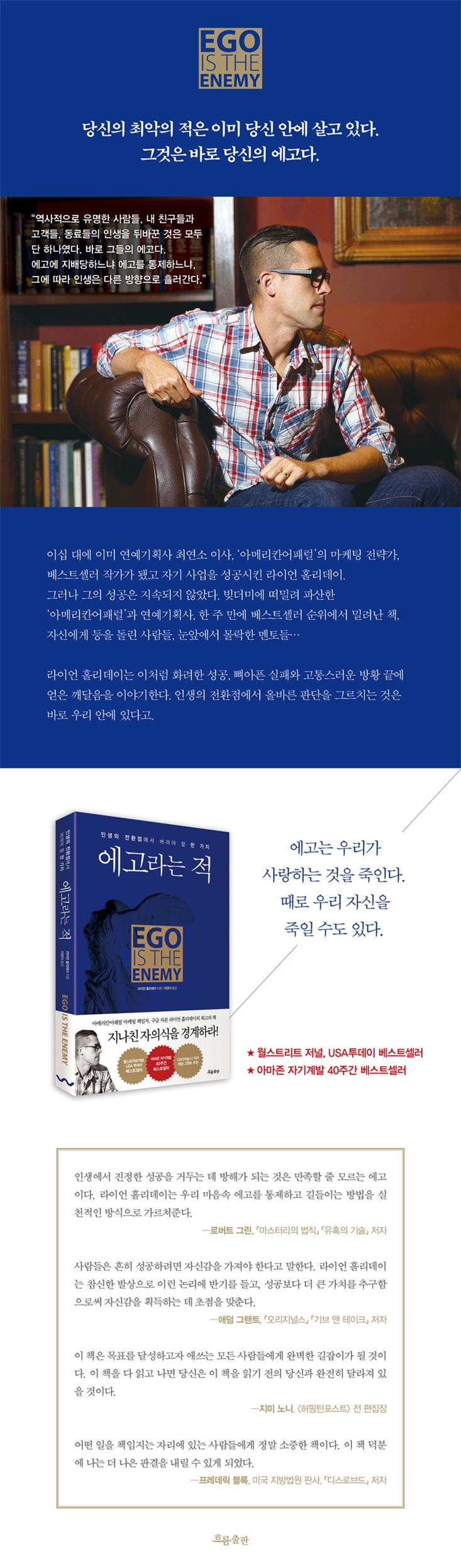
“The ego, like the law of gravity, engulfs us and sinks us.” - Cyril Connolly, literary critic What is the secret of those who have triumphed at turning points in their lives? How did figures like German Chancellor Angela Merkel, American politician Benjamin Franklin, Washington Post publisher Katherine Williams, and Jackie Robinson, the first black Major League Baseball player, overcome life's challenges and achieve success? What choices did they make? Ryan Holiday, renowned media strategist and bestselling author, explores the answers he discovered after experiencing both spectacular success and heartbreaking failure. This book started from the author's regret that he wished he had a book like this at every turning point in his life. Ryan Holiday, who dropped out of college at the age of nineteen and quickly rose to fame as a marketing strategist for American Apparel, a best-selling author, and a businessman, experienced failure and wandered in everything he did. And in the process of overcoming this, countless people throughout history have discovered that their lives change depending on how they control their 'ego'. The author, who has studied history and management for a long time, drew inspiration from Stoic philosophy and ancient Greek and Roman thinkers to find answers to this question and included them in this book. In fact, this book became a bestseller after its publication in the United States, and has continued to garner sympathy and praise from many people to this day. |
- You can preview some of the book's contents.
Preview
index
The Enemy Called Ego
Recommendation
prolog
introduction
Ⅰ.
Aspiration, a flame that begins to burn
The Insidiousness of Words | To Be or to Act | The Reason for Learning
The Passion Disease | Canvas Strategies for Me | The Need for Self-Control
Escape from My Head | The Perils of Premature Complacency | The Difference Between Pro and Amateur
Passion, for what comes next - Ego is the enemy
Ⅱ.
Success, an illusion that doesn't last
Learning: A Beginning but No End | The Perils of Self-Writing Myths
What's Important to You? | The Shadow of Success, Power, Control, and Obsession
The Qualities of a Leader | The Disease Called "I" | Just a Small Being in the Infinite | Stay Awake
Success, and then some - Ego is the enemy
Ⅲ.
Failure, another beginning
Living Time, Dead Time | Do Your Best and Let It Flow
Moments That Must Be Broken | The Value Inherent in Failure
What's Your Scoreboard Recorded? | The Power That Starts with Recognition and Acceptance
Failure, and What Comes Next - The Ego is the Enemy
Epilogue
What else should I read?
Acknowledgements
Recommendation
prolog
introduction
Ⅰ.
Aspiration, a flame that begins to burn
The Insidiousness of Words | To Be or to Act | The Reason for Learning
The Passion Disease | Canvas Strategies for Me | The Need for Self-Control
Escape from My Head | The Perils of Premature Complacency | The Difference Between Pro and Amateur
Passion, for what comes next - Ego is the enemy
Ⅱ.
Success, an illusion that doesn't last
Learning: A Beginning but No End | The Perils of Self-Writing Myths
What's Important to You? | The Shadow of Success, Power, Control, and Obsession
The Qualities of a Leader | The Disease Called "I" | Just a Small Being in the Infinite | Stay Awake
Success, and then some - Ego is the enemy
Ⅲ.
Failure, another beginning
Living Time, Dead Time | Do Your Best and Let It Flow
Moments That Must Be Broken | The Value Inherent in Failure
What's Your Scoreboard Recorded? | The Power That Starts with Recognition and Acceptance
Failure, and What Comes Next - The Ego is the Enemy
Epilogue
What else should I read?
Acknowledgements
Detailed image
Into the book
Some of the so-called geniuses are so obsessed with their talents that they take it for granted.
Some artists mistakenly believe that they must sacrifice everything for their art, even if their immediate life is painful.
This is a kind of empty myth and a whisper of the ego.
People who are swayed by these empty words live in a delusion, disconnected from reality.
We all dream of greatness and strive to achieve it, but the actual path to it is different for each of us.
However, the ego that we all encounter along the way is an 'enemy' that blocks our steps.
--- p.46
People who talk in detail about what kind of person they want to be and what kind of success they want to achieve also talk precisely about when they will achieve those goals.
You can also really complain about the burden you will bear if you achieve that success in advance.
You can talk about things you want to do after you become successful, or you may even be doing them already.
But they never talk about the process they have to go through to become successful.
Because the process is either non-existent or almost impossible to find in their heads.
So sometimes they are busy moving around and working but they don't accomplish anything.
This is the paradox of passion.
--- p.80
The more creative a person is, the more easily he or she loses the clue to finding the path to success.
Therefore, we must keep a tight grip on the reins that control our perception.
Otherwise, you can easily get swept away by the waves of excitement.
How can we accurately predict the future or properly interpret present events when we're caught up in excitement and delusion? How can we remain alert and aware of the present moment? How can we be creative without straying from the realm of reality? --- p.109
When we aspire to something, we are often inspired by others' success stories and feel the urge to follow their path, but we must resist this.
When you achieve your goals, you must resist the temptation to pretend everything went according to plan.
There is no grand epic there.
You just happened to be there when that kind of success happened.
--- p.154
The ego needs honor to be recognized by others.
But true confidence knows how to wait regardless of whether someone acknowledges you or not, and knows how to focus on the task at hand.
(...) Even if someone works to make a name for himself or herself, to reach the top, or to provide good things for himself or his family, we cannot say that he or she is bad.
All we need is balance.
Football manager Tony Adams put it beautifully:
“Play for the team name written on the front of the shirt.
Then people will remember your name on the back of that shirt.” --- p.189
In fact, many meaningful changes in life come from moments when we are completely shattered—moments when what we thought we knew is starkly revealed to be an illusion.
(...) Novelist Hemingway wrote about the realization he gained after falling to rock bottom in his youth in his novel A Farewell to Arms.
He wrote in the novel, “The world breaks everyone, but many people become stronger in the places where they were broken.
But those who are not broken like that end up dying,” he wrote.
The world can show you the truth, but it's up to you to accept it or not.
Some artists mistakenly believe that they must sacrifice everything for their art, even if their immediate life is painful.
This is a kind of empty myth and a whisper of the ego.
People who are swayed by these empty words live in a delusion, disconnected from reality.
We all dream of greatness and strive to achieve it, but the actual path to it is different for each of us.
However, the ego that we all encounter along the way is an 'enemy' that blocks our steps.
--- p.46
People who talk in detail about what kind of person they want to be and what kind of success they want to achieve also talk precisely about when they will achieve those goals.
You can also really complain about the burden you will bear if you achieve that success in advance.
You can talk about things you want to do after you become successful, or you may even be doing them already.
But they never talk about the process they have to go through to become successful.
Because the process is either non-existent or almost impossible to find in their heads.
So sometimes they are busy moving around and working but they don't accomplish anything.
This is the paradox of passion.
--- p.80
The more creative a person is, the more easily he or she loses the clue to finding the path to success.
Therefore, we must keep a tight grip on the reins that control our perception.
Otherwise, you can easily get swept away by the waves of excitement.
How can we accurately predict the future or properly interpret present events when we're caught up in excitement and delusion? How can we remain alert and aware of the present moment? How can we be creative without straying from the realm of reality? --- p.109
When we aspire to something, we are often inspired by others' success stories and feel the urge to follow their path, but we must resist this.
When you achieve your goals, you must resist the temptation to pretend everything went according to plan.
There is no grand epic there.
You just happened to be there when that kind of success happened.
--- p.154
The ego needs honor to be recognized by others.
But true confidence knows how to wait regardless of whether someone acknowledges you or not, and knows how to focus on the task at hand.
(...) Even if someone works to make a name for himself or herself, to reach the top, or to provide good things for himself or his family, we cannot say that he or she is bad.
All we need is balance.
Football manager Tony Adams put it beautifully:
“Play for the team name written on the front of the shirt.
Then people will remember your name on the back of that shirt.” --- p.189
In fact, many meaningful changes in life come from moments when we are completely shattered—moments when what we thought we knew is starkly revealed to be an illusion.
(...) Novelist Hemingway wrote about the realization he gained after falling to rock bottom in his youth in his novel A Farewell to Arms.
He wrote in the novel, “The world breaks everyone, but many people become stronger in the places where they were broken.
But those who are not broken like that end up dying,” he wrote.
The world can show you the truth, but it's up to you to accept it or not.
--- p.246-248
Publisher's Review
The Enemy Called Ego
At the turning point of life, which cycles through three stages: aspiration, success, and failure.
What is hindering your sound judgment?
Everyone goes through three stages in life.
We all have goals, big and small, in life, such as getting into college, succeeding and getting promoted on a project, starting and growing our own company, or achieving social justice. We all aspire to achieve these goals.
And although we achieve success, big or small, in some way, it is not easily maintained, and everyone experiences failure.
This process repeats itself constantly throughout life.
We are all probably at one of those three stages right now.
Or perhaps someone is at a turning point, moving from one to the other.
Even people like German Chancellor Angela Merkel, American politician Benjamin Franklin, Washington Post publisher Katherine Williams, and Jackie Robinson, the first black major league player, did not start out as successful.
They, like us, have had times when they aspired to something, and have achieved success and failure.
But at every turning point, the choices they made ultimately led them to victory.
What is the secret?
The same goes for Ryan Holiday, the author of this book.
He dropped out of college at nineteen to become a marketing strategist for American Apparel, became a best-selling author, and started his own successful business.
But the success that was expected to last forever did not last.
[American Apparel] was in debt and went bankrupt, his book lost its bestseller status after just a week, and his business collapsed.
One person he respected turned his back on him, and he had to watch other mentors fall before his eyes.
Having experienced both brilliant success and heartbreaking failure, Ryan Holiday has spent a long time exploring what determines success or failure in life, examining not only his own successes but also those of those around him and celebrities.
And I discovered that there was one common keyword.
It was none other than 'ego'.
I came to realize that life flows differently depending on how we control the 'ego' that everyone has.
The 'ego' that Ryan Holiday speaks of has a broader meaning than just a psychological one.
It is a false belief that oneself is the most important and greatest being, and is close to excessive self-consciousness that is unconditionally absorbed in 'oneself'.
Having studied history and business administration for a long time, he delved deeply into this question, inspired by Stoic philosophy and ancient Greek and Roman thinkers, and found the answer by drawing on humanity's long experience in philosophy and history.
At every moment your ego is your worst enemy.
Beware of the sweet inner lies that sway you.
Benjamin Franklin, an American politician and thinker, helped out at his brother's printing shop as a child and wrote anonymously for the newspaper published there.
His writings were quite popular, but when his brother discovered who the author was, he became extremely angry, and Franklin eventually left Boston for Philadelphia.
And when he returned from there, having achieved some success, he was full of pride and self-satisfaction.
He was eighteen years old at that time.
Franklin, who was like that, met Cotton Mather, a respected pastor in Boston, and gained great insight.
While chatting excitedly in front of it, he fails to see the low ceiling and ends up hitting his head.
At this time, Mather's advice to Franklin was perfect.
“Remember to not walk around with your head held so stiffly.
They say that if you want to survive in this world, you have to keep your head down, my young friend.
That way, you avoid getting hit on the head like you did before.” Ryan Holiday says that pride makes small accomplishments feel like big successes.
And he points out that it is the ego that fuels this pride.
According to him, the ego clouds our objective judgment by whispering to us what we want to hear.
It causes us to forget the important things in life by fostering inner pride and unnecessary competition.
They make us feel good and complacent by whispering that we already know everything, that we don't need to learn or train anymore, and that we are already qualified, thus eliminating any room for improvement.
It separates us from reality and makes us fall into our own fantasies.
In conclusion, this ego is at the root of many of the problems that everyone encounters in life.
The author says in the book that how we manage and control this is an important key to determining our lives.
In fact, Franklin's experience with Mather left him struggling with his own pride throughout his life.
Because I realized that pride can make what I want to do more difficult.
Not only Franklin, but many real-life characters in the book also faced their own egos at turning points in their lives.
And either they were swayed by their ego and failed, or they overcame their ego and led their lives to victory.
The problems they face in life are not much different from ours.
The life journey they have shown us serves as a good example and even shows us the direction we should take going forward.
It also forces us to reexamine what we think we already know, and provides a stepping stone to a better life by looking at ourselves and the problems facing us objectively and realistically.
Will you rule your ego or be ruled by it?
The author asks this question through the book.
And I encourage you to manage your ego well, which sways us with nice words.
Our lives will certainly change depending on how we answer his questions and suggestions.
At the turning point of life, which cycles through three stages: aspiration, success, and failure.
What is hindering your sound judgment?
Everyone goes through three stages in life.
We all have goals, big and small, in life, such as getting into college, succeeding and getting promoted on a project, starting and growing our own company, or achieving social justice. We all aspire to achieve these goals.
And although we achieve success, big or small, in some way, it is not easily maintained, and everyone experiences failure.
This process repeats itself constantly throughout life.
We are all probably at one of those three stages right now.
Or perhaps someone is at a turning point, moving from one to the other.
Even people like German Chancellor Angela Merkel, American politician Benjamin Franklin, Washington Post publisher Katherine Williams, and Jackie Robinson, the first black major league player, did not start out as successful.
They, like us, have had times when they aspired to something, and have achieved success and failure.
But at every turning point, the choices they made ultimately led them to victory.
What is the secret?
The same goes for Ryan Holiday, the author of this book.
He dropped out of college at nineteen to become a marketing strategist for American Apparel, became a best-selling author, and started his own successful business.
But the success that was expected to last forever did not last.
[American Apparel] was in debt and went bankrupt, his book lost its bestseller status after just a week, and his business collapsed.
One person he respected turned his back on him, and he had to watch other mentors fall before his eyes.
Having experienced both brilliant success and heartbreaking failure, Ryan Holiday has spent a long time exploring what determines success or failure in life, examining not only his own successes but also those of those around him and celebrities.
And I discovered that there was one common keyword.
It was none other than 'ego'.
I came to realize that life flows differently depending on how we control the 'ego' that everyone has.
The 'ego' that Ryan Holiday speaks of has a broader meaning than just a psychological one.
It is a false belief that oneself is the most important and greatest being, and is close to excessive self-consciousness that is unconditionally absorbed in 'oneself'.
Having studied history and business administration for a long time, he delved deeply into this question, inspired by Stoic philosophy and ancient Greek and Roman thinkers, and found the answer by drawing on humanity's long experience in philosophy and history.
At every moment your ego is your worst enemy.
Beware of the sweet inner lies that sway you.
Benjamin Franklin, an American politician and thinker, helped out at his brother's printing shop as a child and wrote anonymously for the newspaper published there.
His writings were quite popular, but when his brother discovered who the author was, he became extremely angry, and Franklin eventually left Boston for Philadelphia.
And when he returned from there, having achieved some success, he was full of pride and self-satisfaction.
He was eighteen years old at that time.
Franklin, who was like that, met Cotton Mather, a respected pastor in Boston, and gained great insight.
While chatting excitedly in front of it, he fails to see the low ceiling and ends up hitting his head.
At this time, Mather's advice to Franklin was perfect.
“Remember to not walk around with your head held so stiffly.
They say that if you want to survive in this world, you have to keep your head down, my young friend.
That way, you avoid getting hit on the head like you did before.” Ryan Holiday says that pride makes small accomplishments feel like big successes.
And he points out that it is the ego that fuels this pride.
According to him, the ego clouds our objective judgment by whispering to us what we want to hear.
It causes us to forget the important things in life by fostering inner pride and unnecessary competition.
They make us feel good and complacent by whispering that we already know everything, that we don't need to learn or train anymore, and that we are already qualified, thus eliminating any room for improvement.
It separates us from reality and makes us fall into our own fantasies.
In conclusion, this ego is at the root of many of the problems that everyone encounters in life.
The author says in the book that how we manage and control this is an important key to determining our lives.
In fact, Franklin's experience with Mather left him struggling with his own pride throughout his life.
Because I realized that pride can make what I want to do more difficult.
Not only Franklin, but many real-life characters in the book also faced their own egos at turning points in their lives.
And either they were swayed by their ego and failed, or they overcame their ego and led their lives to victory.
The problems they face in life are not much different from ours.
The life journey they have shown us serves as a good example and even shows us the direction we should take going forward.
It also forces us to reexamine what we think we already know, and provides a stepping stone to a better life by looking at ourselves and the problems facing us objectively and realistically.
Will you rule your ego or be ruled by it?
The author asks this question through the book.
And I encourage you to manage your ego well, which sways us with nice words.
Our lives will certainly change depending on how we answer his questions and suggestions.
GOODS SPECIFICS
- Date of issue: April 3, 2017
- Page count, weight, size: 296 pages | 481g | 145*218*17mm
- ISBN13: 9788965962090
- ISBN10: 8965962099
You may also like
카테고리
korean


korean

![GQ KOREA Mark (Monthly): December [2025]](http://librairie.coreenne.fr/cdn/shop/files/8ef265dbbfbf186523ed75ba7319009d.jpg?v=1765340328&width=3840)


