

Editor's Note
 |
Description
Book Introduction
- A word from MD
-
How to write 'well' in this day and ageIn an age where vast amounts of information are created and evaporated, what should we leave behind? This book shares the stories of ten editors who find value in the raw.
From the daily philosophies of those who reproduce meaningful content from their own perspectives, such as Newnick, Paulin, and Carrit, to their work know-how, we share various insights into the records of this era.
March 25, 2025. Essay PD Lee Ju-eun
Every day, countless contents are released and evaporate.
In an age of confusion about what to see and what to leave behind,
What, how, and why should we record?
Even in this age of content overload, with Carrot, Paulin, and Newnick,
A look back at the stories of 10 current editors who create compelling content.
A diary that's full until January, 'good' ideas that disappeared because I didn't write them down, a storage filled with bookmarks and screenshots that I might never see again, and SNS that I seem to be the only one not being able to use consistently...
In a society where we often blame ourselves for not being able to record things 'well' in the face of the flood of things.
We asked 10 editors, for whom recording is their job and therefore their way of life, what, how, and why they record in this age overflowing with content.
Editors gather countless raw materials every day, select valuable ones, connect them with their own perspectives, and create readable content.
《Editor's Recording Method》 contains the recording know-how and philosophy of those who create the content we enjoy reading every day.
By exploring the diverse worlds of records from 10 editors and discovering your own unique recording method, you will rediscover the joy of recording.
In an age of confusion about what to see and what to leave behind,
What, how, and why should we record?
Even in this age of content overload, with Carrot, Paulin, and Newnick,
A look back at the stories of 10 current editors who create compelling content.
A diary that's full until January, 'good' ideas that disappeared because I didn't write them down, a storage filled with bookmarks and screenshots that I might never see again, and SNS that I seem to be the only one not being able to use consistently...
In a society where we often blame ourselves for not being able to record things 'well' in the face of the flood of things.
We asked 10 editors, for whom recording is their job and therefore their way of life, what, how, and why they record in this age overflowing with content.
Editors gather countless raw materials every day, select valuable ones, connect them with their own perspectives, and create readable content.
《Editor's Recording Method》 contains the recording know-how and philosophy of those who create the content we enjoy reading every day.
By exploring the diverse worlds of records from 10 editors and discovering your own unique recording method, you will rediscover the joy of recording.
- You can preview some of the book's contents.
Preview
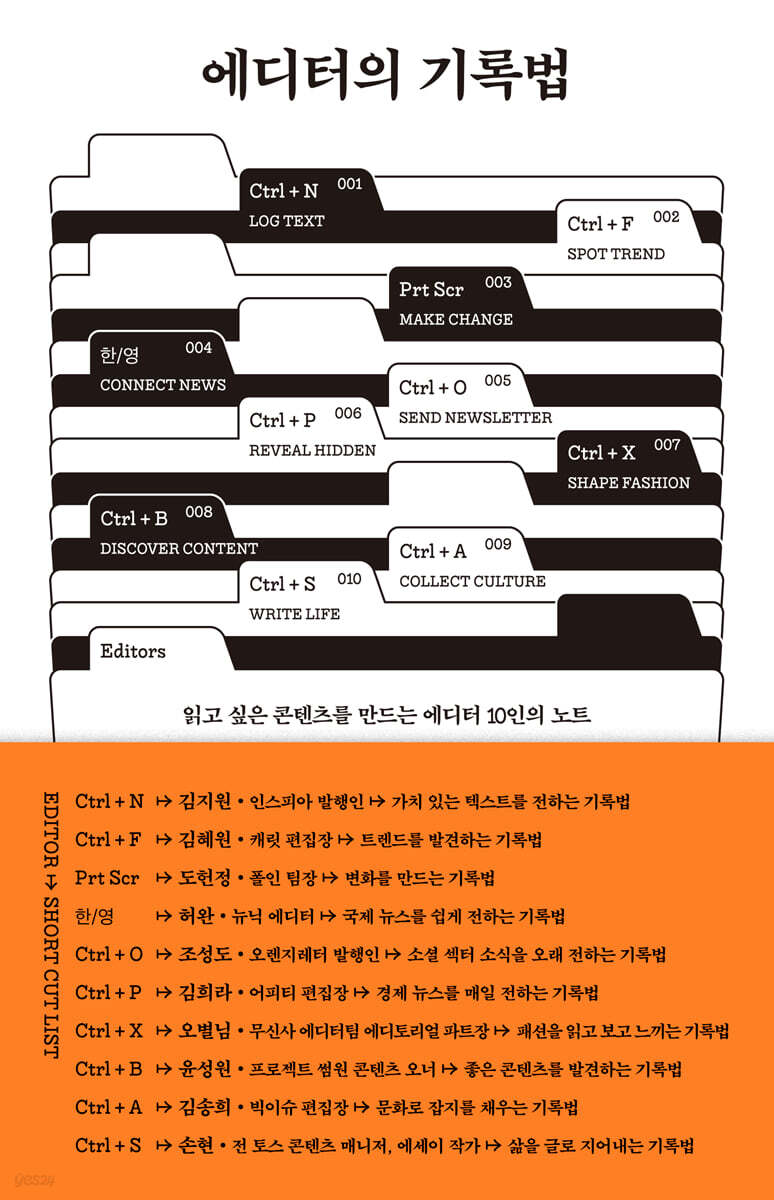
index
001.
Ctrl + N Kim Ji-won, publisher of Inspia
A recording method that conveys valuable texts
002.
Ctrl + F Kim Hye-won, editor-in-chief of Caret
How to Discover Trends
003.
Prt Scr Do Heon-jeong, Team Leader Polin
How to Record Change
004.
Han/Young Heo Wan Newnick Editor
A simple way to report international news
005.
Ctrl + O Composition Orange Letter Publisher
A long-term record of social sector news
006.
Ctrl + P Kim Hee-ra, Editor-in-Chief of APTI
A record of daily economic news
007.
Ctrl + X Oh Byeol-nim, Editorial Team Leader, Musinsa
A way to record fashion by reading, seeing, and feeling it
008.
Ctrl + B Yoon Seong-won Project Some One Content Owner
How to discover good content
009.
Ctrl + A Kim Song-hee, Editor-in-Chief of Big Issue
How to Fill a Magazine with Culture
010.
Ctrl + S Son Hyeon, former Toss content manager and essay writer
A method of writing about life
Ctrl + N Kim Ji-won, publisher of Inspia
A recording method that conveys valuable texts
002.
Ctrl + F Kim Hye-won, editor-in-chief of Caret
How to Discover Trends
003.
Prt Scr Do Heon-jeong, Team Leader Polin
How to Record Change
004.
Han/Young Heo Wan Newnick Editor
A simple way to report international news
005.
Ctrl + O Composition Orange Letter Publisher
A long-term record of social sector news
006.
Ctrl + P Kim Hee-ra, Editor-in-Chief of APTI
A record of daily economic news
007.
Ctrl + X Oh Byeol-nim, Editorial Team Leader, Musinsa
A way to record fashion by reading, seeing, and feeling it
008.
Ctrl + B Yoon Seong-won Project Some One Content Owner
How to discover good content
009.
Ctrl + A Kim Song-hee, Editor-in-Chief of Big Issue
How to Fill a Magazine with Culture
010.
Ctrl + S Son Hyeon, former Toss content manager and essay writer
A method of writing about life
Detailed image

Into the book
I never write to remember.
I keep writing, I record to wander alone.
And the external results are just some of these records and notes taken out, pasted together, cut, and reprocessed here and there.
--- p.15
In today's world, where we can devour anything for free if we set our minds to it, the black lump of our immature desires will remain a lump of guilt for us forever.
The act of seeing something out of a sense of duty among the numerous bookmarks and saved articles and then trying to leave a record of it is also an extension of the compulsion to save.
And this is the world surrounding the lectures on record keeping methods and thought organization methods by record experts being sold at high prices.
But it is worth asking the question at least once.
Why do you want to leave them as a 'record'?
--- p.23
I really like my job as an editor.
Observing everyday life, finding interesting things in it, and creating stories.
Rather than falling into nihilism or cynicism, it is about creating meaning at all costs.
I'm glad that that's what I do.
--- p.33
If I think it will be a topic of conversation, I quickly collect it and put it in my record pocket.
There is no such thing as 'irrelevant work' for an editor.
I have to constantly create new stories, so I keep up with everything that's happening in the world.
Is it the other way around? Anyway.
--- p.33
Where you write is as important as what you write.
It is also a skill to keep ingredients fresh and quickly take them out when needed.
First of all, let me confess that I am a person who keeps a lot of records, but I am not the type to do it systematically.
(…) I have often had the experience that when I set up rules and systems that are too perfect, I end up missing out on what is truly important.
--- p.37
As time went by, I realized that even things we thought we had forgotten were actually stored in our brains.
Even after time has passed, if you do ideation, your brain will surprisingly recall information you thought was forgotten.
And the information that had sunk into the realm of the unconscious also became the basis for forming my perspective in the long run.
As a lazy recorder, I am sure:
What you see does not run away.
--- p.58
As an editor, how can I break away from the norm and create fresh, widely circulated projects? First, I need to have a large amount of information available to me.
So, more important than records is the habit of looking at something consistently.
When input becomes habitual, two radars come into play when planning.
You can immediately draw ideas from information accumulated over the past, or discover items or people you need right now from content you encounter in your daily life.
--- p.61
An editor is someone who observes and discovers.
A person who discovers context and meaning from the countless pieces of information that pour in every moment of every day, and connects individual pieces of information in an integrated manner.
(…) You must become a more perceptive observer than anyone else and a more conscientious recorder.
--- p.84
My writing habits are quite simple.
I don't store information systematically, nor do I use a professional note-taking app.
There are four basic tools: the iCloud tab in the mobile Safari browser introduced earlier, the Notes app on Mac and iPhone, the Things app, and paper notes.
--- p.108
It didn't matter if there was no great enlightenment.
It was enough to just see the confused emotions written down as 'I was confused'.
What was clear was that records somehow made the invisible visible.
--- p.121
There are many records that are never shared with anyone, but in the process of leaving countless records, I find my own answers and strive to create writing that is easier for readers by creating a more gentle path within the writing.
Then, the voice that I thought was scattered like an echo will one day return as a clear whisper.
--- p.128
The number of notes in my iPhone notepad is already approaching 1400.
It's no exaggeration to say that every day is a series of deadlines on a fashion e-commerce platform. To create timely content, a recording tool that allows you to record and retrieve it immediately when needed is essential.
Fashion is influenced not only by trends but also by seasons, environment, and various issues.
--- pp.143-144
Even if it looks like fragments right now, it is enough to just build up a record.
Sometimes, the work of a fashion editor requires me to produce results at every second. Often, when I sit down at my desk, my mind goes blank. For me, these fragments gather together to form a solid, trustworthy corner.
--- p.148
Going forward, it will become increasingly important to organize and record the good content you discover in your own words, and ultimately use it as a source of nourishment for creating your own content, rather than simply consuming it and moving on.
Going one step further, understanding this process as a system and continuously improving your content system may be the fundamental attitude for living in the age of content.
--- p.164
What I'm not good at is organizing rather than recording.
Instead of being good at organizing, I just look for a lot, absorb it, and accumulate it.
I have a habit of collecting things so that they become mine rather than just passing by.
(…) It is difficult to find what you need among the piled up items.
But it doesn't mean that you can't create anything just because you haven't 'stacked it well'.
As the lyrics of Jazzi's song go, "There is nothing that is nothing."
--- p.186
When we hit the deadline, we really go all out.
It's about using all your abilities to the fullest while searching for records of 'things you like' that you've stored in your head in the past.
--- p.198
By shifting the focus of your daily life from near to far, you can discover new writing material.
In reality, there are many cases where I don't see things that are right in front of my eyes because I'm not interested in them.
I often come across certain words that I have always passed by without noticing, someone's passing remark, an experience playing with a child, etc. When I think about what lies behind those phenomena, how people think, and what my thoughts are, I feel like writing down those thoughts and positions.
--- p.216
J.
Another thing that stands out about K. Rowling's and Christopher Nolan's notes is that they were both 'handwritten'.
When your thoughts are not organized, I recommend writing by hand rather than on a keyboard.
The Korean keyboard has a left-to-right input direction, so it's better for writing in a disorganized manner while freely following the flow of thought.
Even if you start writing on a PC or laptop, you may end up printing it out on paper, reading it out loud, and then writing it by hand or reorganizing it in a notebook.
I keep writing, I record to wander alone.
And the external results are just some of these records and notes taken out, pasted together, cut, and reprocessed here and there.
--- p.15
In today's world, where we can devour anything for free if we set our minds to it, the black lump of our immature desires will remain a lump of guilt for us forever.
The act of seeing something out of a sense of duty among the numerous bookmarks and saved articles and then trying to leave a record of it is also an extension of the compulsion to save.
And this is the world surrounding the lectures on record keeping methods and thought organization methods by record experts being sold at high prices.
But it is worth asking the question at least once.
Why do you want to leave them as a 'record'?
--- p.23
I really like my job as an editor.
Observing everyday life, finding interesting things in it, and creating stories.
Rather than falling into nihilism or cynicism, it is about creating meaning at all costs.
I'm glad that that's what I do.
--- p.33
If I think it will be a topic of conversation, I quickly collect it and put it in my record pocket.
There is no such thing as 'irrelevant work' for an editor.
I have to constantly create new stories, so I keep up with everything that's happening in the world.
Is it the other way around? Anyway.
--- p.33
Where you write is as important as what you write.
It is also a skill to keep ingredients fresh and quickly take them out when needed.
First of all, let me confess that I am a person who keeps a lot of records, but I am not the type to do it systematically.
(…) I have often had the experience that when I set up rules and systems that are too perfect, I end up missing out on what is truly important.
--- p.37
As time went by, I realized that even things we thought we had forgotten were actually stored in our brains.
Even after time has passed, if you do ideation, your brain will surprisingly recall information you thought was forgotten.
And the information that had sunk into the realm of the unconscious also became the basis for forming my perspective in the long run.
As a lazy recorder, I am sure:
What you see does not run away.
--- p.58
As an editor, how can I break away from the norm and create fresh, widely circulated projects? First, I need to have a large amount of information available to me.
So, more important than records is the habit of looking at something consistently.
When input becomes habitual, two radars come into play when planning.
You can immediately draw ideas from information accumulated over the past, or discover items or people you need right now from content you encounter in your daily life.
--- p.61
An editor is someone who observes and discovers.
A person who discovers context and meaning from the countless pieces of information that pour in every moment of every day, and connects individual pieces of information in an integrated manner.
(…) You must become a more perceptive observer than anyone else and a more conscientious recorder.
--- p.84
My writing habits are quite simple.
I don't store information systematically, nor do I use a professional note-taking app.
There are four basic tools: the iCloud tab in the mobile Safari browser introduced earlier, the Notes app on Mac and iPhone, the Things app, and paper notes.
--- p.108
It didn't matter if there was no great enlightenment.
It was enough to just see the confused emotions written down as 'I was confused'.
What was clear was that records somehow made the invisible visible.
--- p.121
There are many records that are never shared with anyone, but in the process of leaving countless records, I find my own answers and strive to create writing that is easier for readers by creating a more gentle path within the writing.
Then, the voice that I thought was scattered like an echo will one day return as a clear whisper.
--- p.128
The number of notes in my iPhone notepad is already approaching 1400.
It's no exaggeration to say that every day is a series of deadlines on a fashion e-commerce platform. To create timely content, a recording tool that allows you to record and retrieve it immediately when needed is essential.
Fashion is influenced not only by trends but also by seasons, environment, and various issues.
--- pp.143-144
Even if it looks like fragments right now, it is enough to just build up a record.
Sometimes, the work of a fashion editor requires me to produce results at every second. Often, when I sit down at my desk, my mind goes blank. For me, these fragments gather together to form a solid, trustworthy corner.
--- p.148
Going forward, it will become increasingly important to organize and record the good content you discover in your own words, and ultimately use it as a source of nourishment for creating your own content, rather than simply consuming it and moving on.
Going one step further, understanding this process as a system and continuously improving your content system may be the fundamental attitude for living in the age of content.
--- p.164
What I'm not good at is organizing rather than recording.
Instead of being good at organizing, I just look for a lot, absorb it, and accumulate it.
I have a habit of collecting things so that they become mine rather than just passing by.
(…) It is difficult to find what you need among the piled up items.
But it doesn't mean that you can't create anything just because you haven't 'stacked it well'.
As the lyrics of Jazzi's song go, "There is nothing that is nothing."
--- p.186
When we hit the deadline, we really go all out.
It's about using all your abilities to the fullest while searching for records of 'things you like' that you've stored in your head in the past.
--- p.198
By shifting the focus of your daily life from near to far, you can discover new writing material.
In reality, there are many cases where I don't see things that are right in front of my eyes because I'm not interested in them.
I often come across certain words that I have always passed by without noticing, someone's passing remark, an experience playing with a child, etc. When I think about what lies behind those phenomena, how people think, and what my thoughts are, I feel like writing down those thoughts and positions.
--- p.216
J.
Another thing that stands out about K. Rowling's and Christopher Nolan's notes is that they were both 'handwritten'.
When your thoughts are not organized, I recommend writing by hand rather than on a keyboard.
The Korean keyboard has a left-to-right input direction, so it's better for writing in a disorganized manner while freely following the flow of thought.
Even if you start writing on a PC or laptop, you may end up printing it out on paper, reading it out loud, and then writing it by hand or reorganizing it in a notebook.
--- p.221
Publisher's Review
Are you still berating yourself today because you didn't write 'well'?
Collect and select numerous materials to create meaningful results.
10 Editors Explain the Record-Making Methods of This Era
In an era where everything becomes content and pours out.
We've all had the experience of worrying about what to write down, blaming ourselves, and eventually giving up on it, all under the pressure of having to write something down.
The practical essay "Editor's Record-keeping Method" contains the stories of 10 editors who collect and select countless raw ideas every day to present high-quality content.
They have refined their own writing methods over the years, repeatedly discovering valuable content from the overflowing content and delivering it to readers.
These aren't just simple tips; the specific and practical record-keeping know-how and philosophy our editors have acquired through their hard work in the field will serve as a reliable guide for readers on their journey to discovering their own unique record-keeping methods.
10 Worlds of Records: Hear from 10 Editors
From collecting planned items to reading values and trends and gaining sympathy.
The authors of this book are active editors with an average of over 10 years of experience, and are experts at creating content that many people want to read.
Editors from different fields and media outlets, including Jiwon Kim, publisher of Inspia, Hyewon Kim, editor-in-chief of Carrit, Heonjeong Do, team leader of Polin, Wan Heo, editor of NewNick, Seongdo Jo, publisher of Orange Letter, Heera Kim, editor-in-chief of Apti, Byeolnim Oh, editorial part leader of the Musinsa editorial team, Seongwon Yoon, content owner of Project Some One, Songhee Kim, editor-in-chief of Big Issue, and Hyun Son, former content manager of Toss, share their own unique world of records.
Their records cover the entire process of content creation, from collecting planned items to capturing trends, connecting information, and curating.
It covers a variety of recording tools and methods, spanning both analog and digital, from daily journaling habits to connecting collected records into meaningful content.
Find out what, how, and why editors in your field of interest write, and what writing methods and tools inspire them.
The editor's confession that 'I'm also a clumsy recorder'...
My own way of recording is more important than the perfect way of recording
10 editors who make a living by recording records in their own unique fields.
Their honest confessions that they also have difficulty keeping records add to the appeal of “The Editor’s Recording Method.”
Editors who diligently type on their keyboards every day to leave valuable records confess that they are also "bad recorders" as they present piles of notes and screenshots.
For readers who are wondering, 'Why am I bad at keeping records?', this passage provides great sympathy and comfort.
Still, the ten editors continue to keep the record, each in their own way.
Some people only use digital tools, while others must keep records by hand on paper.
Some people pile up a lot of information at once, while others only record what they want to record.
Reading about various record-keeping experiences makes me realize that the "perfect record-keeping method" is just an illusion, and that it's important to find the record-keeping method that works best for you. It's not about following records like homework, but about records that have their own meaning.
Collect and select numerous materials to create meaningful results.
10 Editors Explain the Record-Making Methods of This Era
In an era where everything becomes content and pours out.
We've all had the experience of worrying about what to write down, blaming ourselves, and eventually giving up on it, all under the pressure of having to write something down.
The practical essay "Editor's Record-keeping Method" contains the stories of 10 editors who collect and select countless raw ideas every day to present high-quality content.
They have refined their own writing methods over the years, repeatedly discovering valuable content from the overflowing content and delivering it to readers.
These aren't just simple tips; the specific and practical record-keeping know-how and philosophy our editors have acquired through their hard work in the field will serve as a reliable guide for readers on their journey to discovering their own unique record-keeping methods.
10 Worlds of Records: Hear from 10 Editors
From collecting planned items to reading values and trends and gaining sympathy.
The authors of this book are active editors with an average of over 10 years of experience, and are experts at creating content that many people want to read.
Editors from different fields and media outlets, including Jiwon Kim, publisher of Inspia, Hyewon Kim, editor-in-chief of Carrit, Heonjeong Do, team leader of Polin, Wan Heo, editor of NewNick, Seongdo Jo, publisher of Orange Letter, Heera Kim, editor-in-chief of Apti, Byeolnim Oh, editorial part leader of the Musinsa editorial team, Seongwon Yoon, content owner of Project Some One, Songhee Kim, editor-in-chief of Big Issue, and Hyun Son, former content manager of Toss, share their own unique world of records.
Their records cover the entire process of content creation, from collecting planned items to capturing trends, connecting information, and curating.
It covers a variety of recording tools and methods, spanning both analog and digital, from daily journaling habits to connecting collected records into meaningful content.
Find out what, how, and why editors in your field of interest write, and what writing methods and tools inspire them.
The editor's confession that 'I'm also a clumsy recorder'...
My own way of recording is more important than the perfect way of recording
10 editors who make a living by recording records in their own unique fields.
Their honest confessions that they also have difficulty keeping records add to the appeal of “The Editor’s Recording Method.”
Editors who diligently type on their keyboards every day to leave valuable records confess that they are also "bad recorders" as they present piles of notes and screenshots.
For readers who are wondering, 'Why am I bad at keeping records?', this passage provides great sympathy and comfort.
Still, the ten editors continue to keep the record, each in their own way.
Some people only use digital tools, while others must keep records by hand on paper.
Some people pile up a lot of information at once, while others only record what they want to record.
Reading about various record-keeping experiences makes me realize that the "perfect record-keeping method" is just an illusion, and that it's important to find the record-keeping method that works best for you. It's not about following records like homework, but about records that have their own meaning.
GOODS SPECIFICS
- Date of issue: March 24, 2025
- Page count, weight, size: 228 pages | 340g | 128*200*15mm
- ISBN13: 9791170873068
- ISBN10: 1170873065
You may also like
카테고리
korean


korean

![GQ KOREA Mark (Monthly): December [2025]](http://librairie.coreenne.fr/cdn/shop/files/8ef265dbbfbf186523ed75ba7319009d.jpg?v=1765340328&width=3840)


