

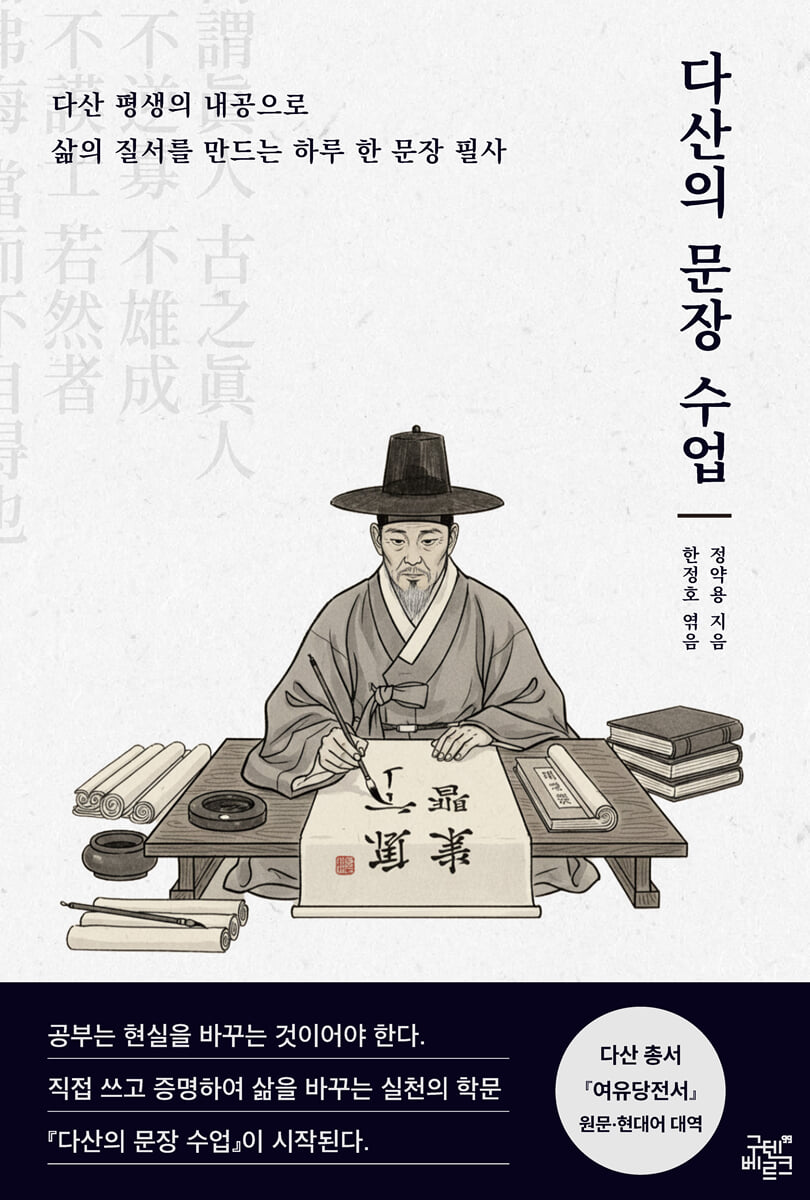
Dasan's sentence class
 |
Description
Book Introduction
Studying should change reality.
A practical study that changes lives by writing and proving it yourself
Dasan's sentence class begins!
Do you find yourself making new resolutions every time, only to find yourself crumbling? Do you desperately need something to give you a firm foundation in life? Now, instead of overflowing words of comfort, you need the intellectual fortitude to confront the chaotic reality head-on.
This book is a collection of famous phrases handwritten by Dasan Jeong Yak-yong, a great practitioner and self-manager of the Joseon Dynasty, containing his way of thinking and principles of life.
Dasan did not limit his studies to the act of sitting at a desk and accumulating knowledge.
He firmly believed that studying should change reality.
The strength that enabled him to overcome frustration and write over 500 volumes during the harsh 18 years of exile came from his practical learning that proved knowledge through life.
This book systematizes the essence of Dasan's philosophy, which he upheld throughout his life, into six core principles.
In Part 1, “Learning and Applying,” the basic attitude toward studying is to learn, ask questions, and apply.
In Part 2, Seeking Truth from Facts, we adopt a practical attitude of seeking truth based on facts.
In Part 3, “Seeking Self-Reflection,” we learn the inner strength to reflect on ourselves and find our own faults before blaming others.
In Part 4, Jihaeng Gyeomjin (知行兼進), we will advance knowledge and practice together to provide the driving force to personally achieve great goals.
In Part 5, “Jeongsimseong-i” (正心誠意), we learn how to rectify the mind and make sincere intentions to solidify the principles of life.
Part 6, “Government and Systems,” goes beyond self-cultivation and expands the scope of designing systems to govern the world.
Readers will be asked to handwrite one sentence each day about these six principles presented by Dasan himself.
It is a specific training to instill Dasan's thought system into one's life through transcription, a practical method of accepting and proving knowledge with one's head and body.
By writing one sentence a day, following the writings of Dasan, a lifetime of inner strength, your scattered mind will be organized and you will find your own center that will not be shaken by any trials.
For those who want to move beyond empty promises and transform their lives into concrete action, Dasan's words will provide the strength to sustain their inner strength.
A practical study that changes lives by writing and proving it yourself
Dasan's sentence class begins!
Do you find yourself making new resolutions every time, only to find yourself crumbling? Do you desperately need something to give you a firm foundation in life? Now, instead of overflowing words of comfort, you need the intellectual fortitude to confront the chaotic reality head-on.
This book is a collection of famous phrases handwritten by Dasan Jeong Yak-yong, a great practitioner and self-manager of the Joseon Dynasty, containing his way of thinking and principles of life.
Dasan did not limit his studies to the act of sitting at a desk and accumulating knowledge.
He firmly believed that studying should change reality.
The strength that enabled him to overcome frustration and write over 500 volumes during the harsh 18 years of exile came from his practical learning that proved knowledge through life.
This book systematizes the essence of Dasan's philosophy, which he upheld throughout his life, into six core principles.
In Part 1, “Learning and Applying,” the basic attitude toward studying is to learn, ask questions, and apply.
In Part 2, Seeking Truth from Facts, we adopt a practical attitude of seeking truth based on facts.
In Part 3, “Seeking Self-Reflection,” we learn the inner strength to reflect on ourselves and find our own faults before blaming others.
In Part 4, Jihaeng Gyeomjin (知行兼進), we will advance knowledge and practice together to provide the driving force to personally achieve great goals.
In Part 5, “Jeongsimseong-i” (正心誠意), we learn how to rectify the mind and make sincere intentions to solidify the principles of life.
Part 6, “Government and Systems,” goes beyond self-cultivation and expands the scope of designing systems to govern the world.
Readers will be asked to handwrite one sentence each day about these six principles presented by Dasan himself.
It is a specific training to instill Dasan's thought system into one's life through transcription, a practical method of accepting and proving knowledge with one's head and body.
By writing one sentence a day, following the writings of Dasan, a lifetime of inner strength, your scattered mind will be organized and you will find your own center that will not be shaken by any trials.
For those who want to move beyond empty promises and transform their lives into concrete action, Dasan's words will provide the strength to sustain their inner strength.
- You can preview some of the book's contents.
Preview
index
Preface ··· 006
How to Use This Book... 010
Part 1: Learning, Inquiring, and Applying - 014
Part 2: Seeking Truth Based on Facts... 056
Part 3: Seeking Self-Reflection - Discovering Faults Through Self-Reflection... 098
Part 4: Knowing and Doing Together - Achieving Great Aims Through Personal Action... 140
Part 5: Jeongsimseongui (正心誠意) - Strengthening the Principles of Life... 184
Part 6: Designing a System for Governing the World... 224
Dasan's philosophy of correcting reality by establishing facts through records and procedures... 266
How to Use This Book... 010
Part 1: Learning, Inquiring, and Applying - 014
Part 2: Seeking Truth Based on Facts... 056
Part 3: Seeking Self-Reflection - Discovering Faults Through Self-Reflection... 098
Part 4: Knowing and Doing Together - Achieving Great Aims Through Personal Action... 140
Part 5: Jeongsimseongui (正心誠意) - Strengthening the Principles of Life... 184
Part 6: Designing a System for Governing the World... 224
Dasan's philosophy of correcting reality by establishing facts through records and procedures... 266
Detailed image

Into the book
Dasan Jeong Yak-yong said that the purpose of studying is to change reality.
He viewed learning from the Analects of Confucius and practicing it in a timely manner (學而時習) as a practical process of establishing order in life.
It is not enough to just judge right and wrong, but we must move on to a process for improvement.
For Dasan, studying meant putting what he had learned into practice, and it had to be expressed through practical systems and practices.
--- From the "Preface"
Learning is about providing evidence based on literature,
The thought is something I ponder deeply in my mind.
'Mang' means being deceived by others, and 'Tae' means danger.
If you believe in old books without considering the root and the root, you may be deceived by lies.
If you do not consult the laws of the ancients and only believe in your own thoughts, your knowledge is in danger.
Learning and thinking should not be abandoned or biased towards either side.
Study, think, think, think, think, think, think, learn.
殆,危也。 不究本末而輕信古書, 則或墮於誣罔。 不稽古先而輕信自心, The one who knows what to do is not to attack. The one who knows what to do is not to attack.
The Complete Works of Yeoyudang, Volume 2, Volume 7, "Government" in the Analects of Confucius, Ancient and Modern Commentaries
Dan means a clue.
Among all the techniques of the Hundred Schools, anything that does not fall under the study of the name and the teachings of the scriptures is heresy.
Even if it is helpful to the daily lives of the people, if one specializes only in that, it is also detrimental to the study of a gentleman.
Learner, learner, learn about life skills, study abroad, learn about life and science. People living in a foreign country, people living in Japan, people living in a foreign country, people living in a foreign country, children living in a foreign country, studying abroad.
The Complete Works of Yeoyudang, Volume 2, Volume 7, "Government" in the Analects of Confucius, Ancient and Modern Commentaries
--- From “Part 1 - Learning, Asking, and Applying”
A sky that is neither foggy nor cloudy, but fattens barley.
The little peach looks drunk, the willow looks asleep.
How could a slow person not want to go out and see the mountains?
I just stay inside and reflect on my mistakes.
非靄非雲養麥天, Small tree like food thought like this. 緩豈無步看山意, 只得深居念罪愆.
The poem "Giseongjapsi (?城雜詩)" from the 1st volume of the Yeoyudangjeonseo, 『Poetry Collection (詩文集)』
He viewed learning from the Analects of Confucius and practicing it in a timely manner (學而時習) as a practical process of establishing order in life.
It is not enough to just judge right and wrong, but we must move on to a process for improvement.
For Dasan, studying meant putting what he had learned into practice, and it had to be expressed through practical systems and practices.
--- From the "Preface"
Learning is about providing evidence based on literature,
The thought is something I ponder deeply in my mind.
'Mang' means being deceived by others, and 'Tae' means danger.
If you believe in old books without considering the root and the root, you may be deceived by lies.
If you do not consult the laws of the ancients and only believe in your own thoughts, your knowledge is in danger.
Learning and thinking should not be abandoned or biased towards either side.
Study, think, think, think, think, think, think, learn.
殆,危也。 不究本末而輕信古書, 則或墮於誣罔。 不稽古先而輕信自心, The one who knows what to do is not to attack. The one who knows what to do is not to attack.
The Complete Works of Yeoyudang, Volume 2, Volume 7, "Government" in the Analects of Confucius, Ancient and Modern Commentaries
Dan means a clue.
Among all the techniques of the Hundred Schools, anything that does not fall under the study of the name and the teachings of the scriptures is heresy.
Even if it is helpful to the daily lives of the people, if one specializes only in that, it is also detrimental to the study of a gentleman.
Learner, learner, learn about life skills, study abroad, learn about life and science. People living in a foreign country, people living in Japan, people living in a foreign country, people living in a foreign country, children living in a foreign country, studying abroad.
The Complete Works of Yeoyudang, Volume 2, Volume 7, "Government" in the Analects of Confucius, Ancient and Modern Commentaries
--- From “Part 1 - Learning, Asking, and Applying”
A sky that is neither foggy nor cloudy, but fattens barley.
The little peach looks drunk, the willow looks asleep.
How could a slow person not want to go out and see the mountains?
I just stay inside and reflect on my mistakes.
非靄非雲養麥天, Small tree like food thought like this. 緩豈無步看山意, 只得深居念罪愆.
The poem "Giseongjapsi (?城雜詩)" from the 1st volume of the Yeoyudangjeonseo, 『Poetry Collection (詩文集)』
--- From “Part 3 - Self-reflection and discovery of faults”
Publisher's Review
I know a lot, but why doesn't my life change?
Dasan Jeong Yak-yong, bringing order to his life through "practical study."
The gap between knowing and doing, that is, the discrepancy between knowledge and life, is a profound symptom of our times.
Knowing what is right and living it out have become two different things.
Faced with this immense separation of knowledge and action, the helplessness of empty knowledge that is not grounded in reality, we are reminded of Dasan Jeong Yak-yong, a scholar from the Joseon Dynasty from 200 years ago.
Dasan was far from being a scholar in his study or a thinker who was limited to philosophical thinking.
He was a statesman who sought to reform the world, and a woman who endured 18 years of brutal exile with her whole body.
For him, studying and writing were different from the play of empty talk.
It was a fierce and concrete practice in itself to solve real-world problems and restore the order of life that had collapsed from the ruins of despair.
His sentences are deeply rooted in the soil of 'reality'.
This is because his thoughts, unlike abstract theories, are honed through desperate struggles and practical experiences about how to put them into practice.
That is why his ideas still offer practical and powerful answers to the fundamental problems of life we face.
From ‘Silsagusi’ to ‘Gyeongseoseolje’,
The sophisticated dialectical structure of the sixth part of Dasan's philosophy
『Dasan's Sentence Lessons』 is different from typical collections of famous quotes or sentence practice books.
This book is a practical training manual designed to help readers systematically acquire and apply Dasan's philosophy to their lives by dividing the vast ideological system he completed throughout his life into six core topics.
Part 1, “Learning and Putting to Use”, presents the teleological nature of study, which states that knowledge (知) must lead to use (用).
Part 2: Seeking Truth from Real Things (實事求是) teaches the epistemological foundation of Dasanism, which excludes all notions and prejudices and seeks truth from concrete facts.
Part 3, “Seeking Self-Reflection,” trains the core principle of Confucian self-discipline, which is to seek the root of all problems within oneself rather than seeking them outside of oneself.
Part 4, Jihaenggyeomjin (知行兼進), is Dasan's practical philosophy that emphasizes that knowledge and practice cannot be separated and must advance together like the two wheels of a cart.
In Part 5, Jeongsimseong-i (正心誠意), the principles derived from the Great Learning (大學) are to straighten the mind (正心) and make the will sincere (誠意) to solidify the unshakable inner subject (主體).
Part 6, Governing the World and Establishing Systems, is the completion of Governing the World and Establishing Systems, which expands the studies completed in self-cultivation into a system that governs the world and benefits the people.
This six-part flow forms a sophisticated and dialectical structure that begins with the attitude toward learning (Part 1), moves through methods of thinking (Part 2) and inner reflection (Part 3), and then expands to practice (Part 4) and moral principles (Part 5), finally reaching social practice (Part 6).
One sentence a day,
Putting knowledge into practice by writing by hand
Dasan said that he solidified the facts and corrected reality by recording and preparing methods.
His pragmatic approach, which sought to establish facts and bring order to the world through means, is closely connected to the physical act of writing that we do today.
Reading with the eyes alone can easily evaporate, but writing each letter by hand is a solid act of embodiment and a ritual of imprinting knowledge.
Copying Dasan's words with a pure heart every day will be a time of meditation to take a break from the fast-paced and busy flow of the world and catch one's breath, and a time of training to internalize Dasan's fierce attitude as one's own.
This book will serve as an excellent guide for those who wish to establish solid principles in life, for anyone who wishes to bridge the gap between knowledge and life, and for readers who wish to gain practical wisdom for daily living through the classics.
I hope that by writing one sentence a day, readers will gain a solid order and brilliant insight that no one can dare to destroy in their daily lives.
Dasan Jeong Yak-yong, bringing order to his life through "practical study."
The gap between knowing and doing, that is, the discrepancy between knowledge and life, is a profound symptom of our times.
Knowing what is right and living it out have become two different things.
Faced with this immense separation of knowledge and action, the helplessness of empty knowledge that is not grounded in reality, we are reminded of Dasan Jeong Yak-yong, a scholar from the Joseon Dynasty from 200 years ago.
Dasan was far from being a scholar in his study or a thinker who was limited to philosophical thinking.
He was a statesman who sought to reform the world, and a woman who endured 18 years of brutal exile with her whole body.
For him, studying and writing were different from the play of empty talk.
It was a fierce and concrete practice in itself to solve real-world problems and restore the order of life that had collapsed from the ruins of despair.
His sentences are deeply rooted in the soil of 'reality'.
This is because his thoughts, unlike abstract theories, are honed through desperate struggles and practical experiences about how to put them into practice.
That is why his ideas still offer practical and powerful answers to the fundamental problems of life we face.
From ‘Silsagusi’ to ‘Gyeongseoseolje’,
The sophisticated dialectical structure of the sixth part of Dasan's philosophy
『Dasan's Sentence Lessons』 is different from typical collections of famous quotes or sentence practice books.
This book is a practical training manual designed to help readers systematically acquire and apply Dasan's philosophy to their lives by dividing the vast ideological system he completed throughout his life into six core topics.
Part 1, “Learning and Putting to Use”, presents the teleological nature of study, which states that knowledge (知) must lead to use (用).
Part 2: Seeking Truth from Real Things (實事求是) teaches the epistemological foundation of Dasanism, which excludes all notions and prejudices and seeks truth from concrete facts.
Part 3, “Seeking Self-Reflection,” trains the core principle of Confucian self-discipline, which is to seek the root of all problems within oneself rather than seeking them outside of oneself.
Part 4, Jihaenggyeomjin (知行兼進), is Dasan's practical philosophy that emphasizes that knowledge and practice cannot be separated and must advance together like the two wheels of a cart.
In Part 5, Jeongsimseong-i (正心誠意), the principles derived from the Great Learning (大學) are to straighten the mind (正心) and make the will sincere (誠意) to solidify the unshakable inner subject (主體).
Part 6, Governing the World and Establishing Systems, is the completion of Governing the World and Establishing Systems, which expands the studies completed in self-cultivation into a system that governs the world and benefits the people.
This six-part flow forms a sophisticated and dialectical structure that begins with the attitude toward learning (Part 1), moves through methods of thinking (Part 2) and inner reflection (Part 3), and then expands to practice (Part 4) and moral principles (Part 5), finally reaching social practice (Part 6).
One sentence a day,
Putting knowledge into practice by writing by hand
Dasan said that he solidified the facts and corrected reality by recording and preparing methods.
His pragmatic approach, which sought to establish facts and bring order to the world through means, is closely connected to the physical act of writing that we do today.
Reading with the eyes alone can easily evaporate, but writing each letter by hand is a solid act of embodiment and a ritual of imprinting knowledge.
Copying Dasan's words with a pure heart every day will be a time of meditation to take a break from the fast-paced and busy flow of the world and catch one's breath, and a time of training to internalize Dasan's fierce attitude as one's own.
This book will serve as an excellent guide for those who wish to establish solid principles in life, for anyone who wishes to bridge the gap between knowledge and life, and for readers who wish to gain practical wisdom for daily living through the classics.
I hope that by writing one sentence a day, readers will gain a solid order and brilliant insight that no one can dare to destroy in their daily lives.
GOODS SPECIFICS
- Date of issue: October 27, 2025
- Format: Guide to book binding methods for four-sided binding
- Page count, weight, size: 280 pages | 152*225*20mm
- ISBN13: 9791199438422
- ISBN10: 1199438421
You may also like
카테고리
korean


korean

![GQ KOREA Mark (Monthly): December [2025]](http://librairie.coreenne.fr/cdn/shop/files/8ef265dbbfbf186523ed75ba7319009d.jpg?v=1765340328&width=3840)


