

The basics of planning
 |
Description
Book Introduction
Great planning requires strategy!
《Planning Essentials》, which dramatically transformed 10,000 proposals over 10 years!
Add 21 detailed skills and 26 real-world planning cases to 10 planning strategies.
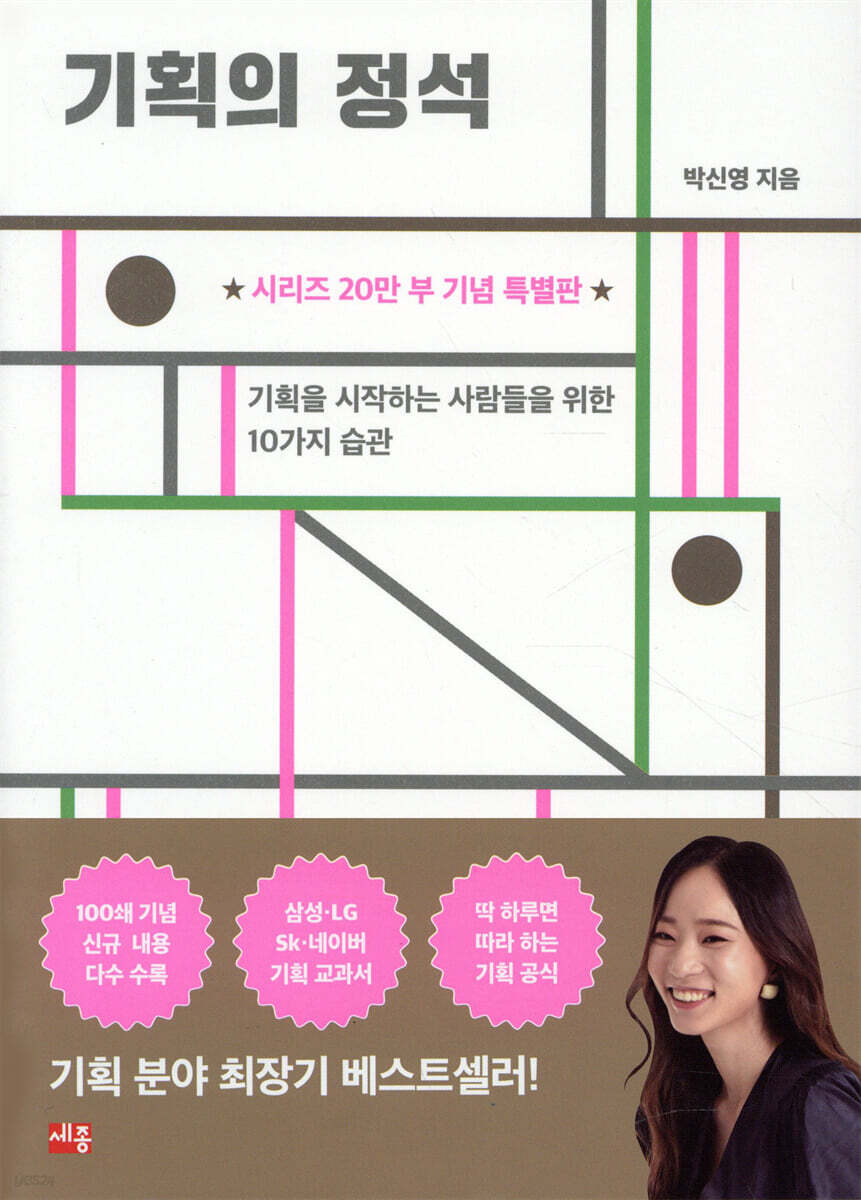
Published as a 'Special Edition to Commemorate 200,000 Series Copies' with 400 new manuscript pages added!
Park Shin-young, Korea's top planning and presentation expert, has published "Planning Essentials," a compilation of 10 challenging planning habits that will help you create something from nothing.
It continues to be the longest-running bestseller in the domestic planning field, and readers continue to seek it out to this day. In early 2022, it surpassed 100 single printings and 200,000 copies of the planning series.
The author says that since the book was published, the planning strategy and specific implementation methods have changed very rapidly.
To help readers plan even better, Sejong Books has published a special edition commemorating the 200,000th copy series, with 21 detailed planning skills and 26 real-world planning cases added to a 400-page manuscript.
The 'Special Edition to Celebrate 200,000 Copies of the Series' is a book that further develops the core strategies of the 10 Planning Habits so that they can be applied immediately.
From a single initial plan to a tightly woven, complete plan, we've rewritten half of the planning theory and implementation methods so readers can easily follow along.
Of course, the author's dark past, which was greatly praised by readers, was left intact to serve as a negative example and to make reading enjoyable.
《Planning Essentials》, which dramatically transformed 10,000 proposals over 10 years!
Add 21 detailed skills and 26 real-world planning cases to 10 planning strategies.
Published as a 'Special Edition to Commemorate 200,000 Series Copies' with 400 new manuscript pages added!
Park Shin-young, Korea's top planning and presentation expert, has published "Planning Essentials," a compilation of 10 challenging planning habits that will help you create something from nothing.
It continues to be the longest-running bestseller in the domestic planning field, and readers continue to seek it out to this day. In early 2022, it surpassed 100 single printings and 200,000 copies of the planning series.
The author says that since the book was published, the planning strategy and specific implementation methods have changed very rapidly.
To help readers plan even better, Sejong Books has published a special edition commemorating the 200,000th copy series, with 21 detailed planning skills and 26 real-world planning cases added to a 400-page manuscript.
The 'Special Edition to Celebrate 200,000 Copies of the Series' is a book that further develops the core strategies of the 10 Planning Habits so that they can be applied immediately.
From a single initial plan to a tightly woven, complete plan, we've rewritten half of the planning theory and implementation methods so readers can easily follow along.
Of course, the author's dark past, which was greatly praised by readers, was left intact to serve as a negative example and to make reading enjoyable.
- You can preview some of the book's contents.
Preview
index
Words of gratitude - I live thanks to you
Prologue - If you are at the planning starting point now
Chapter 1: Brain: What is Fundamentally Important?
Chapter 2 Focus_For the plan to be remembered
Chapter 3 3WRⓡ_What are the basic planning skills?
Chapter 4 Key message_So, in a word, what is it?
Chapter 5 5Why_There's a reason why things sell well.
Chapter 6 Whom_But who bought it
Chapter 7: Flow: Why Can't You Understand Me?
Chapter 8: Dividing_You have to split it to see the gaps.
Chapter 9: Binding: Something Comes Out of It
Chapter 10: Expectation Effect: Let's Test Cost-Effectiveness
Summary - The "Planning Principles" in One Page
Epilogue - To the planners who are currently heading to bare ground
We are publishing a special edition commemorating the 200,000th copy release of the series. We hope this book will be both a pain reliever and a vitamin for those just starting out.
Prologue - If you are at the planning starting point now
Chapter 1: Brain: What is Fundamentally Important?
Chapter 2 Focus_For the plan to be remembered
Chapter 3 3WRⓡ_What are the basic planning skills?
Chapter 4 Key message_So, in a word, what is it?
Chapter 5 5Why_There's a reason why things sell well.
Chapter 6 Whom_But who bought it
Chapter 7: Flow: Why Can't You Understand Me?
Chapter 8: Dividing_You have to split it to see the gaps.
Chapter 9: Binding: Something Comes Out of It
Chapter 10: Expectation Effect: Let's Test Cost-Effectiveness
Summary - The "Planning Principles" in One Page
Epilogue - To the planners who are currently heading to bare ground
We are publishing a special edition commemorating the 200,000th copy release of the series. We hope this book will be both a pain reliever and a vitamin for those just starting out.
Detailed image

Into the book
What I have felt in the field over the past 12 years of conducting full-scale planning training for companies is that the gap in skills is much greater than expected.
There are a few people who produce truly amazing planning results, but I feel that most people are either overwhelmed by even getting started or struggle to get things done but struggle because they lack the fundamentals.
What is natural to some is utterly daunting to others.
So I started to dig into and organize the fundamental structures, principles, and methodologies hidden behind the phenomenon that I thought was just something I did.
---From "Prologue - If you are at the planning starting point now"
According to brain theory, the moment you think, "I really don't want to do this project, but what can I do? I have to do it," images of "I really don't want to do it" will immediately appear in your head.
Even before you start working, you'll be reminded of the things you desperately wanted to do in the past but forced yourself to do, and the things that ended up being a failure, making you want to do it even more.
If you send a message like “I really don’t want to do it ㅠㅠㅠ” through KakaoTalk or Messenger, you will become completely convinced.
And I am convinced by the logic that I don't want to do it like crazy.
So what's the outcome of that? It's obvious.
---From "Chapter 1 Brain_What is fundamentally important?"
If you were to ask me, after 12 years of training with office workers who have to write business plans, which training method would I recommend the most among the numerous methods, I would recommend Planning School's 3WR® training.
Simply put, it is training to think about and organize the basics of planning: why, why so, and what.
(···) Among many methodologies, I trained this frame a lot, and I also trained it, and I saw many cases where the planning, planning documents, and presentations were greatly upgraded.
---From "Chapter 3 3WR®_What are the basics of planning?"
So, don't just ask this once and be done with it. Keep asking until the hidden, real story, the real why comes out.
This process is called '5Why'.
This is the questioning method used by Daiichi Ono, the former president of Toyota.
When you encounter a problem, if you repeat 'why' five times, you will be able to find the real cause, and only then can you come up with a real solution.
Of course, five is a symbolic number.
Sometimes the real why is found in two or three times, and sometimes it takes more than ten times to find the why.
---From "Chapter 5 5Why_There's a reason why things sell well"
No matter how clearly I explain what, there are times when I get asked, “Why that?”
So, rather than thinking, "Why are you asking such a thing? Do I have to explain it all one by one?", it's better to understand, "This person is someone who values why," and then organize the why.
Why? For those who value the "why," the story behind it would be meaningless without the "why" part.
---From "Chapter 7 Flow_Why Can't You Understand What I'm Saying"
A person who is good at planning does not get buried in the phenomenon, but looks at the phenomenon from the perspective of an omniscient writer.
That is, they discover patterns by breaking down phenomena from the perspective of an omniscient author, finding commonalities, and grouping them together.
---「Chapter 9 Binding_Something comes out when you bind it
If we were to summarize the planning process in a simple way, it would be like this, but in reality, a plan is ultimately a battle to eliminate the other person's fears.
The other person keeps asking if he is afraid.
Why? Really? Is that okay? There are other things, too. Will it work? How much will it cost? Do we really need to spend that much money, time, and people? That's why the table of contents of a proposal is a list of the other person's fears, and it's the planner's job to turn those fears into reassurances, one by one.
---From "Summary - 'Planning Principles' Organized in One Page"
There is a powerful scene that I will never forget.
It was a picture of the book "Planning Principles" that someone had taken, but it was so old and worn out.
I was quite shocked that I read it over and over again until it was so worn out.
When I went to a professor's office and saw my books piled up in boxes, I asked why, and he said he gave them out to any child who came to his office.
(···) Planning can be easy and obvious to some people, but difficult and unfamiliar to me.
But even the person who takes it for granted now probably didn't know that at first.
So, please embrace your busy and frustrated heart and give yourself time to read this book.
There are a few people who produce truly amazing planning results, but I feel that most people are either overwhelmed by even getting started or struggle to get things done but struggle because they lack the fundamentals.
What is natural to some is utterly daunting to others.
So I started to dig into and organize the fundamental structures, principles, and methodologies hidden behind the phenomenon that I thought was just something I did.
---From "Prologue - If you are at the planning starting point now"
According to brain theory, the moment you think, "I really don't want to do this project, but what can I do? I have to do it," images of "I really don't want to do it" will immediately appear in your head.
Even before you start working, you'll be reminded of the things you desperately wanted to do in the past but forced yourself to do, and the things that ended up being a failure, making you want to do it even more.
If you send a message like “I really don’t want to do it ㅠㅠㅠ” through KakaoTalk or Messenger, you will become completely convinced.
And I am convinced by the logic that I don't want to do it like crazy.
So what's the outcome of that? It's obvious.
---From "Chapter 1 Brain_What is fundamentally important?"
If you were to ask me, after 12 years of training with office workers who have to write business plans, which training method would I recommend the most among the numerous methods, I would recommend Planning School's 3WR® training.
Simply put, it is training to think about and organize the basics of planning: why, why so, and what.
(···) Among many methodologies, I trained this frame a lot, and I also trained it, and I saw many cases where the planning, planning documents, and presentations were greatly upgraded.
---From "Chapter 3 3WR®_What are the basics of planning?"
So, don't just ask this once and be done with it. Keep asking until the hidden, real story, the real why comes out.
This process is called '5Why'.
This is the questioning method used by Daiichi Ono, the former president of Toyota.
When you encounter a problem, if you repeat 'why' five times, you will be able to find the real cause, and only then can you come up with a real solution.
Of course, five is a symbolic number.
Sometimes the real why is found in two or three times, and sometimes it takes more than ten times to find the why.
---From "Chapter 5 5Why_There's a reason why things sell well"
No matter how clearly I explain what, there are times when I get asked, “Why that?”
So, rather than thinking, "Why are you asking such a thing? Do I have to explain it all one by one?", it's better to understand, "This person is someone who values why," and then organize the why.
Why? For those who value the "why," the story behind it would be meaningless without the "why" part.
---From "Chapter 7 Flow_Why Can't You Understand What I'm Saying"
A person who is good at planning does not get buried in the phenomenon, but looks at the phenomenon from the perspective of an omniscient writer.
That is, they discover patterns by breaking down phenomena from the perspective of an omniscient author, finding commonalities, and grouping them together.
---「Chapter 9 Binding_Something comes out when you bind it
If we were to summarize the planning process in a simple way, it would be like this, but in reality, a plan is ultimately a battle to eliminate the other person's fears.
The other person keeps asking if he is afraid.
Why? Really? Is that okay? There are other things, too. Will it work? How much will it cost? Do we really need to spend that much money, time, and people? That's why the table of contents of a proposal is a list of the other person's fears, and it's the planner's job to turn those fears into reassurances, one by one.
---From "Summary - 'Planning Principles' Organized in One Page"
There is a powerful scene that I will never forget.
It was a picture of the book "Planning Principles" that someone had taken, but it was so old and worn out.
I was quite shocked that I read it over and over again until it was so worn out.
When I went to a professor's office and saw my books piled up in boxes, I asked why, and he said he gave them out to any child who came to his office.
(···) Planning can be easy and obvious to some people, but difficult and unfamiliar to me.
But even the person who takes it for granted now probably didn't know that at first.
So, please embrace your busy and frustrated heart and give yourself time to read this book.
---From "Publishing a special edition commemorating the 200,000th copy release of the series"
Publisher's Review
We've refined the existing 10 planning habits into 21 more detailed ones to make them easier to apply!
Added 26 real-world planning examples, big and small!
Update existing planning cases and theories with the latest trends!
A new standard of planning with 400 new manuscripts!
While giving planning lectures to planners at major domestic corporations and startups pursuing innovation every day, the author discovered that people feel surprisingly fatigued and burdened by planning.
So, in the introduction of the book, I focused on the planning mindset so that readers who get a headache just hearing the word "planning" can start planning in a more novel and enjoyable way.
By referring to Chapters 1 through 4 of the book, you will be able to take a step closer to 'building a brain that is good at planning.'
Meanwhile, readers considering customized planning will find Chapters 5 through 9 very helpful.
It explains in great detail, 'Who are my customers? How do I determine market size and growth potential? How do I position my products? What strategies will I use to win over customers?'
If you're a reader who's pressed for time to plan, has too many thoughts to organize, or is at a loss as to where to start, read the "Planning Essentials in One Page" at the very end of the book.
Just read three pages for three minutes and you will see a breakthrough.
Planning is destiny.
The "Planning Classics Series 200,000-Copy Special Edition" is not just a simple commemorative edition, but is also packed with experiences from planning lectures over the past 10 years and skills that can be applied immediately in the field, not to mention those who have read the previous "Planning Classics".
From those just starting out in planning to those who have been planning for a long time but find it difficult to keep up with the latest trends, this book will be a powerful pain reliever and a vitamin to keep by your side.
The Legend of 23 Contest Winners: The Queen of Planning, Park Shin-young's "Planning Principles"
The author is the self-proclaimed "Queen of Planning," having won the grand prize for individual entries three times in a row, including the Jeil Planning Individual Entry Grand Prize for two consecutive years and the LG Ad Individual Entry Grand Prize, two of the two most prestigious contests during her college years, and has since set an unprecedented record of winning 23 contests.
The author, who rose to stardom as a planning lecturer while working as a planning manager for the content business team at Paul&Mark, an education consulting firm, and in charge of Samsung's brain education and lectures at the Blue House, is living with his unique 'shovel spirit' by expanding his scope to include planning practice, education, and publishing.
This book is a compilation of practical planning know-how and brain theories learned in various fields such as planning, advertising, presentations, lectures, publishing, and education, as well as practical planning techniques and planning know-how from contests.
This book is truly a book solely for ‘planning.’
Instead of difficult, textbook-like language, readers will find practical planning skills they can immediately apply to their business plans.
Readers may think that their idea is not that great.
But if you come across this book, that idea will develop into a groundbreaking plan.
10 years of Mike Impact School's 'Paksin Planning School'
A culmination of 10 years of planning lectures at the Planning School.
A special edition that covers both the fundamentals of planning and the latest trends!
What are the practical planning habits that create successful projects? Author Park Shin-young's nickname is "Paksin," meaning "hard-working," for her relentless, hard work.
Among the numerous lectures offered by Mike Impact School, which is leading the lecture culture, Park Shin-young's 'Park Shin Planning School' is the most popular, and is well-known as a lecture that concentrates essential planning know-how for working people and college students.
There is a clear reason why the 'Paksin Planning School' lectures, which run continuously for 8 hours a day, regardless of weekdays or weekends, sell out every time.
“From the perspective of someone who deals with the field, it feels like receiving a divine plan, without a single gram of useless words”, “A lecture like rain in a drought.
“The lecture progresses through real-life examples and is deeply moving”, “This is a lecture I would not recommend to others.
“I wish I could keep it to myself,” the students unanimously praise.
The author has compiled the know-how he has accumulated through writing dozens of business plans a year since his college days and giving on-site lectures into this book.
《Planning Essentials》 is not just for job seekers or contest participants.
Through the process of listening to the concerns of learners working in various fields that I met during the lecture and presenting solutions, I will teach you how to create a detailed plan that is so detailed that you will wonder if it is even possible to show it all so that anyone who wants to organize their thoughts and appeal to others can see it at a glance and use it right away.
“I have to submit the plan by tomorrow. What should I do?”
10-step planning know-how to complete a project overnight from scratch!
The person who wants to see your plan (anyone who will receive your plan, whether it be a demanding boss, a client, or a high-ranking business partner, is referred to as “that person” in this book) will say, “Bring the plan by tomorrow!”
But what if you say, "I'll do well" or "I'll become the best in the industry" without context, because you don't have time to prepare? He'll ask, "Why should I do that?", "What's the solution?", or "Tell me in one word."
If you explain it in a long and complicated way in front of someone like this, the plan has already failed.
Even if you create a logical and specific implementation plan.
The key to planning is storytelling skills that will make people interested in the plan.
Storytelling is complex and grandiose.
For example, a good example would be a single line like, “I’ve already prepared all the wedding preparations with the prize money from the contest.”
It creates a clear image of a 'planning expert' in the listener's mind.
At the end of the plan, if you summarize it in a single page and say, “This is what I’ve said so far,” and review it, the person will think, “Oh, I heard this today,” organize it in his head, and then he will be proud and adopt your plan.
If you're close to someone who wants you to bring your proposal by tomorrow, if you're at a loss as to where to start, or if you want to take advantage of the latest planning trends, read the "Planning Classics Series 200,000-Copy Special Edition" right now and put it into action!
Added 26 real-world planning examples, big and small!
Update existing planning cases and theories with the latest trends!
A new standard of planning with 400 new manuscripts!
While giving planning lectures to planners at major domestic corporations and startups pursuing innovation every day, the author discovered that people feel surprisingly fatigued and burdened by planning.
So, in the introduction of the book, I focused on the planning mindset so that readers who get a headache just hearing the word "planning" can start planning in a more novel and enjoyable way.
By referring to Chapters 1 through 4 of the book, you will be able to take a step closer to 'building a brain that is good at planning.'
Meanwhile, readers considering customized planning will find Chapters 5 through 9 very helpful.
It explains in great detail, 'Who are my customers? How do I determine market size and growth potential? How do I position my products? What strategies will I use to win over customers?'
If you're a reader who's pressed for time to plan, has too many thoughts to organize, or is at a loss as to where to start, read the "Planning Essentials in One Page" at the very end of the book.
Just read three pages for three minutes and you will see a breakthrough.
Planning is destiny.
The "Planning Classics Series 200,000-Copy Special Edition" is not just a simple commemorative edition, but is also packed with experiences from planning lectures over the past 10 years and skills that can be applied immediately in the field, not to mention those who have read the previous "Planning Classics".
From those just starting out in planning to those who have been planning for a long time but find it difficult to keep up with the latest trends, this book will be a powerful pain reliever and a vitamin to keep by your side.
The Legend of 23 Contest Winners: The Queen of Planning, Park Shin-young's "Planning Principles"
The author is the self-proclaimed "Queen of Planning," having won the grand prize for individual entries three times in a row, including the Jeil Planning Individual Entry Grand Prize for two consecutive years and the LG Ad Individual Entry Grand Prize, two of the two most prestigious contests during her college years, and has since set an unprecedented record of winning 23 contests.
The author, who rose to stardom as a planning lecturer while working as a planning manager for the content business team at Paul&Mark, an education consulting firm, and in charge of Samsung's brain education and lectures at the Blue House, is living with his unique 'shovel spirit' by expanding his scope to include planning practice, education, and publishing.
This book is a compilation of practical planning know-how and brain theories learned in various fields such as planning, advertising, presentations, lectures, publishing, and education, as well as practical planning techniques and planning know-how from contests.
This book is truly a book solely for ‘planning.’
Instead of difficult, textbook-like language, readers will find practical planning skills they can immediately apply to their business plans.
Readers may think that their idea is not that great.
But if you come across this book, that idea will develop into a groundbreaking plan.
10 years of Mike Impact School's 'Paksin Planning School'
A culmination of 10 years of planning lectures at the Planning School.
A special edition that covers both the fundamentals of planning and the latest trends!
What are the practical planning habits that create successful projects? Author Park Shin-young's nickname is "Paksin," meaning "hard-working," for her relentless, hard work.
Among the numerous lectures offered by Mike Impact School, which is leading the lecture culture, Park Shin-young's 'Park Shin Planning School' is the most popular, and is well-known as a lecture that concentrates essential planning know-how for working people and college students.
There is a clear reason why the 'Paksin Planning School' lectures, which run continuously for 8 hours a day, regardless of weekdays or weekends, sell out every time.
“From the perspective of someone who deals with the field, it feels like receiving a divine plan, without a single gram of useless words”, “A lecture like rain in a drought.
“The lecture progresses through real-life examples and is deeply moving”, “This is a lecture I would not recommend to others.
“I wish I could keep it to myself,” the students unanimously praise.
The author has compiled the know-how he has accumulated through writing dozens of business plans a year since his college days and giving on-site lectures into this book.
《Planning Essentials》 is not just for job seekers or contest participants.
Through the process of listening to the concerns of learners working in various fields that I met during the lecture and presenting solutions, I will teach you how to create a detailed plan that is so detailed that you will wonder if it is even possible to show it all so that anyone who wants to organize their thoughts and appeal to others can see it at a glance and use it right away.
“I have to submit the plan by tomorrow. What should I do?”
10-step planning know-how to complete a project overnight from scratch!
The person who wants to see your plan (anyone who will receive your plan, whether it be a demanding boss, a client, or a high-ranking business partner, is referred to as “that person” in this book) will say, “Bring the plan by tomorrow!”
But what if you say, "I'll do well" or "I'll become the best in the industry" without context, because you don't have time to prepare? He'll ask, "Why should I do that?", "What's the solution?", or "Tell me in one word."
If you explain it in a long and complicated way in front of someone like this, the plan has already failed.
Even if you create a logical and specific implementation plan.
The key to planning is storytelling skills that will make people interested in the plan.
Storytelling is complex and grandiose.
For example, a good example would be a single line like, “I’ve already prepared all the wedding preparations with the prize money from the contest.”
It creates a clear image of a 'planning expert' in the listener's mind.
At the end of the plan, if you summarize it in a single page and say, “This is what I’ve said so far,” and review it, the person will think, “Oh, I heard this today,” organize it in his head, and then he will be proud and adopt your plan.
If you're close to someone who wants you to bring your proposal by tomorrow, if you're at a loss as to where to start, or if you want to take advantage of the latest planning trends, read the "Planning Classics Series 200,000-Copy Special Edition" right now and put it into action!
GOODS SPECIFICS
- Publication date: June 26, 2022
- Page count, weight, size: 240 pages | 418g | 150*210*17mm
- ISBN13: 9788984079847
- ISBN10: 8984079847
- KC Certification: Certification Type: Confirming Certification Number: -
You may also like
카테고리
korean


korean

![GQ KOREA Mark (Monthly): December [2025]](http://librairie.coreenne.fr/cdn/shop/files/8ef265dbbfbf186523ed75ba7319009d.jpg?v=1765340328&width=3840)


