

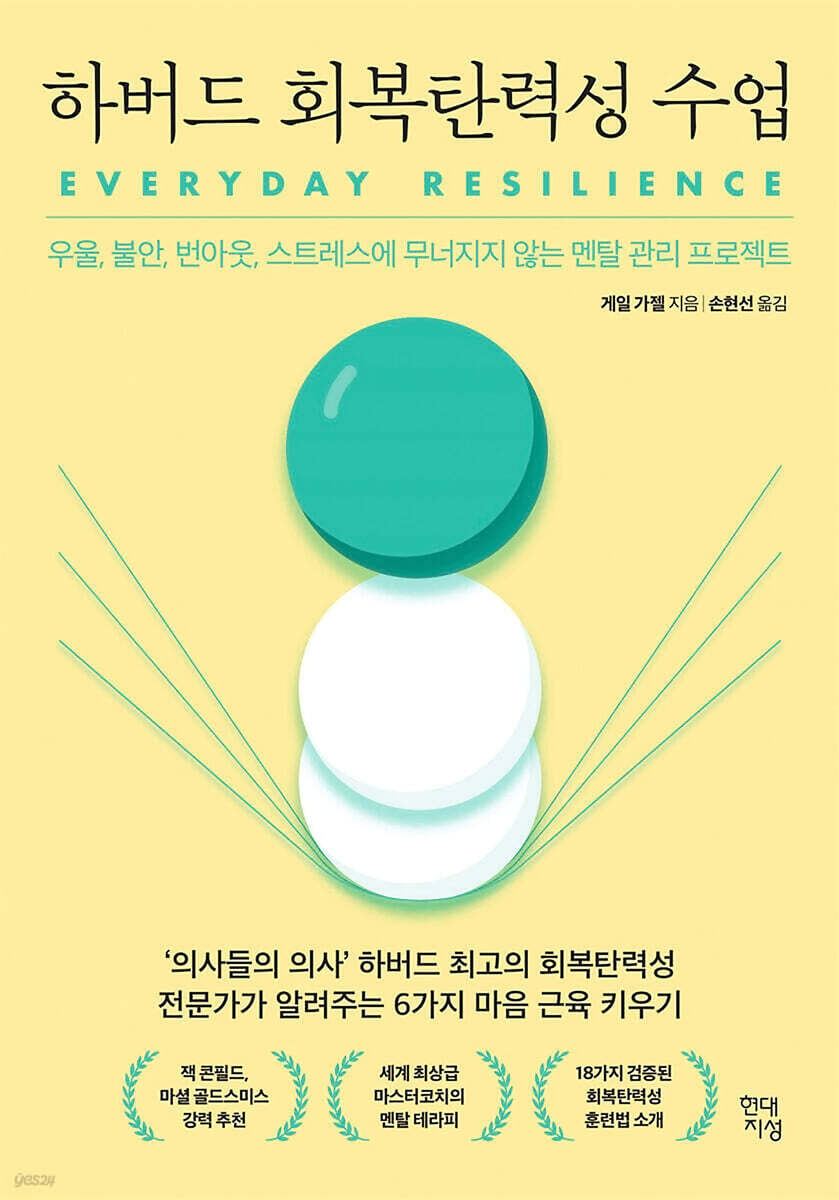
Harvard Resilience Class
 |
Description
Book Introduction
“So how do you build resilience?”
18 Resilience Training Steps to Start Right Now
“Dr. Gail Gazelle, Harvard’s leading resilience expert, shares the most accurate methods for building resilience, no matter where you are in your life.”
- Marshall Goldsmith (world's leading management consultant, author of "Trigger" and "Mojo")
The so-called 'silent massacre' has begun.
People who have been pushed into crisis since COVID-19 are quietly losing their place to stand.
In particular, the number of young people taking their own lives is increasing.
According to recent statistics, the rate of suicide attempts among women in their 20s and 30s shows the greatest increase.
Employment crises, economic burdens, violence and crime, diseases and accidents are not new or second-hand issues, but they have reached an all-time high since the COVID-19 outbreak.
So, the number of people showing signs of mental health problems such as depression, panic disorder, and sleep disorders has increased to the point that a new word, 'Corona Black', has emerged following 'Corona Blue'.
Now, more than ever, we need a 'mental vaccine' to protect our lives.
We may not be able to immediately change the COVID-19 situation or the social structural environment, but we can certainly change our internal attitude and perspective on that environment.
The mental strength to overcome adversity and trials without collapsing under the influence of depression, anxiety, and stress due to external circumstances is called 'resilience.'
Resilience is a latent ability that exists in everyone, not just some exceptional individual.
It's just that we haven't been specifically taught how to harness that power.
Dr. Gail Gazelle, Harvard's leading resilience expert, has applied these resilience principles to doctors suffering from extreme stress, depression, and burnout in high-intensity work environments, with remarkable results.
To date, over 500 doctors have received his help and overcome their inner crises, earning him the title of "Doctor's Doctor."
He also went through a difficult time as a victim of domestic violence during his childhood, but he overcame the pain through resilience training, and through this, he is now giving 'peace of mind' to those going through difficult times.
In this book, Dr. Gazelle uses his extensive experience and knowledge to explain the principles of resilience in an easily understandable way.
The mental muscles necessary for resilience are clearly summarized in six keywords: interpersonal relationships, flexibility, perseverance, self-regulation, positivity, and self-care.
We introduce various cases that we have personally consulted and help readers apply them to their own situations.
We minimize the use of academic terminology, but we aim to provide a practical understanding of the power of resilience through the latest research in medicine and psychology.
Above all, this book is practical.
“18 Resilience Training Methods” that utilize meditation, brain science, positive psychology, and emotional intelligence can be applied to your life right now.
18 Resilience Training Steps to Start Right Now
“Dr. Gail Gazelle, Harvard’s leading resilience expert, shares the most accurate methods for building resilience, no matter where you are in your life.”
- Marshall Goldsmith (world's leading management consultant, author of "Trigger" and "Mojo")
The so-called 'silent massacre' has begun.
People who have been pushed into crisis since COVID-19 are quietly losing their place to stand.
In particular, the number of young people taking their own lives is increasing.
According to recent statistics, the rate of suicide attempts among women in their 20s and 30s shows the greatest increase.
Employment crises, economic burdens, violence and crime, diseases and accidents are not new or second-hand issues, but they have reached an all-time high since the COVID-19 outbreak.
So, the number of people showing signs of mental health problems such as depression, panic disorder, and sleep disorders has increased to the point that a new word, 'Corona Black', has emerged following 'Corona Blue'.
Now, more than ever, we need a 'mental vaccine' to protect our lives.
We may not be able to immediately change the COVID-19 situation or the social structural environment, but we can certainly change our internal attitude and perspective on that environment.
The mental strength to overcome adversity and trials without collapsing under the influence of depression, anxiety, and stress due to external circumstances is called 'resilience.'
Resilience is a latent ability that exists in everyone, not just some exceptional individual.
It's just that we haven't been specifically taught how to harness that power.
Dr. Gail Gazelle, Harvard's leading resilience expert, has applied these resilience principles to doctors suffering from extreme stress, depression, and burnout in high-intensity work environments, with remarkable results.
To date, over 500 doctors have received his help and overcome their inner crises, earning him the title of "Doctor's Doctor."
He also went through a difficult time as a victim of domestic violence during his childhood, but he overcame the pain through resilience training, and through this, he is now giving 'peace of mind' to those going through difficult times.
In this book, Dr. Gazelle uses his extensive experience and knowledge to explain the principles of resilience in an easily understandable way.
The mental muscles necessary for resilience are clearly summarized in six keywords: interpersonal relationships, flexibility, perseverance, self-regulation, positivity, and self-care.
We introduce various cases that we have personally consulted and help readers apply them to their own situations.
We minimize the use of academic terminology, but we aim to provide a practical understanding of the power of resilience through the latest research in medicine and psychology.
Above all, this book is practical.
“18 Resilience Training Methods” that utilize meditation, brain science, positive psychology, and emotional intelligence can be applied to your life right now.
- You can preview some of the book's contents.
Preview
index
What is my resilience index?
Entering
Chapter 1: Everyone Has Resilience
01 What is resilience?
02 You can change your brain circuits sufficiently.
03 Starting Point for Developing Resilience
04 How to use this book?
Key Summary
Chapter 2: Interpersonal Relationships (Connections)
01 To develop interpersonal skills
02 What benefits do human relationships provide?
03 Service is the secret to happiness
Key Summary
Chapter 3: Flexibility
01 To increase flexibility
02 Everything in the world changes
03 Changing your perspective makes your thinking more flexible.
Key Summary
Chapter 4: Perseverance
01 To develop perseverance
02 Does your goal align with your larger life purpose?
03 To be persistent, the plan must be specific.
04 Accept reality as it is
Key Summary
Chapter 5: Self-Regulation
01 To develop self-regulation skills
02 How to deal with turbulent emotions
03 It's okay to stop for a moment
Key Summary
Chapter 6: Positivity
01 To cultivate positivity
02 Confronting Your Inner Critic
03 Optimists see opportunity in every challenge.
Key Summary
Chapter 7: Self-Care
01 To develop self-care skills
02 I am an object of empathy, not judgment.
03 Make time just for yourself
Key Summary
Chapter 8: Resilience is a Marathon
01 Let's move forward one step at a time
02 To complete the marathon
03 In conclusion
Helpful Resources
References
Acknowledgements
Entering
Chapter 1: Everyone Has Resilience
01 What is resilience?
02 You can change your brain circuits sufficiently.
03 Starting Point for Developing Resilience
04 How to use this book?
Key Summary
Chapter 2: Interpersonal Relationships (Connections)
01 To develop interpersonal skills
02 What benefits do human relationships provide?
03 Service is the secret to happiness
Key Summary
Chapter 3: Flexibility
01 To increase flexibility
02 Everything in the world changes
03 Changing your perspective makes your thinking more flexible.
Key Summary
Chapter 4: Perseverance
01 To develop perseverance
02 Does your goal align with your larger life purpose?
03 To be persistent, the plan must be specific.
04 Accept reality as it is
Key Summary
Chapter 5: Self-Regulation
01 To develop self-regulation skills
02 How to deal with turbulent emotions
03 It's okay to stop for a moment
Key Summary
Chapter 6: Positivity
01 To cultivate positivity
02 Confronting Your Inner Critic
03 Optimists see opportunity in every challenge.
Key Summary
Chapter 7: Self-Care
01 To develop self-care skills
02 I am an object of empathy, not judgment.
03 Make time just for yourself
Key Summary
Chapter 8: Resilience is a Marathon
01 Let's move forward one step at a time
02 To complete the marathon
03 In conclusion
Helpful Resources
References
Acknowledgements
Detailed image

Into the book
After meeting thousands of people—hospice patients, trauma survivors, doctors—I've come to realize something important.
Regardless of biological or environmental factors, resilience exists as an innate quality within all people.
We are all born with resilience.
However, not everyone discovers inner strength.
Many people don't even know that they can develop inner strength.
I also didn't learn that if I had high resilience, I could become the author of my own life and write a new ending regardless of what happened in the past.
I also didn't realize that honoring the wisdom gained from experience could help build resilience.
--- p.20~21
Until just 20 years ago, scholars believed that the human brain did not change significantly after adolescence.
But recent brain science research suggests the opposite.
The structure and function of the brain are 'soft' and change continuously throughout life, and this ability is called 'neuroplasticity'.
The brain continually changes to adapt to changes in thoughts, behaviors, and experiences.
This is incredibly good news for building resilience.
Neuroplasticity is the scientific basis for many of the training techniques you'll learn in this book.
… … Surprisingly, what we train for can become our reality.
When you repeatedly recall and think about positive experiences, strengths, or successes, the associated neural circuits grow and your brain focuses on positivity.
On the other hand, if you are full of resentment and dissatisfaction and continue to criticize yourself, you are only fostering negativity.
--- p.28~29
Micro-moments of connection build trust, enhance emotional management, and strengthen resilience by healing the past.
The more we focus on small but meaningful experiences, the more we benefit and the more resilient we become.
Not only small interactions, but also diverse human relationships build resilience.
Friendships with friends are important, as well as ties with biological family.
Deep connections can also occur among friends, coworkers, faith communities, special interest groups, and members of online message boards.
You don't have to be a best friend to have a beneficial relationship.
You can get as much emotional support from a recent acquaintance as from an old friend.
In interpersonal relationships, quality is more important than quantity.
Deep relationships with one or two people enrich us more than many superficial relationships.
--- p.51
To use the tools that are important for developing resilience, you first need to train in 'mindfulness'.
The simplest form of mindfulness is being present in the present moment.
Then I can distinguish between the fictional narrative I created and the reality I experienced firsthand.
You will discover that the stories of guilt, shame, and resentment you tell yourself are actually illusions.
Practicing mindfulness can help you stop ruminating on the past or writing nonsensical novels.
Above all, you can return to the present moment, which is not as bad as you thought.
--- p.74
Persistence is not ignoring reality.
Quite the opposite.
To overcome any obstacle, you must first accept that it exists.
It's comforting to remember that everyone gets off track at times, and that's just how life is.
… … Simply accepting reality as it is is in itself a productive step.
We expend a lot of energy resisting or getting angry about something.
Whether it's internal factors like personality or emotions, or external factors like physical pain, bad timing, or difficult situations.
I get lost in the situation and feel heartbroken, having countless conversations in my head.
Until you accept the situation, you will be stuck in a hamster wheel, unable to move forward with perseverance.
--- p.116~117
‘Pause’ can effectively regulate oneself and correct emotional imbalances.
Just taking three deep breaths can help you 'reset'.
It's about creating a space where you can remind yourself:
… … Pausing is beneficial in many ways.
It is something that is intentionally stopped.
It is about breaking away from your current thoughts and actions and looking back at what is truly inside them.
We often drive through life on autopilot, not really being aware of what we're doing.
A brief pause takes you out of autonomous driving mode and brings you back to full consciousness.
Only when consciousness awakens can everything be seen clearly.
--- p.144~145
There is no debate that optimism is good for resilience.
Like positive emotions, optimism promotes good health and leads to success in life.
A survey of over 70,000 nurses found that those with higher levels of optimism were significantly less likely to die from cancer, heart disease, or stroke.
One study found that among people with a family history of heart disease, those with a positive outlook had a heart attack rate about one-third lower than those with a negative outlook.
Optimistic people also had a 13 percent lower risk of heart attack and other cardiovascular events than pessimistic people.
Optimism has also been shown to be correlated with better test scores, better sales performance for insurance agents, and faster recovery from injury for athletes.
--- p.167~168
Self-care isn't just for me.
If you know how to take care of yourself, you can take care of others and fulfill the responsibilities given to you.
For those who care for others, such as childcare workers, trauma therapists, doctors, and nurses, self-care helps reduce stress and maintain optimal health.
You may have heard the airline safety instruction to put on your own oxygen mask before helping someone else put theirs on.
This is a metaphor that clearly shows the importance of self-care.
Self-care can be a specific activity or it can simply be spending unproductive time, like reading a good book or taking a nap.
Regardless of biological or environmental factors, resilience exists as an innate quality within all people.
We are all born with resilience.
However, not everyone discovers inner strength.
Many people don't even know that they can develop inner strength.
I also didn't learn that if I had high resilience, I could become the author of my own life and write a new ending regardless of what happened in the past.
I also didn't realize that honoring the wisdom gained from experience could help build resilience.
--- p.20~21
Until just 20 years ago, scholars believed that the human brain did not change significantly after adolescence.
But recent brain science research suggests the opposite.
The structure and function of the brain are 'soft' and change continuously throughout life, and this ability is called 'neuroplasticity'.
The brain continually changes to adapt to changes in thoughts, behaviors, and experiences.
This is incredibly good news for building resilience.
Neuroplasticity is the scientific basis for many of the training techniques you'll learn in this book.
… … Surprisingly, what we train for can become our reality.
When you repeatedly recall and think about positive experiences, strengths, or successes, the associated neural circuits grow and your brain focuses on positivity.
On the other hand, if you are full of resentment and dissatisfaction and continue to criticize yourself, you are only fostering negativity.
--- p.28~29
Micro-moments of connection build trust, enhance emotional management, and strengthen resilience by healing the past.
The more we focus on small but meaningful experiences, the more we benefit and the more resilient we become.
Not only small interactions, but also diverse human relationships build resilience.
Friendships with friends are important, as well as ties with biological family.
Deep connections can also occur among friends, coworkers, faith communities, special interest groups, and members of online message boards.
You don't have to be a best friend to have a beneficial relationship.
You can get as much emotional support from a recent acquaintance as from an old friend.
In interpersonal relationships, quality is more important than quantity.
Deep relationships with one or two people enrich us more than many superficial relationships.
--- p.51
To use the tools that are important for developing resilience, you first need to train in 'mindfulness'.
The simplest form of mindfulness is being present in the present moment.
Then I can distinguish between the fictional narrative I created and the reality I experienced firsthand.
You will discover that the stories of guilt, shame, and resentment you tell yourself are actually illusions.
Practicing mindfulness can help you stop ruminating on the past or writing nonsensical novels.
Above all, you can return to the present moment, which is not as bad as you thought.
--- p.74
Persistence is not ignoring reality.
Quite the opposite.
To overcome any obstacle, you must first accept that it exists.
It's comforting to remember that everyone gets off track at times, and that's just how life is.
… … Simply accepting reality as it is is in itself a productive step.
We expend a lot of energy resisting or getting angry about something.
Whether it's internal factors like personality or emotions, or external factors like physical pain, bad timing, or difficult situations.
I get lost in the situation and feel heartbroken, having countless conversations in my head.
Until you accept the situation, you will be stuck in a hamster wheel, unable to move forward with perseverance.
--- p.116~117
‘Pause’ can effectively regulate oneself and correct emotional imbalances.
Just taking three deep breaths can help you 'reset'.
It's about creating a space where you can remind yourself:
… … Pausing is beneficial in many ways.
It is something that is intentionally stopped.
It is about breaking away from your current thoughts and actions and looking back at what is truly inside them.
We often drive through life on autopilot, not really being aware of what we're doing.
A brief pause takes you out of autonomous driving mode and brings you back to full consciousness.
Only when consciousness awakens can everything be seen clearly.
--- p.144~145
There is no debate that optimism is good for resilience.
Like positive emotions, optimism promotes good health and leads to success in life.
A survey of over 70,000 nurses found that those with higher levels of optimism were significantly less likely to die from cancer, heart disease, or stroke.
One study found that among people with a family history of heart disease, those with a positive outlook had a heart attack rate about one-third lower than those with a negative outlook.
Optimistic people also had a 13 percent lower risk of heart attack and other cardiovascular events than pessimistic people.
Optimism has also been shown to be correlated with better test scores, better sales performance for insurance agents, and faster recovery from injury for athletes.
--- p.167~168
Self-care isn't just for me.
If you know how to take care of yourself, you can take care of others and fulfill the responsibilities given to you.
For those who care for others, such as childcare workers, trauma therapists, doctors, and nurses, self-care helps reduce stress and maintain optimal health.
You may have heard the airline safety instruction to put on your own oxygen mask before helping someone else put theirs on.
This is a metaphor that clearly shows the importance of self-care.
Self-care can be a specific activity or it can simply be spending unproductive time, like reading a good book or taking a nap.
--- p.179
Publisher's Review
Potential within us
How to Unleash Your Resilience
The number of people taking their own lives has been increasing since COVID-19.
The so-called "silent massacre" began as people, driven to the brink by COVID-19, quietly lost their places to stand.
In particular, the rate of suicide attempts among women in their 20s and 30s has increased the most.
The ratio of men of the same age is also not bad.
The number of young people visiting hospitals for depression or panic disorder has increased rapidly in recent years.
The problem is serious not only for the youth but also for the elderly.
The suicide rate among elderly people in Korea is the highest in the OECD.
This is a sad reality for middle-aged and older people who will soon become elderly.
Employment crises, economic burdens, violence and crime, diseases and accidents are not new or second-hand issues, but they have reached record highs since the COVID-19 outbreak.
Following the emergence of the new term "Corona Blue," the number of people showing signs of mental health problems, such as depression, panic disorder, and sleep disorders, has increased.
It is not easy to immediately end the COVID-19 situation or change chronic social structural problems.
Of course, we should not neglect efforts to improve the environment, but it is also very important to protect one's mental health.
Now, more than ever, we need a 'mental vaccine' to protect our lives.
Even if you can't change your environment right away, you can certainly change your inner attitude and perspective on that environment.
The mental strength to overcome adversity and trials without collapsing under the influence of depression, anxiety, and stress due to external circumstances is called 'resilience.'
Resilience is a latent ability that exists in everyone, not just some exceptional individual.
It's just that we haven't been specifically taught how to harness that power.
Easy, simple, and effective
Guide to Elasticity of Fire and Wealth
Dr. Gail Gazelle is a self-proclaimed resilience expert who possesses the "three pillars" of professional medical insight, deep empathy for understanding people, and coaching skills to offer effective solutions.
He has been recognized as a "doctor's doctor" for his remarkable resilience coaching of over 500 doctors suffering from extreme stress, depression, and burnout.
Dr. Gazelle, drawing on his extensive experience and knowledge, explains the principles of resilience in an easy-to-understand way for readers.
Unlike some existing academic and esoteric books on resilience, this book is written to be easily readable for the general reader.
Because what readers really want is not abstract knowledge about resilience, but practical alternatives for overcoming life's difficulties.
The author clearly summarizes the mental muscles necessary for developing resilience into six keywords: interpersonal relationships, flexibility, perseverance, self-regulation, positivity, and self-care.
Just as exercise strengthens the body, resilience training can also help build mental strength.
To help you understand, this book presents vivid examples of how real people's lives were transformed by resilience.
This book brings together the diverse stories of the author's clients, including a working mom with two children, a college student struggling with depression, an employee who was suddenly laid off, a burned-out startup CEO, and a wife who devotes all her time to caring for her husband.
Above all, this book is effective and practical.
'18 resilience training methods' utilizing meditation, brain science, positive psychology, and emotional intelligence are presented to help develop six mental muscles.
There are various types of meditation training, including Open Sky Meditation, Love and Caring Meditation, and mindfulness training with widely recognized effectiveness, such as the RAIN technique and the STOP technique.
Anyone can find a training method that works for them and start applying it right now.
Proven by brain science
Resilience Training
When we talk about developing resilience, it's easy to think of it as a far-fetched, "mental victory," but modern science has actually recognized it as a tangible reality.
Recently, neuroscientists have discovered the brain's ability to change its own functions.
Until recently, it was thought that the brain did not change much during adolescence, but the truth turned out to be the opposite.
The structure and function of the brain are 'soft' and change continuously throughout life.
This is called 'neuroplasticity' and is the scientific basis for the various resilience training methods presented in this book.
When you learn, practice, and repeat something new, another thought process is created in your brain.
When repeated activation occurs along the same neural pathways in the brain, the connections and organization of neurons become stronger.
This is where the saying 'habits become ingrained' comes from.
This is a critically important concept in developing resilience.
Life presents unavoidable adversities and trials, but by harnessing the brain's powerful regenerative powers, we can transform our present reality.
The resilience we train can become a real reality.
Even though we can't change the past, we can certainly change the present and future!
How to Unleash Your Resilience
The number of people taking their own lives has been increasing since COVID-19.
The so-called "silent massacre" began as people, driven to the brink by COVID-19, quietly lost their places to stand.
In particular, the rate of suicide attempts among women in their 20s and 30s has increased the most.
The ratio of men of the same age is also not bad.
The number of young people visiting hospitals for depression or panic disorder has increased rapidly in recent years.
The problem is serious not only for the youth but also for the elderly.
The suicide rate among elderly people in Korea is the highest in the OECD.
This is a sad reality for middle-aged and older people who will soon become elderly.
Employment crises, economic burdens, violence and crime, diseases and accidents are not new or second-hand issues, but they have reached record highs since the COVID-19 outbreak.
Following the emergence of the new term "Corona Blue," the number of people showing signs of mental health problems, such as depression, panic disorder, and sleep disorders, has increased.
It is not easy to immediately end the COVID-19 situation or change chronic social structural problems.
Of course, we should not neglect efforts to improve the environment, but it is also very important to protect one's mental health.
Now, more than ever, we need a 'mental vaccine' to protect our lives.
Even if you can't change your environment right away, you can certainly change your inner attitude and perspective on that environment.
The mental strength to overcome adversity and trials without collapsing under the influence of depression, anxiety, and stress due to external circumstances is called 'resilience.'
Resilience is a latent ability that exists in everyone, not just some exceptional individual.
It's just that we haven't been specifically taught how to harness that power.
Easy, simple, and effective
Guide to Elasticity of Fire and Wealth
Dr. Gail Gazelle is a self-proclaimed resilience expert who possesses the "three pillars" of professional medical insight, deep empathy for understanding people, and coaching skills to offer effective solutions.
He has been recognized as a "doctor's doctor" for his remarkable resilience coaching of over 500 doctors suffering from extreme stress, depression, and burnout.
Dr. Gazelle, drawing on his extensive experience and knowledge, explains the principles of resilience in an easy-to-understand way for readers.
Unlike some existing academic and esoteric books on resilience, this book is written to be easily readable for the general reader.
Because what readers really want is not abstract knowledge about resilience, but practical alternatives for overcoming life's difficulties.
The author clearly summarizes the mental muscles necessary for developing resilience into six keywords: interpersonal relationships, flexibility, perseverance, self-regulation, positivity, and self-care.
Just as exercise strengthens the body, resilience training can also help build mental strength.
To help you understand, this book presents vivid examples of how real people's lives were transformed by resilience.
This book brings together the diverse stories of the author's clients, including a working mom with two children, a college student struggling with depression, an employee who was suddenly laid off, a burned-out startup CEO, and a wife who devotes all her time to caring for her husband.
Above all, this book is effective and practical.
'18 resilience training methods' utilizing meditation, brain science, positive psychology, and emotional intelligence are presented to help develop six mental muscles.
There are various types of meditation training, including Open Sky Meditation, Love and Caring Meditation, and mindfulness training with widely recognized effectiveness, such as the RAIN technique and the STOP technique.
Anyone can find a training method that works for them and start applying it right now.
Proven by brain science
Resilience Training
When we talk about developing resilience, it's easy to think of it as a far-fetched, "mental victory," but modern science has actually recognized it as a tangible reality.
Recently, neuroscientists have discovered the brain's ability to change its own functions.
Until recently, it was thought that the brain did not change much during adolescence, but the truth turned out to be the opposite.
The structure and function of the brain are 'soft' and change continuously throughout life.
This is called 'neuroplasticity' and is the scientific basis for the various resilience training methods presented in this book.
When you learn, practice, and repeat something new, another thought process is created in your brain.
When repeated activation occurs along the same neural pathways in the brain, the connections and organization of neurons become stronger.
This is where the saying 'habits become ingrained' comes from.
This is a critically important concept in developing resilience.
Life presents unavoidable adversities and trials, but by harnessing the brain's powerful regenerative powers, we can transform our present reality.
The resilience we train can become a real reality.
Even though we can't change the past, we can certainly change the present and future!
GOODS SPECIFICS
- Publication date: May 26, 2021
- Page count, weight, size: 224 pages | 286g | 140*200*15mm
- ISBN13: 9791166815782
- ISBN10: 1166815781
You may also like
카테고리
korean


korean

![GQ KOREA Mark (Monthly): December [2025]](http://librairie.coreenne.fr/cdn/shop/files/8ef265dbbfbf186523ed75ba7319009d.jpg?v=1765340328&width=3840)


