

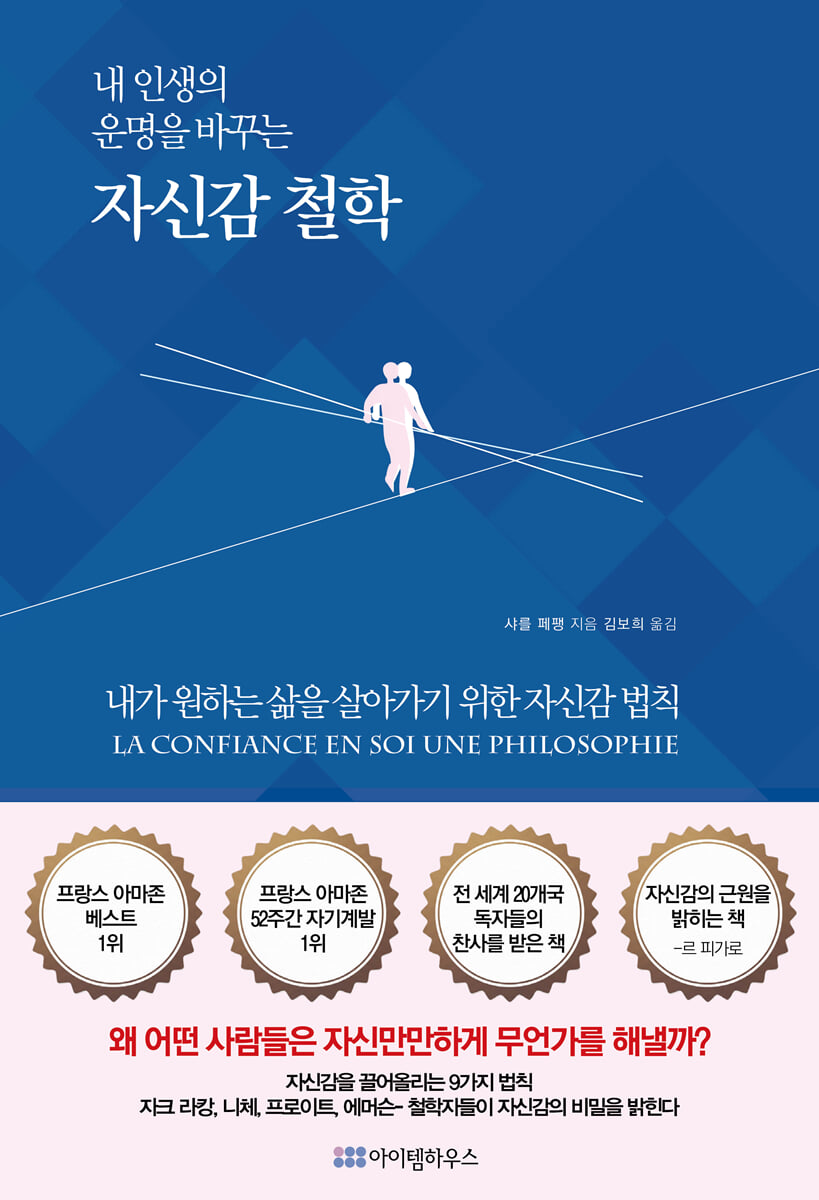
The Philosophy of Confidence That Changed the Destiny of My Life
 |
Description
Book Introduction
A single jump can make the difference between success and failure.
People stand at the edge of a bungee jump to enjoy the thrill of jumping, and sometimes to test and overcome their fears and terrors.
The height at which humans begin to feel fear is 11 meters (approximately the height of a 3rd or 4th floor apartment building), and it takes extreme courage and confidence to fly like a bird from a bungee jumping platform installed at an even higher height of 25 to 60 meters.
Standing on the edge of a cliff several tens of meters high, I draw out my deepest, most primal confidence and try to drive away my fear and terror with extreme self-hypnosis.
But some people jump and feel the utmost joy, while others end up turning back and sighing.
What does a failed bungee jumper need? Just one step.
They never felt the thrill of flying because they couldn't take a single step.
That one step is all about believing that I can do it, believing that I am safe, and believing that when I jump, I will feel the greatest joy.
It's just one step that determines the skill and score of divers who jump from a springboard and dive beautifully into the water.
It's about jumping with all the skills honed through training, the expectations of the cheering crowd, and the confidence that you can win.
The difference between those who succeed at something and those who don't is ultimately the difference between trying and hesitating and faltering.
Before doing something, you're bound to wonder, "Can I do it?"
How can all those hesitant, staggering thoughts turn into "I can do it. Let's do it." Just taking that extra 30 centimeters can change your life.
Uncover the secrets of how those small differences make a crucial difference.
People stand at the edge of a bungee jump to enjoy the thrill of jumping, and sometimes to test and overcome their fears and terrors.
The height at which humans begin to feel fear is 11 meters (approximately the height of a 3rd or 4th floor apartment building), and it takes extreme courage and confidence to fly like a bird from a bungee jumping platform installed at an even higher height of 25 to 60 meters.
Standing on the edge of a cliff several tens of meters high, I draw out my deepest, most primal confidence and try to drive away my fear and terror with extreme self-hypnosis.
But some people jump and feel the utmost joy, while others end up turning back and sighing.
What does a failed bungee jumper need? Just one step.
They never felt the thrill of flying because they couldn't take a single step.
That one step is all about believing that I can do it, believing that I am safe, and believing that when I jump, I will feel the greatest joy.
It's just one step that determines the skill and score of divers who jump from a springboard and dive beautifully into the water.
It's about jumping with all the skills honed through training, the expectations of the cheering crowd, and the confidence that you can win.
The difference between those who succeed at something and those who don't is ultimately the difference between trying and hesitating and faltering.
Before doing something, you're bound to wonder, "Can I do it?"
How can all those hesitant, staggering thoughts turn into "I can do it. Let's do it." Just taking that extra 30 centimeters can change your life.
Uncover the secrets of how those small differences make a crucial difference.
- You can preview some of the book's contents.
Preview
index
To Korean readers
Recommendation_Kim Kyung-jip (Humanist)
Prologue: Where Does Confidence Come From?
First Law
How is confidence built?
_There is one decisive word that brings out confidence.
1.
One word that will inspire confidence
2.
The miraculous moment when 'you can do it' turns into 'I can do it'
3.
Confidence begins with finding myself.
4.
Taking the first step into an unfamiliar place
Second Law
Skill is confidence
_Build solid skills that will make your fear disappear.
1.
The moment when skill leads to confidence
2.
Small successes build confidence.
3.
Small changes make a big difference
Third Law
I follow my heart
Self-confidence and self-trust breed self-confidence.
1.
Confidence is not being chased by time
2.
Confidence is not losing direction
Fourth Law
Confidence comes from determination.
How to choose and decide without hesitation
1.
Every decision is uncertain
2.
Decide before you take on the challenge
3.
Training to make decisions starting from small things
Fifth Law
Small successes build confidence.
How to Experience One Success Every Day
1.
How to Taste Success Every Day
2.
Homo Faber's Confidence Lesson
Law 6
Confidence is just a start
_How to enjoy even the unpredictable
1.
The moment you take a step
2.
Think while you act
Seventh Law
When you want to be like someone, you gain confidence.
_Find someone who will awaken my desires
1.
The power to keep moving forward without stopping
2.
How to live my own way
3.
How to find your own way
Law 8
Don't compare yourself to others
_How to live true to my desires
1.
'I', incomparable to anything else
2.
Desire is mine
Law 9
Confidence is believing in possibilities.
_How to believe that all good things lie ahead
1.
Taking a step outside of your comfort zone
2.
How to Tame Fear
Epilogue
Recommendation_Kim Kyung-jip (Humanist)
Prologue: Where Does Confidence Come From?
First Law
How is confidence built?
_There is one decisive word that brings out confidence.
1.
One word that will inspire confidence
2.
The miraculous moment when 'you can do it' turns into 'I can do it'
3.
Confidence begins with finding myself.
4.
Taking the first step into an unfamiliar place
Second Law
Skill is confidence
_Build solid skills that will make your fear disappear.
1.
The moment when skill leads to confidence
2.
Small successes build confidence.
3.
Small changes make a big difference
Third Law
I follow my heart
Self-confidence and self-trust breed self-confidence.
1.
Confidence is not being chased by time
2.
Confidence is not losing direction
Fourth Law
Confidence comes from determination.
How to choose and decide without hesitation
1.
Every decision is uncertain
2.
Decide before you take on the challenge
3.
Training to make decisions starting from small things
Fifth Law
Small successes build confidence.
How to Experience One Success Every Day
1.
How to Taste Success Every Day
2.
Homo Faber's Confidence Lesson
Law 6
Confidence is just a start
_How to enjoy even the unpredictable
1.
The moment you take a step
2.
Think while you act
Seventh Law
When you want to be like someone, you gain confidence.
_Find someone who will awaken my desires
1.
The power to keep moving forward without stopping
2.
How to live my own way
3.
How to find your own way
Law 8
Don't compare yourself to others
_How to live true to my desires
1.
'I', incomparable to anything else
2.
Desire is mine
Law 9
Confidence is believing in possibilities.
_How to believe that all good things lie ahead
1.
Taking a step outside of your comfort zone
2.
How to Tame Fear
Epilogue
Detailed image

Into the book
Looking at the paths taken by Madonna, Patrick Edranger, George Sand, Serena Williams, and countless others, we can see that confidence is not something you are born with, but something you have to cultivate.
Confidence is something that must always be earned through patience and hard work.
When the confidence you've built up reaches its peak, you'll encounter an opportunity that will bring you great joy.
--- p.18
“You are beautiful, incredibly talented, and have explosive charisma.” Years later, Madonna recalled that these words changed her life.
Until then, she had never felt confident.
But after hearing that, I was able to picture myself working as a dancer in New York.
--- p.29
We can gain the confidence that we can do it with just a few heartfelt words from a teacher or friend.
Words spoken from the heart are more than enough to bring confidence to a person's life.
A few sincere words from the heart will build your confidence, which will in turn give you the confidence to face the world.
--- p.32
Serena, who spent hours every day hitting balls and practicing throughout her life, didn't just train for tennis.
Every day, she has been honing her will and desire, her ability to overcome resistance and barriers.
The courage and confidence she displays today are a product of those experiences.
--- p.65
We stand in front of the mirror every morning and ask ourselves:
Should I wear a skirt or pants? A T-shirt or a dress shirt? Will these jeans look good on me? Is this really something I should be pondering for a long time?
This time, let's think back to when you were sitting at your desk at work.
There will be things to do written on post-its.
Where should I start? Training to build self-confidence and self-esteem begins with small things like these.
It's about learning how to make decisions quickly.
You will feel free in every moment you decide.
--- p.113
If you are true to your desires, you will not suffer from comparison.
Because I can no longer truly hurt myself.
Jacques Lacan said in “Ethics of Psychoanalysis” that “the only thing that deserves criticism is the surrender of desire.”
It means being true to yourself without ‘compromising your desires’, making yourself the center of your life, existing and living your own way.
Confidence is something that must always be earned through patience and hard work.
When the confidence you've built up reaches its peak, you'll encounter an opportunity that will bring you great joy.
--- p.18
“You are beautiful, incredibly talented, and have explosive charisma.” Years later, Madonna recalled that these words changed her life.
Until then, she had never felt confident.
But after hearing that, I was able to picture myself working as a dancer in New York.
--- p.29
We can gain the confidence that we can do it with just a few heartfelt words from a teacher or friend.
Words spoken from the heart are more than enough to bring confidence to a person's life.
A few sincere words from the heart will build your confidence, which will in turn give you the confidence to face the world.
--- p.32
Serena, who spent hours every day hitting balls and practicing throughout her life, didn't just train for tennis.
Every day, she has been honing her will and desire, her ability to overcome resistance and barriers.
The courage and confidence she displays today are a product of those experiences.
--- p.65
We stand in front of the mirror every morning and ask ourselves:
Should I wear a skirt or pants? A T-shirt or a dress shirt? Will these jeans look good on me? Is this really something I should be pondering for a long time?
This time, let's think back to when you were sitting at your desk at work.
There will be things to do written on post-its.
Where should I start? Training to build self-confidence and self-esteem begins with small things like these.
It's about learning how to make decisions quickly.
You will feel free in every moment you decide.
--- p.113
If you are true to your desires, you will not suffer from comparison.
Because I can no longer truly hurt myself.
Jacques Lacan said in “Ethics of Psychoanalysis” that “the only thing that deserves criticism is the surrender of desire.”
It means being true to yourself without ‘compromising your desires’, making yourself the center of your life, existing and living your own way.
--- p.180
Publisher's Review
How do people who eventually succeed behave?
So how can we cultivate confidence, the most important thing in life? French philosopher and author Charles Pépin first explores the answer through a young child riding a two-wheeled bicycle.
The moment a child who has been riding a four-wheeled bicycle finally takes off the training wheels and rides a two-wheeled bicycle is the moment of confidence and joy that he or she feels for the first time in his or her life.
There are three driving forces that can help a child gain confidence at this time.
The belief that my father is holding me securely from behind, the belief in my ability to run as I have practiced, and the joy and satisfaction I feel when riding a two-wheeled bicycle.
In this way, confidence is created through the combination of many factors, much like alchemy.
Is there a way to regain the confidence I once had? Can't we live each day feeling that confidence? To uncover the secret, we need to examine the paths taken by those who live with extraordinary confidence.
Looking at them, we can see that confidence is not something that is innate, but something that is created.
Looking back at the lives of Madonna, Patrick Edranger, George Sand, Serena Williams, and others, we can see how confidence develops.
Madonna, who exudes explosive charisma and delivers groundbreaking performances on stage, was neither talented nor a child with high self-esteem.
But Madonna's life changed with a single word from her dance teacher, Miss Flynn.
The moment she heard the words, “You are beautiful, talented, and have explosive charisma,” the confidence that had been dormant in Madonna’s heart came alive.
A look at the growth of world-class tennis player Serena Williams shows that confidence comes from skill, and that skill is honed through intense training.
As you train by constantly repeating the same movements, your skills will gradually become second nature and you will eventually gain confidence.
Of course, even if you don't have a good teacher nearby like these or haven't been developing your skills since you were four, there are ways to build confidence in your everyday life.
Just taking a quiet moment once a week to reflect on your own feelings, to quickly decide on small things like, "Should I wear a skirt or pants today? Should I wear a T-shirt or a dress shirt?" Just developing the habit of doing this will boost your confidence.
Anyone can become a confidence expert by following these nine rules and training methods to build confidence, from developing skills and knowledge to small, everyday practices.
Where does confidence come from?
So what is the foundation of self-confidence? It's self-belief, or self-trust.
To uncover the source of this confidence, we must listen to philosophers such as Emerson, Nietzsche, Bergson, and Jacques Lacan.
Jacques Lacan reveals the secret of self-confidence through his theory of the 'mirror stage'.
A child standing in front of a mirror in the arms of an adult immediately looks back at the adult to confirm his or her own reflection.
It means being recognized as oneself through others.
In this way, confidence comes from relationships with others.
The source of confidence can also be found in Nietzsche's words, "Be who you are."
People who compare themselves to others by following prevailing morals or norms can never be confident.
People who boldly live their authentic lives know how to confidently express their most intense desires.
Bergson argues that humans are closer to Homo faber (tool-using humans) than to Homo sapiens (thinking humans), and that we can draw confidence from our creative nature.
If you experience a sense of accomplishment from small activities in your daily life, such as making something yourself or fixing an electrical appliance, you will gradually build up your confidence and be able to take on bigger challenges.
We also find the secrets of self-confidence in the experiences of athletes, fighter pilots, and rescue workers, and in the research of psychologists, psychoanalysts, and educators.
So how can we cultivate confidence, the most important thing in life? French philosopher and author Charles Pépin first explores the answer through a young child riding a two-wheeled bicycle.
The moment a child who has been riding a four-wheeled bicycle finally takes off the training wheels and rides a two-wheeled bicycle is the moment of confidence and joy that he or she feels for the first time in his or her life.
There are three driving forces that can help a child gain confidence at this time.
The belief that my father is holding me securely from behind, the belief in my ability to run as I have practiced, and the joy and satisfaction I feel when riding a two-wheeled bicycle.
In this way, confidence is created through the combination of many factors, much like alchemy.
Is there a way to regain the confidence I once had? Can't we live each day feeling that confidence? To uncover the secret, we need to examine the paths taken by those who live with extraordinary confidence.
Looking at them, we can see that confidence is not something that is innate, but something that is created.
Looking back at the lives of Madonna, Patrick Edranger, George Sand, Serena Williams, and others, we can see how confidence develops.
Madonna, who exudes explosive charisma and delivers groundbreaking performances on stage, was neither talented nor a child with high self-esteem.
But Madonna's life changed with a single word from her dance teacher, Miss Flynn.
The moment she heard the words, “You are beautiful, talented, and have explosive charisma,” the confidence that had been dormant in Madonna’s heart came alive.
A look at the growth of world-class tennis player Serena Williams shows that confidence comes from skill, and that skill is honed through intense training.
As you train by constantly repeating the same movements, your skills will gradually become second nature and you will eventually gain confidence.
Of course, even if you don't have a good teacher nearby like these or haven't been developing your skills since you were four, there are ways to build confidence in your everyday life.
Just taking a quiet moment once a week to reflect on your own feelings, to quickly decide on small things like, "Should I wear a skirt or pants today? Should I wear a T-shirt or a dress shirt?" Just developing the habit of doing this will boost your confidence.
Anyone can become a confidence expert by following these nine rules and training methods to build confidence, from developing skills and knowledge to small, everyday practices.
Where does confidence come from?
So what is the foundation of self-confidence? It's self-belief, or self-trust.
To uncover the source of this confidence, we must listen to philosophers such as Emerson, Nietzsche, Bergson, and Jacques Lacan.
Jacques Lacan reveals the secret of self-confidence through his theory of the 'mirror stage'.
A child standing in front of a mirror in the arms of an adult immediately looks back at the adult to confirm his or her own reflection.
It means being recognized as oneself through others.
In this way, confidence comes from relationships with others.
The source of confidence can also be found in Nietzsche's words, "Be who you are."
People who compare themselves to others by following prevailing morals or norms can never be confident.
People who boldly live their authentic lives know how to confidently express their most intense desires.
Bergson argues that humans are closer to Homo faber (tool-using humans) than to Homo sapiens (thinking humans), and that we can draw confidence from our creative nature.
If you experience a sense of accomplishment from small activities in your daily life, such as making something yourself or fixing an electrical appliance, you will gradually build up your confidence and be able to take on bigger challenges.
We also find the secrets of self-confidence in the experiences of athletes, fighter pilots, and rescue workers, and in the research of psychologists, psychoanalysts, and educators.
GOODS SPECIFICS
- Date of issue: October 15, 2025
- Page count, weight, size: 212 pages | 140*205*20mm
- ISBN13: 9791157771745
- ISBN10: 1157771742
You may also like
카테고리
korean


korean

![ELLE 엘르 스페셜 에디션 A형 : 12월 [2025]](http://librairie.coreenne.fr/cdn/shop/files/b8e27a3de6c9538896439686c6b0e8fb.jpg?v=1766436872&width=3840)


