

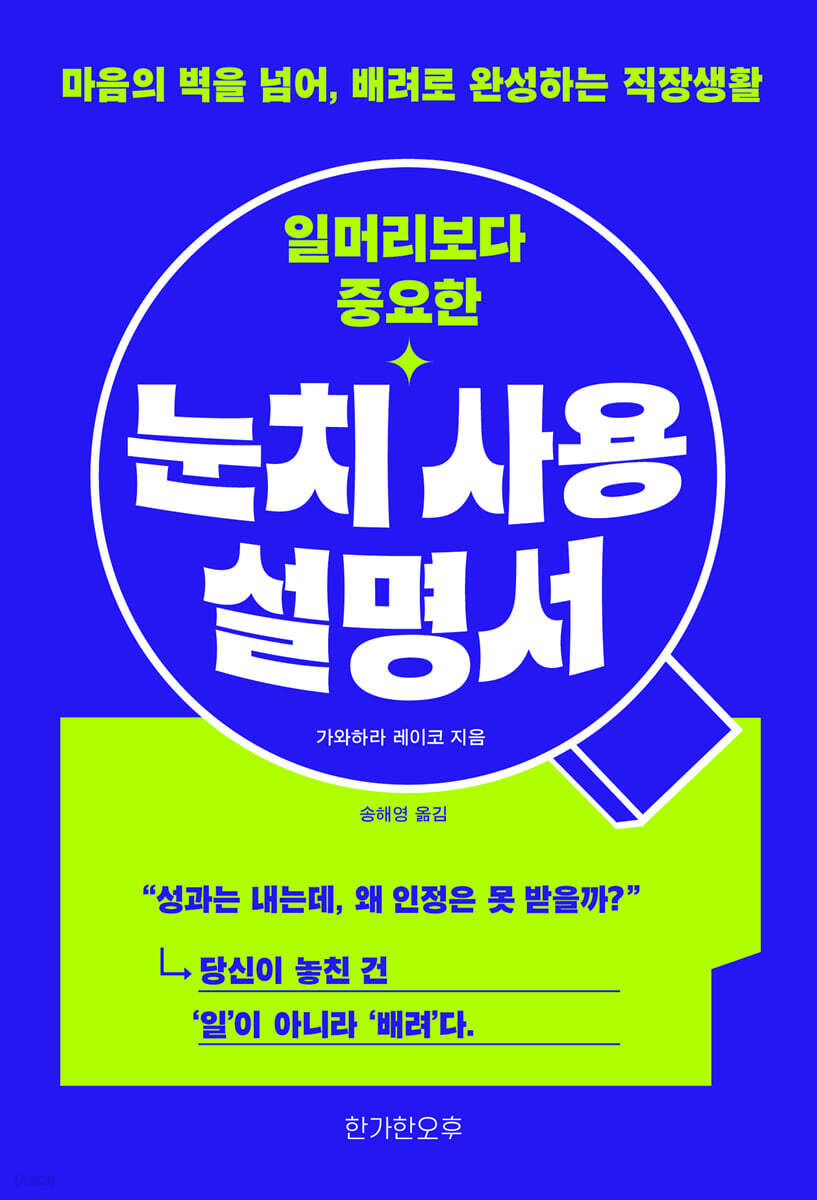
A user manual that is more important than the job
 |
Description
Book Introduction
I'm getting results, but why don't I get any recognition?
What you're missing isn't work, it's consideration.
Achievements leave behind numbers, consideration leaves behind people.
Although they are neat and tidy and have excellent performance, important opportunities in the organization sometimes go to others.
"The Guide to Using Eyes That Are More Important Than Work" finds the reason in the invisible power of 'eyes' and 'consideration.'
The tact we are talking about here is not a superficial way of dealing with the world.
It refers to the sense of first understanding the other person's feelings, sensing even small discomforts in advance, and naturally leading to consideration.
Based on his lectures and consulting experience with over 200 companies and 20,000 employees, the author discusses two barriers that hinder tact and consideration.
One is the 'wall in my heart', which refers to the psychological barrier that prevents us from putting consideration into action because we hesitate to help someone out, thinking, 'Isn't that just meddling?'
The other is the 'wall in the other person's mind', which refers to the area of the other person's emotions and thoughts that should not be crossed, that is, a line that requires respect.
Consideration begins when we overcome the 'wall in our hearts', and consideration is completed only when we protect the 'wall in the other person's hearts'.
This book uses 'good memories from my time' as a standard for consideration, and provides specific practical methods to turn being considerate into being considerate.
It's full of considerate methods you can use right now at work, such as 'How to write emails that save the other person time,' 'How to conduct meetings that address sensitive issues,' and 'How to give concise and clear feedback.'
And it organizes the moments when office workers feel the most stress into five keywords: ‘limitation, notice, sharing, area, and memory’, and also suggests ways to wisely deal with those situations.
It shows that consideration can reduce workplace conflict and stress and increase work efficiency.
In a workplace where performance and efficiency are emphasized, winning people's hearts and minds is the true driving force behind efficiency and growth.
The techniques of consideration contained in "The Instruction Manual for Using Perception, More Important Than Work" may seem so trivial that you might wonder, "Is this all there is to it?"
But these small considerations can move the other person's heart and lead to new business opportunities.
The more trivial and easy to overlook something is, the fewer people will put it into practice, so its effect is even greater.
As you read this book, I hope you compare it to your own experiences and try to overcome the barrier of being conscious of others and practice small acts of consideration one by one.
Small considerations will make a big difference in your life.
What you're missing isn't work, it's consideration.
Achievements leave behind numbers, consideration leaves behind people.
Although they are neat and tidy and have excellent performance, important opportunities in the organization sometimes go to others.
"The Guide to Using Eyes That Are More Important Than Work" finds the reason in the invisible power of 'eyes' and 'consideration.'
The tact we are talking about here is not a superficial way of dealing with the world.
It refers to the sense of first understanding the other person's feelings, sensing even small discomforts in advance, and naturally leading to consideration.
Based on his lectures and consulting experience with over 200 companies and 20,000 employees, the author discusses two barriers that hinder tact and consideration.
One is the 'wall in my heart', which refers to the psychological barrier that prevents us from putting consideration into action because we hesitate to help someone out, thinking, 'Isn't that just meddling?'
The other is the 'wall in the other person's mind', which refers to the area of the other person's emotions and thoughts that should not be crossed, that is, a line that requires respect.
Consideration begins when we overcome the 'wall in our hearts', and consideration is completed only when we protect the 'wall in the other person's hearts'.
This book uses 'good memories from my time' as a standard for consideration, and provides specific practical methods to turn being considerate into being considerate.
It's full of considerate methods you can use right now at work, such as 'How to write emails that save the other person time,' 'How to conduct meetings that address sensitive issues,' and 'How to give concise and clear feedback.'
And it organizes the moments when office workers feel the most stress into five keywords: ‘limitation, notice, sharing, area, and memory’, and also suggests ways to wisely deal with those situations.
It shows that consideration can reduce workplace conflict and stress and increase work efficiency.
In a workplace where performance and efficiency are emphasized, winning people's hearts and minds is the true driving force behind efficiency and growth.
The techniques of consideration contained in "The Instruction Manual for Using Perception, More Important Than Work" may seem so trivial that you might wonder, "Is this all there is to it?"
But these small considerations can move the other person's heart and lead to new business opportunities.
The more trivial and easy to overlook something is, the fewer people will put it into practice, so its effect is even greater.
As you read this book, I hope you compare it to your own experiences and try to overcome the barrier of being conscious of others and practice small acts of consideration one by one.
Small considerations will make a big difference in your life.
- You can preview some of the book's contents.
Preview
index
Entering
There's something special about people who are attracted to the director.
Part 1: Two Walls Blocking Consideration
01 How to overcome your own wall
Consideration begins with the heart that does not expect anything in return, the first wall of one's own.
The Change in Relationships That "Morning Greeting" Creates in Your Wall 2
Change your own wall 3 'I'm sorry' to 'Thank you'
The power of 'calling names' to break down the walls of your heart.
Talk to your own wall 5 'outside guests' first
02 How to Respect the Other Person's Wall
Opponent's Wall 1: Avoid using 'rough expressions' as much as possible
The Opponent's Wall 2: Take responsibility for your actions and don't try to cover them up.
Frequently check to see if the other person's wall 3 'looks like it's difficult to talk to them'
Offering a Chair to Someone Who Comes for Counseling: The Wall of the Other Party 4
Arrive 15 minutes early for your appointment
How to Write an Email That Will Elicit a "Reply" from Your Opponent
Part 2: Five Ways to Make Consideration a Habit
01 The 'Hanjeong' technique that reduces decision stress
Limited 1 A word to ease the 'burden of questions'
No more formal 'Are you okay?'!
For a definitive message, add a small kindness to your assertion.
Limit 4: Instead of a single answer like 'yes', 'answer with a sentence'
In Limited 5 Messenger, 'Reply quickly and concisely'
6 Tips for Writing Emails That Save Your Respondent's Time
When apologizing via email, only mention it at the beginning and end.
02 The power of 'notice' to relieve the other person's anxiety
Tip 1: Ask first via 'Message' before making a call
Notice 2: 'You will be asked to speak during the meeting'
The 'meeting scenario' that sets the tone for the third meeting
Preview 4: Set a 'meeting end time' in advance
Trailer 5: How to Use "Reminder Mail" to Eliminate Misunderstandings
03 The attitude of 'sharing', sharing information rather than giving answers
Share 1 Good things to say when 'advice gets long'
Share 2 'Feedback' should be concise and clear
Share 3 'Once pointed out, don't mention it again'
Share 4: Saying a 'Warm Word' to Someone About to Do Something Important
Share 5: Never flaunt what you've learned through pre-investigation.
Share 6 'Visualizing' the purpose of work
04 The art of 'territory' that respects the opponent's space
Area 1: Tell the 'parts you like' as they are
Area 2: Listen to the other person's circumstances before making a point.
Area 3: Issue Raising Emails: Express your concerns first and then conclude with suggestions.
Area 4: When making a request, give the other person the opportunity to refuse.
Area 5: Write your rejection email from the 'conclusion'
Responding to "light conversation" in Area 6 emails
05 The power of 'memory' that gives comfort to others
Memory 1: Remembering the 'Invisible Toil'
Memory 2: Approaching a 'Dejected Colleague' First
Memory 3: Praise should be given 'when the person is not present'
Memory 4: Ending any situation with "It's fortunate that it's still like that"
Remember 5: Always keep even the smallest promises.
Memory 6: How to Keep a Relationship Going After a Rejection
Memory 7: The Secret to a 'Long-Lasting Relationship'
Coming out
There's something special about people who are attracted to the director.
Part 1: Two Walls Blocking Consideration
01 How to overcome your own wall
Consideration begins with the heart that does not expect anything in return, the first wall of one's own.
The Change in Relationships That "Morning Greeting" Creates in Your Wall 2
Change your own wall 3 'I'm sorry' to 'Thank you'
The power of 'calling names' to break down the walls of your heart.
Talk to your own wall 5 'outside guests' first
02 How to Respect the Other Person's Wall
Opponent's Wall 1: Avoid using 'rough expressions' as much as possible
The Opponent's Wall 2: Take responsibility for your actions and don't try to cover them up.
Frequently check to see if the other person's wall 3 'looks like it's difficult to talk to them'
Offering a Chair to Someone Who Comes for Counseling: The Wall of the Other Party 4
Arrive 15 minutes early for your appointment
How to Write an Email That Will Elicit a "Reply" from Your Opponent
Part 2: Five Ways to Make Consideration a Habit
01 The 'Hanjeong' technique that reduces decision stress
Limited 1 A word to ease the 'burden of questions'
No more formal 'Are you okay?'!
For a definitive message, add a small kindness to your assertion.
Limit 4: Instead of a single answer like 'yes', 'answer with a sentence'
In Limited 5 Messenger, 'Reply quickly and concisely'
6 Tips for Writing Emails That Save Your Respondent's Time
When apologizing via email, only mention it at the beginning and end.
02 The power of 'notice' to relieve the other person's anxiety
Tip 1: Ask first via 'Message' before making a call
Notice 2: 'You will be asked to speak during the meeting'
The 'meeting scenario' that sets the tone for the third meeting
Preview 4: Set a 'meeting end time' in advance
Trailer 5: How to Use "Reminder Mail" to Eliminate Misunderstandings
03 The attitude of 'sharing', sharing information rather than giving answers
Share 1 Good things to say when 'advice gets long'
Share 2 'Feedback' should be concise and clear
Share 3 'Once pointed out, don't mention it again'
Share 4: Saying a 'Warm Word' to Someone About to Do Something Important
Share 5: Never flaunt what you've learned through pre-investigation.
Share 6 'Visualizing' the purpose of work
04 The art of 'territory' that respects the opponent's space
Area 1: Tell the 'parts you like' as they are
Area 2: Listen to the other person's circumstances before making a point.
Area 3: Issue Raising Emails: Express your concerns first and then conclude with suggestions.
Area 4: When making a request, give the other person the opportunity to refuse.
Area 5: Write your rejection email from the 'conclusion'
Responding to "light conversation" in Area 6 emails
05 The power of 'memory' that gives comfort to others
Memory 1: Remembering the 'Invisible Toil'
Memory 2: Approaching a 'Dejected Colleague' First
Memory 3: Praise should be given 'when the person is not present'
Memory 4: Ending any situation with "It's fortunate that it's still like that"
Remember 5: Always keep even the smallest promises.
Memory 6: How to Keep a Relationship Going After a Rejection
Memory 7: The Secret to a 'Long-Lasting Relationship'
Coming out
Detailed image

Into the book
Consideration isn't always a good thing.
It is important not to invade the other person's territory, not to go too far, and to know when to back off.
First of all, we must keep in mind that just as there is a wall in our hearts, there is also a wall in the hearts of others.
At this time, it is good to use yourself as a standard.
This way, we can be considerate while maintaining an appropriate distance without tiring either ourselves or the other person.
--- p.23
There is a way to talk naturally.
Rather than making a resolution to do something good, approach it with a light heart, like, "I'm curious about the situation. Should I look into it?"
It's okay if you don't get a thank you or if you seem like a nosy person.
As explained on page 52, it is more important to have a mind that does not expect anything in return.
--- p.67
Also, be careful not to go overboard when giving advice.
I should avoid getting carried away by the thought of helping and just showing off my knowledge.
The other person just wanted some simple advice, but you need to reflect on whether you are tiring them out by assuming situations that will never happen.
I'll go into more detail later, but the key, whether it's feedback or advice, is to keep it short.
--- p.83
They say the biggest reason young people these days are reluctant to get promoted is because of the increased responsibility.
The responsibility we are talking about here includes not only correcting team members' mistakes, but also guiding and sometimes even scolding juniors.
Some people may feel dizzy at these words.
It may be an uncomfortable role, of course, but if we are to properly teach our juniors the job, it is a role that someone must take on.
--- p.145
In Adlerian psychology, 'giving courage' refers to 'giving energy to others so that they can solve their own problems.'
And one way to encourage others is to 'bring out your strengths'.
It's about pointing out and mentioning a part of the other person's behavior that you think is 'okay'.
But we may be more accustomed to 'pointing out flaws'.
--- p.163
Consistent consideration builds trust, and that trust leads to visible results and outcomes, better opportunities, and luck.
Nowadays, job-changing is common.
No matter how great your previous experience was, you may have to adapt methods or techniques that only worked there from scratch in a new environment.
But the power to overcome the 'wall of perception' works everywhere.
It will serve as your strong weapon in your new job and help you quickly win people's hearts.
But don't try too hard, just start with a goal of 60 points.
It is important not to invade the other person's territory, not to go too far, and to know when to back off.
First of all, we must keep in mind that just as there is a wall in our hearts, there is also a wall in the hearts of others.
At this time, it is good to use yourself as a standard.
This way, we can be considerate while maintaining an appropriate distance without tiring either ourselves or the other person.
--- p.23
There is a way to talk naturally.
Rather than making a resolution to do something good, approach it with a light heart, like, "I'm curious about the situation. Should I look into it?"
It's okay if you don't get a thank you or if you seem like a nosy person.
As explained on page 52, it is more important to have a mind that does not expect anything in return.
--- p.67
Also, be careful not to go overboard when giving advice.
I should avoid getting carried away by the thought of helping and just showing off my knowledge.
The other person just wanted some simple advice, but you need to reflect on whether you are tiring them out by assuming situations that will never happen.
I'll go into more detail later, but the key, whether it's feedback or advice, is to keep it short.
--- p.83
They say the biggest reason young people these days are reluctant to get promoted is because of the increased responsibility.
The responsibility we are talking about here includes not only correcting team members' mistakes, but also guiding and sometimes even scolding juniors.
Some people may feel dizzy at these words.
It may be an uncomfortable role, of course, but if we are to properly teach our juniors the job, it is a role that someone must take on.
--- p.145
In Adlerian psychology, 'giving courage' refers to 'giving energy to others so that they can solve their own problems.'
And one way to encourage others is to 'bring out your strengths'.
It's about pointing out and mentioning a part of the other person's behavior that you think is 'okay'.
But we may be more accustomed to 'pointing out flaws'.
--- p.163
Consistent consideration builds trust, and that trust leads to visible results and outcomes, better opportunities, and luck.
Nowadays, job-changing is common.
No matter how great your previous experience was, you may have to adapt methods or techniques that only worked there from scratch in a new environment.
But the power to overcome the 'wall of perception' works everywhere.
It will serve as your strong weapon in your new job and help you quickly win people's hearts.
But don't try too hard, just start with a goal of 60 points.
--- p.223
Publisher's Review
Only those who are considerate of others
You can reach heights you never imagined possible.
★ Solving problems in the workplace begins with realizing the 'power of consideration'!
★ Learn practical, 1,000% practical consideration from a solution consultant!
Team Leader Park has been having a lot of worries lately.
I worked harder than anyone else since I was a new employee and was promoted quickly, but since becoming a team leader, I feel like I've hit a wall with my work and it's frustrating.
Even when I give advice to my juniors based on my own experience, the atmosphere somehow feels awkward.
Now I realize that it is difficult to survive in the workplace just by following the principles I have been following.
The situation is no different for Manager Kim.
Although he is good at his job, he feels like an outcast among his colleagues because of his reputation as a 'clueless person'.
Their problem is not special.
This is a common concern for many office workers, and the cause lies in the 'wall of being mindful of others' that cannot be overcome and the 'consideration' that cannot be put into practice.
"The Guide to Using Consideration, More Important Than Work," argues that in an era where organizational culture prioritizes performance and efficiency and generational conflict and individualism are growing stronger, "consideration" is a key competency for survival in the workplace.
What's surprising is that even the MZ generation, known for its individualistic tendencies, values teamwork and a sense of belonging.
In other words, although today's workers seek autonomy, they cannot survive long in organizations where relationships and communication are cut off.
In these times, 'consideration' is the only link that connects people's hearts in the workplace.
Even just saying a word first and considering the other person's position first is the starting point for changing the atmosphere of the organization.
This book is not a self-help book that simply tells you to 'behave well in an organization.'
As performance pressures increase and opportunities to share authentic feelings with colleagues diminish, it becomes clear that empathy and a caring attitude are the true force that creates change.
"The Guide to Using Perception, More Important Than Work" is a must-read for office workers that teaches them how to overcome the barriers in relationships they encounter, win people's hearts, and grow.
I hope this book will serve as a reliable guide for you on your way to work today.
You can reach heights you never imagined possible.
★ Solving problems in the workplace begins with realizing the 'power of consideration'!
★ Learn practical, 1,000% practical consideration from a solution consultant!
Team Leader Park has been having a lot of worries lately.
I worked harder than anyone else since I was a new employee and was promoted quickly, but since becoming a team leader, I feel like I've hit a wall with my work and it's frustrating.
Even when I give advice to my juniors based on my own experience, the atmosphere somehow feels awkward.
Now I realize that it is difficult to survive in the workplace just by following the principles I have been following.
The situation is no different for Manager Kim.
Although he is good at his job, he feels like an outcast among his colleagues because of his reputation as a 'clueless person'.
Their problem is not special.
This is a common concern for many office workers, and the cause lies in the 'wall of being mindful of others' that cannot be overcome and the 'consideration' that cannot be put into practice.
"The Guide to Using Consideration, More Important Than Work," argues that in an era where organizational culture prioritizes performance and efficiency and generational conflict and individualism are growing stronger, "consideration" is a key competency for survival in the workplace.
What's surprising is that even the MZ generation, known for its individualistic tendencies, values teamwork and a sense of belonging.
In other words, although today's workers seek autonomy, they cannot survive long in organizations where relationships and communication are cut off.
In these times, 'consideration' is the only link that connects people's hearts in the workplace.
Even just saying a word first and considering the other person's position first is the starting point for changing the atmosphere of the organization.
This book is not a self-help book that simply tells you to 'behave well in an organization.'
As performance pressures increase and opportunities to share authentic feelings with colleagues diminish, it becomes clear that empathy and a caring attitude are the true force that creates change.
"The Guide to Using Perception, More Important Than Work" is a must-read for office workers that teaches them how to overcome the barriers in relationships they encounter, win people's hearts, and grow.
I hope this book will serve as a reliable guide for you on your way to work today.
GOODS SPECIFICS
- Date of issue: November 3, 2025
- Page count, weight, size: 224 pages | 298g | 128*188*19mm
- ISBN13: 9791199040663
- ISBN10: 1199040665
You may also like
카테고리
korean


korean

![GQ KOREA Mark (Monthly): December [2025]](http://librairie.coreenne.fr/cdn/shop/files/8ef265dbbfbf186523ed75ba7319009d.jpg?v=1765340328&width=3840)


