

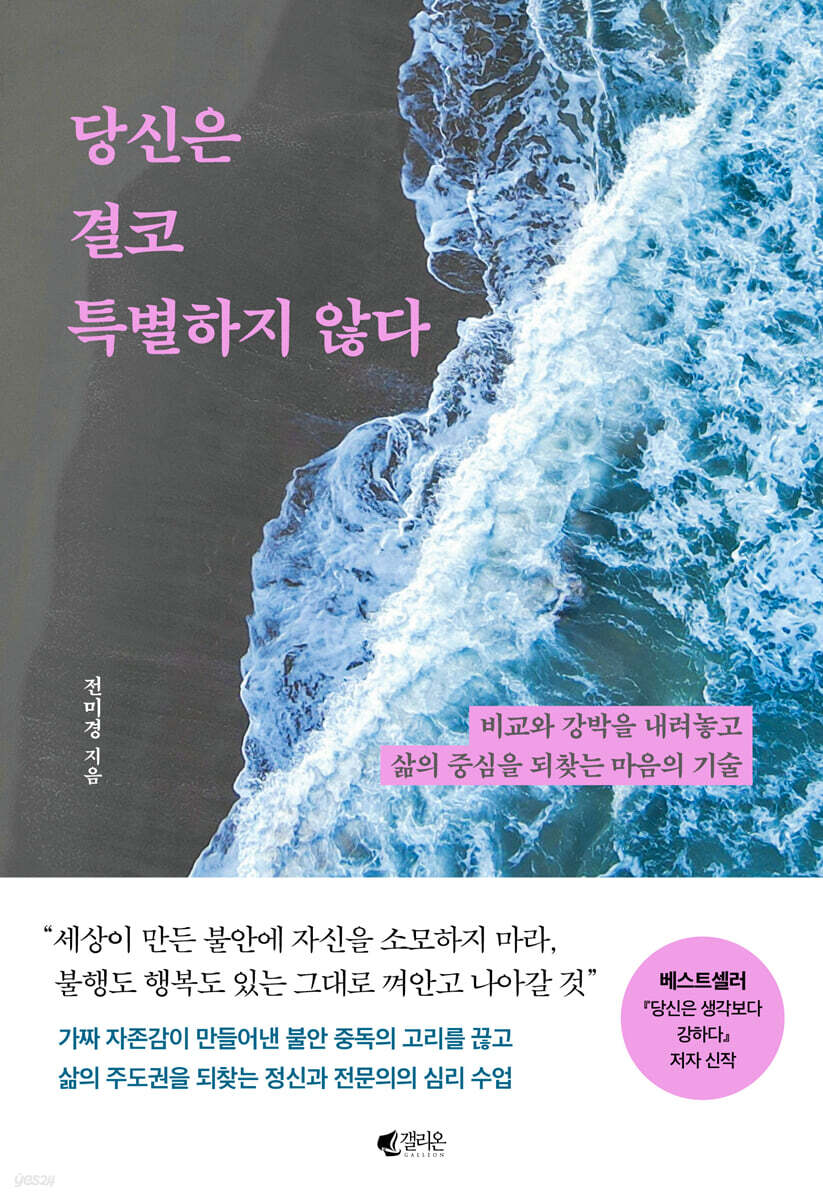
You are never special
 |
Description
Book Introduction
A new book by Jeon Mi-kyung, author of the best-selling book "You Are Stronger Than You Think."
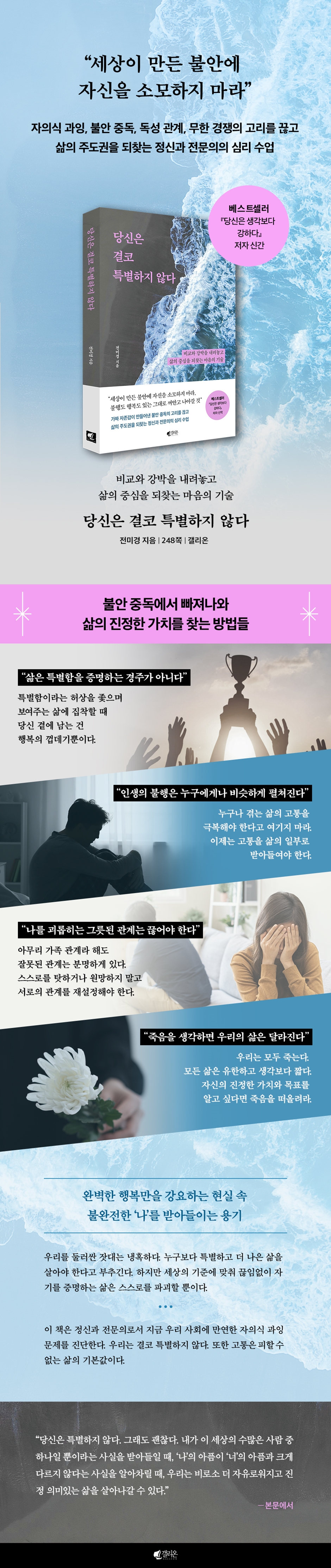
Break the cycle of anxiety addiction created by false self-esteem
A psychology class from a psychiatrist to help you regain control of your life
Psychiatrist Jeon Mi-kyung, author of the best-selling book “You Are Stronger Than You Think,” has returned with her new book, “You Are Not Special at All.”
In a society that constantly pressures us to be special, we trap ourselves in anxiety and obsession, making ourselves sick by comparing ourselves to others and pushing ourselves too hard.
This book guides you through breaking free from the obsession with success and comparison and finding your true self in the midst of ordinary life.
In this book, the author analyzes the cases of various patients who visited the psychiatric clinic and the stories of characters in novels and movies, and diagnoses that while each person's situation and the extent of their suffering may be different, at the root of all of them lies an obsession with being special and an addiction to anxiety stemming from false self-esteem.
It convincingly demonstrates that one is not alone in suffering, and that only when one silently accepts that pain and anxiety are an inescapable part of life can one truly escape from it.
For those who want to re-examine the essence of life and those who still live anxious lives, this book will present the great value of being ordinary.
Break the cycle of anxiety addiction created by false self-esteem
A psychology class from a psychiatrist to help you regain control of your life
Psychiatrist Jeon Mi-kyung, author of the best-selling book “You Are Stronger Than You Think,” has returned with her new book, “You Are Not Special at All.”
In a society that constantly pressures us to be special, we trap ourselves in anxiety and obsession, making ourselves sick by comparing ourselves to others and pushing ourselves too hard.
This book guides you through breaking free from the obsession with success and comparison and finding your true self in the midst of ordinary life.
In this book, the author analyzes the cases of various patients who visited the psychiatric clinic and the stories of characters in novels and movies, and diagnoses that while each person's situation and the extent of their suffering may be different, at the root of all of them lies an obsession with being special and an addiction to anxiety stemming from false self-esteem.
It convincingly demonstrates that one is not alone in suffering, and that only when one silently accepts that pain and anxiety are an inescapable part of life can one truly escape from it.
For those who want to re-examine the essence of life and those who still live anxious lives, this book will present the great value of being ordinary.
- You can preview some of the book's contents.
Preview
index
Prologue - On a Free Life Unswayed by the World and Others
Chapter 1 - The Illusion That You Are Special
: Things that are nothing special when they pass, and as I live, I am nothing special
CCTV we installed ourselves
You are never special
The front and back of our lives
Finding the Self in the Illusion of Perfection
Honesty cannot be a weapon.
Who am I in the mirror?
In search of true ordinariness
Chapter 2 - The Illusion That Misfortune Must Be Eliminated from Life
: Anyway, we are all suffering for our own reasons.
Why does this only happen to me?
A life dancing in step with misfortune
We are all imperfect
About the power to somehow get better
Life is uncontrollable
Breaking free from the prison of perfection
How to Live in a Connected World
The fantasy of survival games and misfortune that have become routine
Chapter 3 - The Illusion That Other People Are Hell
: Other people's lives, not mine, my life that others don't live
You are not the main character in a drama
True Relationships in a World of Blackmail
A gift from a strange encounter
The pattern of reweaving relationships
Self-created hell
On the Courage to Accept Pain
Truly facing the existence of others
Chapter 4 - The Illusion of Infinite Life
: Life ends anyway
A Psychiatrist's Reflections on Death
A new lens through which to view life
How to Accept Death
What a Terminal Diagnosis Taught Us About Life
The dance from having to being
Ginkgo trees and the Colorado Highway
Chapter 1 - The Illusion That You Are Special
: Things that are nothing special when they pass, and as I live, I am nothing special
CCTV we installed ourselves
You are never special
The front and back of our lives
Finding the Self in the Illusion of Perfection
Honesty cannot be a weapon.
Who am I in the mirror?
In search of true ordinariness
Chapter 2 - The Illusion That Misfortune Must Be Eliminated from Life
: Anyway, we are all suffering for our own reasons.
Why does this only happen to me?
A life dancing in step with misfortune
We are all imperfect
About the power to somehow get better
Life is uncontrollable
Breaking free from the prison of perfection
How to Live in a Connected World
The fantasy of survival games and misfortune that have become routine
Chapter 3 - The Illusion That Other People Are Hell
: Other people's lives, not mine, my life that others don't live
You are not the main character in a drama
True Relationships in a World of Blackmail
A gift from a strange encounter
The pattern of reweaving relationships
Self-created hell
On the Courage to Accept Pain
Truly facing the existence of others
Chapter 4 - The Illusion of Infinite Life
: Life ends anyway
A Psychiatrist's Reflections on Death
A new lens through which to view life
How to Accept Death
What a Terminal Diagnosis Taught Us About Life
The dance from having to being
Ginkgo trees and the Colorado Highway
Detailed image
Into the book
I often meet special people in my clinic.
To be more precise, they are people who believe that they are special.
During conversations, they try hard to prove that they are different from others by subtly mentioning the size of the apartment they live in, their children's colleges, or even touting their titles.
Jeffrey Young, a renowned American psychologist, called this phenomenon the “privilege trap.”
This is different from simple confidence.
Healthy self-confidence is a pride based on one's own accomplishments and abilities, whereas a sense of entitlement stems from an unrealistic sense of superiority.
They believe they deserve exceptional treatment and are allowed to deviate from the normal rules and obligations.
---「p.
28. From "You Are Never Special"
Real change in our lives doesn't begin like a mighty river.
It comes from a small stream.
Take just five minutes before going to bed to reflect on your emotions from that day.
Ask yourself, "How did I feel today? What choices did I make, and why?"
Stop by a bookstore you don't usually go to to pick out a new book, or ask your family, "What are you thinking about these days?"
These small practices accumulate and guide us on the path to self-realization.
The journey to self-realization doesn't proceed with dramatic transformations like the protagonists in the movies.
Change in reality is slow, sometimes painful, and requires a lot of patience.
---「p.
49-50, from "Finding the Self in the Illusion of Perfection"
Today's daily life is filled with the process of constantly creating and consuming self-image.
We start our day by directing ourselves in front of the mirror, and that directing continues throughout the day, extending into the digital world.
Their Instagram feeds showcase their perfectly polished daily lives, their Facebook timelines project images of success, and their LinkedIn profiles project a professional image.
Just as light passes through a prism and is scattered into a variety of colors, a single self is dispersed into countless images, but within them, there is always an obsession to appear as a better person.
The hidden face within, our true face that is not reflected in any mirror, is anxious, lonely, and sometimes even empty.
When you put down your smartphone at the end of the day and find yourself alone, think about that unfamiliar, honest face you suddenly encounter.
---「p.
60-61, from "Who am I reflected in the mirror?"
When we face suffering, we choose one of three approaches.
The first is overcoming.
Modern society constantly demands overcoming.
The sayings “anything is possible if you try” and “nothing is impossible” surround us.
This type of effort can sometimes be a driving force for growth.
But humans cannot overcome all suffering.
Attempts to overcome unavoidable suffering, such as death or loss, and misfortunes that cannot be changed through our own efforts, only lead us into deeper despair.
---「p.
78-79, from "Why Does This Only Happen to Me?"
“When I look at social media, it seems like everyone else is doing well, but I feel like I’m falling behind.” “Everyone else seems happy, so why am I like this?” Their words are filled with the fear that they are lacking.
In a world surrounded by perfect images, they grow weary of hiding their imperfections.
But in Japan, there is a different way of looking at this imperfection.
The traditional craft called ‘Kintsugi’ is exactly that.
This technique of reattaching broken ceramics with lacquer mixed with gold dust makes them shine with gold instead of hiding scratches and cracks.
Just as broken places can become new beauty, the cracks and wounds in our lives can become golden seams that make us deeper human beings.
---「p.
91, from “A Life Dancing in Step with Misfortune”
In human relationships, sometimes a mask is necessary.
It may be essential for all of us living in the modern age.
But if that mask becomes too firmly in place, we end up losing ourselves.
What's even scarier is that you lose interest in other people.
Just as Soojin did with her colleagues, we tend to give appropriate answers rather than truly listen to what others have to say, and we tend to give superficial answers rather than empathize with others' feelings.
The desire to be someone who suits him, to blindly conform to his wishes while keeping her own thoughts hidden, also brought about other problems for Soo-jin.
I made myself the most insecure being by bringing about the unattainable desire to appear perfect to others.
---「p.
From 98-99, "We Are All Imperfect"
Psychologist David Elkind describes the psychological characteristics that stand out in adolescence as "imaginary audiences" and "personal fables."
Imaginary audience refers to the tendency to be overly conscious of, say, having slightly disheveled hair when going to school, as if everyone will point it out.
Personal fable is the belief that 'I am special', that one's experiences and thoughts are unique and different from others, and that one's existence is unique in the world.
If these concepts are not overcome during the process of self-formation in adolescence, even as adults, they will fall into the trap of being swayed by the gaze of others or overestimating themselves.
---「p.
144-145, from "You are not the main character in a drama"
Humans are the only beings who are aware that they will one day die, and this consciousness of death brings about an unbearable anxiety.
So we build a 'cultural defense system' to alleviate this anxiety.
They seek 'symbolic immortality' by believing in religion, accomplishing great achievements, or creating beautiful art.
Modern society confines death to isolated spaces like hospitals, nursing homes, and funeral homes, and softens the reality of death with expressions like "passed away peacefully."
This idealization is a social defense mechanism to reduce the fear of death.
But death is more often than not peaceful.
It is a complex process that mixes battles with illness, unfulfilled dreams, and separation from loved ones.
To be more precise, they are people who believe that they are special.
During conversations, they try hard to prove that they are different from others by subtly mentioning the size of the apartment they live in, their children's colleges, or even touting their titles.
Jeffrey Young, a renowned American psychologist, called this phenomenon the “privilege trap.”
This is different from simple confidence.
Healthy self-confidence is a pride based on one's own accomplishments and abilities, whereas a sense of entitlement stems from an unrealistic sense of superiority.
They believe they deserve exceptional treatment and are allowed to deviate from the normal rules and obligations.
---「p.
28. From "You Are Never Special"
Real change in our lives doesn't begin like a mighty river.
It comes from a small stream.
Take just five minutes before going to bed to reflect on your emotions from that day.
Ask yourself, "How did I feel today? What choices did I make, and why?"
Stop by a bookstore you don't usually go to to pick out a new book, or ask your family, "What are you thinking about these days?"
These small practices accumulate and guide us on the path to self-realization.
The journey to self-realization doesn't proceed with dramatic transformations like the protagonists in the movies.
Change in reality is slow, sometimes painful, and requires a lot of patience.
---「p.
49-50, from "Finding the Self in the Illusion of Perfection"
Today's daily life is filled with the process of constantly creating and consuming self-image.
We start our day by directing ourselves in front of the mirror, and that directing continues throughout the day, extending into the digital world.
Their Instagram feeds showcase their perfectly polished daily lives, their Facebook timelines project images of success, and their LinkedIn profiles project a professional image.
Just as light passes through a prism and is scattered into a variety of colors, a single self is dispersed into countless images, but within them, there is always an obsession to appear as a better person.
The hidden face within, our true face that is not reflected in any mirror, is anxious, lonely, and sometimes even empty.
When you put down your smartphone at the end of the day and find yourself alone, think about that unfamiliar, honest face you suddenly encounter.
---「p.
60-61, from "Who am I reflected in the mirror?"
When we face suffering, we choose one of three approaches.
The first is overcoming.
Modern society constantly demands overcoming.
The sayings “anything is possible if you try” and “nothing is impossible” surround us.
This type of effort can sometimes be a driving force for growth.
But humans cannot overcome all suffering.
Attempts to overcome unavoidable suffering, such as death or loss, and misfortunes that cannot be changed through our own efforts, only lead us into deeper despair.
---「p.
78-79, from "Why Does This Only Happen to Me?"
“When I look at social media, it seems like everyone else is doing well, but I feel like I’m falling behind.” “Everyone else seems happy, so why am I like this?” Their words are filled with the fear that they are lacking.
In a world surrounded by perfect images, they grow weary of hiding their imperfections.
But in Japan, there is a different way of looking at this imperfection.
The traditional craft called ‘Kintsugi’ is exactly that.
This technique of reattaching broken ceramics with lacquer mixed with gold dust makes them shine with gold instead of hiding scratches and cracks.
Just as broken places can become new beauty, the cracks and wounds in our lives can become golden seams that make us deeper human beings.
---「p.
91, from “A Life Dancing in Step with Misfortune”
In human relationships, sometimes a mask is necessary.
It may be essential for all of us living in the modern age.
But if that mask becomes too firmly in place, we end up losing ourselves.
What's even scarier is that you lose interest in other people.
Just as Soojin did with her colleagues, we tend to give appropriate answers rather than truly listen to what others have to say, and we tend to give superficial answers rather than empathize with others' feelings.
The desire to be someone who suits him, to blindly conform to his wishes while keeping her own thoughts hidden, also brought about other problems for Soo-jin.
I made myself the most insecure being by bringing about the unattainable desire to appear perfect to others.
---「p.
From 98-99, "We Are All Imperfect"
Psychologist David Elkind describes the psychological characteristics that stand out in adolescence as "imaginary audiences" and "personal fables."
Imaginary audience refers to the tendency to be overly conscious of, say, having slightly disheveled hair when going to school, as if everyone will point it out.
Personal fable is the belief that 'I am special', that one's experiences and thoughts are unique and different from others, and that one's existence is unique in the world.
If these concepts are not overcome during the process of self-formation in adolescence, even as adults, they will fall into the trap of being swayed by the gaze of others or overestimating themselves.
---「p.
144-145, from "You are not the main character in a drama"
Humans are the only beings who are aware that they will one day die, and this consciousness of death brings about an unbearable anxiety.
So we build a 'cultural defense system' to alleviate this anxiety.
They seek 'symbolic immortality' by believing in religion, accomplishing great achievements, or creating beautiful art.
Modern society confines death to isolated spaces like hospitals, nursing homes, and funeral homes, and softens the reality of death with expressions like "passed away peacefully."
This idealization is a social defense mechanism to reduce the fear of death.
But death is more often than not peaceful.
It is a complex process that mixes battles with illness, unfulfilled dreams, and separation from loved ones.
---「p.
204, from “A Psychiatrist’s Reflections on Death”
204, from “A Psychiatrist’s Reflections on Death”
Publisher's Review
"It's okay if it doesn't feel special. It's enough as it is."
How to break free from the obsession with success and comparison and find your true self in ordinary life.
Bestselling author and psychiatrist Jeon Mi-kyung returns with a new book, "You Are Not Special," which addresses the problem of false self-esteem and the anxiety addiction that stems from it.
For those tired of societal pressure to be "better," this book delivers a gentle yet firm message that it's okay not to be special.
Today, we are constantly asked to be ‘special’.
From the competition for grades that begins in childhood, to college entrance exams, the job war, and even the image creation through social media, our lives are filled with endless comparison, proof, and the obsession to "become a better version of myself."
The belief that we have to be special to be loved ultimately leads us to anxiety, emptiness, and self-loathing.
In this book, the author tells those who are swayed by the gaze of others and tired of competition that it is okay not to be special, and that the essence of life lies in that ordinariness.
The author, through counseling cases with clients, sharp analysis of social phenomena, and concepts from philosophy and psychology, identifies the true face of our selves, which we must recover in this "age of losing ourselves."
“Life’s misfortunes unfold similarly for everyone.”
A life that is truly free is one that accepts pain and misfortune without turning away from it.
Chapters 1 and 2 of this book discuss the attitude toward suffering and the finiteness of human existence.
The author says, “Pain is an unavoidable part of life, and misfortune is given to everyone equally.”
Only when we accept pain and unhappiness as a part of life to be embraced and lived with, rather than as something to be overcome or eliminated, can we achieve inner peace.
Therefore, accepting that you are not special can be a practice in accepting the imperfections of life and a starting point for growth.
Chapters 3 and 4 also address the issue of loss and death, one of the greatest sufferings humans experience.
Through the author's experiences of death as an individual and as a psychiatrist, the author makes us look again at the obvious truth that "we all die someday."
It is through death that we can realize that life is finite, and thus feel the beauty and value of everyday life.
The author's experience of facing the deaths of his parents and patients leads readers to ask philosophical questions about how they should view life.
Faced with the immense question of death, we can no longer be swayed by the expectations of others or societal standards.
What matters is the inner question of what life I truly want and what kind of person I want to be remembered as.
This book helps readers find their own answers to that question.
For everyone living in anxious times
The warm gaze and calm comfort of a psychiatrist
The author tells everyone who reads this book, “You are ordinary, and that is why you are beautiful.”
This book convinces us, with quiet but firm sentences, that we do not need to struggle to be special; we are meaningful and sufficient beings simply by existing, and that life is deep and rich enough just by living that way.
The changes this book hopes for are not grand.
In this moment that we are alive, I hope to accept myself as I am and live at my own pace, not by the standards of others.
That will ultimately be the starting point for us to move towards a healthier and freer society.
"You Are Never Special" is a book that offers warm encouragement to all ordinary people living today, and gives them the courage to live their daily lives again.
How to break free from the obsession with success and comparison and find your true self in ordinary life.
Bestselling author and psychiatrist Jeon Mi-kyung returns with a new book, "You Are Not Special," which addresses the problem of false self-esteem and the anxiety addiction that stems from it.
For those tired of societal pressure to be "better," this book delivers a gentle yet firm message that it's okay not to be special.
Today, we are constantly asked to be ‘special’.
From the competition for grades that begins in childhood, to college entrance exams, the job war, and even the image creation through social media, our lives are filled with endless comparison, proof, and the obsession to "become a better version of myself."
The belief that we have to be special to be loved ultimately leads us to anxiety, emptiness, and self-loathing.
In this book, the author tells those who are swayed by the gaze of others and tired of competition that it is okay not to be special, and that the essence of life lies in that ordinariness.
The author, through counseling cases with clients, sharp analysis of social phenomena, and concepts from philosophy and psychology, identifies the true face of our selves, which we must recover in this "age of losing ourselves."
“Life’s misfortunes unfold similarly for everyone.”
A life that is truly free is one that accepts pain and misfortune without turning away from it.
Chapters 1 and 2 of this book discuss the attitude toward suffering and the finiteness of human existence.
The author says, “Pain is an unavoidable part of life, and misfortune is given to everyone equally.”
Only when we accept pain and unhappiness as a part of life to be embraced and lived with, rather than as something to be overcome or eliminated, can we achieve inner peace.
Therefore, accepting that you are not special can be a practice in accepting the imperfections of life and a starting point for growth.
Chapters 3 and 4 also address the issue of loss and death, one of the greatest sufferings humans experience.
Through the author's experiences of death as an individual and as a psychiatrist, the author makes us look again at the obvious truth that "we all die someday."
It is through death that we can realize that life is finite, and thus feel the beauty and value of everyday life.
The author's experience of facing the deaths of his parents and patients leads readers to ask philosophical questions about how they should view life.
Faced with the immense question of death, we can no longer be swayed by the expectations of others or societal standards.
What matters is the inner question of what life I truly want and what kind of person I want to be remembered as.
This book helps readers find their own answers to that question.
For everyone living in anxious times
The warm gaze and calm comfort of a psychiatrist
The author tells everyone who reads this book, “You are ordinary, and that is why you are beautiful.”
This book convinces us, with quiet but firm sentences, that we do not need to struggle to be special; we are meaningful and sufficient beings simply by existing, and that life is deep and rich enough just by living that way.
The changes this book hopes for are not grand.
In this moment that we are alive, I hope to accept myself as I am and live at my own pace, not by the standards of others.
That will ultimately be the starting point for us to move towards a healthier and freer society.
"You Are Never Special" is a book that offers warm encouragement to all ordinary people living today, and gives them the courage to live their daily lives again.
GOODS SPECIFICS
- Date of issue: May 20, 2025
- Page count, weight, size: 248 pages | 392g | 140*204*16mm
- ISBN13: 9788901295312
- ISBN10: 8901295318
You may also like
카테고리
korean


korean

![GQ KOREA Mark (Monthly): December [2025]](http://librairie.coreenne.fr/cdn/shop/files/8ef265dbbfbf186523ed75ba7319009d.jpg?v=1765340328&width=3840)


