

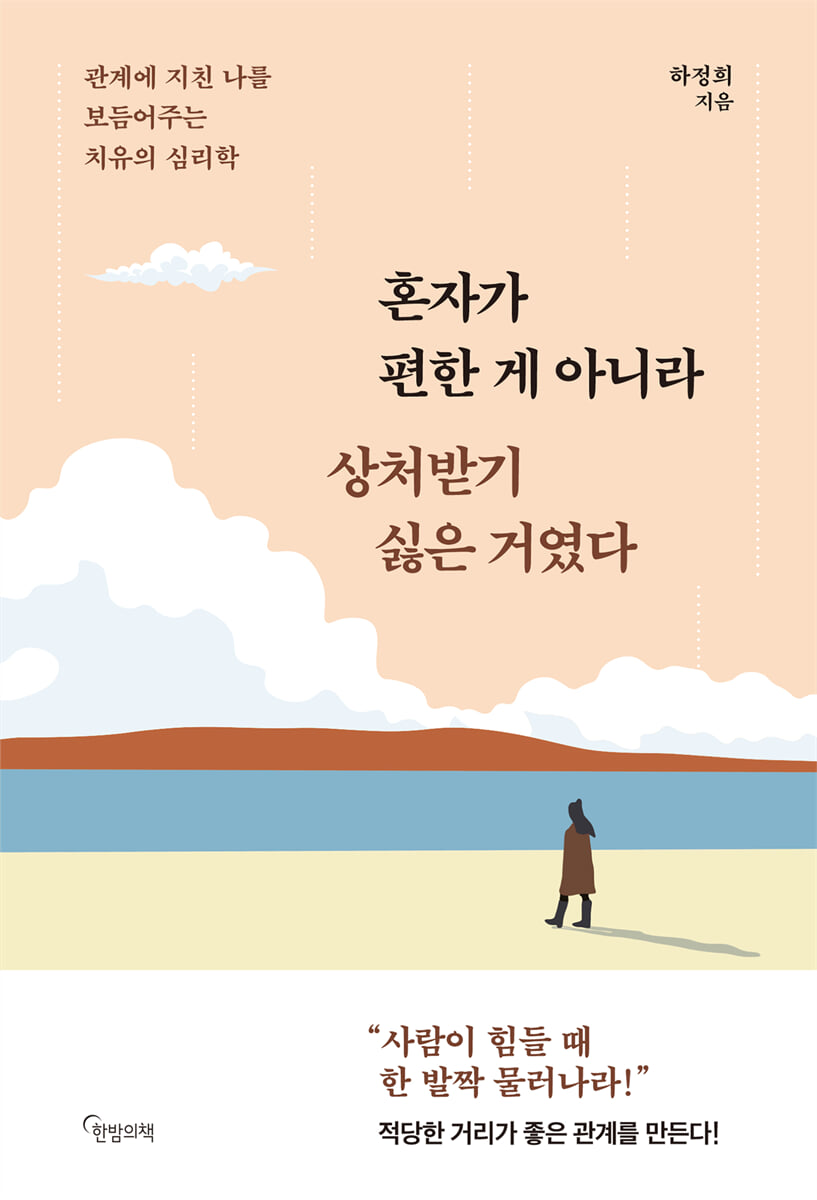
It wasn't that I was comfortable being alone, it was that I didn't want to get hurt.
 |
Description
Book Introduction
It wasn't that it was hard because we were together
It was painful because it was so close!
The author of this book, Professor Ha Jeong-hee, is a psychologist who has met various people in the counseling field for a long time, and is an expert in dealing with stress that arises from interpersonal relationships.
Among the suffering caused by human relationships, the one that particularly torments us is the conflicts with those close to us.
Why do we sometimes argue more intensely with those we're close to? The author points out that it's because we cross boundaries because of our closeness.
The relationship between people is like the relationship between trees.
When several trees come together, they become a lush, vibrant forest.
But what happens when trees grow too close together? Their roots become entangled, entangling each other, and their leaves block each other's sunlight.
Human relationships are similar.
In psychologically close relationships, such as family or lovers, there are times when we encounter sensitive or delicate things. If we ignore the other person's territory and become too close, unnecessary conflicts and fights can arise.
The closer you are to each other, the more you need to know how to look into each other's hearts, which are as tangled as kudzu roots, and carefully separate them.
This book introduces ways to maintain healthy relationships while maintaining a safe distance through diverse and vivid examples commonly encountered around us.
The more you want to be with someone, the more you should allow them some leeway.
The cool breeze blowing through will make your relationship with the other person more refreshing.
It was painful because it was so close!
The author of this book, Professor Ha Jeong-hee, is a psychologist who has met various people in the counseling field for a long time, and is an expert in dealing with stress that arises from interpersonal relationships.
Among the suffering caused by human relationships, the one that particularly torments us is the conflicts with those close to us.
Why do we sometimes argue more intensely with those we're close to? The author points out that it's because we cross boundaries because of our closeness.
The relationship between people is like the relationship between trees.
When several trees come together, they become a lush, vibrant forest.
But what happens when trees grow too close together? Their roots become entangled, entangling each other, and their leaves block each other's sunlight.
Human relationships are similar.
In psychologically close relationships, such as family or lovers, there are times when we encounter sensitive or delicate things. If we ignore the other person's territory and become too close, unnecessary conflicts and fights can arise.
The closer you are to each other, the more you need to know how to look into each other's hearts, which are as tangled as kudzu roots, and carefully separate them.
This book introduces ways to maintain healthy relationships while maintaining a safe distance through diverse and vivid examples commonly encountered around us.
The more you want to be with someone, the more you should allow them some leeway.
The cool breeze blowing through will make your relationship with the other person more refreshing.
index
Preface - Life is enriched when you subtract better than add.
Chapter 1.
Bad feelings are also my feelings
I need to distance myself from myself | It's okay to not be the best, and it's okay to make mistakes | Bad feelings are my feelings | Don't run away from negative feelings | The shorter the regret, the longer the growth | It's okay to hate my family | There are times when I have to cut ties with my parents | Even a petty feeling is my feeling | Consider yourself before considering others | When you're sick, you have to take care of your feelings | You have to know how to have fun before you know how to let it go | It's not words, it's emotions that don't communicate | Get out of the stereotype of a harmonious family | Living true to yourself is the most wonderful thing
Chapter 2.
It's not that I hate people, it's that I hate the hurt.
Don't depend on others' approval | Relationships will only work out if you take care of yourself first | All relationships take time | I can never change the other person | Don't depend on others in the name of love | You won't get hurt if you don't expect anything | You're the coolest when you don't compare | Nothing is taken for granted | Help yourself before helping others | Healthy conflict matures relationships | You can love even if you can't see it | Love is not gaslighting | Don't be afraid of breaking up | Dating is not necessary in life | Deep wounds are left by people close to you | It's okay not to be mainstream
Chapter 3.
It's okay to come closer
Don't be stingy with spending money on yourself | A child's self-esteem grows as much as you listen | Relationships come throughout life | You can date even when you're old | If you don't express yourself, you won't receive empathy | My best friend is myself | Get closer when times are tough | The greatest courage is to forgive myself | Treat human relationships like plants | Everyone offers comfort in their own way | Good relationships are connected even if they aren't visible | There's no need to cut off human relationships harshly | Just because you're not close doesn't mean you can't mix | Listen to the other person's needs | Meet unconditionally and love unconditionally | The deeper the love, the more painful the breakup.
Chapter 4.
Not too close, not too far
The coolest person is the one who loves himself | All the answers are already inside me | If you forcefully open the door of your heart, it will break | A cool relationship is not necessarily a good one | When you look at it from a distance, even the hatred toward your family fades | Becoming close is different from crossing the line | In ambiguous moments, decide in a way that will be detrimental | There is a necessary distance in all relationships | A child's success or failure is up to the child | Happiness always exists in 'this moment' | You can't get along with everyone | An appropriate distance is needed even between couples | An appropriate psychological and physical distance is needed | Keep an appropriate distance from things as well | Give advice but don't interfere | There is an inexplicable charm to a person you are attracted to
Chapter 1.
Bad feelings are also my feelings
I need to distance myself from myself | It's okay to not be the best, and it's okay to make mistakes | Bad feelings are my feelings | Don't run away from negative feelings | The shorter the regret, the longer the growth | It's okay to hate my family | There are times when I have to cut ties with my parents | Even a petty feeling is my feeling | Consider yourself before considering others | When you're sick, you have to take care of your feelings | You have to know how to have fun before you know how to let it go | It's not words, it's emotions that don't communicate | Get out of the stereotype of a harmonious family | Living true to yourself is the most wonderful thing
Chapter 2.
It's not that I hate people, it's that I hate the hurt.
Don't depend on others' approval | Relationships will only work out if you take care of yourself first | All relationships take time | I can never change the other person | Don't depend on others in the name of love | You won't get hurt if you don't expect anything | You're the coolest when you don't compare | Nothing is taken for granted | Help yourself before helping others | Healthy conflict matures relationships | You can love even if you can't see it | Love is not gaslighting | Don't be afraid of breaking up | Dating is not necessary in life | Deep wounds are left by people close to you | It's okay not to be mainstream
Chapter 3.
It's okay to come closer
Don't be stingy with spending money on yourself | A child's self-esteem grows as much as you listen | Relationships come throughout life | You can date even when you're old | If you don't express yourself, you won't receive empathy | My best friend is myself | Get closer when times are tough | The greatest courage is to forgive myself | Treat human relationships like plants | Everyone offers comfort in their own way | Good relationships are connected even if they aren't visible | There's no need to cut off human relationships harshly | Just because you're not close doesn't mean you can't mix | Listen to the other person's needs | Meet unconditionally and love unconditionally | The deeper the love, the more painful the breakup.
Chapter 4.
Not too close, not too far
The coolest person is the one who loves himself | All the answers are already inside me | If you forcefully open the door of your heart, it will break | A cool relationship is not necessarily a good one | When you look at it from a distance, even the hatred toward your family fades | Becoming close is different from crossing the line | In ambiguous moments, decide in a way that will be detrimental | There is a necessary distance in all relationships | A child's success or failure is up to the child | Happiness always exists in 'this moment' | You can't get along with everyone | An appropriate distance is needed even between couples | An appropriate psychological and physical distance is needed | Keep an appropriate distance from things as well | Give advice but don't interfere | There is an inexplicable charm to a person you are attracted to
Detailed image

Into the book
"Do I really need to live a tiring life mixed with other people? Why can't I just live comfortably alone?" But that might not be your true heart.
It's not that you don't like the person, you're just a little tired because the relationship isn't going as well as you expected.
The story is that he was tired of being hit and hurt by people, and wanted to rest in his own quiet cave far away from people.
--- p.7
If your thoughts are becoming too complex and life seems too tiring and difficult, instead of shutting yourself in your own cave, I encourage you to get out into the world and get out and about for a little while.
It's also good to talk to people or go for a walk.
Sometimes the power of action is many times greater than the power of thought.
It's not that things will be solved just because your thoughts are organized, but rather, if you take action, you will gain strength and gradually find solutions in your daily life.
--- p.16
The reason it's hard is because it was worth it, and the reason it makes you mad is because it was worth it.
I cannot judge others about my feelings, and I shouldn't.
I must not forget that I am the master of my emotions.
--- p.
22
People each have their own ideal role models, and they often feel frustrated when they don't live up to them.
But it's good to remember that each person clearly has their own unique strengths.
It may seem trivial because it is something I have always had, so I am so used to it, but to someone who looks at you, it may be a strength they want to emulate.
--- p.56
It is important to be recognized by others, but isn't it true that the person who should be recognized and comforted the most is 'myself'?
When we first acknowledge ourselves and then seek acknowledgement from others, we will be able to become more centered.
I wish I could distance myself a little more from the recognition I receive from others, and instead, embrace and acknowledge myself.
--- p.62
If you look at people who are not satisfied with themselves, you will find that they are usually people with low self-esteem.
They are good at finding people around them who are very good and have good qualities, and they look at those people with fascination and compare themselves to them.
They mistakenly define their ideal self, which is the goal they must reach, as their 'true self' without acknowledging at all their current shortcomings.
--- p.82
If there are couples who say they have never argued, it's likely one of two things.
This is either because they were able to resolve their desires and conflicts really well through conversation, or because they were afraid of such conflicts and had to accommodate the other person.
A true relationship only begins when you start to argue.
When we clearly recognize the differences between ourselves and others and work to accommodate them, we will be able to understand each other more deeply.
--- p.97
When a child's mother ignores what he or she said, he or she is more likely to think, "I must have done something wrong," rather than, "Mom is wrong."
If these thoughts build up from childhood, the thought that 'there is something wrong with me' will eventually dominate your mind even as an adult.
So, in the end, it is easy to end up becoming an adult with low self-esteem.
--- p.123
Human relationships are like a seesaw.
If one person's heart is too big, the seesaw, which is out of balance, tilts and does not move.
If there is no effort to rise above one another in their respective positions, there will be no joy or meaning in the relationship.
No matter how close a relationship is, one-sided attention and sacrifice ultimately leads to boredom and fatigue.
The only way to move a tilted seesaw without effort from the other side is to eventually get off the seesaw.
--- p.164
If you repeatedly suppress your own desires in favor of others' desires, the uncomfortable feelings that arise from neglecting your own desires in favor of the other person will lead to resentment and discomfort towards the other person.
If you do this, you will naturally feel resentful and seek compensation from the other person.
Then it is natural that good human relationships fall apart.
It's not that you don't like the person, you're just a little tired because the relationship isn't going as well as you expected.
The story is that he was tired of being hit and hurt by people, and wanted to rest in his own quiet cave far away from people.
--- p.7
If your thoughts are becoming too complex and life seems too tiring and difficult, instead of shutting yourself in your own cave, I encourage you to get out into the world and get out and about for a little while.
It's also good to talk to people or go for a walk.
Sometimes the power of action is many times greater than the power of thought.
It's not that things will be solved just because your thoughts are organized, but rather, if you take action, you will gain strength and gradually find solutions in your daily life.
--- p.16
The reason it's hard is because it was worth it, and the reason it makes you mad is because it was worth it.
I cannot judge others about my feelings, and I shouldn't.
I must not forget that I am the master of my emotions.
--- p.
22
People each have their own ideal role models, and they often feel frustrated when they don't live up to them.
But it's good to remember that each person clearly has their own unique strengths.
It may seem trivial because it is something I have always had, so I am so used to it, but to someone who looks at you, it may be a strength they want to emulate.
--- p.56
It is important to be recognized by others, but isn't it true that the person who should be recognized and comforted the most is 'myself'?
When we first acknowledge ourselves and then seek acknowledgement from others, we will be able to become more centered.
I wish I could distance myself a little more from the recognition I receive from others, and instead, embrace and acknowledge myself.
--- p.62
If you look at people who are not satisfied with themselves, you will find that they are usually people with low self-esteem.
They are good at finding people around them who are very good and have good qualities, and they look at those people with fascination and compare themselves to them.
They mistakenly define their ideal self, which is the goal they must reach, as their 'true self' without acknowledging at all their current shortcomings.
--- p.82
If there are couples who say they have never argued, it's likely one of two things.
This is either because they were able to resolve their desires and conflicts really well through conversation, or because they were afraid of such conflicts and had to accommodate the other person.
A true relationship only begins when you start to argue.
When we clearly recognize the differences between ourselves and others and work to accommodate them, we will be able to understand each other more deeply.
--- p.97
When a child's mother ignores what he or she said, he or she is more likely to think, "I must have done something wrong," rather than, "Mom is wrong."
If these thoughts build up from childhood, the thought that 'there is something wrong with me' will eventually dominate your mind even as an adult.
So, in the end, it is easy to end up becoming an adult with low self-esteem.
--- p.123
Human relationships are like a seesaw.
If one person's heart is too big, the seesaw, which is out of balance, tilts and does not move.
If there is no effort to rise above one another in their respective positions, there will be no joy or meaning in the relationship.
No matter how close a relationship is, one-sided attention and sacrifice ultimately leads to boredom and fatigue.
The only way to move a tilted seesaw without effort from the other side is to eventually get off the seesaw.
--- p.164
If you repeatedly suppress your own desires in favor of others' desires, the uncomfortable feelings that arise from neglecting your own desires in favor of the other person will lead to resentment and discomfort towards the other person.
If you do this, you will naturally feel resentful and seek compensation from the other person.
Then it is natural that good human relationships fall apart.
--- p.176
Publisher's Review
I pretended to be comfortable being alone because I was afraid of getting hurt again!
In these days when eating and drinking alone have become commonplace, the author, who has been solving various interpersonal problems for people as a counseling psychologist, recently discovered a surprising commonality in the concerns of people who came to see him.
The truth is that those who say that interpersonal relationships are difficult and tiring and that they would rather be 'comfortable alone' are actually people who love people more than anyone else and value relationships.
Why did these once-outgoing individuals become so utterly different? The author attributes it to the unhealed wounds of interpersonal relationships.
The hurt I received from someone close to me was so sudden and painful that I built a high wall to protect myself.
In this psychological state, it is inevitable that you will be reluctant to form new relationships.
It's surprising how many people who appear to enjoy being alone are actually isolating themselves out of a fear of relationships.
Deep down, I want to have a warm relationship, but I run away because I remember past experiences I want to forget.
The more this happens, the more necessary it is to properly look into who you were hurt by and how you were hurt, and to go through a healing process.
Let's carefully diagnose the wounds in my heart that I was unaware of through the various examples contained in this book.
You will be able to free yourself from the pain of the past that binds you to the present and build healthier relationships.
If it's too far, it becomes lonely, and if it's too close, it becomes burdensome!
The author says there is one solution that can be applied across the board to the various concerns that arise in human relationships.
That's what it means to keep the 'Goldilocks zone'.
The Goldilocks zone is a region that is neither too hot nor too cold, and is the perfect distance from the sun for life to exist.
There needs to be a Goldilocks zone between people, too.
A healthy relationship is neither so close that it burns with passion, nor so distant that it becomes indifferent.
The more you like someone, the more you should keep some distance rather than flirting, and the more awkward someone is, the better it is to show initiative and approach them first.
Ultimately, it's the right distance that creates a good relationship.
No matter how beautiful a painting is, if you hold it up close to your nose, you can't see the whole picture, and if you move too far away, you can't see the details.
People are no different.
If you want to make the time you spend together more enjoyable, you should respect each other's individual time, but don't forget that your relationship is about making up for each other's shortcomings.
When your relationship with yourself is right, your relationships with others will also become easier!
In this book, the author says that people who struggle with interpersonal relationships are missing an important fact.
The truth is that in order to properly understand the other person, you must first look deeply into yourself.
I and the other person are like two legs that support the trunk of human relationships.
If you bend one side, the other side must also bend to maintain balance, and if you jump up, the other side must also jump up to avoid falling.
In other words, when problems arise in a relationship, it doesn't mean that one party is to blame, but rather that the two parties are not harmonious.
The author, who has observed such relationships for decades, offers wise solutions in this book.
Instead of simply blaming one party for relationship problems, think about what you want yourself and how what you want is similar or different from what the other person wants.
If we first understand ourselves and try to understand how that affects our relationships with others, the conflicts and clashes that arise in our relationships will be greatly reduced.
In these days when eating and drinking alone have become commonplace, the author, who has been solving various interpersonal problems for people as a counseling psychologist, recently discovered a surprising commonality in the concerns of people who came to see him.
The truth is that those who say that interpersonal relationships are difficult and tiring and that they would rather be 'comfortable alone' are actually people who love people more than anyone else and value relationships.
Why did these once-outgoing individuals become so utterly different? The author attributes it to the unhealed wounds of interpersonal relationships.
The hurt I received from someone close to me was so sudden and painful that I built a high wall to protect myself.
In this psychological state, it is inevitable that you will be reluctant to form new relationships.
It's surprising how many people who appear to enjoy being alone are actually isolating themselves out of a fear of relationships.
Deep down, I want to have a warm relationship, but I run away because I remember past experiences I want to forget.
The more this happens, the more necessary it is to properly look into who you were hurt by and how you were hurt, and to go through a healing process.
Let's carefully diagnose the wounds in my heart that I was unaware of through the various examples contained in this book.
You will be able to free yourself from the pain of the past that binds you to the present and build healthier relationships.
If it's too far, it becomes lonely, and if it's too close, it becomes burdensome!
The author says there is one solution that can be applied across the board to the various concerns that arise in human relationships.
That's what it means to keep the 'Goldilocks zone'.
The Goldilocks zone is a region that is neither too hot nor too cold, and is the perfect distance from the sun for life to exist.
There needs to be a Goldilocks zone between people, too.
A healthy relationship is neither so close that it burns with passion, nor so distant that it becomes indifferent.
The more you like someone, the more you should keep some distance rather than flirting, and the more awkward someone is, the better it is to show initiative and approach them first.
Ultimately, it's the right distance that creates a good relationship.
No matter how beautiful a painting is, if you hold it up close to your nose, you can't see the whole picture, and if you move too far away, you can't see the details.
People are no different.
If you want to make the time you spend together more enjoyable, you should respect each other's individual time, but don't forget that your relationship is about making up for each other's shortcomings.
When your relationship with yourself is right, your relationships with others will also become easier!
In this book, the author says that people who struggle with interpersonal relationships are missing an important fact.
The truth is that in order to properly understand the other person, you must first look deeply into yourself.
I and the other person are like two legs that support the trunk of human relationships.
If you bend one side, the other side must also bend to maintain balance, and if you jump up, the other side must also jump up to avoid falling.
In other words, when problems arise in a relationship, it doesn't mean that one party is to blame, but rather that the two parties are not harmonious.
The author, who has observed such relationships for decades, offers wise solutions in this book.
Instead of simply blaming one party for relationship problems, think about what you want yourself and how what you want is similar or different from what the other person wants.
If we first understand ourselves and try to understand how that affects our relationships with others, the conflicts and clashes that arise in our relationships will be greatly reduced.
GOODS SPECIFICS
- Date of issue: October 7, 2024
- Page count, weight, size: 228 pages | 252g | 128*188*15mm
- ISBN13: 9791191731699
You may also like
카테고리
korean


korean

![GQ KOREA Mark (Monthly): December [2025]](http://librairie.coreenne.fr/cdn/shop/files/8ef265dbbfbf186523ed75ba7319009d.jpg?v=1765340328&width=3840)


