

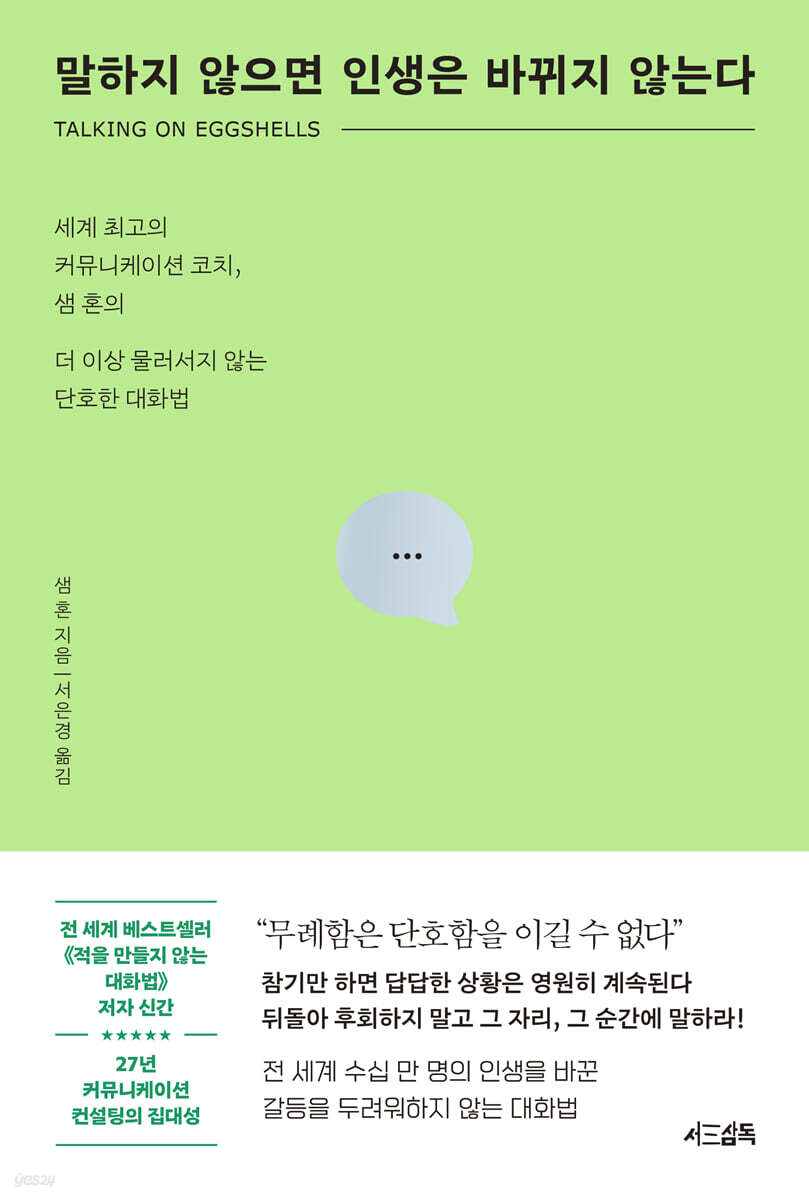
Life doesn't change if you don't speak up.
 |
Description
Book Introduction
- A word from MD
-
With confidence! With determination!A new book on conversation techniques published by Sam Horn, author of the best-selling "How to Talk Without Making Enemies," after 10 years.
Rather than tolerating rude and unfair situations, we suggest confident and firm conversation methods to solve practical problems.
Let's learn the art of pleasant conversation with 28 conversation examples that anyone can experience.
May 21, 2024. Self-Development PD Kim Sang-geun
The art of assertive conversation from Sam Horn, a leading communication coach who has changed the lives of hundreds of thousands of people around the world for 27 years.
I have compiled a collection of realistic and practical conversation techniques that allow both the other person and myself to have a pleasant conversation while speaking firmly without being conscious of others or backing down.
It clearly explains what to say and do in situations that people often find difficult and awkward, such as when you want to stop a rude person from complaining, when you want to correct an unfair rumor, or when you want to talk about your accomplishments without showing off.
Immediately after its release, it received enthusiastic support and rave reviews, with comments like, “The legend is back!” and “This is the long-awaited new book from Sam Horn.”
I have compiled a collection of realistic and practical conversation techniques that allow both the other person and myself to have a pleasant conversation while speaking firmly without being conscious of others or backing down.
It clearly explains what to say and do in situations that people often find difficult and awkward, such as when you want to stop a rude person from complaining, when you want to correct an unfair rumor, or when you want to talk about your accomplishments without showing off.
Immediately after its release, it received enthusiastic support and rave reviews, with comments like, “The legend is back!” and “This is the long-awaited new book from Sam Horn.”
- You can preview some of the book's contents.
Preview
index
Introduction
Part 1.
Life doesn't change if you don't speak up.
Chapter 1: Speak clearly, don't be afraid to ask questions; things won't get better on their own.
Chapter 2: The Key to Human Relationships is Understanding the Context
Chapter 3: Why should I respect people when they don't respect me?
Chapter 4: Plan ahead before having awkward conversations.
Part 2.
Even if you get angry, take a deep breath and stay calm.
Chapter 5: How to Respond Gracefully to Rude People
Chapter 6: Can we be friends with people who have different beliefs?
Chapter 7: Silencing People Who Only Blame Others
Chapter 8: How to Deal with Offensive Jokes with Bravery
Chapter 9: What to Do Before Rumors and Lies Spread
Chapter 10: For those who are tired of hearing someone's complaints every day
Chapter 11: If you want to end your partner's endless chatter
Chapter 12: Say No, Don't Be a People Pleaser
Part 3.
Can I manipulate the other person as I wish without being noticed?
Chapter 13: Is there such a thing as constructive feedback that doesn't offend?
Chapter 14: How to Get People to Move
Chapter 15: People Who Break the Rules and Make Excuses
Chapter 16: Why I Hear "You Don't Know My Heart!" Even When I Clearly Empathize
Chapter 17: What Only Those Who Really Listen Can Gain
Chapter 18: The Magic Words to Let Go of Old Feelings and Restore Relationships
Chapter 19: What Happens When There Are No Agreed-On Rules
Part 4.
Let's speak, don't hesitate, speak confidently
Chapter 20: If you want your abilities to be properly recognized
Chapter 21: Don't Worry About Whether I'm Worthy of Speaking
Chapter 22: How to Speak Without Fear in Important Situations
Chapter 23: Things Change When You Get Properly Angry
Chapter 5.
Stop, stop being so kind
Chapter 24: How to Deal with People Who Try to Manipulate You
Chapter 25: Why You Don't Have to Be Always Kind to Bullies
Chapter 26: If you are miserable to death and say, “I’m okay”
Chapter 27: When There's Nothing You Can Change, Quitting Is the Answer
Chapter 28: Why We Still Need to Talk
The text that appears
A summary of assertive conversation techniques you should keep in mind.
Acknowledgements
annotation
Part 1.
Life doesn't change if you don't speak up.
Chapter 1: Speak clearly, don't be afraid to ask questions; things won't get better on their own.
Chapter 2: The Key to Human Relationships is Understanding the Context
Chapter 3: Why should I respect people when they don't respect me?
Chapter 4: Plan ahead before having awkward conversations.
Part 2.
Even if you get angry, take a deep breath and stay calm.
Chapter 5: How to Respond Gracefully to Rude People
Chapter 6: Can we be friends with people who have different beliefs?
Chapter 7: Silencing People Who Only Blame Others
Chapter 8: How to Deal with Offensive Jokes with Bravery
Chapter 9: What to Do Before Rumors and Lies Spread
Chapter 10: For those who are tired of hearing someone's complaints every day
Chapter 11: If you want to end your partner's endless chatter
Chapter 12: Say No, Don't Be a People Pleaser
Part 3.
Can I manipulate the other person as I wish without being noticed?
Chapter 13: Is there such a thing as constructive feedback that doesn't offend?
Chapter 14: How to Get People to Move
Chapter 15: People Who Break the Rules and Make Excuses
Chapter 16: Why I Hear "You Don't Know My Heart!" Even When I Clearly Empathize
Chapter 17: What Only Those Who Really Listen Can Gain
Chapter 18: The Magic Words to Let Go of Old Feelings and Restore Relationships
Chapter 19: What Happens When There Are No Agreed-On Rules
Part 4.
Let's speak, don't hesitate, speak confidently
Chapter 20: If you want your abilities to be properly recognized
Chapter 21: Don't Worry About Whether I'm Worthy of Speaking
Chapter 22: How to Speak Without Fear in Important Situations
Chapter 23: Things Change When You Get Properly Angry
Chapter 5.
Stop, stop being so kind
Chapter 24: How to Deal with People Who Try to Manipulate You
Chapter 25: Why You Don't Have to Be Always Kind to Bullies
Chapter 26: If you are miserable to death and say, “I’m okay”
Chapter 27: When There's Nothing You Can Change, Quitting Is the Answer
Chapter 28: Why We Still Need to Talk
The text that appears
A summary of assertive conversation techniques you should keep in mind.
Acknowledgements
annotation
Detailed image

Into the book
What did you do when someone hurt you or made a ridiculous decision? Did you just bear it and let it go, but are you still seething inside? Did you clearly communicate how you felt to the other person? (…) The most important thing is not to ignore your feelings and assume you were being treated unfairly, but to take responsibility for what happened and actively address it, giving you the opportunity to make things right.
If you just stay silent, the frustrating situation will continue forever.
--- p.26~27, Chapter 1.
“Speak clearly and don’t be afraid of what others think. The situation won’t get better on its own.”
How should you respond when someone intentionally taunts you with sarcastic remarks? If they continue to taunt, don't react angrily. Instead, actively respond so they can stop provoking you.
Being proactive doesn't just mean being quick to strike back.
This also includes anticipating and preparing in advance what people might say.
(…)Having a list of prepared responses means that people don't have to be embarrassed, stumble over their words, or be wary of what others might think when bringing up sensitive topics.
It is also a way to actively control the situation without being caught off guard by the other person.
--- p.122~123, 「Chapter 8.
From "How to Deal with Offensive Jokes Boldly"
When people insult us and we try to keep quiet, we are teaching them that it is okay to do so.
This confirms that they will not hold those people accountable.
We may think we're just avoiding complications, but unfortunately, we allow them to gossip about us and allow it to continue endlessly.
You have a voice too.
Let's raise our voices.
--- p.135, Chapter 9.
From "Things to do before rumors and lies spread throughout the world"
No matter what happens, say “I’m sorry.
But let's not say, "It's not my fault."
Because it might sound like “I’m sorry, no, I’m not sorry.”
If you summarize the other person's complaint, the other person will feel like you understood what he or she said, so he or she can move on without having to repeat his or her complaint in a louder voice.
And instead of thinking about how this happened, let's focus on what we can do 'now' to improve the situation.
In the long run and in the short run, what people want is action, not explanation.
--- p.151, Chapter 10.
From "For those who are tired of hearing someone's complaints every day"
Don't give a reason for your refusal.
People who want to beat others and do what they want see rejection as an obstacle to be overcome.
(…) No matter what reason you give, the other person will find an answer.
The more reasons you give for your refusal, the more pressure the other person will put on you to agree.
The key here is, “I told you not to.
If I don't like it, I don't like it," he says firmly.
--- p.179~180, Chapter 12.
From "Reject, Don't Be a People Pleaser"
Instead of parroting what the other person says, change it slightly.
You might think:
'Wouldn't the other person be annoyed if I responded by writing down what they said?', 'Wouldn't they think that's what they just said?' In fact, the other person doesn't get annoyed if you respond by writing down what they just said.
It is a verbal confirmation that an 'exchange of meaning', that is, communication, has taken place.
--- p.236, Chapter 16.
From "Why I Hear "You Don't Know My Heart!" Even When I Clearly Empathize with You"
If you change your mind, your life will change.
What labels have you put on yourself? Have you been cautiously watching others closely, feeling like you have to give them what they want because they've looked down on you for so long? Have you been afraid to speak up in certain situations because you lacked confidence?
--- p.303, Chapter 21.
“Don’t worry about whether I am qualified to speak confidently.”
When someone exploits our kindness and abuses our generosity, it's important to address the issue rather than just silently suppressing the seething anger.
Anger is a natural reaction when our rights are violated.
Anger is a unique warning system that lets us know that the other person has crossed the line.
The problem is that some people can't get angry properly because they only try to think logically.
At some point in the past, those people learned that anger was an uncivilized emotion.
But I've learned that there are times when it's appropriate, and even important, to be angry.
--- p.325, Chapter 23.
From "Things that change when you get properly angry"
Have you ever heard the saying, "A tiger never changes its stripes?" Manipulative people, like tigers and scorpions, have unchanging natures.
The only way to avoid being manipulated by these people is to not show them your vulnerability.
(…) Now we must not go to places where such things happen, and we must not go to people who constantly hurt us.
If you just stay silent, the frustrating situation will continue forever.
--- p.26~27, Chapter 1.
“Speak clearly and don’t be afraid of what others think. The situation won’t get better on its own.”
How should you respond when someone intentionally taunts you with sarcastic remarks? If they continue to taunt, don't react angrily. Instead, actively respond so they can stop provoking you.
Being proactive doesn't just mean being quick to strike back.
This also includes anticipating and preparing in advance what people might say.
(…)Having a list of prepared responses means that people don't have to be embarrassed, stumble over their words, or be wary of what others might think when bringing up sensitive topics.
It is also a way to actively control the situation without being caught off guard by the other person.
--- p.122~123, 「Chapter 8.
From "How to Deal with Offensive Jokes Boldly"
When people insult us and we try to keep quiet, we are teaching them that it is okay to do so.
This confirms that they will not hold those people accountable.
We may think we're just avoiding complications, but unfortunately, we allow them to gossip about us and allow it to continue endlessly.
You have a voice too.
Let's raise our voices.
--- p.135, Chapter 9.
From "Things to do before rumors and lies spread throughout the world"
No matter what happens, say “I’m sorry.
But let's not say, "It's not my fault."
Because it might sound like “I’m sorry, no, I’m not sorry.”
If you summarize the other person's complaint, the other person will feel like you understood what he or she said, so he or she can move on without having to repeat his or her complaint in a louder voice.
And instead of thinking about how this happened, let's focus on what we can do 'now' to improve the situation.
In the long run and in the short run, what people want is action, not explanation.
--- p.151, Chapter 10.
From "For those who are tired of hearing someone's complaints every day"
Don't give a reason for your refusal.
People who want to beat others and do what they want see rejection as an obstacle to be overcome.
(…) No matter what reason you give, the other person will find an answer.
The more reasons you give for your refusal, the more pressure the other person will put on you to agree.
The key here is, “I told you not to.
If I don't like it, I don't like it," he says firmly.
--- p.179~180, Chapter 12.
From "Reject, Don't Be a People Pleaser"
Instead of parroting what the other person says, change it slightly.
You might think:
'Wouldn't the other person be annoyed if I responded by writing down what they said?', 'Wouldn't they think that's what they just said?' In fact, the other person doesn't get annoyed if you respond by writing down what they just said.
It is a verbal confirmation that an 'exchange of meaning', that is, communication, has taken place.
--- p.236, Chapter 16.
From "Why I Hear "You Don't Know My Heart!" Even When I Clearly Empathize with You"
If you change your mind, your life will change.
What labels have you put on yourself? Have you been cautiously watching others closely, feeling like you have to give them what they want because they've looked down on you for so long? Have you been afraid to speak up in certain situations because you lacked confidence?
--- p.303, Chapter 21.
“Don’t worry about whether I am qualified to speak confidently.”
When someone exploits our kindness and abuses our generosity, it's important to address the issue rather than just silently suppressing the seething anger.
Anger is a natural reaction when our rights are violated.
Anger is a unique warning system that lets us know that the other person has crossed the line.
The problem is that some people can't get angry properly because they only try to think logically.
At some point in the past, those people learned that anger was an uncivilized emotion.
But I've learned that there are times when it's appropriate, and even important, to be angry.
--- p.325, Chapter 23.
From "Things that change when you get properly angry"
Have you ever heard the saying, "A tiger never changes its stripes?" Manipulative people, like tigers and scorpions, have unchanging natures.
The only way to avoid being manipulated by these people is to not show them your vulnerability.
(…) Now we must not go to places where such things happen, and we must not go to people who constantly hurt us.
--- p.342~343, Chapter 24.
From "How to Deal with People Who Try to Manipulate You"
From "How to Deal with People Who Try to Manipulate You"
Publisher's Review
★★★New book from the author of the global bestseller "How to Talk Without Making Enemies"★★★
★★★The culmination of 27 years of communication consulting★★★
Rudeness cannot overcome firmness.
If you just endure it, the frustrating situation will continue forever.
Don't look back and regret, speak at that moment, at that place!
◆ Sam Horn, a communications expert who has changed the lives of more than 500,000 people over 27 years.
Breaking the silence after 10 years, I'm back!
Sam Horn, author of the international bestseller "The Untold Story" and an expert on human relations and communication skills, has been active in business consulting, lectures, and workshops, but has not published a book on conversation skills in the past 10 years, leaving fans around the world intrigued.
Breaking her long silence, her book, "Life Doesn't Change If You Don't Speak," reveals the lengths of time she has spent trying to provide useful conversation techniques for today's readers.
Because in an age where people are becoming increasingly rude and avoiding uncomfortable conversations, we know better than anyone that idealistic and vague advice like always being kind or that sincerity will always get through no longer works.
So, this book vividly captures everyday conversation situations and the concerns that arise from them, based on numerous examples from various workshops and lectures.
For example, when I meet a customer who is constantly complaining and asks why I should apologize when it is not my fault, I respond like this.
“It’s not that you have to apologize because you did something wrong, it’s just that it’s better to apologize.
Then at least that noisy customer won't yell anymore.
Wouldn't it be better to end the situation quickly?" It's such realistic advice, yet it's so compelling that you can't help but accept it.
This book, which compiles the know-how and insights accumulated over 27 years by Sam Horn, the world's most unrivaled communication expert, was immediately praised upon publication, with comments such as, "The return of the legend!", "As expected, it's Sam Horn you can trust and rely on", and "So useful."
It became a hot topic, receiving enthusiastic support and praise, with people saying, “I think this conversation method should be taught in schools like math or science.”
◆ If only I knew what to say in a situation like this
My life would have been completely different!
Most people now know that simply enduring unfair situations or rude people isn't always the best approach.
Because I realized that someone's consideration and sacrifice do not fundamentally solve the problem, and that it is no different from allowing rude and violent people to continue their behavior.
But the problem is that when you encounter such a situation, you become speechless.
I know I need to say something, but my mind goes blank, wondering what to say and how to say it confidently without being nervous.
This book carefully selects 28 difficult and awkward conversation situations that anyone can experience, such as when you no longer want to be swayed by someone who is harassing you, when you want to present your achievements at work without showing off, or when you discover that an unfair rumor is circulating. It explains what to say and what not to say in such situations through various examples in an easy-to-understand manner.
And I emphasize to you, “Don’t worry about whether I should say this, if you don’t speak up, if you just keep silent, nothing will change.”
People who always have the habit of being considerate of others and being picky with their words end up tiring themselves out.
According to Sam Horn, “the scale of desire must be balanced, but if it is only tilted to one side, the relationship will not last long.”
If you're tired of being the unconditional tolerant and considerate person, and if you want your life to be different from what it is now, it's time to change.
I can't hold it in any longer and I have to speak up.
◆ “I don’t look back and regret anymore.”
A conversational style that speaks confidently and firmly without avoiding conflict.
People who are afraid to speak up for themselves usually fear that doing so will offend the other person, cause conflict, and potentially ruin the relationship.
Also, I take a step back because I think I will look like a 'noisy troublemaker'.
That is, they are afraid of being seen as a 'fighter'.
But Sam Horn says speaking my mind doesn't mean fighting back.
It's just about setting the situation straight so that the other person doesn't make the wrong judgment or misunderstand me due to incorrect information.
Because most things can be solved if you talk enough.
Rather than feeling resentful and being treated unfairly, you should take responsibility for what happened and deal with it proactively.
So, the conversation method discussed in this book is not a conversation method that involves fighting to win or persuading with flowery words.
Rather, it is a conversational method that can turn the situation around and soften the other person's sharp mind with a single, firm but simple word.
When the other person makes accusations based on untrue facts, instead of protesting by saying, “I’m not that kind of person,” ask, “Why do you think that is?” to get the other person to reveal their true intentions. Also, if someone is trying to take away your right to speak, actively respond by saying, “Please speak when I am finished speaking.”
You don't need many words to convey your intention to the other person.
As Sam Horn suggests, if you minimize the words that make the situation worse and never forget to say what you need to say, you can have a conversation that satisfies both you and the other person, rather than an argument.
Communication skills are essential and the most important skill to get your life where you want it to be.
If you want to clearly portray your relationships and life as you envision them, rather than being swayed by what others think, Sam Horn's "Life Doesn't Change If You Don't Speak" will be your essential life bible.
★★★The culmination of 27 years of communication consulting★★★
Rudeness cannot overcome firmness.
If you just endure it, the frustrating situation will continue forever.
Don't look back and regret, speak at that moment, at that place!
◆ Sam Horn, a communications expert who has changed the lives of more than 500,000 people over 27 years.
Breaking the silence after 10 years, I'm back!
Sam Horn, author of the international bestseller "The Untold Story" and an expert on human relations and communication skills, has been active in business consulting, lectures, and workshops, but has not published a book on conversation skills in the past 10 years, leaving fans around the world intrigued.
Breaking her long silence, her book, "Life Doesn't Change If You Don't Speak," reveals the lengths of time she has spent trying to provide useful conversation techniques for today's readers.
Because in an age where people are becoming increasingly rude and avoiding uncomfortable conversations, we know better than anyone that idealistic and vague advice like always being kind or that sincerity will always get through no longer works.
So, this book vividly captures everyday conversation situations and the concerns that arise from them, based on numerous examples from various workshops and lectures.
For example, when I meet a customer who is constantly complaining and asks why I should apologize when it is not my fault, I respond like this.
“It’s not that you have to apologize because you did something wrong, it’s just that it’s better to apologize.
Then at least that noisy customer won't yell anymore.
Wouldn't it be better to end the situation quickly?" It's such realistic advice, yet it's so compelling that you can't help but accept it.
This book, which compiles the know-how and insights accumulated over 27 years by Sam Horn, the world's most unrivaled communication expert, was immediately praised upon publication, with comments such as, "The return of the legend!", "As expected, it's Sam Horn you can trust and rely on", and "So useful."
It became a hot topic, receiving enthusiastic support and praise, with people saying, “I think this conversation method should be taught in schools like math or science.”
◆ If only I knew what to say in a situation like this
My life would have been completely different!
Most people now know that simply enduring unfair situations or rude people isn't always the best approach.
Because I realized that someone's consideration and sacrifice do not fundamentally solve the problem, and that it is no different from allowing rude and violent people to continue their behavior.
But the problem is that when you encounter such a situation, you become speechless.
I know I need to say something, but my mind goes blank, wondering what to say and how to say it confidently without being nervous.
This book carefully selects 28 difficult and awkward conversation situations that anyone can experience, such as when you no longer want to be swayed by someone who is harassing you, when you want to present your achievements at work without showing off, or when you discover that an unfair rumor is circulating. It explains what to say and what not to say in such situations through various examples in an easy-to-understand manner.
And I emphasize to you, “Don’t worry about whether I should say this, if you don’t speak up, if you just keep silent, nothing will change.”
People who always have the habit of being considerate of others and being picky with their words end up tiring themselves out.
According to Sam Horn, “the scale of desire must be balanced, but if it is only tilted to one side, the relationship will not last long.”
If you're tired of being the unconditional tolerant and considerate person, and if you want your life to be different from what it is now, it's time to change.
I can't hold it in any longer and I have to speak up.
◆ “I don’t look back and regret anymore.”
A conversational style that speaks confidently and firmly without avoiding conflict.
People who are afraid to speak up for themselves usually fear that doing so will offend the other person, cause conflict, and potentially ruin the relationship.
Also, I take a step back because I think I will look like a 'noisy troublemaker'.
That is, they are afraid of being seen as a 'fighter'.
But Sam Horn says speaking my mind doesn't mean fighting back.
It's just about setting the situation straight so that the other person doesn't make the wrong judgment or misunderstand me due to incorrect information.
Because most things can be solved if you talk enough.
Rather than feeling resentful and being treated unfairly, you should take responsibility for what happened and deal with it proactively.
So, the conversation method discussed in this book is not a conversation method that involves fighting to win or persuading with flowery words.
Rather, it is a conversational method that can turn the situation around and soften the other person's sharp mind with a single, firm but simple word.
When the other person makes accusations based on untrue facts, instead of protesting by saying, “I’m not that kind of person,” ask, “Why do you think that is?” to get the other person to reveal their true intentions. Also, if someone is trying to take away your right to speak, actively respond by saying, “Please speak when I am finished speaking.”
You don't need many words to convey your intention to the other person.
As Sam Horn suggests, if you minimize the words that make the situation worse and never forget to say what you need to say, you can have a conversation that satisfies both you and the other person, rather than an argument.
Communication skills are essential and the most important skill to get your life where you want it to be.
If you want to clearly portray your relationships and life as you envision them, rather than being swayed by what others think, Sam Horn's "Life Doesn't Change If You Don't Speak" will be your essential life bible.
GOODS SPECIFICS
- Date of issue: May 16, 2024
- Page count, weight, size: 424 pages | 584g | 145*215*26mm
- ISBN13: 9791193904046
- ISBN10: 1193904048
You may also like
카테고리
korean


korean

![GQ KOREA Mark (Monthly): December [2025]](http://librairie.coreenne.fr/cdn/shop/files/8ef265dbbfbf186523ed75ba7319009d.jpg?v=1765340328&width=3840)


