

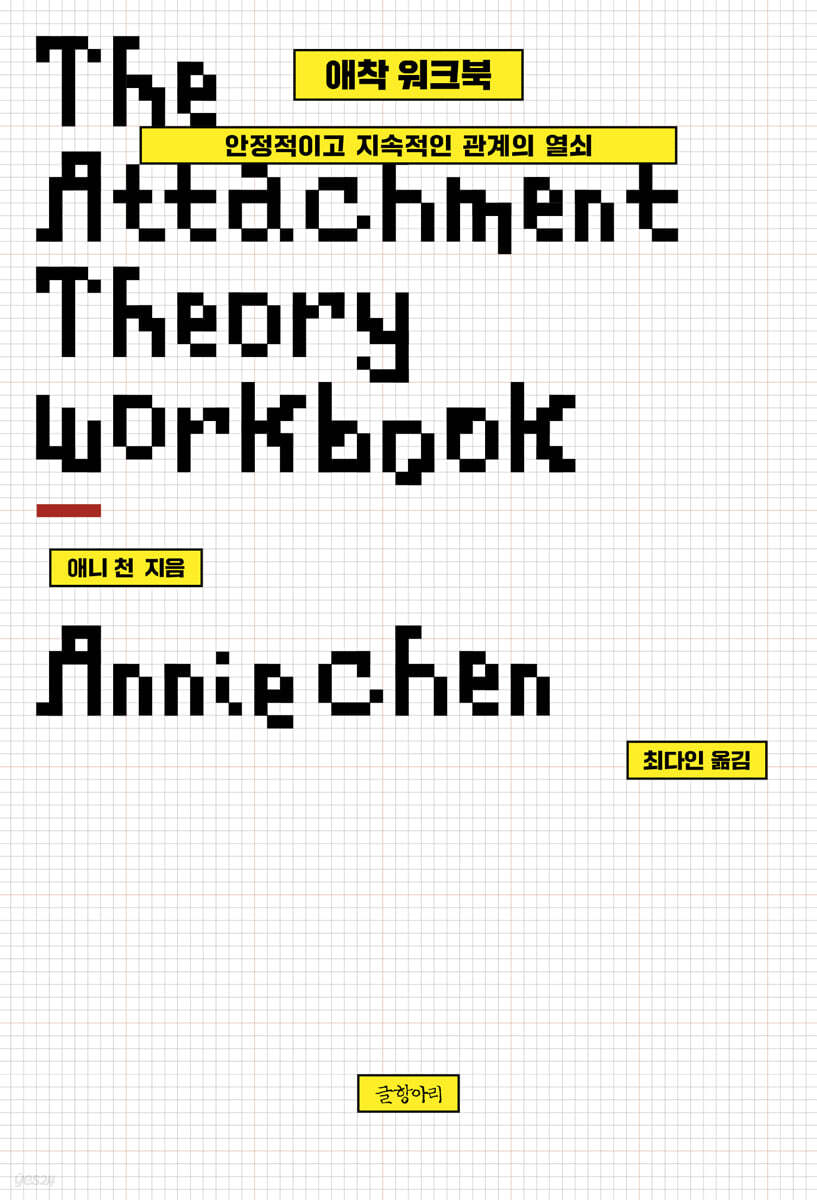
Attachment Workbook
 |
Description
Book Introduction
Lover, family, friend, colleague
The closer you are, the more difficult the relationship becomes… …?
I want to have a long-lasting relationship where we understand each other and feel comfortable.
Everything about 'attachment' for people!
Attachment specialist psychotherapist with over 10 years of experience
Includes a validated attachment style test and key tasks for each type.
The Experience and Healing of Anxious, Avoidant, and Secure Attachment
Introduction to problems that may arise depending on the combination of attachment styles.
Presenting a variety of approaches that can be applied to real-world relationships
Solid theoretical background and clinical experience base
Anxious, avoidant, secure... We've all heard about attachment styles at least once. What does this spectrum tell us about ourselves and the relationships we form? Why are close relationships more challenging? How can we build long-lasting, stable relationships, sharing affection and friendship with the most important people in our lives? "Attachment Workbook" is a psychotherapy workbook based on the concept of "attachment." It helps readers answer these questions and explore various challenges to discover themselves and cultivate healthy relationships.
Author Annie Chen is a psychotherapist who has specialized in relationship issues for the past 10 years. She has compiled her experiences working with hundreds of couples, friends, and family members in her counseling practice into this book.
From detailed explanations of each attachment type and behavioral pattern to a variety of self-discovery tasks, thoughtful advice applicable to real-life relationships, and heartfelt empathy to soothe wounded hearts, "Attachment Workbook" becomes the psychotherapist anyone can turn to, accompanying readers on their journey toward stable relationships.
The closer you are, the more difficult the relationship becomes… …?
I want to have a long-lasting relationship where we understand each other and feel comfortable.
Everything about 'attachment' for people!
Attachment specialist psychotherapist with over 10 years of experience
Includes a validated attachment style test and key tasks for each type.
The Experience and Healing of Anxious, Avoidant, and Secure Attachment
Introduction to problems that may arise depending on the combination of attachment styles.
Presenting a variety of approaches that can be applied to real-world relationships
Solid theoretical background and clinical experience base
Anxious, avoidant, secure... We've all heard about attachment styles at least once. What does this spectrum tell us about ourselves and the relationships we form? Why are close relationships more challenging? How can we build long-lasting, stable relationships, sharing affection and friendship with the most important people in our lives? "Attachment Workbook" is a psychotherapy workbook based on the concept of "attachment." It helps readers answer these questions and explore various challenges to discover themselves and cultivate healthy relationships.
Author Annie Chen is a psychotherapist who has specialized in relationship issues for the past 10 years. She has compiled her experiences working with hundreds of couples, friends, and family members in her counseling practice into this book.
From detailed explanations of each attachment type and behavioral pattern to a variety of self-discovery tasks, thoughtful advice applicable to real-life relationships, and heartfelt empathy to soothe wounded hearts, "Attachment Workbook" becomes the psychotherapist anyone can turn to, accompanying readers on their journey toward stable relationships.
- You can preview some of the book's contents.
Preview
index
preface
Chapter 1.
What is my attachment style?
Chapter 2.
anxious attachment
Chapter 3.
avoidant attachment
Chapter 4.
secure attachment
Chapter 5.
Interactions between attachment styles
Chapter 6.
For a stable relationship
supplement
Further Reading
References
Acknowledgements
Chapter 1.
What is my attachment style?
Chapter 2.
anxious attachment
Chapter 3.
avoidant attachment
Chapter 4.
secure attachment
Chapter 5.
Interactions between attachment styles
Chapter 6.
For a stable relationship
supplement
Further Reading
References
Acknowledgements
Detailed image

Into the book
People with anxiety sometimes fall into self-contradiction.
They want the other person's support, but once their anxiety is triggered, they become so agitated that they cannot stand being around the other person.
Relationships with anxious individuals tend to be volatile.
This is because a cycle of giving in because you are anxious, feeling wronged, complaining, demanding, feeling briefly satisfied, and then giving in again is formed.
People who try to satisfy their needs through blame, anger, guilt, and nagging rarely realize that this approach places tremendous stress on those around them and quickly erodes their relationship capital—the bonds of trust that have built up together to help them deal with problems when they arise.
---From "Chapter 2: Anxious Attachment"
People with avoidant attachment styles may panic or feel uncomfortable at the mere thought of relying too deeply on someone.
This discomfort can manifest itself in many forms, from mild stress to a full-blown threat response.
Many types of relationships, especially those that are inherently serious, are triggers for avoidance tendencies.
What can you do as a friend, partner, colleague, or family member of someone whose triggers have been triggered in this way? (…) The first thing to do is to take seriously their need for stability and comfort.
Taking on the risk of interacting in an emotionally charged situation might seem simple to you, but it's not so easy for an avoidant person.
For them, the very act of continuing a conversation about an emotionally charged topic might be the most difficult thing that happened all week.
---From "Chapter 3 Avoidant Attachment"
People cannot choose the type of attachment they will have.
But if you let your insecure attachment patterns run rampant, there will come a time when you wonder why the same problems keep repeating themselves in your relationships.
Eventually, you come to the realization that you need to invest interest and effort into learning about your own attachment patterns and those of your partner.
---From "Chapter 5 Interactions Between Attachment Types"
We can feel a sense of ongoing security through emotional safety and support.
Now you are your own dedicated advisor who knows better than anyone what it takes to get it.
Remember, finding out what works for you in a relationship takes experience and experimentation.
Some people value a deep and intimate relationship with just one person.
On the other hand, some people may need three close friends to feel a constant sense of security.
Our brains are wired to want to communicate, but there's no formal definition of what that should look like.
I hope you find a relationship that works for you, no matter what.
They want the other person's support, but once their anxiety is triggered, they become so agitated that they cannot stand being around the other person.
Relationships with anxious individuals tend to be volatile.
This is because a cycle of giving in because you are anxious, feeling wronged, complaining, demanding, feeling briefly satisfied, and then giving in again is formed.
People who try to satisfy their needs through blame, anger, guilt, and nagging rarely realize that this approach places tremendous stress on those around them and quickly erodes their relationship capital—the bonds of trust that have built up together to help them deal with problems when they arise.
---From "Chapter 2: Anxious Attachment"
People with avoidant attachment styles may panic or feel uncomfortable at the mere thought of relying too deeply on someone.
This discomfort can manifest itself in many forms, from mild stress to a full-blown threat response.
Many types of relationships, especially those that are inherently serious, are triggers for avoidance tendencies.
What can you do as a friend, partner, colleague, or family member of someone whose triggers have been triggered in this way? (…) The first thing to do is to take seriously their need for stability and comfort.
Taking on the risk of interacting in an emotionally charged situation might seem simple to you, but it's not so easy for an avoidant person.
For them, the very act of continuing a conversation about an emotionally charged topic might be the most difficult thing that happened all week.
---From "Chapter 3 Avoidant Attachment"
People cannot choose the type of attachment they will have.
But if you let your insecure attachment patterns run rampant, there will come a time when you wonder why the same problems keep repeating themselves in your relationships.
Eventually, you come to the realization that you need to invest interest and effort into learning about your own attachment patterns and those of your partner.
---From "Chapter 5 Interactions Between Attachment Types"
We can feel a sense of ongoing security through emotional safety and support.
Now you are your own dedicated advisor who knows better than anyone what it takes to get it.
Remember, finding out what works for you in a relationship takes experience and experimentation.
Some people value a deep and intimate relationship with just one person.
On the other hand, some people may need three close friends to feel a constant sense of security.
Our brains are wired to want to communicate, but there's no formal definition of what that should look like.
I hope you find a relationship that works for you, no matter what.
---From "Chapter 6: For a Stable Relationship"
Publisher's Review
♥ The Blueprint for Stability and Trust: The Attachment Spectrum
In psychology, an individual's perception of the security that comes from relationships with others is called attachment style.
As relationships become closer and we become more dependent on others, we either become comfortable with our attachment relationships (secure) or feel stressed by their instability (anxious/avoidant), depending on our attachment style.
When an insecure attachment style, such as an anxious or avoidant one, is formed, certain behavioral patterns emerge, and if these are repeated, they can become problems that shake the bond of the relationship.
For example, anxious attachment types are sensitive to feelings of abandonment [abandonment anxiety], easily reveal their emotions to others, and tend to blame others for their own emotions.
Avoidant attachment, on the other hand, is self-reliant, tends to express discomfort indirectly rather than complaining, and tends to seek refuge from conflict.
On the other hand, stable types are open to change, work to repair problems in relationships, and are receptive to diversity and complexity.
These attachment patterns can manifest differently depending on the other person's attachment style or the dynamics of the relationship, but they generally influence the relationships we form throughout our lives.
Attachment theory has been supported by numerous studies for over 60 years since its establishment in the mid-20th century.
Meanwhile, it has become a concept referenced and cited by experts in various fields, including neuroscience, psychiatry, traumatology, and pediatrics, and has also become widely known to the general public along with the popularization of psychiatry and psychology.
Attachment patterns formed in childhood have a significant impact on an individual's life and mental health, not only from infancy through adolescence, but also into adulthood. The relationships that have the greatest impact are those close to us—in other words, the long-term relationships we rely on for emotional support.
While there are many different types of relationships in which attachment patterns recur, including romantic partners, the core idea is that when we become close to someone and become dependent on them, our true attachment style is revealed when we are placed in a stressful situation.
In short, the person who has the greatest influence on my attachment style is the person closest to me, and regardless of how much I love and cherish the other person, we contribute to the foundation of our relationships by engaging in attachment behaviors that have become habitual patterns.
♥ Break free from the past and cultivate the future
Attachment behavior is just a pattern; anyone can become secure.
The journey of the 『Attachment Workbook』 begins with understanding ‘my’ attachment type.
Chapter 1, "What's My Attachment Style?" provides an attachment test based on psychological research and years of experience.
This is the stage where you learn to identify your own and your partner's attachment types and how to make the most of this book.
Chapter 2, “Anxious Attachment,” Chapter 3, “Avoidant Attachment,” and Chapter 4, “Secure Attachment,” introduce the process of becoming aware of each attachment type, how it manifests in behavior within relationships, why each attachment type was formed, how to understand emotions and accept yourself and others, activities that help heal past wounds, actual counseling cases, and advice that allows you to interact in a healthier way, and present various tasks for each type.
In these three chapters, readers will learn about their own attachment styles as well as those of others, and develop the capacity to build better relationships with people across the attachment spectrum.
Chapter 5, “Interactions Between Attachment Types,” examines the interactions that occur in different types of attachment, such as anxious-anxious, avoidant-avoidant, secure-anxious, secure-avoidant, and secure-secure, noting that different dynamics arise in different relationships.
We also introduce tasks that can help alleviate conflict and increase intimacy in each combination.
Chapter 6, "For Stable Relationships," builds on the insights and courage gained earlier to explore what it means to recognize our own fundamental values that apply to all relationships, and to utilize the skills and tools to put these values into practice.
The author emphasizes that this is not just a personal matter, but rather a movement that creates “a larger movement that transforms society as a whole by changing the way we understand and treat each other.”
The "Appendix," which includes various activity tasks from Chapters 2-4, allows you to expand your insights to a wider range of human relationships by recalling other relationships and completing new tasks.
After completing this journey, you will find yourself no longer trapped in past behavior patterns.
Knowing what attachment patterns we and our loved ones exhibit, especially how we behave when faced with stressful situations or challenges.
Learn new tools and habits to restart communication and regain a sense of stability so that conflicts don't escalate.
Break old patterns of behavior that aren't helping your relationships, and learn how to act in ways that will allow you to build healthy relationships the way you want.
That's where it starts.
The Attachment Workbook will serve as a reliable tool you can use whenever you need it as you grow to become a better person and a better partner.
In psychology, an individual's perception of the security that comes from relationships with others is called attachment style.
As relationships become closer and we become more dependent on others, we either become comfortable with our attachment relationships (secure) or feel stressed by their instability (anxious/avoidant), depending on our attachment style.
When an insecure attachment style, such as an anxious or avoidant one, is formed, certain behavioral patterns emerge, and if these are repeated, they can become problems that shake the bond of the relationship.
For example, anxious attachment types are sensitive to feelings of abandonment [abandonment anxiety], easily reveal their emotions to others, and tend to blame others for their own emotions.
Avoidant attachment, on the other hand, is self-reliant, tends to express discomfort indirectly rather than complaining, and tends to seek refuge from conflict.
On the other hand, stable types are open to change, work to repair problems in relationships, and are receptive to diversity and complexity.
These attachment patterns can manifest differently depending on the other person's attachment style or the dynamics of the relationship, but they generally influence the relationships we form throughout our lives.
Attachment theory has been supported by numerous studies for over 60 years since its establishment in the mid-20th century.
Meanwhile, it has become a concept referenced and cited by experts in various fields, including neuroscience, psychiatry, traumatology, and pediatrics, and has also become widely known to the general public along with the popularization of psychiatry and psychology.
Attachment patterns formed in childhood have a significant impact on an individual's life and mental health, not only from infancy through adolescence, but also into adulthood. The relationships that have the greatest impact are those close to us—in other words, the long-term relationships we rely on for emotional support.
While there are many different types of relationships in which attachment patterns recur, including romantic partners, the core idea is that when we become close to someone and become dependent on them, our true attachment style is revealed when we are placed in a stressful situation.
In short, the person who has the greatest influence on my attachment style is the person closest to me, and regardless of how much I love and cherish the other person, we contribute to the foundation of our relationships by engaging in attachment behaviors that have become habitual patterns.
♥ Break free from the past and cultivate the future
Attachment behavior is just a pattern; anyone can become secure.
The journey of the 『Attachment Workbook』 begins with understanding ‘my’ attachment type.
Chapter 1, "What's My Attachment Style?" provides an attachment test based on psychological research and years of experience.
This is the stage where you learn to identify your own and your partner's attachment types and how to make the most of this book.
Chapter 2, “Anxious Attachment,” Chapter 3, “Avoidant Attachment,” and Chapter 4, “Secure Attachment,” introduce the process of becoming aware of each attachment type, how it manifests in behavior within relationships, why each attachment type was formed, how to understand emotions and accept yourself and others, activities that help heal past wounds, actual counseling cases, and advice that allows you to interact in a healthier way, and present various tasks for each type.
In these three chapters, readers will learn about their own attachment styles as well as those of others, and develop the capacity to build better relationships with people across the attachment spectrum.
Chapter 5, “Interactions Between Attachment Types,” examines the interactions that occur in different types of attachment, such as anxious-anxious, avoidant-avoidant, secure-anxious, secure-avoidant, and secure-secure, noting that different dynamics arise in different relationships.
We also introduce tasks that can help alleviate conflict and increase intimacy in each combination.
Chapter 6, "For Stable Relationships," builds on the insights and courage gained earlier to explore what it means to recognize our own fundamental values that apply to all relationships, and to utilize the skills and tools to put these values into practice.
The author emphasizes that this is not just a personal matter, but rather a movement that creates “a larger movement that transforms society as a whole by changing the way we understand and treat each other.”
The "Appendix," which includes various activity tasks from Chapters 2-4, allows you to expand your insights to a wider range of human relationships by recalling other relationships and completing new tasks.
After completing this journey, you will find yourself no longer trapped in past behavior patterns.
Knowing what attachment patterns we and our loved ones exhibit, especially how we behave when faced with stressful situations or challenges.
Learn new tools and habits to restart communication and regain a sense of stability so that conflicts don't escalate.
Break old patterns of behavior that aren't helping your relationships, and learn how to act in ways that will allow you to build healthy relationships the way you want.
That's where it starts.
The Attachment Workbook will serve as a reliable tool you can use whenever you need it as you grow to become a better person and a better partner.
GOODS SPECIFICS
- Date of issue: October 23, 2023
- Format: Hardcover book binding method guide
- Page count, weight, size: 316 pages | 128*188*30mm
- ISBN13: 9791169091671
- ISBN10: 1169091679
You may also like
카테고리
korean


korean

![GQ KOREA Mark (Monthly): December [2025]](http://librairie.coreenne.fr/cdn/shop/files/8ef265dbbfbf186523ed75ba7319009d.jpg?v=1765340328&width=3840)


