

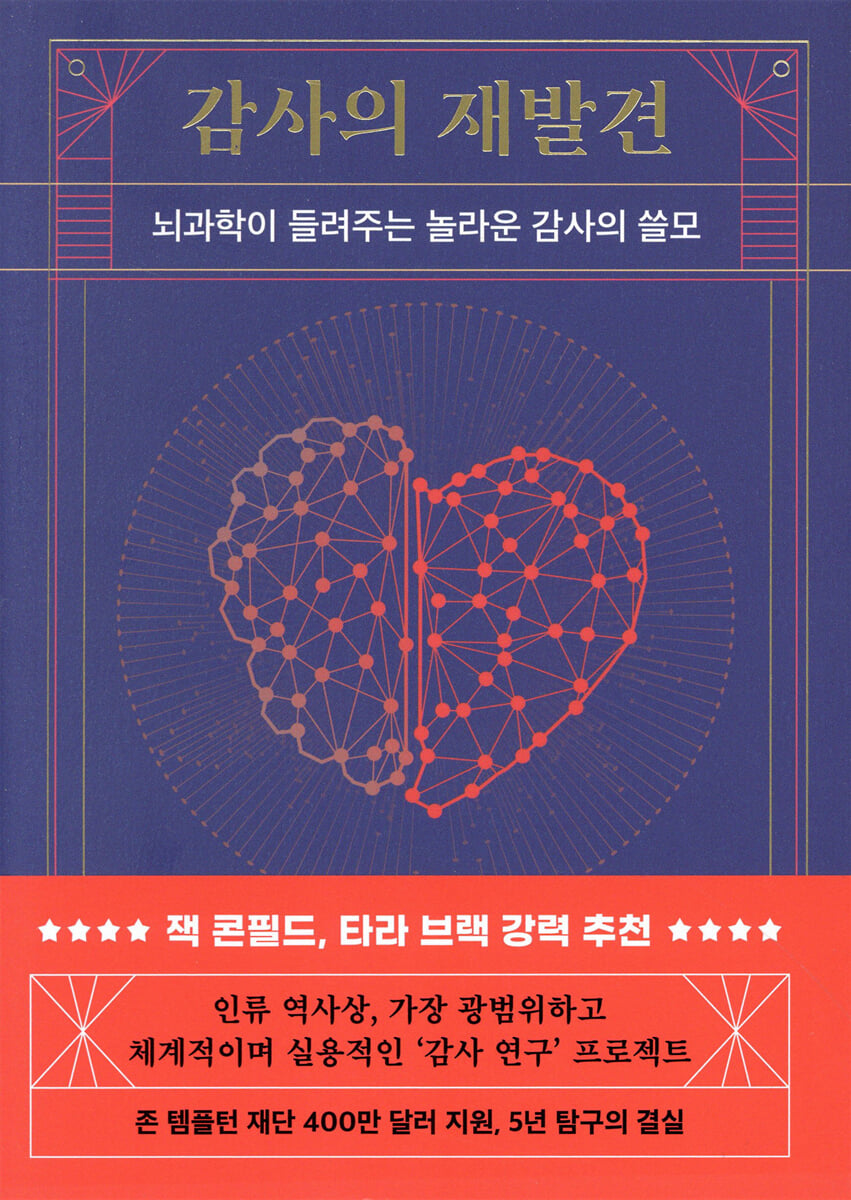
Rediscovering Gratitude
 |
Description
Book Introduction
A brain science-based gratitude practice that allows you to savor the gifts of everyday life.
“How can we practice gratitude to reduce depression, increase resilience, restore relationships, and achieve emotional stability?”
There are scientific practices that maximize the benefits of gratitude.
Writing a gratitude journal twice a week was more effective than writing it every day.
The impact of gratitude that comes from 'experiences' such as concerts or lectures by favorite singers or writers lasts much longer than the gratitude that comes from 'consumption' of products.
Grateful people have a much greater chance of success, and not only humans but also animals like monkeys and birds show gratitude in various ways.
Recent neuroscience research has revealed that there are brain regions involved in expressing and engaging gratitude, and that structural changes occur in the brain when gratitude is practiced.
Everyone knows that gratitude is good.
This book doesn't just stick to the vague, obvious assertion that "good things happen when you're grateful."
We are guided through the “art of gratitude,” proven through in-depth research based on brain science, psychology, and sociology, to learn how to practice it to enjoy its benefits and gifts.
“How can we practice gratitude to reduce depression, increase resilience, restore relationships, and achieve emotional stability?”
There are scientific practices that maximize the benefits of gratitude.
Writing a gratitude journal twice a week was more effective than writing it every day.
The impact of gratitude that comes from 'experiences' such as concerts or lectures by favorite singers or writers lasts much longer than the gratitude that comes from 'consumption' of products.
Grateful people have a much greater chance of success, and not only humans but also animals like monkeys and birds show gratitude in various ways.
Recent neuroscience research has revealed that there are brain regions involved in expressing and engaging gratitude, and that structural changes occur in the brain when gratitude is practiced.
Everyone knows that gratitude is good.
This book doesn't just stick to the vague, obvious assertion that "good things happen when you're grateful."
We are guided through the “art of gratitude,” proven through in-depth research based on brain science, psychology, and sociology, to learn how to practice it to enjoy its benefits and gifts.
- You can preview some of the book's contents.
Preview
index
Entering
Part 1: Why Thanks Again?
Chapter 1: A New Definition of Gratitude
- Three Dimensions of Gratitude
Chapter 2: When did humans start feeling grateful?
- Is there a separate DNA for gratitude?
Chapter 3: How to Raise a Grateful Child
Chapter 4: How does our brain react when we are grateful?
Chapter 5: If You Want to Be a Giving Person, Be Grateful
- The relationship between gratitude and other emotions
Part 2: What will change if we are grateful?
Chapter 6: Why Gratitude Benefits Us
- People who are grateful succeed.
- Can gratitude be the answer to all problems?
Chapter 7: Who is more grateful, men or women?
Chapter 8: Gratitude is Different in Each Country
Chapter 9: A Tower of Collaboration Built on Gratitude
Part 3: How to Be Good at Being Thankful
Chapter 10: How to Cultivate Gratitude in Everyday Life
How to Use Your Gratitude Journal 120%
- When you don't want to be grateful
- Sometimes gratitude backfires.
Chapter 11: The Enemy of Gratitude: The Consciousness of Debt
Chapter 12: My mother passed away, and I should be thankful?
- Sadness, grace, gratitude
Chapter 13: How to Be Grateful in Hard Times
Part 4: How to Become a Grateful Family
Chapter 14: Why Couples Need Gratitude
- How to express gratitude to your spouse
- Why men lack empathy
How to Share Gratitude Even When Your Spouse Is Sick
Chapter 15: How to Raise Grateful Children
Chapter 16: Don't you deserve this much gratitude on Mother's Day?
Chapter 17 Gratitude Learned Through Being a New Father
Part 5: How to Be Grateful at School and Work
Chapter 18: How to Cultivate a Culture of Gratitude in Your School
Chapter 19: Gratitude is a Survival Skill
Chapter 20: Five Ways to Cultivate a Grateful Workplace Culture
- What does a grateful organization look like?
How to foster positive emotions in the workplace through gratitude
Chapter 21: Is there anything to be thankful for in a hospital?
- To establish a culture of gratitude in the hospital
Chapter 22: How to Help Others Be Grateful
Part 6: A Society Where Gratitude Takes Root
Chapter 23: Can Gratitude Help Us Face Adversity?
- Can we create a society of trust through gratitude?
- Can we overcome materialism with gratitude?
Chapter 24: Can Gratitude Eliminate Hatred?
- Gratitude increases voter turnout
Chapter 25: Is Gratitude the Path to a Better World?
About the Contributors and Editors
References
Part 1: Why Thanks Again?
Chapter 1: A New Definition of Gratitude
- Three Dimensions of Gratitude
Chapter 2: When did humans start feeling grateful?
- Is there a separate DNA for gratitude?
Chapter 3: How to Raise a Grateful Child
Chapter 4: How does our brain react when we are grateful?
Chapter 5: If You Want to Be a Giving Person, Be Grateful
- The relationship between gratitude and other emotions
Part 2: What will change if we are grateful?
Chapter 6: Why Gratitude Benefits Us
- People who are grateful succeed.
- Can gratitude be the answer to all problems?
Chapter 7: Who is more grateful, men or women?
Chapter 8: Gratitude is Different in Each Country
Chapter 9: A Tower of Collaboration Built on Gratitude
Part 3: How to Be Good at Being Thankful
Chapter 10: How to Cultivate Gratitude in Everyday Life
How to Use Your Gratitude Journal 120%
- When you don't want to be grateful
- Sometimes gratitude backfires.
Chapter 11: The Enemy of Gratitude: The Consciousness of Debt
Chapter 12: My mother passed away, and I should be thankful?
- Sadness, grace, gratitude
Chapter 13: How to Be Grateful in Hard Times
Part 4: How to Become a Grateful Family
Chapter 14: Why Couples Need Gratitude
- How to express gratitude to your spouse
- Why men lack empathy
How to Share Gratitude Even When Your Spouse Is Sick
Chapter 15: How to Raise Grateful Children
Chapter 16: Don't you deserve this much gratitude on Mother's Day?
Chapter 17 Gratitude Learned Through Being a New Father
Part 5: How to Be Grateful at School and Work
Chapter 18: How to Cultivate a Culture of Gratitude in Your School
Chapter 19: Gratitude is a Survival Skill
Chapter 20: Five Ways to Cultivate a Grateful Workplace Culture
- What does a grateful organization look like?
How to foster positive emotions in the workplace through gratitude
Chapter 21: Is there anything to be thankful for in a hospital?
- To establish a culture of gratitude in the hospital
Chapter 22: How to Help Others Be Grateful
Part 6: A Society Where Gratitude Takes Root
Chapter 23: Can Gratitude Help Us Face Adversity?
- Can we create a society of trust through gratitude?
- Can we overcome materialism with gratitude?
Chapter 24: Can Gratitude Eliminate Hatred?
- Gratitude increases voter turnout
Chapter 25: Is Gratitude the Path to a Better World?
About the Contributors and Editors
References
Detailed image

Into the book
At first glance, gratitude seems like a simple, predictable emotion with no exciting aspects.
So we've been ignoring gratitude for decades, only to discover, painfully, how powerfully it contributes to our health, happiness, and social connections.
The reason the social benefits of gratitude (which we will discuss later) are important is because gratitude is a social emotion.
Gratitude strengthens social relationships because it requires us to recognize how we have received support and recognition from others.
--- p.15
Research shows that people who consciously practice gratitude are more successful at achieving their goals.
Our researchers asked participants to set six personal goals (e.g., academic, spiritual, social, and health [weight loss]) that they wanted to achieve over a 10-week period.
Participants were randomly divided into two groups. One group kept a gratitude journal once a week, listing five things they were grateful for.
The study found that these participants worked harder to achieve their goals than those who were not given the gratitude task.
The group that kept gratitude journals achieved their goals 20 percent higher than the group that did not.
That's not all.
They reported that they continued to work toward their goals even after the experiment.
--- p.17
Recent research shows that capuchin monkeys and four-year-old children practice upstream reciprocity, or 'social giving', in remarkably similar ways.
Upstream reciprocity is the concept that individuals who have experienced a favor are more likely to return the favor to a third party in the future.
In experiments with monkeys and children, after an individual did someone a favor, a third partner was introduced into the experimental setting.
Surprisingly, both capuchin monkeys and children were more likely to reward a partner they had never seen before if they had recently received a reward.
When they lost the opportunity to repay the individuals who helped them, they chose to give back through social giving.
Some researchers suggest that gratitude motivates social giving, and that capuchin monkeys are no exception.
--- p.28
People who are good at expressing gratitude have the habit of being specific.
They don't say, "I love you because you're so cool and wonderful!"
A true veteran says this.
“I love you for making me pancakes when I was hungry, for massaging my feet when I was tired after work, and for hugging me and comforting me when I was sad!” They recognize gratitude concretely.
This kind of expression of gratitude is more sincere.
Such expressions show that the grateful person is not just pretending but genuinely cares.
The most rich gratitude statements describe the intention (you made me pancakes when I was hungry), the value (you massaged my feet when I was tired after work), and the value of the benefit you received (you hugged me and comforted me when I was sad).
--- p.102
Gratitude overdose
The adage 'the more the merrier' isn't always true in gratitude activities.
Rather, if you set an excessively high goal for gratitude, the paradoxical result is that if you fall short of the goal, your happiness index will be lower than if you had not known gratitude at all.
In a study that asked people to keep a gratitude journal, those who kept one journal a week reported increased happiness after six weeks, but those who kept one journal three times a week did not.
This is especially true when you start to feel like your life isn't very good or that you have nothing to be grateful for.
At times like these, let's take a step back and focus on quality rather than quantity.
--- p.110
I have experienced pain before.
There have been times when relationships have fallen apart, times when I've been sick, times when I've lost loved ones.
But this kind of pain was a first.
If there's one thing I've learned from going through this process, it's that we're not here on earth to accumulate victories or avoid failures.
We stay on this earth to be filtered, shorn, and worn away until only the essence remains.
There is no other way to find purpose in suffering and loss.
So we've been ignoring gratitude for decades, only to discover, painfully, how powerfully it contributes to our health, happiness, and social connections.
The reason the social benefits of gratitude (which we will discuss later) are important is because gratitude is a social emotion.
Gratitude strengthens social relationships because it requires us to recognize how we have received support and recognition from others.
--- p.15
Research shows that people who consciously practice gratitude are more successful at achieving their goals.
Our researchers asked participants to set six personal goals (e.g., academic, spiritual, social, and health [weight loss]) that they wanted to achieve over a 10-week period.
Participants were randomly divided into two groups. One group kept a gratitude journal once a week, listing five things they were grateful for.
The study found that these participants worked harder to achieve their goals than those who were not given the gratitude task.
The group that kept gratitude journals achieved their goals 20 percent higher than the group that did not.
That's not all.
They reported that they continued to work toward their goals even after the experiment.
--- p.17
Recent research shows that capuchin monkeys and four-year-old children practice upstream reciprocity, or 'social giving', in remarkably similar ways.
Upstream reciprocity is the concept that individuals who have experienced a favor are more likely to return the favor to a third party in the future.
In experiments with monkeys and children, after an individual did someone a favor, a third partner was introduced into the experimental setting.
Surprisingly, both capuchin monkeys and children were more likely to reward a partner they had never seen before if they had recently received a reward.
When they lost the opportunity to repay the individuals who helped them, they chose to give back through social giving.
Some researchers suggest that gratitude motivates social giving, and that capuchin monkeys are no exception.
--- p.28
People who are good at expressing gratitude have the habit of being specific.
They don't say, "I love you because you're so cool and wonderful!"
A true veteran says this.
“I love you for making me pancakes when I was hungry, for massaging my feet when I was tired after work, and for hugging me and comforting me when I was sad!” They recognize gratitude concretely.
This kind of expression of gratitude is more sincere.
Such expressions show that the grateful person is not just pretending but genuinely cares.
The most rich gratitude statements describe the intention (you made me pancakes when I was hungry), the value (you massaged my feet when I was tired after work), and the value of the benefit you received (you hugged me and comforted me when I was sad).
--- p.102
Gratitude overdose
The adage 'the more the merrier' isn't always true in gratitude activities.
Rather, if you set an excessively high goal for gratitude, the paradoxical result is that if you fall short of the goal, your happiness index will be lower than if you had not known gratitude at all.
In a study that asked people to keep a gratitude journal, those who kept one journal a week reported increased happiness after six weeks, but those who kept one journal three times a week did not.
This is especially true when you start to feel like your life isn't very good or that you have nothing to be grateful for.
At times like these, let's take a step back and focus on quality rather than quantity.
--- p.110
I have experienced pain before.
There have been times when relationships have fallen apart, times when I've been sick, times when I've lost loved ones.
But this kind of pain was a first.
If there's one thing I've learned from going through this process, it's that we're not here on earth to accumulate victories or avoid failures.
We stay on this earth to be filtered, shorn, and worn away until only the essence remains.
There is no other way to find purpose in suffering and loss.
--- p.128
Publisher's Review
The most extensive, systematic, and practical 'gratitude research' project in human history.
A $4 million grant from the John Templeton Foundation marks the culmination of five years of research.
Recently, the 'Miracle Morning' has become popular again among the MZ generation.
They broke away from the vague idea that waking up early would lead to success and began to seriously explore routines that would make them happy and allow them to live their lives authentically.
Among them, the most notable routines are positive affirmations and a gratitude journal.
Why do YouTubers who claim to be into self-improvement all write gratitude journals and preach the importance of gratitude?
We often hear that it's good to be grateful, but we don't really know why.
Moreover, there are many misunderstandings surrounding gratitude.
Gratitude is nothing more than positive thinking and formality. You have to push yourself to your limits to know its true value, but it makes you settle for the reality. If only I could live comfortably like that person, I could be grateful enough.
This misunderstanding stems from a deep-rooted distrust that gratitude is a simple, ignorant emotion that is done without much thought.
But this book overturns such common sense in an instant.
In 2014, the Greater Good Science Center, with support from the John Templeton Foundation, launched a massive project called “Expanding the Science and Practice of Gratitude.”
The project, which has awarded $4 million in research grants over several years to university professors, postdoctoral fellows, and graduate students across the United States, has explored topics such as the benefits of gratitude for cardiovascular health, the role of gratitude in romantic relationships, the impact of gratitude on voter turnout, and how to incorporate gratitude into workplaces.
The results were surprising.
There was a reason why gratitude was central to growth psychology.
It wasn't that if you were vaguely grateful, everything would work out well.
Gratitude actually structurally changes our brains.
Rather than denying their efforts and becoming complacent, grateful people strive more persistently toward their goals.
The effects of practicing gratitude varied depending on an individual's innate tendencies, upbringing, and gender rather than income disparity.
In American culture, gratitude is often expressed verbally, but Korean and Chinese children tend to reciprocate with something they think the other person would like to receive.
This was a characteristic seen in group-centered cultures, that is, cultures with high connectivity with others.
On the other hand, there were also cultures where people felt a strong sense of 'indebtedness' when receiving thanks.
'A boring day becomes a gift!'
The Life-Changing Power of Gratitude
Gratitude is the power to find the preciousness in the familiar.
We think that if we just get into that company, get promoted to that position, or date that person, everything will change.
But even if you achieve your dream, it only lasts for a moment.
Because the progress we make becomes a new benchmark, and soon we are striving for more of the same level of satisfaction, excitement, and joy, and for something more.
Gratitude isn't just a practice that makes you feel good.
Gratitude cultivates positive emotions, reduces negative ones, empowers you to pursue your goals, and increases your resilience, allowing you to recover more quickly from upcoming trials and tribulations.
Moreover, it reminds us that we cannot live self-sufficiently alone in a world where everything is just about me, me, me, and it makes us pay attention to others.
If you want to change your life, starting with small things, use this book.
Even if nothing new happens, even if you feel like you have nothing to be thankful for, there are always things that you can appreciate only by “looking closely.”
This book helps you discover the precious happiness in life.
If you want to rediscover the meaning of life that has become dull due to familiarity, if you want to strengthen your relationships with those around you, if you want to know the joy of setting and achieving goals, the answer is 'gratitude.'
Oprah Winfrey, Arianna Huffington, Jack Kornfield, and countless others have already confessed that gratitude is behind their success.
Let's experience the great power of gratitude that can transform your inner self, your daily life, and even the workplace and society surrounding you by following the "How to Be Grateful in Everyday Life" introduced in this book step by step.
A $4 million grant from the John Templeton Foundation marks the culmination of five years of research.
Recently, the 'Miracle Morning' has become popular again among the MZ generation.
They broke away from the vague idea that waking up early would lead to success and began to seriously explore routines that would make them happy and allow them to live their lives authentically.
Among them, the most notable routines are positive affirmations and a gratitude journal.
Why do YouTubers who claim to be into self-improvement all write gratitude journals and preach the importance of gratitude?
We often hear that it's good to be grateful, but we don't really know why.
Moreover, there are many misunderstandings surrounding gratitude.
Gratitude is nothing more than positive thinking and formality. You have to push yourself to your limits to know its true value, but it makes you settle for the reality. If only I could live comfortably like that person, I could be grateful enough.
This misunderstanding stems from a deep-rooted distrust that gratitude is a simple, ignorant emotion that is done without much thought.
But this book overturns such common sense in an instant.
In 2014, the Greater Good Science Center, with support from the John Templeton Foundation, launched a massive project called “Expanding the Science and Practice of Gratitude.”
The project, which has awarded $4 million in research grants over several years to university professors, postdoctoral fellows, and graduate students across the United States, has explored topics such as the benefits of gratitude for cardiovascular health, the role of gratitude in romantic relationships, the impact of gratitude on voter turnout, and how to incorporate gratitude into workplaces.
The results were surprising.
There was a reason why gratitude was central to growth psychology.
It wasn't that if you were vaguely grateful, everything would work out well.
Gratitude actually structurally changes our brains.
Rather than denying their efforts and becoming complacent, grateful people strive more persistently toward their goals.
The effects of practicing gratitude varied depending on an individual's innate tendencies, upbringing, and gender rather than income disparity.
In American culture, gratitude is often expressed verbally, but Korean and Chinese children tend to reciprocate with something they think the other person would like to receive.
This was a characteristic seen in group-centered cultures, that is, cultures with high connectivity with others.
On the other hand, there were also cultures where people felt a strong sense of 'indebtedness' when receiving thanks.
'A boring day becomes a gift!'
The Life-Changing Power of Gratitude
Gratitude is the power to find the preciousness in the familiar.
We think that if we just get into that company, get promoted to that position, or date that person, everything will change.
But even if you achieve your dream, it only lasts for a moment.
Because the progress we make becomes a new benchmark, and soon we are striving for more of the same level of satisfaction, excitement, and joy, and for something more.
Gratitude isn't just a practice that makes you feel good.
Gratitude cultivates positive emotions, reduces negative ones, empowers you to pursue your goals, and increases your resilience, allowing you to recover more quickly from upcoming trials and tribulations.
Moreover, it reminds us that we cannot live self-sufficiently alone in a world where everything is just about me, me, me, and it makes us pay attention to others.
If you want to change your life, starting with small things, use this book.
Even if nothing new happens, even if you feel like you have nothing to be thankful for, there are always things that you can appreciate only by “looking closely.”
This book helps you discover the precious happiness in life.
If you want to rediscover the meaning of life that has become dull due to familiarity, if you want to strengthen your relationships with those around you, if you want to know the joy of setting and achieving goals, the answer is 'gratitude.'
Oprah Winfrey, Arianna Huffington, Jack Kornfield, and countless others have already confessed that gratitude is behind their success.
Let's experience the great power of gratitude that can transform your inner self, your daily life, and even the workplace and society surrounding you by following the "How to Be Grateful in Everyday Life" introduced in this book step by step.
GOODS SPECIFICS
- Date of issue: January 12, 2022
- Page count, weight, size: 296 pages | 404g | 148*210*20mm
- ISBN13: 9791139701319
- ISBN10: 1139701312
You may also like
카테고리
korean


korean

![GQ KOREA Mark (Monthly): December [2025]](http://librairie.coreenne.fr/cdn/shop/files/8ef265dbbfbf186523ed75ba7319009d.jpg?v=1765340328&width=3840)


