

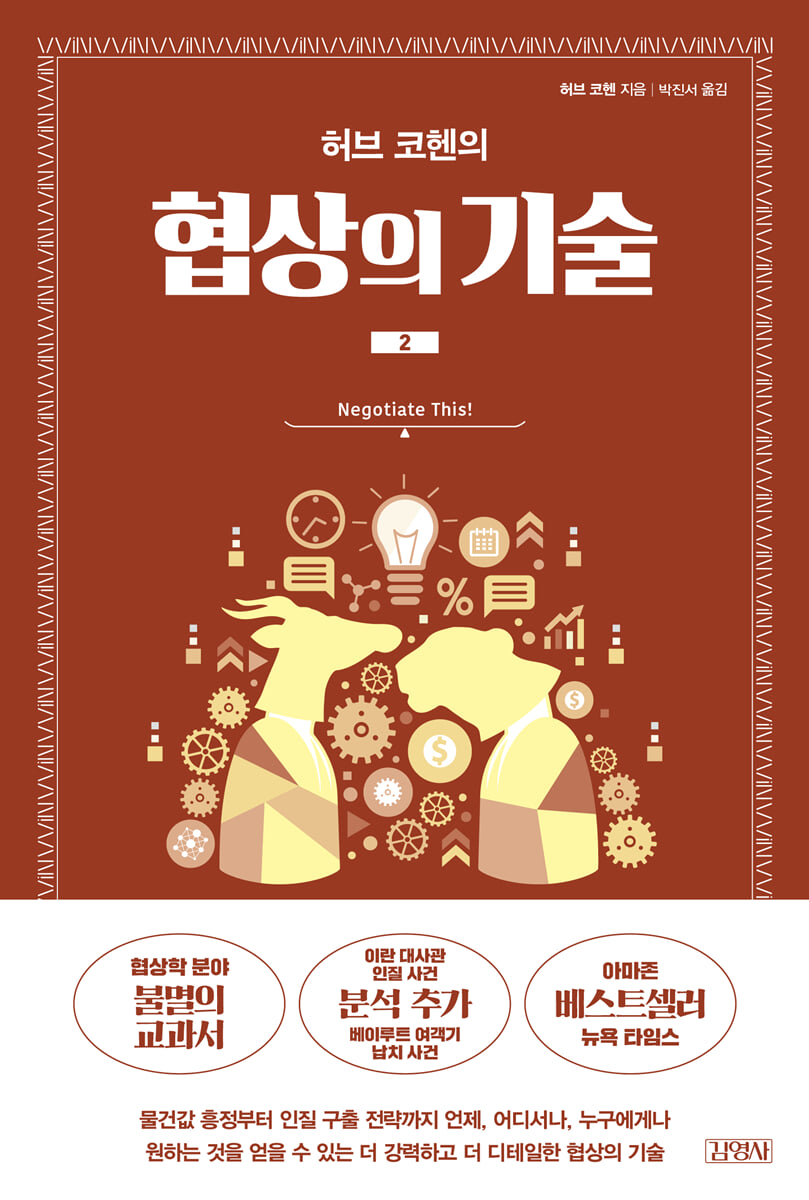
Herb Cohen's The Art of Negotiation 2
 |
Description
Book Introduction
Another negotiation textbook following Herb Cohen's The Art of Negotiation 1.
Amazon and New York Times bestseller
Practical negotiation skills of persuasion and dialogue that turn the impossible into possible and failure into success.
Negotiation is a decision-making tool for two or more parties to resolve their differing needs and interests.
It is also about understanding complex beings that are subtly different and constantly changing.
While "The Art of Negotiation: The Art of Negotiation 1," published in 1983 and established as a steadfast negotiation textbook, focused on understanding the three factors that influence negotiation—power, time, and information—and the principles of negotiation, "Negotiate This!", published 20 years later, offers more insight into the persuasion and communication skills needed to gain an advantageous position in negotiation.
Among the thousands of negotiations he was directly involved in, the book includes analyses of the Iranian embassy hostage crisis and the Beirut airliner hijacking, demonstrating how the elements and principles highlighted in Volume 1 were applied in practice.
Amazon and New York Times bestseller
Practical negotiation skills of persuasion and dialogue that turn the impossible into possible and failure into success.
Negotiation is a decision-making tool for two or more parties to resolve their differing needs and interests.
It is also about understanding complex beings that are subtly different and constantly changing.
While "The Art of Negotiation: The Art of Negotiation 1," published in 1983 and established as a steadfast negotiation textbook, focused on understanding the three factors that influence negotiation—power, time, and information—and the principles of negotiation, "Negotiate This!", published 20 years later, offers more insight into the persuasion and communication skills needed to gain an advantageous position in negotiation.
Among the thousands of negotiations he was directly involved in, the book includes analyses of the Iranian embassy hostage crisis and the Beirut airliner hijacking, demonstrating how the elements and principles highlighted in Volume 1 were applied in practice.
- You can preview some of the book's contents.
Preview
index
preface.
Negotiation: A psychological game to win the other party over to your side
Chapter 1.
Taking a Step Back: The Mechanism of Negotiation
Chapter 2.
Your Destiny Is in Your Own Hand: Negotiation in the Bible
Chapter 3.
It's Not Words, It's Attitude: Reagan's Negotiation
Chapter 4.
We're Similar, Yet So Different: Why Strategy Matters
Chapter 5.
Enjoy the Game: The Negotiation Formula
Chapter 6.
TIPs on Perception: Time, Information, and Power
Chapter 7.
It ain't over till it's over: Time and Timing
Chapter 8.
The more you get, the better: information
Chapter 9.
Depends on the viewer: strength
Chapter 10.
You Already Have It: The Source of Power
Chapter 11.
Special Negotiations: Terrorism and Child Rearing
Chapter 12.
Again, enjoy the game
supplement
1.
Carter defied all logic by excluding negotiation "experts."
2.
inadequate response to the Iran hostage crisis
3.
The Reality of Hostile Negotiations
4.
The Scourge of International Terrorism: The Threat International Terrorism Poses to the United States
5.
Terrorism and the Mass Media
References
Negotiation: A psychological game to win the other party over to your side
Chapter 1.
Taking a Step Back: The Mechanism of Negotiation
Chapter 2.
Your Destiny Is in Your Own Hand: Negotiation in the Bible
Chapter 3.
It's Not Words, It's Attitude: Reagan's Negotiation
Chapter 4.
We're Similar, Yet So Different: Why Strategy Matters
Chapter 5.
Enjoy the Game: The Negotiation Formula
Chapter 6.
TIPs on Perception: Time, Information, and Power
Chapter 7.
It ain't over till it's over: Time and Timing
Chapter 8.
The more you get, the better: information
Chapter 9.
Depends on the viewer: strength
Chapter 10.
You Already Have It: The Source of Power
Chapter 11.
Special Negotiations: Terrorism and Child Rearing
Chapter 12.
Again, enjoy the game
supplement
1.
Carter defied all logic by excluding negotiation "experts."
2.
inadequate response to the Iran hostage crisis
3.
The Reality of Hostile Negotiations
4.
The Scourge of International Terrorism: The Threat International Terrorism Poses to the United States
5.
Terrorism and the Mass Media
References
Detailed image

Into the book
Negotiation is the game of life.
When we try to mediate differences and conflicts, resolve disputes, build relationships, or mediate, we engage in a game called negotiation.
Negotiation is the source of real relationships.
People recognize the importance of these negotiation skills in foreign affairs and labor relations, but they fail to see the opportunity to use these negotiation skills to lead a more proactive life.
--- p.22
The reason we find certain behavior unexpected is because it contains values, beliefs, and experiences that we do not understand.
In fact, no matter how strange it may be, from the subject's perspective, all actions make sense.
In this sense, there's no reason why you shouldn't be able to talk to a malicious ex-spouse, a disobedient child, a troublesome in-law, a vengeful former colleague, or a callous government official.
--- p.38
Style is the way you negotiate, your approach and attitude.
Remember that style is more important than what you say.
Desirable styles include active listening, warmth and sensitivity, patience, empathy, and consideration for others' values and self-esteem.
Therefore, depending on the attitude we show during this process, it affects the other person's emotions, mood, perception, intimacy, trust, and expectations.
--- p.111
I have said that negotiations are a mixture of agreement and disagreement.
Negotiation is always a game of multiple motivations, with commonalities and conflicts.
Therefore, negotiation requires a strategy that appropriately mixes style and content.
Remember that how you communicate has a greater impact than what you discuss.
Therefore, we must show flexibility in means (methods) and firm determination in goals and interests (what).
--- p.187
Start with something in common that you can both relate to.
During the negotiation process, you must respect the other party's point of view in a natural and unadorned manner.
Listen actively, take notes, and occasionally express empathy.
If the other person complains or raises an objection, don't respond immediately.
Instead, let the other person know you are listening by repeating what they said first.
Then, after carefully considering the other person's feelings, ask a new question to elicit their fundamental interests and concerns.
--- p.197
The demands I talk about at the beginning of the negotiation are the ones that are visible above the water surface.
There are many hidden factors that led me to choose this first request, and I believe they ultimately serve my fundamental interests and needs.
What I'm trying to say is that the initial position someone speaks of is not the reality, but only a shadow.
--- p.203
The point is, when confessing a mistake, don't put conditions on it.
Then people will understand.
If you admit that you are not perfect, you come across as a human being.
In fact, this behavior could be considered a concession in the sense that it could elicit compensation from the other party.
--- p.232
I hope you've realized that thinking of negotiation as a game can be a psychological shield that protects your self-esteem from attacks from the other party.
And with this attitude, you will gain the perspective and detachment of an onlooker.
If you have this game spirit, you won't go to extremes trying to close a deal.
If you take your time, things will work out naturally.
Why? Because if you over-pressure people with excessive worry, they're more likely to rebel.
--- p.409
I have witnessed many people in negotiations immediately withdraw their offer and move on when it is rejected.
They forget that the answer “no” is the starting point of negotiation, and that it always takes time to adjust to something unexpected.
Therefore, we must whip ourselves to be more patient and persistent.
If the other person responds coldly to your approach or suggestion, try again at another time and in a different way.
Remember, “After every ‘no’ comes a ‘yes.’”
When we try to mediate differences and conflicts, resolve disputes, build relationships, or mediate, we engage in a game called negotiation.
Negotiation is the source of real relationships.
People recognize the importance of these negotiation skills in foreign affairs and labor relations, but they fail to see the opportunity to use these negotiation skills to lead a more proactive life.
--- p.22
The reason we find certain behavior unexpected is because it contains values, beliefs, and experiences that we do not understand.
In fact, no matter how strange it may be, from the subject's perspective, all actions make sense.
In this sense, there's no reason why you shouldn't be able to talk to a malicious ex-spouse, a disobedient child, a troublesome in-law, a vengeful former colleague, or a callous government official.
--- p.38
Style is the way you negotiate, your approach and attitude.
Remember that style is more important than what you say.
Desirable styles include active listening, warmth and sensitivity, patience, empathy, and consideration for others' values and self-esteem.
Therefore, depending on the attitude we show during this process, it affects the other person's emotions, mood, perception, intimacy, trust, and expectations.
--- p.111
I have said that negotiations are a mixture of agreement and disagreement.
Negotiation is always a game of multiple motivations, with commonalities and conflicts.
Therefore, negotiation requires a strategy that appropriately mixes style and content.
Remember that how you communicate has a greater impact than what you discuss.
Therefore, we must show flexibility in means (methods) and firm determination in goals and interests (what).
--- p.187
Start with something in common that you can both relate to.
During the negotiation process, you must respect the other party's point of view in a natural and unadorned manner.
Listen actively, take notes, and occasionally express empathy.
If the other person complains or raises an objection, don't respond immediately.
Instead, let the other person know you are listening by repeating what they said first.
Then, after carefully considering the other person's feelings, ask a new question to elicit their fundamental interests and concerns.
--- p.197
The demands I talk about at the beginning of the negotiation are the ones that are visible above the water surface.
There are many hidden factors that led me to choose this first request, and I believe they ultimately serve my fundamental interests and needs.
What I'm trying to say is that the initial position someone speaks of is not the reality, but only a shadow.
--- p.203
The point is, when confessing a mistake, don't put conditions on it.
Then people will understand.
If you admit that you are not perfect, you come across as a human being.
In fact, this behavior could be considered a concession in the sense that it could elicit compensation from the other party.
--- p.232
I hope you've realized that thinking of negotiation as a game can be a psychological shield that protects your self-esteem from attacks from the other party.
And with this attitude, you will gain the perspective and detachment of an onlooker.
If you have this game spirit, you won't go to extremes trying to close a deal.
If you take your time, things will work out naturally.
Why? Because if you over-pressure people with excessive worry, they're more likely to rebel.
--- p.409
I have witnessed many people in negotiations immediately withdraw their offer and move on when it is rejected.
They forget that the answer “no” is the starting point of negotiation, and that it always takes time to adjust to something unexpected.
Therefore, we must whip ourselves to be more patient and persistent.
If the other person responds coldly to your approach or suggestion, try again at another time and in a different way.
Remember, “After every ‘no’ comes a ‘yes.’”
--- p.424
Publisher's Review
Another negotiation textbook following Herb Cohen's The Art of Negotiation 1.
Amazon, New York Times bestseller
More powerful and detailed than Herb Cohen's The Art of Negotiation 1!
Practical negotiation skills of persuasion and dialogue that turn the impossible into possible and failure into success.
There are things in the environment surrounding us that we cannot change.
But Herb Cohen says that through negotiation, you can live a proactive life even in extreme situations.
The quality of life, or rather survival itself, depends on how well you negotiate.
Negotiation is necessary every moment, just like breathing.
This book, which condenses the negotiation experience and know-how of Herb Cohen, a negotiation advisor to the Jimmy Carter and Reagan administrations and who has negotiated on behalf of numerous corporations and governments, emphasizes only one thing.
How you communicate, rather than what you negotiate, determines the success or failure of a negotiation.
Negotiation is a decision-making tool for two or more parties to resolve their differing needs and interests.
It is also about understanding complex beings that are subtly different and constantly changing.
Published in 1983, "The Art of Negotiation: The Art of Negotiation 1" established itself as a steadfast negotiation textbook. It focused on understanding the three key elements of negotiation—power, time, and information—and the principles of negotiation. Published 20 years later, "Negotiate This!" offers a deeper understanding of the persuasion and communication skills needed to gain an advantageous position in negotiation.
Among the thousands of negotiations he was directly involved in, the book includes analyses of the Iranian embassy hostage crisis and the Beirut airliner hijacking, demonstrating how the elements and principles highlighted in Volume 1 were applied in practice.
“There is no impossible negotiation in the world!”
Practice negotiating words that turn no into yes.
“When we find someone’s behavior surprising, it is because that behavior is based on values, beliefs, or experiences that we do not understand.
Because every action makes sense from the subject's perspective.
In this sense, there is no reason why you can't have a conversation with a spiteful ex-spouse, a disobedient child, a troublesome in-law, a vengeful former colleague, or a callous government official." In other words, you should approach negotiations as if you can talk to anyone, on any topic.
Sometimes you will hear the other person say “no.”
But “no” only means not now, it doesn’t mean never.
It's just a temporary reflex reaction to an unexpected offer.
This is when you use the magic word that elicits a “yes.”
- “Help me!”: The other person has information you don’t know.
If you ask him for help, he will be more than happy to share what he knows.
It is a strategy to make the other person feel superior.
Use that as evidence to support your argument and reach a consensus.
- “I don’t know”: Start with a question even if you know the answer, let the other person go off topic, and don’t try to argue with them.
Use this conversational style to gather information about the other person's beliefs, motivations, and values.
This information will provide hints that can help remove obstacles in negotiations.
Also, in negotiation, it is better to be stupid than smart.
Curiosity and humility lead to new ideas.
- “I would have done the same thing”: How you respond is more important than what you discuss.
Your attentiveness, patience, and consideration influence the other person's feelings, perceptions, and expectations.
Even if you don't agree with the other person's argument at all, if you respond calmly and show empathy, the other person will change from an enemy to an ally.
If you do someone a favor first and give them something valuable, they will want to repay you.
Negotiators aren't born, they're made.
Cheat keys to enjoy the game of negotiation: power, time, and information.
The three elements of negotiation that Herb Cohen mentioned in Volume 1 are still important.
This is emphasized again in Volume 2.
- Power: Power is not something I actually have, but something others think I have.
Just like standards of beauty, strength also depends on the eye of the beholder.
To gain the upper hand, you must build a reputation as someone willing to take risks for the sake of principles.
- Time: There is no need to blindly adhere to deadlines set for convenience.
You can calculate the risks and benefits of missing the deadline and then make your move.
You should not let the other party know your deadline, as the person with the time constraints is more likely to yield.
Seize the 'timing' when demand is at its peak.
Patience is rewarded.
- Information: The output changes depending on the input.
Before negotiating, you need to gather and select information to gain the upper hand.
You must start before the starting signal sounds.
Satisfaction and dissatisfaction are determined by the difference between expectations and results.
Provide timely information in the early stages of negotiations so that the other party can adjust their expectations to reality.
When you listen more, talk less, ask non-threatening questions, and express gratitude for the information the other person provides, the amount of information you receive increases and its quality improves.
Amazon, New York Times bestseller
More powerful and detailed than Herb Cohen's The Art of Negotiation 1!
Practical negotiation skills of persuasion and dialogue that turn the impossible into possible and failure into success.
There are things in the environment surrounding us that we cannot change.
But Herb Cohen says that through negotiation, you can live a proactive life even in extreme situations.
The quality of life, or rather survival itself, depends on how well you negotiate.
Negotiation is necessary every moment, just like breathing.
This book, which condenses the negotiation experience and know-how of Herb Cohen, a negotiation advisor to the Jimmy Carter and Reagan administrations and who has negotiated on behalf of numerous corporations and governments, emphasizes only one thing.
How you communicate, rather than what you negotiate, determines the success or failure of a negotiation.
Negotiation is a decision-making tool for two or more parties to resolve their differing needs and interests.
It is also about understanding complex beings that are subtly different and constantly changing.
Published in 1983, "The Art of Negotiation: The Art of Negotiation 1" established itself as a steadfast negotiation textbook. It focused on understanding the three key elements of negotiation—power, time, and information—and the principles of negotiation. Published 20 years later, "Negotiate This!" offers a deeper understanding of the persuasion and communication skills needed to gain an advantageous position in negotiation.
Among the thousands of negotiations he was directly involved in, the book includes analyses of the Iranian embassy hostage crisis and the Beirut airliner hijacking, demonstrating how the elements and principles highlighted in Volume 1 were applied in practice.
“There is no impossible negotiation in the world!”
Practice negotiating words that turn no into yes.
“When we find someone’s behavior surprising, it is because that behavior is based on values, beliefs, or experiences that we do not understand.
Because every action makes sense from the subject's perspective.
In this sense, there is no reason why you can't have a conversation with a spiteful ex-spouse, a disobedient child, a troublesome in-law, a vengeful former colleague, or a callous government official." In other words, you should approach negotiations as if you can talk to anyone, on any topic.
Sometimes you will hear the other person say “no.”
But “no” only means not now, it doesn’t mean never.
It's just a temporary reflex reaction to an unexpected offer.
This is when you use the magic word that elicits a “yes.”
- “Help me!”: The other person has information you don’t know.
If you ask him for help, he will be more than happy to share what he knows.
It is a strategy to make the other person feel superior.
Use that as evidence to support your argument and reach a consensus.
- “I don’t know”: Start with a question even if you know the answer, let the other person go off topic, and don’t try to argue with them.
Use this conversational style to gather information about the other person's beliefs, motivations, and values.
This information will provide hints that can help remove obstacles in negotiations.
Also, in negotiation, it is better to be stupid than smart.
Curiosity and humility lead to new ideas.
- “I would have done the same thing”: How you respond is more important than what you discuss.
Your attentiveness, patience, and consideration influence the other person's feelings, perceptions, and expectations.
Even if you don't agree with the other person's argument at all, if you respond calmly and show empathy, the other person will change from an enemy to an ally.
If you do someone a favor first and give them something valuable, they will want to repay you.
Negotiators aren't born, they're made.
Cheat keys to enjoy the game of negotiation: power, time, and information.
The three elements of negotiation that Herb Cohen mentioned in Volume 1 are still important.
This is emphasized again in Volume 2.
- Power: Power is not something I actually have, but something others think I have.
Just like standards of beauty, strength also depends on the eye of the beholder.
To gain the upper hand, you must build a reputation as someone willing to take risks for the sake of principles.
- Time: There is no need to blindly adhere to deadlines set for convenience.
You can calculate the risks and benefits of missing the deadline and then make your move.
You should not let the other party know your deadline, as the person with the time constraints is more likely to yield.
Seize the 'timing' when demand is at its peak.
Patience is rewarded.
- Information: The output changes depending on the input.
Before negotiating, you need to gather and select information to gain the upper hand.
You must start before the starting signal sounds.
Satisfaction and dissatisfaction are determined by the difference between expectations and results.
Provide timely information in the early stages of negotiations so that the other party can adjust their expectations to reality.
When you listen more, talk less, ask non-threatening questions, and express gratitude for the information the other person provides, the amount of information you receive increases and its quality improves.
GOODS SPECIFICS
- Date of issue: January 8, 2021
- Page count, weight, size: 532 pages | 696g | 145*215*35mm
- ISBN13: 9788934989745
- ISBN10: 8934989742
You may also like
카테고리
korean


korean

![GQ KOREA Mark (Monthly): December [2025]](http://librairie.coreenne.fr/cdn/shop/files/8ef265dbbfbf186523ed75ba7319009d.jpg?v=1765340328&width=3840)


