

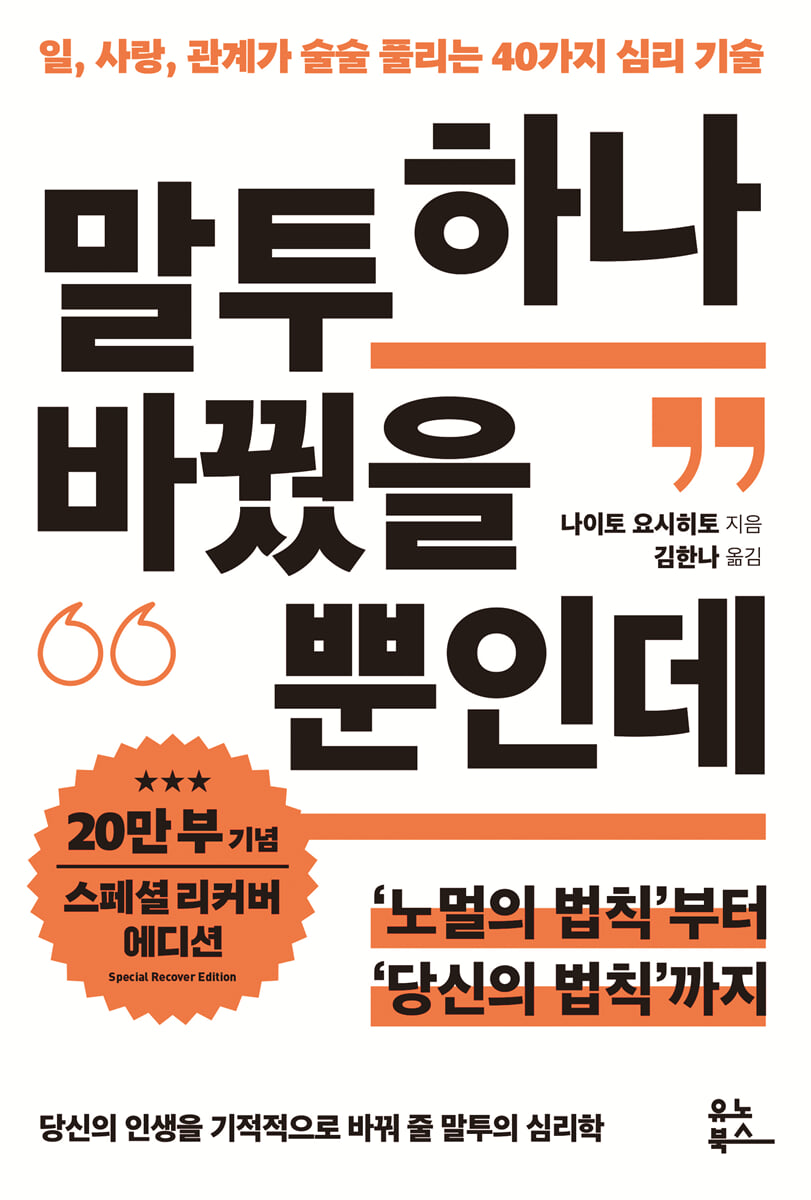
I just changed the tone (Recovery Edition)
 |
Description
Book Introduction
The decisive reason why 200,000 readers read, own, and recommend this book!
“Your tone of voice changes your results, and it changes your life!”
"Just Changing the Way I Spoke" created a "speech syndrome" in South Korea.
Special recover edition commemorating 200,000 copies sold
Would you believe that simply changing your tone of voice could increase your chances of persuading someone by more than 40%? It would probably sound like a joke.
But according to Dr. Yoshihito Naito, a bestselling Japanese psychologist and author of "Just Change Your Tone of Speech," adding "psychology" to your speech is possible.
Consider an experiment by University of Texas psychologist Senna Gaven.
When he simply asked, "What do you think?" on a topic, only 10 percent agreed. But when he asked, "Everyone says so, so what do you think?", that percentage jumped to a staggering 50 percent! This is the effect of what psychology calls the "law of sociality."
Even if it's the same story, if you add, "Everyone does it that way," the chances of the other person agreeing with your opinion increase dramatically!
When asking someone for a favor, it's best to start with a 'small request'.
Instead of simply saying, “Can you help me with some work?”, ask, “Can you help me with 10 minutes?” This will make it less of a burden and more likely to get the other person to agree, rather than asking for an hour.
If you respond again, there are very few people who will leave immediately after 10 minutes have passed.
Psychologist Robert Cialdini discovered this psychological phenomenon through experiments and named it the 'Even-a-Penny Technique'.
In this way, people are driven by 90% psychology, and psychology is driven by 90% words.
Therefore, by understanding the psychological laws that move the human mind and simply changing the way you speak a little, things will go better and your relationships will change dramatically.
If you use your words well, you can make money, get along well with the opposite sex, and even have a happy married life.
《Just Change Your Tone of Speech》 tells the story of the 'psychology of speech' that uses 40 psychological techniques to move people's hearts.
It provides specific tips on how to use certain speech styles to make the other person behave and how to use certain speech styles to make the other person not behave.
From now on, let's change the way we speak just a little bit.
Just by doing this, you will be able to experience a positive change in your life.
This book will serve as a guide.
“Your tone of voice changes your results, and it changes your life!”
"Just Changing the Way I Spoke" created a "speech syndrome" in South Korea.
Special recover edition commemorating 200,000 copies sold
Would you believe that simply changing your tone of voice could increase your chances of persuading someone by more than 40%? It would probably sound like a joke.
But according to Dr. Yoshihito Naito, a bestselling Japanese psychologist and author of "Just Change Your Tone of Speech," adding "psychology" to your speech is possible.
Consider an experiment by University of Texas psychologist Senna Gaven.
When he simply asked, "What do you think?" on a topic, only 10 percent agreed. But when he asked, "Everyone says so, so what do you think?", that percentage jumped to a staggering 50 percent! This is the effect of what psychology calls the "law of sociality."
Even if it's the same story, if you add, "Everyone does it that way," the chances of the other person agreeing with your opinion increase dramatically!
When asking someone for a favor, it's best to start with a 'small request'.
Instead of simply saying, “Can you help me with some work?”, ask, “Can you help me with 10 minutes?” This will make it less of a burden and more likely to get the other person to agree, rather than asking for an hour.
If you respond again, there are very few people who will leave immediately after 10 minutes have passed.
Psychologist Robert Cialdini discovered this psychological phenomenon through experiments and named it the 'Even-a-Penny Technique'.
In this way, people are driven by 90% psychology, and psychology is driven by 90% words.
Therefore, by understanding the psychological laws that move the human mind and simply changing the way you speak a little, things will go better and your relationships will change dramatically.
If you use your words well, you can make money, get along well with the opposite sex, and even have a happy married life.
《Just Change Your Tone of Speech》 tells the story of the 'psychology of speech' that uses 40 psychological techniques to move people's hearts.
It provides specific tips on how to use certain speech styles to make the other person behave and how to use certain speech styles to make the other person not behave.
From now on, let's change the way we speak just a little bit.
Just by doing this, you will be able to experience a positive change in your life.
This book will serve as a guide.
- You can preview some of the book's contents.
Preview
index
Just change your prologue tone and your life will change!
The Psychology of Speech, Chapter 1
How to get a 'Yes' from someone
When you express your opinion, involve everyone - The Law of Sociality
Even if you need 10,000 won, ask for 1,000 won first - The Even-A-Penny Technique
Ask awkward requests while eating together - The Luncheon Rule
A clear reason and purpose motivates - the DTAG law
Let the other person say the answer with their own mouth - the art of rhetoric
A drop of water wears away a rock - the law of accumulation
Subtly increase the value of information - the information value-giving effect
The Other Person's Personality Is Defined by 'Me' - The Label Effect
The Psychology of Speech, Chapter 2
How can I be loved by someone I want to be loved by?
Great lines don't guarantee great results - The Law of Normal
Finding what you can do rather than changing others - The Law of the North Wind and Sunshine
Who would spit in a smiling face? - The Smile Effect
Subtly Inject 'Numbers' - The Number Effect
If you want to know your lover's heart, incite fear - Operation Fear
Hide 'I' and reveal 'you' - The Law of 'You'
How you say something is more important than what you say - the halo effect
Creating a positive frame increases favorability - The Framing Law
The Psychology of Speech, Chapter 3
How can I say this so that the other person doesn't say 'No'?
Use someone else's voice rather than your own - the eavesdropping effect.
Spread happiness with a smile - The infectious effect of a smiling face
Even the most strict person is powerless against praise - The Praise Trap Effect
Sharing Your Interests Makes You More Generous - The Law of Sharing
Twice is OK, three or more times is NO - Sandwich Method
A plausible "background episode" breaks down the ironclad barrier - Episode Persuasion
Understanding the "Frog Psychology" in the Human Mind - The Irony Effect
The only last resort is the "Tearful Operation" - the underdog effect.
The Psychology of Speech, Chapter 4
How to get someone to behave the way you want them to
Make them believe they made the decision themselves - Mystification
When you have expectations, you try to live up to them - the Pygmalion effect
Don't close the door prematurely by forcing a conclusion - the method of withholding conclusions
Divide a request into two parts - the digging technique
What if I told you to work hard without a salary? - Reinforcement Theory
The bandwagon effect: fueling anxiety about being left behind and urging a decision.
The Ussuri Effect: A Middling Number Motivates
Waste tends to gather around waste - the zero tolerance principle
The Psychology of Speech, Chapter 5
How can I say something so that things go smoothly?
Everyone wants to hear from someone who speaks politely - the law of speech
Saying hello first is also a skill - the preventive effect of greetings
A subtle hint of your upper limit will make your opponent's heart flutter - the top-of-the-line technique.
Give your opponent the power to choose - the option technique
Make them see their selfishness by putting them in their shoes - the persuasion technique of changing their perspective.
The basic principle of negotiation is 'an eye for an eye, a tooth for a tooth' - a retaliatory strategy.
Just clenching your fist can give you strength - the power pose effect
Warm drinks have a magical effect on opening the heart - The Hot Drink Effect
Epilogue: The person who knows how to wait leisurely is the ultimate winner.
Translator's Note: The Psychology of Speech Hidden in Everyday Psychological Laws
References
The Psychology of Speech, Chapter 1
How to get a 'Yes' from someone
When you express your opinion, involve everyone - The Law of Sociality
Even if you need 10,000 won, ask for 1,000 won first - The Even-A-Penny Technique
Ask awkward requests while eating together - The Luncheon Rule
A clear reason and purpose motivates - the DTAG law
Let the other person say the answer with their own mouth - the art of rhetoric
A drop of water wears away a rock - the law of accumulation
Subtly increase the value of information - the information value-giving effect
The Other Person's Personality Is Defined by 'Me' - The Label Effect
The Psychology of Speech, Chapter 2
How can I be loved by someone I want to be loved by?
Great lines don't guarantee great results - The Law of Normal
Finding what you can do rather than changing others - The Law of the North Wind and Sunshine
Who would spit in a smiling face? - The Smile Effect
Subtly Inject 'Numbers' - The Number Effect
If you want to know your lover's heart, incite fear - Operation Fear
Hide 'I' and reveal 'you' - The Law of 'You'
How you say something is more important than what you say - the halo effect
Creating a positive frame increases favorability - The Framing Law
The Psychology of Speech, Chapter 3
How can I say this so that the other person doesn't say 'No'?
Use someone else's voice rather than your own - the eavesdropping effect.
Spread happiness with a smile - The infectious effect of a smiling face
Even the most strict person is powerless against praise - The Praise Trap Effect
Sharing Your Interests Makes You More Generous - The Law of Sharing
Twice is OK, three or more times is NO - Sandwich Method
A plausible "background episode" breaks down the ironclad barrier - Episode Persuasion
Understanding the "Frog Psychology" in the Human Mind - The Irony Effect
The only last resort is the "Tearful Operation" - the underdog effect.
The Psychology of Speech, Chapter 4
How to get someone to behave the way you want them to
Make them believe they made the decision themselves - Mystification
When you have expectations, you try to live up to them - the Pygmalion effect
Don't close the door prematurely by forcing a conclusion - the method of withholding conclusions
Divide a request into two parts - the digging technique
What if I told you to work hard without a salary? - Reinforcement Theory
The bandwagon effect: fueling anxiety about being left behind and urging a decision.
The Ussuri Effect: A Middling Number Motivates
Waste tends to gather around waste - the zero tolerance principle
The Psychology of Speech, Chapter 5
How can I say something so that things go smoothly?
Everyone wants to hear from someone who speaks politely - the law of speech
Saying hello first is also a skill - the preventive effect of greetings
A subtle hint of your upper limit will make your opponent's heart flutter - the top-of-the-line technique.
Give your opponent the power to choose - the option technique
Make them see their selfishness by putting them in their shoes - the persuasion technique of changing their perspective.
The basic principle of negotiation is 'an eye for an eye, a tooth for a tooth' - a retaliatory strategy.
Just clenching your fist can give you strength - the power pose effect
Warm drinks have a magical effect on opening the heart - The Hot Drink Effect
Epilogue: The person who knows how to wait leisurely is the ultimate winner.
Translator's Note: The Psychology of Speech Hidden in Everyday Psychological Laws
References
Detailed image

Into the book
When asking a friend for something, try to start with something 'small'.
Even if you want to ask for something big, it is important to intentionally only ask for 'small' requests.
If you ask for a small favor, the other person won't feel too burdened.
In other words, the standard for judging whether it is okay to accept something has been significantly lowered, so people are more willing to accept the request.
At this time, a very strange phenomenon occurs.
There are many cases where you only ask for a 'small' favor, but the other person does you a 'favor that goes beyond that'.
--- p.20, Even-a-Penny Technique
Robert E. Burnkrant of Ohio State University
Burnkrant) had college students read a sentence that said, "It is better for students to take rigorous tests."
Of course, there weren't many college students who agreed with this.
Next, Burns had college students read the same sentences again, but with rhetoric like, "Wouldn't it be helpful for students to take tests?" and "Wouldn't it promote learning?"
Then, this time, the number of students who agreed increased.
--- p.37, Rhetoric
If your partner is always late for dates, you can decide on a place to meet at their favorite restaurant or a cafe where they can read a book and wait.
If you do that, you won't get angry at all even if you wait for hours.
(.…)
In short, you just have to change what you can do.
It's difficult to ask someone to change their behavior or personality, but if it's something you can change yourself, you can do it right now.
Also, the relationship between each other becomes more harmonious.
--- p.62, The Law of the North Wind and Sunshine
When persuading someone, 'How will I convey my message?' is much more important than 'What will I say?'
To put it very crudely, it doesn't really matter what you say.
If you express your feelings with sincere words, the other person will be able to feel your warmth and listen to you more easily.
So, it doesn't matter whether you have the words or not, what matters is how much you can put into it.
--- p.82, Halo effect
There is also data that shows that if I show a smiling face, the other person will smile back in just 30 seconds.
This was discovered through an experiment by Ulf Sandberg of Uppsala University in Sweden, who found that when we see a picture of a smiling person, we automatically smile after just 30 seconds.
The infectious effect of a smiling face is very powerful.
If I talk for 30 seconds while smiling, the other person will laugh along.
If you tell them what you want after feeling, "Oh, the other person is starting to laugh too," you won't be rejected outright.
--- p.101, The infectious effect of a smiling face
If you ask for a small favor, they will listen to you even if you later increase the level of your demands.
Let's say your child is overweight and you want to make him exercise a little.
In times like this, it would be good to first suggest, “It’ll only take 5 minutes, so why don’t you try walking?” and if the child follows that suggestion, add, “From now on, let’s try walking briskly for 5 minutes.”
Once we agree to something, we often feel like we can't back down, so we often readily take on a second request.
--- p.147, Digging in
Using polite language gives the impression that you are intelligent and capable of doing your job, but using vulgar language gives a bad impression.
Even subordinates don't want to hear what that kind of person says.
(…) Let us be careful to use polite language to everyone at all times, regardless of age or position.
--- p.171, The Law of Speech
Regardless of whether we think it's a good idea or not, if we are given information like, "The best product costs ○○○ won," we are bound to be influenced by that information.
Even in a conveyor belt sushi restaurant, if there are flyers posted all over the place that say, "A plate of premium tuna costs 5,000 won," you might not order that sushi, but you end up choosing sushi that is a little cheaper, around 3,000 won, so you end up ordering only 1,000 won sushi.
Even if you want to ask for something big, it is important to intentionally only ask for 'small' requests.
If you ask for a small favor, the other person won't feel too burdened.
In other words, the standard for judging whether it is okay to accept something has been significantly lowered, so people are more willing to accept the request.
At this time, a very strange phenomenon occurs.
There are many cases where you only ask for a 'small' favor, but the other person does you a 'favor that goes beyond that'.
--- p.20, Even-a-Penny Technique
Robert E. Burnkrant of Ohio State University
Burnkrant) had college students read a sentence that said, "It is better for students to take rigorous tests."
Of course, there weren't many college students who agreed with this.
Next, Burns had college students read the same sentences again, but with rhetoric like, "Wouldn't it be helpful for students to take tests?" and "Wouldn't it promote learning?"
Then, this time, the number of students who agreed increased.
--- p.37, Rhetoric
If your partner is always late for dates, you can decide on a place to meet at their favorite restaurant or a cafe where they can read a book and wait.
If you do that, you won't get angry at all even if you wait for hours.
(.…)
In short, you just have to change what you can do.
It's difficult to ask someone to change their behavior or personality, but if it's something you can change yourself, you can do it right now.
Also, the relationship between each other becomes more harmonious.
--- p.62, The Law of the North Wind and Sunshine
When persuading someone, 'How will I convey my message?' is much more important than 'What will I say?'
To put it very crudely, it doesn't really matter what you say.
If you express your feelings with sincere words, the other person will be able to feel your warmth and listen to you more easily.
So, it doesn't matter whether you have the words or not, what matters is how much you can put into it.
--- p.82, Halo effect
There is also data that shows that if I show a smiling face, the other person will smile back in just 30 seconds.
This was discovered through an experiment by Ulf Sandberg of Uppsala University in Sweden, who found that when we see a picture of a smiling person, we automatically smile after just 30 seconds.
The infectious effect of a smiling face is very powerful.
If I talk for 30 seconds while smiling, the other person will laugh along.
If you tell them what you want after feeling, "Oh, the other person is starting to laugh too," you won't be rejected outright.
--- p.101, The infectious effect of a smiling face
If you ask for a small favor, they will listen to you even if you later increase the level of your demands.
Let's say your child is overweight and you want to make him exercise a little.
In times like this, it would be good to first suggest, “It’ll only take 5 minutes, so why don’t you try walking?” and if the child follows that suggestion, add, “From now on, let’s try walking briskly for 5 minutes.”
Once we agree to something, we often feel like we can't back down, so we often readily take on a second request.
--- p.147, Digging in
Using polite language gives the impression that you are intelligent and capable of doing your job, but using vulgar language gives a bad impression.
Even subordinates don't want to hear what that kind of person says.
(…) Let us be careful to use polite language to everyone at all times, regardless of age or position.
--- p.171, The Law of Speech
Regardless of whether we think it's a good idea or not, if we are given information like, "The best product costs ○○○ won," we are bound to be influenced by that information.
Even in a conveyor belt sushi restaurant, if there are flyers posted all over the place that say, "A plate of premium tuna costs 5,000 won," you might not order that sushi, but you end up choosing sushi that is a little cheaper, around 3,000 won, so you end up ordering only 1,000 won sushi.
--- p.180, Top of the Line Technique
Publisher's Review
Just change your tone a little!
That alone will change your relationships and transform your life!
Edwin Gross of Loyola University in the United States
J. Gross) showed Chicagoans pens and pencils and asked, “How much do you ‘like’ these products?”
Then, 36.1% answered that they liked it.
He showed me the same products and this time asked, “How much do you ‘hate’ these products?”
Then, surprisingly, the number of people who answered that they liked it decreased to 15.6%.
Strangely enough, the human mind is greatly influenced by even such small differences in speech.
A small difference in tone can make you willingly accept the other person's request, or for some reason, make you want to resist.
Dr. Yoshihito Naito, a Japanese bestselling psychologist and author of “Just Change Your Tone of Speech,” says, “People act 90% psychologically,” and explains that by understanding a few psychological laws and slightly changing your tone of speech accordingly, your relationships with people around you will change and your life will change.
At the same time, it clearly organizes and introduces 40 psychological techniques and the psychology of speech that anyone can easily use in their daily lives.
★ How should I say something to get the other person to say YES?
“Would you like to come to the company dinner this Friday?” (X)
“There’s a company dinner this Friday, and the girl I like is coming too.
“You come too and help me get along with her.” (O)
No matter how close you are, if you leave out the reason and purpose of your request, it will be difficult for the other person to listen.
However, if you are specific about the reason and purpose, the other person is more likely to grant your request.
University of Utah psychologist Jakob Jensen discovered that people are motivated simply by being told about their purpose or goal, and he called this the 'DTAG (driving toward a goal) law.'
It means 'the desire to move towards a goal' and is a very effective psychological technique for getting the other person to say yes.
★ How should I say this so that you will believe me?
So how can we get others to believe what we say without resistance? A representative psychological technique is the "information valorization effect."
“Eating eel is good for preventing summer heat.” (X)
“A famous nutritionist said on TV that eating eel is good for preventing summer heat.” (O)
It matters who said it.
If you subtly mention credible sources when speaking, the credibility of your words will increase dramatically.
If you just tell them to eat eel, it sounds like a simple folk tale, but if you tell them that an expert said it, it somehow feels more believable.
In an experiment where department store employees and research lab researchers each observed the reactions of carpet recommendations, Carlton Miles, a psychologist at Northern Illinois University, demonstrated that attaching value to information increases its persuasive power.
★ How should I speak to appear likeable?
Words act like lubricants in human relationships.
Small differences in speech can make someone else see me as either likable or unlikable.
Especially when approaching a woman you like, the tone of voice you use can either win her favor or cause her rejection.
“I would like to talk to you, is that okay?” (O)
“When I look at you, my heart feels like it’s going to burst out of my mouth.” (X)
“Would you like to go for a drink with me?” (△)
Men often have a habit of exaggerating their words in front of women to get their attention.
But experiments by University of Alaska psychologist Chris Kleinke found that the most likability was achieved when the approach was very casual.
In psychology, this is called the 'law of normality'.
So, there is no need for fancy lines like those from movies or cartoons.
It is enough to just smile and say something like, “I would like to talk to Mr. OO.”
Then, there is a pretty high probability that the woman will answer “yes.”
★ How should I speak to strengthen my relationships?
Along with the 'Law of Normal', 'Your Law' is also a psychological technique that has a powerful effect in strengthening human relationships.
This law can be illustrated with the example of a veteran salesman.
People feel uncomfortable with salespeople because they believe that they are ultimately promoting products for their own benefit.
Therefore, a veteran salesman never recommends a product.
Just say, “If you have any difficulties, please don’t hesitate to let me know.”
That is, when the center of interests is placed on 'you' rather than 'me', relationships improve and communication becomes easier.
Because human psychology is the same, this logic can be applied to romantic relationships as well.
“I wish you would OO a little more.” (X)
“If you do this, it will definitely help you.” (O)
By emphasizing in this way that it is always beneficial to the other person, not yourself, you can gain trust.
Since trust is the solid foundation of all human relationships, naturally, your relationship with the other person will also improve.
In times like this, do this~
The psychology of speech that can be used in everyday life!
The 40 psychological techniques and the psychology of speech presented in "Just Change Your Speech" have all been experimentally proven to be effective in the fields of psychology and marketing.
In particular, each chapter is easy to understand and specific enough to be applied immediately in everyday life, whether at home, at work, or in romantic relationships, making it the perfect introductory book for anyone curious about human psychology or seeking to positively change their relationships.
Anyone can ride a bicycle or play the violin with practice.
Likewise, no matter how reserved a person is or how introverted they are, if they practice, they will be able to speak well.
All you need is a little motivation and a little ingenuity.
This book will be the first step.
That alone will change your relationships and transform your life!
Edwin Gross of Loyola University in the United States
J. Gross) showed Chicagoans pens and pencils and asked, “How much do you ‘like’ these products?”
Then, 36.1% answered that they liked it.
He showed me the same products and this time asked, “How much do you ‘hate’ these products?”
Then, surprisingly, the number of people who answered that they liked it decreased to 15.6%.
Strangely enough, the human mind is greatly influenced by even such small differences in speech.
A small difference in tone can make you willingly accept the other person's request, or for some reason, make you want to resist.
Dr. Yoshihito Naito, a Japanese bestselling psychologist and author of “Just Change Your Tone of Speech,” says, “People act 90% psychologically,” and explains that by understanding a few psychological laws and slightly changing your tone of speech accordingly, your relationships with people around you will change and your life will change.
At the same time, it clearly organizes and introduces 40 psychological techniques and the psychology of speech that anyone can easily use in their daily lives.
★ How should I say something to get the other person to say YES?
“Would you like to come to the company dinner this Friday?” (X)
“There’s a company dinner this Friday, and the girl I like is coming too.
“You come too and help me get along with her.” (O)
No matter how close you are, if you leave out the reason and purpose of your request, it will be difficult for the other person to listen.
However, if you are specific about the reason and purpose, the other person is more likely to grant your request.
University of Utah psychologist Jakob Jensen discovered that people are motivated simply by being told about their purpose or goal, and he called this the 'DTAG (driving toward a goal) law.'
It means 'the desire to move towards a goal' and is a very effective psychological technique for getting the other person to say yes.
★ How should I say this so that you will believe me?
So how can we get others to believe what we say without resistance? A representative psychological technique is the "information valorization effect."
“Eating eel is good for preventing summer heat.” (X)
“A famous nutritionist said on TV that eating eel is good for preventing summer heat.” (O)
It matters who said it.
If you subtly mention credible sources when speaking, the credibility of your words will increase dramatically.
If you just tell them to eat eel, it sounds like a simple folk tale, but if you tell them that an expert said it, it somehow feels more believable.
In an experiment where department store employees and research lab researchers each observed the reactions of carpet recommendations, Carlton Miles, a psychologist at Northern Illinois University, demonstrated that attaching value to information increases its persuasive power.
★ How should I speak to appear likeable?
Words act like lubricants in human relationships.
Small differences in speech can make someone else see me as either likable or unlikable.
Especially when approaching a woman you like, the tone of voice you use can either win her favor or cause her rejection.
“I would like to talk to you, is that okay?” (O)
“When I look at you, my heart feels like it’s going to burst out of my mouth.” (X)
“Would you like to go for a drink with me?” (△)
Men often have a habit of exaggerating their words in front of women to get their attention.
But experiments by University of Alaska psychologist Chris Kleinke found that the most likability was achieved when the approach was very casual.
In psychology, this is called the 'law of normality'.
So, there is no need for fancy lines like those from movies or cartoons.
It is enough to just smile and say something like, “I would like to talk to Mr. OO.”
Then, there is a pretty high probability that the woman will answer “yes.”
★ How should I speak to strengthen my relationships?
Along with the 'Law of Normal', 'Your Law' is also a psychological technique that has a powerful effect in strengthening human relationships.
This law can be illustrated with the example of a veteran salesman.
People feel uncomfortable with salespeople because they believe that they are ultimately promoting products for their own benefit.
Therefore, a veteran salesman never recommends a product.
Just say, “If you have any difficulties, please don’t hesitate to let me know.”
That is, when the center of interests is placed on 'you' rather than 'me', relationships improve and communication becomes easier.
Because human psychology is the same, this logic can be applied to romantic relationships as well.
“I wish you would OO a little more.” (X)
“If you do this, it will definitely help you.” (O)
By emphasizing in this way that it is always beneficial to the other person, not yourself, you can gain trust.
Since trust is the solid foundation of all human relationships, naturally, your relationship with the other person will also improve.
In times like this, do this~
The psychology of speech that can be used in everyday life!
The 40 psychological techniques and the psychology of speech presented in "Just Change Your Speech" have all been experimentally proven to be effective in the fields of psychology and marketing.
In particular, each chapter is easy to understand and specific enough to be applied immediately in everyday life, whether at home, at work, or in romantic relationships, making it the perfect introductory book for anyone curious about human psychology or seeking to positively change their relationships.
Anyone can ride a bicycle or play the violin with practice.
Likewise, no matter how reserved a person is or how introverted they are, if they practice, they will be able to speak well.
All you need is a little motivation and a little ingenuity.
This book will be the first step.
GOODS SPECIFICS
- Date of issue: March 17, 2017
- Page count, weight, size: 216 pages | 298g | 142*210*13mm
- ISBN13: 9791186665503
- ISBN10: 1186665505
You may also like
카테고리
korean


korean

![GQ KOREA Mark (Monthly): December [2025]](http://librairie.coreenne.fr/cdn/shop/files/8ef265dbbfbf186523ed75ba7319009d.jpg?v=1765340328&width=3840)


