

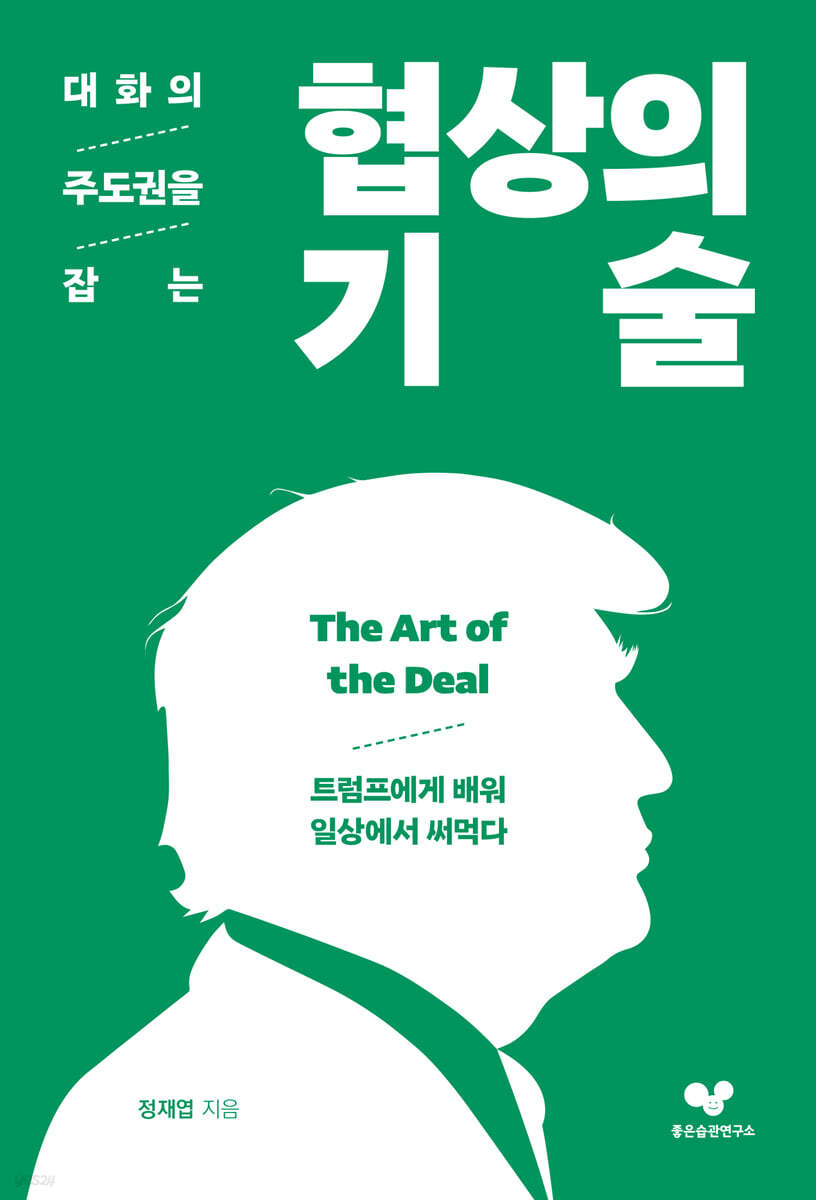
Negotiation skills that take the lead in conversation
 |
Description
Book Introduction
We analyzed and summarized the negotiation skills of US President Donald Trump, who is called the “master negotiator” and “master of the deal.”
We selected a total of 10 negotiation techniques and explored how each technique can be applied in daily life, and conversely, how to respond when encountering a counterparty who uses these techniques.
It's a good habit to have in order to become someone who takes the initiative in conversation and builds trust and persuasion.
We selected a total of 10 negotiation techniques and explored how each technique can be applied in daily life, and conversely, how to respond when encountering a counterparty who uses these techniques.
It's a good habit to have in order to become someone who takes the initiative in conversation and builds trust and persuasion.
- You can preview some of the book's contents.
Preview
index
Trump's Negotiation Skills - 10 Key Practical Phrases
introduction.
Relearning to negotiate amidst harsh language
Trump's Three Principles of Negotiation
Skill 1: Extreme Demands
- Set high standards from the beginning to gain an advantageous starting point in negotiations.
Case Study: Trump's 2025 Global Tariff War
Skill 2: Unpredictability
- Intentionally act ambiguously to make the other party feel uneasy and lead the negotiation in the desired direction.
- Case: After the 2025 US-Ukraine Summit, the US stated its position on whether to intervene in the war.
Skill 3: Display of Power
- By clearly presenting deadlines and alternatives, I demonstrate that I have the power to choose from a variety of options.
Case Study: 2019 US-Mexico Tariff Negotiations and Conditional Links to Immigration Policy
Skill 4: Prepare to Break
- Make it clear that negotiations can be terminated if the conditions are not met.
- Cases: The US's withdrawal from NAFTA in 2017, and the US-China trade negotiations in 2018-2019.
Technique 5: Personalized Approach
- Treat the other person specially and give the impression that this is an offer just for you.
Case Study: Trump's Tailored Relationship Design with Shinzo Abe, Macron, and Kim Jong-un
Skill 6: Unannounced Gift
- Increase goodwill and negotiation momentum by offering a gift at an unexpected time.
- Case: 2018 Sentosa, Singapore North Korea-US Summit - Trump's vision video exposed
Technique 7: Pressure Through Public Opinion
- Indirectly pressure the opponent by turning public opinion to your side.
- Case: 2025 US-Ukraine Summit - War of Words with President Zelensky
Skill 8: Multi-Issue Linking
-Bind multiple issues together and use advantageous points as leverage to reach an overall agreement.
Case Study: Trump's Global Tariff War in 2025
Skill 9: Emotional Explosion
- Strategically express your emotions to grab the other person's attention and lead the negotiation atmosphere.
Case Study: The Trump Administration and Harvard University Conflict in 2025
Skill 10: Exploiting Weaknesses
- Lead negotiations to your advantage by pointing out the other party's weaknesses and suggesting alternative solutions to address them.
- Case: 2025 US-South Africa Summit - South Africa's human rights issues were raised in public
The Light and Shadow of Trump's Negotiations
What We Can Learn from Trump
Epilogue.
The end of negotiations, or the beginning of another
supplement.
Key Negotiation Strategies/Techniques
introduction.
Relearning to negotiate amidst harsh language
Trump's Three Principles of Negotiation
Skill 1: Extreme Demands
- Set high standards from the beginning to gain an advantageous starting point in negotiations.
Case Study: Trump's 2025 Global Tariff War
Skill 2: Unpredictability
- Intentionally act ambiguously to make the other party feel uneasy and lead the negotiation in the desired direction.
- Case: After the 2025 US-Ukraine Summit, the US stated its position on whether to intervene in the war.
Skill 3: Display of Power
- By clearly presenting deadlines and alternatives, I demonstrate that I have the power to choose from a variety of options.
Case Study: 2019 US-Mexico Tariff Negotiations and Conditional Links to Immigration Policy
Skill 4: Prepare to Break
- Make it clear that negotiations can be terminated if the conditions are not met.
- Cases: The US's withdrawal from NAFTA in 2017, and the US-China trade negotiations in 2018-2019.
Technique 5: Personalized Approach
- Treat the other person specially and give the impression that this is an offer just for you.
Case Study: Trump's Tailored Relationship Design with Shinzo Abe, Macron, and Kim Jong-un
Skill 6: Unannounced Gift
- Increase goodwill and negotiation momentum by offering a gift at an unexpected time.
- Case: 2018 Sentosa, Singapore North Korea-US Summit - Trump's vision video exposed
Technique 7: Pressure Through Public Opinion
- Indirectly pressure the opponent by turning public opinion to your side.
- Case: 2025 US-Ukraine Summit - War of Words with President Zelensky
Skill 8: Multi-Issue Linking
-Bind multiple issues together and use advantageous points as leverage to reach an overall agreement.
Case Study: Trump's Global Tariff War in 2025
Skill 9: Emotional Explosion
- Strategically express your emotions to grab the other person's attention and lead the negotiation atmosphere.
Case Study: The Trump Administration and Harvard University Conflict in 2025
Skill 10: Exploiting Weaknesses
- Lead negotiations to your advantage by pointing out the other party's weaknesses and suggesting alternative solutions to address them.
- Case: 2025 US-South Africa Summit - South Africa's human rights issues were raised in public
The Light and Shadow of Trump's Negotiations
What We Can Learn from Trump
Epilogue.
The end of negotiations, or the beginning of another
supplement.
Key Negotiation Strategies/Techniques
Detailed image

Into the book
Trump's remarks send a clear message.
By making extreme demands from the beginning, you can adjust the other party's expectations and then secure an advantageous position through the subsequent negotiation process.
He never actually imposed the high tariffs he set.
It was used as a strategic move to gain an upper hand at the negotiating table.
--- p.29
Extreme demands are used when you want the other person to respond immediately.
But if you block that expectation, the other person can lose their center of gravity and waver.
The quietest response is to 'defer judgment'.
“That condition is a bit big.
“I’ll think about it for a day or so.” This statement gives the other party time to think, while also giving you the opportunity to take the initiative in the negotiation back into your own hands.
--- p.36
Trump has been gradually managing "strategic ambiguity" and maximizing information asymmetry (meaning that the party with less information is at a disadvantage in negotiations due to differences in the quantity or quality of information).
He has consistently maintained his place at the center of the diplomatic stage through international public opinion and media attention, without ever sending a clear message.
While controlling the flow of negotiations from the outside, he exerted influence as an internal player.
--- p.45
“I’ll just try it once and then decide.” This single phrase is an expression that places the power of choice and evaluation as a consumer entirely in my hands.
“That’s a good suggestion, but I’d actually like to compare a few more places.
For now, I'll just try it out today.
“Is it possible to experience it?” From that moment on, the staff started to look at me not as a ‘confirmed customer’ but as a ‘can’t-miss’ floating customer.
If you withhold judgment like this, the other party is more likely to try to induce you to make a choice by offering better discounts, free gifts, or premium services.
--- p.49
The United States maintained its position that it was “insufficient” and continued to pressure by imposing deadlines.
Even within the White House, Stephen Miller, Vice President Mike Pence and others maintained a hard-line stance, repeating, “We can no longer afford to listen to words without action.”
The situation was becoming increasingly tense, but Trump kept one route open throughout the negotiations.
“If Mexico presents a stronger proposal within two days, I will be willing to revisit the negotiations.” This statement was intended to encourage Mexico to propose additional, more robust security measures.
--- p.59
“I’ve recently received two offers to produce branded videos of similar scale.
So, I think we need to discuss adjusting the schedule and unit price at least once.” While not being aggressive, this statement gives the impression that he is not someone who will accept any conditions because he has no work right now.
In particular, the specific expression, "I'm receiving it from two places," increases trust and leaves the client with the burden of "I have to keep this person."
This attitude strengthens my position in all aspects of negotiation, including not only unit price but also schedule coordination, limiting the scope of modifications, and contract terms.
--- p.64
The United States has made a wide range of demands, including strengthening country-of-origin standards for the auto industry, raising labor standards, and strengthening intellectual property protections.
In particular, Trump has repeatedly stated, “If I am not satisfied with the negotiations, we will terminate the agreement.”
This high-handed attitude was enough to instill in then-Canadian Prime Minister Justin Trudeau and Mexican President Enrique Peña Nieto a sense of unease that the United States was “kick[ing] away from the negotiating table itself.”
--- p.74
“Decisions that are different from the direction discussed in advance are repeated, and I must take responsibility for the resulting consequences.
If this method continues, I think we will have to be more careful about how we proceed with future projects.” This is not a rebellion of “I can’t do this,” but rather an expression of a position that we will only work under conditions where we can take responsibility as professionals.
What's important here is tone.
To avoid sounding emotional, you should deliver your message in a calm and composed tone, but make sure your message is clear.
In fact, when clients hear this, they realize that this person is not an outsourced worker who just does what they are told without saying anything, and they are more likely to be more careful about their work methods and demands, and listen to suggestions.
--- p.79
Trump has clashed and cooperated with French President Emmanuel Macron on issues such as the Paris Climate Agreement, the Iran nuclear deal, and NATO burden sharing, but he has always emphasized his personal connection to the press, repeatedly saying, “He’s a great guy” and “Macron is really smart and warm.”
And inviting the Macrons as guests at the first state dinner held at the White House in 2018 was also a symbolic event that utilized personal feelings for diplomacy.
--- p.88
We must find the hidden intention in the words.
“This is a proposal just for you”, “No one else knows.
When I hear things like, “Only you know,” I feel like I’m getting special treatment.
But it's just a temptation.
At this time, the specific conditions must be asked again.
We need to get into the habit of asking, “What makes it special?” and “What conditions are presented to other people?”
--- p.95
Trump tried to break through this point emotionally.
The video Trump prepared was a message that appealed to emotions rather than logical persuasion, and was a "visionary presentation" aimed at Kim Jong-un personally.
It was highly calculated and strategic in that it was produced directly by the United States, not propaganda produced by the North Korean regime, and in that it portrayed "Kim Jong-un personally," not North Korea, as the protagonist. CNN described the video as "an extremely rare strategic production that emotionally reframes the negotiations."
--- p.103
One must ask oneself the following questions:
"What effect is this gift intended to have on the overall negotiation?", "Has this favor lowered my guard?", "What 'conditions' are attached to the gift?" You need to be able to structurally analyze the nature of the gift.
If you only take it with 'good intentions', you will make a big mistake.
--- p.109
The very scene itself—the White House stage, the live broadcast around the world, the debate in front of reporters—was a means of pressuring Ukraine.
As a result, Ukraine was forced to accept a humiliating position before the international community, and the United States became more explicit in its intention to reduce military support.
And Trump was able to project an image of himself as a tough president to his own people.
--- p.115
On a public stage, short, clear words are far more powerful than complex ones.
“Our position is simple.
“If it’s fair, I’ll agree.” You need to prepare a simple but unwavering message like this.
From the perspective of the author, the most important thing is a short, core sentence rather than a long sentence.
In the public eye, the longer a speech is made, the more mistakes are made and misunderstandings are bound to arise.
--- p.120
Trump began leveraging the agreement itself in March 2025, saying, “I will also revisit the provisions of the USMCA.”
At the same time, border security, immigration issues, and the issue of U.S. military facilities in Mexico were also brought to the table for discussion.
He then issued an official statement saying, “Tariffs are not just a matter of price, but a condition for border security.”
--- p.128
Trump brings seemingly unrelated issues to the negotiating table.
In such cases, it is necessary to use techniques to separate the negotiation items.
"This issue is security-related, so it's better to discuss it at a separate table." By intentionally drawing lines and splitting the issue, you narrow the scope of negotiations and give B more control.
--- p.136
Trump often becomes very angry during negotiations, yelling at press conferences, spewing offensive language on social media, and publicly telling his opponents he is “very disappointed.”
Trump's outbursts are not mere outbursts of anger, but calculated pretense, a strategic device designed to shake the negotiating framework and apply psychological pressure.
In other words, it is a strategy that exploits the 'psychological gap' to make the other party nervous, induce mistakes, and lower their confidence, leading to more concessions in negotiations.
--- p.148
What may seem like a sudden outburst of anger is actually a calculated reaction to change the situation.
Eul must figure out what 'hwa' is trying to change.
If you're discussing a price and the other person suddenly starts getting angry and says, "You guys are so rude," you can think, "Oh, this person is just trying to distract me by getting angry and trying to get me to compromise."
The moment you realize this, those feelings cannot be weapons.
--- p.149
Trump's weakness exploitation is not a simple attack; it's a psychological design that packages the opponent's weakness as a public issue and then induces them to find a solution through "negotiation with him."
This time, Trump reframed the negotiations by presenting a moral framework of "white farmer massacre" and making it seem like the solution lies in cooperation with the United States.
--- p.158
'Good intentions' always hide conditions.
Trump often says this:
“I want to help you win,” “This offer is best for you,” “I hope this decision is for the good of your people.”
These words are the sweetest poison in negotiation.
When you hear this, you should immediately ask yourself:
“What is the real purpose of these words?”, “What weakness of mine is this word targeting?”, “What do I have to give in return for this ‘help’?” The power to read the other side of words becomes Eul’s shield.
By making extreme demands from the beginning, you can adjust the other party's expectations and then secure an advantageous position through the subsequent negotiation process.
He never actually imposed the high tariffs he set.
It was used as a strategic move to gain an upper hand at the negotiating table.
--- p.29
Extreme demands are used when you want the other person to respond immediately.
But if you block that expectation, the other person can lose their center of gravity and waver.
The quietest response is to 'defer judgment'.
“That condition is a bit big.
“I’ll think about it for a day or so.” This statement gives the other party time to think, while also giving you the opportunity to take the initiative in the negotiation back into your own hands.
--- p.36
Trump has been gradually managing "strategic ambiguity" and maximizing information asymmetry (meaning that the party with less information is at a disadvantage in negotiations due to differences in the quantity or quality of information).
He has consistently maintained his place at the center of the diplomatic stage through international public opinion and media attention, without ever sending a clear message.
While controlling the flow of negotiations from the outside, he exerted influence as an internal player.
--- p.45
“I’ll just try it once and then decide.” This single phrase is an expression that places the power of choice and evaluation as a consumer entirely in my hands.
“That’s a good suggestion, but I’d actually like to compare a few more places.
For now, I'll just try it out today.
“Is it possible to experience it?” From that moment on, the staff started to look at me not as a ‘confirmed customer’ but as a ‘can’t-miss’ floating customer.
If you withhold judgment like this, the other party is more likely to try to induce you to make a choice by offering better discounts, free gifts, or premium services.
--- p.49
The United States maintained its position that it was “insufficient” and continued to pressure by imposing deadlines.
Even within the White House, Stephen Miller, Vice President Mike Pence and others maintained a hard-line stance, repeating, “We can no longer afford to listen to words without action.”
The situation was becoming increasingly tense, but Trump kept one route open throughout the negotiations.
“If Mexico presents a stronger proposal within two days, I will be willing to revisit the negotiations.” This statement was intended to encourage Mexico to propose additional, more robust security measures.
--- p.59
“I’ve recently received two offers to produce branded videos of similar scale.
So, I think we need to discuss adjusting the schedule and unit price at least once.” While not being aggressive, this statement gives the impression that he is not someone who will accept any conditions because he has no work right now.
In particular, the specific expression, "I'm receiving it from two places," increases trust and leaves the client with the burden of "I have to keep this person."
This attitude strengthens my position in all aspects of negotiation, including not only unit price but also schedule coordination, limiting the scope of modifications, and contract terms.
--- p.64
The United States has made a wide range of demands, including strengthening country-of-origin standards for the auto industry, raising labor standards, and strengthening intellectual property protections.
In particular, Trump has repeatedly stated, “If I am not satisfied with the negotiations, we will terminate the agreement.”
This high-handed attitude was enough to instill in then-Canadian Prime Minister Justin Trudeau and Mexican President Enrique Peña Nieto a sense of unease that the United States was “kick[ing] away from the negotiating table itself.”
--- p.74
“Decisions that are different from the direction discussed in advance are repeated, and I must take responsibility for the resulting consequences.
If this method continues, I think we will have to be more careful about how we proceed with future projects.” This is not a rebellion of “I can’t do this,” but rather an expression of a position that we will only work under conditions where we can take responsibility as professionals.
What's important here is tone.
To avoid sounding emotional, you should deliver your message in a calm and composed tone, but make sure your message is clear.
In fact, when clients hear this, they realize that this person is not an outsourced worker who just does what they are told without saying anything, and they are more likely to be more careful about their work methods and demands, and listen to suggestions.
--- p.79
Trump has clashed and cooperated with French President Emmanuel Macron on issues such as the Paris Climate Agreement, the Iran nuclear deal, and NATO burden sharing, but he has always emphasized his personal connection to the press, repeatedly saying, “He’s a great guy” and “Macron is really smart and warm.”
And inviting the Macrons as guests at the first state dinner held at the White House in 2018 was also a symbolic event that utilized personal feelings for diplomacy.
--- p.88
We must find the hidden intention in the words.
“This is a proposal just for you”, “No one else knows.
When I hear things like, “Only you know,” I feel like I’m getting special treatment.
But it's just a temptation.
At this time, the specific conditions must be asked again.
We need to get into the habit of asking, “What makes it special?” and “What conditions are presented to other people?”
--- p.95
Trump tried to break through this point emotionally.
The video Trump prepared was a message that appealed to emotions rather than logical persuasion, and was a "visionary presentation" aimed at Kim Jong-un personally.
It was highly calculated and strategic in that it was produced directly by the United States, not propaganda produced by the North Korean regime, and in that it portrayed "Kim Jong-un personally," not North Korea, as the protagonist. CNN described the video as "an extremely rare strategic production that emotionally reframes the negotiations."
--- p.103
One must ask oneself the following questions:
"What effect is this gift intended to have on the overall negotiation?", "Has this favor lowered my guard?", "What 'conditions' are attached to the gift?" You need to be able to structurally analyze the nature of the gift.
If you only take it with 'good intentions', you will make a big mistake.
--- p.109
The very scene itself—the White House stage, the live broadcast around the world, the debate in front of reporters—was a means of pressuring Ukraine.
As a result, Ukraine was forced to accept a humiliating position before the international community, and the United States became more explicit in its intention to reduce military support.
And Trump was able to project an image of himself as a tough president to his own people.
--- p.115
On a public stage, short, clear words are far more powerful than complex ones.
“Our position is simple.
“If it’s fair, I’ll agree.” You need to prepare a simple but unwavering message like this.
From the perspective of the author, the most important thing is a short, core sentence rather than a long sentence.
In the public eye, the longer a speech is made, the more mistakes are made and misunderstandings are bound to arise.
--- p.120
Trump began leveraging the agreement itself in March 2025, saying, “I will also revisit the provisions of the USMCA.”
At the same time, border security, immigration issues, and the issue of U.S. military facilities in Mexico were also brought to the table for discussion.
He then issued an official statement saying, “Tariffs are not just a matter of price, but a condition for border security.”
--- p.128
Trump brings seemingly unrelated issues to the negotiating table.
In such cases, it is necessary to use techniques to separate the negotiation items.
"This issue is security-related, so it's better to discuss it at a separate table." By intentionally drawing lines and splitting the issue, you narrow the scope of negotiations and give B more control.
--- p.136
Trump often becomes very angry during negotiations, yelling at press conferences, spewing offensive language on social media, and publicly telling his opponents he is “very disappointed.”
Trump's outbursts are not mere outbursts of anger, but calculated pretense, a strategic device designed to shake the negotiating framework and apply psychological pressure.
In other words, it is a strategy that exploits the 'psychological gap' to make the other party nervous, induce mistakes, and lower their confidence, leading to more concessions in negotiations.
--- p.148
What may seem like a sudden outburst of anger is actually a calculated reaction to change the situation.
Eul must figure out what 'hwa' is trying to change.
If you're discussing a price and the other person suddenly starts getting angry and says, "You guys are so rude," you can think, "Oh, this person is just trying to distract me by getting angry and trying to get me to compromise."
The moment you realize this, those feelings cannot be weapons.
--- p.149
Trump's weakness exploitation is not a simple attack; it's a psychological design that packages the opponent's weakness as a public issue and then induces them to find a solution through "negotiation with him."
This time, Trump reframed the negotiations by presenting a moral framework of "white farmer massacre" and making it seem like the solution lies in cooperation with the United States.
--- p.158
'Good intentions' always hide conditions.
Trump often says this:
“I want to help you win,” “This offer is best for you,” “I hope this decision is for the good of your people.”
These words are the sweetest poison in negotiation.
When you hear this, you should immediately ask yourself:
“What is the real purpose of these words?”, “What weakness of mine is this word targeting?”, “What do I have to give in return for this ‘help’?” The power to read the other side of words becomes Eul’s shield.
--- p.163
Publisher's Review
The 58th good habit from the Good Habits Institute is “the habit of taking the lead in conversation.”
Taking control of a conversation means mastering the art of negotiation to ensure a decision is made in your favor.
Trump's ten negotiating techniques—extreme demands, unpredictability, a show of force, readiness to break, unannounced gifts, pressure through public opinion, linking multiple issues, emotional outbursts, and exploiting weaknesses—have pressured and moved world leaders.
Sometimes it brought cheers, sometimes it brought sighs.
Not all negotiations were favorable or successful for the United States, and in some cases the United States gained nothing or even suffered damage to its image.
The book defines Trump's negotiation techniques one by one, first examining how they've been utilized in the real world of politics, and then examining how they can be applied in everyday life (such as when buying or selling goods, communicating with a superior and subordinate at work, or negotiating a price).
And in the opposite case, when the other party brings up Trump's negotiating techniques, I looked at how I could take the initiative in the conversation and lead the negotiation to my advantage.
This book is recommended to readers who want to apply proven negotiation skills from the political and diplomatic arena to their daily lives.
· Technology 1.
Extreme demands - Set high standards from the start to gain an advantageous starting point in negotiations.
· Technology 2.
Unpredictability - deliberately being ambiguous to make the other party feel uneasy and steer the negotiation in your desired direction.
· Technology 3.
Show of Power - Show that you have the power to choose by clearly stating deadlines and alternatives.
· Technology 4.
Be prepared to break - Make it clear that you can stop negotiating if your terms are not met.
· Technology 5.
Personalized approach - Treat the other person specially and give the impression that the offer is 'just for you'.
· Technology 6.
Unannounced gifts - Increase goodwill and negotiation momentum by giving a gift at an unexpected time.
· Technology 7.
Pressure through public opinion - Indirectly pressuring the opponent by turning public opinion to your side.
· Technology 8.
Multi-issue linking - Leverage advantageous points by linking multiple issues together to achieve overall consensus.
· Technology 9.
Emotional outbursts - Strategically display your emotions to grab the attention of the other person and dominate the negotiation atmosphere.
· Technology 10.
Weakness Attack - Point out the other party's weaknesses and propose alternative solutions to overcome them to gain an advantage in negotiations.
Taking control of a conversation means mastering the art of negotiation to ensure a decision is made in your favor.
Trump's ten negotiating techniques—extreme demands, unpredictability, a show of force, readiness to break, unannounced gifts, pressure through public opinion, linking multiple issues, emotional outbursts, and exploiting weaknesses—have pressured and moved world leaders.
Sometimes it brought cheers, sometimes it brought sighs.
Not all negotiations were favorable or successful for the United States, and in some cases the United States gained nothing or even suffered damage to its image.
The book defines Trump's negotiation techniques one by one, first examining how they've been utilized in the real world of politics, and then examining how they can be applied in everyday life (such as when buying or selling goods, communicating with a superior and subordinate at work, or negotiating a price).
And in the opposite case, when the other party brings up Trump's negotiating techniques, I looked at how I could take the initiative in the conversation and lead the negotiation to my advantage.
This book is recommended to readers who want to apply proven negotiation skills from the political and diplomatic arena to their daily lives.
· Technology 1.
Extreme demands - Set high standards from the start to gain an advantageous starting point in negotiations.
· Technology 2.
Unpredictability - deliberately being ambiguous to make the other party feel uneasy and steer the negotiation in your desired direction.
· Technology 3.
Show of Power - Show that you have the power to choose by clearly stating deadlines and alternatives.
· Technology 4.
Be prepared to break - Make it clear that you can stop negotiating if your terms are not met.
· Technology 5.
Personalized approach - Treat the other person specially and give the impression that the offer is 'just for you'.
· Technology 6.
Unannounced gifts - Increase goodwill and negotiation momentum by giving a gift at an unexpected time.
· Technology 7.
Pressure through public opinion - Indirectly pressuring the opponent by turning public opinion to your side.
· Technology 8.
Multi-issue linking - Leverage advantageous points by linking multiple issues together to achieve overall consensus.
· Technology 9.
Emotional outbursts - Strategically display your emotions to grab the attention of the other person and dominate the negotiation atmosphere.
· Technology 10.
Weakness Attack - Point out the other party's weaknesses and propose alternative solutions to overcome them to gain an advantage in negotiations.
GOODS SPECIFICS
- Date of issue: September 15, 2025
- Page count, weight, size: 200 pages | 234g | 128*188*15mm
- ISBN13: 9791193639542
- ISBN10: 1193639549
You may also like
카테고리
korean


korean

![GQ KOREA Mark (Monthly): December [2025]](http://librairie.coreenne.fr/cdn/shop/files/8ef265dbbfbf186523ed75ba7319009d.jpg?v=1765340328&width=3840)


