

ChatGPT Writing: Cut Your Work Time in Half
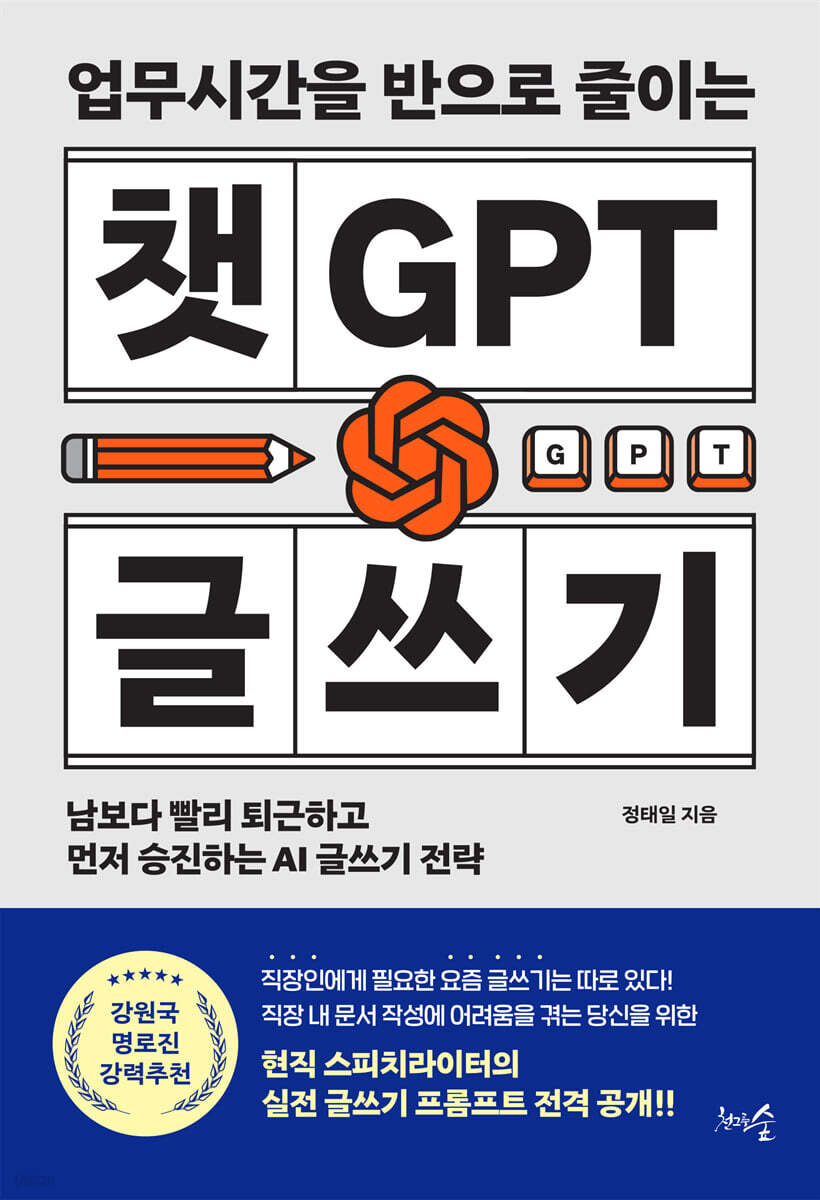 |
Description
Book Introduction
Steal Writing Prompts from a 20-Year-Old Speechwriter
ChatGPT writing strategy of a super office worker who leaves work earlier than others and gets promoted first!
A working person's day begins and ends with writing.
One email, one report, a few lines of meeting minutes can determine your reputation and the time you leave work.
The reason for the rejection of reports, demanding revisions from superiors, and endless overtime work that everyone has experienced at least once in their careers ultimately comes down to 'writing skills.'
This book, "Chat GPT Writing: Cut Your Work Time in Half," is neither a typical writing book nor a boring AI manual.
This comprehensive guide, written by a speechwriter with 20 years of experience, details effective writing techniques for almost every type of writing used in the workplace, and includes proven prompt examples and results for automating writing with ChatGPT.
By slightly modifying the prompts included in the book to suit your own situation, you can complete a writing task that used to take all day in just 30 minutes, instantly improving both speed and quality.
He also offers concrete ways to increase your value by writing outside of the company, drawing on his own experience.
It covers everything from personal branding using LinkedIn and Brunch, to writing my book after work, to a content automation system using GPTs.
By following the author's vivid writing episodes with a comfortable mind while reading the essay, readers can naturally learn the basics and advanced aspects of writing, as well as practical chat GPT prompts, without even realizing it.
Just as everyone searches before writing, it will become impossible to imagine writing alone without ChatGPT in the future.
Let's steal the 20 years of experience and know-how of a speechwriter and borrow the innovative speed and competitiveness of ChatGPT.
You can get off work earlier and get promoted sooner.
ChatGPT writing strategy of a super office worker who leaves work earlier than others and gets promoted first!
A working person's day begins and ends with writing.
One email, one report, a few lines of meeting minutes can determine your reputation and the time you leave work.
The reason for the rejection of reports, demanding revisions from superiors, and endless overtime work that everyone has experienced at least once in their careers ultimately comes down to 'writing skills.'
This book, "Chat GPT Writing: Cut Your Work Time in Half," is neither a typical writing book nor a boring AI manual.
This comprehensive guide, written by a speechwriter with 20 years of experience, details effective writing techniques for almost every type of writing used in the workplace, and includes proven prompt examples and results for automating writing with ChatGPT.
By slightly modifying the prompts included in the book to suit your own situation, you can complete a writing task that used to take all day in just 30 minutes, instantly improving both speed and quality.
He also offers concrete ways to increase your value by writing outside of the company, drawing on his own experience.
It covers everything from personal branding using LinkedIn and Brunch, to writing my book after work, to a content automation system using GPTs.
By following the author's vivid writing episodes with a comfortable mind while reading the essay, readers can naturally learn the basics and advanced aspects of writing, as well as practical chat GPT prompts, without even realizing it.
Just as everyone searches before writing, it will become impossible to imagine writing alone without ChatGPT in the future.
Let's steal the 20 years of experience and know-how of a speechwriter and borrow the innovative speed and competitiveness of ChatGPT.
You can get off work earlier and get promoted sooner.
- You can preview some of the book's contents.
Preview
index
prolog
PART 1: Writing for Office Workers with ChatGPT
[3 Generative AIs to Choose from] Writing Made Easy for Office Workers
[Basic Writing Framework] AI Can't Write Well
[The Power of Chain Questions] "Writing Persistently" with Chains of Thought (CoT)
[Writer's Block] AI Asks Questions, Humans Answer: "Reverse Writing"
[Hallucination] How to Reduce and Use AI's Nonsense
PART 2: The Absolute Principles of Business Writing That Call for Yes
[Golden Circle and PREP] Office workers should use "classical" rather than "jazz."
[Loglines and Parentheses] A good piece of writing is all about the first sentence.
[Repeat] If you're good at flattering, you'll write well.
[The Power of Feedback] Appreciating Your Boss's "Criticism" Will Improve Your Writing
[Writing Style] Reading your boss's writing style can lead to a promotion.
PART 3: Writing Prompts by Type to Get Off Work 2 Hours Early
[Self-Introduction] Writing to Increase Your Value with the STAR Structure
[Email and KakaoTalk] The first thing a company writes to evaluate you
[Minutes] Writing that summarizes only the key points in a FAST structure
[Report] Writing to Pass the Exam and Get Promoted Quickly
[Press Release] Writing that Wins the Hearts of Journalists and Customers
[Apology and Statement of Fact] There's No Principle, But There Are Principles
[Rejection and Reprimand] How to Say No with Dignity
[Presentation] Writing a Presentation Using the TALK Principle
[Vision Statement] Writing for an Organization with Visible Goals
[Reviews and Columns] Writing Outside the Company: Creating Plan B
PART 4: The Secrets of True Masters' Writing That Surpass AI
[Experience, Personality, Context] Use things that ChatGPT absolutely can't use.
[Every Day, Every Day] Learning the Basics of Writing from One Punch Man
[Critical Timing] There are three crucial moments in writing.
[Observe, Structure, Respond] 3 Rules for Writing for the Workplace, Found in Stand-Up Comedy
PART 5: Personal Writing Extends Beyond the Company
[LinkedIn Writing] The First Steps of a Super Employee to Leave the Company
[Writing is more valuable than stocks] Writing is an acquired asset that accumulates knowledge and experience.
[Writing a Book for Salaried Workers] Real Company Stories Written After Work
[My GPTs] How to Train an AI Writing Assistant
Epilogue _ We support the desire of office workers who want to write well and easily.
PART 1: Writing for Office Workers with ChatGPT
[3 Generative AIs to Choose from] Writing Made Easy for Office Workers
[Basic Writing Framework] AI Can't Write Well
[The Power of Chain Questions] "Writing Persistently" with Chains of Thought (CoT)
[Writer's Block] AI Asks Questions, Humans Answer: "Reverse Writing"
[Hallucination] How to Reduce and Use AI's Nonsense
PART 2: The Absolute Principles of Business Writing That Call for Yes
[Golden Circle and PREP] Office workers should use "classical" rather than "jazz."
[Loglines and Parentheses] A good piece of writing is all about the first sentence.
[Repeat] If you're good at flattering, you'll write well.
[The Power of Feedback] Appreciating Your Boss's "Criticism" Will Improve Your Writing
[Writing Style] Reading your boss's writing style can lead to a promotion.
PART 3: Writing Prompts by Type to Get Off Work 2 Hours Early
[Self-Introduction] Writing to Increase Your Value with the STAR Structure
[Email and KakaoTalk] The first thing a company writes to evaluate you
[Minutes] Writing that summarizes only the key points in a FAST structure
[Report] Writing to Pass the Exam and Get Promoted Quickly
[Press Release] Writing that Wins the Hearts of Journalists and Customers
[Apology and Statement of Fact] There's No Principle, But There Are Principles
[Rejection and Reprimand] How to Say No with Dignity
[Presentation] Writing a Presentation Using the TALK Principle
[Vision Statement] Writing for an Organization with Visible Goals
[Reviews and Columns] Writing Outside the Company: Creating Plan B
PART 4: The Secrets of True Masters' Writing That Surpass AI
[Experience, Personality, Context] Use things that ChatGPT absolutely can't use.
[Every Day, Every Day] Learning the Basics of Writing from One Punch Man
[Critical Timing] There are three crucial moments in writing.
[Observe, Structure, Respond] 3 Rules for Writing for the Workplace, Found in Stand-Up Comedy
PART 5: Personal Writing Extends Beyond the Company
[LinkedIn Writing] The First Steps of a Super Employee to Leave the Company
[Writing is more valuable than stocks] Writing is an acquired asset that accumulates knowledge and experience.
[Writing a Book for Salaried Workers] Real Company Stories Written After Work
[My GPTs] How to Train an AI Writing Assistant
Epilogue _ We support the desire of office workers who want to write well and easily.
Detailed image

Into the book
While search changed the way we 'find' information, generative AI is completely changing the traditional paradigm of 'processing and recreating' information.
It's time to decide whether we'll hurriedly follow the development of innovative tools, or whether we'll be ahead of the curve this time.
--- pp.25-26
Prompt is a new language for the ChatGPT era.
It may feel awkward and frustrating at first, but with a little practice and the mindset of teaching new employees, anyone can become fluent.
The time will soon come when good questioning will get you promoted and even feed you at work.
Since we're just getting started, there's not much difference between an expert and a beginner.
A person who asks a lot of questions and quickly becomes familiar with something is an expert.
--- p.36
If literary writing is likened to 'jazz', which is characterized by its unconventional improvisation, then writing for office workers can be likened to 'classical music', which strictly follows the score.
Moreover, if literary writing is an "abstraction" that freely expresses emotions and imagination with free brushstrokes and a variety of colors, then writing for office workers is closer to an "architectural blueprint" drawn with precise lines and proportions.
--- p.66
As a way to help with writing for the workplace, I always recommend the 'Golden Circle' and 'PREP'.
Having been around the competitive writing scene for a long time, I've found that there's nothing as simple to explain and as effective as this.
--- p.68
Are you thinking, "I'm doing well at work, so my resume has nothing to do with me?" You might regret it later, while drinking some soju.
Successful professionals are constantly updating their self-introductions to check their career paths.
True experts use their self-introductions not as a means of job change, but as a tool for performance measurement, self-objectification, and goal reaffirmation.
--- pp.115-116
Email is the most common and frequently used form of communication in a company.
Just as we can gauge someone's posture and attitude just by looking at their facial expressions, office workers can evaluate each other based on the structure and expression of their emails.
--- p.117
The saying, 'If you just take good minutes, you can be recognized by your boss and get promoted quickly' didn't just come out of nowhere.
The writing skills we develop while taking meeting minutes strengthen our competitiveness as employees and serve as a foundation for building trust within the organization.
--- p.130
A report is created through the process of 'planning' to organize thoughts, 'writing' to express them in words, diagrams, and pictures, and 'editing' to review and refine the content.
It is only completed through the 'feedback' stage, where the decided matters are implemented and evaluated.
The reason why office workers write such complex reports instead of just giving a vague explanation is to reduce organizational errors and mistakes, avoid crises, and seize better opportunities.
That's the core of business communication.
--- pp.136-137
Whether it's a review or a column, I encourage you to choose one that suits you and write about it on your blog, LinkedIn, or Brunch.
Nothing builds your writing muscles like regularly writing for public viewing.
By finding material from our surroundings or a specific field, distinguishing between facts and opinions and thoughts, and then putting them into writing, our writing skills will improve dramatically.
--- p.197
I am convinced that as artificial intelligence advances, human writing skills will become increasingly important.
The power of observation to capture the decisive moments of everyday life, the ability to structure a coherent story, and the flexibility to adjust to the other person's response—these are abilities unique to humans that artificial intelligence has yet to replicate.
--- p.231
In a wider range of fields than you might think, more ordinary office workers are creating new opportunities by sharing their work experiences and expertise in writing.
This means that writing is no longer simply a personal record, but is becoming a core element of 'personal branding' and a 'truly profitable content asset.'
It's time to decide whether we'll hurriedly follow the development of innovative tools, or whether we'll be ahead of the curve this time.
--- pp.25-26
Prompt is a new language for the ChatGPT era.
It may feel awkward and frustrating at first, but with a little practice and the mindset of teaching new employees, anyone can become fluent.
The time will soon come when good questioning will get you promoted and even feed you at work.
Since we're just getting started, there's not much difference between an expert and a beginner.
A person who asks a lot of questions and quickly becomes familiar with something is an expert.
--- p.36
If literary writing is likened to 'jazz', which is characterized by its unconventional improvisation, then writing for office workers can be likened to 'classical music', which strictly follows the score.
Moreover, if literary writing is an "abstraction" that freely expresses emotions and imagination with free brushstrokes and a variety of colors, then writing for office workers is closer to an "architectural blueprint" drawn with precise lines and proportions.
--- p.66
As a way to help with writing for the workplace, I always recommend the 'Golden Circle' and 'PREP'.
Having been around the competitive writing scene for a long time, I've found that there's nothing as simple to explain and as effective as this.
--- p.68
Are you thinking, "I'm doing well at work, so my resume has nothing to do with me?" You might regret it later, while drinking some soju.
Successful professionals are constantly updating their self-introductions to check their career paths.
True experts use their self-introductions not as a means of job change, but as a tool for performance measurement, self-objectification, and goal reaffirmation.
--- pp.115-116
Email is the most common and frequently used form of communication in a company.
Just as we can gauge someone's posture and attitude just by looking at their facial expressions, office workers can evaluate each other based on the structure and expression of their emails.
--- p.117
The saying, 'If you just take good minutes, you can be recognized by your boss and get promoted quickly' didn't just come out of nowhere.
The writing skills we develop while taking meeting minutes strengthen our competitiveness as employees and serve as a foundation for building trust within the organization.
--- p.130
A report is created through the process of 'planning' to organize thoughts, 'writing' to express them in words, diagrams, and pictures, and 'editing' to review and refine the content.
It is only completed through the 'feedback' stage, where the decided matters are implemented and evaluated.
The reason why office workers write such complex reports instead of just giving a vague explanation is to reduce organizational errors and mistakes, avoid crises, and seize better opportunities.
That's the core of business communication.
--- pp.136-137
Whether it's a review or a column, I encourage you to choose one that suits you and write about it on your blog, LinkedIn, or Brunch.
Nothing builds your writing muscles like regularly writing for public viewing.
By finding material from our surroundings or a specific field, distinguishing between facts and opinions and thoughts, and then putting them into writing, our writing skills will improve dramatically.
--- p.197
I am convinced that as artificial intelligence advances, human writing skills will become increasingly important.
The power of observation to capture the decisive moments of everyday life, the ability to structure a coherent story, and the flexibility to adjust to the other person's response—these are abilities unique to humans that artificial intelligence has yet to replicate.
--- p.231
In a wider range of fields than you might think, more ordinary office workers are creating new opportunities by sharing their work experiences and expertise in writing.
This means that writing is no longer simply a personal record, but is becoming a core element of 'personal branding' and a 'truly profitable content asset.'
--- p.248
Publisher's Review
From cover letters, emails, reports, and meeting minutes to press releases, apologies, reviews, and columns.
Quickly learn and immediately apply the writing formula of office workers and ChatGPT prompts revealed!
Since the advent of ChatGPT, the writing paradigm for office workers has completely changed.
Documents that used to require dozens of presses of the Enter key a day can now be completed in just a few minutes.
However, many office workers still work overtime every day and are burdened with reports, emails, and meeting minutes.
Why? Because we don't know how to properly utilize generative AI.
There's a world of difference between simply asking someone to "write a report" and getting a sophisticated piece of writing through prompt engineering.
The author, a current speechwriter, emphasizes that “simply using ChatGPT is different from using it well.”
In particular, he says, “The gap in work productivity between those who are good at handling AI in companies and those who are not will widen.”
The author, who has spent 20 years writing on behalf of companies and CEOs, has fully utilized his strengths in this book, eliminating vague and obvious writing theories and complex ChatGPT usage methods, and filling it with only specific and proven methods and results specialized for writing in the workplace.
Part 1 introduces the characteristics of generative AI such as ChatGPT, Perplexity, and Claude, as well as the basics of prompt writing.
Chain of Thought (CoT), backwards writing, and methods for minimizing hallucinations are introduced.
Part 2 details the principles of writing for the workplace, including the Golden Circle, the PREP structure, log lines, parentheses, how to accept feedback, and analyzing your boss's writing style.
Part 3 is the real thing.
We introduce practical prompts for various writings used in the workplace, such as emails, KakaoTalk messages, self-introductions, meeting minutes, reports, press releases, and presentations.
Part 4 presents a differentiated writing style that only humans can achieve through writing that reflects experience and individuality, the importance of consistent practice, and how to utilize critical timing.
Part 5 covers personal writing.
It shows new possibilities in writing through LinkedIn writing, building writing assets, writing books for a salary, and building customized GPTs.
Reading this book will help you increase your writing speed and write better by accurately understanding the logical structure and expressions your boss wants.
This saves me time and allows me to focus on creative and strategic work, and I can even write my own articles for Brunch, LinkedIn, and even publish a book.
This book will be an essential guide for office workers who want to become successful workers by using their differentiated writing skills as a weapon, and for ambitious salaried workers who want to write their own articles after work.
Quickly learn and immediately apply the writing formula of office workers and ChatGPT prompts revealed!
Since the advent of ChatGPT, the writing paradigm for office workers has completely changed.
Documents that used to require dozens of presses of the Enter key a day can now be completed in just a few minutes.
However, many office workers still work overtime every day and are burdened with reports, emails, and meeting minutes.
Why? Because we don't know how to properly utilize generative AI.
There's a world of difference between simply asking someone to "write a report" and getting a sophisticated piece of writing through prompt engineering.
The author, a current speechwriter, emphasizes that “simply using ChatGPT is different from using it well.”
In particular, he says, “The gap in work productivity between those who are good at handling AI in companies and those who are not will widen.”
The author, who has spent 20 years writing on behalf of companies and CEOs, has fully utilized his strengths in this book, eliminating vague and obvious writing theories and complex ChatGPT usage methods, and filling it with only specific and proven methods and results specialized for writing in the workplace.
Part 1 introduces the characteristics of generative AI such as ChatGPT, Perplexity, and Claude, as well as the basics of prompt writing.
Chain of Thought (CoT), backwards writing, and methods for minimizing hallucinations are introduced.
Part 2 details the principles of writing for the workplace, including the Golden Circle, the PREP structure, log lines, parentheses, how to accept feedback, and analyzing your boss's writing style.
Part 3 is the real thing.
We introduce practical prompts for various writings used in the workplace, such as emails, KakaoTalk messages, self-introductions, meeting minutes, reports, press releases, and presentations.
Part 4 presents a differentiated writing style that only humans can achieve through writing that reflects experience and individuality, the importance of consistent practice, and how to utilize critical timing.
Part 5 covers personal writing.
It shows new possibilities in writing through LinkedIn writing, building writing assets, writing books for a salary, and building customized GPTs.
Reading this book will help you increase your writing speed and write better by accurately understanding the logical structure and expressions your boss wants.
This saves me time and allows me to focus on creative and strategic work, and I can even write my own articles for Brunch, LinkedIn, and even publish a book.
This book will be an essential guide for office workers who want to become successful workers by using their differentiated writing skills as a weapon, and for ambitious salaried workers who want to write their own articles after work.
GOODS SPECIFICS
- Date of issue: April 10, 2025
- Page count, weight, size: 268 pages | 350g | 140*205*18mm
- ISBN13: 9791193000717
You may also like
카테고리
korean


korean

![GQ KOREA Mark (Monthly): December [2025]](http://librairie.coreenne.fr/cdn/shop/files/8ef265dbbfbf186523ed75ba7319009d.jpg?v=1765340328&width=3840)


