

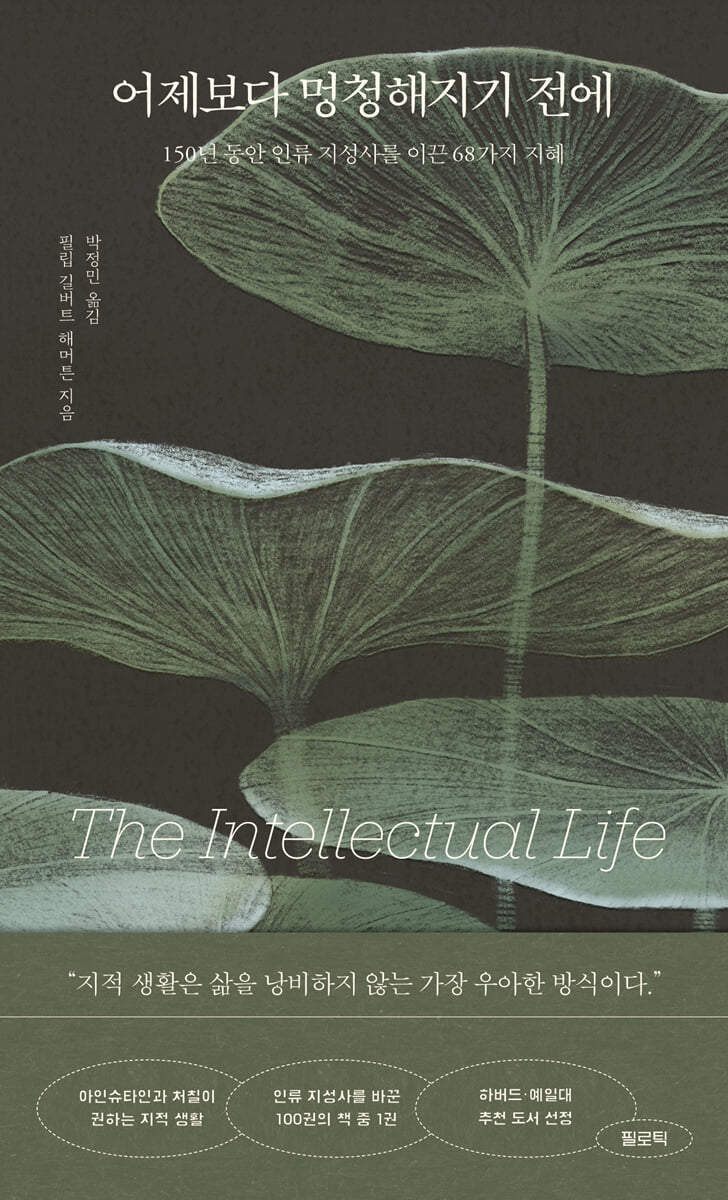
Before you become more stupid than yesterday
 |
Description
Book Introduction
★ The Bible of Intellectual Life, Praised by Andrew Carnegie and Mark Twain ★
★ A classic beloved by intellectuals around the world for 150 years ★
★ Selected as a recommended book by Harvard and Yale universities ★
★ A must-read for living as an intellectual in an age where it's difficult to be intellectual ★
The process of a person becoming stupid is silent and painless.
Sentences that were once easy to understand now require multiple readings, and words that were once familiar have become unfamiliar.
Our judgment is slowly giving way to AI.
Amazingly, Philip Gilbert Hammerton foresaw this problem 150 years ago.
"Before You Become Dumber Than Yesterday" contains his insight that "the more information we have, the duller our thinking becomes," and presents practical answers to the question "How to live intellectually."
Hammerton defines intellectual life as 'discipline' rather than 'romantic'.
A true intellectual life is not a vague longing or a realm of talent, but a process of thorough training.
Self-discipline, physical fitness, financial stability? All of these are the foundation for deep thinking.
From the emotional exhaustion, loneliness, poverty, and burnout he encounters in his research and thinking process, Hammerton hides nothing.
This honesty is why Andrew Carnegie and Mark Twain praised this book so highly.
Aren't you losing the power to think for yourself? An intellectual life is the most elegant way to avoid wasting your life.
For those who yearn for a deeper life, this book will serve as the most realistic and systematic compass.
★ A classic beloved by intellectuals around the world for 150 years ★
★ Selected as a recommended book by Harvard and Yale universities ★
★ A must-read for living as an intellectual in an age where it's difficult to be intellectual ★
The process of a person becoming stupid is silent and painless.
Sentences that were once easy to understand now require multiple readings, and words that were once familiar have become unfamiliar.
Our judgment is slowly giving way to AI.
Amazingly, Philip Gilbert Hammerton foresaw this problem 150 years ago.
"Before You Become Dumber Than Yesterday" contains his insight that "the more information we have, the duller our thinking becomes," and presents practical answers to the question "How to live intellectually."
Hammerton defines intellectual life as 'discipline' rather than 'romantic'.
A true intellectual life is not a vague longing or a realm of talent, but a process of thorough training.
Self-discipline, physical fitness, financial stability? All of these are the foundation for deep thinking.
From the emotional exhaustion, loneliness, poverty, and burnout he encounters in his research and thinking process, Hammerton hides nothing.
This honesty is why Andrew Carnegie and Mark Twain praised this book so highly.
Aren't you losing the power to think for yourself? An intellectual life is the most elegant way to avoid wasting your life.
For those who yearn for a deeper life, this book will serve as the most realistic and systematic compass.
- You can preview some of the book's contents.
Preview
index
To those who read this book
introduction
Part 1.
The courage not to be stupid
To a person who has learned this and that superficially and lost depth
To a person who doesn't know whether to sell one well or several wells
To those who harbor the illusion that perfect education exists
To those who have chosen true study rather than superficial education
For those who want to study something useful right now
For those who are anxious if they are not perfect
Intellectual Life Guide for Modern People 01
“There is no useless study.”
Part 2.
Don't even think about using your head without a physical foundation!
On Kant's thorough routine management
For those who are worried about their poor memory
For those who neglect exercise
To the person sick from mental labor
For those who want to lay the foundation for an intellectual life
To those who are concerned about illness and death
Intellectual Life Guide for Modern People 02
“When the body stops, the mind stops too.”
Part 3: Emotional Management for Intellectual Life
For those who are obsessed with the idea that everything must be done quickly
For workaholics on the verge of burnout
To the intellectual who lives without any noticeable achievements
For those who feel bored with work
To those who study alone in a noisy world
For the intellectually isolated in a distracted age
Intellectual Life Guide for Modern People 03
“The ability to endure the slow fermentation of knowledge is the beginning of true learning.”
Part 4.
Time Management for an Intelligent Life
For those who are concerned about proper time allocation
For people who maintain very irregular lifestyle habits
For those who want to tame time
For those suffering from deadline stress
For those looking for optimal working hours
For those who do not want to waste even a single minute
For businessmen who want to improve their knowledge but don't have time
To those who have free time but complain about lack of time
Intellectual Life Guide for Modern People 04
“The brain follows rhythm, not clocks.”
Part 5.
Friendship and love of smart people
To you who feels like you have no friends to have intellectual conversations with
To someone who is passive or shy in conversation
To you who only repeats superficial conversations
To you who believes that communication is essential in a relationship
To you who are afraid that your growth will stop once you get married
To the intellectual life trapped in the shackles of marriage
To you who has lost your own time after marriage
To you who are upset because you can't communicate with your parents
To you who asks whether an intelligent marriage is feasible
For those who can't stand boredom
Intellectual Life Guide for Modern People 05
“Even if one person’s lamp lights a hundred fires, its light will not diminish.”
Part 6.
On the Moral Foundations of Intellectual Life
For those who need moral character
To those who read classical literature merely for show
For those who are curious about the correct posture of an explorer
For those who want to have the strength to see anything through to the end
To you who thinks that if you're smart, you don't need to be kind
To those who live according to the rules imposed by others
To you who wavers between the lab and the social world
Intellectual Life Guide for Modern People 06
“Culture is not a cloak for show, but a tool for shaping the soul.”
Part 7.
Things money can't buy
For those who dream of freedom without having to make a lot of money
To a person caught in the dilemma of wealth and intelligence
For students experiencing severe poverty
To a genius who is indifferent to money matters
To a disciple who had just inherited a fortune and was about to give up his dream of becoming a writer
To wealthy patrons
To those who have prejudice against their profession
Intellectual Life Guide for Modern People 07
“Choose the freedom to earn less.”
Part 8.
Finding Work-Life Balance
For those of you looking for a job that allows you to work freely and earn money.
For those of you who love art but need to find a realistic job
For those who want to make a living from writing
To a friend who runs passionately without rest
Intellectual Life Guide for Modern People 08
“True intelligence is the harmony between deep thought and reality.”
Part 9.
A peek into the geniuses' studios
To you who believe you can work anywhere
To a friend who moves frequently
To a person who is constantly moving and eating away at his intelligence
For those curious about Goethe's study and bedroom
For those who desperately need their own workspace
To you who believes that the scenery outside the window influences your work
Intellectual Life Guide for Modern People 09
“One desk is enough.”
Part 10.
In the forest of books and language
For people with biased reading habits
To you who only find answers in books
On the Illusion of Scholasticism and the True Image of the Artist
To those who don't know how to read the book called life
For those looking for the fastest way to learn a language
To you who are frustrated because your foreign language skills are not improving
To those who believe in the myth of perfect bilingualism
To a person who tried to learn a foreign language but ended up not being able to speak his native language properly
10 Guides to Intellectual Living for Modern People
“Reading is a journey, not an accomplishment; it is an exploration, not an arrival.”
introduction
Part 1.
The courage not to be stupid
To a person who has learned this and that superficially and lost depth
To a person who doesn't know whether to sell one well or several wells
To those who harbor the illusion that perfect education exists
To those who have chosen true study rather than superficial education
For those who want to study something useful right now
For those who are anxious if they are not perfect
Intellectual Life Guide for Modern People 01
“There is no useless study.”
Part 2.
Don't even think about using your head without a physical foundation!
On Kant's thorough routine management
For those who are worried about their poor memory
For those who neglect exercise
To the person sick from mental labor
For those who want to lay the foundation for an intellectual life
To those who are concerned about illness and death
Intellectual Life Guide for Modern People 02
“When the body stops, the mind stops too.”
Part 3: Emotional Management for Intellectual Life
For those who are obsessed with the idea that everything must be done quickly
For workaholics on the verge of burnout
To the intellectual who lives without any noticeable achievements
For those who feel bored with work
To those who study alone in a noisy world
For the intellectually isolated in a distracted age
Intellectual Life Guide for Modern People 03
“The ability to endure the slow fermentation of knowledge is the beginning of true learning.”
Part 4.
Time Management for an Intelligent Life
For those who are concerned about proper time allocation
For people who maintain very irregular lifestyle habits
For those who want to tame time
For those suffering from deadline stress
For those looking for optimal working hours
For those who do not want to waste even a single minute
For businessmen who want to improve their knowledge but don't have time
To those who have free time but complain about lack of time
Intellectual Life Guide for Modern People 04
“The brain follows rhythm, not clocks.”
Part 5.
Friendship and love of smart people
To you who feels like you have no friends to have intellectual conversations with
To someone who is passive or shy in conversation
To you who only repeats superficial conversations
To you who believes that communication is essential in a relationship
To you who are afraid that your growth will stop once you get married
To the intellectual life trapped in the shackles of marriage
To you who has lost your own time after marriage
To you who are upset because you can't communicate with your parents
To you who asks whether an intelligent marriage is feasible
For those who can't stand boredom
Intellectual Life Guide for Modern People 05
“Even if one person’s lamp lights a hundred fires, its light will not diminish.”
Part 6.
On the Moral Foundations of Intellectual Life
For those who need moral character
To those who read classical literature merely for show
For those who are curious about the correct posture of an explorer
For those who want to have the strength to see anything through to the end
To you who thinks that if you're smart, you don't need to be kind
To those who live according to the rules imposed by others
To you who wavers between the lab and the social world
Intellectual Life Guide for Modern People 06
“Culture is not a cloak for show, but a tool for shaping the soul.”
Part 7.
Things money can't buy
For those who dream of freedom without having to make a lot of money
To a person caught in the dilemma of wealth and intelligence
For students experiencing severe poverty
To a genius who is indifferent to money matters
To a disciple who had just inherited a fortune and was about to give up his dream of becoming a writer
To wealthy patrons
To those who have prejudice against their profession
Intellectual Life Guide for Modern People 07
“Choose the freedom to earn less.”
Part 8.
Finding Work-Life Balance
For those of you looking for a job that allows you to work freely and earn money.
For those of you who love art but need to find a realistic job
For those who want to make a living from writing
To a friend who runs passionately without rest
Intellectual Life Guide for Modern People 08
“True intelligence is the harmony between deep thought and reality.”
Part 9.
A peek into the geniuses' studios
To you who believe you can work anywhere
To a friend who moves frequently
To a person who is constantly moving and eating away at his intelligence
For those curious about Goethe's study and bedroom
For those who desperately need their own workspace
To you who believes that the scenery outside the window influences your work
Intellectual Life Guide for Modern People 09
“One desk is enough.”
Part 10.
In the forest of books and language
For people with biased reading habits
To you who only find answers in books
On the Illusion of Scholasticism and the True Image of the Artist
To those who don't know how to read the book called life
For those looking for the fastest way to learn a language
To you who are frustrated because your foreign language skills are not improving
To those who believe in the myth of perfect bilingualism
To a person who tried to learn a foreign language but ended up not being able to speak his native language properly
10 Guides to Intellectual Living for Modern People
“Reading is a journey, not an accomplishment; it is an exploration, not an arrival.”
Detailed image
.jpg)
Into the book
I want to emphasize again that intellectual life is not a 'skill to be mastered' but a 'state'.
It is a process of constantly walking towards a higher and purer truth.
Between big and small truths, between complete understanding and still-incomplete understanding, if we always strive to make the "better choice," even a moment of wandering will become a valuable learning experience.
--- From the "Preface"
Look at the great creators in the pharmacy.
Wordsworth enjoyed walking tours, and Goethe swam and skated under the moonlight.
Humboldt was frail, but he trained himself through exercise and prepared for his great explorations, and Leonardo da Vinci, though poor, enjoyed horseback riding instead of selling his horse.
Most city dwellers try to reduce outdoor activities and replace them with gymnastics or exercise.
While there may be the benefit of systematically training specific muscles, you won't be able to enjoy the refreshing stimulation of the mountain breeze and wind.
In fact, for us, not only simple 'exercise' but also 'exposure' itself, willingly submitting our bodies to the whims of the weather, such as rain, wind, or cold, is a great source of nourishment.
--- From "To Those Who Neglect Exercise"
The biggest enemy you will face in the future will be the psychological pressure to 'finish quickly'.
To overcome this, we need to emulate Colton's "go slow but build steadily" attitude, or the leisurely attitude of a sailor's wife with a teacup on a canal boat.
I firmly believe that the only way to sustain an intellectual life is to accept that all time is a 'process' and to move forward calmly, enjoying each day.
--- From "To the person obsessed with the idea that everything must be done quickly"
Didn't the French writer Claude Tillier say, "The best time spent is time lost"?
It is often in the time we often dismiss as waste that important moments of intelligence blossom.
Examples include conversations at social gatherings, shouts at the hunting grounds, leisurely moments on a yacht, and even stories shared in a carriage.
It would be foolish to recommend indolence to a man of profound intelligence, but we must be on guard against excessive diligence becoming a shackle that binds us.
--- From "To a Workaholic on the Verge of Burnout"
Sometimes pressure helps.
Just as strong pressure on iron can cause sparks to fly, tension can also stimulate creativity.
I am reminded of the advice Rossini gave to a young composer.
“Write the opera overture the night before the first performance.
“It will inspire you to see the sight of a cornered man, a sheet music copyist waiting, and a theater manager pulling out his hair,” he joked, adding, “The Italian impresarios of my time were already bald by the age of thirty.”
In fact, Rossini completed the overture "Otello" on the day of the performance when the manager locked him in his room at dawn, and he also wrote "The Thieving Magpie" on the morning of the premiere, throwing down sheets of paper one by one from the upper floor.
It is clear that this extreme pressure brought out a special energy.
But in Rossini's case, it was possible because he had the confidence that "he could do it within that time."
--- From "To a person who does not want to waste even a minute"
If someone just says, “I saw a rat last week,” it won’t make much of an impression.
But what if I said this: “Late one night, I was walking up the stairs, and I saw a rat walking up the stairs in the same direction as me.
What's funny is that even though I'm following him with a candle, he stops every couple of steps to glance at me and the candle, and then when I pass by, he starts moving leisurely again.
I thought it might be a lemming because its face and tail were different in color from normal rats.
"Three days later, we met again, and this time, it moved slightly to the side, as if it recognized me. I wonder if I could tame it." This kind of story may seem trivial, but it connects to the topic of "animal personality," and it instantly captures the listener's interest.
What I'm suggesting is that rather than avoiding "small talk," why not take the initiative and steer the conversation in a meaningful direction?
--- From "To those who are passive or timid in conversation"
The loneliest moments are when you discover that your spouse is more alive in conversation with others.
We love each other, but it's more interesting to spend time with a colleague who can think about things at the same depth.
And although your spouse won't say anything, they'll definitely notice.
And then you probably think like this.
'We almost never meet.
Because we live in different worlds.' Even our once or twice-a-week walks together are filled with the worries of our children and everyday life.
The deep insights and concerns they face in their respective worlds ultimately fail to lead to a conversation between them.
--- From "To you who believes that communication is essential in a relationship"
The essence of discipline is twofold.
The first is to do the best we can with the abilities we have now, and the second is to not stop there and to be willing to accept the training necessary to achieve greater potential.
Innate talent is just the starting point.
It is not a completed ability, but a potential for future growth.
True growth only occurs when you figure out what training you need and practice it consistently.
It is a process of constantly walking towards a higher and purer truth.
Between big and small truths, between complete understanding and still-incomplete understanding, if we always strive to make the "better choice," even a moment of wandering will become a valuable learning experience.
--- From the "Preface"
Look at the great creators in the pharmacy.
Wordsworth enjoyed walking tours, and Goethe swam and skated under the moonlight.
Humboldt was frail, but he trained himself through exercise and prepared for his great explorations, and Leonardo da Vinci, though poor, enjoyed horseback riding instead of selling his horse.
Most city dwellers try to reduce outdoor activities and replace them with gymnastics or exercise.
While there may be the benefit of systematically training specific muscles, you won't be able to enjoy the refreshing stimulation of the mountain breeze and wind.
In fact, for us, not only simple 'exercise' but also 'exposure' itself, willingly submitting our bodies to the whims of the weather, such as rain, wind, or cold, is a great source of nourishment.
--- From "To Those Who Neglect Exercise"
The biggest enemy you will face in the future will be the psychological pressure to 'finish quickly'.
To overcome this, we need to emulate Colton's "go slow but build steadily" attitude, or the leisurely attitude of a sailor's wife with a teacup on a canal boat.
I firmly believe that the only way to sustain an intellectual life is to accept that all time is a 'process' and to move forward calmly, enjoying each day.
--- From "To the person obsessed with the idea that everything must be done quickly"
Didn't the French writer Claude Tillier say, "The best time spent is time lost"?
It is often in the time we often dismiss as waste that important moments of intelligence blossom.
Examples include conversations at social gatherings, shouts at the hunting grounds, leisurely moments on a yacht, and even stories shared in a carriage.
It would be foolish to recommend indolence to a man of profound intelligence, but we must be on guard against excessive diligence becoming a shackle that binds us.
--- From "To a Workaholic on the Verge of Burnout"
Sometimes pressure helps.
Just as strong pressure on iron can cause sparks to fly, tension can also stimulate creativity.
I am reminded of the advice Rossini gave to a young composer.
“Write the opera overture the night before the first performance.
“It will inspire you to see the sight of a cornered man, a sheet music copyist waiting, and a theater manager pulling out his hair,” he joked, adding, “The Italian impresarios of my time were already bald by the age of thirty.”
In fact, Rossini completed the overture "Otello" on the day of the performance when the manager locked him in his room at dawn, and he also wrote "The Thieving Magpie" on the morning of the premiere, throwing down sheets of paper one by one from the upper floor.
It is clear that this extreme pressure brought out a special energy.
But in Rossini's case, it was possible because he had the confidence that "he could do it within that time."
--- From "To a person who does not want to waste even a minute"
If someone just says, “I saw a rat last week,” it won’t make much of an impression.
But what if I said this: “Late one night, I was walking up the stairs, and I saw a rat walking up the stairs in the same direction as me.
What's funny is that even though I'm following him with a candle, he stops every couple of steps to glance at me and the candle, and then when I pass by, he starts moving leisurely again.
I thought it might be a lemming because its face and tail were different in color from normal rats.
"Three days later, we met again, and this time, it moved slightly to the side, as if it recognized me. I wonder if I could tame it." This kind of story may seem trivial, but it connects to the topic of "animal personality," and it instantly captures the listener's interest.
What I'm suggesting is that rather than avoiding "small talk," why not take the initiative and steer the conversation in a meaningful direction?
--- From "To those who are passive or timid in conversation"
The loneliest moments are when you discover that your spouse is more alive in conversation with others.
We love each other, but it's more interesting to spend time with a colleague who can think about things at the same depth.
And although your spouse won't say anything, they'll definitely notice.
And then you probably think like this.
'We almost never meet.
Because we live in different worlds.' Even our once or twice-a-week walks together are filled with the worries of our children and everyday life.
The deep insights and concerns they face in their respective worlds ultimately fail to lead to a conversation between them.
--- From "To you who believes that communication is essential in a relationship"
The essence of discipline is twofold.
The first is to do the best we can with the abilities we have now, and the second is to not stop there and to be willing to accept the training necessary to achieve greater potential.
Innate talent is just the starting point.
It is not a completed ability, but a potential for future growth.
True growth only occurs when you figure out what training you need and practice it consistently.
--- From "To those who want the strength to see anything through to the end"
Publisher's Review
“Am I still a thinking person?”
In this age of thoughtlessness, everything you need to know about "intellectual living" to avoid becoming stupid.
“An intellectual life is the most elegant way to avoid wasting life.” This single line of insight resonates with us for 150 years.
Between smartphone notifications, five-second skips, and endless scrolling, we may be drifting through a sea of information, missing the opportunity to truly live a "deep life."
Philip Gilbert Hammerton, a 19th-century British artist and critic, surprisingly accurately predicted this modern-day concern in his book, The Intellectual Life.
His warning that "the more information we have, the duller our thinking becomes" is even more urgent today, when AI takes over our thinking and our attention is divided.
This book is not just about motivation; it realistically covers all the elements of living a "thoughtful life"—self-discipline, physical training, financial foundation, time management, friendship, and even love.
Although written 150 years ago, this book has been consistently on the must-read lists of Harvard and Yale universities since the Victorian era, and offers insights that are even more timely for modern people living in the digital age.
The Power of Sustaining an Intellectual Life: Self-Discipline, Physical Training, and Economic Freedom
Hammerton rejects romantic fantasies about intellectual life.
"Deep thinking doesn't just happen through passion," he says, adding, "I've never heard of anyone who's been successful without setting and following their own rules."
He also addresses head-on the practical obstacles of intellectual life.
"I won't try to fool you into thinking that poverty isn't a problem.
It is clearly one of the major obstacles to the fulfillment of intellectual life." It is a sobering insight that if you lack space to study, money to buy books, and time to explore, deep thinking can only become a luxury.
Even though it was published in the 19th century, it is still deeply respected among academics and intellectuals today because it anticipated the problems of 'information overload' and 'attentional distraction' that would arise during the Industrial Revolution.
Hammerton weaves together anecdotes from great thinkers, including mathematician Franz Boecke, philosopher Kant, scientist Newton, writer Balzac, and painter Ingres, with his own experiences to present a concrete methodology for intellectual life.
Through Wordsworth's walking tours and Goethe's moonlight bathing, he shows that "the balance of body and mind is the path to intellectual excellence," and emphasizes that in learning a foreign language, one must understand not only the language but also the culture and way of thinking to expand one's worldview.
The appeal of this book lies precisely in its practical wisdom and timeless insights.
A solid guide to perfecting your 'intellectual life'
Hammerton, a painter, writer, and founder and editor of Britain's first art monthly, Portfolio, emphasizes a lifestyle that allows for 'learning and thinking', saying, "Everywhere we stand is a school."
It emphasizes that even everyday moments, such as conversations with friends or learning a new language, can serve as springboards for intellectual growth, and that when these small actions accumulate, powerful changes can occur that shake up life to its core.
Even in time management, it reminds us that "life is short, and the smarter we are, the more we tend to overestimate what we can accomplish, and end up lacking what we can do."
"Before You Become Dumber Than Yesterday" is a philosophical and practical guide that goes beyond the typical self-help book framework and answers the fundamental question of "How should we think and live?"
The small habit of pondering one sentence a day and the attitude of delving into trivial curiosities to the end make Hammerton's teaching that "intellectual ability, like physical strength, requires daily training" come to life.
Even after 150 years, in an age overflowing with superficial information, the need for 'deep thinking' is even more urgent.
This classic book is a treasure trove of timeless wisdom that will help you realize how elegant and powerful the small steps you can take to "become less stupid" can be when you pause your smartphone notifications and step into the "intellectual life."
In this age of thoughtlessness, everything you need to know about "intellectual living" to avoid becoming stupid.
“An intellectual life is the most elegant way to avoid wasting life.” This single line of insight resonates with us for 150 years.
Between smartphone notifications, five-second skips, and endless scrolling, we may be drifting through a sea of information, missing the opportunity to truly live a "deep life."
Philip Gilbert Hammerton, a 19th-century British artist and critic, surprisingly accurately predicted this modern-day concern in his book, The Intellectual Life.
His warning that "the more information we have, the duller our thinking becomes" is even more urgent today, when AI takes over our thinking and our attention is divided.
This book is not just about motivation; it realistically covers all the elements of living a "thoughtful life"—self-discipline, physical training, financial foundation, time management, friendship, and even love.
Although written 150 years ago, this book has been consistently on the must-read lists of Harvard and Yale universities since the Victorian era, and offers insights that are even more timely for modern people living in the digital age.
The Power of Sustaining an Intellectual Life: Self-Discipline, Physical Training, and Economic Freedom
Hammerton rejects romantic fantasies about intellectual life.
"Deep thinking doesn't just happen through passion," he says, adding, "I've never heard of anyone who's been successful without setting and following their own rules."
He also addresses head-on the practical obstacles of intellectual life.
"I won't try to fool you into thinking that poverty isn't a problem.
It is clearly one of the major obstacles to the fulfillment of intellectual life." It is a sobering insight that if you lack space to study, money to buy books, and time to explore, deep thinking can only become a luxury.
Even though it was published in the 19th century, it is still deeply respected among academics and intellectuals today because it anticipated the problems of 'information overload' and 'attentional distraction' that would arise during the Industrial Revolution.
Hammerton weaves together anecdotes from great thinkers, including mathematician Franz Boecke, philosopher Kant, scientist Newton, writer Balzac, and painter Ingres, with his own experiences to present a concrete methodology for intellectual life.
Through Wordsworth's walking tours and Goethe's moonlight bathing, he shows that "the balance of body and mind is the path to intellectual excellence," and emphasizes that in learning a foreign language, one must understand not only the language but also the culture and way of thinking to expand one's worldview.
The appeal of this book lies precisely in its practical wisdom and timeless insights.
A solid guide to perfecting your 'intellectual life'
Hammerton, a painter, writer, and founder and editor of Britain's first art monthly, Portfolio, emphasizes a lifestyle that allows for 'learning and thinking', saying, "Everywhere we stand is a school."
It emphasizes that even everyday moments, such as conversations with friends or learning a new language, can serve as springboards for intellectual growth, and that when these small actions accumulate, powerful changes can occur that shake up life to its core.
Even in time management, it reminds us that "life is short, and the smarter we are, the more we tend to overestimate what we can accomplish, and end up lacking what we can do."
"Before You Become Dumber Than Yesterday" is a philosophical and practical guide that goes beyond the typical self-help book framework and answers the fundamental question of "How should we think and live?"
The small habit of pondering one sentence a day and the attitude of delving into trivial curiosities to the end make Hammerton's teaching that "intellectual ability, like physical strength, requires daily training" come to life.
Even after 150 years, in an age overflowing with superficial information, the need for 'deep thinking' is even more urgent.
This classic book is a treasure trove of timeless wisdom that will help you realize how elegant and powerful the small steps you can take to "become less stupid" can be when you pause your smartphone notifications and step into the "intellectual life."
GOODS SPECIFICS
- Date of issue: March 13, 2025
- Page count, weight, size: 280 pages | 300g | 122*201*18mm
- ISBN13: 9791198713667
- ISBN10: 1198713666
You may also like
카테고리
korean


korean

![GQ KOREA Mark (Monthly): December [2025]](http://librairie.coreenne.fr/cdn/shop/files/8ef265dbbfbf186523ed75ba7319009d.jpg?v=1765340328&width=3840)


