

The Prince: A Study of Life
 |
Description
Book Introduction
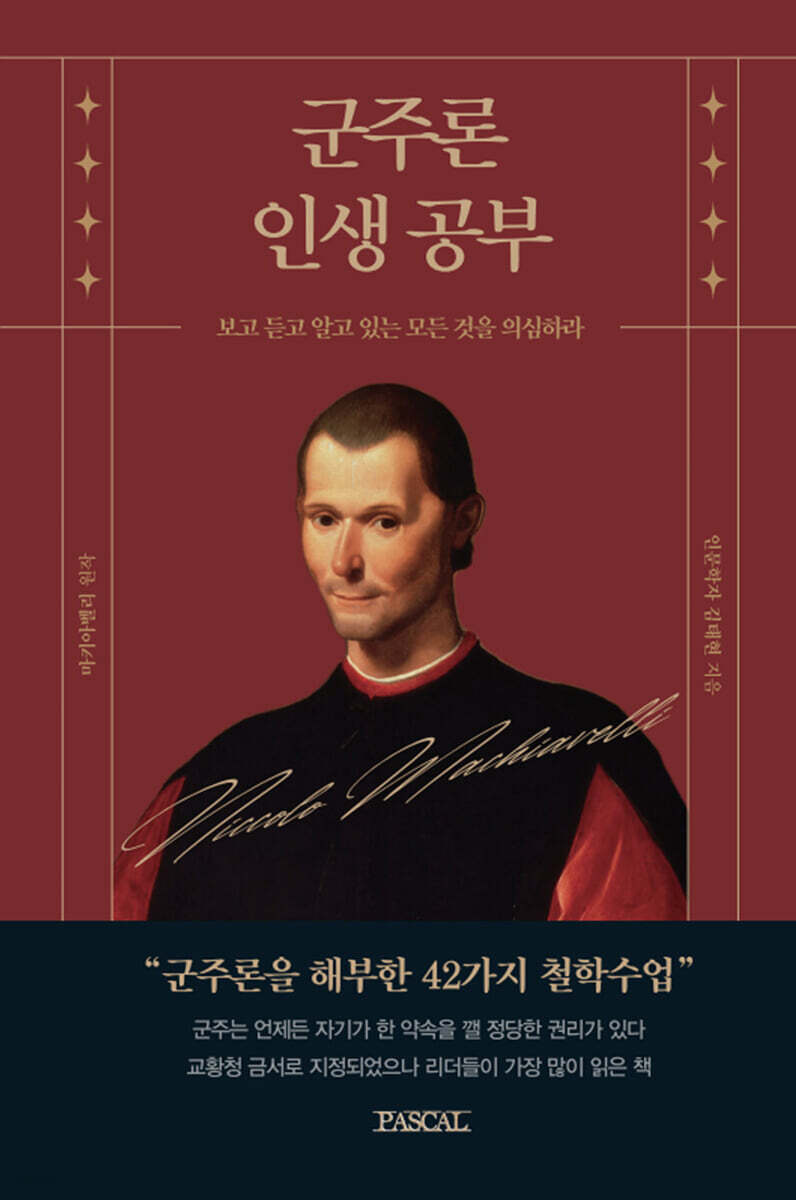
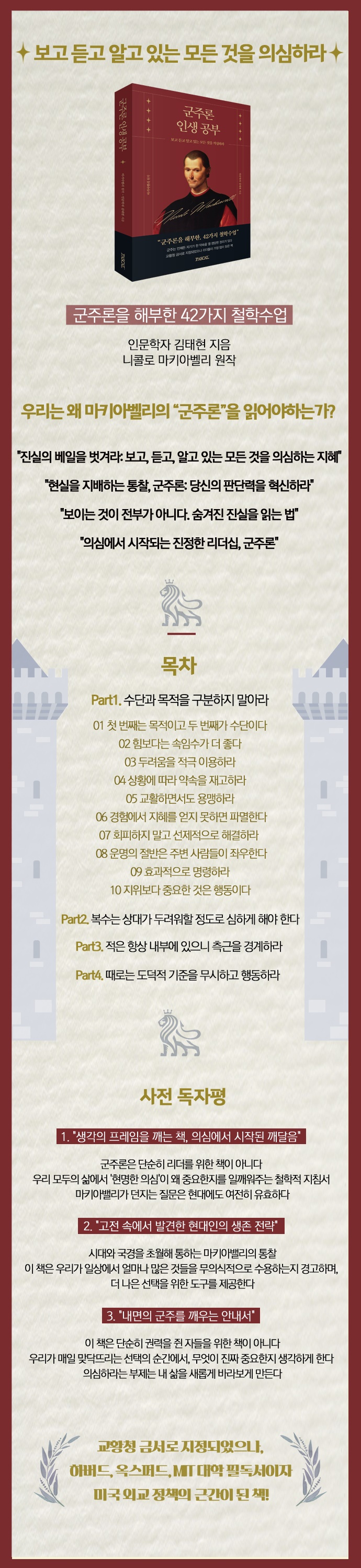
42 Philosophy Lessons Dissecting The Prince Even today, The Prince is considered an important reference material in various fields, including political science and business administration. It is also evaluated as a work that sharply explores the nature of power and human nature, and lays the foundation for a realistic political philosophy that contrasts with idealistic philosophy. It was selected as a required reading at Harvard University and Oxford University, and was selected as one of the world's top 100 books by Time magazine and Newsweek. It is one of the books most loved by world leaders for 500 years. This book selects 42 representative propositions from the original Italian edition of Machiavelli's The Prince, reinterprets them from a modern perspective, and explores what lessons they can teach us today. Each vertex is structured around a single proposition. To help readers understand the meaning more easily, we present an example first. These cases, drawn from historical events, corporate strategies, and everyday experiences, paint a concrete picture of how Machiavelli's propositions can be applied today. And in the interpretation section, along with Machiavelli's philosophical background, it explains what context the proposition has in the entirety of The Prince and what message he ultimately wanted to convey. Through this book, readers will come to realize that the propositions of The Prince provide practical insight and inspiration into humanity, and that they remain valid guidelines even in today's complex society. |
- You can preview some of the book's contents.
Preview
index
prolog
Entering
Into the turbulent 16th century Europe…
PART 1 Don't Distinguish Between Means and Ends
01 The first is the purpose, the second is the means.
02 Deception is better than strength
03 Use fear actively
04 Reconsider your promise depending on the situation.
05 Be cunning yet brave
06 If you don't gain wisdom from experience, you will be ruined.
07 Don't avoid, solve problems proactively.
08 Half of your destiny is determined by the people around you.
09 Command Effectively
10 Actions are more important than status.
PART 2 Revenge must be severe enough to make the opponent fear it.
11 The public is easily fooled by appearances.
12 Prepare thoroughly and be armed.
13 Radical change brings crisis
14 Don't give them a chance to counterattack.
15 Boldness is the essential virtue for achieving true success.
16 Humans are inherently selfish and value material gain more.
17 Be mean to those who are mean.
18 Beware of Unexpected Backlash
Secure the power to support 19 and above
20. Ethics and strategy must be considered simultaneously.
21 The root of all problems is oneself.
PART 3 The enemy is always within, so beware of your inner circle.
22 Beware of Excessive Kindness
23 Disguise for a purpose
24 The desire for conquest is natural.
25 Face the dark side of human nature
26 Choose the least evil
27 Go forward alone and alone
28 The best fortress is the crowd
29 Sleep with the enemy
30 Humans remember wounds and seek revenge.
31 Don't Ignore Early Warning Signs
32 Beware of the enemy within
PART 4 Sometimes, act without regard for moral standards.
33 Give positive rewards gradually, but cruelty all at once.
34 Overcoming Resistance to Innovation
35 Adorn yourself with trust and kindness
36 History is a repetition of good and evil.
37 Beware of Betrayal After Success
38 Beware of Short-Term Temptations
39 Explore the uncontrollable parts
40 Sometimes Ignore Moral Standards
41 God must be protected by force.
42 Absence of Leadership Leads to Destruction
Epilogue
Entering
Into the turbulent 16th century Europe…
PART 1 Don't Distinguish Between Means and Ends
01 The first is the purpose, the second is the means.
02 Deception is better than strength
03 Use fear actively
04 Reconsider your promise depending on the situation.
05 Be cunning yet brave
06 If you don't gain wisdom from experience, you will be ruined.
07 Don't avoid, solve problems proactively.
08 Half of your destiny is determined by the people around you.
09 Command Effectively
10 Actions are more important than status.
PART 2 Revenge must be severe enough to make the opponent fear it.
11 The public is easily fooled by appearances.
12 Prepare thoroughly and be armed.
13 Radical change brings crisis
14 Don't give them a chance to counterattack.
15 Boldness is the essential virtue for achieving true success.
16 Humans are inherently selfish and value material gain more.
17 Be mean to those who are mean.
18 Beware of Unexpected Backlash
Secure the power to support 19 and above
20. Ethics and strategy must be considered simultaneously.
21 The root of all problems is oneself.
PART 3 The enemy is always within, so beware of your inner circle.
22 Beware of Excessive Kindness
23 Disguise for a purpose
24 The desire for conquest is natural.
25 Face the dark side of human nature
26 Choose the least evil
27 Go forward alone and alone
28 The best fortress is the crowd
29 Sleep with the enemy
30 Humans remember wounds and seek revenge.
31 Don't Ignore Early Warning Signs
32 Beware of the enemy within
PART 4 Sometimes, act without regard for moral standards.
33 Give positive rewards gradually, but cruelty all at once.
34 Overcoming Resistance to Innovation
35 Adorn yourself with trust and kindness
36 History is a repetition of good and evil.
37 Beware of Betrayal After Success
38 Beware of Short-Term Temptations
39 Explore the uncontrollable parts
40 Sometimes Ignore Moral Standards
41 God must be protected by force.
42 Absence of Leadership Leads to Destruction
Epilogue
Detailed image
Into the book
“The ends justify the means.”
“Il fine giustifica i mezzi.”
- From Chapters 15-17 of The Prince -
In William Shakespeare's tragedy Macbeth, Macbeth is a brave warrior and loyal subject of King Duncan.
But one day, his heart burns with ambition when three witches prophesy that he is destined to become king.
At the urging of his wife, Lady Macbeth, he decides to assassinate King Duncan.
Macbeth, who entered the king's bedroom in the middle of the night with a sword in his hand, trembled in fear, but eventually killed the king and took the throne.
His goal was to become king, and he committed murder as a means to achieve that goal.
But his actions ultimately lead to tremendous tragedy for him and those around him.
Through the story of Macbeth, Shakespeare raises questions about the use of immoral means to achieve one's ends.
Machiavelli's The Prince does not simply evaluate Macbeth's actions as means to an end as immoral.
This can also be seen as a concept that summarizes Machiavelli's overall realistic political philosophy: "The ends justify the means."
Machiavelli argues that when a ruler is faced with a choice between ideal morality and practical politics, even immoral means can be justified for the sake of national interest and stability.
For example, he says that it is necessary to use unethical means such as lies, betrayal, and violence to ensure national stability.
In the 16th century, Italy was divided into many small city-states.
These city-states each maintained independent regimes, including Venice, Florence, Milan, Naples, and the Papal States.
However, these Italian city-states suffered from internal power struggles as well as invasions by foreign powers such as Spain, France, and the Holy Roman Empire.
Italy was plagued by constant political and military turmoil, and rivalries and divisions between cities prevented it from forming a strong, centralized state.
Niccolò Machiavelli was born and raised in this turmoil, working as a diplomat and civil servant in Florence.
At the time, Florence was under the rule of the Medici family, and Machiavelli studied ways for this city-state to survive.
He pondered deeply how small city-states like Florence could withstand foreign invasion and maintain internal stability.
Machiavelli faced this unstable political situation and developed a realistic political view.
He realized that the Italian city-states could not survive with a simple idealistic approach, and argued that maintaining power and political survival required pragmatic and cool-headed decisions.
“Il fine giustifica i mezzi.”
- From Chapters 15-17 of The Prince -
In William Shakespeare's tragedy Macbeth, Macbeth is a brave warrior and loyal subject of King Duncan.
But one day, his heart burns with ambition when three witches prophesy that he is destined to become king.
At the urging of his wife, Lady Macbeth, he decides to assassinate King Duncan.
Macbeth, who entered the king's bedroom in the middle of the night with a sword in his hand, trembled in fear, but eventually killed the king and took the throne.
His goal was to become king, and he committed murder as a means to achieve that goal.
But his actions ultimately lead to tremendous tragedy for him and those around him.
Through the story of Macbeth, Shakespeare raises questions about the use of immoral means to achieve one's ends.
Machiavelli's The Prince does not simply evaluate Macbeth's actions as means to an end as immoral.
This can also be seen as a concept that summarizes Machiavelli's overall realistic political philosophy: "The ends justify the means."
Machiavelli argues that when a ruler is faced with a choice between ideal morality and practical politics, even immoral means can be justified for the sake of national interest and stability.
For example, he says that it is necessary to use unethical means such as lies, betrayal, and violence to ensure national stability.
In the 16th century, Italy was divided into many small city-states.
These city-states each maintained independent regimes, including Venice, Florence, Milan, Naples, and the Papal States.
However, these Italian city-states suffered from internal power struggles as well as invasions by foreign powers such as Spain, France, and the Holy Roman Empire.
Italy was plagued by constant political and military turmoil, and rivalries and divisions between cities prevented it from forming a strong, centralized state.
Niccolò Machiavelli was born and raised in this turmoil, working as a diplomat and civil servant in Florence.
At the time, Florence was under the rule of the Medici family, and Machiavelli studied ways for this city-state to survive.
He pondered deeply how small city-states like Florence could withstand foreign invasion and maintain internal stability.
Machiavelli faced this unstable political situation and developed a realistic political view.
He realized that the Italian city-states could not survive with a simple idealistic approach, and argued that maintaining power and political survival required pragmatic and cool-headed decisions.
--- From "01 The first is the purpose and the second is the means"
Publisher's Review
Although The Prince was written in 1513, it was not published during Machiavelli's lifetime. Five years after his death, the first edition of The Prince (Il Principe) was published in Rome by his friend Antonio Blado.
Through this, The Prince was officially introduced to the world and established itself as a classic of political philosophy.
Machiavelli's cool-headed insight into power gave rise to the term Machiavellianism, and continues to have a profound influence today.
The recently published 『The Prince: A Study of Life』 consists of 42 carefully selected propositions from the original text, designed to make diplomacy and worldly skills more accessible to modern readers.
Each chapter is accompanied by a commentary on the era in which it was written, making it easier to understand The Prince. Modern examples are provided where additional explanation is needed, allowing readers to understand The Prince more clearly and apply it to appropriate situations.
Through this, readers can apply the skills and attitude toward life required to become a strong ruler, or “leader,” as Machiavelli pursued, to their own lives.
I hope that all readers of this book will apply Machiavelli's wisdom of insight at crucial moments in their lives and navigate their futures successfully.
Through this, The Prince was officially introduced to the world and established itself as a classic of political philosophy.
Machiavelli's cool-headed insight into power gave rise to the term Machiavellianism, and continues to have a profound influence today.
The recently published 『The Prince: A Study of Life』 consists of 42 carefully selected propositions from the original text, designed to make diplomacy and worldly skills more accessible to modern readers.
Each chapter is accompanied by a commentary on the era in which it was written, making it easier to understand The Prince. Modern examples are provided where additional explanation is needed, allowing readers to understand The Prince more clearly and apply it to appropriate situations.
Through this, readers can apply the skills and attitude toward life required to become a strong ruler, or “leader,” as Machiavelli pursued, to their own lives.
I hope that all readers of this book will apply Machiavelli's wisdom of insight at crucial moments in their lives and navigate their futures successfully.
GOODS SPECIFICS
- Date of issue: January 20, 2025
- Page count, weight, size: 224 pages | 290g | 128*187*20mm
- ISBN13: 9791186151754
- ISBN10: 1186151757
You may also like
카테고리
korean


korean

![GQ KOREA Mark (Monthly): December [2025]](http://librairie.coreenne.fr/cdn/shop/files/8ef265dbbfbf186523ed75ba7319009d.jpg?v=1765340328&width=3840)


