

Rediscovering Learning
 |
Description
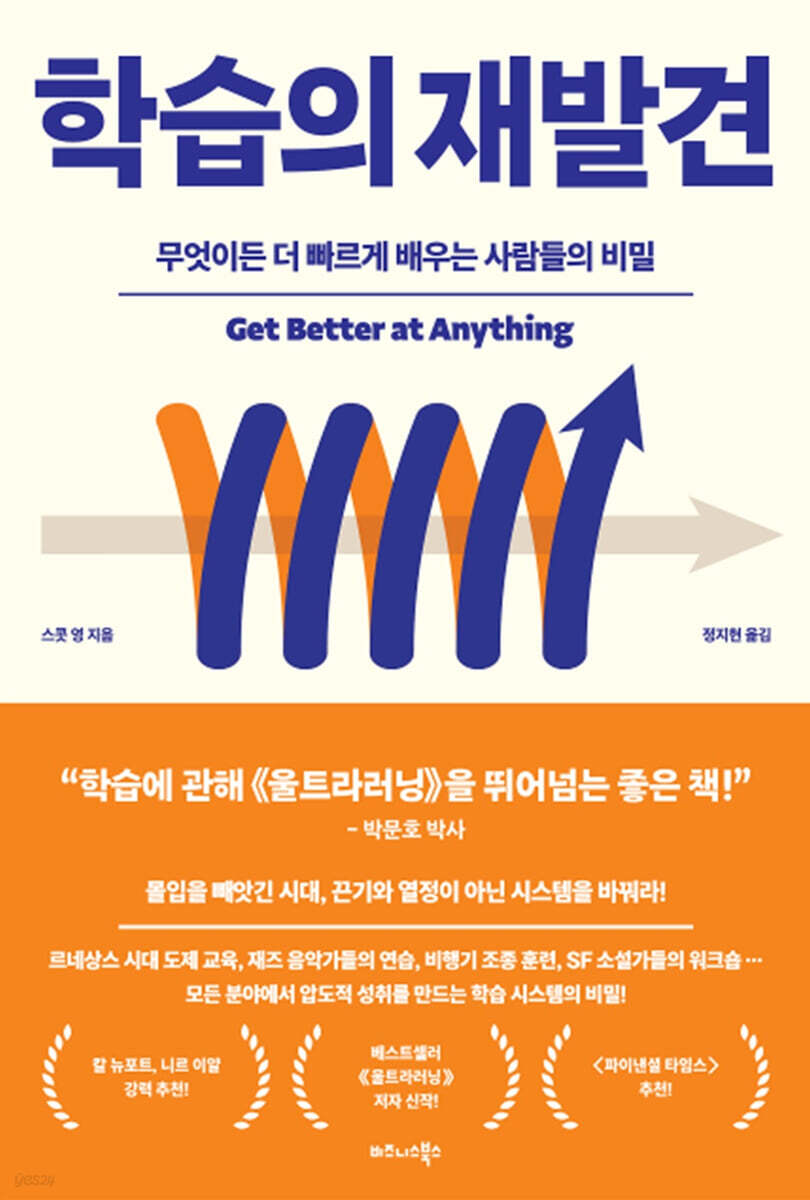
Book Introduction
Complete MIT's four-year program in one year! Scott Young, founder of Ultralearning The 12 sciences of learning that apply to all learning in the world! "A book that surpasses 'Ultra Learning' in terms of learning!" - Dr. Park Moon-ho Scott Young, author of the international bestseller "UltraLearning: The Secret to Knowledge Acquisition for the Top 0.1%," has returned with a new learning method after five years. While my previous work demonstrated the incredible power of self-directed learning through my personal experience of completing a four-year MIT computer science program and mastering four languages in just one year, this book takes a much broader look at learning culture and systems, encompassing the core principles that enable you to master anything quickly. In 『Rediscovering Learning』, the author presents a three-step process: ‘See, Do, and Get Feedback.’ Rapid progress is made when you learn from others, practice extensively on your own, and receive trustworthy feedback. If one or all of these are suppressed, it is asserted that improvement is impossible. It then extracts patterns that will help you learn anything faster and presents 12 detailed guidelines. Reading a book also offers the intellectual pleasure of looking into ourselves through the latest research on how our minds and brains work, how we are motivated, and how we are rewarded to feel happy. If you want to do more than just do something, but become better and more outstanding than others, you need to understand the principles of learning. By understanding the profound principles of learning, anyone can make a fundamental leap forward, regardless of their field. Whether you're a working professional learning a new skill, a student preparing for an exam, or simply looking to excel in a field of interest, this book will help you achieve faster, more powerful results through successful learning. As Dr. Moon-Ho Park, a neuroscientist, recommends, “A great book that surpasses ‘Ultra Learning’ when it comes to learning!”, this book is a surprising sequel that instantly surpasses the high expectations of its predecessor! |
- You can preview some of the book's contents.
Preview
index
Recommendation | Park Moon-ho, author of "Brain: The Emergence of Thought"
Enter | You can learn and do better at anything
Part 1.
See: Learn from others
Chapter 1.
Problem solving is exploration
Explore the problem space as if navigating a maze/ How can we tackle difficult problems?/ Problem-solving strategies we commonly use/ Stand on the strategies of giants/ Three lessons for proper exploration/ Understanding the principles of problem-solving comes first
Chapter 2.
Creativity begins with imitation.
Learning vs.
Creativity, what comes first? / You can't just solve problems alone / The capacity of the human mind / Beware of information overload / Would it be more helpful to find the answer on your own? / You have to take action after imitation / How to effectively learn new things / Study the methods of those who have gone before
Chapter 3.
Success is the best teacher
The right foundation fosters learning potential. / How can school classes be as effective as one-on-one learning? / Why success, not failure, is the best motivation. / The moment when early success becomes expertise.
Chapter 4.
Experience is sometimes the enemy of knowledge.
Inexplicable knowledge, 'intuition' / The secret of the abilities possessed by experts / Why experts are not always the best teachers / Extracting the knowledge of experts / Moving from examples to practice
Part 2.
Practice (Do): Learn through practice.
Chapter 5.
Find the sweet spot of difficulty
Why do writers struggle with writing? / When does struggle become helpful? / Creating the right practice cycle / Examples vs.
Try, What Comes First? / 3 Strategies for Finding the Right Difficulty / Optimal Difficulty is Key
Chapter 6.
The mind is not a muscle
If you learn one thing, will you be good at another? / How does learning one skill generalize to other skills? / How do we acquire skills? / How to use the knowledge in your head properly / The practical consequences of precise skills / The mind is a collection of knowledge tools.
Chapter 7.
Change is important after repetition
Practice mixing different techniques / Look at similar or completely different examples / Have a variety of expressive tools / When is variable practice helpful? / Four variation strategies to use in learning / Now that you've developed flexibility, it's time to get creative
Chapter 8.
Quality comes from quantity
Are geniuses prolific? / Combining the three elements of creativity / Does increasing creative output lead to better quality? / Productivity strategies that ensure both quantity and quality / If you've practiced, now's the time for feedback.
Part 3.
Get Feedback: Learn from Experience
Chapter 9.
Having a lot of experience doesn't make you an expert.
Poker: The Power of Experience and Feedback / How to Develop Skills to Overcome Uncertainty / When Should You Trust Your Intuition / Is Expert Intuition a Skill or a Pride? / How to Deal with Unpredictable Environments / Four Learning Strategies to Overcome Uncertainty / Experience is Supplemented by Feedback
Chapter 10.
Practice must be grounded in reality.
Why practice is important for real-world situations / Feedback is essential even if you excel at technical skills / How should real-world practice be conducted? / Learn by interacting with your surroundings / Apprenticeships are more effective in real-world situations than theory / Things to keep in mind when learning in real-world situations / Practice in real-world situations
Chapter 11.
The path to improvement is not a straight line.
Unlearning: Crouching to Leap / When Old Skills Hinder New Achievements / Cutting Bad Habits / How to Confront Faulty Thinking / 3 Strategies for Successful Unlearning
Chapter 12.
The more you face fear, the weaker it becomes.
The Psychology of Fear and Safety / Can Exposure Alone Overcome Fear? / Eliminating Fear Makes Learning Easier / 4 Strategies for Overcoming Fear / How to Get Better at Anything
Coming out | We can become better people
Enter | You can learn and do better at anything
Part 1.
See: Learn from others
Chapter 1.
Problem solving is exploration
Explore the problem space as if navigating a maze/ How can we tackle difficult problems?/ Problem-solving strategies we commonly use/ Stand on the strategies of giants/ Three lessons for proper exploration/ Understanding the principles of problem-solving comes first
Chapter 2.
Creativity begins with imitation.
Learning vs.
Creativity, what comes first? / You can't just solve problems alone / The capacity of the human mind / Beware of information overload / Would it be more helpful to find the answer on your own? / You have to take action after imitation / How to effectively learn new things / Study the methods of those who have gone before
Chapter 3.
Success is the best teacher
The right foundation fosters learning potential. / How can school classes be as effective as one-on-one learning? / Why success, not failure, is the best motivation. / The moment when early success becomes expertise.
Chapter 4.
Experience is sometimes the enemy of knowledge.
Inexplicable knowledge, 'intuition' / The secret of the abilities possessed by experts / Why experts are not always the best teachers / Extracting the knowledge of experts / Moving from examples to practice
Part 2.
Practice (Do): Learn through practice.
Chapter 5.
Find the sweet spot of difficulty
Why do writers struggle with writing? / When does struggle become helpful? / Creating the right practice cycle / Examples vs.
Try, What Comes First? / 3 Strategies for Finding the Right Difficulty / Optimal Difficulty is Key
Chapter 6.
The mind is not a muscle
If you learn one thing, will you be good at another? / How does learning one skill generalize to other skills? / How do we acquire skills? / How to use the knowledge in your head properly / The practical consequences of precise skills / The mind is a collection of knowledge tools.
Chapter 7.
Change is important after repetition
Practice mixing different techniques / Look at similar or completely different examples / Have a variety of expressive tools / When is variable practice helpful? / Four variation strategies to use in learning / Now that you've developed flexibility, it's time to get creative
Chapter 8.
Quality comes from quantity
Are geniuses prolific? / Combining the three elements of creativity / Does increasing creative output lead to better quality? / Productivity strategies that ensure both quantity and quality / If you've practiced, now's the time for feedback.
Part 3.
Get Feedback: Learn from Experience
Chapter 9.
Having a lot of experience doesn't make you an expert.
Poker: The Power of Experience and Feedback / How to Develop Skills to Overcome Uncertainty / When Should You Trust Your Intuition / Is Expert Intuition a Skill or a Pride? / How to Deal with Unpredictable Environments / Four Learning Strategies to Overcome Uncertainty / Experience is Supplemented by Feedback
Chapter 10.
Practice must be grounded in reality.
Why practice is important for real-world situations / Feedback is essential even if you excel at technical skills / How should real-world practice be conducted? / Learn by interacting with your surroundings / Apprenticeships are more effective in real-world situations than theory / Things to keep in mind when learning in real-world situations / Practice in real-world situations
Chapter 11.
The path to improvement is not a straight line.
Unlearning: Crouching to Leap / When Old Skills Hinder New Achievements / Cutting Bad Habits / How to Confront Faulty Thinking / 3 Strategies for Successful Unlearning
Chapter 12.
The more you face fear, the weaker it becomes.
The Psychology of Fear and Safety / Can Exposure Alone Overcome Fear? / Eliminating Fear Makes Learning Easier / 4 Strategies for Overcoming Fear / How to Get Better at Anything
Coming out | We can become better people
Detailed image

Into the book
Seilie is obviously good at Tetris.
What's surprising is that his skills are far superior to those of the first generation players who were fascinated by this game.
Level 29 has long been considered impossible.
Reaching a high score of 999,999 in one go has also been a long-held goal for early players.
This score was first achieved by Harry Hong 20 years after the game's release.
Meanwhile, Seilie reached the highest score in singles tournament matches a whopping twelve times in 2020.
Even in the same competition, there were forty other people who achieved the highest score.
Why do players continue to emerge who are far more skilled than before, even though the game is long past its prime?
--- From "Entering"
Imitation of masterpieces formed the backbone of Renaissance art education.
Da Vinci also insisted that one must study in the proper order.
“The order in which one learns to draw should begin with drawing from the drawings of the great masters, and after acquiring that skill, practice drawing objects excellently using reliefs under the critique of a teacher.” The very notion of spending a lot of time on imitation seems to contradict modern understandings of artistic training.
The perception is that artists should be the source of originality, and that repetitive training kills the creative spirit.
However, artists in an era where imitation training was widespread often produced surprisingly original works.
--- From Chapter 2, “Creativity Begins with Imitation”
Perhaps no molecule is more recognizable in the public imagination than the structure of DNA.
(…) X-ray crystallography takes a specific type of picture.
Rosalind Franklin was an expert in this field.
In particular, she was as gifted with theoretical insight to solve problems as she was with experimental skills.
(…) How did Franklin immediately recognize that Watson and Crick's first model of DNA was incorrect? And how did she immediately deduce the correct method for preparing the delicate fibers, despite having never handled the molecule before? Furthermore, how did Watson and Crick, who had only glimpsed Franklin's X-ray diffraction images, discern the overall shape of the molecule and eliminate sufficient possibilities to arrive at the answer they needed?
--- From Chapter 4, “Experience is sometimes the enemy of knowledge”
The improvisational nature of jazz should not be mistaken for a lack of discipline.
Trumpeter Wynton Marsalis explains:
“Jazz is not something you play thinking, ‘Well, I feel like playing it like this.’
Jazz has a strong structural character that follows tradition and requires a lot of thought and study.” (…) For those who want to become jazz musicians, learning to improvise is a very serious challenge.
How can we avoid repetitive playing and develop the skill to perfectly execute complex chord changes and rhythms while maintaining flexibility?
--- From “Chapter 7: Change is Important After Repetition”
Edison is a typical prolific genius.
His inventions were as numerous as they were influential.
But Edison's case raises general questions about creative productivity.
Do creators who produce the best work produce more or less than their less accomplished peers? Let's compare Leonardo da Vinci and Pablo Picasso.
Da Vinci completed only about 20 works during his lifetime, and many of them were left unfinished.
On the other hand, Picasso completed over 13,000 paintings, and including prints, he left behind over 100,000 works in total.
--- From Chapter 8, “Quality Comes from Quantity”
Aerial dogfights had become an essential strategy for dominating the skies, and Britain was lagging far behind in this technology.
The biggest reason was poor training.
The training course conducted in peacetime emphasized the mechanical operation of aircraft, aircraft construction, and flight theory.
In contrast, the actual practical experience of flying an airplane was woefully lacking.
(…) Smith Barry’s innovation was a remarkable success.
Intensive training greatly increased the survival rate of pilots.
According to historian Robert Morley, before Smith-Barry's training reforms, the majority of crashes were fatal and almost always the result of serious pilot error.
However, subsequent accidents occurred almost exclusively during landing, and most were not serious enough to destroy the aircraft.
--- From Chapter 10, “Practice Must Be in Touch with Reality”
Although there were certainly risks involved, Tiger Woods didn't want to make half-hearted changes.
Rather than gradually correcting his swing, as coach Butch Harmon suggested, he wanted to completely change it all at once.
To Harmon's point that it would be difficult to continue playing while making changes, Woods replied, "It doesn't matter."
After 18 months of grueling practice and the inevitable poor performance due to an unfamiliar swing,
And the following year, he won a whopping eight competitions.
This was a feat that no one had achieved since 1974.
What's surprising is that his skills are far superior to those of the first generation players who were fascinated by this game.
Level 29 has long been considered impossible.
Reaching a high score of 999,999 in one go has also been a long-held goal for early players.
This score was first achieved by Harry Hong 20 years after the game's release.
Meanwhile, Seilie reached the highest score in singles tournament matches a whopping twelve times in 2020.
Even in the same competition, there were forty other people who achieved the highest score.
Why do players continue to emerge who are far more skilled than before, even though the game is long past its prime?
--- From "Entering"
Imitation of masterpieces formed the backbone of Renaissance art education.
Da Vinci also insisted that one must study in the proper order.
“The order in which one learns to draw should begin with drawing from the drawings of the great masters, and after acquiring that skill, practice drawing objects excellently using reliefs under the critique of a teacher.” The very notion of spending a lot of time on imitation seems to contradict modern understandings of artistic training.
The perception is that artists should be the source of originality, and that repetitive training kills the creative spirit.
However, artists in an era where imitation training was widespread often produced surprisingly original works.
--- From Chapter 2, “Creativity Begins with Imitation”
Perhaps no molecule is more recognizable in the public imagination than the structure of DNA.
(…) X-ray crystallography takes a specific type of picture.
Rosalind Franklin was an expert in this field.
In particular, she was as gifted with theoretical insight to solve problems as she was with experimental skills.
(…) How did Franklin immediately recognize that Watson and Crick's first model of DNA was incorrect? And how did she immediately deduce the correct method for preparing the delicate fibers, despite having never handled the molecule before? Furthermore, how did Watson and Crick, who had only glimpsed Franklin's X-ray diffraction images, discern the overall shape of the molecule and eliminate sufficient possibilities to arrive at the answer they needed?
--- From Chapter 4, “Experience is sometimes the enemy of knowledge”
The improvisational nature of jazz should not be mistaken for a lack of discipline.
Trumpeter Wynton Marsalis explains:
“Jazz is not something you play thinking, ‘Well, I feel like playing it like this.’
Jazz has a strong structural character that follows tradition and requires a lot of thought and study.” (…) For those who want to become jazz musicians, learning to improvise is a very serious challenge.
How can we avoid repetitive playing and develop the skill to perfectly execute complex chord changes and rhythms while maintaining flexibility?
--- From “Chapter 7: Change is Important After Repetition”
Edison is a typical prolific genius.
His inventions were as numerous as they were influential.
But Edison's case raises general questions about creative productivity.
Do creators who produce the best work produce more or less than their less accomplished peers? Let's compare Leonardo da Vinci and Pablo Picasso.
Da Vinci completed only about 20 works during his lifetime, and many of them were left unfinished.
On the other hand, Picasso completed over 13,000 paintings, and including prints, he left behind over 100,000 works in total.
--- From Chapter 8, “Quality Comes from Quantity”
Aerial dogfights had become an essential strategy for dominating the skies, and Britain was lagging far behind in this technology.
The biggest reason was poor training.
The training course conducted in peacetime emphasized the mechanical operation of aircraft, aircraft construction, and flight theory.
In contrast, the actual practical experience of flying an airplane was woefully lacking.
(…) Smith Barry’s innovation was a remarkable success.
Intensive training greatly increased the survival rate of pilots.
According to historian Robert Morley, before Smith-Barry's training reforms, the majority of crashes were fatal and almost always the result of serious pilot error.
However, subsequent accidents occurred almost exclusively during landing, and most were not serious enough to destroy the aircraft.
--- From Chapter 10, “Practice Must Be in Touch with Reality”
Although there were certainly risks involved, Tiger Woods didn't want to make half-hearted changes.
Rather than gradually correcting his swing, as coach Butch Harmon suggested, he wanted to completely change it all at once.
To Harmon's point that it would be difficult to continue playing while making changes, Woods replied, "It doesn't matter."
After 18 months of grueling practice and the inevitable poor performance due to an unfamiliar swing,
And the following year, he won a whopping eight competitions.
This was a feat that no one had achieved since 1974.
--- From Chapter 11, “The Road to Improvement Is Not a Straight Line”
Publisher's Review
What matters in learning is not 'intelligence' or 'persistence'!
If you know the 'principles' and have a 'system', your learning will accelerate!
How does "learning" occur? We live our lives constantly acquiring knowledge and skills, whether at work, at school, or through hobbies.
Some things are learned and mastered quickly, while others, no matter how hard you try, just never improve.
What makes the difference? How do those who learn faster and get ahead of others learn? Can we acquire the knack for learning itself, for learning anything better?
Scott Young, who started the 'ultralearning' craze in the US and around the world with his super-learning method of completing the MIT 4-year course in one year and learning 4 languages, has returned after 5 years.
"Rediscovering Learning" is a book that delves into the fundamental principles of learning and contains the secrets of those who learn anything faster.
Dr. Park Moon-ho, a neuroscientist who highly praised the previous work, "Ultra Running," praised the book, saying, "This book surpasses 'Ultra Running'!" The book is also receiving favorable reviews from intellectuals who have studied learning and productivity, such as Cal Newport and Nir Eyal, as well as major media outlets such as the Financial Times.
In 『Rediscovering Learning』, the author presents a three-step process: ‘See, Do, and Get Feedback.’
First, we learn by seeing the examples of others, and then we practice continuously by doing.
Finally, adjust any missing or incorrect parts through appropriate feedback.
First, we learn most easily by watching others perform.
It is often thought that geniuses like Leonardo da Vinci and Michelangelo created great works of art through solitude, but they learned by following their masters and imitating masterpieces like apprentice workers.
The fact that this system, which seems far removed from creativity, has produced so many masters gives us a new perspective on how to learn to foster creativity.
Although the common belief that “failure is the mother of success” is widespread, the author asserts that we learn more from success than from failure.
Success effectively reduces study time and is a great help in motivation.
Especially when you succeed frequently on simple problems, you build confidence and the strength to tackle bigger problems.
It's also interesting to note that experts aren't necessarily great teachers, and sometimes they can be the worst teachers.
Because teaching something isn't something you can do just by being good at it.
It is only possible if you break down the technology you know, know pedagogy, and learn how to break down the technology.
It also offers learning methods tailored to different types of knowledge and skills, including tips for acquiring improvisational and variable skills like jazz musicians, finding the optimal difficulty level for efficient learning, flashcard learning that helps you retain knowledge longer than cramming, how to create feedback loops that actually help you improve, and how to break down and rebuild previously acquired skills to reach the highest level.
The various cases and studies supporting the theory are also interesting.
We explore examples of exceptional learners, including Tiger Woods' determination to change his swing several times from the top, why it took 20 years for Tetris to see significant advances in gaming technology, the training secrets of Renaissance master painters, and how jazz musicians master improvisation.
We also reviewed hundreds of academic books and articles to synthesize the most important concepts and practical points for learning.
The secret of those who have mastered 'learning' itself!
No matter what you're learning or practicing, understanding how learning happens can make the entire process much faster and more efficient.
This is why we must learn ‘learning’ itself.
It's packed with real-world examples and helpful guidance for anyone preparing for exams, learning new skills at work, or simply wanting to improve their hobbies or interests.
For learners who need to learn something, it provides the strategies and skills they need to excel in everyday life.
If you are a teacher, coach, parent, or anyone who facilitates learning within an organization, you will gain insight into how to lead learners.
This book will help you achieve faster and more overwhelming results through successful learning.
If you know the 'principles' and have a 'system', your learning will accelerate!
How does "learning" occur? We live our lives constantly acquiring knowledge and skills, whether at work, at school, or through hobbies.
Some things are learned and mastered quickly, while others, no matter how hard you try, just never improve.
What makes the difference? How do those who learn faster and get ahead of others learn? Can we acquire the knack for learning itself, for learning anything better?
Scott Young, who started the 'ultralearning' craze in the US and around the world with his super-learning method of completing the MIT 4-year course in one year and learning 4 languages, has returned after 5 years.
"Rediscovering Learning" is a book that delves into the fundamental principles of learning and contains the secrets of those who learn anything faster.
Dr. Park Moon-ho, a neuroscientist who highly praised the previous work, "Ultra Running," praised the book, saying, "This book surpasses 'Ultra Running'!" The book is also receiving favorable reviews from intellectuals who have studied learning and productivity, such as Cal Newport and Nir Eyal, as well as major media outlets such as the Financial Times.
In 『Rediscovering Learning』, the author presents a three-step process: ‘See, Do, and Get Feedback.’
First, we learn by seeing the examples of others, and then we practice continuously by doing.
Finally, adjust any missing or incorrect parts through appropriate feedback.
First, we learn most easily by watching others perform.
It is often thought that geniuses like Leonardo da Vinci and Michelangelo created great works of art through solitude, but they learned by following their masters and imitating masterpieces like apprentice workers.
The fact that this system, which seems far removed from creativity, has produced so many masters gives us a new perspective on how to learn to foster creativity.
Although the common belief that “failure is the mother of success” is widespread, the author asserts that we learn more from success than from failure.
Success effectively reduces study time and is a great help in motivation.
Especially when you succeed frequently on simple problems, you build confidence and the strength to tackle bigger problems.
It's also interesting to note that experts aren't necessarily great teachers, and sometimes they can be the worst teachers.
Because teaching something isn't something you can do just by being good at it.
It is only possible if you break down the technology you know, know pedagogy, and learn how to break down the technology.
It also offers learning methods tailored to different types of knowledge and skills, including tips for acquiring improvisational and variable skills like jazz musicians, finding the optimal difficulty level for efficient learning, flashcard learning that helps you retain knowledge longer than cramming, how to create feedback loops that actually help you improve, and how to break down and rebuild previously acquired skills to reach the highest level.
The various cases and studies supporting the theory are also interesting.
We explore examples of exceptional learners, including Tiger Woods' determination to change his swing several times from the top, why it took 20 years for Tetris to see significant advances in gaming technology, the training secrets of Renaissance master painters, and how jazz musicians master improvisation.
We also reviewed hundreds of academic books and articles to synthesize the most important concepts and practical points for learning.
The secret of those who have mastered 'learning' itself!
No matter what you're learning or practicing, understanding how learning happens can make the entire process much faster and more efficient.
This is why we must learn ‘learning’ itself.
It's packed with real-world examples and helpful guidance for anyone preparing for exams, learning new skills at work, or simply wanting to improve their hobbies or interests.
For learners who need to learn something, it provides the strategies and skills they need to excel in everyday life.
If you are a teacher, coach, parent, or anyone who facilitates learning within an organization, you will gain insight into how to lead learners.
This book will help you achieve faster and more overwhelming results through successful learning.
GOODS SPECIFICS
- Date of issue: December 17, 2024
- Page count, weight, size: 352 pages | 152*225*25mm
- ISBN13: 9791162544013
- ISBN10: 1162544015
You may also like
카테고리
korean


korean

![GQ KOREA Mark (Monthly): December [2025]](http://librairie.coreenne.fr/cdn/shop/files/8ef265dbbfbf186523ed75ba7319009d.jpg?v=1765340328&width=3840)


