

Mental stamina
 |
Description
Book Introduction
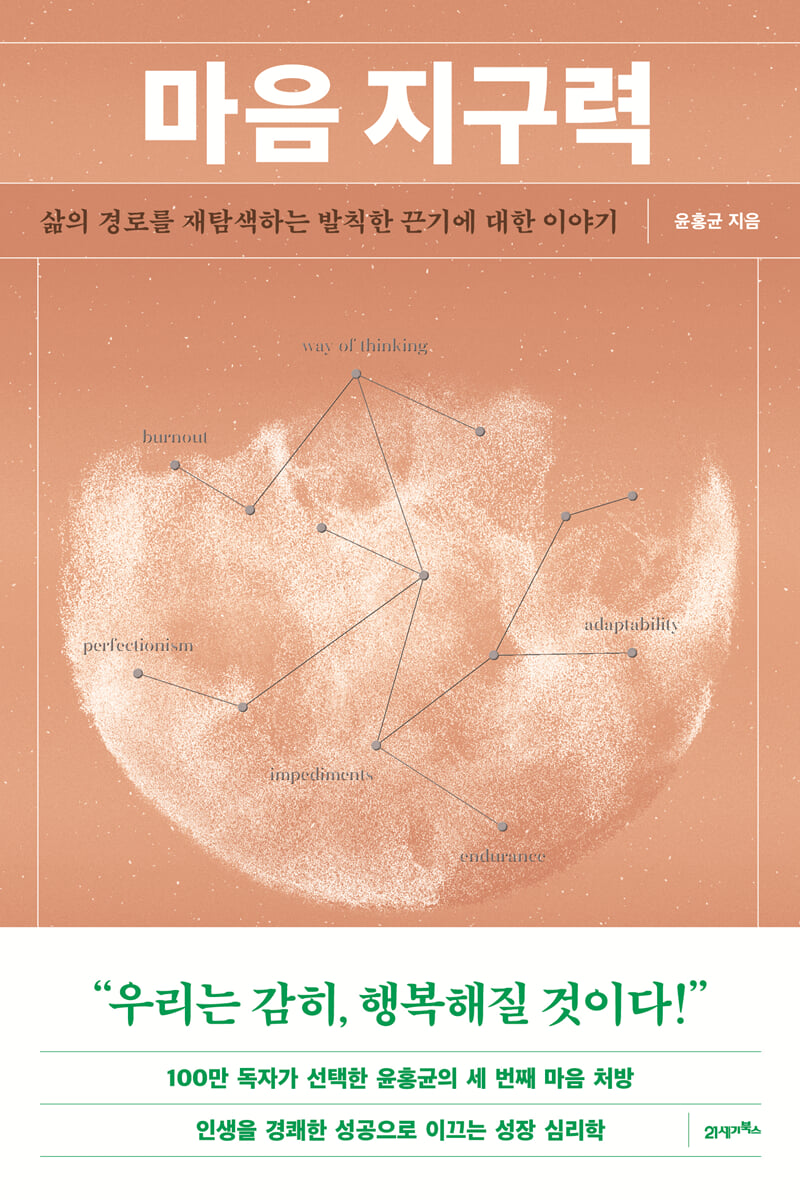
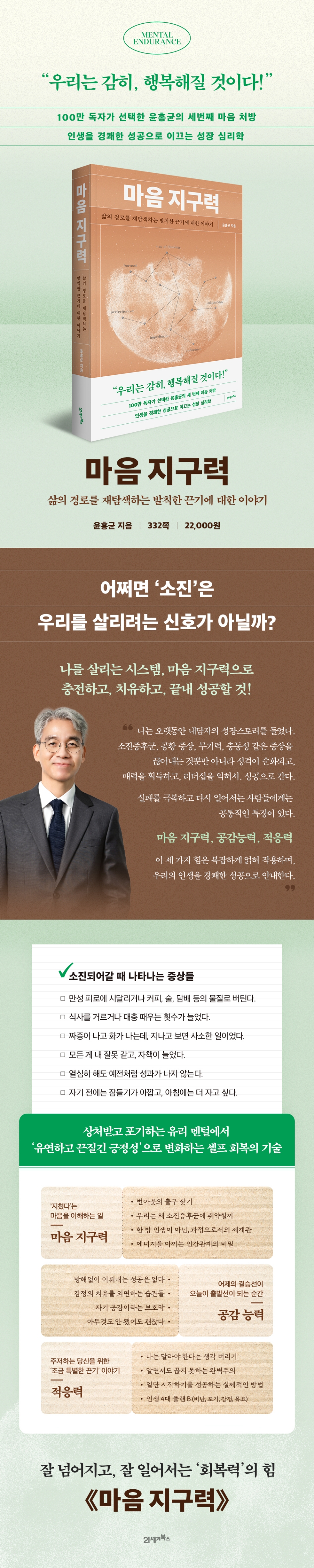
Hong-Kyun Yoon's Third Prescription for the Heart: "Self-Esteem Class," Chosen by 1 Million Readers In Yuri's mentality, which is hurt and gives up Changing to 'flexible and persistent positivity' The art of self-healing, mental endurance Director Hong-Kyun Yoon, author of "Self-Esteem Class," which created a "self-esteem craze" in Korea and provided a solution to mental recovery for 1 million readers, reveals the law of bold persistence that leads to success beyond resetting the mind and interpersonal relationships through his new book "Mental Endurance." 《Mental Endurance》 contains self-healing techniques that transform an anxious, weak, and exhausted mentality into a 'flexible and persistent positivity'. As a long-time psychiatrist, I have witnessed firsthand how vulnerable clients transform into strong and capable individuals. This has led me to focus on "mental stamina," the power that leads our lives to brisk success. How to overcome the feeling of "I can't do this anymore," why Plan B can become a new philosophy in an era where crisis and opportunity are mixed, and what ultimately accelerates recovery in life, sometimes providing an immediate diagnosis and sometimes indirect soothing, providing the right amount of psychological prescription. This book will not only help you overcome symptoms such as depression, panic attacks, lethargy, and impulsivity, but will also serve as a thick and warm guide to purifying your personality, acquiring charm, and developing leadership skills to achieve success in life. |
- You can preview some of the book's contents.
Preview
index
prolog
PART 1: Understanding the Feeling of Being 'Tired'
CHAPTER 1: The Answer Is Not Big Success, But 'Moderate' Success: Finding a Way Out of Burnout
01 Why Start with Burnout?
02 Compensation Center, the Accelerator of Life
03 People who no longer feel passionate
04 Why Are Koreans Vulnerable to Burnout Syndrome?
05 Burnout and avoidance among office workers
06 My Mind's Brake Amygdala
07 From stranger to acquaintance
CHAPTER 2 How to Easily Overcome Life's Failures_Mental Endurance
01 A happy ending outlook on life
:: Resilience Lesson 01 | How to Have a Happy Ending in Life
02 A worldview of life as a process, not a one-time thing
:: Resilience Lesson 02 | How to Apply a Worldview as a Process to Life
03 Don't be obsessed with the mind, and value real life.
:: Resilience Lesson 03 | A spell to help you focus on real-world problems
04 The Power to Drive Life: Is Money Enough?
:: Resilience Lesson 04 | How to Connect Your Pursuit of Goals and Values
05 The Secret to Energy-Saving Relationships
:: Resilience Lesson 05 | How to Find Answers in Relationships
06 How to Increase Mental Endurance 1: Sleep Well
:: Resilience Lesson 06 | Things to Keep in Mind for Rest and Sleep
07 How to Increase Mental Endurance 2: Increase Stamina
08 How to Increase Mental Endurance 3: The Importance of Play
:: Resilience Lesson 07 | Suggestions for Playing Well
PART 2 The moment when yesterday's finish line becomes today's starting line
CHAPTER 3 Empathy is a Power: Clearing the Blockages of Emotion
01 There is no success without obstacles.
02 Wounds attack thoughts and emotions.
03 The moment when defense and interference collide
04 The key to defense is empathy
05 Habits that Ignore Emotional Healing
06 The protective shield of self-empathy
07 Variation of the previous question on emotions, the problem of ambivalence
CHAPTER 4: The First System That Saves Me: The Thinking of People with Strong Defense
01 Immune cells of my heart
:: Resilience Class 08 | Words that Boost Mental Immunity
02 Thoughts that lower our defenses
:: Resilience Lesson 09 | Practical Ways to Boost Your Defenses
03 Thinking Frames That Lower Defense: Black-and-White Logic
:: Resilience Lesson 10 | Practical Ways to Break Free from Black-and-White Thinking
04 Complex Emotions Related to Obstacles: Revenge
:: Resilience Lesson 11 | Practical Ways to Wisely Handle the Desire for Revenge
05 Three Major Disturbances Caused by Family_Part Ⅰ
:: Resilience Lesson 12 | How to Transform Family Relationships into Social Life
06 Three Major Disturbances Caused by Family_Part II
:: Resilience Lesson 12 | How to Transform Family Relationships into Social Life
07 Social life of people with strong defenses
:: Resilience Lesson 13 | Realistic Tips for a Safe Social Life
08 Habits That Undermine Your Defenses
09 How to Break Bad Habits
:: Resilience Lesson 14 | How to Break Free from Habits That Hold You Back
10 It's okay if nothing happens
PART 3: A Story of "A Little Special Perseverance" for Those Hesitant
CHAPTER 5: If You Can't Get Started, It's Because of Perfectionism - Let Go of the Idea That You Should Be Different
01 Is this okay? Is this okay?
02 How Perfectionism Is Born
03 Why Can't We Stop Believing That Effort Is All That Matters?
04 Hidden Perfectionism
05 Perfectionism that you know you can't stop
06 What kind of outlook on life should I have from now on?
CHAPTER 6 A New Philosophy to Replace Perfectionism: Plan B and Adaptability
01 Now is the era of adaptation
02 What is Adaptability?
:: Resilience Lesson 15 | What to Do Today to Become Adaptable
03 Going through negative emotions
04 What you need to prepare to increase your adaptability 1: Just get started
:: Resilience Lesson 16 | Practical Ways to Succeed at Getting Started
05 What to prepare to increase adaptability 2: Water supply and sewerage installation
:: Resilience Lesson 17 | What to Do During Stress Relief
06 What You Need to Prepare to Increase Your Adaptability: Plan B
Epilogue
PART 1: Understanding the Feeling of Being 'Tired'
CHAPTER 1: The Answer Is Not Big Success, But 'Moderate' Success: Finding a Way Out of Burnout
01 Why Start with Burnout?
02 Compensation Center, the Accelerator of Life
03 People who no longer feel passionate
04 Why Are Koreans Vulnerable to Burnout Syndrome?
05 Burnout and avoidance among office workers
06 My Mind's Brake Amygdala
07 From stranger to acquaintance
CHAPTER 2 How to Easily Overcome Life's Failures_Mental Endurance
01 A happy ending outlook on life
:: Resilience Lesson 01 | How to Have a Happy Ending in Life
02 A worldview of life as a process, not a one-time thing
:: Resilience Lesson 02 | How to Apply a Worldview as a Process to Life
03 Don't be obsessed with the mind, and value real life.
:: Resilience Lesson 03 | A spell to help you focus on real-world problems
04 The Power to Drive Life: Is Money Enough?
:: Resilience Lesson 04 | How to Connect Your Pursuit of Goals and Values
05 The Secret to Energy-Saving Relationships
:: Resilience Lesson 05 | How to Find Answers in Relationships
06 How to Increase Mental Endurance 1: Sleep Well
:: Resilience Lesson 06 | Things to Keep in Mind for Rest and Sleep
07 How to Increase Mental Endurance 2: Increase Stamina
08 How to Increase Mental Endurance 3: The Importance of Play
:: Resilience Lesson 07 | Suggestions for Playing Well
PART 2 The moment when yesterday's finish line becomes today's starting line
CHAPTER 3 Empathy is a Power: Clearing the Blockages of Emotion
01 There is no success without obstacles.
02 Wounds attack thoughts and emotions.
03 The moment when defense and interference collide
04 The key to defense is empathy
05 Habits that Ignore Emotional Healing
06 The protective shield of self-empathy
07 Variation of the previous question on emotions, the problem of ambivalence
CHAPTER 4: The First System That Saves Me: The Thinking of People with Strong Defense
01 Immune cells of my heart
:: Resilience Class 08 | Words that Boost Mental Immunity
02 Thoughts that lower our defenses
:: Resilience Lesson 09 | Practical Ways to Boost Your Defenses
03 Thinking Frames That Lower Defense: Black-and-White Logic
:: Resilience Lesson 10 | Practical Ways to Break Free from Black-and-White Thinking
04 Complex Emotions Related to Obstacles: Revenge
:: Resilience Lesson 11 | Practical Ways to Wisely Handle the Desire for Revenge
05 Three Major Disturbances Caused by Family_Part Ⅰ
:: Resilience Lesson 12 | How to Transform Family Relationships into Social Life
06 Three Major Disturbances Caused by Family_Part II
:: Resilience Lesson 12 | How to Transform Family Relationships into Social Life
07 Social life of people with strong defenses
:: Resilience Lesson 13 | Realistic Tips for a Safe Social Life
08 Habits That Undermine Your Defenses
09 How to Break Bad Habits
:: Resilience Lesson 14 | How to Break Free from Habits That Hold You Back
10 It's okay if nothing happens
PART 3: A Story of "A Little Special Perseverance" for Those Hesitant
CHAPTER 5: If You Can't Get Started, It's Because of Perfectionism - Let Go of the Idea That You Should Be Different
01 Is this okay? Is this okay?
02 How Perfectionism Is Born
03 Why Can't We Stop Believing That Effort Is All That Matters?
04 Hidden Perfectionism
05 Perfectionism that you know you can't stop
06 What kind of outlook on life should I have from now on?
CHAPTER 6 A New Philosophy to Replace Perfectionism: Plan B and Adaptability
01 Now is the era of adaptation
02 What is Adaptability?
:: Resilience Lesson 15 | What to Do Today to Become Adaptable
03 Going through negative emotions
04 What you need to prepare to increase your adaptability 1: Just get started
:: Resilience Lesson 16 | Practical Ways to Succeed at Getting Started
05 What to prepare to increase adaptability 2: Water supply and sewerage installation
:: Resilience Lesson 17 | What to Do During Stress Relief
06 What You Need to Prepare to Increase Your Adaptability: Plan B
Epilogue
Detailed image
Into the book
Maybe burnout syndrome is a gift from God for us.
If there had been no burnout syndrome when people didn't know how to play or rest, many people would have suffered from overwork and adult diseases.
First of all, we need to look at burnout syndrome from a positive perspective.
But we can't just be blindly optimistic.
Brakes that are applied too frequently or lock up too badly can also lead to failure.
It's not a bad thing because we have it, but we should see it as something that needs repair.
Between frequent acceleration and braking, our brains become sick.
Ultimately, the answer lies in appropriateness.
Moderate acceleration, moderate deceleration.
Balancing the two is a skill we must acquire.
You may want to learn that skill right away, but that will only lead to another rash of mistakes.
We plan to approach it step by step, so prepare yourself mentally with an appropriate amount of tension.
--- p.50, from “Burnt-out Syndrome: Could it be a signal to save us?”
A broken heart means that the power of the obstacle has overcome your defenses.
When the nagging starts ringing in our ears, when we start doubting ourselves, when negative thoughts start to occupy our minds, that's when we become hurt.
If you live with a wounded heart, your defenses will weaken further and you will get hurt again and again.
It leads to giving up and failure, that is, burnout.
So you have to be able to recognize the moment when you get hurt.
From now on, when a problem arises, you must first recognize your own feelings.
You have to name the emotion, saying, “Oh, you’re angry,” or “Oh, you feel wronged.”
This is what you should do when empathizing with the feelings of others, but you should also name your own feelings when they hurt you.
When you call someone's name, the prefrontal cortex, which contains the language center, is activated.
It kick-starts a move away from instinctive self-defense and toward a mature response.
Even if there is no one to listen or comfort you, you must use your language center to express yourself by saying, “Oh, I am having a really hard time right now.”
This will also give the amygdala some breathing room.
--- p.132, from “When the heart is hurt, emotions hurt first”
There is a technique in judo called counterattack.
This is a technique to counter the opponent's attack in the same way when they come in with a technique and then return.
When we confront the thoughts that are disturbing our minds head-on, it creates a backlash.
For example, if someone has a deep-seated belief that they are weak, saying “You are strong!” will not be convincing.
It's just frustrating to get caught up in the debate about whether something is strong or weak.
But the power of such interference can be easily countered.
Using the power of interference to your advantage can be a great defensive technique.
If you think you are weak, say, “That’s right.
It is better to accept it by saying, “It does have its weaknesses.”
Rather than opposing it head-on, you need to acknowledge it to some extent so that you can have room to think differently.
There are several ways to shake up negative thoughts by accepting them: partial affirmation, partial negation, generalization (everyone does this), changing one's perspective, assuming the opposite, and adding thoughts.
--- p.186, from “Practical Ways to Increase Defense”
The greatest weapon of adaptable people is their freedom from negative feelings.
Even in situations where it seems impossible, impossible, or unnecessary, do not be swayed by negative feelings.
Ignore them to some extent, empathize to some extent, and fight with their emotions while going their own way.
It's not about unconditionally suppressing or avoiding emotions.
We embrace our emotions through self-empathy, and we use our emotions as resources through artistic activities.
You also create a support group in case your emotions break down.
Defense is important, but I recognize that my defense isn't eternal.
So, prepare extra energy, rest, and helpers.
If there had been no burnout syndrome when people didn't know how to play or rest, many people would have suffered from overwork and adult diseases.
First of all, we need to look at burnout syndrome from a positive perspective.
But we can't just be blindly optimistic.
Brakes that are applied too frequently or lock up too badly can also lead to failure.
It's not a bad thing because we have it, but we should see it as something that needs repair.
Between frequent acceleration and braking, our brains become sick.
Ultimately, the answer lies in appropriateness.
Moderate acceleration, moderate deceleration.
Balancing the two is a skill we must acquire.
You may want to learn that skill right away, but that will only lead to another rash of mistakes.
We plan to approach it step by step, so prepare yourself mentally with an appropriate amount of tension.
--- p.50, from “Burnt-out Syndrome: Could it be a signal to save us?”
A broken heart means that the power of the obstacle has overcome your defenses.
When the nagging starts ringing in our ears, when we start doubting ourselves, when negative thoughts start to occupy our minds, that's when we become hurt.
If you live with a wounded heart, your defenses will weaken further and you will get hurt again and again.
It leads to giving up and failure, that is, burnout.
So you have to be able to recognize the moment when you get hurt.
From now on, when a problem arises, you must first recognize your own feelings.
You have to name the emotion, saying, “Oh, you’re angry,” or “Oh, you feel wronged.”
This is what you should do when empathizing with the feelings of others, but you should also name your own feelings when they hurt you.
When you call someone's name, the prefrontal cortex, which contains the language center, is activated.
It kick-starts a move away from instinctive self-defense and toward a mature response.
Even if there is no one to listen or comfort you, you must use your language center to express yourself by saying, “Oh, I am having a really hard time right now.”
This will also give the amygdala some breathing room.
--- p.132, from “When the heart is hurt, emotions hurt first”
There is a technique in judo called counterattack.
This is a technique to counter the opponent's attack in the same way when they come in with a technique and then return.
When we confront the thoughts that are disturbing our minds head-on, it creates a backlash.
For example, if someone has a deep-seated belief that they are weak, saying “You are strong!” will not be convincing.
It's just frustrating to get caught up in the debate about whether something is strong or weak.
But the power of such interference can be easily countered.
Using the power of interference to your advantage can be a great defensive technique.
If you think you are weak, say, “That’s right.
It is better to accept it by saying, “It does have its weaknesses.”
Rather than opposing it head-on, you need to acknowledge it to some extent so that you can have room to think differently.
There are several ways to shake up negative thoughts by accepting them: partial affirmation, partial negation, generalization (everyone does this), changing one's perspective, assuming the opposite, and adding thoughts.
--- p.186, from “Practical Ways to Increase Defense”
The greatest weapon of adaptable people is their freedom from negative feelings.
Even in situations where it seems impossible, impossible, or unnecessary, do not be swayed by negative feelings.
Ignore them to some extent, empathize to some extent, and fight with their emotions while going their own way.
It's not about unconditionally suppressing or avoiding emotions.
We embrace our emotions through self-empathy, and we use our emotions as resources through artistic activities.
You also create a support group in case your emotions break down.
Defense is important, but I recognize that my defense isn't eternal.
So, prepare extra energy, rest, and helpers.
--- p.304, from “It’s okay to be slow, just find the direction”
Publisher's Review
“The key to success stories written by doctors is resilience!”
Hongkyun Yoon's Growth Psychology: Re-Exploring Life's Path
Currently, South Korean society is simultaneously facing a mental sense of liberation from the COVID-19 pandemic and an economic downturn caused by high interest rates, high prices, and international conflict.
The average educational attainment of the nation has increased, but this has led to employment problems. While the importance of self-esteem has become common knowledge, the development of social media has led to comparisons and feelings of inferiority that threaten mental health more than ever.
In this world where conflicts between men and women, conflicts between generations, and the difficulty of dating make each person struggle to survive, everyone is angry, but the loneliness of not being able to receive comfort or support adds to the situation.
In this dualistic situation, hopeful blueprints feel repulsive, and emotions that convey healing and comfort feel unrealistic.
Although I have a desire for success, I also feel fear that I will be eliminated.
Director Hong-Kyun Yoon, who created the 'self-esteem craze', emphasizes that now is the time to focus on 'resilience'.
"Mental Endurance" is a growth psychology course by Director Hong-Kyun Yoon that teaches how to improve and maintain resilience in an era of crisis and opportunity where one must fully utilize one's potential while enduring anxiety and fear.
I put consideration and sincerity into each sentence, worrying that any unintentional cynicism or coldness in the words and sentences might hurt the readers' hearts.
The author, in his characteristically calm yet concise way of speaking, emphasizes that we can grow further when we demonstrate consistent and persistent perseverance, rather than expecting good things to happen with a single choice.
The courage to start from the beginning, prepared to experience bad things, and the keep-going spirit to try one more time even when it seems impossible, give us an open ending that allows us to re-explore a new path when we have reached a dead end.
This is why I define this book as ‘a story about success written by a doctor.’
The answer to sustainable living ultimately lies in moderation!
A happy ending to life where you fall down and get back up again
A hurt heart means that the power of the interference has overcome the defenses.
Defense is technically called 'strategy' and refers to a way to deal with various things you encounter in life.
To enhance the book's value as a practical guide, the author includes tips on how to overcome habits that hinder growth and recovery solutions to address them.
No matter how tenacious and talented you are, if your defenses are weak, your immune system that protects your mind will break down and you will be hurt.
Here are some habits and coping strategies that can weaken your defenses, like smoking in recovery mode.
* Habit of thinking of the word 'death' ▶ Expressing it as it is, 'I've been having a hard time lately'
* The habit of asking why I have to go through this ▶ Embodying 'this kind of thing' and empathizing with yourself
* The habit of trying to find only one cause ▶ Have the mindset that 'everything has a cause'
* Habit of postponing decisions ▶ Making decisions within a set time frame, being satisfied with the decision already made
* The habit of rationalizing one's own unhappiness ▶ Starting with "nevertheless" instead of "because"
* Predictive and mind-reading ▶ Remember that what we can change is the 'present' and 'myself'
Meanwhile, people with good 'mental stamina', as introduced in the book, are not only positive but also have a step-by-step worldview that allows them to flexibly overcome difficulties.
For example, instead of thinking, "I'll only walk on a flowery path from now on," and then getting disappointed, think, "I'll experience stress and some upsetting things will happen, but I'll also walk on a flowery path here and there."
A staged worldview not only accepts events through the emotional center, but also sends active substances to the prefrontal cortex as it realizes reality.
So, you can focus on each game and clear the stage as if you were playing an electronic game, and even if you lose a game, you can keep your mentality and remain humble even if you win a game.
As I follow the author's engaging explanations, reflect on myself, re-establish relationships with others, and build a safe space where I can vent my pent-up emotions, I discover that the frequency of my heart, once swayed by the circumstances around me, resonates solely with me.
This book is a life strategy book for the over-worried perfectionists of this era, and it is also a flexible steering wheel that prevents frequent sudden acceleration and braking.
The answer to sustainable living ultimately lies in moderation.
The skill we must acquire is to strike a balance between appropriate acceleration and appropriate deceleration.
This is the beginning of mental endurance.
Hongkyun Yoon's Growth Psychology: Re-Exploring Life's Path
Currently, South Korean society is simultaneously facing a mental sense of liberation from the COVID-19 pandemic and an economic downturn caused by high interest rates, high prices, and international conflict.
The average educational attainment of the nation has increased, but this has led to employment problems. While the importance of self-esteem has become common knowledge, the development of social media has led to comparisons and feelings of inferiority that threaten mental health more than ever.
In this world where conflicts between men and women, conflicts between generations, and the difficulty of dating make each person struggle to survive, everyone is angry, but the loneliness of not being able to receive comfort or support adds to the situation.
In this dualistic situation, hopeful blueprints feel repulsive, and emotions that convey healing and comfort feel unrealistic.
Although I have a desire for success, I also feel fear that I will be eliminated.
Director Hong-Kyun Yoon, who created the 'self-esteem craze', emphasizes that now is the time to focus on 'resilience'.
"Mental Endurance" is a growth psychology course by Director Hong-Kyun Yoon that teaches how to improve and maintain resilience in an era of crisis and opportunity where one must fully utilize one's potential while enduring anxiety and fear.
I put consideration and sincerity into each sentence, worrying that any unintentional cynicism or coldness in the words and sentences might hurt the readers' hearts.
The author, in his characteristically calm yet concise way of speaking, emphasizes that we can grow further when we demonstrate consistent and persistent perseverance, rather than expecting good things to happen with a single choice.
The courage to start from the beginning, prepared to experience bad things, and the keep-going spirit to try one more time even when it seems impossible, give us an open ending that allows us to re-explore a new path when we have reached a dead end.
This is why I define this book as ‘a story about success written by a doctor.’
The answer to sustainable living ultimately lies in moderation!
A happy ending to life where you fall down and get back up again
A hurt heart means that the power of the interference has overcome the defenses.
Defense is technically called 'strategy' and refers to a way to deal with various things you encounter in life.
To enhance the book's value as a practical guide, the author includes tips on how to overcome habits that hinder growth and recovery solutions to address them.
No matter how tenacious and talented you are, if your defenses are weak, your immune system that protects your mind will break down and you will be hurt.
Here are some habits and coping strategies that can weaken your defenses, like smoking in recovery mode.
* Habit of thinking of the word 'death' ▶ Expressing it as it is, 'I've been having a hard time lately'
* The habit of asking why I have to go through this ▶ Embodying 'this kind of thing' and empathizing with yourself
* The habit of trying to find only one cause ▶ Have the mindset that 'everything has a cause'
* Habit of postponing decisions ▶ Making decisions within a set time frame, being satisfied with the decision already made
* The habit of rationalizing one's own unhappiness ▶ Starting with "nevertheless" instead of "because"
* Predictive and mind-reading ▶ Remember that what we can change is the 'present' and 'myself'
Meanwhile, people with good 'mental stamina', as introduced in the book, are not only positive but also have a step-by-step worldview that allows them to flexibly overcome difficulties.
For example, instead of thinking, "I'll only walk on a flowery path from now on," and then getting disappointed, think, "I'll experience stress and some upsetting things will happen, but I'll also walk on a flowery path here and there."
A staged worldview not only accepts events through the emotional center, but also sends active substances to the prefrontal cortex as it realizes reality.
So, you can focus on each game and clear the stage as if you were playing an electronic game, and even if you lose a game, you can keep your mentality and remain humble even if you win a game.
As I follow the author's engaging explanations, reflect on myself, re-establish relationships with others, and build a safe space where I can vent my pent-up emotions, I discover that the frequency of my heart, once swayed by the circumstances around me, resonates solely with me.
This book is a life strategy book for the over-worried perfectionists of this era, and it is also a flexible steering wheel that prevents frequent sudden acceleration and braking.
The answer to sustainable living ultimately lies in moderation.
The skill we must acquire is to strike a balance between appropriate acceleration and appropriate deceleration.
This is the beginning of mental endurance.
GOODS SPECIFICS
- Date of issue: January 10, 2024
- Page count, weight, size: 332 pages | 532g | 140*210*18mm
- ISBN13: 9791171172870
- ISBN10: 1171172877
You may also like
카테고리
korean


korean

![GQ KOREA Mark (Monthly): December [2025]](http://librairie.coreenne.fr/cdn/shop/files/8ef265dbbfbf186523ed75ba7319009d.jpg?v=1765340328&width=3840)


