

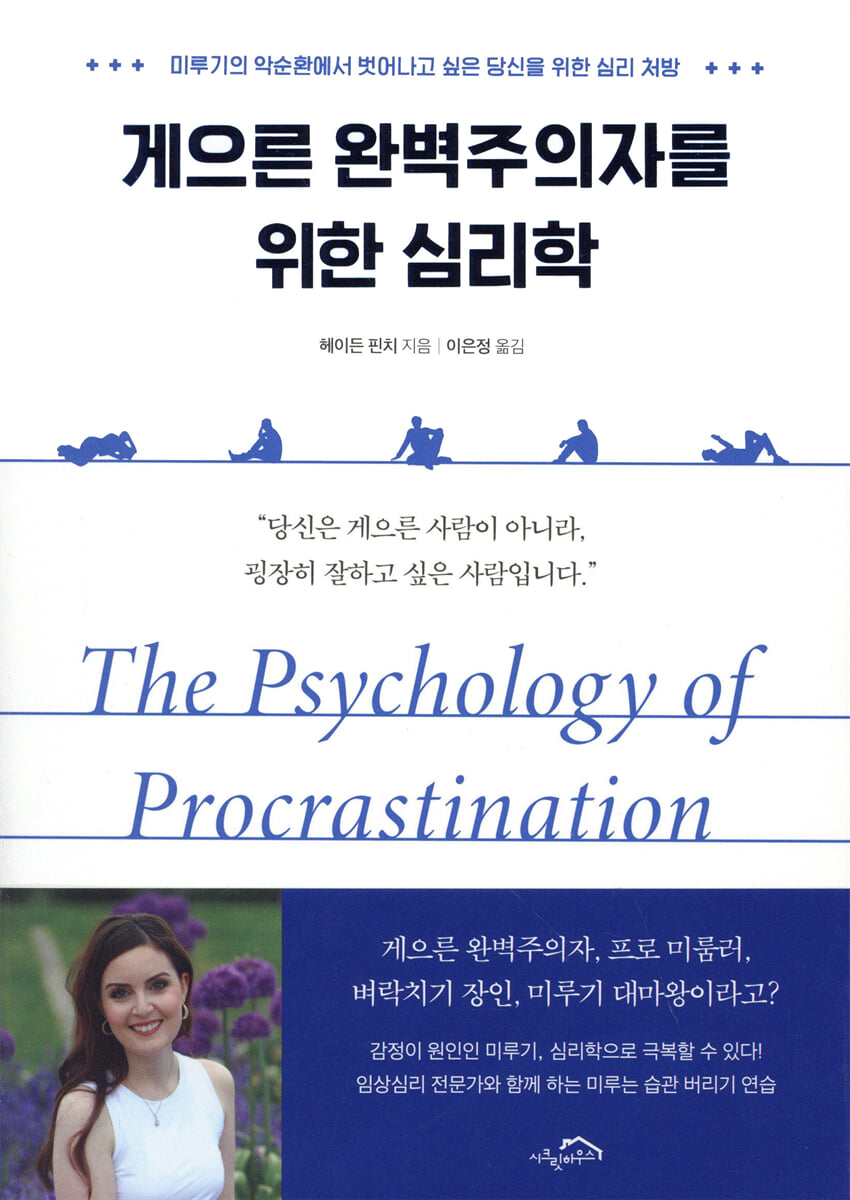
Psychology for Lazy Perfectionists
 |
Description
Book Introduction
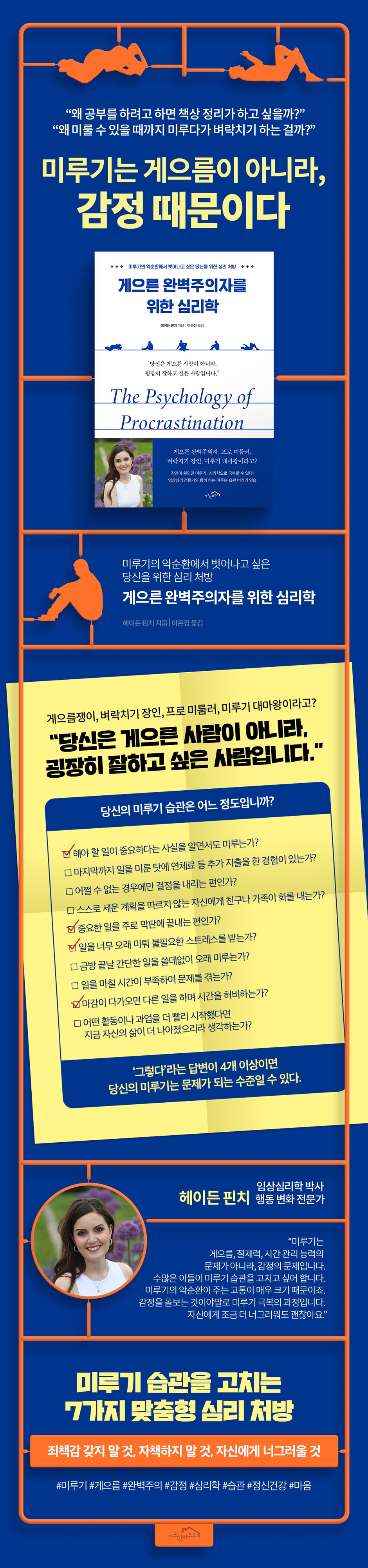
“You are not a lazy person,
“I am a person who wants to do very well.”
Procrastination isn't about laziness, it's about emotions.
There are people who procrastinate.
They procrastinate as long as they can, and when they can no longer procrastinate, they rush to do something, saying, “If I don’t do it now, I’ll die.”
People who procrastinate even though the consequences are obvious: they will be more stressed later, the quality of their work will decline, and their peace of mind will be disturbed.
They have the ability and the effort, but they know they shouldn't do it, so they don't do it.
They seem lazy in some ways.
Even those who procrastinate often blame themselves for being lazy.
But are they really just lazy people with little self-control? No.
Rather, they are people who are unable to start because they are burdened by the pressure of wanting to do it too perfectly.
According to Dr. Hayden Finch, author of the new book "Psychology for Lazy Perfectionists," procrastination isn't a matter of laziness, self-control, or time management skills; it's an emotional issue.
Since procrastination is caused by psychological factors such as perfectionism, depression, anxiety, ADHD, low self-esteem, and imposter syndrome, using psychology is the only way to overcome this troublesome habit.
The author has run a mental health clinic for many years, helping people struggling with procrastination overcome their psychological challenges.
Through this book, readers will learn why we procrastinate, why we can't escape the vicious cycle of procrastination, and how to overcome procrastination and achieve lasting change.
You will also be able to apply the various forms of procrastination that appear in life and the methods to overcome procrastination based on research in psychology and neuroscience.
Are you a procrastinator? If so, the book "Psychology for Lazy Perfectionists" will help you understand your emotions and psychology, helping you overcome the vicious cycle of procrastination.
“I am a person who wants to do very well.”
Procrastination isn't about laziness, it's about emotions.
There are people who procrastinate.
They procrastinate as long as they can, and when they can no longer procrastinate, they rush to do something, saying, “If I don’t do it now, I’ll die.”
People who procrastinate even though the consequences are obvious: they will be more stressed later, the quality of their work will decline, and their peace of mind will be disturbed.
They have the ability and the effort, but they know they shouldn't do it, so they don't do it.
They seem lazy in some ways.
Even those who procrastinate often blame themselves for being lazy.
But are they really just lazy people with little self-control? No.
Rather, they are people who are unable to start because they are burdened by the pressure of wanting to do it too perfectly.
According to Dr. Hayden Finch, author of the new book "Psychology for Lazy Perfectionists," procrastination isn't a matter of laziness, self-control, or time management skills; it's an emotional issue.
Since procrastination is caused by psychological factors such as perfectionism, depression, anxiety, ADHD, low self-esteem, and imposter syndrome, using psychology is the only way to overcome this troublesome habit.
The author has run a mental health clinic for many years, helping people struggling with procrastination overcome their psychological challenges.
Through this book, readers will learn why we procrastinate, why we can't escape the vicious cycle of procrastination, and how to overcome procrastination and achieve lasting change.
You will also be able to apply the various forms of procrastination that appear in life and the methods to overcome procrastination based on research in psychology and neuroscience.
Are you a procrastinator? If so, the book "Psychology for Lazy Perfectionists" will help you understand your emotions and psychology, helping you overcome the vicious cycle of procrastination.
- You can preview some of the book's contents.
Preview
index
Procrastination is not a matter of laziness.
Part 1: Why do I always procrastinate?
Chapter 1: To Change Habits, Understand Them
What is procrastination?
The moment procrastination becomes a serious problem
Moral misconceptions about procrastination
#How bad is my procrastination habit?
Chapter 2: Why We Can't Break the Vicious Cycle of Procrastination
There are many causes of habits.
What Happens When You Procrastinate
Procrastination is an emotional issue.
#Is procrastination a time management issue?
#Why Our Brains Love to Procrastinate
Chapter 3: When Psychological Issues Cause Procrastination
ADHD, unable to start tasks themselves
Depression, lack of energy to start
Anxiety disorder, fear of completing tasks successfully
Low self-esteem and confidence, lack of confidence in one's abilities
Perfectionism, not being satisfied even after successfully completing a task
Mask Syndrome: Doubting and doubting one's own abilities
It all sounds like my story…
#Is procrastination the cause of addiction?
Part 2: The Psychology of Breaking the Habit of Procrastination
Chapter 4: Approaches to Overcoming Procrastination
Why do I procrastinate?
Two months will break your procrastination habit.
What procrastination strategy is right for me?
#What is my procrastination style?
#What if I can't trust my memory?
Chapter 5: There is an order to things.
How to prioritize?
Chapter 6: First, identify the motivation behind the work.
Motivation begins with emotion
Chapter 7: Getting Started is Harder Than You Think
It's just hard to get started
Chapter 8: How to Stay Focused
It's hard to concentrate and maintain focus.
Chapter 9: Emotional Skills for Overcoming Avoidance
What is avoidance?
Chapter 10: How to Maintain Consistency
I started, but I have to persevere to finish it.
Chapter 11: To Finish What You Start
Crossing the finish line is difficult for anyone.
Coming out_ A life without suffering from procrastination
Recommended Resources
References
Acknowledgements
Part 1: Why do I always procrastinate?
Chapter 1: To Change Habits, Understand Them
What is procrastination?
The moment procrastination becomes a serious problem
Moral misconceptions about procrastination
#How bad is my procrastination habit?
Chapter 2: Why We Can't Break the Vicious Cycle of Procrastination
There are many causes of habits.
What Happens When You Procrastinate
Procrastination is an emotional issue.
#Is procrastination a time management issue?
#Why Our Brains Love to Procrastinate
Chapter 3: When Psychological Issues Cause Procrastination
ADHD, unable to start tasks themselves
Depression, lack of energy to start
Anxiety disorder, fear of completing tasks successfully
Low self-esteem and confidence, lack of confidence in one's abilities
Perfectionism, not being satisfied even after successfully completing a task
Mask Syndrome: Doubting and doubting one's own abilities
It all sounds like my story…
#Is procrastination the cause of addiction?
Part 2: The Psychology of Breaking the Habit of Procrastination
Chapter 4: Approaches to Overcoming Procrastination
Why do I procrastinate?
Two months will break your procrastination habit.
What procrastination strategy is right for me?
#What is my procrastination style?
#What if I can't trust my memory?
Chapter 5: There is an order to things.
How to prioritize?
Chapter 6: First, identify the motivation behind the work.
Motivation begins with emotion
Chapter 7: Getting Started is Harder Than You Think
It's just hard to get started
Chapter 8: How to Stay Focused
It's hard to concentrate and maintain focus.
Chapter 9: Emotional Skills for Overcoming Avoidance
What is avoidance?
Chapter 10: How to Maintain Consistency
I started, but I have to persevere to finish it.
Chapter 11: To Finish What You Start
Crossing the finish line is difficult for anyone.
Coming out_ A life without suffering from procrastination
Recommended Resources
References
Acknowledgements
Detailed image
Into the book
We usually assume that procrastination is due to problems with organizing and managing time.
That may be partially true.
But as we've discussed before, procrastination is not only a behavior, but also an emotional issue.
When we think about the things we have to do, we start to feel quite uncomfortable: pressure, boredom, helplessness, burden, etc.
Most people don't like emotions very much, so we try to find ways to avoid or block them.
---From "Procrastination is a matter of emotions"
Perfectionists are usually very capable.
However, because you set unreasonable standards and procrastinate, your ability to meet those standards declines.
For them, procrastination leads to self-criticism such as, "I should have started earlier," or, "I always mess things up."
Perfectionists also often unintentionally project the pressure they place on themselves onto those around them.
Other people also believe that they should be criticized if they fail to meet the standards they have set.
---From "Perfectionism, Not Being Satisfied Even After Successfully Completing a Task"
There's a reason we use kind, compassionate language to motivate others.
The reason is simple.
Because it is much more effective than criticism.
Let's take the same approach to the conversations we have with ourselves.
You need to practice self-compassion.
The very moment you criticize yourself for not starting a task, not finishing it, or not getting it done fast enough, think about how you would talk to a friend, a child, or even a dog if they were going through the same problem.
Let's keep this in mind.
What happened can't be helped.
Instead of dwelling on what we haven't done in the past, let's try to focus on what we can do from now on.
---From "What is the right procrastination strategy for me?"
The secret to getting started is to acknowledge that it won't be easy.
Luckily, there never comes a day when there's nothing to do but make the bedroom.
Let's be honest.
And let's develop strategies to control the thoughts and emotions that arise when doing difficult tasks.
The reason we struggle to get started is because instead of devising strategies to deal with difficult emotions and thoughts, we ignore them and pretend they don't exist.
Ignoring your feelings is like ignoring a mosquito flying around your living room.
It hides quietly and eventually bites us.
---From "Just getting started is difficult"
Indecision is a unique form of avoidance, in which the object of avoidance is decision-making.
Of course, there are times when we postpone decisions out of strategic caution.
In the meantime, you can get information to make a more satisfying choice, or you can get a better discount from a salesperson who is trying to sell you something aggressively by stalling for time.
But if you don't make a decision even after getting all the information, that's simply decisional procrastination.
Indecision is deeply rooted in avoidance tendencies.
Delaying a decision avoids responsibility and the consequences of the decision.
Plus, you can avoid the regrets and fears that come with making the 'wrong' choice.
---From "What is Avoidance"
One reason it's difficult to keep trying consistently is because our brains have a hard time remembering why we wanted to complete a task in the first place.
The brain, which prioritizes energy conservation, works hard to persuade us to stop doing things that require energy consumption.
This is why, the moment we recall the importance of a task, our efforts, determination, and productivity explode, only to quickly lose motivation and become listless for a long time.
To maintain a consistent level of effort, you need to keep fueling your brain (through activities like eating healthy, exercising, and taking breaks) and remind yourself that it's important to devote energy to this task.
That may be partially true.
But as we've discussed before, procrastination is not only a behavior, but also an emotional issue.
When we think about the things we have to do, we start to feel quite uncomfortable: pressure, boredom, helplessness, burden, etc.
Most people don't like emotions very much, so we try to find ways to avoid or block them.
---From "Procrastination is a matter of emotions"
Perfectionists are usually very capable.
However, because you set unreasonable standards and procrastinate, your ability to meet those standards declines.
For them, procrastination leads to self-criticism such as, "I should have started earlier," or, "I always mess things up."
Perfectionists also often unintentionally project the pressure they place on themselves onto those around them.
Other people also believe that they should be criticized if they fail to meet the standards they have set.
---From "Perfectionism, Not Being Satisfied Even After Successfully Completing a Task"
There's a reason we use kind, compassionate language to motivate others.
The reason is simple.
Because it is much more effective than criticism.
Let's take the same approach to the conversations we have with ourselves.
You need to practice self-compassion.
The very moment you criticize yourself for not starting a task, not finishing it, or not getting it done fast enough, think about how you would talk to a friend, a child, or even a dog if they were going through the same problem.
Let's keep this in mind.
What happened can't be helped.
Instead of dwelling on what we haven't done in the past, let's try to focus on what we can do from now on.
---From "What is the right procrastination strategy for me?"
The secret to getting started is to acknowledge that it won't be easy.
Luckily, there never comes a day when there's nothing to do but make the bedroom.
Let's be honest.
And let's develop strategies to control the thoughts and emotions that arise when doing difficult tasks.
The reason we struggle to get started is because instead of devising strategies to deal with difficult emotions and thoughts, we ignore them and pretend they don't exist.
Ignoring your feelings is like ignoring a mosquito flying around your living room.
It hides quietly and eventually bites us.
---From "Just getting started is difficult"
Indecision is a unique form of avoidance, in which the object of avoidance is decision-making.
Of course, there are times when we postpone decisions out of strategic caution.
In the meantime, you can get information to make a more satisfying choice, or you can get a better discount from a salesperson who is trying to sell you something aggressively by stalling for time.
But if you don't make a decision even after getting all the information, that's simply decisional procrastination.
Indecision is deeply rooted in avoidance tendencies.
Delaying a decision avoids responsibility and the consequences of the decision.
Plus, you can avoid the regrets and fears that come with making the 'wrong' choice.
---From "What is Avoidance"
One reason it's difficult to keep trying consistently is because our brains have a hard time remembering why we wanted to complete a task in the first place.
The brain, which prioritizes energy conservation, works hard to persuade us to stop doing things that require energy consumption.
This is why, the moment we recall the importance of a task, our efforts, determination, and productivity explode, only to quickly lose motivation and become listless for a long time.
To maintain a consistent level of effort, you need to keep fueling your brain (through activities like eating healthy, exercising, and taking breaks) and remind yourself that it's important to devote energy to this task.
---From "I started, but how can I persevere and finish it"
Publisher's Review
Why do I want to clean my desk when I try to study?
The psychology of procrastinators
Anxiety, fear of failure, avoidance, waiting for the perfect timing…
Procrastination doesn't mean simply putting off a task, it means postponing it for no good reason.
Procrastination isn't just about missing a deadline.
We also postpone making phone calls, filling out paperwork, writing resumes for job applications, conducting research or studies, and asking for help.
We put off not only work and school, but also everyday chores, household chores, spring cleaning, and grocery shopping.
That's not all.
We also put off money-related tasks like paying bills, budgeting, paying off loans, and filing taxes.
We put off things necessary for maintaining interpersonal relationships, such as calling our grandmother or responding to invitations, and we also put off things necessary for managing our personal affairs.
You can't even start making hospital appointments, reading books, or developing hobbies.
We postpone scheduling health checkups, starting a diet, and even quitting smoking and drinking.
Procrastination occurs in almost every area of our lives and has a greater impact on our lives than we might think.
So why do we procrastinate? Procrastination isn't a phenomenon driven by a single cause.
It occurs when various factors are reflected in a complex manner.
People who procrastinate feel 'anxiety' when they try to start something.
Usually, it is better to do more work later than to do less work now.
This is related to the feelings of uncertainty, helplessness, and irritation that we feel when starting a task.
Procrastinators focus more on present feelings than future feelings or long-term goals.
Additionally, the emotional coping strategy called 'avoidance' has a significant impact on procrastination.
When we think about the things we have to do, we start to feel quite uncomfortable: pressure, boredom, helplessness, burden, etc.
Everyone wants to avoid uncomfortable feelings.
However, procrastinators take this particularly seriously, have less tolerance for uncomfortable situations, and have less experience dealing with them effectively.
These characteristics prevent us from breaking free from the cycle of emotional avoidance and procrastination.
Another cause of procrastination is 'fear of failure'.
For example, 'Even if I start dieting now, I'll probably quit after a few days' or 'I can't submit my resume until it's perfect.'
Because of these thoughts, the situation ends with you not being able to start a diet or submit your resume to a company.
Fear of failure is linked to fear of uncertainty.
They make excuses, saying that they can only start if a positive outcome is guaranteed.
Moreover, procrastinators tend to wait for the perfect moment to start a task.
But perfect timing doesn't exist.
For example, if you're looking to start a home workout routine by watching workout videos on YouTube, the perfect timing will never come.
If you really want to achieve your goals, you have to take action even if the timing is not right.
Many people want to break their procrastination habit.
Between 70 and 95 percent of college students consider themselves procrastinators, and more than half consider their procrastination a serious problem.
Additionally, more than 95 percent of procrastinators recognize that their procrastination habit is harmful and want to change it.
And 94 percent of procrastinators said procrastination negatively impacted their well-being.
Procrastination is bad for your physical and mental health.
In fact, everyone procrastinates to some degree.
But everyone procrastinates, but not everyone procrastinates.
The reason we don't easily realize our procrastination is because we are always doing something.
It's like sitting at your desk to study for a test, and then suddenly starting to organize your desk and clean your room.
We don't just sit around procrastinating.
It's just a very skillful swapping of one task for another, less important one.
In the process of doing something else, we actually rationalize it by saying, 'I'm not procrastinating, I'm just busy.'
Look back on your day, check off the tasks you've completed, and feel a sense of accomplishment.
But if you look closely, you'll find that you've either been dealing with unimportant and less urgent tasks first, or you've been obsessing over meaningless details and putting off what really needs to be done.
If you put it off, you feel good for now.
It's much more enjoyable to spend an evening watching Netflix and refreshing your Instagram feed than to fold laundry, budget, and finish your resume.
Of course, later on, you will have to pay the price for putting off important things.
The 'price' means feeling stressed and anxious about getting things done when they're imminent, feeling discouraged when you can't reach your goals, feeling defeated when you see a pile of unfinished work, and feeling ashamed of the impact your procrastination has on those around you.
Ultimately, the vicious cycle of repetition and the guilt that comes from repeated disappointment in oneself lower the quality of life.
Procrastination is bad for your physical and mental health.
Procrastination leads to self-blame, self-criticism, anxiety, depression, and unmanageable stress.
Procrastinators also experience more health problems, including headaches, indigestion, colds, flu, and insomnia.
Studies show that procrastination ultimately leads to more stress.
Procrastination causes stress (though stress doesn't cause procrastination), and stress activates several psychological processes in the body, lowers immunity, and negatively impacts the body's ability to deal with inflammation.
As a result, the risk of developing health problems such as high blood pressure or heart disease increases.
Moreover, the stress response dampens our motivation to engage in health-maintaining activities, such as exercising, maintaining a healthy diet, and getting enough sleep.
Procrastination can also be caused by mental health issues, and the causes of procrastination vary depending on the mental health issue.
People with depression have difficulty starting or finishing tasks due to lack of energy, but people with ADHD have difficulty starting tasks due to their distractibility or poor ability to delay gratification.
People with high anxiety feel pressured to do things, so they put off starting them and feel guilty about putting them off.
People with low self-esteem also have difficulty starting and finishing tasks, but their procrastination stems from a belief that they are unworthy of success or incapable of completing tasks.
Perfectionists are overly concerned about making mistakes, which prevents them from getting started, and even when they do succeed, they lack the satisfaction they need, which leads to anxiety and depression, which worsens their procrastination habits.
They also fall into self-criticism.
Imposter syndrome is when a person is quite capable, but doubts his or her own abilities and is afraid of being exposed as incompetent, so he or she does not even try.
7 Customized Psychological Prescriptions to Break Your Procrastination Habit
Breaking the Habit of Procrastination with a Clinical Psychologist
Procrastination can be overcome.
At this point, saying 'Just do it!' is of no help at all.
The reason this approach doesn't work is because, rather than addressing the root cause of procrastination, it ignores and amplifies the emotional roots of the problem.
Instead of ignoring emotional issues and beating yourself up, focus on the root cause of why you want to avoid tasks and address it.
Once you understand whether procrastination stems from lack of self-control or motivation, a lack of ability to cope with uncomfortable emotions, an unrealistic perception of time, or another factor, you can determine the type of approach you need to take to overcome it.
▶ 1.
Procrastination: Do you struggle to prioritize and end up stuck at a dead end, unable to figure out where to start? Prioritizing requires a tremendous amount of brain processing.
Use the methods of prioritizing tasks by importance and deadline, categorizing them by expected time required, categorizing them by their impact on quality of life, and boldly eliminating tasks that are not helpful.
▶ 2.
Procrastination due to lack of motivation: Feeling unmotivated and unsure of why you should do something? Like procrastination, motivation interacts with our emotions.
Ask yourself what your 'future self' wants and picture yourself successfully completing tasks.
Combining things you like with things you dislike is also an effective strategy.
Make a to-do list, cross off the tasks that are done, and write down the tasks that are completed.
It gives you time to acknowledge your accomplishments and motivates you to move on to new tasks.
▶ 3.
The procrastination style because it's hard to get started: Starting something is harder than you think.
The reason we struggle to get started is because instead of devising strategies to deal with difficult emotions and thoughts, we ignore them and pretend they don't exist.
Effective strategies include utilizing both planned and unplanned schedules and breaking large tasks down into chunks.
Try techniques that leverage momentum, such as setting time limits for your work or working for just 5 minutes.
These methods are all psychological methods that give you the choice to continue with a task.
▶ 4.
If you're prone to procrastination because you're distracted and have trouble concentrating: Stimulating the parts of your brain involved in concentration, like working out with dumbbells to build arm muscles, can help strengthen those areas.
However, concentration also requires basic physical strength.
Fatigue, hunger, and malnutrition can interfere with concentration.
It is important to first create an environment where your brain can keep up by getting enough sleep, exercising, and eating healthy foods.
Next, use strategies such as creating a relaxing environment, taking notes to distract yourself, using white noise, and using a timer.
▶ 5.
Avoidance-Procrastination Style: In fact, procrastination is more about avoiding uncomfortable feelings than avoiding the task itself.
Indecision is another form of avoidance.
You need to reduce negative self-talk and break down tasks into very small pieces.
When you have trouble making a decision, it's helpful to use the 'miracle question' technique.
And you have to let go of the fear of regretting your choice and be satisfied with your decision.
You also need to pat yourself on the back.
Tell yourself that you are capable enough.
▶ 6.
The style of putting off something because you can't do it consistently: One of the reasons why it's difficult to make consistent efforts is because our brains don't remember why we wanted to do something in the first place.
Our brains work hard to convince us to stop doing things that require energy.
So, to avoid losing motivation and becoming lethargic and maintain a consistent level of effort, it is essential to continuously supply energy to the brain through activities such as eating healthy foods, exercising, and taking time to relax.
You can then use strategies such as making a plan, using the five-step problem-solving technique, and setting intermediate goals.
▶ 7.
A style of procrastination where you can't finish something because of the burden of failure or success: In the habit of procrastination, finishing something is as difficult as starting it.
As we get closer to achieving our goals, we may feel the need to strive for perfection, which can also be related to our fear of failure.
Fear of failure can manifest itself in the form of self-criticism, such as, "I'm sure I can't do it right," "I'd rather just give up now," or "What's the point of trying if it's not going to work anyway?"
At this time, you should encourage yourself and give advice as you would to others.
You need to be kind to yourself and let go of self-critical thinking.
Another effective strategy is to visualize yourself dealing with different situations.
Hayden Finch, author of the book "Psychology for Lazy Perfectionists," says:
Ultimately, to break the habit of procrastination, you have to 'take action'.
Additionally, 'self-compassion', which is looking at oneself generously without beating oneself up, and 'self-awareness', which is recognizing one's own actions, must come first.
You could be a little more generous to yourself.
The psychology of procrastinators
Anxiety, fear of failure, avoidance, waiting for the perfect timing…
Procrastination doesn't mean simply putting off a task, it means postponing it for no good reason.
Procrastination isn't just about missing a deadline.
We also postpone making phone calls, filling out paperwork, writing resumes for job applications, conducting research or studies, and asking for help.
We put off not only work and school, but also everyday chores, household chores, spring cleaning, and grocery shopping.
That's not all.
We also put off money-related tasks like paying bills, budgeting, paying off loans, and filing taxes.
We put off things necessary for maintaining interpersonal relationships, such as calling our grandmother or responding to invitations, and we also put off things necessary for managing our personal affairs.
You can't even start making hospital appointments, reading books, or developing hobbies.
We postpone scheduling health checkups, starting a diet, and even quitting smoking and drinking.
Procrastination occurs in almost every area of our lives and has a greater impact on our lives than we might think.
So why do we procrastinate? Procrastination isn't a phenomenon driven by a single cause.
It occurs when various factors are reflected in a complex manner.
People who procrastinate feel 'anxiety' when they try to start something.
Usually, it is better to do more work later than to do less work now.
This is related to the feelings of uncertainty, helplessness, and irritation that we feel when starting a task.
Procrastinators focus more on present feelings than future feelings or long-term goals.
Additionally, the emotional coping strategy called 'avoidance' has a significant impact on procrastination.
When we think about the things we have to do, we start to feel quite uncomfortable: pressure, boredom, helplessness, burden, etc.
Everyone wants to avoid uncomfortable feelings.
However, procrastinators take this particularly seriously, have less tolerance for uncomfortable situations, and have less experience dealing with them effectively.
These characteristics prevent us from breaking free from the cycle of emotional avoidance and procrastination.
Another cause of procrastination is 'fear of failure'.
For example, 'Even if I start dieting now, I'll probably quit after a few days' or 'I can't submit my resume until it's perfect.'
Because of these thoughts, the situation ends with you not being able to start a diet or submit your resume to a company.
Fear of failure is linked to fear of uncertainty.
They make excuses, saying that they can only start if a positive outcome is guaranteed.
Moreover, procrastinators tend to wait for the perfect moment to start a task.
But perfect timing doesn't exist.
For example, if you're looking to start a home workout routine by watching workout videos on YouTube, the perfect timing will never come.
If you really want to achieve your goals, you have to take action even if the timing is not right.
Many people want to break their procrastination habit.
Between 70 and 95 percent of college students consider themselves procrastinators, and more than half consider their procrastination a serious problem.
Additionally, more than 95 percent of procrastinators recognize that their procrastination habit is harmful and want to change it.
And 94 percent of procrastinators said procrastination negatively impacted their well-being.
Procrastination is bad for your physical and mental health.
In fact, everyone procrastinates to some degree.
But everyone procrastinates, but not everyone procrastinates.
The reason we don't easily realize our procrastination is because we are always doing something.
It's like sitting at your desk to study for a test, and then suddenly starting to organize your desk and clean your room.
We don't just sit around procrastinating.
It's just a very skillful swapping of one task for another, less important one.
In the process of doing something else, we actually rationalize it by saying, 'I'm not procrastinating, I'm just busy.'
Look back on your day, check off the tasks you've completed, and feel a sense of accomplishment.
But if you look closely, you'll find that you've either been dealing with unimportant and less urgent tasks first, or you've been obsessing over meaningless details and putting off what really needs to be done.
If you put it off, you feel good for now.
It's much more enjoyable to spend an evening watching Netflix and refreshing your Instagram feed than to fold laundry, budget, and finish your resume.
Of course, later on, you will have to pay the price for putting off important things.
The 'price' means feeling stressed and anxious about getting things done when they're imminent, feeling discouraged when you can't reach your goals, feeling defeated when you see a pile of unfinished work, and feeling ashamed of the impact your procrastination has on those around you.
Ultimately, the vicious cycle of repetition and the guilt that comes from repeated disappointment in oneself lower the quality of life.
Procrastination is bad for your physical and mental health.
Procrastination leads to self-blame, self-criticism, anxiety, depression, and unmanageable stress.
Procrastinators also experience more health problems, including headaches, indigestion, colds, flu, and insomnia.
Studies show that procrastination ultimately leads to more stress.
Procrastination causes stress (though stress doesn't cause procrastination), and stress activates several psychological processes in the body, lowers immunity, and negatively impacts the body's ability to deal with inflammation.
As a result, the risk of developing health problems such as high blood pressure or heart disease increases.
Moreover, the stress response dampens our motivation to engage in health-maintaining activities, such as exercising, maintaining a healthy diet, and getting enough sleep.
Procrastination can also be caused by mental health issues, and the causes of procrastination vary depending on the mental health issue.
People with depression have difficulty starting or finishing tasks due to lack of energy, but people with ADHD have difficulty starting tasks due to their distractibility or poor ability to delay gratification.
People with high anxiety feel pressured to do things, so they put off starting them and feel guilty about putting them off.
People with low self-esteem also have difficulty starting and finishing tasks, but their procrastination stems from a belief that they are unworthy of success or incapable of completing tasks.
Perfectionists are overly concerned about making mistakes, which prevents them from getting started, and even when they do succeed, they lack the satisfaction they need, which leads to anxiety and depression, which worsens their procrastination habits.
They also fall into self-criticism.
Imposter syndrome is when a person is quite capable, but doubts his or her own abilities and is afraid of being exposed as incompetent, so he or she does not even try.
7 Customized Psychological Prescriptions to Break Your Procrastination Habit
Breaking the Habit of Procrastination with a Clinical Psychologist
Procrastination can be overcome.
At this point, saying 'Just do it!' is of no help at all.
The reason this approach doesn't work is because, rather than addressing the root cause of procrastination, it ignores and amplifies the emotional roots of the problem.
Instead of ignoring emotional issues and beating yourself up, focus on the root cause of why you want to avoid tasks and address it.
Once you understand whether procrastination stems from lack of self-control or motivation, a lack of ability to cope with uncomfortable emotions, an unrealistic perception of time, or another factor, you can determine the type of approach you need to take to overcome it.
▶ 1.
Procrastination: Do you struggle to prioritize and end up stuck at a dead end, unable to figure out where to start? Prioritizing requires a tremendous amount of brain processing.
Use the methods of prioritizing tasks by importance and deadline, categorizing them by expected time required, categorizing them by their impact on quality of life, and boldly eliminating tasks that are not helpful.
▶ 2.
Procrastination due to lack of motivation: Feeling unmotivated and unsure of why you should do something? Like procrastination, motivation interacts with our emotions.
Ask yourself what your 'future self' wants and picture yourself successfully completing tasks.
Combining things you like with things you dislike is also an effective strategy.
Make a to-do list, cross off the tasks that are done, and write down the tasks that are completed.
It gives you time to acknowledge your accomplishments and motivates you to move on to new tasks.
▶ 3.
The procrastination style because it's hard to get started: Starting something is harder than you think.
The reason we struggle to get started is because instead of devising strategies to deal with difficult emotions and thoughts, we ignore them and pretend they don't exist.
Effective strategies include utilizing both planned and unplanned schedules and breaking large tasks down into chunks.
Try techniques that leverage momentum, such as setting time limits for your work or working for just 5 minutes.
These methods are all psychological methods that give you the choice to continue with a task.
▶ 4.
If you're prone to procrastination because you're distracted and have trouble concentrating: Stimulating the parts of your brain involved in concentration, like working out with dumbbells to build arm muscles, can help strengthen those areas.
However, concentration also requires basic physical strength.
Fatigue, hunger, and malnutrition can interfere with concentration.
It is important to first create an environment where your brain can keep up by getting enough sleep, exercising, and eating healthy foods.
Next, use strategies such as creating a relaxing environment, taking notes to distract yourself, using white noise, and using a timer.
▶ 5.
Avoidance-Procrastination Style: In fact, procrastination is more about avoiding uncomfortable feelings than avoiding the task itself.
Indecision is another form of avoidance.
You need to reduce negative self-talk and break down tasks into very small pieces.
When you have trouble making a decision, it's helpful to use the 'miracle question' technique.
And you have to let go of the fear of regretting your choice and be satisfied with your decision.
You also need to pat yourself on the back.
Tell yourself that you are capable enough.
▶ 6.
The style of putting off something because you can't do it consistently: One of the reasons why it's difficult to make consistent efforts is because our brains don't remember why we wanted to do something in the first place.
Our brains work hard to convince us to stop doing things that require energy.
So, to avoid losing motivation and becoming lethargic and maintain a consistent level of effort, it is essential to continuously supply energy to the brain through activities such as eating healthy foods, exercising, and taking time to relax.
You can then use strategies such as making a plan, using the five-step problem-solving technique, and setting intermediate goals.
▶ 7.
A style of procrastination where you can't finish something because of the burden of failure or success: In the habit of procrastination, finishing something is as difficult as starting it.
As we get closer to achieving our goals, we may feel the need to strive for perfection, which can also be related to our fear of failure.
Fear of failure can manifest itself in the form of self-criticism, such as, "I'm sure I can't do it right," "I'd rather just give up now," or "What's the point of trying if it's not going to work anyway?"
At this time, you should encourage yourself and give advice as you would to others.
You need to be kind to yourself and let go of self-critical thinking.
Another effective strategy is to visualize yourself dealing with different situations.
Hayden Finch, author of the book "Psychology for Lazy Perfectionists," says:
Ultimately, to break the habit of procrastination, you have to 'take action'.
Additionally, 'self-compassion', which is looking at oneself generously without beating oneself up, and 'self-awareness', which is recognizing one's own actions, must come first.
You could be a little more generous to yourself.
GOODS SPECIFICS
- Publication date: August 30, 2022
- Page count, weight, size: 252 pages | 378g | 140*200*14mm
- ISBN13: 9791192312200
- ISBN10: 1192312201
You may also like
카테고리
korean


korean

![GQ KOREA Mark (Monthly): December [2025]](http://librairie.coreenne.fr/cdn/shop/files/8ef265dbbfbf186523ed75ba7319009d.jpg?v=1765340328&width=3840)


