

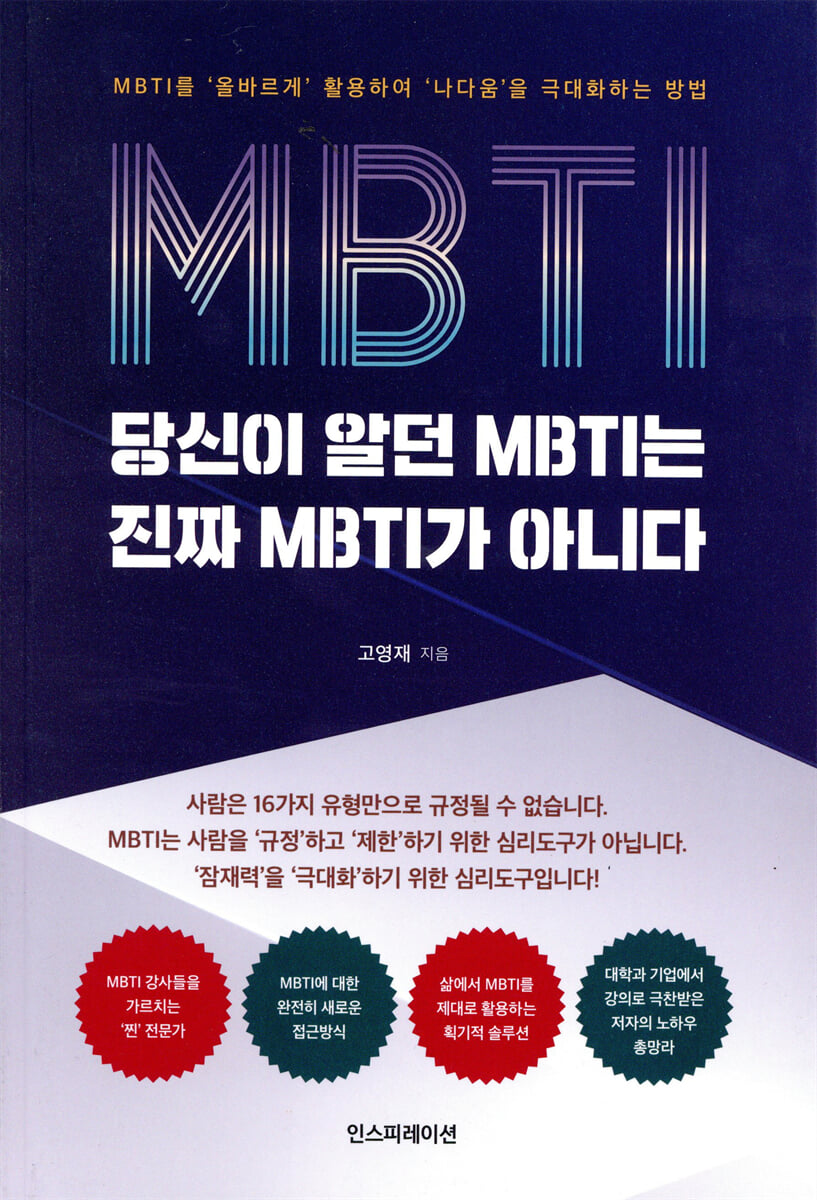
The MBTI you knew is not the real MBTI.
 |
Description
Book Introduction
A 'real' expert who teaches MBTI instructors
A completely new approach to MBTI
A groundbreaking solution for effectively utilizing MBTI in life.
A comprehensive compilation of the author's expertise, acclaimed for his lectures at universities and companies.
People cannot be defined by just 16 personality types. The MBTI is not a psychological tool designed to "define" or "limit" people, but rather to "maximize" their "potential."
"The MBTI You Knew Wasn't the Real MBTI" is a book written by an expert instructor of MBTI types. It teaches how to utilize the MBTI as a "tool for self-exploration." It encompasses the author's expertise, which has earned him rave reviews from universities and companies. Let's learn how to properly utilize the MBTI to respect both "self" and "we."
A completely new approach to MBTI
A groundbreaking solution for effectively utilizing MBTI in life.
A comprehensive compilation of the author's expertise, acclaimed for his lectures at universities and companies.
People cannot be defined by just 16 personality types. The MBTI is not a psychological tool designed to "define" or "limit" people, but rather to "maximize" their "potential."
"The MBTI You Knew Wasn't the Real MBTI" is a book written by an expert instructor of MBTI types. It teaches how to utilize the MBTI as a "tool for self-exploration." It encompasses the author's expertise, which has earned him rave reviews from universities and companies. Let's learn how to properly utilize the MBTI to respect both "self" and "we."
- You can preview some of the book's contents.
Preview
index
Recommendation
Author's MBTI lecture review
prolog
Part 1
Basic concepts you must know
Chapter 1. MBTI is a 'useful' psychological tool, not a 'perfect' one.
Chapter 2. 3 Frequently Asked Questions After the MBTI Test
Chapter 3.
Beautiful Concepts for Self-Esteem: Innate Psychological Preferences
Chapter 4.
The Basics of Understanding Types: Four Preference Indicators
Chapter 5.
Characteristics of the 16 personality types
Part 2
Understanding the Psychological Structure of Personality Types: Understanding Type Dynamics
Chapter 6.
Mechanism (Operating Principle) of Personality Types
Chapter 7.
Another Me Inside Me (1): Hero, Parent, Boy/Girl, and Shameful Me
Chapter 8.
Another Me Within Me (2): Characteristics of the Eight Psychological Functions
Chapter 9.
Characteristics of 16 personality types according to typological dynamics
Chapter 10. Why MBTI Test Results Often Inconsistent: Three Core Concepts of Type Dynamics
Part 3
Self-Development Principles Tailored to Your Personality Type: Using Type Dynamics
Chapter 11.
Utilizing Type Dynamics (1): Stress
Chapter 12.
Utilizing Type Dynamics (2): Communication
Chapter 13.
Utilizing Type Dynamics (3): Career
Chapter 14.
Why there are differences even among the same personality types
Part 4
The Principle of Awakening Your Own Excellence: Type Development
Chapter 15.
A Compass to Guide Your Growth: Carl Jung's Developmental Model
Chapter 16.
Healing Your Inner Wounds: The Interaction Between Personality Type and Environment
Chapter 17.
Creating the Ideal Psychological Structure: Conscious Type Development
Epilogue: A final word of advice
Appendix: Decision Principles of the Hierarchy of Psychological Functions (Explanation of the 5 Steps)
References
Author's MBTI lecture review
prolog
Part 1
Basic concepts you must know
Chapter 1. MBTI is a 'useful' psychological tool, not a 'perfect' one.
Chapter 2. 3 Frequently Asked Questions After the MBTI Test
Chapter 3.
Beautiful Concepts for Self-Esteem: Innate Psychological Preferences
Chapter 4.
The Basics of Understanding Types: Four Preference Indicators
Chapter 5.
Characteristics of the 16 personality types
Part 2
Understanding the Psychological Structure of Personality Types: Understanding Type Dynamics
Chapter 6.
Mechanism (Operating Principle) of Personality Types
Chapter 7.
Another Me Inside Me (1): Hero, Parent, Boy/Girl, and Shameful Me
Chapter 8.
Another Me Within Me (2): Characteristics of the Eight Psychological Functions
Chapter 9.
Characteristics of 16 personality types according to typological dynamics
Chapter 10. Why MBTI Test Results Often Inconsistent: Three Core Concepts of Type Dynamics
Part 3
Self-Development Principles Tailored to Your Personality Type: Using Type Dynamics
Chapter 11.
Utilizing Type Dynamics (1): Stress
Chapter 12.
Utilizing Type Dynamics (2): Communication
Chapter 13.
Utilizing Type Dynamics (3): Career
Chapter 14.
Why there are differences even among the same personality types
Part 4
The Principle of Awakening Your Own Excellence: Type Development
Chapter 15.
A Compass to Guide Your Growth: Carl Jung's Developmental Model
Chapter 16.
Healing Your Inner Wounds: The Interaction Between Personality Type and Environment
Chapter 17.
Creating the Ideal Psychological Structure: Conscious Type Development
Epilogue: A final word of advice
Appendix: Decision Principles of the Hierarchy of Psychological Functions (Explanation of the 5 Steps)
References
Into the book
If you want to 'respect' someone, you must first understand that person's 'way of being'.
‘Personality’ is that person’s ‘unique way of being.’
Understanding 'personality' makes 'deep respect' possible.
This principle applies equally to respect for oneself and respect for others.
This book is written for people who want to experience such respect in their lives.
--- p.5
The free personality test currently trending online (from a site called "16Personalities") isn't the MBTI. While it closely follows the MBTI format, it's actually the "NERIS Type Test," which is based on the Big Five personality model.
Because of the similarities between the two tests, the NERIS test can be somewhat helpful in determining your MBTI personality type.
However, it is difficult to experience the 'differentiating benefits' of MBTI with just the NERIS test.
Above all, if you take the test without knowing exactly what the MBTI 'criteria for measuring personality types' are, there are many cases where your type is incorrect.
If you don't know the measurement criteria, most of the time the 'current status' is reflected in the test.
For example, if you are stressed or in a relationship, your test results are very likely to be different.
Therefore, before taking the test, you must properly understand the measurement criteria, and after taking the test, you must receive sufficient counseling to confirm whether your type is correct.
Just because your test results show ENFP, it doesn't mean you're an ENFP.
It may or may not be true.
Many people think of MBTI as a simple psychological test.
However, MBTI is closer to a ‘tool for self-exploration’ than a ‘psychological test.’
Taking a psychological test is just the starting point for self-exploration.
If you want to know what MBTI really is, you need to clearly understand that MBTI is not a simple psychological test, but a 'tool for self-exploration.'
This book teaches you how to use MBTI as a 'tool for self-exploration.'
--- p.10
There are two alphabets for each indicator, and if you choose your preferred alphabet, a total of four alphabets will appear.
For example, the first indicator, extroversion (E) and introversion (I), is to choose which one you prefer more.
If you are extroverted, choose E; if you are introverted, choose I.
The second one is the same.
You just have to decide which one you prefer between S and N.
If you select the third and fourth indicators in the same way, you will get a combination of four alphabets, such as ESTJ and ENTP, which is your personality type.
It's easy to think of it as finding your 'right hand in your heart (or left hand if you're left-handed)' while remembering the experience of writing your name with both hands before.
That is, both are within us, but we can choose the preference indicator that we use more easily and comfortably, like our right hand.
In other words, you just need to remember that the standard for determining your type is your ‘innate psychological preference.’
As mentioned earlier, personality test results may vary depending on the environment one is in.
Let's approach this step by step, remembering that the most important thing is to find your own 'true type'.
--- p.61
The purpose of this chapter is to use type dynamics to identify the communication patterns of each type.
By understanding communication patterns from a typological dynamics perspective, we can clearly recognize each type's communication style, strengths and weaknesses.
Additionally, it becomes easier to understand the other person's core needs and ways of expressing them.
To help understanding, types with the same main function are placed in front and behind.
Because having the same primary function means that they are very similar in their core needs and ways of expressing them.
Additionally, you will be able to understand what differences arise when the primary function is the same but the secondary function is different.
After explaining the 16 types, we will also briefly discuss 'Conflict Management Tips'.
Please make sure to take care of that part too.
This time, let's start with the type that uses Si as its main function.
--- p.279
The basic principles of type dynamics are the same in the career field as well.
Primary and secondary functions create a strength pattern, while tertiary and inferior functions create a weakness pattern.
The key point is to appropriately utilize these principles in the process of choosing a career.
The most important thing to remember for this is that 'the basic psychological structure of type dynamics does not change.'
As explained in Chapter 10, the 'basic framework' of primary, secondary, tertiary, and inferior functions does not change.
However, within the basic framework, the ‘way of forming relationships between psychological functions’ is constantly changing.
It is very important to know that there is an unchanging psychological structure within our minds.
Because it can be used as an important criterion for setting the direction of one's career.
If your primary function changes frequently, applying personality type to your career becomes very risky.
Can't we use psychological characteristics that change from time to time as a criterion for choosing a career?
Of course, when choosing a career, many other factors should be considered in addition to personality.
It's not easy to find the right job for you based on just your personality type information.
However, it is clear that we must avoid being too far removed from the strengths of the primary and secondary functions, or having the vulnerabilities of the tertiary and inferior functions act as fatal weaknesses.
Otherwise, it will be very difficult to be evaluated as competent in one's field (this is a common case in the field).
Therefore, when choosing a field of work, the following questions should be asked first:
“What can be done to best utilize the strengths of the primary and secondary functions?”
“What is it that does not cause the vulnerability of the tertiary and inferior functions to become a fatal weakness?”
--- p.306
How is your self-esteem? If you had to rate your self-esteem, how would you rate it? Give it a score out of 10.
Then think about why you gave it that score.
Self-esteem is 'a subjective feeling about oneself'.
We call the belief that one is a 'precious being' worthy of being loved and a 'competent person' capable of achieving good results self-esteem.
People with healthy self-esteem develop healthy identities.
And based on that identity, there is a high possibility that you will be able to fully demonstrate your abilities in various areas of life.
In interpersonal relationships, they also show healthy reactions.
The problem is that once this self-esteem is formed, it is not easily changed.
That's why the wounds we receive in childhood often have lasting effects even after we become adults.
From a personality type perspective, low self-esteem can be seen as an overall sign that you 'don't like your personality type.'
In this chapter, we will examine whether healthy development occurred in the first half of your life.
The process of looking back on the first half of one's life can be a process of 'healing inner wounds' for people with low self-esteem.
This is because it includes a process of looking back and reinterpreting the process in which one's innate personality type was not supported in a healthy way.
‘Personality’ is that person’s ‘unique way of being.’
Understanding 'personality' makes 'deep respect' possible.
This principle applies equally to respect for oneself and respect for others.
This book is written for people who want to experience such respect in their lives.
--- p.5
The free personality test currently trending online (from a site called "16Personalities") isn't the MBTI. While it closely follows the MBTI format, it's actually the "NERIS Type Test," which is based on the Big Five personality model.
Because of the similarities between the two tests, the NERIS test can be somewhat helpful in determining your MBTI personality type.
However, it is difficult to experience the 'differentiating benefits' of MBTI with just the NERIS test.
Above all, if you take the test without knowing exactly what the MBTI 'criteria for measuring personality types' are, there are many cases where your type is incorrect.
If you don't know the measurement criteria, most of the time the 'current status' is reflected in the test.
For example, if you are stressed or in a relationship, your test results are very likely to be different.
Therefore, before taking the test, you must properly understand the measurement criteria, and after taking the test, you must receive sufficient counseling to confirm whether your type is correct.
Just because your test results show ENFP, it doesn't mean you're an ENFP.
It may or may not be true.
Many people think of MBTI as a simple psychological test.
However, MBTI is closer to a ‘tool for self-exploration’ than a ‘psychological test.’
Taking a psychological test is just the starting point for self-exploration.
If you want to know what MBTI really is, you need to clearly understand that MBTI is not a simple psychological test, but a 'tool for self-exploration.'
This book teaches you how to use MBTI as a 'tool for self-exploration.'
--- p.10
There are two alphabets for each indicator, and if you choose your preferred alphabet, a total of four alphabets will appear.
For example, the first indicator, extroversion (E) and introversion (I), is to choose which one you prefer more.
If you are extroverted, choose E; if you are introverted, choose I.
The second one is the same.
You just have to decide which one you prefer between S and N.
If you select the third and fourth indicators in the same way, you will get a combination of four alphabets, such as ESTJ and ENTP, which is your personality type.
It's easy to think of it as finding your 'right hand in your heart (or left hand if you're left-handed)' while remembering the experience of writing your name with both hands before.
That is, both are within us, but we can choose the preference indicator that we use more easily and comfortably, like our right hand.
In other words, you just need to remember that the standard for determining your type is your ‘innate psychological preference.’
As mentioned earlier, personality test results may vary depending on the environment one is in.
Let's approach this step by step, remembering that the most important thing is to find your own 'true type'.
--- p.61
The purpose of this chapter is to use type dynamics to identify the communication patterns of each type.
By understanding communication patterns from a typological dynamics perspective, we can clearly recognize each type's communication style, strengths and weaknesses.
Additionally, it becomes easier to understand the other person's core needs and ways of expressing them.
To help understanding, types with the same main function are placed in front and behind.
Because having the same primary function means that they are very similar in their core needs and ways of expressing them.
Additionally, you will be able to understand what differences arise when the primary function is the same but the secondary function is different.
After explaining the 16 types, we will also briefly discuss 'Conflict Management Tips'.
Please make sure to take care of that part too.
This time, let's start with the type that uses Si as its main function.
--- p.279
The basic principles of type dynamics are the same in the career field as well.
Primary and secondary functions create a strength pattern, while tertiary and inferior functions create a weakness pattern.
The key point is to appropriately utilize these principles in the process of choosing a career.
The most important thing to remember for this is that 'the basic psychological structure of type dynamics does not change.'
As explained in Chapter 10, the 'basic framework' of primary, secondary, tertiary, and inferior functions does not change.
However, within the basic framework, the ‘way of forming relationships between psychological functions’ is constantly changing.
It is very important to know that there is an unchanging psychological structure within our minds.
Because it can be used as an important criterion for setting the direction of one's career.
If your primary function changes frequently, applying personality type to your career becomes very risky.
Can't we use psychological characteristics that change from time to time as a criterion for choosing a career?
Of course, when choosing a career, many other factors should be considered in addition to personality.
It's not easy to find the right job for you based on just your personality type information.
However, it is clear that we must avoid being too far removed from the strengths of the primary and secondary functions, or having the vulnerabilities of the tertiary and inferior functions act as fatal weaknesses.
Otherwise, it will be very difficult to be evaluated as competent in one's field (this is a common case in the field).
Therefore, when choosing a field of work, the following questions should be asked first:
“What can be done to best utilize the strengths of the primary and secondary functions?”
“What is it that does not cause the vulnerability of the tertiary and inferior functions to become a fatal weakness?”
--- p.306
How is your self-esteem? If you had to rate your self-esteem, how would you rate it? Give it a score out of 10.
Then think about why you gave it that score.
Self-esteem is 'a subjective feeling about oneself'.
We call the belief that one is a 'precious being' worthy of being loved and a 'competent person' capable of achieving good results self-esteem.
People with healthy self-esteem develop healthy identities.
And based on that identity, there is a high possibility that you will be able to fully demonstrate your abilities in various areas of life.
In interpersonal relationships, they also show healthy reactions.
The problem is that once this self-esteem is formed, it is not easily changed.
That's why the wounds we receive in childhood often have lasting effects even after we become adults.
From a personality type perspective, low self-esteem can be seen as an overall sign that you 'don't like your personality type.'
In this chapter, we will examine whether healthy development occurred in the first half of your life.
The process of looking back on the first half of one's life can be a process of 'healing inner wounds' for people with low self-esteem.
This is because it includes a process of looking back and reinterpreting the process in which one's innate personality type was not supported in a healthy way.
--- p.382
Publisher's Review
People cannot be defined by just 16 types.
MBTI is not a psychological tool for ‘defining’ or ‘limiting’ people.
It is a psychological tool to ‘maximize’ your ‘potential’!
A 'real' expert who teaches MBTI instructors
A completely new approach to MBTI
A groundbreaking solution for effectively utilizing MBTI in life.
A comprehensive compilation of the author's expertise, acclaimed for his lectures at universities and companies.
MBTI is not just a psychological test.
We'll show you how to use MBTI as a 'tool for self-exploration'!
Taking a psychological test is just the starting point of self-exploration.
Let's learn how to properly utilize MBTI to respect 'me' and 'us'!
The author's belief in respect for humanity seems to speak to me beyond the book, saying, "You deserve it."
I recommend this to people who want to stop confining themselves to their MBTI type and live as their true selves.
- Lee Ju-yeon (Human Resources Team, Semiconductor Company S)
The time when the question mark of 'Why am I, an ENTJ, so spontaneous and emotional?' changed into an exclamation point.
This is a meaningful book that taught me that the real MBTI is 'understanding, not defining, myself' and helped me realize my own 'uniqueness.'
- Eunbi Jo (Sales Manager, H Department Store)
After learning about the real MBTI, I was able to live my life unwaveringly and true to myself 'in any situation'!
- Heo Jeong-yoon (Public Relations Team, Foreign Company B)
MBTI is not a psychological tool for ‘defining’ or ‘limiting’ people.
It is a psychological tool to ‘maximize’ your ‘potential’!
A 'real' expert who teaches MBTI instructors
A completely new approach to MBTI
A groundbreaking solution for effectively utilizing MBTI in life.
A comprehensive compilation of the author's expertise, acclaimed for his lectures at universities and companies.
MBTI is not just a psychological test.
We'll show you how to use MBTI as a 'tool for self-exploration'!
Taking a psychological test is just the starting point of self-exploration.
Let's learn how to properly utilize MBTI to respect 'me' and 'us'!
The author's belief in respect for humanity seems to speak to me beyond the book, saying, "You deserve it."
I recommend this to people who want to stop confining themselves to their MBTI type and live as their true selves.
- Lee Ju-yeon (Human Resources Team, Semiconductor Company S)
The time when the question mark of 'Why am I, an ENTJ, so spontaneous and emotional?' changed into an exclamation point.
This is a meaningful book that taught me that the real MBTI is 'understanding, not defining, myself' and helped me realize my own 'uniqueness.'
- Eunbi Jo (Sales Manager, H Department Store)
After learning about the real MBTI, I was able to live my life unwaveringly and true to myself 'in any situation'!
- Heo Jeong-yoon (Public Relations Team, Foreign Company B)
GOODS SPECIFICS
- Date of issue: April 7, 2022
- Page count, weight, size: 472 pages | 832g | 153*224*28mm
- ISBN13: 9791188929023
- ISBN10: 118892902X
You may also like
카테고리
korean


korean

![GQ KOREA Mark (Monthly): December [2025]](http://librairie.coreenne.fr/cdn/shop/files/8ef265dbbfbf186523ed75ba7319009d.jpg?v=1765340328&width=3840)


