

Every relationship sends signals
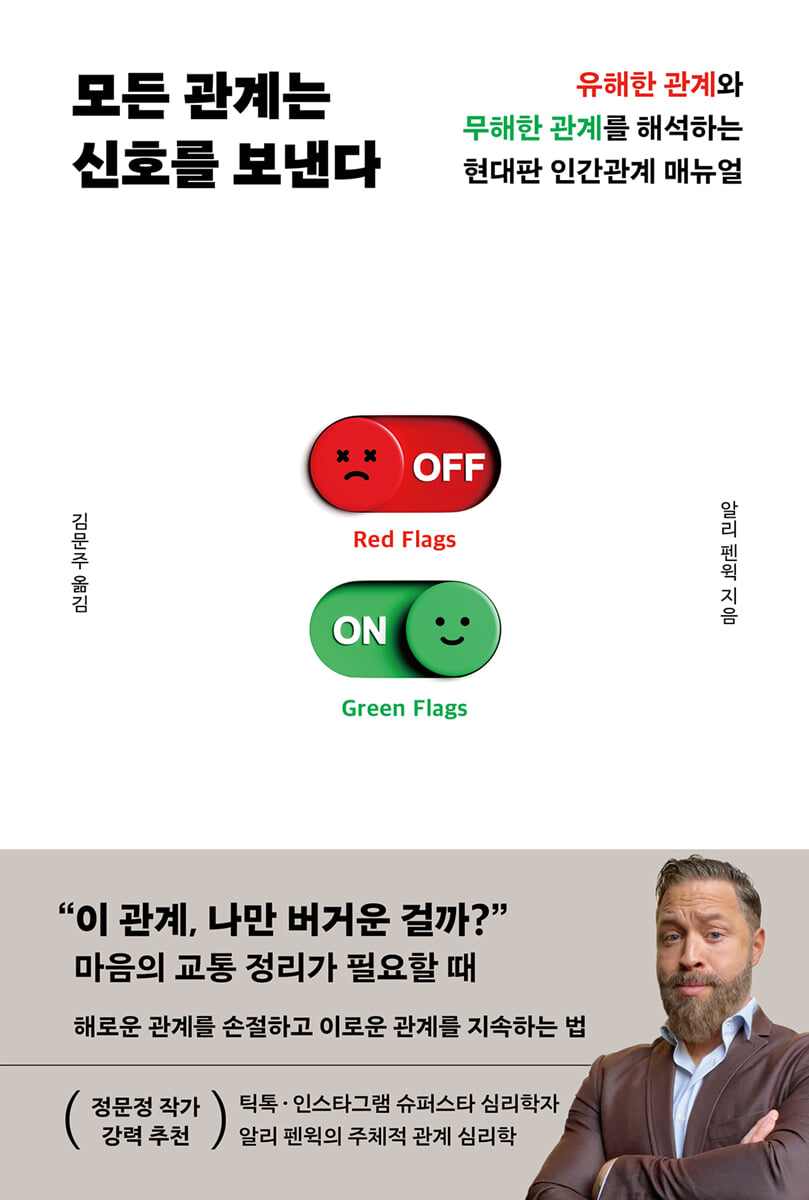 |
Description
Book Introduction
"Is this relationship just burdensome for me?" When you need to sort out your emotional turmoil
How to Break Off Harmful Relationships and Maintain Beneficial Relationships
The Psychology of Subjective Relationships by TikTok and Instagram Superstar Ali Fenwick
A modern-day human relations manual has been published for those who have ever wondered, "Why do I always struggle with the same problems?" or "Is this person a good person for me or a bad person?"
To anyone who has ever wondered, "Why do they do this to me?" at family gatherings, meetings with friends, conversations with coworkers, or romantic partners.
Dr. Ali Fenwick, a renowned relationship strategist and social media superstar with millions of followers, offers a clear answer in Red Flags, Green Flags.
This book addresses the crises in relationships we form throughout our lives, from family and friends to coworkers and lovers, through specific examples of relationships that anyone can experience at least once (overly interfering parents, friends who only spout negative evaluations, bosses who demand loyalty by calling themselves “family-like companies,” repetitive, distorted dating patterns, partners who gaslight or cheat, etc.).
By presenting a total of 24 'red flags' and diagnosing the 'red lights' and 'green lights' in each relationship, you can learn how to stop a relationship that is only hurting and maintain a healthy relationship.
Drawing on the latest behavioral science research and extensive counseling experience, the author constantly asks the questions, “Is this relationship beneficial or detrimental to me?” and “Is it harmful or harmless?”
Furthermore, it helps readers to read the signals sent by others, listen to their inner voice, and proactively decide the direction of the relationship.
As an author who has gained a lot of sympathy from the MZ generation based on TikTok and Instagram, he shows clear standards for distinguishing between bad and good relationships, with red and green lights, through episodes that anyone can understand and relate to, at an eye level that anyone can understand.
How to Break Off Harmful Relationships and Maintain Beneficial Relationships
The Psychology of Subjective Relationships by TikTok and Instagram Superstar Ali Fenwick
A modern-day human relations manual has been published for those who have ever wondered, "Why do I always struggle with the same problems?" or "Is this person a good person for me or a bad person?"
To anyone who has ever wondered, "Why do they do this to me?" at family gatherings, meetings with friends, conversations with coworkers, or romantic partners.
Dr. Ali Fenwick, a renowned relationship strategist and social media superstar with millions of followers, offers a clear answer in Red Flags, Green Flags.
This book addresses the crises in relationships we form throughout our lives, from family and friends to coworkers and lovers, through specific examples of relationships that anyone can experience at least once (overly interfering parents, friends who only spout negative evaluations, bosses who demand loyalty by calling themselves “family-like companies,” repetitive, distorted dating patterns, partners who gaslight or cheat, etc.).
By presenting a total of 24 'red flags' and diagnosing the 'red lights' and 'green lights' in each relationship, you can learn how to stop a relationship that is only hurting and maintain a healthy relationship.
Drawing on the latest behavioral science research and extensive counseling experience, the author constantly asks the questions, “Is this relationship beneficial or detrimental to me?” and “Is it harmful or harmless?”
Furthermore, it helps readers to read the signals sent by others, listen to their inner voice, and proactively decide the direction of the relationship.
As an author who has gained a lot of sympathy from the MZ generation based on TikTok and Instagram, he shows clear standards for distinguishing between bad and good relationships, with red and green lights, through episodes that anyone can understand and relate to, at an eye level that anyone can understand.
- You can preview some of the book's contents.
Preview
index
Preface to the Korean edition
Entering
Part 1.
Family and Friends Relationships
Red Flag ① "Don't Mess with My Life"
When parents keep interfering in your life
Red Flag ② “Why weren’t you by my side then?”
Parents you can neither rely on nor trust
Red Flag ③ “Middle Child Syndrome”
The Effect of Birth Order on Sibling Rivalry
Red Flag ④ “Oh my god, did you hear what happened to Wendy?”
When friends and family gossip
Red Flag ⑤ "This cute idiot"
When your friends look down on you
Red Flag ⑥ “Will you shoot this time?”
Dealing with a selfish friend
Part 2.
Interpersonal relationships in the workplace
Red Flag ⑦ “A Family-Like Company”
Managers who demand unwavering loyalty
Red Flag ⑧ “Can you come to work this Sunday?”
When boundaries aren't respected at work
Red Flag ⑨ "Don't complain! That's how it works in this world!"
A company that has no regard for its employees' happiness and mental health.
Red Flag ⑩ “How about trying it this way?”
A boss who micromanages
Red Flag ⑪ “Trust me!”
Office politics
Red Flag ⑫ “Next time, reach your goal!”
A boss who keeps moving the goalposts
Part 3.
A relationship called love
Red Flag ⑬ “I just don’t want to date!”
People who choose to remain single
Red Flag ⑭ “I don’t want to define it yet.”
We're just dating
Red Flag ⑮ “I’m sorry.
We haven't been in touch for nine months.
I lost my charger, but now I found it.
What are you doing today?
The Perils of Modern Dating
Red Flag (16) “I know this is only our second time meeting, but I love you!”
Love offensive
Red Flag (17) “Why do I like older lovers?”
Dating someone older or younger
Red Flag (18) “I think I found the right person for me.
But I don't feel anything at all!”
When you don't feel any emotions
Part 4.
All romantic relationships
Red Flag (19) “Stable relationships are boring now!”
Is chaos a sign of love?
Red Flag (20) “You are too good for me!”
Anxious partner
Red Flag (21) “Let’s be open now!”
When one is not enough
Red Flag (22) “Why don’t you know it’s your fault?”
When your partner gaslights you
Red Flag (23) “I didn’t mean to hurt you!”
Cheating partner
Red Flag (24) “I was separated from the situation ship, but
At least I forgot about my unlucky ex-lover.”
Transfer love
In conclusion
supplement
References
Acknowledgements
Entering
Part 1.
Family and Friends Relationships
Red Flag ① "Don't Mess with My Life"
When parents keep interfering in your life
Red Flag ② “Why weren’t you by my side then?”
Parents you can neither rely on nor trust
Red Flag ③ “Middle Child Syndrome”
The Effect of Birth Order on Sibling Rivalry
Red Flag ④ “Oh my god, did you hear what happened to Wendy?”
When friends and family gossip
Red Flag ⑤ "This cute idiot"
When your friends look down on you
Red Flag ⑥ “Will you shoot this time?”
Dealing with a selfish friend
Part 2.
Interpersonal relationships in the workplace
Red Flag ⑦ “A Family-Like Company”
Managers who demand unwavering loyalty
Red Flag ⑧ “Can you come to work this Sunday?”
When boundaries aren't respected at work
Red Flag ⑨ "Don't complain! That's how it works in this world!"
A company that has no regard for its employees' happiness and mental health.
Red Flag ⑩ “How about trying it this way?”
A boss who micromanages
Red Flag ⑪ “Trust me!”
Office politics
Red Flag ⑫ “Next time, reach your goal!”
A boss who keeps moving the goalposts
Part 3.
A relationship called love
Red Flag ⑬ “I just don’t want to date!”
People who choose to remain single
Red Flag ⑭ “I don’t want to define it yet.”
We're just dating
Red Flag ⑮ “I’m sorry.
We haven't been in touch for nine months.
I lost my charger, but now I found it.
What are you doing today?
The Perils of Modern Dating
Red Flag (16) “I know this is only our second time meeting, but I love you!”
Love offensive
Red Flag (17) “Why do I like older lovers?”
Dating someone older or younger
Red Flag (18) “I think I found the right person for me.
But I don't feel anything at all!”
When you don't feel any emotions
Part 4.
All romantic relationships
Red Flag (19) “Stable relationships are boring now!”
Is chaos a sign of love?
Red Flag (20) “You are too good for me!”
Anxious partner
Red Flag (21) “Let’s be open now!”
When one is not enough
Red Flag (22) “Why don’t you know it’s your fault?”
When your partner gaslights you
Red Flag (23) “I didn’t mean to hurt you!”
Cheating partner
Red Flag (24) “I was separated from the situation ship, but
At least I forgot about my unlucky ex-lover.”
Transfer love
In conclusion
supplement
References
Acknowledgements
Detailed image
.jpg)
Into the book
Red light and green light are also very subjective.
What is a red light for one person may be a green light for another, and vice versa.
You might have taken someone's behavior as a green light in a certain situation, but it might actually be a bright red light, as red as a boiled crayfish! Or maybe you thought you saw a red light in someone, but you were actually the one who was the red light.
You have formed your beliefs and perceptions through the influence of your upbringing, social culture, life experiences, and the media, and based on these, you determine what is a red light and what is a green light.
Unfortunately, the brain's operating system is not without its flaws (it's prone to making mistakes in cognitive processes), and making quick judgments can lead to poor decision-making.
This book uses science, anecdotes, personal stories, and a variety of tools to explain our decision-making process.
--- p.16
Learning to recognize when and when your mother and father are healthily involved in your life is crucial to your self-development, your mental well-being, and how you relate to others.
Learning to set your own boundaries is important, but it is often very difficult socially and culturally.
Being able to distinguish between red and green lights in your relationships with your parents or caregivers can help you build healthier relationships and give you the freedom to be who you want to be.
Let's be the ones to stop intergenerational trauma by continuing and expanding healthy behaviors that are passed down from one generation to the next.
--- p.34
By raising self-awareness and learning how to escape the shadow of an untrustworthy parent, we can shed some of the negative parental influence and even intergenerational trauma.
As adults, we can't change our parents or their behavior, but we can find ways to heal our inner child and help them grow into mature selves.
Let us remember the saying, “We are all products of our past, but we don’t have to be trapped by it.”
This is an expression that touches our hearts deeply when we are caught in a dilemma.
The past shapes who we are today, and to some extent, how we think and act, but it does not define who we want to be.
If we truly want to change, we always have a choice.
When we become aware of our own entrenched behaviors and thought patterns and are willing to change to become better people, power is in our hands.
--- p.47
Burnout and dissatisfaction are not uncommon in our always-online culture.
When you are micromanaged, you feel more pressure and bigger problems can arise.
So why is it so difficult to fight back when boundaries are crossed? Often, fear of raising your voice to management can lead to hesitation, preventing you from actively expressing your needs.
Fear of retaliation or job loss can be a fundamental reason why people are reluctant to speak out.
Another common reason is the tendency to try to please others.
Coworkers and managers have a knack for noticing when someone is a people-pleaser (a new term for someone who has an obsession with pleasing others) and see them as an easy target for work overload.
--- p.146
I believe that how we define mental health is important.
Is mental health a condition requiring care, a condition of illness? Or is it a state of productivity, coping strategies, and resilience—in other words, a state of well-being? The latter question fundamentally changes what mental health means, how it should be developed, and how employees should be engaged.
Most of my research looks at individuals in a state of well-being and resilience, rather than illness.
Clinical models are merely one paradigm for assessing human cognition and behavior.
In fact, there is a great example in the United Arab Emirates where people with mental or physical disabilities are called 'People of Determination'.
Depending on how we label life's various situations, we can either miss out on new possibilities or gain the vitality to grow further.
Determining how to define mental health in the workplace is the most important first step companies can take to support employee growth.
--- p.160
Situationship is somewhat similar to FWB, but adds enough complexity that it can never be called a relationship at all.
In a situationship, the status is not clearly defined, so one partner may develop romantic feelings for the other and hope for an exclusive relationship (while the other partner may not).
Because of the ambiguity surrounding situationship and the stress it can cause, I like to call it situationship.
The level of sexual involvement is high to moderate, and the level of emotional connection is moderate to high.
--- p.242
Studies show that one of the reasons people stick with dating apps after finding a potential partner is their persuasive design and excessive swiping (which focuses more on instant gratification and self-esteem assessments than on connecting).
App developers and designers intentionally apply behavioral psychology to create habitual behaviors in users.
The longer you engage in actions like swiping, matching, and commenting, the more likely you are to continue using the service.
These techniques tap into your brain chemicals, delivering explosive spikes of dopamine that either make you feel good or temporarily soothe negative emotions.
Unfortunately, using our smartphones or consuming social media doesn't help us erase negative emotions; in fact, it makes the problem worse.
The constant dopamine rush and quick fixes have also been shown to numb people's emotions.
Dating apps don't care whether we find love or not, and they don't care if we experience trauma after meeting someone online.
They only care about keeping us on their apps as long as possible.
--- p.329~330
Putting your words into action will help you become the best version of yourself.
The important thing is to take ownership of how you think and relate to others.
Today's technological advancements and lifestyles have made it easier for us to be independent and move through default settings.
Let's improve the way we think and the quality of our relationships by being more reflective and becoming better people.
As we improve our interactions with others, let's relearn what it means to survive as a human being in a digital society.
And hopefully, let's make this world a better place to live in.
Only positive intentions can create change.
What is a red light for one person may be a green light for another, and vice versa.
You might have taken someone's behavior as a green light in a certain situation, but it might actually be a bright red light, as red as a boiled crayfish! Or maybe you thought you saw a red light in someone, but you were actually the one who was the red light.
You have formed your beliefs and perceptions through the influence of your upbringing, social culture, life experiences, and the media, and based on these, you determine what is a red light and what is a green light.
Unfortunately, the brain's operating system is not without its flaws (it's prone to making mistakes in cognitive processes), and making quick judgments can lead to poor decision-making.
This book uses science, anecdotes, personal stories, and a variety of tools to explain our decision-making process.
--- p.16
Learning to recognize when and when your mother and father are healthily involved in your life is crucial to your self-development, your mental well-being, and how you relate to others.
Learning to set your own boundaries is important, but it is often very difficult socially and culturally.
Being able to distinguish between red and green lights in your relationships with your parents or caregivers can help you build healthier relationships and give you the freedom to be who you want to be.
Let's be the ones to stop intergenerational trauma by continuing and expanding healthy behaviors that are passed down from one generation to the next.
--- p.34
By raising self-awareness and learning how to escape the shadow of an untrustworthy parent, we can shed some of the negative parental influence and even intergenerational trauma.
As adults, we can't change our parents or their behavior, but we can find ways to heal our inner child and help them grow into mature selves.
Let us remember the saying, “We are all products of our past, but we don’t have to be trapped by it.”
This is an expression that touches our hearts deeply when we are caught in a dilemma.
The past shapes who we are today, and to some extent, how we think and act, but it does not define who we want to be.
If we truly want to change, we always have a choice.
When we become aware of our own entrenched behaviors and thought patterns and are willing to change to become better people, power is in our hands.
--- p.47
Burnout and dissatisfaction are not uncommon in our always-online culture.
When you are micromanaged, you feel more pressure and bigger problems can arise.
So why is it so difficult to fight back when boundaries are crossed? Often, fear of raising your voice to management can lead to hesitation, preventing you from actively expressing your needs.
Fear of retaliation or job loss can be a fundamental reason why people are reluctant to speak out.
Another common reason is the tendency to try to please others.
Coworkers and managers have a knack for noticing when someone is a people-pleaser (a new term for someone who has an obsession with pleasing others) and see them as an easy target for work overload.
--- p.146
I believe that how we define mental health is important.
Is mental health a condition requiring care, a condition of illness? Or is it a state of productivity, coping strategies, and resilience—in other words, a state of well-being? The latter question fundamentally changes what mental health means, how it should be developed, and how employees should be engaged.
Most of my research looks at individuals in a state of well-being and resilience, rather than illness.
Clinical models are merely one paradigm for assessing human cognition and behavior.
In fact, there is a great example in the United Arab Emirates where people with mental or physical disabilities are called 'People of Determination'.
Depending on how we label life's various situations, we can either miss out on new possibilities or gain the vitality to grow further.
Determining how to define mental health in the workplace is the most important first step companies can take to support employee growth.
--- p.160
Situationship is somewhat similar to FWB, but adds enough complexity that it can never be called a relationship at all.
In a situationship, the status is not clearly defined, so one partner may develop romantic feelings for the other and hope for an exclusive relationship (while the other partner may not).
Because of the ambiguity surrounding situationship and the stress it can cause, I like to call it situationship.
The level of sexual involvement is high to moderate, and the level of emotional connection is moderate to high.
--- p.242
Studies show that one of the reasons people stick with dating apps after finding a potential partner is their persuasive design and excessive swiping (which focuses more on instant gratification and self-esteem assessments than on connecting).
App developers and designers intentionally apply behavioral psychology to create habitual behaviors in users.
The longer you engage in actions like swiping, matching, and commenting, the more likely you are to continue using the service.
These techniques tap into your brain chemicals, delivering explosive spikes of dopamine that either make you feel good or temporarily soothe negative emotions.
Unfortunately, using our smartphones or consuming social media doesn't help us erase negative emotions; in fact, it makes the problem worse.
The constant dopamine rush and quick fixes have also been shown to numb people's emotions.
Dating apps don't care whether we find love or not, and they don't care if we experience trauma after meeting someone online.
They only care about keeping us on their apps as long as possible.
--- p.329~330
Putting your words into action will help you become the best version of yourself.
The important thing is to take ownership of how you think and relate to others.
Today's technological advancements and lifestyles have made it easier for us to be independent and move through default settings.
Let's improve the way we think and the quality of our relationships by being more reflective and becoming better people.
As we improve our interactions with others, let's relearn what it means to survive as a human being in a digital society.
And hopefully, let's make this world a better place to live in.
Only positive intentions can create change.
--- p.444
Publisher's Review
“Good relationships never happen by accident.”
Recommended for those who are on the borderline between continuing and ending a relationship.
Red Light and Green Light Psychology: Protecting Myself and Connecting with Others
The most difficult task in life may be 'people'.
The worries are endless: who to be with, how to keep your distance, what signals the other person is sending you, etc.
Human relationships occupy the center of our lives, but they also cause the most confusion.
The author dives right into the heart of this confusion and offers concrete, practical methods for identifying the nature of ambiguous relationships.
This book consists of four parts and 24 cases.
Each section focuses on the major areas we encounter in life (family and friends, work, romantic relationships, and all other romantic relationships), and presents the criteria for red and green lights through detailed clinical cases and psychological analysis.
Additionally, the author suggests the 'RED Thinking Method (Reflect-Engage-Decide)' to help readers who are at a crossroads about whether to continue or end a relationship make more mature and proactive choices.
- Reflect: Recognize the real cause of your current emotions
- Engage: Instead of avoiding, engage directly and talk to yourself.
- Decide: Make the best decision in the situation.
This simple yet powerful framework guides readers to choose relationships through conscious action rather than emotional reaction.
Although it analyzes a total of 24 cases, this book goes beyond simply listing them.
For example, the boundary violation hidden behind a boss's question, "Can you help me with some work this weekend?", the attachment avoidance hidden in a boyfriend's words, "Let's not decide yet," the desire for control amid a lover's excessive affection, "What's wrong with loving you?"... By psychologically dissecting familiar scenes that we have all experienced at least once in our daily lives, the book helps readers interpret their own experiences in a new way.
“This book itself is the only ‘green light’!”
In-depth analysis of 24 cases by classifying human relationships throughout life.
If you can read other people's hand signals, you can become a true leader in your relationships.
“If you can distinguish between risky and safe relationships by following the checklist suggested by the author of this book, you can avoid struggling in a relationship and ending up hating yourself.”
_Jeong Moon-jeong, author of "How to Deal with Rude People with a Smile"
This book doesn't tell you to immediately cut off a relationship that has warning or red flags.
Before that, ask yourself what kind of relationship you really want, and develop a sense of being able to interpret the other person's signals on your own.
This stemmed, above all, from the author's warm gaze toward people.
While clearly analyzing the red light points in relationships, he acknowledges that no one is perfect and seeks to offer hope by finding the fleeting green light hidden in all relationships.
For example, even if you are suffering from over-interfering parents, the author does not recommend hastily cutting them off.
Recognize that parental love can take the form of control, and suggest practicing setting boundaries for yourself.
For those who grew up with parents who were emotionally unavailable, it guides them to find their own path to recovery by nurturing their “inner child” rather than blaming their shortcomings.
It's the same at work.
Even in the face of an irrational organizational culture or an authoritarian boss, we don't tell people to run away right away.
Instead, start by figuring out what kind of values you want to uphold and what kind of relationships you can thrive in.
It also helps couples realize that anxiety, obsession, and blame between partners are not just common problems, but rather mirrors of each other's wounds, allowing them to discover intimate moments that can be created through true communication.
In other words, the author explores the resilience of relationships and the potential for personal growth in any situation.
Therefore, “Every Relationship Sends Signals” is not a simple guidebook on human relationships.
The author brings psychological concepts to life, forcing readers to reflect on their own experiences and ask, "What does this signal tell me?"
In the process, readers come to realize that not only the actions of others but also their own reactions are signals, and that all relationships are interactive.
In the face of these emotional traffic lights, we are always faced with difficult choices.
Should I stop now or should I keep going?
What signals are you receiving from others right now? The moment you understand this, your life will change completely.
And at that moment, this book will become the most reliable, realistic, yet warm compass.
Recommended for those who are on the borderline between continuing and ending a relationship.
Red Light and Green Light Psychology: Protecting Myself and Connecting with Others
The most difficult task in life may be 'people'.
The worries are endless: who to be with, how to keep your distance, what signals the other person is sending you, etc.
Human relationships occupy the center of our lives, but they also cause the most confusion.
The author dives right into the heart of this confusion and offers concrete, practical methods for identifying the nature of ambiguous relationships.
This book consists of four parts and 24 cases.
Each section focuses on the major areas we encounter in life (family and friends, work, romantic relationships, and all other romantic relationships), and presents the criteria for red and green lights through detailed clinical cases and psychological analysis.
Additionally, the author suggests the 'RED Thinking Method (Reflect-Engage-Decide)' to help readers who are at a crossroads about whether to continue or end a relationship make more mature and proactive choices.
- Reflect: Recognize the real cause of your current emotions
- Engage: Instead of avoiding, engage directly and talk to yourself.
- Decide: Make the best decision in the situation.
This simple yet powerful framework guides readers to choose relationships through conscious action rather than emotional reaction.
Although it analyzes a total of 24 cases, this book goes beyond simply listing them.
For example, the boundary violation hidden behind a boss's question, "Can you help me with some work this weekend?", the attachment avoidance hidden in a boyfriend's words, "Let's not decide yet," the desire for control amid a lover's excessive affection, "What's wrong with loving you?"... By psychologically dissecting familiar scenes that we have all experienced at least once in our daily lives, the book helps readers interpret their own experiences in a new way.
“This book itself is the only ‘green light’!”
In-depth analysis of 24 cases by classifying human relationships throughout life.
If you can read other people's hand signals, you can become a true leader in your relationships.
“If you can distinguish between risky and safe relationships by following the checklist suggested by the author of this book, you can avoid struggling in a relationship and ending up hating yourself.”
_Jeong Moon-jeong, author of "How to Deal with Rude People with a Smile"
This book doesn't tell you to immediately cut off a relationship that has warning or red flags.
Before that, ask yourself what kind of relationship you really want, and develop a sense of being able to interpret the other person's signals on your own.
This stemmed, above all, from the author's warm gaze toward people.
While clearly analyzing the red light points in relationships, he acknowledges that no one is perfect and seeks to offer hope by finding the fleeting green light hidden in all relationships.
For example, even if you are suffering from over-interfering parents, the author does not recommend hastily cutting them off.
Recognize that parental love can take the form of control, and suggest practicing setting boundaries for yourself.
For those who grew up with parents who were emotionally unavailable, it guides them to find their own path to recovery by nurturing their “inner child” rather than blaming their shortcomings.
It's the same at work.
Even in the face of an irrational organizational culture or an authoritarian boss, we don't tell people to run away right away.
Instead, start by figuring out what kind of values you want to uphold and what kind of relationships you can thrive in.
It also helps couples realize that anxiety, obsession, and blame between partners are not just common problems, but rather mirrors of each other's wounds, allowing them to discover intimate moments that can be created through true communication.
In other words, the author explores the resilience of relationships and the potential for personal growth in any situation.
Therefore, “Every Relationship Sends Signals” is not a simple guidebook on human relationships.
The author brings psychological concepts to life, forcing readers to reflect on their own experiences and ask, "What does this signal tell me?"
In the process, readers come to realize that not only the actions of others but also their own reactions are signals, and that all relationships are interactive.
In the face of these emotional traffic lights, we are always faced with difficult choices.
Should I stop now or should I keep going?
What signals are you receiving from others right now? The moment you understand this, your life will change completely.
And at that moment, this book will become the most reliable, realistic, yet warm compass.
GOODS SPECIFICS
- Date of issue: October 22, 2025
- Page count, weight, size: 476 pages | 656g | 145*215*27mm
- ISBN13: 9788925573069
- ISBN10: 8925573067
You may also like
카테고리
korean


korean

![GQ KOREA Mark (Monthly): December [2025]](http://librairie.coreenne.fr/cdn/shop/files/8ef265dbbfbf186523ed75ba7319009d.jpg?v=1765340328&width=3840)


