

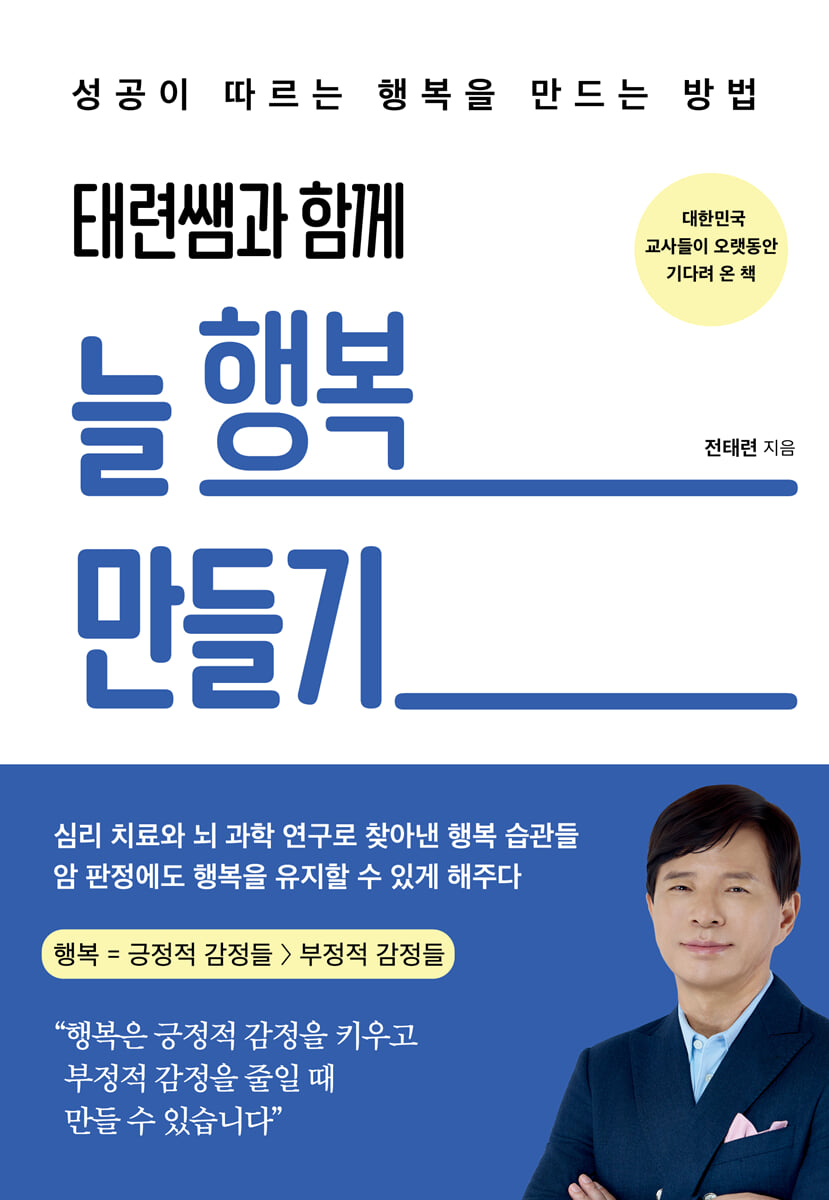
Always creating happiness with Teacher Taeryeon
 |
Description
Book Introduction
Happiness Habits Discovered Through Psychotherapy and Brain Science Research
Helping you stay happy despite a cancer diagnosis
Happiness = positive emotions 〉 negative emotions
“Happiness is created by cultivating positive emotions and reducing negative ones.”
★ A book long-awaited by Korean teachers ★
Why are we so unhappy, even though we work hard? This book begins with this question.
Many people run tirelessly every day for success and happiness, but their hearts are filled with anxiety and depression.
The author, who has taught education and how to create happiness to over 300,000 people over the past several decades, points out the essence of happiness that people often misunderstand in this book.
Happiness isn't something you achieve by setting bigger, more ambitious goals, but rather something that grows from the habit of cultivating positive emotions and reducing negative ones in your daily life.
The author has studied a wide range of disciplines, including psychotherapy, counseling theory, educational psychology, cognitive psychology, evolutionary psychology, behavioral economics, and brain science, to find ways to create a happy life.
Also, based on this, I have met and counseled countless people and witnessed changes in their real lives.
In this book, he summarizes and introduces five happiness habits he has discovered over time.
The author has also faced many hardships throughout his life, most notably being diagnosed with cancer in March 2025.
Even then, the driving force that allowed me to remain unshaken and find new challenges with a positive mindset and maintain happiness was this very 'habit of happiness.'
The happiness habits you'll discover in this book aren't just theories; they're practical guidelines that will transform your life.
Helping you stay happy despite a cancer diagnosis
Happiness = positive emotions 〉 negative emotions
“Happiness is created by cultivating positive emotions and reducing negative ones.”
★ A book long-awaited by Korean teachers ★
Why are we so unhappy, even though we work hard? This book begins with this question.
Many people run tirelessly every day for success and happiness, but their hearts are filled with anxiety and depression.
The author, who has taught education and how to create happiness to over 300,000 people over the past several decades, points out the essence of happiness that people often misunderstand in this book.
Happiness isn't something you achieve by setting bigger, more ambitious goals, but rather something that grows from the habit of cultivating positive emotions and reducing negative ones in your daily life.
The author has studied a wide range of disciplines, including psychotherapy, counseling theory, educational psychology, cognitive psychology, evolutionary psychology, behavioral economics, and brain science, to find ways to create a happy life.
Also, based on this, I have met and counseled countless people and witnessed changes in their real lives.
In this book, he summarizes and introduces five happiness habits he has discovered over time.
The author has also faced many hardships throughout his life, most notably being diagnosed with cancer in March 2025.
Even then, the driving force that allowed me to remain unshaken and find new challenges with a positive mindset and maintain happiness was this very 'habit of happiness.'
The happiness habits you'll discover in this book aren't just theories; they're practical guidelines that will transform your life.
- You can preview some of the book's contents.
Preview
index
Prologue: Why am I unhappy even though I work hard?
A brief moment of happiness, always a repetition of unhappiness
Happiness = positive emotions 〉 negative emotions
Happiness Habit 1.
Thank goodness, thank goodness, thank goodness
I should have done ~, it would have been nice if ~ vs. Fortunately
Fortunately, I learned 'fortunately'
'Thank goodness' lifted me from the underground to happiness
Thank goodness you saved my life
Thank goodness the student who got stuck in the swamp was saved.
It's fortunate that you know now (이·알·다)
Happiness Habit 2.
Break free from irrational beliefs
Easy, convenient and fast
Automatic, fast, but distorted thoughts
The result of distorted thinking
Irrational beliefs and distorted thoughts
Characteristics of irrational beliefs
Distorted thinking type
Overgeneralization | Inferences | Catastrophizing | Dichotomous thinking | Personalization
Examples of irrational beliefs
Fast response and slow control
Applying the brakes with awareness
Take a deep breath
A conversation with the Socrates within me
Observing other people
Avoid creating new irrational beliefs
Using thoughts that can replace irrational beliefs
Practice awareness
Quitting Smoking Using Passive Conditioning and Awareness
Reduce smartphone use through awareness
Happiness Habit 3.
Execute challenging tasks
Goals that lead to lethargy and depression
What is a challenging task?
The skills required for challenging tasks
Self-control | Self-efficacy | Self-acceptance | Consideration, respect, and gratitude
Types of challenging tasks
Gradually, gradually, strategy
Make it as if
self-praise
Specific and positive feedback
Turning Prostate Cancer Treatment into a Writing Journey
Happiness Habit 4.
Studying with a table of contents
Why is studying a source of negative emotions?
Inefficient study methods
Learning strategies that promote understanding and memory
The effectiveness of the table of contents study method
Enhanced comprehension | Enhanced memory and retrieval | Enhanced logical and analytical thinking | Enhanced brain circuit structure
How to create a table of contents
Preview and listen to the lecture by organizing the table of contents
Review by organizing the table of contents and creating brain circuits
Review the first part with brain circuits | Review the second part with a table of contents | Review the third part with a blank sheet of paper | Review the fourth part with practice problems | Review the fourth part with a key vocabulary list
Developing Test-Taking Strategies Based on Cognitive Psychology
Strategies for Solving Practice Problems | Strategies for Taking the Exam
A Reading Guide to Creating a Table of Contents for the AI Era
The Benefits of the Table of Contents Reading Method | Reading with a Table of Contents
Finding Prostate Cancer Treatment Options with Table of Contents
Happiness Habit 5.
I choose
I chose the person I could choose
How to Become a Person of Choice
I chose a job that helped others and brought in money.
I chose honesty
I chose batting average management
I chose meaningful work over easy work.
I chose the Jeon Tae-ryeon that I treasured over the Jeon Tae-ryeon that was trampled on.
I chose to eat with the merchant instead of the merchant.
He put students before the money he stole.
I chose to establish an academy and donate.
I chose to donate my talents
I chose divorce
Epilogue: A Life Always Leading to Happiness
A brief moment of happiness, always a repetition of unhappiness
Happiness = positive emotions 〉 negative emotions
Happiness Habit 1.
Thank goodness, thank goodness, thank goodness
I should have done ~, it would have been nice if ~ vs. Fortunately
Fortunately, I learned 'fortunately'
'Thank goodness' lifted me from the underground to happiness
Thank goodness you saved my life
Thank goodness the student who got stuck in the swamp was saved.
It's fortunate that you know now (이·알·다)
Happiness Habit 2.
Break free from irrational beliefs
Easy, convenient and fast
Automatic, fast, but distorted thoughts
The result of distorted thinking
Irrational beliefs and distorted thoughts
Characteristics of irrational beliefs
Distorted thinking type
Overgeneralization | Inferences | Catastrophizing | Dichotomous thinking | Personalization
Examples of irrational beliefs
Fast response and slow control
Applying the brakes with awareness
Take a deep breath
A conversation with the Socrates within me
Observing other people
Avoid creating new irrational beliefs
Using thoughts that can replace irrational beliefs
Practice awareness
Quitting Smoking Using Passive Conditioning and Awareness
Reduce smartphone use through awareness
Happiness Habit 3.
Execute challenging tasks
Goals that lead to lethargy and depression
What is a challenging task?
The skills required for challenging tasks
Self-control | Self-efficacy | Self-acceptance | Consideration, respect, and gratitude
Types of challenging tasks
Gradually, gradually, strategy
Make it as if
self-praise
Specific and positive feedback
Turning Prostate Cancer Treatment into a Writing Journey
Happiness Habit 4.
Studying with a table of contents
Why is studying a source of negative emotions?
Inefficient study methods
Learning strategies that promote understanding and memory
The effectiveness of the table of contents study method
Enhanced comprehension | Enhanced memory and retrieval | Enhanced logical and analytical thinking | Enhanced brain circuit structure
How to create a table of contents
Preview and listen to the lecture by organizing the table of contents
Review by organizing the table of contents and creating brain circuits
Review the first part with brain circuits | Review the second part with a table of contents | Review the third part with a blank sheet of paper | Review the fourth part with practice problems | Review the fourth part with a key vocabulary list
Developing Test-Taking Strategies Based on Cognitive Psychology
Strategies for Solving Practice Problems | Strategies for Taking the Exam
A Reading Guide to Creating a Table of Contents for the AI Era
The Benefits of the Table of Contents Reading Method | Reading with a Table of Contents
Finding Prostate Cancer Treatment Options with Table of Contents
Happiness Habit 5.
I choose
I chose the person I could choose
How to Become a Person of Choice
I chose a job that helped others and brought in money.
I chose honesty
I chose batting average management
I chose meaningful work over easy work.
I chose the Jeon Tae-ryeon that I treasured over the Jeon Tae-ryeon that was trampled on.
I chose to eat with the merchant instead of the merchant.
He put students before the money he stole.
I chose to establish an academy and donate.
I chose to donate my talents
I chose divorce
Epilogue: A Life Always Leading to Happiness
Into the book
I realized that I could be happy when I felt positive emotions more strongly than negative ones, and thanks to learning and practicing the happiness habits that make this possible, I was able to feel happy and write and publish a book even in the difficult situation of being diagnosed with cancer.
The five happiness habits presented in this book and the content contained within each habit are designed to help increase positive emotions and reduce negative emotions.
These are things I have actually put into practice and applied while counseling tens of thousands of students, and they have proven effective.
Therefore, if we properly understand and practice this content, we can create happiness even in difficult situations, and the happiness we create will lead us to a successful life.
--- p.15
There are times when we realize new facts and knowledge in the process of striving to live a better life.
At times like that, I often think, 'I wish I had known then what I know now.'
Then, you feel incompetent for not knowing what you know now, and that incompetence leads to frustration and self-reproach, which makes you depressed.
The joy of learning new knowledge that will help you in life is gone, and you are filled with only negative thoughts, making it difficult to focus on what you are doing.
When that happens, if you shout, "I'm glad I know now," and try to change based on what you've learned, a new life will unfold, no matter what your situation or age.
--- p.59
In the example above, Socrates uses questions to help his students realize the limitations of their thinking, and by synthesizing the answers they provide, he helps them arrive at a more precise definition of the concept.
Therefore, if you imagine that there is a Socrates (hereinafter referred to as 'inner sorcerer') within you and utilize the process of asking and answering questions with the inner sorcerer, you can clarify your thoughts and find irrational beliefs and distorted thoughts.
Then, by asking and answering questions again, you determine whether your irrational beliefs have logical evidence, are feasible, and help you achieve your life goals.
Through this, you can change rigid and unrealistic, irrational beliefs such as 'must, always, absolutely must' and 'must never, absolutely not' into flexible thoughts.
--- p.96
The first skill that challenging tasks require is self-control.
In order to avoid being helplessly dragged around by the demands of others, you need to first choose for yourself and then have the self-control to focus on solving the task by regulating your thoughts, emotions, and actions so that you can solve the task you have chosen.
The ‘awareness and deep breathing’ explained in ‘Happiness Habit 2’ is the most fundamental habit for developing self-control.
If you notice yourself reaching for your phone out of boredom while studying and take a deep breath, you can put the brakes on your phone-grabbing behavior and refocus on what you were doing.
--- p.126
When you feel like throwing down everything you're working on and running away, the strategy you need is to 'act as if'.
When I'm tired of writing and want to run away, I picture myself publishing a book, standing in an art hall with excellent lighting and sound, and giving a lecture, breathing together with the audience.
If I stand in the middle of the living room as if I were a lecturer, gesturing and lecturing as if I were giving a real lecture, I can feel the audience's enthusiasm and gain strength to write again.
--- p.142
Because reflection focuses on mistakes and shortcomings, it stimulates negative emotions such as self-reproach, frustration, guilt, and feelings of incompetence.
When you perform a challenging task and then reflect on it, which triggers negative emotions, you may lose the desire to do the challenging task itself.
This is because the reflection you do to improve on a challenging task can lead you to avoid performing the challenging task itself because it continually points out your mistakes and errors.
Specific and positive feedback (negative, positive, negative) focuses on improving what you did well, identifying areas for improvement and finding ways to do so, and ultimately finding new, challenging tasks.
So, positive thinking helps us to better execute challenging tasks, and it not only gives us a sense of accomplishment and enjoyment, but also helps us find new challenging tasks.
--- p.160
Using this principle, when you take the subway or bus after class to a study cafe or home, think in your head, "What did we learn in class today?", "How was it structured?", "Why did we have to do it that way?", and draw a table of contents in your head. When you think of a concept in the table of contents, structure it around what, how, and why and recall it.
--- p.191
What difference does it make to declare, "I chose it"? Humans have a natural desire for autonomy: to choose for themselves, to focus on their chosen endeavors, and to excel at them.
So, when someone else tells you to do something, you get annoyed and do it half-heartedly, but when you choose something because you like it, you want to do it well.
To do a good job, you need to concentrate, so what you need at this time is self-control.
Even when doing something you have to do, if you declare, "I chose it," and strive to find and solve challenging tasks, you will feel joy and the thrill of accomplishment in the process, which will increase your self-control and self-efficacy.
Surprisingly, as you live, you will experience that the skills you develop while solving challenging tasks become the foundation for taking on new challenges.
--- p.215
I started my first lecture with, “Welcome to the National Health Club.”
I shared my experience and told him that it was the best gym that allowed me to wake up at 6 in the morning and go to bed at 10 at night, and that it provided clothing, food, and a salary, and that it allowed me to work out. I encouraged him to quit smoking if he could while training, and if he couldn't, to at least try to achieve his goal of building up his physical strength.
Because mental training was conducted for all trainees of each rank, at least 700 people took the course at one time.
Even at that moment, I had no idea that I would be making a living by giving lectures.
If it weren't for that time, I wouldn't have had the experience of lecturing to that many people.
Thanks to my experience in the Air Force, when I started teaching at the academy, I was able to teach with ease and without feeling any fear of the podium.
Giving up easy and comfortable work and choosing difficult but meaningful work became the foundation of my entire life.
As expected, 'there is not a single moment to be wasted if you give your best effort.'
The five happiness habits presented in this book and the content contained within each habit are designed to help increase positive emotions and reduce negative emotions.
These are things I have actually put into practice and applied while counseling tens of thousands of students, and they have proven effective.
Therefore, if we properly understand and practice this content, we can create happiness even in difficult situations, and the happiness we create will lead us to a successful life.
--- p.15
There are times when we realize new facts and knowledge in the process of striving to live a better life.
At times like that, I often think, 'I wish I had known then what I know now.'
Then, you feel incompetent for not knowing what you know now, and that incompetence leads to frustration and self-reproach, which makes you depressed.
The joy of learning new knowledge that will help you in life is gone, and you are filled with only negative thoughts, making it difficult to focus on what you are doing.
When that happens, if you shout, "I'm glad I know now," and try to change based on what you've learned, a new life will unfold, no matter what your situation or age.
--- p.59
In the example above, Socrates uses questions to help his students realize the limitations of their thinking, and by synthesizing the answers they provide, he helps them arrive at a more precise definition of the concept.
Therefore, if you imagine that there is a Socrates (hereinafter referred to as 'inner sorcerer') within you and utilize the process of asking and answering questions with the inner sorcerer, you can clarify your thoughts and find irrational beliefs and distorted thoughts.
Then, by asking and answering questions again, you determine whether your irrational beliefs have logical evidence, are feasible, and help you achieve your life goals.
Through this, you can change rigid and unrealistic, irrational beliefs such as 'must, always, absolutely must' and 'must never, absolutely not' into flexible thoughts.
--- p.96
The first skill that challenging tasks require is self-control.
In order to avoid being helplessly dragged around by the demands of others, you need to first choose for yourself and then have the self-control to focus on solving the task by regulating your thoughts, emotions, and actions so that you can solve the task you have chosen.
The ‘awareness and deep breathing’ explained in ‘Happiness Habit 2’ is the most fundamental habit for developing self-control.
If you notice yourself reaching for your phone out of boredom while studying and take a deep breath, you can put the brakes on your phone-grabbing behavior and refocus on what you were doing.
--- p.126
When you feel like throwing down everything you're working on and running away, the strategy you need is to 'act as if'.
When I'm tired of writing and want to run away, I picture myself publishing a book, standing in an art hall with excellent lighting and sound, and giving a lecture, breathing together with the audience.
If I stand in the middle of the living room as if I were a lecturer, gesturing and lecturing as if I were giving a real lecture, I can feel the audience's enthusiasm and gain strength to write again.
--- p.142
Because reflection focuses on mistakes and shortcomings, it stimulates negative emotions such as self-reproach, frustration, guilt, and feelings of incompetence.
When you perform a challenging task and then reflect on it, which triggers negative emotions, you may lose the desire to do the challenging task itself.
This is because the reflection you do to improve on a challenging task can lead you to avoid performing the challenging task itself because it continually points out your mistakes and errors.
Specific and positive feedback (negative, positive, negative) focuses on improving what you did well, identifying areas for improvement and finding ways to do so, and ultimately finding new, challenging tasks.
So, positive thinking helps us to better execute challenging tasks, and it not only gives us a sense of accomplishment and enjoyment, but also helps us find new challenging tasks.
--- p.160
Using this principle, when you take the subway or bus after class to a study cafe or home, think in your head, "What did we learn in class today?", "How was it structured?", "Why did we have to do it that way?", and draw a table of contents in your head. When you think of a concept in the table of contents, structure it around what, how, and why and recall it.
--- p.191
What difference does it make to declare, "I chose it"? Humans have a natural desire for autonomy: to choose for themselves, to focus on their chosen endeavors, and to excel at them.
So, when someone else tells you to do something, you get annoyed and do it half-heartedly, but when you choose something because you like it, you want to do it well.
To do a good job, you need to concentrate, so what you need at this time is self-control.
Even when doing something you have to do, if you declare, "I chose it," and strive to find and solve challenging tasks, you will feel joy and the thrill of accomplishment in the process, which will increase your self-control and self-efficacy.
Surprisingly, as you live, you will experience that the skills you develop while solving challenging tasks become the foundation for taking on new challenges.
--- p.215
I started my first lecture with, “Welcome to the National Health Club.”
I shared my experience and told him that it was the best gym that allowed me to wake up at 6 in the morning and go to bed at 10 at night, and that it provided clothing, food, and a salary, and that it allowed me to work out. I encouraged him to quit smoking if he could while training, and if he couldn't, to at least try to achieve his goal of building up his physical strength.
Because mental training was conducted for all trainees of each rank, at least 700 people took the course at one time.
Even at that moment, I had no idea that I would be making a living by giving lectures.
If it weren't for that time, I wouldn't have had the experience of lecturing to that many people.
Thanks to my experience in the Air Force, when I started teaching at the academy, I was able to teach with ease and without feeling any fear of the podium.
Giving up easy and comfortable work and choosing difficult but meaningful work became the foundation of my entire life.
As expected, 'there is not a single moment to be wasted if you give your best effort.'
--- p.230
Publisher's Review
Why are we so unhappy even though we work hard?
From irritation, frustration, anxiety and depression
With joy, satisfaction, fulfillment and pleasure
Teacher Tae-ryeon's 5 Happy Habits for a New Life
True happiness comes not from grand achievements, but from the repetition of small habits.
The five happiness habits presented in this book are easy for anyone to start in their daily lives, but their effects can be so profound that they can change your life.
The first habit of happiness is the power of the thought, “Thank goodness.”
Instead of feeling regret and sorrow, thinking, "I should have done ~" or "It would have been better if ~", if you develop the habit of thinking, "Thank goodness," you can find the positive in difficult and challenging situations and turn despair into hope.
In this book, the author presents several examples of how the word "thank goodness" comforted and healed him, and how it changed the lives of others.
The second happiness habit is ‘letting go of irrational beliefs.’
Everyone is prone to automatic and distorted thinking.
Cognitive distortions such as overgeneralization, catastrophizing, and dichotomous thinking exacerbate anxiety and frustration.
Here, the author shows us how to correct our wrong thoughts and beliefs using techniques such as awareness, breathing, and conversations with the Socrates within us.
The third happiness habit is ‘taking on challenging tasks.’
To overcome feelings of helplessness and depression, we need to develop abilities such as self-control, self-efficacy, self-acceptance, consideration, respect, and gratitude.
The author presents practical strategies for finding and executing challenging tasks in trials and transforming them into opportunities for growth, similar to his own experience of growing through the challenging task of a "writing journey" during cancer treatment.
The fourth happy habit is ‘studying by making a table of contents.’
The author, who graduated from Seoul National University's Department of Diplomacy and has taught over 300,000 people over the past 20 years, cites the table of contents study method as the most effective study method.
In the book, he explains the basis for this study method, which organizes and visualizes learning content, making it easier to understand and remember, and increasing application, and teaches specific methods that can be applied to actual study.
The fifth and final habit of happiness is ‘I choose.’
The message is that instead of being swayed by circumstances or living by the rules, we should live a life of our own choosing.
It shows that people who can make choices based on their own life journey, such as helping others and choosing meaningful work, live satisfying lives.
“If you want to learn true happiness and success,
“Open this book right now!”
The habit of creating happiness is the strength that protects you even in times of crisis, and in the long run, it becomes the driving force that leads to success.
The book emphasizes "cultivating positive emotions and reducing negative ones," which gives you the strength and ability to calm your mind and challenge yourself again in difficult situations.
People who can create their own happiness turn crises into opportunities, find their way through anxiety, and ultimately lead successful lives.
If you want to learn about true happiness and success, I urge you to open this book.
This book will confirm that starting to develop happy habits right now is the surest way to a healthier and more fulfilling future.
From irritation, frustration, anxiety and depression
With joy, satisfaction, fulfillment and pleasure
Teacher Tae-ryeon's 5 Happy Habits for a New Life
True happiness comes not from grand achievements, but from the repetition of small habits.
The five happiness habits presented in this book are easy for anyone to start in their daily lives, but their effects can be so profound that they can change your life.
The first habit of happiness is the power of the thought, “Thank goodness.”
Instead of feeling regret and sorrow, thinking, "I should have done ~" or "It would have been better if ~", if you develop the habit of thinking, "Thank goodness," you can find the positive in difficult and challenging situations and turn despair into hope.
In this book, the author presents several examples of how the word "thank goodness" comforted and healed him, and how it changed the lives of others.
The second happiness habit is ‘letting go of irrational beliefs.’
Everyone is prone to automatic and distorted thinking.
Cognitive distortions such as overgeneralization, catastrophizing, and dichotomous thinking exacerbate anxiety and frustration.
Here, the author shows us how to correct our wrong thoughts and beliefs using techniques such as awareness, breathing, and conversations with the Socrates within us.
The third happiness habit is ‘taking on challenging tasks.’
To overcome feelings of helplessness and depression, we need to develop abilities such as self-control, self-efficacy, self-acceptance, consideration, respect, and gratitude.
The author presents practical strategies for finding and executing challenging tasks in trials and transforming them into opportunities for growth, similar to his own experience of growing through the challenging task of a "writing journey" during cancer treatment.
The fourth happy habit is ‘studying by making a table of contents.’
The author, who graduated from Seoul National University's Department of Diplomacy and has taught over 300,000 people over the past 20 years, cites the table of contents study method as the most effective study method.
In the book, he explains the basis for this study method, which organizes and visualizes learning content, making it easier to understand and remember, and increasing application, and teaches specific methods that can be applied to actual study.
The fifth and final habit of happiness is ‘I choose.’
The message is that instead of being swayed by circumstances or living by the rules, we should live a life of our own choosing.
It shows that people who can make choices based on their own life journey, such as helping others and choosing meaningful work, live satisfying lives.
“If you want to learn true happiness and success,
“Open this book right now!”
The habit of creating happiness is the strength that protects you even in times of crisis, and in the long run, it becomes the driving force that leads to success.
The book emphasizes "cultivating positive emotions and reducing negative ones," which gives you the strength and ability to calm your mind and challenge yourself again in difficult situations.
People who can create their own happiness turn crises into opportunities, find their way through anxiety, and ultimately lead successful lives.
If you want to learn about true happiness and success, I urge you to open this book.
This book will confirm that starting to develop happy habits right now is the surest way to a healthier and more fulfilling future.
GOODS SPECIFICS
- Date of issue: September 25, 2025
- Page count, weight, size: 256 pages | 152*220*20mm
- ISBN13: 9791197393358
- ISBN10: 1197393358
You may also like
카테고리
korean


korean

![GQ KOREA Mark (Monthly): December [2025]](http://librairie.coreenne.fr/cdn/shop/files/8ef265dbbfbf186523ed75ba7319009d.jpg?v=1765340328&width=3840)


