

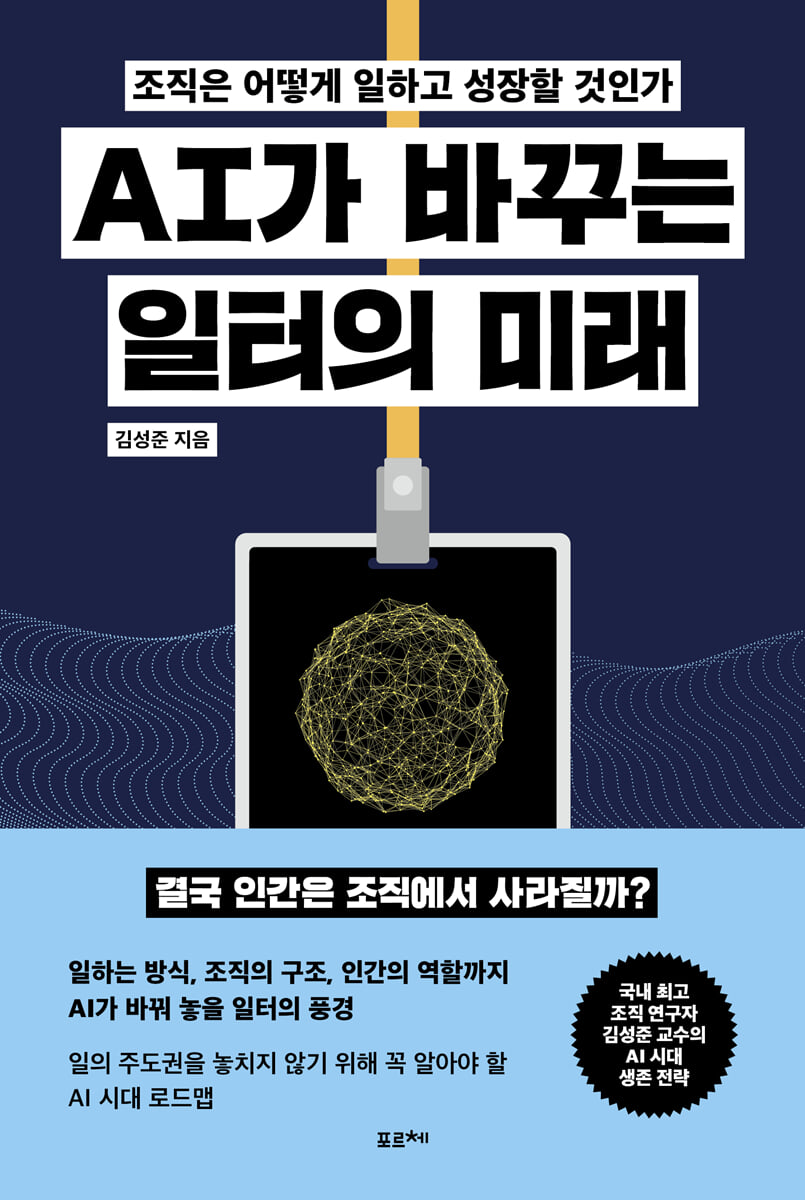
The Future of Workplace Transformed by AI
 |
Description
Book Introduction
Insights from Korea's top organizational expert on the future of the AI-era workplace.
A definitive guide with sharp insights into the nature of work and the future of organizations!
In-depth analysis and advice from Professor Kim Seong-jun, South Korea's leading organizational researcher.
Read past innovations and design future changes.
Amidst the massive wave of change known as artificial intelligence, the relationship between humans and organizations is being rewritten.
From general-purpose technologies to generative AI to autonomous AI agents, technological advancements are reshaping the workplace at an unprecedented pace.
These changes are directly linked to the anxiety of the 'end of jobs'.
However, Professor Kim Seong-jun, the author of this book and Korea's leading organizational researcher, defines this as the "evolution of work," and emphasizes that artificial intelligence is not a crisis, but a tool that can help us design better work and organizations.
Building on this foundation, the author combines over 20 years of research on organizational change with the latest AI trends to propose strategies that enable individuals and organizations to survive and thrive together.
In particular, we examine how past technological innovations, such as the steam engine, the telephone, and the Internet, have transformed the workplace, and predict the changes that generative artificial intelligence and agent technology will bring about. We then explore specific strategies and survival strategies for organizations that thrive alongside artificial intelligence.
This book offers a keen insight into the nature of work and the future of organizations. It guides readers and leaders concerned about the future of work to take the lead in the AI era by breaking down boundaries and realizing true collaboration.
A definitive guide with sharp insights into the nature of work and the future of organizations!
In-depth analysis and advice from Professor Kim Seong-jun, South Korea's leading organizational researcher.
Read past innovations and design future changes.
Amidst the massive wave of change known as artificial intelligence, the relationship between humans and organizations is being rewritten.
From general-purpose technologies to generative AI to autonomous AI agents, technological advancements are reshaping the workplace at an unprecedented pace.
These changes are directly linked to the anxiety of the 'end of jobs'.
However, Professor Kim Seong-jun, the author of this book and Korea's leading organizational researcher, defines this as the "evolution of work," and emphasizes that artificial intelligence is not a crisis, but a tool that can help us design better work and organizations.
Building on this foundation, the author combines over 20 years of research on organizational change with the latest AI trends to propose strategies that enable individuals and organizations to survive and thrive together.
In particular, we examine how past technological innovations, such as the steam engine, the telephone, and the Internet, have transformed the workplace, and predict the changes that generative artificial intelligence and agent technology will bring about. We then explore specific strategies and survival strategies for organizations that thrive alongside artificial intelligence.
This book offers a keen insight into the nature of work and the future of organizations. It guides readers and leaders concerned about the future of work to take the lead in the AI era by breaking down boundaries and realizing true collaboration.
- You can preview some of the book's contents.
Preview
index
Entering 4
Chapter 1: A History of Workplace Revolutions: From Steam Engines to the Internet, Technologies That Transformed the Office
Before Digital: 23 Work Built on Fingertips and Toes
How Has Technology Changed the Workplace? 29
How have general-purpose technologies changed the way we work? 56
Chapter 2: Generative AI: How Agents Will Transform the Workplace
The Birth of Generative AI and Agents 87
Change Outlook 1.
How Can AI Improve Efficiency? 105
Change Outlook 2.
How Will Artificial Intelligence Transform Learning? 126
Change Outlook 3.
How will artificial intelligence promote division of labor? 151
Change Outlook 4.
How Will AI Transform Collaboration? 165
Change Outlook 5.
How will artificial intelligence change the status and value of jobs? 203
Change Outlook 6.
How Will Artificial Intelligence Transform Decision-Making? 225
Change Outlook 7.
How Will Artificial Intelligence Transform Organizations and Their Boundaries? 266
Change Outlook 8.
What Happens to People in Organizations? 288
Eventually, you'll get used to it. Until then, survival is the issue. 310
Americas 316
Chapter 1: A History of Workplace Revolutions: From Steam Engines to the Internet, Technologies That Transformed the Office
Before Digital: 23 Work Built on Fingertips and Toes
How Has Technology Changed the Workplace? 29
How have general-purpose technologies changed the way we work? 56
Chapter 2: Generative AI: How Agents Will Transform the Workplace
The Birth of Generative AI and Agents 87
Change Outlook 1.
How Can AI Improve Efficiency? 105
Change Outlook 2.
How Will Artificial Intelligence Transform Learning? 126
Change Outlook 3.
How will artificial intelligence promote division of labor? 151
Change Outlook 4.
How Will AI Transform Collaboration? 165
Change Outlook 5.
How will artificial intelligence change the status and value of jobs? 203
Change Outlook 6.
How Will Artificial Intelligence Transform Decision-Making? 225
Change Outlook 7.
How Will Artificial Intelligence Transform Organizations and Their Boundaries? 266
Change Outlook 8.
What Happens to People in Organizations? 288
Eventually, you'll get used to it. Until then, survival is the issue. 310
Americas 316
Detailed image

Into the book
The world is now exploring and experimenting with the value and utility this technology can create.
Human experience with artificial intelligence is not yet sufficient to formulate specific hypotheses or predictions about how the workplace will change.
The rapidly developing artificial intelligence technology is like a runaway train that is running without knowing where its final destination is.
If we could know the ultimate state of technology, we could at least imagine how the world will change when we reach that destination, but the problem is that we have no way of predicting how far this technology will go.
---From "Entering"
Seeing the recent infiltration of artificial intelligence technology into various organizations and the dynamics it creates, I've become both curious and concerned.
Today, technology is everywhere, acting as our 'secretary' and 'alter ego'.
The realization that technology is not just a tool, but can reshape organizational order, human roles, and even the meaning of work came as a great shock, and that shock soon became a question.
"How will organizations change in the future? How will its members work? What kind of beings will humans be?" This book is the result of diligently exploring these questions.
---From "Entering"
Some scholars have defined technology in a way that encapsulates its trajectory.
For example, German scholar Karl Marx argued that “capital, by its very nature, seeks to overcome all spatial barriers, and in the process of realizing profit, it pursues the disappearance of space through time through the development of transportation and communication.”
This meant that technology had functioned as a tool to carry out the logic of capital—that is, the desire to expand faster, further, and into wider markets.
Some sociologists who have accepted this argument have defined industrialization as intensifying what is called "time-space compression."
---From "How have general-purpose technologies changed the way we work?"
In organizations overrun by fake work, so-called "productivity theater" takes place.
On the surface, everyone appears to be busy working, but if you look inside, you will see that the activities are repetitive and have no real value.
Employees are more likely to submit pointless reports to their superiors to demonstrate their sincerity.
You need to demonstrate your presence and contribution by responding in real time through messengers or collaboration tools.
While AI has improved the speed of work, the irony is that it has also resulted in a snowballing of worthless work within organizations.
In such organizations, increasing work efficiency often leads to increasing the total amount of fake work.
---「Change Outlook 1.
How can artificial intelligence improve efficiency?
We stand before a new question.
Is it truly optimal to divide tasks among individuals? Or is it wiser to tie them all together again, perhaps with AI? We previously examined the existence of "personally perceived efficiency," "cognitively estimated organizational efficiency," and "actually perceived organizational efficiency."
While AI can bring immediate efficiencies at the individual level, it may not bring about substantial change at the organizational level as long as the existing system, which is strictly divided into labor, remains in place.
---「Change Outlook 3.
How will artificial intelligence promote division of labor?
The waves of change are quiet but permeating deeply.
It's amazing how artificial intelligence, once considered nothing more than a tool, has taken a firm hold on many people's hearts.
Before we know it, people are sharing their emotions with artificial intelligence and even pondering the small details of life together.
Humans have always had relationships with new tools, but now they are even experiencing self-understanding and comfort within those relationships.
The line separating humans and machines is becoming increasingly blurred, and new 'private beings' are emerging in between.
This isn't just about technological advancement.
It touches on much more fundamental questions, like how we perceive others and who we can connect with deeply.
---「Change Outlook 4.
How will artificial intelligence change collaboration?
Critical challenges for organizations will be how to integrate AI as a new collaborative partner and how to support and manage the emotional and social relationships that develop between humans and AI.
Concepts such as bonding with colleagues, teamwork, and psychological safety may also evolve to include experiences interacting with AI.
We are now at the beginning of a new era of working with 'digital colleagues'.
What kind of social norms and culture will be formed in the future? What kind of emotional connection will humans have with artificial intelligence? We must now create the answers ourselves.
---「Change Outlook 4.
How will artificial intelligence change collaboration?
As the adoption of AI becomes more visible, organizations must take the lead and apply the following principles:
First, we need to clearly explain why it is changing, what is changing, and when and how it is changing.
Furthermore, we must clearly distinguish between areas that will be replaced by AI and areas that will be led by humans, and provide members with opportunities to develop the capabilities necessary to utilize AI.
Ultimately, we need to implement change step by step and commit to managing it with our members through ongoing communication.
---「Change Outlook 5.
How will artificial intelligence change the status and value of jobs?
The very concept of organization is being shaken to its core.
In the past, when economies of scale dominated, organizing more people and building larger facilities to secure cost efficiency and market dominance was the key to creating competitiveness.
As production volume increases, unit costs decrease, which allows for price competitiveness and maximized profits.
Naturally, organizational size and performance have become strongly linked, and the ability to effectively organize and manage a large workforce has become a critical requirement for corporate success.
---「Change Outlook 7.
How will artificial intelligence transform organizations and their boundaries?
If we become complacent in the face of those who are thoroughly optimizing the way they run their organizations and the way they execute them, rather than simply using AI as an additional complementary function, we could soon find ourselves at a significant disadvantage, leaving us with a gap that will be difficult to bridge.
Rather than being a source of competitive advantage, artificial intelligence could become a do-or-die technology.
We must survive in the face of this technology, which is like a gigantic tidal wave.
Everyone, whether it's an organization or an individual member within it.
Human experience with artificial intelligence is not yet sufficient to formulate specific hypotheses or predictions about how the workplace will change.
The rapidly developing artificial intelligence technology is like a runaway train that is running without knowing where its final destination is.
If we could know the ultimate state of technology, we could at least imagine how the world will change when we reach that destination, but the problem is that we have no way of predicting how far this technology will go.
---From "Entering"
Seeing the recent infiltration of artificial intelligence technology into various organizations and the dynamics it creates, I've become both curious and concerned.
Today, technology is everywhere, acting as our 'secretary' and 'alter ego'.
The realization that technology is not just a tool, but can reshape organizational order, human roles, and even the meaning of work came as a great shock, and that shock soon became a question.
"How will organizations change in the future? How will its members work? What kind of beings will humans be?" This book is the result of diligently exploring these questions.
---From "Entering"
Some scholars have defined technology in a way that encapsulates its trajectory.
For example, German scholar Karl Marx argued that “capital, by its very nature, seeks to overcome all spatial barriers, and in the process of realizing profit, it pursues the disappearance of space through time through the development of transportation and communication.”
This meant that technology had functioned as a tool to carry out the logic of capital—that is, the desire to expand faster, further, and into wider markets.
Some sociologists who have accepted this argument have defined industrialization as intensifying what is called "time-space compression."
---From "How have general-purpose technologies changed the way we work?"
In organizations overrun by fake work, so-called "productivity theater" takes place.
On the surface, everyone appears to be busy working, but if you look inside, you will see that the activities are repetitive and have no real value.
Employees are more likely to submit pointless reports to their superiors to demonstrate their sincerity.
You need to demonstrate your presence and contribution by responding in real time through messengers or collaboration tools.
While AI has improved the speed of work, the irony is that it has also resulted in a snowballing of worthless work within organizations.
In such organizations, increasing work efficiency often leads to increasing the total amount of fake work.
---「Change Outlook 1.
How can artificial intelligence improve efficiency?
We stand before a new question.
Is it truly optimal to divide tasks among individuals? Or is it wiser to tie them all together again, perhaps with AI? We previously examined the existence of "personally perceived efficiency," "cognitively estimated organizational efficiency," and "actually perceived organizational efficiency."
While AI can bring immediate efficiencies at the individual level, it may not bring about substantial change at the organizational level as long as the existing system, which is strictly divided into labor, remains in place.
---「Change Outlook 3.
How will artificial intelligence promote division of labor?
The waves of change are quiet but permeating deeply.
It's amazing how artificial intelligence, once considered nothing more than a tool, has taken a firm hold on many people's hearts.
Before we know it, people are sharing their emotions with artificial intelligence and even pondering the small details of life together.
Humans have always had relationships with new tools, but now they are even experiencing self-understanding and comfort within those relationships.
The line separating humans and machines is becoming increasingly blurred, and new 'private beings' are emerging in between.
This isn't just about technological advancement.
It touches on much more fundamental questions, like how we perceive others and who we can connect with deeply.
---「Change Outlook 4.
How will artificial intelligence change collaboration?
Critical challenges for organizations will be how to integrate AI as a new collaborative partner and how to support and manage the emotional and social relationships that develop between humans and AI.
Concepts such as bonding with colleagues, teamwork, and psychological safety may also evolve to include experiences interacting with AI.
We are now at the beginning of a new era of working with 'digital colleagues'.
What kind of social norms and culture will be formed in the future? What kind of emotional connection will humans have with artificial intelligence? We must now create the answers ourselves.
---「Change Outlook 4.
How will artificial intelligence change collaboration?
As the adoption of AI becomes more visible, organizations must take the lead and apply the following principles:
First, we need to clearly explain why it is changing, what is changing, and when and how it is changing.
Furthermore, we must clearly distinguish between areas that will be replaced by AI and areas that will be led by humans, and provide members with opportunities to develop the capabilities necessary to utilize AI.
Ultimately, we need to implement change step by step and commit to managing it with our members through ongoing communication.
---「Change Outlook 5.
How will artificial intelligence change the status and value of jobs?
The very concept of organization is being shaken to its core.
In the past, when economies of scale dominated, organizing more people and building larger facilities to secure cost efficiency and market dominance was the key to creating competitiveness.
As production volume increases, unit costs decrease, which allows for price competitiveness and maximized profits.
Naturally, organizational size and performance have become strongly linked, and the ability to effectively organize and manage a large workforce has become a critical requirement for corporate success.
---「Change Outlook 7.
How will artificial intelligence transform organizations and their boundaries?
If we become complacent in the face of those who are thoroughly optimizing the way they run their organizations and the way they execute them, rather than simply using AI as an additional complementary function, we could soon find ourselves at a significant disadvantage, leaving us with a gap that will be difficult to bridge.
Rather than being a source of competitive advantage, artificial intelligence could become a do-or-die technology.
We must survive in the face of this technology, which is like a gigantic tidal wave.
Everyone, whether it's an organization or an individual member within it.
---From "You eventually get used to it, until then, survival is the issue"
Publisher's Review
The history of technology is the history of the evolution of the workplace.
From steam engines to generative artificial intelligence,
The flow of technological revolution that changed the workplace
The 18th century steam engine revolutionized factories and transportation, revolutionizing the industrial revolution.
Then, with the successive appearance of electricity, telegraphs, telephones, computers, and the Internet, the human workplace expanded beyond physical limitations and reached the entire world.
Technology has not simply introduced machines; it has also increased work efficiency, reshaped collaboration, and constantly redefine the value and meaning of work.
Now we stand at another huge inflection point.
Generative artificial intelligence and agent technologies are penetrating the realm of human creativity and judgment, transforming the very methods of knowledge production and decision-making.
If past technologies primarily replaced 'hands and feet,' today's artificial intelligence extends to replacing 'heads and thoughts.'
In this book, Professor Kim Seong-jun traces the continuity of the workplace revolution that began with the steam engine, and sharply analyzes how the new general-purpose technology called artificial intelligence will transform organizational structures, collaboration methods, job values, and even the meaning of humanity.
While he cautions against the fear of "replacement" brought about by technological advancements, he emphasizes that only organizations and individuals that evolve alongside artificial intelligence can become the protagonists of the new era.
Focus on human interaction and creative activities.
In today's world where technology is ubiquitous,
Organizational Strategies and Solutions to Restore Humanity
As technology becomes more pervasive, ironically, human-to-human conversations are rapidly declining.
Emoticons replace smiles on screens, algorithms determine our tastes, and in our busy schedules, we have lost the time to deeply read each other's expressions and voices.
As a result, disconnection and psychological isolation within organizations are deepening, which in turn leads to anxiety and fatigue.
In this situation, artificial intelligence should not be limited to being a ‘tool for efficiency.’
Depending on how we use AI, we can either further alienate humanity or, conversely, strengthen its protection.
To this end, the author argues that organizations must prioritize "member well-being" as a core strategy and create a "human space" that technology cannot invade.
This means that instead of reducing meeting time, we should design it so that members have more time to talk to each other, and people can focus on more creative and meaningful activities based on tasks automated by AI.
Furthermore, he says that establishing an independent organization such as the "Committee for the Defense of Humanity" could be a solution in the process of introducing artificial intelligence.
This committee continuously monitors the impact of artificial intelligence on organizational operations and provides guidelines to protect the psychological and emotional health of its members.
Ultimately, this book emphasizes that the true value of technological advancement lies not only in efficiency, but also in preserving 'humanity.'
As the author says, "In an era where artificial intelligence assists with many functions, small, loose, yet warm connections between people become the lifeblood of an organization," let's open this book and reflect on the importance of reclaiming our "lost humanity."
From steam engines to generative artificial intelligence,
The flow of technological revolution that changed the workplace
The 18th century steam engine revolutionized factories and transportation, revolutionizing the industrial revolution.
Then, with the successive appearance of electricity, telegraphs, telephones, computers, and the Internet, the human workplace expanded beyond physical limitations and reached the entire world.
Technology has not simply introduced machines; it has also increased work efficiency, reshaped collaboration, and constantly redefine the value and meaning of work.
Now we stand at another huge inflection point.
Generative artificial intelligence and agent technologies are penetrating the realm of human creativity and judgment, transforming the very methods of knowledge production and decision-making.
If past technologies primarily replaced 'hands and feet,' today's artificial intelligence extends to replacing 'heads and thoughts.'
In this book, Professor Kim Seong-jun traces the continuity of the workplace revolution that began with the steam engine, and sharply analyzes how the new general-purpose technology called artificial intelligence will transform organizational structures, collaboration methods, job values, and even the meaning of humanity.
While he cautions against the fear of "replacement" brought about by technological advancements, he emphasizes that only organizations and individuals that evolve alongside artificial intelligence can become the protagonists of the new era.
Focus on human interaction and creative activities.
In today's world where technology is ubiquitous,
Organizational Strategies and Solutions to Restore Humanity
As technology becomes more pervasive, ironically, human-to-human conversations are rapidly declining.
Emoticons replace smiles on screens, algorithms determine our tastes, and in our busy schedules, we have lost the time to deeply read each other's expressions and voices.
As a result, disconnection and psychological isolation within organizations are deepening, which in turn leads to anxiety and fatigue.
In this situation, artificial intelligence should not be limited to being a ‘tool for efficiency.’
Depending on how we use AI, we can either further alienate humanity or, conversely, strengthen its protection.
To this end, the author argues that organizations must prioritize "member well-being" as a core strategy and create a "human space" that technology cannot invade.
This means that instead of reducing meeting time, we should design it so that members have more time to talk to each other, and people can focus on more creative and meaningful activities based on tasks automated by AI.
Furthermore, he says that establishing an independent organization such as the "Committee for the Defense of Humanity" could be a solution in the process of introducing artificial intelligence.
This committee continuously monitors the impact of artificial intelligence on organizational operations and provides guidelines to protect the psychological and emotional health of its members.
Ultimately, this book emphasizes that the true value of technological advancement lies not only in efficiency, but also in preserving 'humanity.'
As the author says, "In an era where artificial intelligence assists with many functions, small, loose, yet warm connections between people become the lifeblood of an organization," let's open this book and reflect on the importance of reclaiming our "lost humanity."
GOODS SPECIFICS
- Date of issue: August 27, 2025
- Page count, weight, size: 336 pages | 578g | 145*216*21mm
- ISBN13: 9791194634485
- ISBN10: 1194634486
You may also like
카테고리
korean


korean

![GQ KOREA Mark (Monthly): December [2025]](http://librairie.coreenne.fr/cdn/shop/files/8ef265dbbfbf186523ed75ba7319009d.jpg?v=1765340328&width=3840)


