

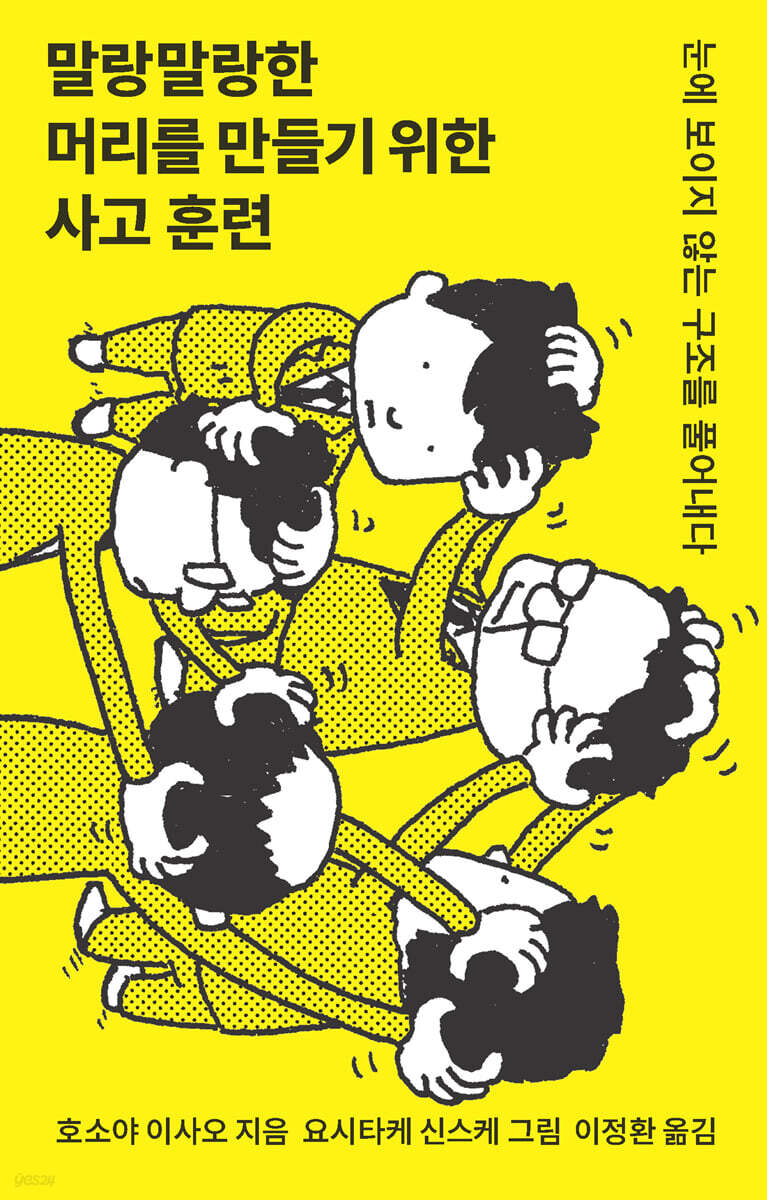
Thought training to create soft hair
 |
Description
Book Introduction
My head is completely blocked and won't turn at all,
I wonder if it's because I've gotten older and it's become hard.
Or for change
Fear or rejection is ingrained in the body
Does it hinder flexible thinking?
Changing your mindset is easy to say, but really hard.
Thinking training that leads to flexible and innovative ideas
Understand the invisible thought structure!
The genius of ideas, Shinsuke Yoshitake
Includes witty illustrations!
A thought circuit that leads to free thinking
How confident are you in the accuracy of your perspective or way of thinking? Simply developing the habit of questioning and shifting your perspective and axis of thought will infinitely expand your thinking and enable free thinking.
Everyone tends to insist on their own standards, to judge the whole by looking at only one side of things, or to think that their values are absolute.
Although each person has their own way of life, it can have negative effects, such as not being able to narrow the gap in perception with those around them or not being able to come up with new ideas.
"Thought Training for a Soft Brain" explains that understanding invisible thought structures enables rapid change of thinking and can lead to positive evaluations in interpersonal relationships and work abilities.
The genius of ideas, Shinsuke Yoshitake, who has published bestsellers such as "Is This Really an Apple?" and "I Shouldn't Have Taken It Off," has drawn illustrations that not only make the content easier to understand but also more enjoyable.
I wonder if it's because I've gotten older and it's become hard.
Or for change
Fear or rejection is ingrained in the body
Does it hinder flexible thinking?
Changing your mindset is easy to say, but really hard.
Thinking training that leads to flexible and innovative ideas
Understand the invisible thought structure!
The genius of ideas, Shinsuke Yoshitake
Includes witty illustrations!
A thought circuit that leads to free thinking
How confident are you in the accuracy of your perspective or way of thinking? Simply developing the habit of questioning and shifting your perspective and axis of thought will infinitely expand your thinking and enable free thinking.
Everyone tends to insist on their own standards, to judge the whole by looking at only one side of things, or to think that their values are absolute.
Although each person has their own way of life, it can have negative effects, such as not being able to narrow the gap in perception with those around them or not being able to come up with new ideas.
"Thought Training for a Soft Brain" explains that understanding invisible thought structures enables rapid change of thinking and can lead to positive evaluations in interpersonal relationships and work abilities.
The genius of ideas, Shinsuke Yoshitake, who has published bestsellers such as "Is This Really an Apple?" and "I Shouldn't Have Taken It Off," has drawn illustrations that not only make the content easier to understand but also more enjoyable.
- You can preview some of the book's contents.
Preview
index
preface
CHAPTER 1: Recognizing Rigid Thinking Habits
1.
The thought circuit determines the action
2.
The beginning determines the end
3.
Being far away helps
4.
It's already been resolved at the moment of realization
5.
It's harder to think simply
6.
Everyone thinks 'I'm special'
7.
Think outside the box
CHAPTER 2 Understanding the Mechanism of Thought Through the Laws of Physics
1.
The physical world and the spiritual world
2.
The law of action and reaction
3.
The Doppler effect of the mind
4.
Everything has an upstream and a downstream.
5.
It is decided who will be eroded
6.
Fractal structures are everywhere
CHAPTER 3: A Shift in Thinking That Doubles Your Thinking Power
1.
Assets eventually become a 'burden'
2.
Is the opposite of success failure?
3.
Which one is correct
4.
Common sense becomes nonsense, and nonsense becomes common sense.
5.
The Benefits and Risks of Drawing Lines 1
6.
People who lack ideas rely on numbers.
7.
Independent travel or package tours: which is better?
8.
It's better to divide things into smaller groups than to group them into large groups 1 4 7
9.
Use large and small bundles appropriately.
CHAPTER 4 A Very Unexpected Perspective for Flexible Thinking
1.
The difference between logic and emotion
2.
The back-and-forth process of concrete and abstract thinking
3.
Will it have form or will it have content?
4.
Concepts of time and money
5.
The difference between 'same' and 'different'
6.
Determinist and probabilist thinking
7.
High and low degrees of freedom
8.
An unexpected perspective on choosing a job
After finishing
Paperback review
CHAPTER 1: Recognizing Rigid Thinking Habits
1.
The thought circuit determines the action
2.
The beginning determines the end
3.
Being far away helps
4.
It's already been resolved at the moment of realization
5.
It's harder to think simply
6.
Everyone thinks 'I'm special'
7.
Think outside the box
CHAPTER 2 Understanding the Mechanism of Thought Through the Laws of Physics
1.
The physical world and the spiritual world
2.
The law of action and reaction
3.
The Doppler effect of the mind
4.
Everything has an upstream and a downstream.
5.
It is decided who will be eroded
6.
Fractal structures are everywhere
CHAPTER 3: A Shift in Thinking That Doubles Your Thinking Power
1.
Assets eventually become a 'burden'
2.
Is the opposite of success failure?
3.
Which one is correct
4.
Common sense becomes nonsense, and nonsense becomes common sense.
5.
The Benefits and Risks of Drawing Lines 1
6.
People who lack ideas rely on numbers.
7.
Independent travel or package tours: which is better?
8.
It's better to divide things into smaller groups than to group them into large groups 1 4 7
9.
Use large and small bundles appropriately.
CHAPTER 4 A Very Unexpected Perspective for Flexible Thinking
1.
The difference between logic and emotion
2.
The back-and-forth process of concrete and abstract thinking
3.
Will it have form or will it have content?
4.
Concepts of time and money
5.
The difference between 'same' and 'different'
6.
Determinist and probabilist thinking
7.
High and low degrees of freedom
8.
An unexpected perspective on choosing a job
After finishing
Paperback review
Detailed image

Into the book
“I should have studied more when I was younger….”
“If only I had studied English properly….”
“If I could go back to being a high school student right now….”
There are times when I regret things like this.
But in most cases, these regrets about 'if only' would likely not change even if you were to go back in time.
It is a common saying that “It is foolish to regret when you die,” but even in this case, knowing this fact in advance rarely leads to a different life.
For example, most people would agree that “I should have done what I liked without caring about what other people thought,” but people who have lived their lives caring about what other people thought would likely live the same life if they were to go back in time.
At that time, each choice would have been the best or second best option.
--- p.17~18
‘Changing the thought circuit’ is difficult and takes time.
In particular, 'changing' another person's thought process is time-consuming and difficult.
On the other hand, once achieved, there is a huge advantage in that all actions change at once without having to respond individually.
I completely understand the desire to yell, “How many times do I have to tell you until you understand?” But people who hear this kind of thing have basically not changed their way of thinking, so even if you point out their behavior hundreds of times, they will immediately revert to their original state.
So unless you think of another way to change your thought process, it's a waste of time no matter how many times you say it.
--- p.21
The worry that nothing can last long can also be thought of as meaning that you can constantly challenge yourself with new things.
In other words, it can be seen as ‘continuing to challenge new things.’
If you take 'how to end' as your standard, it may seem like a disadvantage at first glance, but if you take 'how to start' as your standard, it can be an advantage.
Likewise, the disadvantage of the 'starting method' of not being able to start because you are always thinking about this and that can be turned into the advantage of the 'finishing method' of not being able to quit.
--- p.28
“Read not only the object in front of you, but also what lies ahead and act accordingly.”
“The meaning lies in continuing consistently.”
Self-help books, training sessions, and lectures often present a few simple messages in a condensed form.
But these are messages that we have actually heard countless times from our parents and school teachers since we were young.
Why do we still pay to hear the same words or read the same books even as adults? It seems humans are more inclined to listen to advice from those "far away."
It's like listening to the advice of relatives more than parents, school teachers more than relatives, and academy teachers more than school teachers.
“If only I had studied English properly….”
“If I could go back to being a high school student right now….”
There are times when I regret things like this.
But in most cases, these regrets about 'if only' would likely not change even if you were to go back in time.
It is a common saying that “It is foolish to regret when you die,” but even in this case, knowing this fact in advance rarely leads to a different life.
For example, most people would agree that “I should have done what I liked without caring about what other people thought,” but people who have lived their lives caring about what other people thought would likely live the same life if they were to go back in time.
At that time, each choice would have been the best or second best option.
--- p.17~18
‘Changing the thought circuit’ is difficult and takes time.
In particular, 'changing' another person's thought process is time-consuming and difficult.
On the other hand, once achieved, there is a huge advantage in that all actions change at once without having to respond individually.
I completely understand the desire to yell, “How many times do I have to tell you until you understand?” But people who hear this kind of thing have basically not changed their way of thinking, so even if you point out their behavior hundreds of times, they will immediately revert to their original state.
So unless you think of another way to change your thought process, it's a waste of time no matter how many times you say it.
--- p.21
The worry that nothing can last long can also be thought of as meaning that you can constantly challenge yourself with new things.
In other words, it can be seen as ‘continuing to challenge new things.’
If you take 'how to end' as your standard, it may seem like a disadvantage at first glance, but if you take 'how to start' as your standard, it can be an advantage.
Likewise, the disadvantage of the 'starting method' of not being able to start because you are always thinking about this and that can be turned into the advantage of the 'finishing method' of not being able to quit.
--- p.28
“Read not only the object in front of you, but also what lies ahead and act accordingly.”
“The meaning lies in continuing consistently.”
Self-help books, training sessions, and lectures often present a few simple messages in a condensed form.
But these are messages that we have actually heard countless times from our parents and school teachers since we were young.
Why do we still pay to hear the same words or read the same books even as adults? It seems humans are more inclined to listen to advice from those "far away."
It's like listening to the advice of relatives more than parents, school teachers more than relatives, and academy teachers more than school teachers.
--- p.30~31
Publisher's Review
Your thinking habits determine your actions.
They say the opposite of success is not failure, but 'doing nothing.'
Will current common sense remain common sense as times change? What if common sense doesn't even cross national borders? If the opposite of "for" is based on the presence or absence of an opinion, "against" is not "against," but "no opinion."
In this way, our ideas, convictions, and thoughts that are standardized and fixed become fixed like habits and become the mechanism that determines our actions and judgments.
The author, a business consultant and columnist, says in his book, "Thinking Training for a Flexible Mind," that the most important and difficult thing to do to think flexibly is to "recognize that you don't have flexible thinking."
As with anything, most problems are solved the moment they are recognized.
It's a common story, but people with really low communication skills don't read 'books to improve communication skills,' and really incompetent bosses don't read 'books for incompetent bosses.'
In other words, the most serious problem is not being able to 'realize' what is happening.
'I'm probably quite flexible, aren't I?' If you find yourself thinking this way, it might be time to question your train of thought.
A 'soft-headed person' is someone who realizes that they lack flexible thinking habits and actively adopts new perspectives and changes their way of thinking about things and tasks.
In today's rapidly changing society, those who cling to the old ways and reject new perspectives or values are not only shunned as "old farts," but are also never welcomed in business or interpersonal relationships.
Do you need a softer head? Do you want to live a more fulfilling and nourishing life? If so, this book will help.
Flexible thinking requires a subtractive mindset.
In today's world, the ripple effects of change are so rapid and large-scale that we are accelerating an era of uncertainty and unpredictability.
In times like these, the importance of 'soft hair', the theme of this book, is highlighted even more.
In a time of rapid change, where past precedents no longer apply, we must 'think for ourselves and make decisions' by selecting appropriate information from the vast amount of information overflowing in the world.
What you need at this time is ‘soft hair’.
AI technologies such as ChatGPT are spurring this movement.
How we utilize AI, which 'knows almost all' of the information and knowledge accumulated by humanity, is a problem that depends on us humans.
Now, what is required is not 'how to have a large amount of knowledge', but 'how to utilize' the vast amount of AI knowledge, the so-called 'prompt engineering' technology.
Prompt engineering requires a 'subtractive' mindset, like carving a piece of stone or wood to create a specific shape, rather than an additive mindset like painting, which creates something from nothing.
It is meaningless for humans to compete based on the amount of knowledge they possess.
Rather, it is important to discover meaningful new insights by subtracting as if sculpting.
To do so, you need a truly 'soft mind' that can shake off prejudice and preconceptions, observe the subject from various perspectives, and discover your own unique perspective.
If you want to come up with groundbreaking ideas and build smooth relationships, you need to make your hardened brain 'soft'.
Develop the habit of thinking outside the box! Remember that the law of action and reaction applies to human relationships! Remember that common sense can become absurd, and absurdity can become common sense!
They say the opposite of success is not failure, but 'doing nothing.'
Will current common sense remain common sense as times change? What if common sense doesn't even cross national borders? If the opposite of "for" is based on the presence or absence of an opinion, "against" is not "against," but "no opinion."
In this way, our ideas, convictions, and thoughts that are standardized and fixed become fixed like habits and become the mechanism that determines our actions and judgments.
The author, a business consultant and columnist, says in his book, "Thinking Training for a Flexible Mind," that the most important and difficult thing to do to think flexibly is to "recognize that you don't have flexible thinking."
As with anything, most problems are solved the moment they are recognized.
It's a common story, but people with really low communication skills don't read 'books to improve communication skills,' and really incompetent bosses don't read 'books for incompetent bosses.'
In other words, the most serious problem is not being able to 'realize' what is happening.
'I'm probably quite flexible, aren't I?' If you find yourself thinking this way, it might be time to question your train of thought.
A 'soft-headed person' is someone who realizes that they lack flexible thinking habits and actively adopts new perspectives and changes their way of thinking about things and tasks.
In today's rapidly changing society, those who cling to the old ways and reject new perspectives or values are not only shunned as "old farts," but are also never welcomed in business or interpersonal relationships.
Do you need a softer head? Do you want to live a more fulfilling and nourishing life? If so, this book will help.
Flexible thinking requires a subtractive mindset.
In today's world, the ripple effects of change are so rapid and large-scale that we are accelerating an era of uncertainty and unpredictability.
In times like these, the importance of 'soft hair', the theme of this book, is highlighted even more.
In a time of rapid change, where past precedents no longer apply, we must 'think for ourselves and make decisions' by selecting appropriate information from the vast amount of information overflowing in the world.
What you need at this time is ‘soft hair’.
AI technologies such as ChatGPT are spurring this movement.
How we utilize AI, which 'knows almost all' of the information and knowledge accumulated by humanity, is a problem that depends on us humans.
Now, what is required is not 'how to have a large amount of knowledge', but 'how to utilize' the vast amount of AI knowledge, the so-called 'prompt engineering' technology.
Prompt engineering requires a 'subtractive' mindset, like carving a piece of stone or wood to create a specific shape, rather than an additive mindset like painting, which creates something from nothing.
It is meaningless for humans to compete based on the amount of knowledge they possess.
Rather, it is important to discover meaningful new insights by subtracting as if sculpting.
To do so, you need a truly 'soft mind' that can shake off prejudice and preconceptions, observe the subject from various perspectives, and discover your own unique perspective.
If you want to come up with groundbreaking ideas and build smooth relationships, you need to make your hardened brain 'soft'.
Develop the habit of thinking outside the box! Remember that the law of action and reaction applies to human relationships! Remember that common sense can become absurd, and absurdity can become common sense!
GOODS SPECIFICS
- Date of issue: July 18, 2025
- Page count, weight, size: 228 pages | 128*200*14mm
- ISBN13: 9791162183595
- ISBN10: 1162183594
You may also like
카테고리
korean


korean

![GQ KOREA Mark (Monthly): December [2025]](http://librairie.coreenne.fr/cdn/shop/files/8ef265dbbfbf186523ed75ba7319009d.jpg?v=1765340328&width=3840)


