

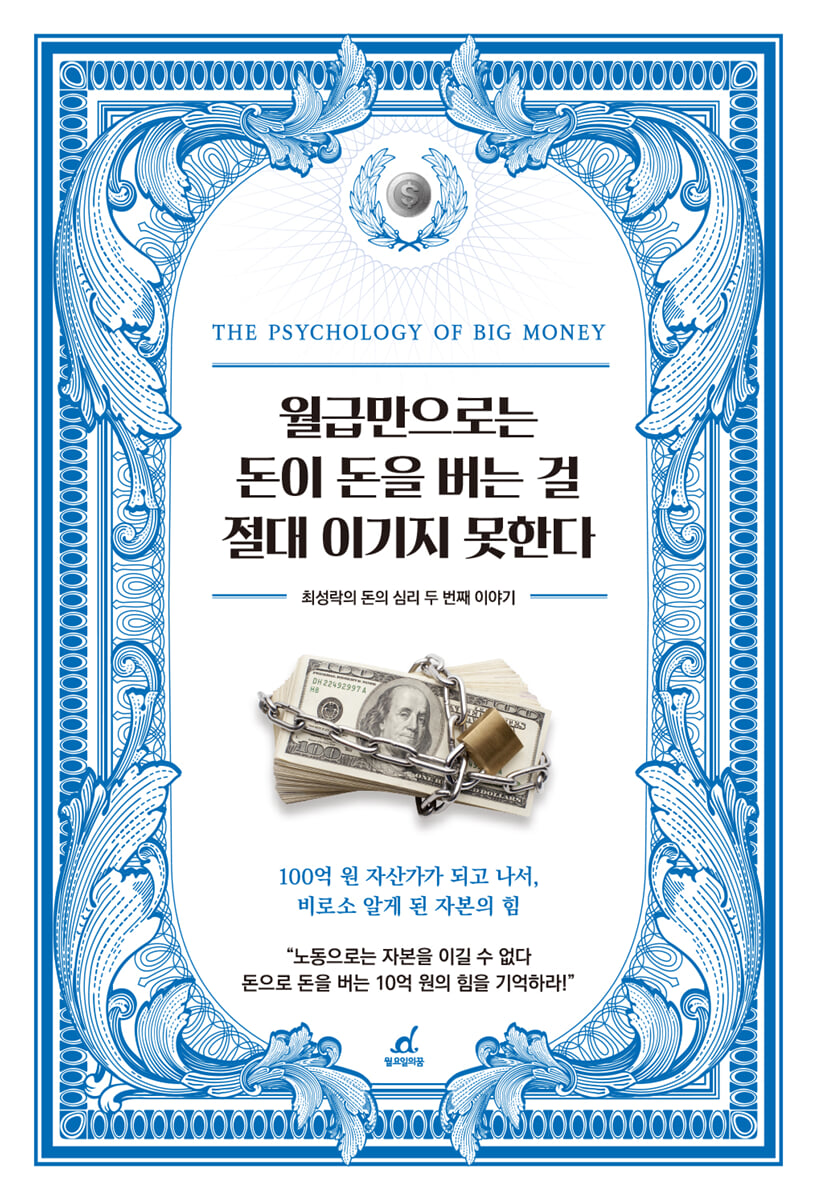
Money can never beat making money with just a salary.
 |
Description
Book Introduction
After becoming a 10 billion won asset owner,
The power of capital that I finally discovered!
Psychological Experiment Results Reveal the Psychology, Properties, and Power of Money
Labor cannot defeat capital.
Remember the power of 1 billion won to make money with money!”
We are now living in a capitalist society.
So what does it mean to live in a capitalist society? Former Professor Choi Seong-rak (currently the director of SR Economic Research Institute), who started out as a salaried worker, then transformed his life by investing in stocks and Bitcoin, becoming a member of the FIRE tribe. After entering the so-called world of the wealthy, he came to understand the true nature of the capitalist world.
And after becoming a billionaire, he summarized the meaning of living in a capitalist society in his new book, “Wage alone can never beat making money.”
“As your assets grow, your way of thinking about money will gradually change.
There are also some differences in interpretation of what people mean when they talk about money.
(…) The story of this book is a compilation of such stories.
I don't think the stories about rich people and money in this book are true.
As your wealth grows and your age changes, your perspective on wealth and money may change.
In other words, the story of this book is a perspective on the rich and money from the perspective of my current assets (about 10 billion won)” (from the preface).
As in his previous work, "How Money Moves the Human Heart," the author provides readers with insights into the "psychology of money, its properties, and its power" based on various experiments and research results from behavioral economics, psychology, and investment studies.
In particular, readers will be reminded of the truth that we need to understand the psychology and properties of money because we live in a capitalist era.
The power of capital that I finally discovered!
Psychological Experiment Results Reveal the Psychology, Properties, and Power of Money
Labor cannot defeat capital.
Remember the power of 1 billion won to make money with money!”
We are now living in a capitalist society.
So what does it mean to live in a capitalist society? Former Professor Choi Seong-rak (currently the director of SR Economic Research Institute), who started out as a salaried worker, then transformed his life by investing in stocks and Bitcoin, becoming a member of the FIRE tribe. After entering the so-called world of the wealthy, he came to understand the true nature of the capitalist world.
And after becoming a billionaire, he summarized the meaning of living in a capitalist society in his new book, “Wage alone can never beat making money.”
“As your assets grow, your way of thinking about money will gradually change.
There are also some differences in interpretation of what people mean when they talk about money.
(…) The story of this book is a compilation of such stories.
I don't think the stories about rich people and money in this book are true.
As your wealth grows and your age changes, your perspective on wealth and money may change.
In other words, the story of this book is a perspective on the rich and money from the perspective of my current assets (about 10 billion won)” (from the preface).
As in his previous work, "How Money Moves the Human Heart," the author provides readers with insights into the "psychology of money, its properties, and its power" based on various experiments and research results from behavioral economics, psychology, and investment studies.
In particular, readers will be reminded of the truth that we need to understand the psychology and properties of money because we live in a capitalist era.
- You can preview some of the book's contents.
Preview
index
Things you can only see after becoming a billionaire
Chapter 1: The Psychology of Money, the Properties of Money, and the Power of Money
01 Money, Confucius said 'a small person', Socrates said 'a good thing'
02 It is easy to get your money back if you lose it if you have cash in your wallet.
03 Why spending your own money is different from spending someone else's money
04 The more money you have, the more satisfied you become with life.
05 The reason for the increase in perception, money that relieves the feeling of guilt
06 The Placebo Effect of Money, “Expensive is better after all!”
07 Without money, relationships are lost.
Chapter 2: I'm Rich, But Why?
01 Why are rich people so indifferent to those around them?
02 Neophobia: Why Steve Jobs Insisted on Black T-Shirts
03 Why a billionaire with assets of 10 billion won stopped standing and sat on the train floor
04 Investors feel more joy from an investment return of 200 million won than from 1 billion won in "public money."
05 Why do older people leave this world without spending money?
Chapter 3 Living in a Capitalist Society
01 The standard for the rich: property rather than income
02 Why a Capitalist Society is Better than a Class Society
03 Henry George and Thomas Piketty, Let's Read Honestly
04 When basic income is implemented, invest in luxury real estate!
05 The Venetian Merchant's "Contract" That Even Rulers and Judges Couldn't Break
06 Things Money Can't Buy, Things You Can't Buy in Poverty
07 Your Boss Already Knows About Your Quiet Resignation
08 Noomp, "Welfare is great! But I can't afford more."
09 Why the Rich Can't Continue to Help the Poor
10 The inside story of a multi-family homeowner
You can never win on just November paychecks, return on capital vs. return on labor.
Chapter 4: Things to Remember When Investing
01 Long-term investment: diversification over knowledge and information
02 The turning point of making money with money, the power of 1 billion won
Why I Didn't Sell Nvidia, Even Though It Was the World's Largest Stock by Market Cap, Bought for $8
04 The 11-year cycle of economic crises: Prepare for a crash to make a fortune.
05 Positive Thinking and Wealth
06 Why You Can't Get Out of a Stock Market Crash: The Psychological Fallacy of Sunk Costs
Why did Bitcoin plummet immediately after martial law was declared on December 3, 2017?
08 US Stock User Guide
Chapter 5 Money, “Earn honestly and spend it nobly!”
01 Like the steel king Carnegie
02 Like the great king Cyrus, “Earn honestly and spend noblely.”
Chapter 1: The Psychology of Money, the Properties of Money, and the Power of Money
01 Money, Confucius said 'a small person', Socrates said 'a good thing'
02 It is easy to get your money back if you lose it if you have cash in your wallet.
03 Why spending your own money is different from spending someone else's money
04 The more money you have, the more satisfied you become with life.
05 The reason for the increase in perception, money that relieves the feeling of guilt
06 The Placebo Effect of Money, “Expensive is better after all!”
07 Without money, relationships are lost.
Chapter 2: I'm Rich, But Why?
01 Why are rich people so indifferent to those around them?
02 Neophobia: Why Steve Jobs Insisted on Black T-Shirts
03 Why a billionaire with assets of 10 billion won stopped standing and sat on the train floor
04 Investors feel more joy from an investment return of 200 million won than from 1 billion won in "public money."
05 Why do older people leave this world without spending money?
Chapter 3 Living in a Capitalist Society
01 The standard for the rich: property rather than income
02 Why a Capitalist Society is Better than a Class Society
03 Henry George and Thomas Piketty, Let's Read Honestly
04 When basic income is implemented, invest in luxury real estate!
05 The Venetian Merchant's "Contract" That Even Rulers and Judges Couldn't Break
06 Things Money Can't Buy, Things You Can't Buy in Poverty
07 Your Boss Already Knows About Your Quiet Resignation
08 Noomp, "Welfare is great! But I can't afford more."
09 Why the Rich Can't Continue to Help the Poor
10 The inside story of a multi-family homeowner
You can never win on just November paychecks, return on capital vs. return on labor.
Chapter 4: Things to Remember When Investing
01 Long-term investment: diversification over knowledge and information
02 The turning point of making money with money, the power of 1 billion won
Why I Didn't Sell Nvidia, Even Though It Was the World's Largest Stock by Market Cap, Bought for $8
04 The 11-year cycle of economic crises: Prepare for a crash to make a fortune.
05 Positive Thinking and Wealth
06 Why You Can't Get Out of a Stock Market Crash: The Psychological Fallacy of Sunk Costs
Why did Bitcoin plummet immediately after martial law was declared on December 3, 2017?
08 US Stock User Guide
Chapter 5 Money, “Earn honestly and spend it nobly!”
01 Like the steel king Carnegie
02 Like the great king Cyrus, “Earn honestly and spend noblely.”
Into the book
After becoming so-called rich, I got to know many rich people around me.
Sometimes you find out that someone you knew before is rich, and sometimes you meet someone new.
That doesn't mean I know everything that every rich person thinks.
Even if a person is rich, whether they are worth 2 billion won, 5 billion won, 10 billion won, 50 billion won, or 100 billion won, they are not all the same.
There is a difference between someone with tens of millions of won, someone with 100 million won, and someone with 1 billion won.
I can only know the extent of my wealth.
Still, I can understand that much.
It was a world I would never have known about if I hadn't been rich.
--- p.8, from the "Preface"
Money stimulates people's morality.
The 18,800 won I initially put in my wallet is not a large sum of money.
The owner of the wallet will not experience great difficulties without this amount of money, and he will not gain much benefit from keeping this amount of money.
However, the rate of people willing to return a wallet increased significantly when there was 18,800 won in the wallet.
It's not because 18,800 won is a lot of money.
Even if it was a small amount of money, there was a resistance to keeping it for oneself.
There has also been an increase in empathy for those who have lost money, even if it is only a small amount.
A wallet without money can be ignored, but a wallet with money cannot be ignored.
The sense of justice and morality that the wallet should be returned to its owner for only 18,800 won has grown stronger.
As the amount of money increases, so does the sense of justice and morality.
It is difficult to find any other reason for the fact that more than 70% of people tried to return a wallet containing 130,000 won.
Money is not simply a material means.
There are moral values in it.
Even a small amount of money can touch people's moral values and change their behavior.
This is why problems arise when money is distributed only as a use value or exchange value.
Money is associated with moral feelings.
This is probably the biggest characteristic of money that sets it apart from other things.
--- pp.28-29, from “Chapter 1: The Psychology of Money, the Properties of Money, the Power of Money”
There may be some debate as to which of these three reasons parents give for more tardiness is more valid when it comes to imposing fines.
One thing is clear, however, that paying money will lessen the feeling of guilt towards the other person.
I have feelings like, 'Wouldn't the teacher be angry?', 'Wouldn't this be putting an unfair burden on the teacher?', 'Wouldn't this be making the teacher sacrifice himself?', but if I pay, these feelings of guilt are greatly reduced.
Money serves to dilute your own feelings of guilt by making the other person feel that they have paid a fair price.
Is this a bad thing?
I don't think it's bad.
Some might say that it is better to feel sorry than to have money.
But is it true that expressing sorry with words means you really feel sorry?
There may be cases like that, but most of the time it's just lip service to get out of that situation.
Wouldn't money or material things be better than such lip service?
That is why the saying, “A small person apologizes with words, but a gentleman apologizes with things” came about.
In conclusion, money dilutes feelings of regret.
It's about giving money and taking the guilt away.
This can be seen as another effect of money, whether good or bad.
This is why we need the wisdom to put our hearts into money.
--- pp.52-53, from “Chapter 1: The Psychology of Money, the Properties of Money, the Power of Money”
Michael Sandel believes that in areas such as morality, social justice, civic virtue, and human life, it is desirable that transactions involving money do not take place.
This claim is correct.
No one wants anything in this field to be traded for money.
But to do that, more money is needed in this field.
The problem is mostly due to lack of money or lack of money.
The problems in "What Money Can't Buy" are actually things that wouldn't have been problems in the first place if there was enough money.
It would be wrong to look at this and think, 'Money isn't that important' or 'There are many things more important than money.'
Sometimes you find out that someone you knew before is rich, and sometimes you meet someone new.
That doesn't mean I know everything that every rich person thinks.
Even if a person is rich, whether they are worth 2 billion won, 5 billion won, 10 billion won, 50 billion won, or 100 billion won, they are not all the same.
There is a difference between someone with tens of millions of won, someone with 100 million won, and someone with 1 billion won.
I can only know the extent of my wealth.
Still, I can understand that much.
It was a world I would never have known about if I hadn't been rich.
--- p.8, from the "Preface"
Money stimulates people's morality.
The 18,800 won I initially put in my wallet is not a large sum of money.
The owner of the wallet will not experience great difficulties without this amount of money, and he will not gain much benefit from keeping this amount of money.
However, the rate of people willing to return a wallet increased significantly when there was 18,800 won in the wallet.
It's not because 18,800 won is a lot of money.
Even if it was a small amount of money, there was a resistance to keeping it for oneself.
There has also been an increase in empathy for those who have lost money, even if it is only a small amount.
A wallet without money can be ignored, but a wallet with money cannot be ignored.
The sense of justice and morality that the wallet should be returned to its owner for only 18,800 won has grown stronger.
As the amount of money increases, so does the sense of justice and morality.
It is difficult to find any other reason for the fact that more than 70% of people tried to return a wallet containing 130,000 won.
Money is not simply a material means.
There are moral values in it.
Even a small amount of money can touch people's moral values and change their behavior.
This is why problems arise when money is distributed only as a use value or exchange value.
Money is associated with moral feelings.
This is probably the biggest characteristic of money that sets it apart from other things.
--- pp.28-29, from “Chapter 1: The Psychology of Money, the Properties of Money, the Power of Money”
There may be some debate as to which of these three reasons parents give for more tardiness is more valid when it comes to imposing fines.
One thing is clear, however, that paying money will lessen the feeling of guilt towards the other person.
I have feelings like, 'Wouldn't the teacher be angry?', 'Wouldn't this be putting an unfair burden on the teacher?', 'Wouldn't this be making the teacher sacrifice himself?', but if I pay, these feelings of guilt are greatly reduced.
Money serves to dilute your own feelings of guilt by making the other person feel that they have paid a fair price.
Is this a bad thing?
I don't think it's bad.
Some might say that it is better to feel sorry than to have money.
But is it true that expressing sorry with words means you really feel sorry?
There may be cases like that, but most of the time it's just lip service to get out of that situation.
Wouldn't money or material things be better than such lip service?
That is why the saying, “A small person apologizes with words, but a gentleman apologizes with things” came about.
In conclusion, money dilutes feelings of regret.
It's about giving money and taking the guilt away.
This can be seen as another effect of money, whether good or bad.
This is why we need the wisdom to put our hearts into money.
--- pp.52-53, from “Chapter 1: The Psychology of Money, the Properties of Money, the Power of Money”
Michael Sandel believes that in areas such as morality, social justice, civic virtue, and human life, it is desirable that transactions involving money do not take place.
This claim is correct.
No one wants anything in this field to be traded for money.
But to do that, more money is needed in this field.
The problem is mostly due to lack of money or lack of money.
The problems in "What Money Can't Buy" are actually things that wouldn't have been problems in the first place if there was enough money.
It would be wrong to look at this and think, 'Money isn't that important' or 'There are many things more important than money.'
--- pp.158-159, from “Chapter 3: Living in a Capitalist Society”
Publisher's Review
Living in a capitalist society
You need to know the psychology of money and the properties of money!
· If you don't have money, your relationships will end.
· You can never win on salary alone: Return on Capital vs. Return on Labor
· The turning point of making money with money, the power of 1 billion won
· The 11-year cycle of economic crises requires preparation for a major crash to make a fortune.
· Your mindset is important, positive thinking and wealth
# Study of fines in Israeli childcare centers
The fine study was conducted at ten childcare centers in Haifa, Israel.
For the first four weeks, we simply observed and recorded how many parents were late for the center's closing time.
The survey results showed that the probability of parents being late was approximately 5%.
Starting from the fifth week of the experiment, parents began to fine children when they were late.
The researchers initially expected that fines would make parents less tardy.
But when they actually started imposing fines, the results were different from what was expected.
Imposing a fine actually increased the number of parents arriving late.
Previously, the probability of a parent being late was 5%.
However, this probability increased to 10%.
The number of parents arriving late has doubled compared to before.
Why did this result come about? What's clear is that paying money reduces feelings of guilt toward the other person.
Money diluted the feeling of guilt by making it feel like a price had been paid.
In other words, you pay money and get rid of your guilt.
For better or worse, this can be seen as another effect of money.
This is why we need the wisdom to put our hearts into money.
# Why should salaried workers invest? "Like it or not, ruthless capital is the only winner."
Economist Thomas Piketty has found that historically, the return on capital has always been higher than the return on labor.
When looking at society as a whole, the relationship between the rate of return on capital and the rate of return on labor always holds: ‘return on capital > rate of return on labor.’
In other words, the rate of return when you invest your capital is higher than the rate of return when you work hard.
That's why Piketty argued for a tax on capital.
Why is the rate of return on capital higher than the rate of return on labor?
The most important reason is that capital always moves in search of higher returns, but labor finds it difficult to do so. When AI (artificial intelligence) takes off, capital immediately shifts to it.
However, an ordinary office worker cannot immediately move to becoming an AI developer.
“In labor, you may suffer a little loss because you think about the loyalty and affection you have for your coworkers.
But it's not capital.
Capital moves only at expected rates of return.
It is inevitable that criticism will arise that it is cold and unsympathetic capital.
But that's the nature of capital.
No, it's not a property of capital, it's a property of our dealings with money.
(…) Ultimately, the reason why the rate of return on capital is higher than the rate of return on labor is because capital continues to move, searching for more with a clear goal of return.
Between labor that is difficult to move and capital that is constantly moving, capital, that is, money, is bound to be the winner.
Like it or not, this is the reality of labor and capital.”
# Where is the turning point for making money with money? The power of 1 billion won.
The author became a FIRE member at the end of August 2021.
From then on, I had to live solely on the money I had saved.
And I spent the money hard.
However, starting in late 2021, stocks and Bitcoin began to plummet.
I had to live a life of spending money without any new income, but by early 2024, all my assets had returned to their original levels (to the level at the end of August 2021).
What's even more surprising is that the prices of stocks and Bitcoin have continued to rise since the spring of 2024.
“I quit my job and just spent money lavishly without doing any income-generating activities.
But instead, his wealth increased.
It didn't just increase a little, it increased a lot.
In fact, this made people around me angry.” After this experience, the author rediscovered a passage from a book he had read before.
"Once you accumulate 1 billion won in financial assets, your assets won't decrease, and you can live without working." Through his own experience, the author discovers that 1 billion won is the critical point where your assets actually increase, even if you don't work and just spend money.
“So, you just have to cross that line.
There is no need to try to make tens or hundreds of billions of won from the beginning. Once you cross that line, you will become richer and richer without working, while living a rich life.” Like it or not, this is the power of capital.
※ Note
This book is a revised and supplemented version of the author's column, "The Psychology of Money," which was serialized weekly in Weekly Dong-A, from May 26, 2024 to January 18, 2025.
You need to know the psychology of money and the properties of money!
· If you don't have money, your relationships will end.
· You can never win on salary alone: Return on Capital vs. Return on Labor
· The turning point of making money with money, the power of 1 billion won
· The 11-year cycle of economic crises requires preparation for a major crash to make a fortune.
· Your mindset is important, positive thinking and wealth
# Study of fines in Israeli childcare centers
The fine study was conducted at ten childcare centers in Haifa, Israel.
For the first four weeks, we simply observed and recorded how many parents were late for the center's closing time.
The survey results showed that the probability of parents being late was approximately 5%.
Starting from the fifth week of the experiment, parents began to fine children when they were late.
The researchers initially expected that fines would make parents less tardy.
But when they actually started imposing fines, the results were different from what was expected.
Imposing a fine actually increased the number of parents arriving late.
Previously, the probability of a parent being late was 5%.
However, this probability increased to 10%.
The number of parents arriving late has doubled compared to before.
Why did this result come about? What's clear is that paying money reduces feelings of guilt toward the other person.
Money diluted the feeling of guilt by making it feel like a price had been paid.
In other words, you pay money and get rid of your guilt.
For better or worse, this can be seen as another effect of money.
This is why we need the wisdom to put our hearts into money.
# Why should salaried workers invest? "Like it or not, ruthless capital is the only winner."
Economist Thomas Piketty has found that historically, the return on capital has always been higher than the return on labor.
When looking at society as a whole, the relationship between the rate of return on capital and the rate of return on labor always holds: ‘return on capital > rate of return on labor.’
In other words, the rate of return when you invest your capital is higher than the rate of return when you work hard.
That's why Piketty argued for a tax on capital.
Why is the rate of return on capital higher than the rate of return on labor?
The most important reason is that capital always moves in search of higher returns, but labor finds it difficult to do so. When AI (artificial intelligence) takes off, capital immediately shifts to it.
However, an ordinary office worker cannot immediately move to becoming an AI developer.
“In labor, you may suffer a little loss because you think about the loyalty and affection you have for your coworkers.
But it's not capital.
Capital moves only at expected rates of return.
It is inevitable that criticism will arise that it is cold and unsympathetic capital.
But that's the nature of capital.
No, it's not a property of capital, it's a property of our dealings with money.
(…) Ultimately, the reason why the rate of return on capital is higher than the rate of return on labor is because capital continues to move, searching for more with a clear goal of return.
Between labor that is difficult to move and capital that is constantly moving, capital, that is, money, is bound to be the winner.
Like it or not, this is the reality of labor and capital.”
# Where is the turning point for making money with money? The power of 1 billion won.
The author became a FIRE member at the end of August 2021.
From then on, I had to live solely on the money I had saved.
And I spent the money hard.
However, starting in late 2021, stocks and Bitcoin began to plummet.
I had to live a life of spending money without any new income, but by early 2024, all my assets had returned to their original levels (to the level at the end of August 2021).
What's even more surprising is that the prices of stocks and Bitcoin have continued to rise since the spring of 2024.
“I quit my job and just spent money lavishly without doing any income-generating activities.
But instead, his wealth increased.
It didn't just increase a little, it increased a lot.
In fact, this made people around me angry.” After this experience, the author rediscovered a passage from a book he had read before.
"Once you accumulate 1 billion won in financial assets, your assets won't decrease, and you can live without working." Through his own experience, the author discovers that 1 billion won is the critical point where your assets actually increase, even if you don't work and just spend money.
“So, you just have to cross that line.
There is no need to try to make tens or hundreds of billions of won from the beginning. Once you cross that line, you will become richer and richer without working, while living a rich life.” Like it or not, this is the power of capital.
※ Note
This book is a revised and supplemented version of the author's column, "The Psychology of Money," which was serialized weekly in Weekly Dong-A, from May 26, 2024 to January 18, 2025.
GOODS SPECIFICS
- Date of issue: May 12, 2025
- Page count, weight, size: 284 pages | 392g | 143*210*19mm
- ISBN13: 9791192044590
- ISBN10: 1192044592
You may also like
카테고리
korean


korean

![GQ KOREA Mark (Monthly): December [2025]](http://librairie.coreenne.fr/cdn/shop/files/8ef265dbbfbf186523ed75ba7319009d.jpg?v=1765340328&width=3840)


