

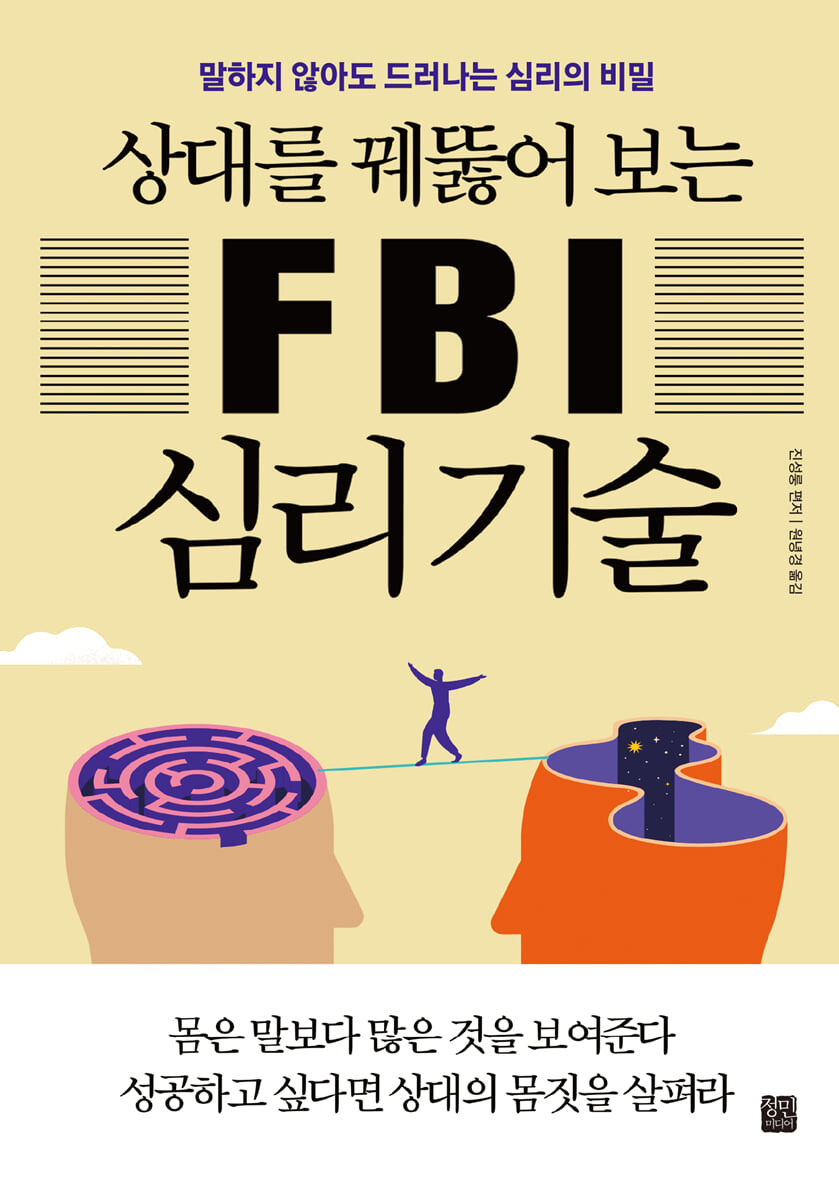
FBI psychological techniques to see through your opponents
 |
Description
Book Introduction
100 Years of Proven FBI Psychological Techniques and Amazing Results
Read the other person's feelings through their gestures and facial expressions.
FBI Special Agent Joseph L.
Scott (Joseph L.
Scott) says.
“No matter who the opponent is, a competitive spirit is bound to arise in the process of competing for profit.
Because everyone wants to maximize their own interests.
This tight competition is always decided by a single point, and that single point is determined by who can quickly perceive the opponent's psychological changes."
This book is a compilation of customized analyses and interpretations of various aspects of human body language and personality traits compiled by the FBI over a period of over 100 years, as well as psychological techniques applicable to real life.
Observe a person's gait to understand their psychological state, and discover the inner world of others hidden in an ordinary handshake.
Because our bodies are more honest than words.
It shows us, through real-life examples, the surprising fact that the posture of the feet while speaking reveals one's true feelings more honestly than the words that come out of the mouth.
Even through the type of laughter or the slightest movement of the nose, you can immediately see through the other person's psychology.
Even if you understand the other person's psychology, it is of no use if you cannot utilize it.
Based on this, the author also introduces several psychological strategies that can move the other person's heart.
In addition to the well-known 'prisoner's dilemma', it introduces psychological manipulation techniques using new strategies such as the law of reciprocity, the butterfly effect, the law of substitution, and smokescreen tactics, with specific examples so that you can easily learn them.
These are quite useful skills for those of us who must communicate and interact with others, whether in our daily lives or at work. If you master the psychological techniques outlined by the FBI, you can take control of your work and relationships and steer them in the direction you desire.
Read the other person's feelings through their gestures and facial expressions.
FBI Special Agent Joseph L.
Scott (Joseph L.
Scott) says.
“No matter who the opponent is, a competitive spirit is bound to arise in the process of competing for profit.
Because everyone wants to maximize their own interests.
This tight competition is always decided by a single point, and that single point is determined by who can quickly perceive the opponent's psychological changes."
This book is a compilation of customized analyses and interpretations of various aspects of human body language and personality traits compiled by the FBI over a period of over 100 years, as well as psychological techniques applicable to real life.
Observe a person's gait to understand their psychological state, and discover the inner world of others hidden in an ordinary handshake.
Because our bodies are more honest than words.
It shows us, through real-life examples, the surprising fact that the posture of the feet while speaking reveals one's true feelings more honestly than the words that come out of the mouth.
Even through the type of laughter or the slightest movement of the nose, you can immediately see through the other person's psychology.
Even if you understand the other person's psychology, it is of no use if you cannot utilize it.
Based on this, the author also introduces several psychological strategies that can move the other person's heart.
In addition to the well-known 'prisoner's dilemma', it introduces psychological manipulation techniques using new strategies such as the law of reciprocity, the butterfly effect, the law of substitution, and smokescreen tactics, with specific examples so that you can easily learn them.
These are quite useful skills for those of us who must communicate and interact with others, whether in our daily lives or at work. If you master the psychological techniques outlined by the FBI, you can take control of your work and relationships and steer them in the direction you desire.
- You can preview some of the book's contents.
Preview
index
Introduction: You can read the other person's mind and thoughts.
FBI Psychological Techniques 1.
Observing a person's actions reveals his or her heart.
Your gait reveals your psychological state.
A simple handshake reveals the inner world of others.
The feet speak louder than the mouth.
Psychological changes can be seen in laughter.
Expresses discomfort or distress through the nose
You can judge a person's character by observing their temperament.
FBI Psychological Techniques 2.
Swaying people's minds through psychological warfare
The prisoner's dilemma, where pursuing only one's own interests leads to unfavorable outcomes
The law of reciprocity: kind words must be kind to receive kind words in return.
The enormous butterfly effect caused by a small flap of wings
The principle of the game that utilizes immediate profits
The method of considering the other person's position
Smokescreen tactics to confuse the opponent's mind
FBI Psychological Techniques 3.
Change someone's mind in an instant with words
The key to lowering your opponent's guard: calling their name.
Talk indirectly to gain favor
Praise makes even the stubborn dance.
Anyone loses their senses in front of someone who belittles them.
The hamster wheel tactic of persistent, continuous attacks
Conversational techniques derived from the FBI's extensive investigative experience
FBI Psychological Techniques 4.
Captures information contained in eye movements
The eyes don't lie
Reading the psychology hidden in eyebrows
Digging into the truth through the size of your pupils
The eyes are the voice of the heart
A fleeting glance reveals one's true feelings.
Information contained in eye movements
FBI Psychological Technique 5.
How to deal with people effectively
Respect first
How to chill someone's liver and gall bladder
Avoid arguments by being thorough
Gain the trust of others
Psychological techniques to keep promises
Satisfy the other person's vanity
If you grant my request, I will let down my guard.
Overcoming strength with softness
FBI Psychological Technique 6.
Win people's hearts and make them my side
The mistake effect of reassuring the other person
The Law of Liking, Empathy
The seesaw principle that makes others feel good
Help the other person solve their worries
Subtly complimenting the other person's shortcomings
smile effect
emotional investment
FBI Psychological Technique 7.
Manipulate people's minds by detecting lies
Detect lies through facial expressions
A smile can't hide a lie.
The truth is hidden in our unconscious actions.
Can read signs of lies
How to expose someone's lies
FBI Psychological Technique 8.
Strategies for Smooth Relationships
How to open the door to someone's heart
Find a way to "objectify" the other person's "subjectivity."
Encourage your partner to participate actively.
FBI Psychological Techniques 1.
Observing a person's actions reveals his or her heart.
Your gait reveals your psychological state.
A simple handshake reveals the inner world of others.
The feet speak louder than the mouth.
Psychological changes can be seen in laughter.
Expresses discomfort or distress through the nose
You can judge a person's character by observing their temperament.
FBI Psychological Techniques 2.
Swaying people's minds through psychological warfare
The prisoner's dilemma, where pursuing only one's own interests leads to unfavorable outcomes
The law of reciprocity: kind words must be kind to receive kind words in return.
The enormous butterfly effect caused by a small flap of wings
The principle of the game that utilizes immediate profits
The method of considering the other person's position
Smokescreen tactics to confuse the opponent's mind
FBI Psychological Techniques 3.
Change someone's mind in an instant with words
The key to lowering your opponent's guard: calling their name.
Talk indirectly to gain favor
Praise makes even the stubborn dance.
Anyone loses their senses in front of someone who belittles them.
The hamster wheel tactic of persistent, continuous attacks
Conversational techniques derived from the FBI's extensive investigative experience
FBI Psychological Techniques 4.
Captures information contained in eye movements
The eyes don't lie
Reading the psychology hidden in eyebrows
Digging into the truth through the size of your pupils
The eyes are the voice of the heart
A fleeting glance reveals one's true feelings.
Information contained in eye movements
FBI Psychological Technique 5.
How to deal with people effectively
Respect first
How to chill someone's liver and gall bladder
Avoid arguments by being thorough
Gain the trust of others
Psychological techniques to keep promises
Satisfy the other person's vanity
If you grant my request, I will let down my guard.
Overcoming strength with softness
FBI Psychological Technique 6.
Win people's hearts and make them my side
The mistake effect of reassuring the other person
The Law of Liking, Empathy
The seesaw principle that makes others feel good
Help the other person solve their worries
Subtly complimenting the other person's shortcomings
smile effect
emotional investment
FBI Psychological Technique 7.
Manipulate people's minds by detecting lies
Detect lies through facial expressions
A smile can't hide a lie.
The truth is hidden in our unconscious actions.
Can read signs of lies
How to expose someone's lies
FBI Psychological Technique 8.
Strategies for Smooth Relationships
How to open the door to someone's heart
Find a way to "objectify" the other person's "subjectivity."
Encourage your partner to participate actively.
Into the book
For most people, walking is a very ordinary thing.
However, FBI agents say that each person walks differently and that their gait reflects their psychological state.
Former FBI agent and criminal psychologist Robert K.
The Wrestler (Robert K.
Ressler) emphasizes.
“By observing the suspect’s gait, you can determine his psychological state after the incident.
This is of great help in finding loopholes in the alibi and uncovering the truth of the case.
The same is true in everyday life.
“By observing others’ gait and understanding their psychological state, you can reduce unnecessary friction and build better relationships.”
--- p.15
'Hwanwibeop' refers to the technique of understanding the other person's intentions by thinking from their perspective, and further, eliciting new ideas from the other person based on one's own thoughts.
In short, the purpose is to gain an advantage in the psychological warfare against the opponent by turning the situation to one's advantage through putting oneself in another's shoes.
--- p.89
When people are in fierce competition with someone, they tend to keep their true thoughts hidden.
In times like these, it's a good idea to set up a hypothesis that puts the other party at a disadvantage and launch a barrage of questions, just like Detective Morris did.
By messing with the opponent's mind and understanding their psychological changes, you can eventually control their psychology and win the game.
Of course, there are many people around us who are good at hiding their thoughts.
These people are quite a headache in competition.
This is because they find our weaknesses and use them as a 'stepping stone' for their own success while hiding their true intentions.
--- p.101
This is a fact that has actually been proven through experiments on the 'effect of feedback' for psychological research.
If you had to choose between receiving praise or harsh criticism from others, which would you choose? Under normal circumstances, most people would naturally choose the praise.
So what if you were faced with harsh criticism or even outright ignorance from others? Perhaps many would argue that being ignored would be preferable to being criticized.
But the actual results were the exact opposite of what people expected.
--- p.129
FBI agents advise that when a person's eyes move upward to the left, it not only means that they are recalling a past experience, but also that they like to reminisce about the past in general, so you should be patient when dealing with this type of person.
Another characteristic of these people is that they recall their own happy pasts while listening to other people's stories, and it is said that there are more people like this around us than we think.
--- p.194
If you deliberately reveal your weaknesses, the other person will feel superior and get satisfaction from thinking that they are inferior to you.
This makes it much easier to persuade others. The FBI advises that if you want to win over more people, you have to be vulnerable.
Like British comedy master Rowan Atkinson.
When you think of Rowan Atkinson, you think of 'Mr. Bean', and he was so loved for his character 'Mr. Bean'. In fact, 'Mr. Bean' is a good example of how he made great use of the mistake effect to win the love of the audience.
However, FBI agents say that each person walks differently and that their gait reflects their psychological state.
Former FBI agent and criminal psychologist Robert K.
The Wrestler (Robert K.
Ressler) emphasizes.
“By observing the suspect’s gait, you can determine his psychological state after the incident.
This is of great help in finding loopholes in the alibi and uncovering the truth of the case.
The same is true in everyday life.
“By observing others’ gait and understanding their psychological state, you can reduce unnecessary friction and build better relationships.”
--- p.15
'Hwanwibeop' refers to the technique of understanding the other person's intentions by thinking from their perspective, and further, eliciting new ideas from the other person based on one's own thoughts.
In short, the purpose is to gain an advantage in the psychological warfare against the opponent by turning the situation to one's advantage through putting oneself in another's shoes.
--- p.89
When people are in fierce competition with someone, they tend to keep their true thoughts hidden.
In times like these, it's a good idea to set up a hypothesis that puts the other party at a disadvantage and launch a barrage of questions, just like Detective Morris did.
By messing with the opponent's mind and understanding their psychological changes, you can eventually control their psychology and win the game.
Of course, there are many people around us who are good at hiding their thoughts.
These people are quite a headache in competition.
This is because they find our weaknesses and use them as a 'stepping stone' for their own success while hiding their true intentions.
--- p.101
This is a fact that has actually been proven through experiments on the 'effect of feedback' for psychological research.
If you had to choose between receiving praise or harsh criticism from others, which would you choose? Under normal circumstances, most people would naturally choose the praise.
So what if you were faced with harsh criticism or even outright ignorance from others? Perhaps many would argue that being ignored would be preferable to being criticized.
But the actual results were the exact opposite of what people expected.
--- p.129
FBI agents advise that when a person's eyes move upward to the left, it not only means that they are recalling a past experience, but also that they like to reminisce about the past in general, so you should be patient when dealing with this type of person.
Another characteristic of these people is that they recall their own happy pasts while listening to other people's stories, and it is said that there are more people like this around us than we think.
--- p.194
If you deliberately reveal your weaknesses, the other person will feel superior and get satisfaction from thinking that they are inferior to you.
This makes it much easier to persuade others. The FBI advises that if you want to win over more people, you have to be vulnerable.
Like British comedy master Rowan Atkinson.
When you think of Rowan Atkinson, you think of 'Mr. Bean', and he was so loved for his character 'Mr. Bean'. In fact, 'Mr. Bean' is a good example of how he made great use of the mistake effect to win the love of the audience.
--- p.245
Publisher's Review
Learn 100 Years of FBI Psychological Techniques
Mind-reading is essential for successful work and relationships.
In modern society, with the development of digital technologies such as social media, opportunities to meet face-to-face with others are decreasing.
We meet and talk to people through computer and smartphone screens in our own private space, away from others.
As people become accustomed to such environments, many find it difficult to know how to start a conversation and develop a relationship when they actually meet someone.
Furthermore, it has become increasingly difficult to take the lead in a relationship by observing the other person's reactions and understanding their psychology.
No matter how much digital technology advances and internet communication becomes more active, to live a social life, you still need to meet someone in person, have a conversation, and get things done.
If you can observe the other person's words, facial expressions, and gestures to determine whether they are lying or being sincere, you can not only overcome difficulties in interpersonal relationships but also steer the relationship in a direction that is advantageous to you.
The FBI, a world-renowned criminal investigation agency, has developed a variety of psychological strategies over the past 100 years by meeting countless suspects.
Of all the organizations on Earth, we have experienced and recorded the most concrete real-world examples.
It is not just a theory, but the result of experiences of success and failure in reality.
This book introduces various psychological techniques taught by the FBI in an engaging way with case studies.
The body speaks louder than words.
If you want to succeed, watch your opponent's body language.
By mastering the FBI's psychological techniques, you can break free from the past of being passively dragged along in interpersonal relationships and create proactive relationships that are enjoyable for both you and the other person.
This book shows how FBI agents use psychological techniques to solve cases, and teaches them how to read other people's minds through body signals.
By describing in detail the specific gestures, hand gestures, and eye contact shown by the suspect during the investigation, we explain the meaning behind the signals the body sends and show how we can apply them in real life.
For example, it is said that people who frequently touch their noses while talking have other ulterior motives.
When interacting with such people, it's advised to be mindful of their emotional fluctuations. The FBI also introduces various conversation strategies.
Special agents use advanced psychological conversational techniques when conducting undercover investigations or interrogating suspects.
A seemingly ordinary, seemingly trivial word can open the mind of a crime boss, making him trust an agent disguised as an organization member, and even make a suspect confess to a crime he had denied.
It may seem simple, but it is a conversation method based on a detailed psychological strategy.
We also introduce conversation techniques that can be useful in situations we often encounter in social life.
For example, when refusing a burdensome request, it is more effective to simply repeat the reason why it is difficult to grant it rather than explaining the reason in detail.
In addition, it provides specific and realistic information on all the psychological skills necessary for successful work and relationships in modern society, such as how to effectively manage others according to your intentions, how to detect lies, how to win people's hearts and achieve your goals, and how to break down others' guard.
By the time you turn the last page, you'll want to put the psychological skills you learned in the book to use immediately.
Through this book, you will be able to see through the psychology of others, gain confidence in interpersonal relationships, and take the initiative in your work, relationships, and life.
Mind-reading is essential for successful work and relationships.
In modern society, with the development of digital technologies such as social media, opportunities to meet face-to-face with others are decreasing.
We meet and talk to people through computer and smartphone screens in our own private space, away from others.
As people become accustomed to such environments, many find it difficult to know how to start a conversation and develop a relationship when they actually meet someone.
Furthermore, it has become increasingly difficult to take the lead in a relationship by observing the other person's reactions and understanding their psychology.
No matter how much digital technology advances and internet communication becomes more active, to live a social life, you still need to meet someone in person, have a conversation, and get things done.
If you can observe the other person's words, facial expressions, and gestures to determine whether they are lying or being sincere, you can not only overcome difficulties in interpersonal relationships but also steer the relationship in a direction that is advantageous to you.
The FBI, a world-renowned criminal investigation agency, has developed a variety of psychological strategies over the past 100 years by meeting countless suspects.
Of all the organizations on Earth, we have experienced and recorded the most concrete real-world examples.
It is not just a theory, but the result of experiences of success and failure in reality.
This book introduces various psychological techniques taught by the FBI in an engaging way with case studies.
The body speaks louder than words.
If you want to succeed, watch your opponent's body language.
By mastering the FBI's psychological techniques, you can break free from the past of being passively dragged along in interpersonal relationships and create proactive relationships that are enjoyable for both you and the other person.
This book shows how FBI agents use psychological techniques to solve cases, and teaches them how to read other people's minds through body signals.
By describing in detail the specific gestures, hand gestures, and eye contact shown by the suspect during the investigation, we explain the meaning behind the signals the body sends and show how we can apply them in real life.
For example, it is said that people who frequently touch their noses while talking have other ulterior motives.
When interacting with such people, it's advised to be mindful of their emotional fluctuations. The FBI also introduces various conversation strategies.
Special agents use advanced psychological conversational techniques when conducting undercover investigations or interrogating suspects.
A seemingly ordinary, seemingly trivial word can open the mind of a crime boss, making him trust an agent disguised as an organization member, and even make a suspect confess to a crime he had denied.
It may seem simple, but it is a conversation method based on a detailed psychological strategy.
We also introduce conversation techniques that can be useful in situations we often encounter in social life.
For example, when refusing a burdensome request, it is more effective to simply repeat the reason why it is difficult to grant it rather than explaining the reason in detail.
In addition, it provides specific and realistic information on all the psychological skills necessary for successful work and relationships in modern society, such as how to effectively manage others according to your intentions, how to detect lies, how to win people's hearts and achieve your goals, and how to break down others' guard.
By the time you turn the last page, you'll want to put the psychological skills you learned in the book to use immediately.
Through this book, you will be able to see through the psychology of others, gain confidence in interpersonal relationships, and take the initiative in your work, relationships, and life.
GOODS SPECIFICS
- Date of issue: April 20, 2025
- Page count, weight, size: 336 pages | 526g | 145*210*21mm
- ISBN13: 9791191669893
- ISBN10: 1191669890
You may also like
카테고리
korean


korean

![GQ KOREA Mark (Monthly): December [2025]](http://librairie.coreenne.fr/cdn/shop/files/8ef265dbbfbf186523ed75ba7319009d.jpg?v=1765340328&width=3840)


