

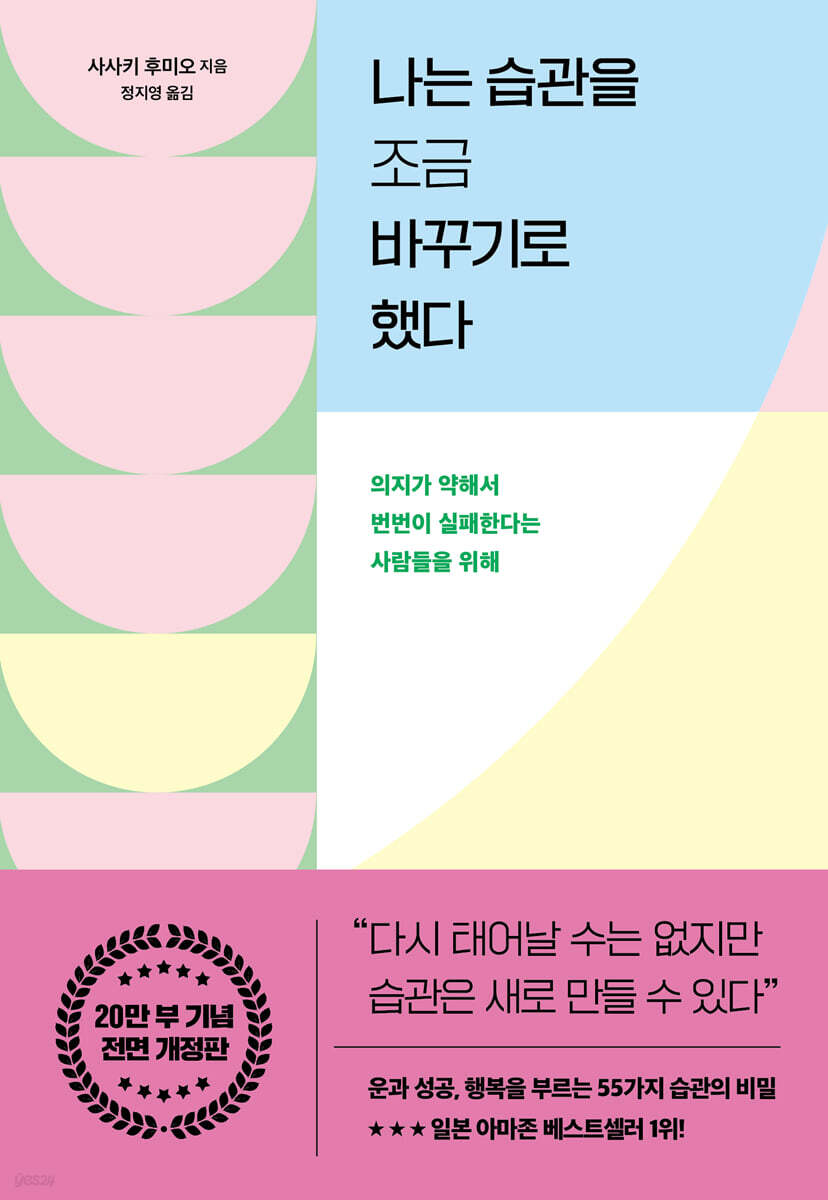
I decided to change my habits a little.
 |
Description
Book Introduction
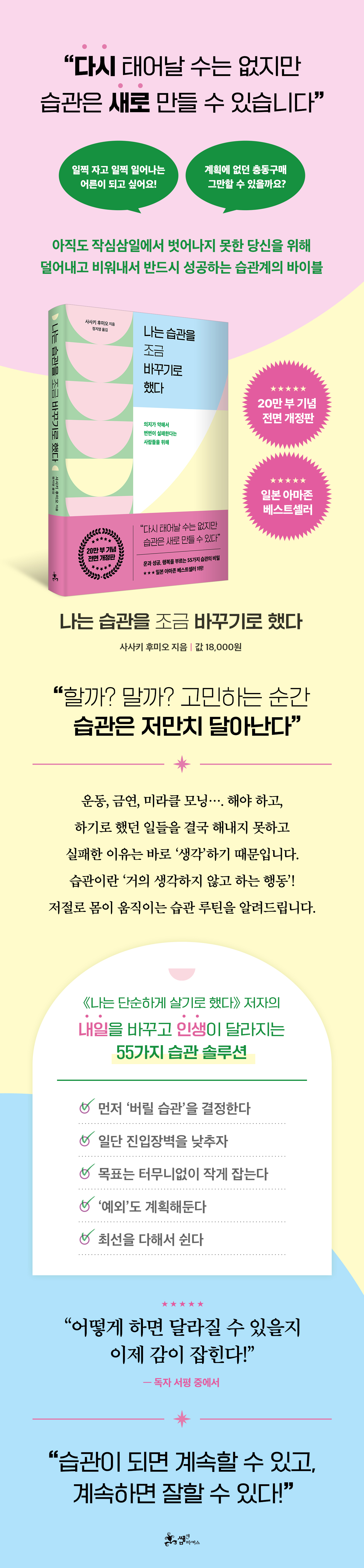
“You can’t be born again, but you can form new habits!”
The Secret to the Crucial Habit of Never Fail by Letting Go and Emptying
★ 55 Habit Solutions That Will Change Your Tomorrow and Transform Your Life ★
★ Completely revised edition, including a Korean-language preface commemorating the 200,000th copy sale! ★
"I Decided to Change My Habits a Little," which became an instant bestseller and became the bible of habits, has published a revised and expanded edition to commemorate the sale of 200,000 copies.
This revised edition includes a special preface by the author for Korean readers, as well as 55 magical tips that the author has used since the first edition was published, supplementing the parts he felt were lacking.
With this book, you can set yourself on the path to success, so you can achieve what you truly desire. You can now say goodbye to the me who struggled to get up in the morning and the me who couldn't stand it and ate a late-night snack.
If you've ever believed that you failed because you lacked willpower or talent, it's time to shatter your illusions about willpower and talent and experience the incredible power of habits that can infuse your life effortlessly.
If you live the rest of your life with habits, you will gradually but clearly see yourself changing.
This book covers everything from how to form new habits, how to break bad ones, and how to create a solid routine with cues, routines, and rewards, all while providing specific triggers to move from thought to action.
The Secret to the Crucial Habit of Never Fail by Letting Go and Emptying
★ 55 Habit Solutions That Will Change Your Tomorrow and Transform Your Life ★
★ Completely revised edition, including a Korean-language preface commemorating the 200,000th copy sale! ★
"I Decided to Change My Habits a Little," which became an instant bestseller and became the bible of habits, has published a revised and expanded edition to commemorate the sale of 200,000 copies.
This revised edition includes a special preface by the author for Korean readers, as well as 55 magical tips that the author has used since the first edition was published, supplementing the parts he felt were lacking.
With this book, you can set yourself on the path to success, so you can achieve what you truly desire. You can now say goodbye to the me who struggled to get up in the morning and the me who couldn't stand it and ate a late-night snack.
If you've ever believed that you failed because you lacked willpower or talent, it's time to shatter your illusions about willpower and talent and experience the incredible power of habits that can infuse your life effortlessly.
If you live the rest of your life with habits, you will gradually but clearly see yourself changing.
This book covers everything from how to form new habits, how to break bad ones, and how to create a solid routine with cues, routines, and rewards, all while providing specific triggers to move from thought to action.
- You can preview some of the book's contents.
Preview
index
[Korean Edition Preface] To my beloved Korean readers:
[To begin with] What matters is not talent, but persistence.
[Note] How to read this book
Chapter 1: Is willpower innate?
How I spend my days | Enjoying seclusion for a while | Free time that isn't enjoyable at all | Minimalism is a safety net | Why New Year's resolutions always fail? | Everything is a 'reward' and a 'punishment' | One apple today, two apples tomorrow | The immediate reward seems bigger | Why can't we wait for a later reward? | Should I eat the marshmallow or not? | Can the marshmallow experiment predict the future? | Questions raised by the marshmallow experiment | Does willpower decrease with use? - The radish experiment | Why couldn't I resist the last ice cream? | Some willpower decreases because I 'didn't do it' | The emotion called 'anxiety' that eats away at willpower | The hormone that calms anxiety | It's not willpower that's consumed, it's emotions | If you're in a good mood, you can even wait for a marshmallow | Hot and cold systems | A hot system that runs wild with stress | Cooling by the cold system | Is willpower an innate talent? | Willpower changes with changing environments | Isn't it just a matter of the number of times you're tempted? | The trick of dopamine | 'Cognition' is a skill that can be learned | People with strong willpower are never tempted in the first place. | Worrying = becoming conscious. | Habits are actions performed with little thought. | Chapter 1 Summary
Chapter 2: What is a Habit?
45 percent of our actions are habits | Our morning routine | Can you explain how to ride a bike in words? | People who cook and drive while asleep | Consciousness is like a 'newspaper' | Why we can't see our noses | The moment we wake up | Newspaper headlines change when we have a stomachache | Do humans have free will? | Who decides what we hum? | My actions are determined by majority vote | Habits that overcome dissent | I am not my own king | Making myself a creature of habit | The rat that finds chocolate without using its head | The three elements of habit | Habits actually change the brain | The 'cues' of yoga and journaling | It starts with looking at your desk | The cue that makes you drink | A chain-linked routine | Routines move the mind | People need a reward to move | Anything can be a reward | Why do we run in the blazing sun in midsummer? | Does running release endorphins? | The essential stress | Why Bill Gates and Jeff Bezos work | Aerobic exercise makes neurons grow | Schools that improved grades with "zero period PE" | First, define "reward" | How to ignore marshmallows | Chapter 2 Summary
Chapter 3: 55 Ways to Stick to New Habits
STEP 01 Break the vicious cycle
STEP 02 First, decide on the 'habit to give up'.
STEP 03 Use the turning point
STEP 04 It's easier to quit completely
STEP 05 You must pay the price
STEP 06 Identify the cue and reward of the habit.
STEP 07 Become a detective and find the culprit behind bad habits.
STEP 08 There is no such thing as a 'naturally like that person'
STEP 09: First, conquer the 'Keystone Habit'.
STEP 10: Write a self-observation journal.
STEP 11: Train Your "Cold System" Through Meditation
STEP 12 It's normal to feel unmotivated before starting.
STEP 13: Let's lower the barrier to entry.
STEP 14 Don't leave even the smallest obstacles unattended
STEP 15: Raise the barrier to entry for habits you want to break.
STEP 16 Investing money in the initial investment
STEP 17 Break your goals down into smaller chunks.
STEP 18: Set your goals ridiculously small.
STEP 19 Start right now, starting today
STEP 20 It's easier to do it every day
STEP 21: Plan for 'Exceptions'
STEP 22 You can enjoy it because it's clumsy
STEP 23 Pull the trigger
STEP 24 Create an adult schedule
STEP 25 No one has concentration.
STEP 26 Act according to the date
STEP 27: Habits are promises to yourself.
STEP 28 Set up temporary compensation
STEP 29 There are many types of motivation and rewards.
STEP 30: Use the perspectives of others
STEP 31 Declare in advance
STEP 32 Think from a third-person perspective
STEP 33: Take your hands off when you want to do more.
STEP 34 Does not stop completely
STEP 35 If you don't do it every day, you'll get awkward.
STEP 36 Be sure to keep a record
STEP 37 Rest as much as you can
STEP 38 The benefits of napping are enormous.
STEP 39 Take a break while being active
STEP 40: Cherish your break time too.
STEP 41 Don't confuse 'purpose' with 'goal'
STEP 42: First, look only at the goal in front of you.
STEP 43: Failure is essential.
STEP 44: Give yourself 100 points
STEP 45 How many days will it take for it to become a habit?
STEP 46 It's better to do something than not to do something.
STEP 47 Increase the difficulty level little by little
STEP 48: Overcome the Valley of Trials
STEP 49 Self-efficacy increases with each practice
STEP 50: Start a chain reaction
STEP 51 Habits have application.
STEP 52 Create your own habits
STEP 53 Compromise with other people's habits
STEP 54 Habits eventually break.
STEP 55 There is no perfection in habits.
Chapter 4: We Are Made of Habits
The true nature of 'effort' revealed in habits | Is 'effort' painful? | "I'm just doing what I love to my heart's content" | Let's distinguish between effort and perseverance | Did you choose it yourself? | There are levels of perseverance in habits, too | Effort based on your own standards is enough | Misconceptions about 'talent' | Geniuses without talent | Are Einstein and Darwin also criminals? | How far can you push yourself? | The truth about talent that's too ordinary | Separating genius from yourself | Talent for addition, talent for multiplication | It's not that you don't have talent, it's that you stop | Giving up means making it clear | You can understand even if you get sick | Forget the word 'talent' | What about the issue of genetics? | The answer to genetics or environment | You have no choice but to play with the cards you're given | Is it because I'm too greedy? | The greatest reward is liking yourself | Not everyone aspires to be the best | From complexity to simplicity | An era when life and growth were connected | Why do people pursue growth? | An era when growth must be desired | There's a hole in the wallet of happiness | Anxiety won't go away, so we have no choice but to live with it | I hate it, but it's essential | The mind is also made of habits | Kindness and laughter are also habits | Habits of thinking | Habits are being formed even at this moment | The pain of laziness, the pain of effort | Emotions and willpower are one body | Everyone is somehow happy and somehow unhappy | The companion called suffering | Thinking while running, and running while thinking
[In conclusion] The last habit I learned
[Revised Edition Review] Protecting Your Own and Others' Dignity
References
[To begin with] What matters is not talent, but persistence.
[Note] How to read this book
Chapter 1: Is willpower innate?
How I spend my days | Enjoying seclusion for a while | Free time that isn't enjoyable at all | Minimalism is a safety net | Why New Year's resolutions always fail? | Everything is a 'reward' and a 'punishment' | One apple today, two apples tomorrow | The immediate reward seems bigger | Why can't we wait for a later reward? | Should I eat the marshmallow or not? | Can the marshmallow experiment predict the future? | Questions raised by the marshmallow experiment | Does willpower decrease with use? - The radish experiment | Why couldn't I resist the last ice cream? | Some willpower decreases because I 'didn't do it' | The emotion called 'anxiety' that eats away at willpower | The hormone that calms anxiety | It's not willpower that's consumed, it's emotions | If you're in a good mood, you can even wait for a marshmallow | Hot and cold systems | A hot system that runs wild with stress | Cooling by the cold system | Is willpower an innate talent? | Willpower changes with changing environments | Isn't it just a matter of the number of times you're tempted? | The trick of dopamine | 'Cognition' is a skill that can be learned | People with strong willpower are never tempted in the first place. | Worrying = becoming conscious. | Habits are actions performed with little thought. | Chapter 1 Summary
Chapter 2: What is a Habit?
45 percent of our actions are habits | Our morning routine | Can you explain how to ride a bike in words? | People who cook and drive while asleep | Consciousness is like a 'newspaper' | Why we can't see our noses | The moment we wake up | Newspaper headlines change when we have a stomachache | Do humans have free will? | Who decides what we hum? | My actions are determined by majority vote | Habits that overcome dissent | I am not my own king | Making myself a creature of habit | The rat that finds chocolate without using its head | The three elements of habit | Habits actually change the brain | The 'cues' of yoga and journaling | It starts with looking at your desk | The cue that makes you drink | A chain-linked routine | Routines move the mind | People need a reward to move | Anything can be a reward | Why do we run in the blazing sun in midsummer? | Does running release endorphins? | The essential stress | Why Bill Gates and Jeff Bezos work | Aerobic exercise makes neurons grow | Schools that improved grades with "zero period PE" | First, define "reward" | How to ignore marshmallows | Chapter 2 Summary
Chapter 3: 55 Ways to Stick to New Habits
STEP 01 Break the vicious cycle
STEP 02 First, decide on the 'habit to give up'.
STEP 03 Use the turning point
STEP 04 It's easier to quit completely
STEP 05 You must pay the price
STEP 06 Identify the cue and reward of the habit.
STEP 07 Become a detective and find the culprit behind bad habits.
STEP 08 There is no such thing as a 'naturally like that person'
STEP 09: First, conquer the 'Keystone Habit'.
STEP 10: Write a self-observation journal.
STEP 11: Train Your "Cold System" Through Meditation
STEP 12 It's normal to feel unmotivated before starting.
STEP 13: Let's lower the barrier to entry.
STEP 14 Don't leave even the smallest obstacles unattended
STEP 15: Raise the barrier to entry for habits you want to break.
STEP 16 Investing money in the initial investment
STEP 17 Break your goals down into smaller chunks.
STEP 18: Set your goals ridiculously small.
STEP 19 Start right now, starting today
STEP 20 It's easier to do it every day
STEP 21: Plan for 'Exceptions'
STEP 22 You can enjoy it because it's clumsy
STEP 23 Pull the trigger
STEP 24 Create an adult schedule
STEP 25 No one has concentration.
STEP 26 Act according to the date
STEP 27: Habits are promises to yourself.
STEP 28 Set up temporary compensation
STEP 29 There are many types of motivation and rewards.
STEP 30: Use the perspectives of others
STEP 31 Declare in advance
STEP 32 Think from a third-person perspective
STEP 33: Take your hands off when you want to do more.
STEP 34 Does not stop completely
STEP 35 If you don't do it every day, you'll get awkward.
STEP 36 Be sure to keep a record
STEP 37 Rest as much as you can
STEP 38 The benefits of napping are enormous.
STEP 39 Take a break while being active
STEP 40: Cherish your break time too.
STEP 41 Don't confuse 'purpose' with 'goal'
STEP 42: First, look only at the goal in front of you.
STEP 43: Failure is essential.
STEP 44: Give yourself 100 points
STEP 45 How many days will it take for it to become a habit?
STEP 46 It's better to do something than not to do something.
STEP 47 Increase the difficulty level little by little
STEP 48: Overcome the Valley of Trials
STEP 49 Self-efficacy increases with each practice
STEP 50: Start a chain reaction
STEP 51 Habits have application.
STEP 52 Create your own habits
STEP 53 Compromise with other people's habits
STEP 54 Habits eventually break.
STEP 55 There is no perfection in habits.
Chapter 4: We Are Made of Habits
The true nature of 'effort' revealed in habits | Is 'effort' painful? | "I'm just doing what I love to my heart's content" | Let's distinguish between effort and perseverance | Did you choose it yourself? | There are levels of perseverance in habits, too | Effort based on your own standards is enough | Misconceptions about 'talent' | Geniuses without talent | Are Einstein and Darwin also criminals? | How far can you push yourself? | The truth about talent that's too ordinary | Separating genius from yourself | Talent for addition, talent for multiplication | It's not that you don't have talent, it's that you stop | Giving up means making it clear | You can understand even if you get sick | Forget the word 'talent' | What about the issue of genetics? | The answer to genetics or environment | You have no choice but to play with the cards you're given | Is it because I'm too greedy? | The greatest reward is liking yourself | Not everyone aspires to be the best | From complexity to simplicity | An era when life and growth were connected | Why do people pursue growth? | An era when growth must be desired | There's a hole in the wallet of happiness | Anxiety won't go away, so we have no choice but to live with it | I hate it, but it's essential | The mind is also made of habits | Kindness and laughter are also habits | Habits of thinking | Habits are being formed even at this moment | The pain of laziness, the pain of effort | Emotions and willpower are one body | Everyone is somehow happy and somehow unhappy | The companion called suffering | Thinking while running, and running while thinking
[In conclusion] The last habit I learned
[Revised Edition Review] Protecting Your Own and Others' Dignity
References
Detailed image
Into the book
I also think the words 'talent' and 'effort' are misused.
Talent isn't a gift from heaven, and hard work isn't something you have to grit your teeth over.
I would like to make that point clear under the topic of 'habit'.
So I want to put talent and effort back into the hands of more ordinary people.
It is not something that only a limited number of people can obtain, but something that can be learned and acquired.
--- From "'Starting Out: It's Not Talent That Matters, It's Persistence'"
Haruki Murakami runs for an hour every day, but he says he runs a little longer when he is criticized or rejected by someone without reason.
I run almost every day, but when I'm feeling down, I run longer.
Because when you do that, you can definitely feel the change in your mood.
The essence of the problem lies not in the problem itself, but in how we perceive it.
--- From "Chapter 2: What is a Habit?"
Why do we want to pinpoint a turning point and start then? It's because when we decide, "Let's start tomorrow," or "Let's start next week," we feel comfortable until then.
And these words, ‘tomorrow’ and ‘from tomorrow’, are the most powerful cards of the procrastinator.
--- From "Chapter 3: 55 Ways to Form New Habits"
It's okay to have smaller goals, but don't reduce their frequency.
You need to do it every day until it becomes a habit.
Once you feel like doing it voluntarily without being told to, you can adjust the frequency accordingly.
--- From "Chapter 3: 55 Ways to Form New Habits"
Steve Jobs is said to have asked himself every morning for 33 years, "If today were the last day of my life, would I really want to do what I'm about to do today?"
I tried imitating it for a while, but I soon got tired of it and stopped.
So, to get into the habit, I changed it like this.
“If today were to repeat itself forever, what kind of day would I want to spend it with?”
--- From "Chapter 3: 55 Ways to Form New Habits"
Whether it's something that a beginner does that seems easy or something that an expert does that seems difficult, the satisfaction they both feel is likely to be similar.
Joy does not come from objective perfection.
So don't be afraid and get started.
The earliest time to start is now.
I'm starting to learn the piano, but I think I'll be able to play it for about 30 years before I can hear it any better.
--- From "Chapter 3: 55 Ways to Form New Habits"
For problems that are not urgent and can be solved somehow without having to do them right away, we tend to think, 'I'll do it later' or 'I'll do it when I have time.'
But in my 38 years of life, I've never once thought, "Ah, is this finally the time? Isn't this the time?"
Clearly, such a time will never come again.
So, if you have something to do, you should set a date first.
--- From "Chapter 3: 55 Ways to Form New Habits"
When you keep the habits you've set for yourself, you'll be proud of yourself for keeping your promises to yourself.
This is why your self-esteem improves when you achieve a habit.
I can affirm myself as a trustworthy human being.
Although he has many shortcomings, he is a conscientious person who generally keeps his promises, and if you think of him as someone worth keeping an eye on, there is nothing better.
--- From "Chapter 3: 55 Ways to Form New Habits"
To be successful in sports, you need to be part of a high-level team.
Sociologist Daniel Chambliss, who spent six years accompanying and interviewing swimmers at their practices, argued that to become a great swimmer, you have to be on a great team.
“If you are in an environment where everyone around you wakes up at 4 o’clock and goes to practice, you will naturally do the same.
It feels natural and becomes a habit.”
When you belong to a high-level team, you are forced to compete with each other and hone your skills to keep up with the group.
This is also true for the general public.
You just need to find a team that suits your level.
Finding a runner to run with makes it easier to keep running.
--- From "Chapter 3: 55 Ways to Form New Habits"
Author Anthony Trollope said, “If you do one small thing every day, you can accomplish more than Hercules, even if he is fickle.”
Small, consistent habits we practice daily will take us to a farther destination safely in the long run, rather than the occasional grand adventure.
--- From "Chapter 3: 55 Ways to Form New Habits"
Enduring to do something you chose to do because you wanted to do it is 'effort'.
Being forced to do something you did not choose and do not want to do is 'patience'.
The reason habits persist is because you chose to do them.
The reason I can continue doing what I love is because I convinced myself and chose it, even though there was some suffering there.
--- From "Chapter 4 We Are Made of Habits"
The moment when anxiety sets in is not when your savings run out.
Anxiety came at the end of a lazy day where I didn't do my work properly.
Anxiety starts to attack not because of objective facts like my bank balance, but because of my regrets.
--- From "Chapter 4 We Are Made of Habits"
Anxiety is an emotion about the future.
And at the end of today, there is a future.
If you are satisfied with each day, the future created by the accumulation of those todays will not go in a strange direction.
Talent isn't a gift from heaven, and hard work isn't something you have to grit your teeth over.
I would like to make that point clear under the topic of 'habit'.
So I want to put talent and effort back into the hands of more ordinary people.
It is not something that only a limited number of people can obtain, but something that can be learned and acquired.
--- From "'Starting Out: It's Not Talent That Matters, It's Persistence'"
Haruki Murakami runs for an hour every day, but he says he runs a little longer when he is criticized or rejected by someone without reason.
I run almost every day, but when I'm feeling down, I run longer.
Because when you do that, you can definitely feel the change in your mood.
The essence of the problem lies not in the problem itself, but in how we perceive it.
--- From "Chapter 2: What is a Habit?"
Why do we want to pinpoint a turning point and start then? It's because when we decide, "Let's start tomorrow," or "Let's start next week," we feel comfortable until then.
And these words, ‘tomorrow’ and ‘from tomorrow’, are the most powerful cards of the procrastinator.
--- From "Chapter 3: 55 Ways to Form New Habits"
It's okay to have smaller goals, but don't reduce their frequency.
You need to do it every day until it becomes a habit.
Once you feel like doing it voluntarily without being told to, you can adjust the frequency accordingly.
--- From "Chapter 3: 55 Ways to Form New Habits"
Steve Jobs is said to have asked himself every morning for 33 years, "If today were the last day of my life, would I really want to do what I'm about to do today?"
I tried imitating it for a while, but I soon got tired of it and stopped.
So, to get into the habit, I changed it like this.
“If today were to repeat itself forever, what kind of day would I want to spend it with?”
--- From "Chapter 3: 55 Ways to Form New Habits"
Whether it's something that a beginner does that seems easy or something that an expert does that seems difficult, the satisfaction they both feel is likely to be similar.
Joy does not come from objective perfection.
So don't be afraid and get started.
The earliest time to start is now.
I'm starting to learn the piano, but I think I'll be able to play it for about 30 years before I can hear it any better.
--- From "Chapter 3: 55 Ways to Form New Habits"
For problems that are not urgent and can be solved somehow without having to do them right away, we tend to think, 'I'll do it later' or 'I'll do it when I have time.'
But in my 38 years of life, I've never once thought, "Ah, is this finally the time? Isn't this the time?"
Clearly, such a time will never come again.
So, if you have something to do, you should set a date first.
--- From "Chapter 3: 55 Ways to Form New Habits"
When you keep the habits you've set for yourself, you'll be proud of yourself for keeping your promises to yourself.
This is why your self-esteem improves when you achieve a habit.
I can affirm myself as a trustworthy human being.
Although he has many shortcomings, he is a conscientious person who generally keeps his promises, and if you think of him as someone worth keeping an eye on, there is nothing better.
--- From "Chapter 3: 55 Ways to Form New Habits"
To be successful in sports, you need to be part of a high-level team.
Sociologist Daniel Chambliss, who spent six years accompanying and interviewing swimmers at their practices, argued that to become a great swimmer, you have to be on a great team.
“If you are in an environment where everyone around you wakes up at 4 o’clock and goes to practice, you will naturally do the same.
It feels natural and becomes a habit.”
When you belong to a high-level team, you are forced to compete with each other and hone your skills to keep up with the group.
This is also true for the general public.
You just need to find a team that suits your level.
Finding a runner to run with makes it easier to keep running.
--- From "Chapter 3: 55 Ways to Form New Habits"
Author Anthony Trollope said, “If you do one small thing every day, you can accomplish more than Hercules, even if he is fickle.”
Small, consistent habits we practice daily will take us to a farther destination safely in the long run, rather than the occasional grand adventure.
--- From "Chapter 3: 55 Ways to Form New Habits"
Enduring to do something you chose to do because you wanted to do it is 'effort'.
Being forced to do something you did not choose and do not want to do is 'patience'.
The reason habits persist is because you chose to do them.
The reason I can continue doing what I love is because I convinced myself and chose it, even though there was some suffering there.
--- From "Chapter 4 We Are Made of Habits"
The moment when anxiety sets in is not when your savings run out.
Anxiety came at the end of a lazy day where I didn't do my work properly.
Anxiety starts to attack not because of objective facts like my bank balance, but because of my regrets.
--- From "Chapter 4 We Are Made of Habits"
Anxiety is an emotion about the future.
And at the end of today, there is a future.
If you are satisfied with each day, the future created by the accumulation of those todays will not go in a strange direction.
--- From "Chapter 4 We Are Made of Habits"
Publisher's Review
The moment you hesitate, "Should I do it or not?", the habit runs away.
55 Habit Strategies That Make Your Body React Before Your Mind
I asked a 90-year-old grandmother what her biggest regret was in life.
The author's perspective on life changed 180 degrees after hearing an unexpected answer.
“I wanted to learn the violin when I was around 60, but I gave up because I thought it was too late.
If I had started then, I could have played for 30 years… ” Once the excitement of the beginning of the year wears off, the ‘three-day’ New Year’s resolutions naturally lose their luster.
If you have been secretly giving up on becoming the 'me I want to be' this year, saying things like, 'That's just how I am,' 'I need to be reborn to do that,' or 'I'll just live the way I've always lived,' now is the time to meet the changed you with this book.
Healthy eating habits, quitting smoking, quitting drinking, studying English…
Why do we fail and fail to accomplish the things we've decided to do and should do? The answer isn't a lack of willpower or a lack of effort.
This is because it brought about the ‘consciousness’ that requires immediate choice and decision.
Fumio Sasaki, who became a world-wide bestselling author through minimalism, emphasizes that in order to create habits, you must reduce the number of times you bring something to your consciousness by thinking about whether to do it or not in the first place, so that you act “almost without thinking.”
Just as we can't remember whether we put our shoes on the left or the right when we left the house this morning, the habits we want to develop must become unconscious actions.
And this book contains 55 specific and friendly steps so that you can start creating habits at any time, even with a very light heart.
If you make the honest habits you've been dreaming of your own for a tomorrow without regrets, your life will change completely.
Once it becomes a habit, you can continue,
If you keep going, you can do well
If you resolved to write a diary every day at the beginning of the year, but you feel discouraged after a day or two, try writing a line in your diary saying, "Oh, I don't want to write a diary."
Then the next sentence will follow naturally.
‘Because I had a hard day today…’ This psychology of continuing something once you start is called ‘operational excitement theory.’
Whatever the name, the important thing is that the human brain structure is designed to continue without difficulty once it is started.
In addition, it thoroughly analyzes and utilizes our behavioral patterns and brain structures, such as planning 'exceptions', making an adult's schedule, and using other people's gaze, as well as the three elements of habits - signals, routines, and reward mechanisms - to become a kind and delicate guide so that you can continue to move forward without giving up or stopping.
Additionally, what the author particularly emphasizes in this revised and expanded edition is that we must understand and support ourselves even if we fail to maintain a habit.
Habits, once formed, do not last forever.
It's the same for everyone.
So, even in such moments, instead of feeling frustrated or blaming yourself, you should be able to start over from the beginning with a light heart, thinking, “This is how habits are.”
That's where the habit is completed.
You can't be born again, but if you develop good habits, it's like being born again.
Habits are the one success mechanism that all successful people unanimously emphasize.
Through "I Decided to Change My Habits a Little," you will experience the wonders of small habits that can bring about overwhelming achievements.
55 Habit Strategies That Make Your Body React Before Your Mind
I asked a 90-year-old grandmother what her biggest regret was in life.
The author's perspective on life changed 180 degrees after hearing an unexpected answer.
“I wanted to learn the violin when I was around 60, but I gave up because I thought it was too late.
If I had started then, I could have played for 30 years… ” Once the excitement of the beginning of the year wears off, the ‘three-day’ New Year’s resolutions naturally lose their luster.
If you have been secretly giving up on becoming the 'me I want to be' this year, saying things like, 'That's just how I am,' 'I need to be reborn to do that,' or 'I'll just live the way I've always lived,' now is the time to meet the changed you with this book.
Healthy eating habits, quitting smoking, quitting drinking, studying English…
Why do we fail and fail to accomplish the things we've decided to do and should do? The answer isn't a lack of willpower or a lack of effort.
This is because it brought about the ‘consciousness’ that requires immediate choice and decision.
Fumio Sasaki, who became a world-wide bestselling author through minimalism, emphasizes that in order to create habits, you must reduce the number of times you bring something to your consciousness by thinking about whether to do it or not in the first place, so that you act “almost without thinking.”
Just as we can't remember whether we put our shoes on the left or the right when we left the house this morning, the habits we want to develop must become unconscious actions.
And this book contains 55 specific and friendly steps so that you can start creating habits at any time, even with a very light heart.
If you make the honest habits you've been dreaming of your own for a tomorrow without regrets, your life will change completely.
Once it becomes a habit, you can continue,
If you keep going, you can do well
If you resolved to write a diary every day at the beginning of the year, but you feel discouraged after a day or two, try writing a line in your diary saying, "Oh, I don't want to write a diary."
Then the next sentence will follow naturally.
‘Because I had a hard day today…’ This psychology of continuing something once you start is called ‘operational excitement theory.’
Whatever the name, the important thing is that the human brain structure is designed to continue without difficulty once it is started.
In addition, it thoroughly analyzes and utilizes our behavioral patterns and brain structures, such as planning 'exceptions', making an adult's schedule, and using other people's gaze, as well as the three elements of habits - signals, routines, and reward mechanisms - to become a kind and delicate guide so that you can continue to move forward without giving up or stopping.
Additionally, what the author particularly emphasizes in this revised and expanded edition is that we must understand and support ourselves even if we fail to maintain a habit.
Habits, once formed, do not last forever.
It's the same for everyone.
So, even in such moments, instead of feeling frustrated or blaming yourself, you should be able to start over from the beginning with a light heart, thinking, “This is how habits are.”
That's where the habit is completed.
You can't be born again, but if you develop good habits, it's like being born again.
Habits are the one success mechanism that all successful people unanimously emphasize.
Through "I Decided to Change My Habits a Little," you will experience the wonders of small habits that can bring about overwhelming achievements.
GOODS SPECIFICS
- Date of issue: March 26, 2025
- Page count, weight, size: 352 pages | 546g | 145*210*20mm
- ISBN13: 9791194246909
- ISBN10: 1194246907
You may also like
카테고리
korean


korean

![GQ KOREA Mark (Monthly): December [2025]](http://librairie.coreenne.fr/cdn/shop/files/8ef265dbbfbf186523ed75ba7319009d.jpg?v=1765340328&width=3840)


