

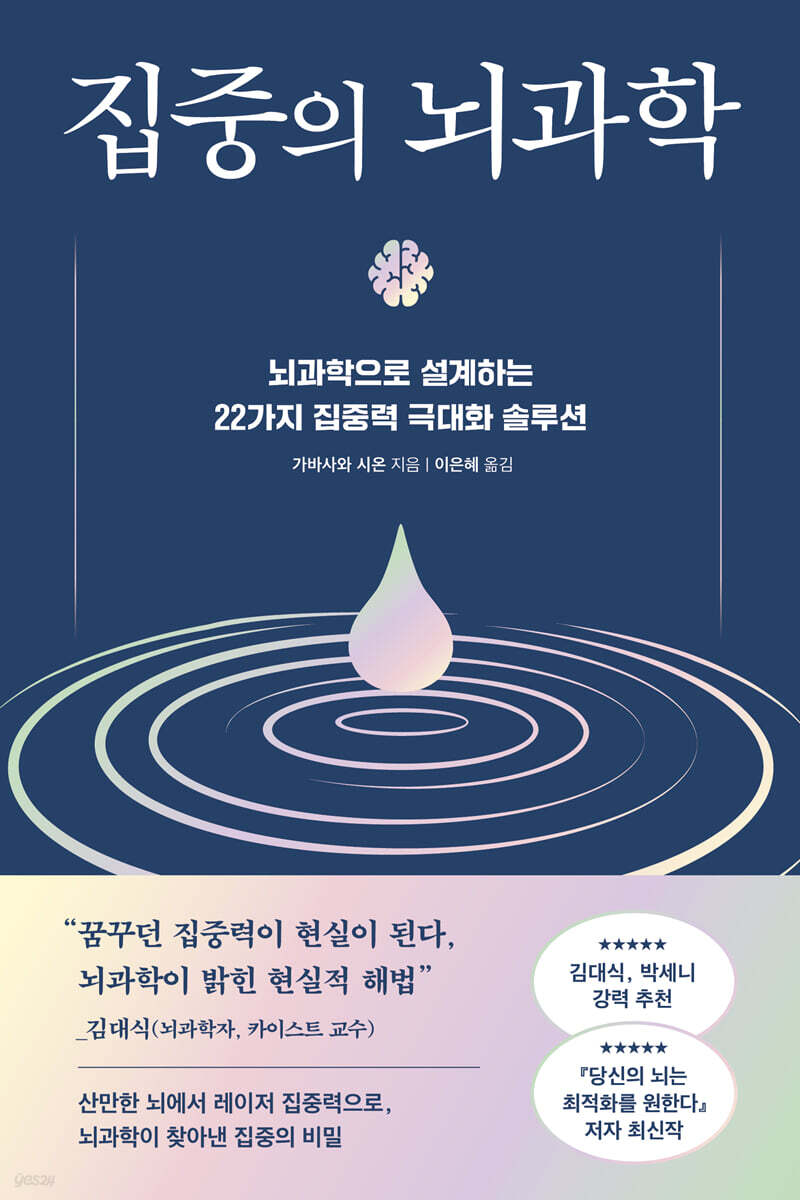
The Brain Science of Concentration
 |
Description
Book Introduction
“Your brain is screaming for help right now.”
* You check your smartphone more than 100 times a day
* You have trouble sitting in one place for even 30 minutes
* For those of you who are tired of endless notifications and messages,
A neuroscientist's concentration recovery project!
"The concentration you've always dreamed of becomes a reality: A practical solution revealed by brain science."
★★★ Neuroscientist Kim Dae-sik
“It contains everything I’ve proven while coaching top-level professionals in the field!”
★★★ "Change Your Mentality to Change Your Life" by Park Se-ni
A bestselling author and neuroscientist with 2.5 million copies sold reveals
The Secret to Immersion and Solutions to Maximize Productivity
We live in an age where it is increasingly difficult to concentrate.
It's common to check your smartphone 100 times a day, lose focus to all the notifications, and interrupt your work to complete other tasks.
Shion Gabasawa, a neuroscientist and psychiatrist who studied the brain at the University of Illinois in the United States, discovered the fundamental cause of decreased concentration in the brain's biological rhythms and hormones.
Based on this discovery, he found a scientific solution and put it into practice himself, bringing about amazing changes.
Not only did their performance and income more than triple, but they also succeeded in building healthier interpersonal relationships.
This proves that anyone can dramatically improve their concentration simply by improving their lifestyle habits.
This book is full of practical solutions that will have immediate results, from improving your working memory to managing your schedule and reducing mistakes.
Among them, the best is 'Gabasawa Todoist'.
This system, designed by the author himself, is an innovative way to categorize work based on concentration, and the moment you use it, your productivity will explode.
Concentration determines everything.
The only difference between someone who achieves great things and someone who is always pressed for time is focus.
This book will take you to a new level of concentration and immersion.
* You check your smartphone more than 100 times a day
* You have trouble sitting in one place for even 30 minutes
* For those of you who are tired of endless notifications and messages,
A neuroscientist's concentration recovery project!
"The concentration you've always dreamed of becomes a reality: A practical solution revealed by brain science."
★★★ Neuroscientist Kim Dae-sik
“It contains everything I’ve proven while coaching top-level professionals in the field!”
★★★ "Change Your Mentality to Change Your Life" by Park Se-ni
A bestselling author and neuroscientist with 2.5 million copies sold reveals
The Secret to Immersion and Solutions to Maximize Productivity
We live in an age where it is increasingly difficult to concentrate.
It's common to check your smartphone 100 times a day, lose focus to all the notifications, and interrupt your work to complete other tasks.
Shion Gabasawa, a neuroscientist and psychiatrist who studied the brain at the University of Illinois in the United States, discovered the fundamental cause of decreased concentration in the brain's biological rhythms and hormones.
Based on this discovery, he found a scientific solution and put it into practice himself, bringing about amazing changes.
Not only did their performance and income more than triple, but they also succeeded in building healthier interpersonal relationships.
This proves that anyone can dramatically improve their concentration simply by improving their lifestyle habits.
This book is full of practical solutions that will have immediate results, from improving your working memory to managing your schedule and reducing mistakes.
Among them, the best is 'Gabasawa Todoist'.
This system, designed by the author himself, is an innovative way to categorize work based on concentration, and the moment you use it, your productivity will explode.
Concentration determines everything.
The only difference between someone who achieves great things and someone who is always pressed for time is focus.
This book will take you to a new level of concentration and immersion.
- You can preview some of the book's contents.
Preview
index
Recommendation
Introduction: When your focus changes, everything in your life changes.
The One Thing Successful People Have in Common: Focus | Simple Training Can Improve Your Focus | The Secret to My Explosive Success: Tripled My Income from Burnout
PART 1 The Secret of Immersion: The Most Powerful Moment Your Brain Experiences
1.
Save Your Brain from the Digital Black Hole
Your Focus is at Risk | Smartphones Have Devoured Our Focus | The Age of Addiction Brought on by AI
2.
Warning signs that indicate a loss of focus
Fatigue makes it hard to focus | Burnout is on the verge, your frontal lobe sends an SOS | Your brain's RAM is full
3.
Leap from concentration to immersion
The Difference Between Attention and Concentration | The Art of Peaking and Entering Immersion | The Mechanism of Immersion Revealed by Brain Science
4.
9 Habits of Engaged Talents
6 Optimal Settings for Optimal Conditioning | 3 Essentials for Immersion: A Clear Mind, Moderate Difficulty, and One Well
PART 2: The art of input that accurately remembers only the important things
1.
How to use working memory effectively
Working memory: The first step in determining concentration | Working memory capacity can be increased | Easy but effective habits to improve working memory
2.
Multitasking is the main culprit in distracting you from focusing.
Break free from the illusion of multitasking | Dual-tasking that stimulates both your brain and body | Is listening to music also multitasking?
3.
Trust the power of notes, not memory.
Notes stimulate the reticular activating system | Write only important things down on paper by hand.
4.
Are you using your smartphone smartly?
Why You Don't Remember What You Read on Your Smartphone | How to Minimize Digital Dementia
5.
Brain Training Techniques to Improve Concentration and Working Memory
Less is more; more is more | The 3-Point Rule: The Brain's Best Amount of Information | Awaken Your Brain with Exam Preparation | Lifelong Learning Creates a Super Brain
PART 3: The Law of Output for Maximum Productivity Without Mistakes
1.
Concentration: The key to your work performance
2.
Understanding the rhythms of the brain reduces mistakes.
The Secret to High Performance: The 90-Minute Focus Rule | Avoid Mistake-Prone Times and Days | Increase Your Focus | Don't Over-Schedule
3.
The best tool to boost your brain's productivity: the to-do list.
The Hidden Power of To-Do Lists | Gabasa and the To-Do List: Reflecting Focus | When Things Get Stuck, Just Write Them on a Whiteboard
4.
The skills of a successful worker who achieves results without mistakes
"One by one, in order" is the most efficient way. | Write down any procrastination on a to-do list. | A quick completion is more important than a perfect start.
PART 4: The Power to Concentrate Without Getting Tired: Self-Insight
1.
Knowing myself can improve my concentration.
The 3-Step Questionnaire to Diagnose Your Condition | Why You Need to Cultivate Self-Insight
2.
Easy and simple journaling habits that foster self-insight
Keeping a diary reveals your heart | Social media isn't a waste of life.
3.
The freedom to look back on myself comes from thorough preparation.
Create a paper checklist | Anxiety is a panacea | The best way to prevent mistakes and reduce carelessness
4.
A routine to escape from worries and become a better person
Habits, behaviors, and routines that clear your mind of distractions | Keep score and observe your changes.
PART 5: A Brain-Cleaning Method That Emptys Everything but the Essentials
1.
You need to clear your head to optimize your brain.
Let's quickly forget what's been done and clear our heads | Use travel time as brain clearing time | Spacing out is a time to reorganize the brain
2.
You have to sort out your failures before you can move forward.
How to learn from failure, feedback | Drink when something good happens | Exercise on days when things are tough
3.
People who are good at controlling their emotions also have better concentration.
15 Minutes Is Enough for Complaining | Anger and Fear That Trigger Trauma | Laughter Dispels Negative Emotions
4.
Stress Hormones and Brain Health
The Two Faces of Stress | Does Stress Worsen Your Memory? | What Happens Inside Your Body When You're Tired
5.
The Golden Time for Rest: The Secret of the Two Hours Before Bed
The Time Your Brain Needs to Rest | The Importance of 7 Hours of Sleep to Improve Brain Condition | Sleeping Pills Won't Protect Your Sleep
In conclusion: My own brain habits starting today
References
Introduction: When your focus changes, everything in your life changes.
The One Thing Successful People Have in Common: Focus | Simple Training Can Improve Your Focus | The Secret to My Explosive Success: Tripled My Income from Burnout
PART 1 The Secret of Immersion: The Most Powerful Moment Your Brain Experiences
1.
Save Your Brain from the Digital Black Hole
Your Focus is at Risk | Smartphones Have Devoured Our Focus | The Age of Addiction Brought on by AI
2.
Warning signs that indicate a loss of focus
Fatigue makes it hard to focus | Burnout is on the verge, your frontal lobe sends an SOS | Your brain's RAM is full
3.
Leap from concentration to immersion
The Difference Between Attention and Concentration | The Art of Peaking and Entering Immersion | The Mechanism of Immersion Revealed by Brain Science
4.
9 Habits of Engaged Talents
6 Optimal Settings for Optimal Conditioning | 3 Essentials for Immersion: A Clear Mind, Moderate Difficulty, and One Well
PART 2: The art of input that accurately remembers only the important things
1.
How to use working memory effectively
Working memory: The first step in determining concentration | Working memory capacity can be increased | Easy but effective habits to improve working memory
2.
Multitasking is the main culprit in distracting you from focusing.
Break free from the illusion of multitasking | Dual-tasking that stimulates both your brain and body | Is listening to music also multitasking?
3.
Trust the power of notes, not memory.
Notes stimulate the reticular activating system | Write only important things down on paper by hand.
4.
Are you using your smartphone smartly?
Why You Don't Remember What You Read on Your Smartphone | How to Minimize Digital Dementia
5.
Brain Training Techniques to Improve Concentration and Working Memory
Less is more; more is more | The 3-Point Rule: The Brain's Best Amount of Information | Awaken Your Brain with Exam Preparation | Lifelong Learning Creates a Super Brain
PART 3: The Law of Output for Maximum Productivity Without Mistakes
1.
Concentration: The key to your work performance
2.
Understanding the rhythms of the brain reduces mistakes.
The Secret to High Performance: The 90-Minute Focus Rule | Avoid Mistake-Prone Times and Days | Increase Your Focus | Don't Over-Schedule
3.
The best tool to boost your brain's productivity: the to-do list.
The Hidden Power of To-Do Lists | Gabasa and the To-Do List: Reflecting Focus | When Things Get Stuck, Just Write Them on a Whiteboard
4.
The skills of a successful worker who achieves results without mistakes
"One by one, in order" is the most efficient way. | Write down any procrastination on a to-do list. | A quick completion is more important than a perfect start.
PART 4: The Power to Concentrate Without Getting Tired: Self-Insight
1.
Knowing myself can improve my concentration.
The 3-Step Questionnaire to Diagnose Your Condition | Why You Need to Cultivate Self-Insight
2.
Easy and simple journaling habits that foster self-insight
Keeping a diary reveals your heart | Social media isn't a waste of life.
3.
The freedom to look back on myself comes from thorough preparation.
Create a paper checklist | Anxiety is a panacea | The best way to prevent mistakes and reduce carelessness
4.
A routine to escape from worries and become a better person
Habits, behaviors, and routines that clear your mind of distractions | Keep score and observe your changes.
PART 5: A Brain-Cleaning Method That Emptys Everything but the Essentials
1.
You need to clear your head to optimize your brain.
Let's quickly forget what's been done and clear our heads | Use travel time as brain clearing time | Spacing out is a time to reorganize the brain
2.
You have to sort out your failures before you can move forward.
How to learn from failure, feedback | Drink when something good happens | Exercise on days when things are tough
3.
People who are good at controlling their emotions also have better concentration.
15 Minutes Is Enough for Complaining | Anger and Fear That Trigger Trauma | Laughter Dispels Negative Emotions
4.
Stress Hormones and Brain Health
The Two Faces of Stress | Does Stress Worsen Your Memory? | What Happens Inside Your Body When You're Tired
5.
The Golden Time for Rest: The Secret of the Two Hours Before Bed
The Time Your Brain Needs to Rest | The Importance of 7 Hours of Sleep to Improve Brain Condition | Sleeping Pills Won't Protect Your Sleep
In conclusion: My own brain habits starting today
References
Detailed image
.jpg)
Into the book
According to brain science research, concentration is controlled by a specific brain region called the frontal lobe.
The frontal lobe is the front part of the brain and is responsible for higher-order thinking such as information processing, reasoning, and behavior control.
People who lack concentration often also have poorer other cognitive abilities.
The statement, “poor concentration but great creativity” is difficult to establish.
Because the frontal lobe is at the center of all these abilities.
--- From "Entering"
The key hormone that controls concentration is norepinephrine.
When noradrenaline is secreted, the heart rate increases, blood flow to the brain increases, and a state of arousal is created that allows for quick reactions.
On the other hand, if the secretion amount decreases, attention and concentration decrease, making mistakes more frequent and making it difficult to concentrate on work or study for a long time.
When brain fatigue builds up due to chronic stress, norepinephrine is not secreted properly, further reducing concentration.
What's the difference between attention and concentration? Attention is the ability to focus consciousness for a brief moment, say a second. Concentration, on the other hand, is the ability to sustain attention in these moments.
Just as one second is made up of 60 repetitions to make one minute, concentration is the result of a series of moments of attention.
Although there are differences in specific definitions, attention and concentration are usually considered similar concepts and treated together.
--- From "Part 1: The Secret of Immersion, the Most Powerful Moment Your Brain Experiences"
Working memory temporarily stores information that enters the brain and performs tasks such as thinking, calculating, and judging based on that information. The time it takes to process this information is very short, at most about 30 seconds.
It is to remember for a while, delete it immediately after processing the information, and then receive the next information and store it anew.
To use an analogy, working memory is RAM and long-term memory is hard disk drive (HDD).
While taking notes, your brain's concentration and memory improve, allowing you to hear the content accurately and remember it for a long time.
It may sound absurd to say that just taking notes can improve your concentration, but it is a fact proven by neuroscience.
This is because the act of writing stimulates the reticular activating system (RAS) in the brainstem.
The reticular activating system is the brain's command center that controls attention. When stimulated, it secretes hormones such as norepinephrine, serotonin, and acetylcholine throughout the cerebral cortex.
It also acts as a filter to distinguish between important and unimportant information among the numerous pieces of information the brain processes.
--- From "Part 2: Input Techniques for Accurately Remembering Only Important Things"
The human brain repeats a rhythm throughout the day, staying awake for about 90 minutes and resting for about 10 minutes.
This is called 'ultradian rhythm'.
It is called that to distinguish it from the circadian rhythm, which is maintained on a daily basis and is commonly called a biological rhythm.
When you are awake, your concentration and attention are high, so you make fewer mistakes, but when you are resting, the probability of making mistakes increases significantly.
Feeling drowsy while driving is also because you have entered a rest period.
If you look at the checklists that people often use, they are designed to randomly record ten or more tasks, but this method does not allow you to see the entire work at a glance.
If you have more than ten things to do in the morning, it's overwhelming and your brain doesn't have time to take in other information.
The key to my to-do list is to divide tasks into six categories and limit each item to three things.
Let's write down non-urgent matters in the spare time and other spaces.
Even if you just divide it into items like this, you can see the entire task at a glance.
--- From "Part 3: The Law of Output for Maximum Productivity Without Mistakes"
The ability to understand one's own mental state is called 'introspection' in psychological terms.
Introspection is simply expressed as self-insight, and since it is a more commonly used word in the public eye, the term self-insight will be used in this book.
However, while introspection largely refers to the ability to look back on one's 'heart' and 'spirit', self-insight refers to a broader ability to look back on not only one's heart and spirit, but also one's 'body condition'.
--- From "Part 4: The Power to Concentrate Without Getting Tired, Self-Insight"
The human autonomic nervous system is divided into the sympathetic and parasympathetic nerves.
During the day, the sympathetic nervous system is active and helps us work hard.
At night, the parasympathetic nervous system becomes active, helping the body and mind recover from the fatigue of the day.
The nerve cells in our body work by regulating speed like this, and during this transition process, the body needs time to gradually stabilize.
If you spend two hours relaxing and comfortable before going to bed, your sympathetic nervous system will naturally calm down and your parasympathetic nervous system will become active.
--- From "Part 5: Brain-tailored organizing method that leaves only what is necessary"
If you've read this book to the end, you'll understand the fundamental brain mechanisms that increase concentration.
If you practice the methods I've introduced step by step, you will be able to calmly resolve not only your work, but also your interpersonal relationships and even your personal problems.
If you use your brain a little differently, you can solve the problems right in front of you in new ways.
The frontal lobe is the front part of the brain and is responsible for higher-order thinking such as information processing, reasoning, and behavior control.
People who lack concentration often also have poorer other cognitive abilities.
The statement, “poor concentration but great creativity” is difficult to establish.
Because the frontal lobe is at the center of all these abilities.
--- From "Entering"
The key hormone that controls concentration is norepinephrine.
When noradrenaline is secreted, the heart rate increases, blood flow to the brain increases, and a state of arousal is created that allows for quick reactions.
On the other hand, if the secretion amount decreases, attention and concentration decrease, making mistakes more frequent and making it difficult to concentrate on work or study for a long time.
When brain fatigue builds up due to chronic stress, norepinephrine is not secreted properly, further reducing concentration.
What's the difference between attention and concentration? Attention is the ability to focus consciousness for a brief moment, say a second. Concentration, on the other hand, is the ability to sustain attention in these moments.
Just as one second is made up of 60 repetitions to make one minute, concentration is the result of a series of moments of attention.
Although there are differences in specific definitions, attention and concentration are usually considered similar concepts and treated together.
--- From "Part 1: The Secret of Immersion, the Most Powerful Moment Your Brain Experiences"
Working memory temporarily stores information that enters the brain and performs tasks such as thinking, calculating, and judging based on that information. The time it takes to process this information is very short, at most about 30 seconds.
It is to remember for a while, delete it immediately after processing the information, and then receive the next information and store it anew.
To use an analogy, working memory is RAM and long-term memory is hard disk drive (HDD).
While taking notes, your brain's concentration and memory improve, allowing you to hear the content accurately and remember it for a long time.
It may sound absurd to say that just taking notes can improve your concentration, but it is a fact proven by neuroscience.
This is because the act of writing stimulates the reticular activating system (RAS) in the brainstem.
The reticular activating system is the brain's command center that controls attention. When stimulated, it secretes hormones such as norepinephrine, serotonin, and acetylcholine throughout the cerebral cortex.
It also acts as a filter to distinguish between important and unimportant information among the numerous pieces of information the brain processes.
--- From "Part 2: Input Techniques for Accurately Remembering Only Important Things"
The human brain repeats a rhythm throughout the day, staying awake for about 90 minutes and resting for about 10 minutes.
This is called 'ultradian rhythm'.
It is called that to distinguish it from the circadian rhythm, which is maintained on a daily basis and is commonly called a biological rhythm.
When you are awake, your concentration and attention are high, so you make fewer mistakes, but when you are resting, the probability of making mistakes increases significantly.
Feeling drowsy while driving is also because you have entered a rest period.
If you look at the checklists that people often use, they are designed to randomly record ten or more tasks, but this method does not allow you to see the entire work at a glance.
If you have more than ten things to do in the morning, it's overwhelming and your brain doesn't have time to take in other information.
The key to my to-do list is to divide tasks into six categories and limit each item to three things.
Let's write down non-urgent matters in the spare time and other spaces.
Even if you just divide it into items like this, you can see the entire task at a glance.
--- From "Part 3: The Law of Output for Maximum Productivity Without Mistakes"
The ability to understand one's own mental state is called 'introspection' in psychological terms.
Introspection is simply expressed as self-insight, and since it is a more commonly used word in the public eye, the term self-insight will be used in this book.
However, while introspection largely refers to the ability to look back on one's 'heart' and 'spirit', self-insight refers to a broader ability to look back on not only one's heart and spirit, but also one's 'body condition'.
--- From "Part 4: The Power to Concentrate Without Getting Tired, Self-Insight"
The human autonomic nervous system is divided into the sympathetic and parasympathetic nerves.
During the day, the sympathetic nervous system is active and helps us work hard.
At night, the parasympathetic nervous system becomes active, helping the body and mind recover from the fatigue of the day.
The nerve cells in our body work by regulating speed like this, and during this transition process, the body needs time to gradually stabilize.
If you spend two hours relaxing and comfortable before going to bed, your sympathetic nervous system will naturally calm down and your parasympathetic nervous system will become active.
--- From "Part 5: Brain-tailored organizing method that leaves only what is necessary"
If you've read this book to the end, you'll understand the fundamental brain mechanisms that increase concentration.
If you practice the methods I've introduced step by step, you will be able to calmly resolve not only your work, but also your interpersonal relationships and even your personal problems.
If you use your brain a little differently, you can solve the problems right in front of you in new ways.
--- From "Going Out"
Publisher's Review
Falling into a digital black hole
Save your brain!
We spend all day staring at our computers and smartphones, swept up in a deluge of information. Social media notifications are the first thing we reach for, and even during work, we're constantly bombarded with new information.
At the same time, our concentration is drastically reduced.
Some say it's multitasking, but according to Professor Earl Miller of MIT's Picower Institute, the human brain is not capable of multitasking.
In the end, you are exposed to a flood of information without protection and only end up accumulating fatigue.
After 15 years of research, psychiatrist and bestselling author Shion Kabasawa found the answer.
His new book, "The Brain Science of Concentration," directly addresses the modern-day problem of "lack of concentration."
“Concentration is not simply the ability to sit at a desk for long periods of time.
“It’s a shield that protects you from the endless temptations of the digital world,” he says.
To live wisely in the digital revolution, you must be able to judge what is important and immerse yourself deeply in it.
And the secret to this immersion begins with understanding the brain's mechanisms.
Triple your productivity,
A to-do list directly used by neuroscientists
Is there a way to do everything perfectly at once? The answer, discovered by neuroscientist Shion Kabasawa after 15 years of research, is surprisingly simple.
It is a new work management system based on ‘concentration’.
Most traditional to-do lists fail.
Endlessly listing tasks or simply categorizing them by urgency and importance can actually confuse your brain.
This is because the human brain has a limited ability to process information at one time.
An overflowing to-do list only adds to your anxiety and stress.
'Gabasawa To-Do List' fundamentally solves this problem.
The key is to restructure work based on 'concentration'.
Allocate only three core tasks each in the morning and afternoon, and classify the rest into 'short breaks' and 'other' categories.
Adding a 'leisure activity' section here helps achieve both work efficiency and life balance.
Another feature of this system is the concept of 'adjustment days'.
After finishing an important project, I always take a day or two off.
This time is essential to review completed work and prepare for the next steps.
The secret to reducing mistakes and improving performance is having adequate margin, not a tight schedule.
What makes Gabasawa's system special is that it is thoroughly based on brain science.
Because it is designed to take into account the brain's information processing method and biological rhythms, tasks are naturally prioritized and divided into actionable units.
In fact, people who have adopted this method have experienced amazing changes.
They report faster work, fewer mistakes, and, most importantly, greater satisfaction with their work and life.
“Read the warning signals your brain is sending you.”
A 5-minute brain-wakeup habit every morning
The beginning of all solutions is knowing yourself.
Prefrontal activation and to-do lists alone are not enough.
Gasaba and Zion guide us to more fundamental concepts.
It is ‘self-insight’.
We constantly deceive ourselves.
We mistakenly believe we are “doing a good job” even though our concentration is at a low level, and we believe we are “normal” even though our cognitive abilities have declined due to sleep deprivation.
Even though I am on the verge of depression due to overwork, I let my guard down and say, “I’m okay for now.”
Neuroscientists warn that this type of self-deception is the most dangerous trap.
After 15 years of brain science research, Kabasawa makes a surprising discovery.
In order to utilize 100% of the brain's available capacity, 'recovery' must come first.
The starting point of this recovery is self-insight.
The ability to accurately read your own brain and body condition is the beginning of all change.
Surprisingly, the way to develop this ability is surprisingly simple.
Just start by taking 5 minutes every morning to rate your condition.
These small and simple habits will accumulate and give you the power to accurately read your brain state.
By adding the indicator of 'lifestyle attitude and habits according to concentration' to this, anyone can scientifically diagnose their brain condition.
In an age of information overload, the key to success is selection and focus.
And the starting point of all this is knowing yourself accurately.
Lifestyle habits that awaken the frontal lobe, a scientific to-do list, and sharp self-insight.
The moment these three meet, your potential is explosively awakened.
Let's practice brain-awakening habits one by one with this book.
Save your brain!
We spend all day staring at our computers and smartphones, swept up in a deluge of information. Social media notifications are the first thing we reach for, and even during work, we're constantly bombarded with new information.
At the same time, our concentration is drastically reduced.
Some say it's multitasking, but according to Professor Earl Miller of MIT's Picower Institute, the human brain is not capable of multitasking.
In the end, you are exposed to a flood of information without protection and only end up accumulating fatigue.
After 15 years of research, psychiatrist and bestselling author Shion Kabasawa found the answer.
His new book, "The Brain Science of Concentration," directly addresses the modern-day problem of "lack of concentration."
“Concentration is not simply the ability to sit at a desk for long periods of time.
“It’s a shield that protects you from the endless temptations of the digital world,” he says.
To live wisely in the digital revolution, you must be able to judge what is important and immerse yourself deeply in it.
And the secret to this immersion begins with understanding the brain's mechanisms.
Triple your productivity,
A to-do list directly used by neuroscientists
Is there a way to do everything perfectly at once? The answer, discovered by neuroscientist Shion Kabasawa after 15 years of research, is surprisingly simple.
It is a new work management system based on ‘concentration’.
Most traditional to-do lists fail.
Endlessly listing tasks or simply categorizing them by urgency and importance can actually confuse your brain.
This is because the human brain has a limited ability to process information at one time.
An overflowing to-do list only adds to your anxiety and stress.
'Gabasawa To-Do List' fundamentally solves this problem.
The key is to restructure work based on 'concentration'.
Allocate only three core tasks each in the morning and afternoon, and classify the rest into 'short breaks' and 'other' categories.
Adding a 'leisure activity' section here helps achieve both work efficiency and life balance.
Another feature of this system is the concept of 'adjustment days'.
After finishing an important project, I always take a day or two off.
This time is essential to review completed work and prepare for the next steps.
The secret to reducing mistakes and improving performance is having adequate margin, not a tight schedule.
What makes Gabasawa's system special is that it is thoroughly based on brain science.
Because it is designed to take into account the brain's information processing method and biological rhythms, tasks are naturally prioritized and divided into actionable units.
In fact, people who have adopted this method have experienced amazing changes.
They report faster work, fewer mistakes, and, most importantly, greater satisfaction with their work and life.
“Read the warning signals your brain is sending you.”
A 5-minute brain-wakeup habit every morning
The beginning of all solutions is knowing yourself.
Prefrontal activation and to-do lists alone are not enough.
Gasaba and Zion guide us to more fundamental concepts.
It is ‘self-insight’.
We constantly deceive ourselves.
We mistakenly believe we are “doing a good job” even though our concentration is at a low level, and we believe we are “normal” even though our cognitive abilities have declined due to sleep deprivation.
Even though I am on the verge of depression due to overwork, I let my guard down and say, “I’m okay for now.”
Neuroscientists warn that this type of self-deception is the most dangerous trap.
After 15 years of brain science research, Kabasawa makes a surprising discovery.
In order to utilize 100% of the brain's available capacity, 'recovery' must come first.
The starting point of this recovery is self-insight.
The ability to accurately read your own brain and body condition is the beginning of all change.
Surprisingly, the way to develop this ability is surprisingly simple.
Just start by taking 5 minutes every morning to rate your condition.
These small and simple habits will accumulate and give you the power to accurately read your brain state.
By adding the indicator of 'lifestyle attitude and habits according to concentration' to this, anyone can scientifically diagnose their brain condition.
In an age of information overload, the key to success is selection and focus.
And the starting point of all this is knowing yourself accurately.
Lifestyle habits that awaken the frontal lobe, a scientific to-do list, and sharp self-insight.
The moment these three meet, your potential is explosively awakened.
Let's practice brain-awakening habits one by one with this book.
GOODS SPECIFICS
- Date of issue: February 12, 2025
- Page count, weight, size: 216 pages | 290g | 140*210*15mm
- ISBN13: 9791139718805
- ISBN10: 1139718800
You may also like
카테고리
korean


korean

![GQ KOREA Mark (Monthly): December [2025]](http://librairie.coreenne.fr/cdn/shop/files/8ef265dbbfbf186523ed75ba7319009d.jpg?v=1765340328&width=3840)


