

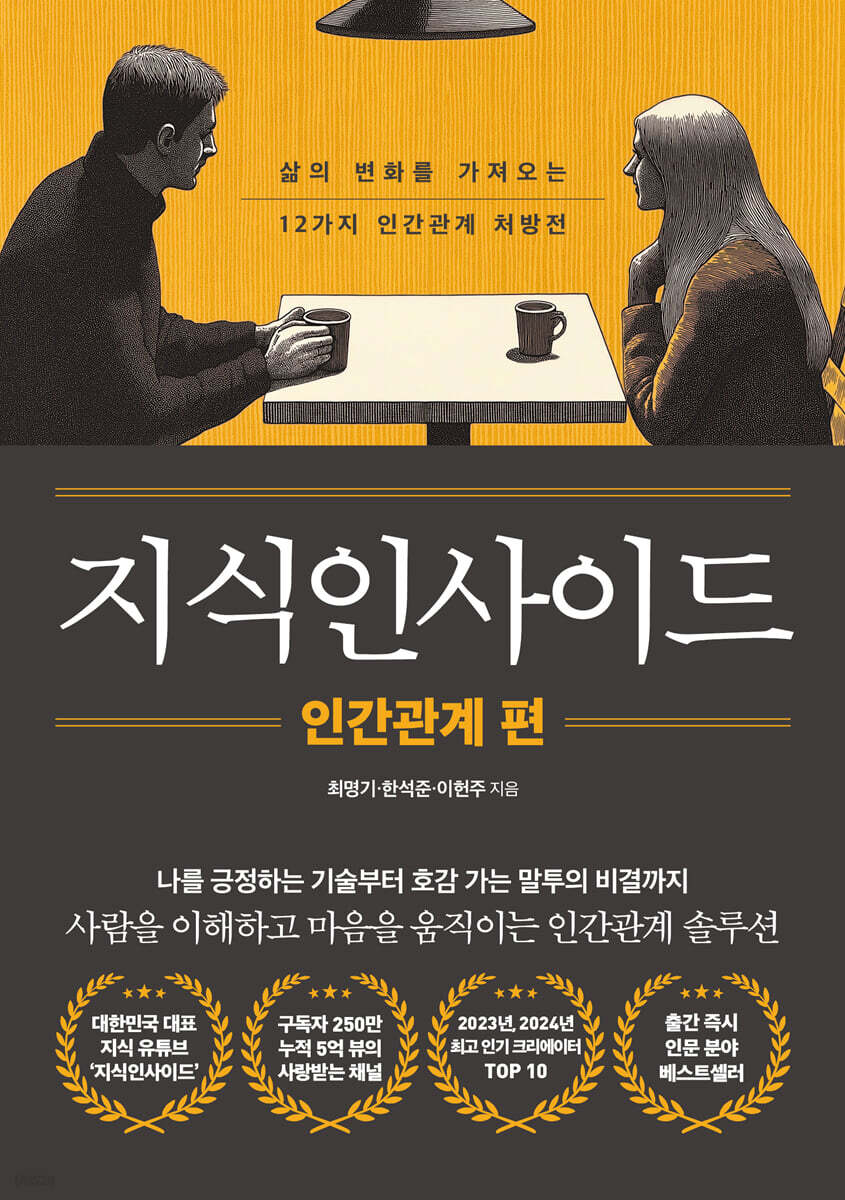
Knowledge Inside: Human Relationships
 |
Description
Book Introduction
Human relations solutions that understand people and move their hearts
'I can expand my world through human relationships!'
★ Korea's representative knowledge YouTube 'Knowledge Inside' ★
★ A beloved channel with 2.5 million subscribers and 530 million cumulative views ★
★ Top 10 Most Popular Creators of 2023 and 2024 ★
The first book of Korea's leading knowledge channel, 'Knowledge Inside', boasting 2.5 million subscribers and 530 million cumulative views, has been published by Mix Coffee.
It explores various aspects of human relationships, from how to overcome bad worry habits, the secret to escaping the hell of comparison, the art of giving heart-touching compliments, and even the secret to building harmonious family relationships, examining mental health, psychological counseling, and communication from a humanistic perspective.
Stories that seem easy but difficult, and shallow but deep, are told in an interesting and understandable way by knowledgeable authorities.
There is a warm gaze that maintains the relationship without losing me.
"Knowledge Inside: Human Relationships" is the ultimate humanities textbook, filled with knowledge and wisdom about work, love, and relationships.
We filled in the parts that were not covered in the video, corrected inaccurate expressions, placed sensuous illustrations in the right places, and added key points and prescriptions for human relationships, trying to reach readers in a way that is more in-depth and easy to understand than the video.
You can look forward to a book armed with a different charm from the video.
'I can expand my world through human relationships!'
★ Korea's representative knowledge YouTube 'Knowledge Inside' ★
★ A beloved channel with 2.5 million subscribers and 530 million cumulative views ★
★ Top 10 Most Popular Creators of 2023 and 2024 ★
The first book of Korea's leading knowledge channel, 'Knowledge Inside', boasting 2.5 million subscribers and 530 million cumulative views, has been published by Mix Coffee.
It explores various aspects of human relationships, from how to overcome bad worry habits, the secret to escaping the hell of comparison, the art of giving heart-touching compliments, and even the secret to building harmonious family relationships, examining mental health, psychological counseling, and communication from a humanistic perspective.
Stories that seem easy but difficult, and shallow but deep, are told in an interesting and understandable way by knowledgeable authorities.
There is a warm gaze that maintains the relationship without losing me.
"Knowledge Inside: Human Relationships" is the ultimate humanities textbook, filled with knowledge and wisdom about work, love, and relationships.
We filled in the parts that were not covered in the video, corrected inaccurate expressions, placed sensuous illustrations in the right places, and added key points and prescriptions for human relationships, trying to reach readers in a way that is more in-depth and easy to understand than the video.
You can look forward to a book armed with a different charm from the video.
- You can preview some of the book's contents.
Preview
index
Entering_
I hope you can approach human relationships realistically and vividly.
Chapter 1: Things to Do Before Your Emotions Become Hurt
_ The beloved egoist
5 Things Mentally Strong People Always Do
Why We Pretend to Be Mentally Strong | Characteristics of a Strong Mentality | How to Build Mental Strength | What to Do When Your Mental Illness Fails | Protecting the Mental Health of Others
7 Ways People with Low Self-Esteem Can Boost Theirs
4 Keys to Building Self-Esteem | Why We're Attracted to People with High Self-Esteem | What People with High Self-Esteem Say | How to Build and Maintain Self-Esteem | When Your Beloved Family Member Has Low Self-Esteem
6 Ways to Break Bad Worry Habits
Worries That Were Needless | Why We Worry | The Effects of Worrying | How to Break Bad Worrying Habits | What to Do When Worries Strike
Prescription for Human Relationships #1
Chapter 2 How to Set Me Straight and Make Me Strong
_ Standing alone as a complete me
3 Secrets to Escaping Comparison Hell and Living as Yourself
Koreans' Comparative Culture | What Comes from an Other-Centered Culture | When We Force Misfortune on Each Other | The Positives of Comparative Culture | How to Become Master of Your Life
3 Secrets to Living Confidently Alone
Characteristics of People Who Don't Contact First | Contacting First Isn't Important | How to Stop Seeking Someone Only When They Need You | The Uniqueness of Relationships and How to Deal with Them | When Relationships Hit You | The Secret to Living Confidently Alone
5 Ways to Find Your True Self
An experience of obsession with relationships | Natural changes in relationships | How to prevent relationships from getting worse | How to stand alone when relationships are difficult | When to realize the futility of relationships | How to find your true self | The friend you absolutely must have by your side
Prescription for Human Relationships Part 2
Chapter 3: The Dignified Speaking Skills of a Mature Adult
_ The first step in a relationship
3 Secrets to Attractive, Likeable Speech
What Your Tone of Speech Determines | Types of Unfriendly Tone of Speech | Koreans' Uniquely Rude Tone of Speech | Online Tone of Speech | How to Change Your Tone of Speech to a Likeable One | 3 Secrets to Likeable Tone of Speech | How to Converse Naturally
4 Complimentary Techniques That Move People's Hearts
Commonly Misunderstood Compliments | The Art of Complimenting to Move Hearts | When Compliments Become Poisonous | Tips for Creating Likeable Conversations
5 Ways People Express Their Respect
Reasons for wanting to tell secrets | Things you shouldn't say_Socially unacceptable things | Things you shouldn't say_The other person's negative feelings | Things you shouldn't say_Private life | Things you shouldn't say_Gossip | Things you shouldn't say_Bragging | Why we perceive the same words differently | Expressions that people who become more respected as they age
Prescription for Human Relationships #3
Chapter 4: The Secret to Maintaining Relationships Without Losing Yourself
_ The Psychology of Relationship Recovery
5 Techniques for Dealing with Rude People in a Lighthearted Way
When Encountering Rude People | Characteristics of Rude People | How to Deal with Rude People While Maintaining Dignity | Practical Tips for Subduing Rude People | The Secret to Being Respected
5 Types of People You Should Avoid
Experiences of losing relationships | Types of people you should cut off if possible | Types you should definitely stay away from | The best time to break up with a painful relationship | How to break up without getting hurt | The worst mindset for relationships | Can people really change? | People who stand upright on their own two feet | How to protect myself
6 Secrets to Harmonious Family Relationships
Appropriate Distance Between Family Members | Why Family Communication Is Difficult | On Sacrifice, Exploitation, and Patience | Fighting Families vs.
Indifferent families | Why the closer you get to your children, the more distant they become | Responsibility for strained family relationships | How to communicate with your adolescent child | What constitutes a healthy parent-child relationship | How to repair strained family relationships
Prescription for Human Relationships #4
I hope you can approach human relationships realistically and vividly.
Chapter 1: Things to Do Before Your Emotions Become Hurt
_ The beloved egoist
5 Things Mentally Strong People Always Do
Why We Pretend to Be Mentally Strong | Characteristics of a Strong Mentality | How to Build Mental Strength | What to Do When Your Mental Illness Fails | Protecting the Mental Health of Others
7 Ways People with Low Self-Esteem Can Boost Theirs
4 Keys to Building Self-Esteem | Why We're Attracted to People with High Self-Esteem | What People with High Self-Esteem Say | How to Build and Maintain Self-Esteem | When Your Beloved Family Member Has Low Self-Esteem
6 Ways to Break Bad Worry Habits
Worries That Were Needless | Why We Worry | The Effects of Worrying | How to Break Bad Worrying Habits | What to Do When Worries Strike
Prescription for Human Relationships #1
Chapter 2 How to Set Me Straight and Make Me Strong
_ Standing alone as a complete me
3 Secrets to Escaping Comparison Hell and Living as Yourself
Koreans' Comparative Culture | What Comes from an Other-Centered Culture | When We Force Misfortune on Each Other | The Positives of Comparative Culture | How to Become Master of Your Life
3 Secrets to Living Confidently Alone
Characteristics of People Who Don't Contact First | Contacting First Isn't Important | How to Stop Seeking Someone Only When They Need You | The Uniqueness of Relationships and How to Deal with Them | When Relationships Hit You | The Secret to Living Confidently Alone
5 Ways to Find Your True Self
An experience of obsession with relationships | Natural changes in relationships | How to prevent relationships from getting worse | How to stand alone when relationships are difficult | When to realize the futility of relationships | How to find your true self | The friend you absolutely must have by your side
Prescription for Human Relationships Part 2
Chapter 3: The Dignified Speaking Skills of a Mature Adult
_ The first step in a relationship
3 Secrets to Attractive, Likeable Speech
What Your Tone of Speech Determines | Types of Unfriendly Tone of Speech | Koreans' Uniquely Rude Tone of Speech | Online Tone of Speech | How to Change Your Tone of Speech to a Likeable One | 3 Secrets to Likeable Tone of Speech | How to Converse Naturally
4 Complimentary Techniques That Move People's Hearts
Commonly Misunderstood Compliments | The Art of Complimenting to Move Hearts | When Compliments Become Poisonous | Tips for Creating Likeable Conversations
5 Ways People Express Their Respect
Reasons for wanting to tell secrets | Things you shouldn't say_Socially unacceptable things | Things you shouldn't say_The other person's negative feelings | Things you shouldn't say_Private life | Things you shouldn't say_Gossip | Things you shouldn't say_Bragging | Why we perceive the same words differently | Expressions that people who become more respected as they age
Prescription for Human Relationships #3
Chapter 4: The Secret to Maintaining Relationships Without Losing Yourself
_ The Psychology of Relationship Recovery
5 Techniques for Dealing with Rude People in a Lighthearted Way
When Encountering Rude People | Characteristics of Rude People | How to Deal with Rude People While Maintaining Dignity | Practical Tips for Subduing Rude People | The Secret to Being Respected
5 Types of People You Should Avoid
Experiences of losing relationships | Types of people you should cut off if possible | Types you should definitely stay away from | The best time to break up with a painful relationship | How to break up without getting hurt | The worst mindset for relationships | Can people really change? | People who stand upright on their own two feet | How to protect myself
6 Secrets to Harmonious Family Relationships
Appropriate Distance Between Family Members | Why Family Communication Is Difficult | On Sacrifice, Exploitation, and Patience | Fighting Families vs.
Indifferent families | Why the closer you get to your children, the more distant they become | Responsibility for strained family relationships | How to communicate with your adolescent child | What constitutes a healthy parent-child relationship | How to repair strained family relationships
Prescription for Human Relationships #4
Detailed image

Into the book
When everything is going well, when things are going well, when things are bright, there are people who are nice to hang out with and nice to be with.
When the dark night of the soul comes, when the harsh winter of life comes, there are people who give us strength.
Just having those people around you helps you recover mentally to some extent.
While anxiety is contagious, so are strong inner feelings, such as a sense of challenge, security, and resilience.
So, protecting someone else's mental health is possible just by being by their side as someone with a strong mental health.
--- p.34
There are ways to maintain self-esteem.
You just need to have one or two things you're good at.
For example, there are people who know a lot of movie titles.
For him, knowing a lot of movie titles is a huge source of self-esteem.
That alone makes me think, 'No matter how good you are, I know movies best.'
Regardless of the general notion the world has given us of 'this person must have high self-esteem', we need to have our own self-esteem measurement.
For some, it's a movie, for others, it's a marathon, and for others, it's a book.
That's why this society needs to accept diverse values.
--- p.54
Aristotle once said, “The good fortune of others is suffering.”
When people see that someone else has something they don't have, they go beyond envy and even feel pain.
But in this day and age, social media is constantly amplifying people's psychological anxiety.
It's true that people all over the world are comparing themselves to others.
Windy Dryden, a British expert on cognitive behavioral therapy, called this “comparison disease.”
Especially in Korea, comparisons with others are extreme.
I wonder if indiscriminate successism and the stigmatization of the socially disadvantaged are hidden behind it.
--- p.81
I think it's necessary to respond appropriately rather than react.
It wouldn't be good to be so stressed out by interpersonal relationships that you cut off all of them.
Also, it is not good to always bow down and enter into all human relationships.
On the other hand, it wouldn't be good to fight back in all human relationships.
I think it would be good to continuously practice in a balanced way according to the intention and context that suits each situation and characteristic.
When you find yourself overly accommodating to others or caring too much about their evaluations and thoughts of you, you need to practice thinking about yourself first.
--- p.112
They say that when you try to listen, your whole body should be turned towards the other person.
Not only your eyes, but your face should also be turned towards the other person, and the direction of your shoulders, torso, and even your feet should also be turned towards the other person.
That way, the other person will understand that I am 100% willing to listen to what he or she has to say.
Since then, whenever I have a conversation or an interview, I try to focus my whole body and soul on the other person.
--- p.161
American psychologist Carl Rogers said there are three key conditions for a counseling relationship.
Empathic understanding, unconditional positive regard, and truthfulness or congruence.
Among them, unconditional positive respect matches the case of Director Choi Myeong-gi.
It is about unconditionally respecting the other person, their very existence.
“You can do that,” or “Your very existence shines.”
It can be said to be one of the techniques of complimenting that moves people's hearts.
--- p.174
If a package arrives without you even ordering it, shouldn't you not accept it?
Because it's not mine and I don't even know what it is.
So if you don't receive it, it will be returned to the owner.
I think rude words are the same.
I don't accept the other person's rudeness towards me.
I guess it would be right to say that I'm ignoring it.
Whether you say rude things or not, I won't accept it, so I'll take it back.
Then the rudeness is not mine, but the master's.
--- p.216~217
British psychologist and psychiatrist John Bowlby created 'attachment theory' in the late 1950s.
It is a theory that explains the fundamental causes of long-term human relationships, starting with cases of infant development and expanding to cases of adults.
They are divided into stable, anxious, and avoidant types.
The stable type is a type that values self-affirmation and others-affirmation, expressing their emotions honestly and naturally accepting the interest and love of others.
I tend to treat myself and others equally.
Meanwhile, the anxious type is a type that denies self and affirms others, and the avoidant type is a type that denies self and affirms others.
The dissonance between the anxious and avoidant types will create a difficult relationship.
I think stability is the key to building harmonious family relationships.
When the dark night of the soul comes, when the harsh winter of life comes, there are people who give us strength.
Just having those people around you helps you recover mentally to some extent.
While anxiety is contagious, so are strong inner feelings, such as a sense of challenge, security, and resilience.
So, protecting someone else's mental health is possible just by being by their side as someone with a strong mental health.
--- p.34
There are ways to maintain self-esteem.
You just need to have one or two things you're good at.
For example, there are people who know a lot of movie titles.
For him, knowing a lot of movie titles is a huge source of self-esteem.
That alone makes me think, 'No matter how good you are, I know movies best.'
Regardless of the general notion the world has given us of 'this person must have high self-esteem', we need to have our own self-esteem measurement.
For some, it's a movie, for others, it's a marathon, and for others, it's a book.
That's why this society needs to accept diverse values.
--- p.54
Aristotle once said, “The good fortune of others is suffering.”
When people see that someone else has something they don't have, they go beyond envy and even feel pain.
But in this day and age, social media is constantly amplifying people's psychological anxiety.
It's true that people all over the world are comparing themselves to others.
Windy Dryden, a British expert on cognitive behavioral therapy, called this “comparison disease.”
Especially in Korea, comparisons with others are extreme.
I wonder if indiscriminate successism and the stigmatization of the socially disadvantaged are hidden behind it.
--- p.81
I think it's necessary to respond appropriately rather than react.
It wouldn't be good to be so stressed out by interpersonal relationships that you cut off all of them.
Also, it is not good to always bow down and enter into all human relationships.
On the other hand, it wouldn't be good to fight back in all human relationships.
I think it would be good to continuously practice in a balanced way according to the intention and context that suits each situation and characteristic.
When you find yourself overly accommodating to others or caring too much about their evaluations and thoughts of you, you need to practice thinking about yourself first.
--- p.112
They say that when you try to listen, your whole body should be turned towards the other person.
Not only your eyes, but your face should also be turned towards the other person, and the direction of your shoulders, torso, and even your feet should also be turned towards the other person.
That way, the other person will understand that I am 100% willing to listen to what he or she has to say.
Since then, whenever I have a conversation or an interview, I try to focus my whole body and soul on the other person.
--- p.161
American psychologist Carl Rogers said there are three key conditions for a counseling relationship.
Empathic understanding, unconditional positive regard, and truthfulness or congruence.
Among them, unconditional positive respect matches the case of Director Choi Myeong-gi.
It is about unconditionally respecting the other person, their very existence.
“You can do that,” or “Your very existence shines.”
It can be said to be one of the techniques of complimenting that moves people's hearts.
--- p.174
If a package arrives without you even ordering it, shouldn't you not accept it?
Because it's not mine and I don't even know what it is.
So if you don't receive it, it will be returned to the owner.
I think rude words are the same.
I don't accept the other person's rudeness towards me.
I guess it would be right to say that I'm ignoring it.
Whether you say rude things or not, I won't accept it, so I'll take it back.
Then the rudeness is not mine, but the master's.
--- p.216~217
British psychologist and psychiatrist John Bowlby created 'attachment theory' in the late 1950s.
It is a theory that explains the fundamental causes of long-term human relationships, starting with cases of infant development and expanding to cases of adults.
They are divided into stable, anxious, and avoidant types.
The stable type is a type that values self-affirmation and others-affirmation, expressing their emotions honestly and naturally accepting the interest and love of others.
I tend to treat myself and others equally.
Meanwhile, the anxious type is a type that denies self and affirms others, and the avoidant type is a type that denies self and affirms others.
The dissonance between the anxious and avoidant types will create a difficult relationship.
I think stability is the key to building harmonious family relationships.
--- p.254
Publisher's Review
From techniques for affirming yourself to the secrets of a likeable tone of voice
A prescription for human relationships that helps you understand work, love, and relationships!
The so-called 'Avengers of Human Relationships' were mobilized, including psychiatrist Choi Myeong-gi, veteran announcer Han Seok-jun, and psychological counselor Lee Heon-ju.
These three came together in 'Knowledge Omakase', a series of clear life prescriptions on Knowledge Inside, Korea's leading knowledge channel with 2.5 million subscribers and 530 million cumulative views.
The series began in December 2023 and has been loved by many, garnering over 20 million views and over 20,000 comments in just over a year.
With its interesting topics, smooth progress, rich content, and lively editing, it has established itself as a trusted source of knowledge.
If you look into human relationships, you will find a methodology that centers on the 'self', such as the behavior of people with a strong mentality, how to find your true self, and the secret to living confidently alone, as well as coping methods that center on 'relationships' with others, such as the technique of giving compliments that move people's hearts, the expressions of people who earn the respect of others, and the technique of dealing with rude people.
The so-called Avengers of human relationships will answer your questions with engaging storytelling, expert knowledge, and wise answers based on personal experience.
As Professor Lee Heon-ju stated in the introduction, the area of human relations covered in this book is work, love, relationships, etc. The book seeks to find and apply the optimal solution to understanding people and moving their hearts through actions, not ideas.
We must recognize that human relationships are a realm of coping, not reaction.
Only then will we be able to approach human relationships in a realistic and vivid way.
This book consists of four chapters.
In Chapter 1, we learn what to do before your feelings become hurt.
What mentally strong people should do, how to increase self-esteem, how to break bad worrying habits, etc.
Chapter 2 tells me how to set myself up correctly and make me strong.
The secret to escaping the hell of comparison, the secret to living confidently on your own, and how to find your true self.
Chapter 3 demonstrates the dignified speaking skills of a mature adult.
The secret to a likable tone of voice, the art of giving heart-touching compliments, and the expressions of respected people.
Chapter 4 covers the secrets to maintaining relationships without losing yourself.
Skills for dealing with rude people, types of people to avoid, secrets to harmonious family relationships, etc.
For those of you who are tired of human relationships, we have boldly prepared the optimal solution for a better life for you and me.
A prescription for human relationships that helps you understand work, love, and relationships!
The so-called 'Avengers of Human Relationships' were mobilized, including psychiatrist Choi Myeong-gi, veteran announcer Han Seok-jun, and psychological counselor Lee Heon-ju.
These three came together in 'Knowledge Omakase', a series of clear life prescriptions on Knowledge Inside, Korea's leading knowledge channel with 2.5 million subscribers and 530 million cumulative views.
The series began in December 2023 and has been loved by many, garnering over 20 million views and over 20,000 comments in just over a year.
With its interesting topics, smooth progress, rich content, and lively editing, it has established itself as a trusted source of knowledge.
If you look into human relationships, you will find a methodology that centers on the 'self', such as the behavior of people with a strong mentality, how to find your true self, and the secret to living confidently alone, as well as coping methods that center on 'relationships' with others, such as the technique of giving compliments that move people's hearts, the expressions of people who earn the respect of others, and the technique of dealing with rude people.
The so-called Avengers of human relationships will answer your questions with engaging storytelling, expert knowledge, and wise answers based on personal experience.
As Professor Lee Heon-ju stated in the introduction, the area of human relations covered in this book is work, love, relationships, etc. The book seeks to find and apply the optimal solution to understanding people and moving their hearts through actions, not ideas.
We must recognize that human relationships are a realm of coping, not reaction.
Only then will we be able to approach human relationships in a realistic and vivid way.
This book consists of four chapters.
In Chapter 1, we learn what to do before your feelings become hurt.
What mentally strong people should do, how to increase self-esteem, how to break bad worrying habits, etc.
Chapter 2 tells me how to set myself up correctly and make me strong.
The secret to escaping the hell of comparison, the secret to living confidently on your own, and how to find your true self.
Chapter 3 demonstrates the dignified speaking skills of a mature adult.
The secret to a likable tone of voice, the art of giving heart-touching compliments, and the expressions of respected people.
Chapter 4 covers the secrets to maintaining relationships without losing yourself.
Skills for dealing with rude people, types of people to avoid, secrets to harmonious family relationships, etc.
For those of you who are tired of human relationships, we have boldly prepared the optimal solution for a better life for you and me.
GOODS SPECIFICS
- Date of issue: February 14, 2025
- Page count, weight, size: 284 pages | 446g | 148*210*20mm
- ISBN13: 9791170436126
- ISBN10: 1170436129
You may also like
카테고리
korean


korean

![GQ KOREA Mark (Monthly): December [2025]](http://librairie.coreenne.fr/cdn/shop/files/8ef265dbbfbf186523ed75ba7319009d.jpg?v=1765340328&width=3840)


