

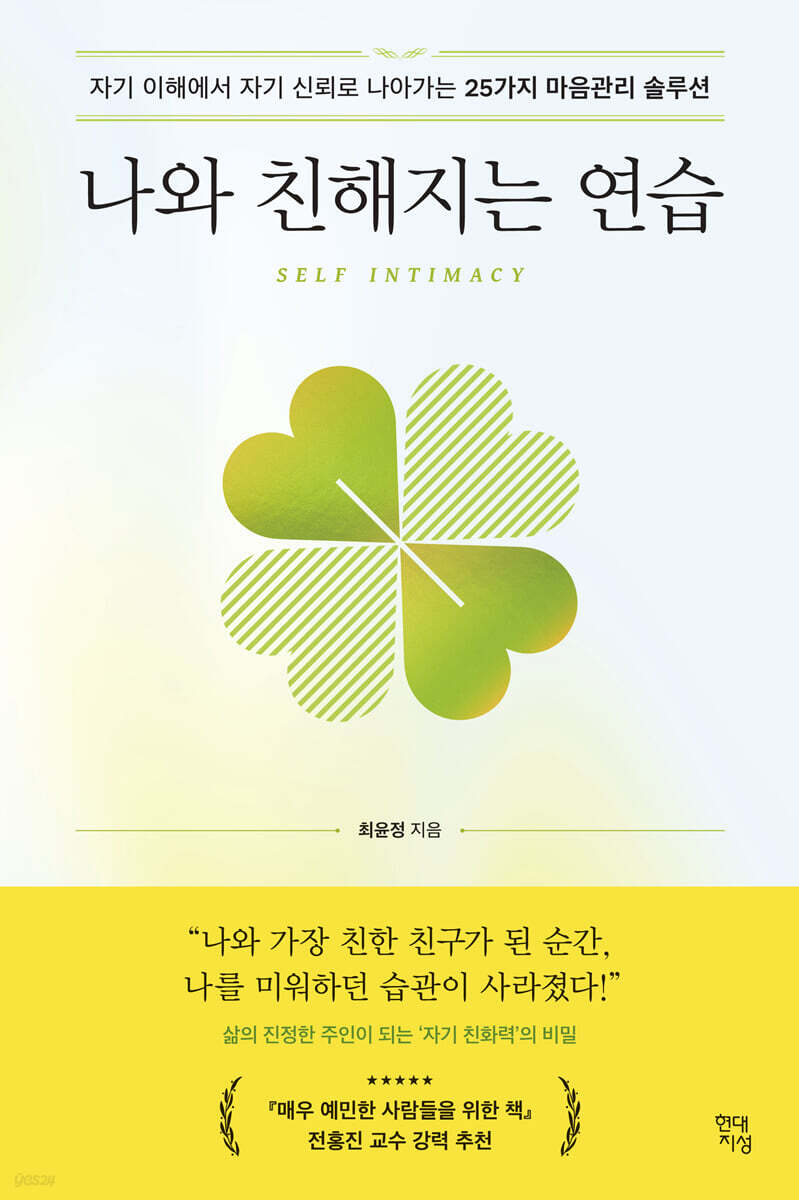
Practice getting to know me
 |
Description
Book Introduction
[Urgent] 1 in 2 adults in South Korea are experiencing a self-esteem crisis!
“Don’t just tell me to love you,
“Please tell me the specific method.”
*** Highly recommended by Professor Jeon Hong-jin, Department of Psychiatry, Samsung Seoul Hospital
*** A practical manual for self-love, a culmination of five years of research and clinical experience.
*** Includes 25 mind management solutions based on scientific evidence.
*** An integrative approach of brain science x psychology x mindfulness
“Every day, I press hundreds of ‘likes’ on social media.
“How much do I really like myself?”
People post their glamorized daily lives and edited photos of themselves on Instagram, and share edited vlogs of their daily lives on YouTube.
It's no longer unusual to ask someone you just met what their MBTI personality type is.
Ironically, even in this obsession with self, the 'true self' cannot be found.
As the years passed, the author observed an increasing number of patients in the clinic complaining, “I don’t know,” or “I just feel frustrated.”
The phenomenon of being disconnected from one's own emotions and alienating oneself from life is becoming more severe.
The author, a psychiatrist and the director of 'Mind-Free Clinic' affiliated with the Korea Occupational Medical Welfare Research Institute, has developed a formula for self-love based on five years of research and clinical experience based on this awareness of the problem.
The conclusion I reached while exploring the boundaries of human psychology, brain science, and mindfulness is, “We must become closer to ourselves than to anyone else.”
If you can't empathize with my feelings and trust me, you can never live a healthy life.
By following the 25 scientifically evidence-based mind-management solutions presented in this book, including writing a behavioral journal, identifying hidden addictions, saving gratitude, practicing mindfulness, and discovering the benefits of stress, you will experience the amazing experience of healing your mind that has given in to dopamine and eliminating the habits that used to hate you.
“Don’t just tell me to love you,
“Please tell me the specific method.”
*** Highly recommended by Professor Jeon Hong-jin, Department of Psychiatry, Samsung Seoul Hospital
*** A practical manual for self-love, a culmination of five years of research and clinical experience.
*** Includes 25 mind management solutions based on scientific evidence.
*** An integrative approach of brain science x psychology x mindfulness
“Every day, I press hundreds of ‘likes’ on social media.
“How much do I really like myself?”
People post their glamorized daily lives and edited photos of themselves on Instagram, and share edited vlogs of their daily lives on YouTube.
It's no longer unusual to ask someone you just met what their MBTI personality type is.
Ironically, even in this obsession with self, the 'true self' cannot be found.
As the years passed, the author observed an increasing number of patients in the clinic complaining, “I don’t know,” or “I just feel frustrated.”
The phenomenon of being disconnected from one's own emotions and alienating oneself from life is becoming more severe.
The author, a psychiatrist and the director of 'Mind-Free Clinic' affiliated with the Korea Occupational Medical Welfare Research Institute, has developed a formula for self-love based on five years of research and clinical experience based on this awareness of the problem.
The conclusion I reached while exploring the boundaries of human psychology, brain science, and mindfulness is, “We must become closer to ourselves than to anyone else.”
If you can't empathize with my feelings and trust me, you can never live a healthy life.
By following the 25 scientifically evidence-based mind-management solutions presented in this book, including writing a behavioral journal, identifying hidden addictions, saving gratitude, practicing mindfulness, and discovering the benefits of stress, you will experience the amazing experience of healing your mind that has given in to dopamine and eliminating the habits that used to hate you.
- You can preview some of the book's contents.
Preview
index
Recommendation
Prologue To you who will be your best friend
Chapter 1: A Life Determined by Self-Affinity
The three pillars that create affinity
What Happens When You Give Up on Your Relationship
Anyone can be friends with me
Smart individualism, not egoism
There's no need to be anxious about the future.
Chapter 2: Only I can determine my worth - Self-worth
Don't let your parents determine your worth.
:: Exercise 1 for becoming close to me To an adult child who is in pain from past wounds
Why do I constantly feel a sense of lack?
Not perfect, but good enough
:: Exercise 2: Becoming Close to Myself: Forgiving Myself and Being Thankful for Myself
Only I can give you confidence in myself.
:: Exercise 3 for becoming close to myself: Are you giving me unconditional love?
I am only happy when I live as myself.
Chapter 3: Empathizing with My Behaviors and Emotions _ Self-Empathy
Your actions reveal your relationship with me.
Choose actions that are friendly to me
:: Exercise 4: Becoming Close to Yourself: Writing a Behavior Diary
Identify Hidden Addictions
:: Exercise 5: Getting to Know Yourself: Identifying Hidden Addictions
Emotions are my guardian angel
:: Exercise 6: Getting to Know Me: A Guest Called Emotion
Empathize with me
Make peace with your suppressed emotions
The Mechanism of Emotions as Seen Through Brain Science
Mindfulness is medicine
:: Exercise 7: Mindfulness Training Methods to Follow to Get to Know Yourself
:: Exercise 8: Getting to Know Me: Environments and Tools for Mindfulness
Name your feelings
:: Exercise 9: Getting to Know Myself: How to Deal with Emotions Healthily
:: Exercise 10: Getting to Know Me Negative Emotions Like a Camel's Nose
Chapter 4: How to Trust and Move Forward _ Self-Trust
How to signal to your brain that it's safe
The more grateful you are, the more your brain changes.
:: Exercise 11: Getting to Know Myself: Gratitude Practice
Why am I so vulnerable to stress?
Stress: A Threat or a Challenge?
:: Exercise 12: Getting to Know Myself: The Stronger Me That Stress Makes Me
How to Use Stress to Your Advantage
:: Exercise 13: Discovering the Benefits of Stress
:: Exercise 14: Get Out of the Victim Role
The self-confidence that small successes bring
:: Exercise 15: Getting to Know Yourself: A 3-Step Recording Method for Building Self-Confidence
Exercise to relieve the burden of stress
Mindfulness for a Strong Mentality
:: Exercise 16: Getting to Know Me: The Mechanism of Self-Confidence
Chapter 5: Increasing Self-Affinity in Relationships
Relationships are another form of self-care
Finding the balance between consideration and sacrifice
Who is poisonous to me?
The synergistic effect of self-affinity
Heal the wounds you receive from others with others.
Helper vs. Helpee
:: Exercise 17: Getting to Know Me: The Courage to Ask for Help, Self-Help Groups
Chapter 6: Creating My Eternal Safe Base
Self-compassion is needed
:: Exercise 18: Becoming Close to Myself Let Me Be My Own Mother
:: Exercise 19: Becoming an Adult
Why did this misfortune have to befall me?
:: Exercise 20: Getting to Know Myself: A 3-Step Exercise to Awaken the Kindness Within Me
Attitude toward loss
The loneliness I couldn't tell anyone about
:: Exercise 21: Getting to Know Me My Own Strategy for Growing Wisdom
:: Exercise 22: Getting to Know Me: The Opposite of Loneliness
Why am I not happy?
:: Exercise 23: Getting to Know Me: South Korea Sick with Addiction
Rest is also my responsibility
:: Exercise 24: Burnout Syndrome Self-Diagnosis
:: Exercise 25: Getting to Know Me: A List of 100% Pure Relaxation
References
Prologue To you who will be your best friend
Chapter 1: A Life Determined by Self-Affinity
The three pillars that create affinity
What Happens When You Give Up on Your Relationship
Anyone can be friends with me
Smart individualism, not egoism
There's no need to be anxious about the future.
Chapter 2: Only I can determine my worth - Self-worth
Don't let your parents determine your worth.
:: Exercise 1 for becoming close to me To an adult child who is in pain from past wounds
Why do I constantly feel a sense of lack?
Not perfect, but good enough
:: Exercise 2: Becoming Close to Myself: Forgiving Myself and Being Thankful for Myself
Only I can give you confidence in myself.
:: Exercise 3 for becoming close to myself: Are you giving me unconditional love?
I am only happy when I live as myself.
Chapter 3: Empathizing with My Behaviors and Emotions _ Self-Empathy
Your actions reveal your relationship with me.
Choose actions that are friendly to me
:: Exercise 4: Becoming Close to Yourself: Writing a Behavior Diary
Identify Hidden Addictions
:: Exercise 5: Getting to Know Yourself: Identifying Hidden Addictions
Emotions are my guardian angel
:: Exercise 6: Getting to Know Me: A Guest Called Emotion
Empathize with me
Make peace with your suppressed emotions
The Mechanism of Emotions as Seen Through Brain Science
Mindfulness is medicine
:: Exercise 7: Mindfulness Training Methods to Follow to Get to Know Yourself
:: Exercise 8: Getting to Know Me: Environments and Tools for Mindfulness
Name your feelings
:: Exercise 9: Getting to Know Myself: How to Deal with Emotions Healthily
:: Exercise 10: Getting to Know Me Negative Emotions Like a Camel's Nose
Chapter 4: How to Trust and Move Forward _ Self-Trust
How to signal to your brain that it's safe
The more grateful you are, the more your brain changes.
:: Exercise 11: Getting to Know Myself: Gratitude Practice
Why am I so vulnerable to stress?
Stress: A Threat or a Challenge?
:: Exercise 12: Getting to Know Myself: The Stronger Me That Stress Makes Me
How to Use Stress to Your Advantage
:: Exercise 13: Discovering the Benefits of Stress
:: Exercise 14: Get Out of the Victim Role
The self-confidence that small successes bring
:: Exercise 15: Getting to Know Yourself: A 3-Step Recording Method for Building Self-Confidence
Exercise to relieve the burden of stress
Mindfulness for a Strong Mentality
:: Exercise 16: Getting to Know Me: The Mechanism of Self-Confidence
Chapter 5: Increasing Self-Affinity in Relationships
Relationships are another form of self-care
Finding the balance between consideration and sacrifice
Who is poisonous to me?
The synergistic effect of self-affinity
Heal the wounds you receive from others with others.
Helper vs. Helpee
:: Exercise 17: Getting to Know Me: The Courage to Ask for Help, Self-Help Groups
Chapter 6: Creating My Eternal Safe Base
Self-compassion is needed
:: Exercise 18: Becoming Close to Myself Let Me Be My Own Mother
:: Exercise 19: Becoming an Adult
Why did this misfortune have to befall me?
:: Exercise 20: Getting to Know Myself: A 3-Step Exercise to Awaken the Kindness Within Me
Attitude toward loss
The loneliness I couldn't tell anyone about
:: Exercise 21: Getting to Know Me My Own Strategy for Growing Wisdom
:: Exercise 22: Getting to Know Me: The Opposite of Loneliness
Why am I not happy?
:: Exercise 23: Getting to Know Me: South Korea Sick with Addiction
Rest is also my responsibility
:: Exercise 24: Burnout Syndrome Self-Diagnosis
:: Exercise 25: Getting to Know Me: A List of 100% Pure Relaxation
References
Detailed image

Into the book
There was something I really wanted to tell you through this book.
I wanted to convey it clearly in one word.
After much thought, the word I chose was self-intimacy.
The term self-affinity may sound a bit unfamiliar.
This is because we usually use the word affinity in our relationships with others.
I wanted to use the word affinity to say that you are alienating yourself as if you were an outsider.
I wanted to say that sometimes you live as someone you are not.
--- p.12, from "Prologue"
The biggest problem that Ji-eun had was feeling ashamed when she failed to control her eating habits.
Shame is the feeling of recognizing that “not only my actions but my very existence is wrong,” and I focused on transforming this into guilt.
Guilt is an emotion that judges, “My existence is okay, but this action is wrong.”
At first glance, they may seem like similar feelings, but being ashamed of one's actions and being ashamed of one's existence are completely different.
This is because we often feel that we can correct our actions, but that changing our being is impossible.
--- p.50, from “Life Determined by Self-Affinity”
The reason why the feeling of lack didn't go away even after I got something was because it wasn't what I truly wanted.
I was desperately searching for a way to become perfect, having lost the most important thing, myself.
You have been fooled by the lie that “you are inadequate.”
Now you must choose to be enough for yourself.
It's about living the way you want to live, not the way the world says.
Everyone born on this earth has the freedom to find themselves, to protect themselves, and to reject unwanted identities.
--- p.74, from “Only I am the One Who Determines My Value”
Positive affirmations are a technique that involves repeating positive phrases to yourself to boost your confidence and induce positive emotions.
However, a study from the University of Waterloo and the University of New Brunswick in Canada found that when people who have negative relationships with themselves try to use positive affirmations, it can actually increase their internal conflict and stress.
In particular, when people with low self-worth repeated the phrase “I am a lovable person,” their negative emotions tended to increase and their self-worth tended to decrease further.
The researchers explained this phenomenon as a backlash that occurs when positive affirmations do not match one's inner state.
--- p.110, from “Empathizing with My Behaviors and Emotions”
It is very rare for someone to be unaffected by a hidden addiction.
This is because humans, consciously or unconsciously, tend to become insensitive or engage in activities that can distract them.
This is due to the nature of avoidance, which is an act of running away from uncomfortable feelings and wanting only positive feelings.
The busy schedule that fills up the schedule, the alcohol we drink to become indifferent and the caffeine we seek to wake up again, social media and YouTube, sugar-laden food, endless worry, perfectionism, repetitive spending through shopping carts and checkouts, even relationship addiction that fills us with relationships with other people… … Anything that distances us from our true feelings and thoughts is a hidden addiction.
--- p.120, from “Empathizing with My Behaviors and Emotions”
Grief is the doctor who tends the wounds.
When we experience loss and pain, it leads us into a process of healing.
Anger is a strong guard.
When someone tries to infringe on our rights, we firmly draw the line, saying, “This is it! No more!”
Once we understand why emotions exist, we will realize that we have been mistaking our guardian angels for monsters.
My emotions are part of me and help me, not destroy me.
If you fear my feelings, you should fear my heart and lungs too.
--- p.132, from “Empathizing with My Behaviors and Emotions”
A good therapist works to enhance the patient's flexibility in responding.
It helps patients maintain an appropriate distance from their emotions and look at the situation objectively.
This is because it allows us to make wiser decisions and choose more beneficial actions.
However, there are ways to improve your reactivity on your own, without the help of a therapist.
It is mindfulness.
--- p.157, from “Empathizing with My Behaviors and Emotions”
I explained to Hyejin that practicing gratitude isn't simply about changing your mood or maintaining a positive mindset.
Gratitude has made me realize that it sends a direct “safe” signal to the brain, stopping unnecessary survival responses.
He also said that the format of a diary is simply a device for repeatedly practicing gratitude, and that there is no need to be bound to a specific format.
--- p.199, from “How to Trust in Myself and Move Forward”
Although the number of relationships we really need is actually smaller than we think, many people, like Nayoung, suffer by holding on to unnecessary relationships.
Sometimes, when we struggle with a harmful relationship that could be cut off, we mistakenly believe that it is a problem we can solve.
No matter how long you've been together and how close your relationship once was, things can change at times.
Life is such that a precious person who once held a VIP position can one day become a demon who destroys my life.
When a relationship has deteriorated, the ability to quickly and accurately cut ties and let go of the relationship is an important skill in human relations.
--- p.271, from “Increasing Self-Affinity in Relationships”
When you make peace with yourself, you reach a state of true overcoming, and your natural healing system is activated within you, making you a different person than before.
True overcoming is not a simple return to a previous state, but a positive transformation that occurs across all areas of life.
In other words, it is about achieving post-traumatic growth.
The most dramatic change during this growth occurs in self-affinity.
Adversity becomes a turning point in our relationship with ourselves.
Those who do not let go of their own hands even in the midst of a whirlwind of adversity will later say that this period was the most important springboard in their lives.
I wanted to convey it clearly in one word.
After much thought, the word I chose was self-intimacy.
The term self-affinity may sound a bit unfamiliar.
This is because we usually use the word affinity in our relationships with others.
I wanted to use the word affinity to say that you are alienating yourself as if you were an outsider.
I wanted to say that sometimes you live as someone you are not.
--- p.12, from "Prologue"
The biggest problem that Ji-eun had was feeling ashamed when she failed to control her eating habits.
Shame is the feeling of recognizing that “not only my actions but my very existence is wrong,” and I focused on transforming this into guilt.
Guilt is an emotion that judges, “My existence is okay, but this action is wrong.”
At first glance, they may seem like similar feelings, but being ashamed of one's actions and being ashamed of one's existence are completely different.
This is because we often feel that we can correct our actions, but that changing our being is impossible.
--- p.50, from “Life Determined by Self-Affinity”
The reason why the feeling of lack didn't go away even after I got something was because it wasn't what I truly wanted.
I was desperately searching for a way to become perfect, having lost the most important thing, myself.
You have been fooled by the lie that “you are inadequate.”
Now you must choose to be enough for yourself.
It's about living the way you want to live, not the way the world says.
Everyone born on this earth has the freedom to find themselves, to protect themselves, and to reject unwanted identities.
--- p.74, from “Only I am the One Who Determines My Value”
Positive affirmations are a technique that involves repeating positive phrases to yourself to boost your confidence and induce positive emotions.
However, a study from the University of Waterloo and the University of New Brunswick in Canada found that when people who have negative relationships with themselves try to use positive affirmations, it can actually increase their internal conflict and stress.
In particular, when people with low self-worth repeated the phrase “I am a lovable person,” their negative emotions tended to increase and their self-worth tended to decrease further.
The researchers explained this phenomenon as a backlash that occurs when positive affirmations do not match one's inner state.
--- p.110, from “Empathizing with My Behaviors and Emotions”
It is very rare for someone to be unaffected by a hidden addiction.
This is because humans, consciously or unconsciously, tend to become insensitive or engage in activities that can distract them.
This is due to the nature of avoidance, which is an act of running away from uncomfortable feelings and wanting only positive feelings.
The busy schedule that fills up the schedule, the alcohol we drink to become indifferent and the caffeine we seek to wake up again, social media and YouTube, sugar-laden food, endless worry, perfectionism, repetitive spending through shopping carts and checkouts, even relationship addiction that fills us with relationships with other people… … Anything that distances us from our true feelings and thoughts is a hidden addiction.
--- p.120, from “Empathizing with My Behaviors and Emotions”
Grief is the doctor who tends the wounds.
When we experience loss and pain, it leads us into a process of healing.
Anger is a strong guard.
When someone tries to infringe on our rights, we firmly draw the line, saying, “This is it! No more!”
Once we understand why emotions exist, we will realize that we have been mistaking our guardian angels for monsters.
My emotions are part of me and help me, not destroy me.
If you fear my feelings, you should fear my heart and lungs too.
--- p.132, from “Empathizing with My Behaviors and Emotions”
A good therapist works to enhance the patient's flexibility in responding.
It helps patients maintain an appropriate distance from their emotions and look at the situation objectively.
This is because it allows us to make wiser decisions and choose more beneficial actions.
However, there are ways to improve your reactivity on your own, without the help of a therapist.
It is mindfulness.
--- p.157, from “Empathizing with My Behaviors and Emotions”
I explained to Hyejin that practicing gratitude isn't simply about changing your mood or maintaining a positive mindset.
Gratitude has made me realize that it sends a direct “safe” signal to the brain, stopping unnecessary survival responses.
He also said that the format of a diary is simply a device for repeatedly practicing gratitude, and that there is no need to be bound to a specific format.
--- p.199, from “How to Trust in Myself and Move Forward”
Although the number of relationships we really need is actually smaller than we think, many people, like Nayoung, suffer by holding on to unnecessary relationships.
Sometimes, when we struggle with a harmful relationship that could be cut off, we mistakenly believe that it is a problem we can solve.
No matter how long you've been together and how close your relationship once was, things can change at times.
Life is such that a precious person who once held a VIP position can one day become a demon who destroys my life.
When a relationship has deteriorated, the ability to quickly and accurately cut ties and let go of the relationship is an important skill in human relations.
--- p.271, from “Increasing Self-Affinity in Relationships”
When you make peace with yourself, you reach a state of true overcoming, and your natural healing system is activated within you, making you a different person than before.
True overcoming is not a simple return to a previous state, but a positive transformation that occurs across all areas of life.
In other words, it is about achieving post-traumatic growth.
The most dramatic change during this growth occurs in self-affinity.
Adversity becomes a turning point in our relationship with ourselves.
Those who do not let go of their own hands even in the midst of a whirlwind of adversity will later say that this period was the most important springboard in their lives.
--- p.321, from “Creating My Own Eternal Safety Base”
Publisher's Review
One in two adults says they have low self-esteem.
Why You Should Practice Getting to Know Me
According to a survey on self-esteem conducted in 2024 on approximately 1,200 adult men and women nationwide, more than one in two adults currently rate their self-esteem as low.
On the other hand, 92.7% of respondents answered that it is necessary to live with high self-esteem in Korean society.
There is a growing consensus that high self-esteem is a necessary 'survival strategy'.
However, in reality, self-esteem is perceived as a vague virtue with an ambiguous meaning and difficult to improve.
Despite the popularity of self-esteem books, people still ask, "How can I love myself?" when it comes to relationships, dreams, and love.
The author of this book also faced the same question in his clinic where he met numerous patients, and came to a profound realization.
The concrete suggestion, “Be my best friend,” moves people’s hearts more than the abstract statement, “Love me.”
When I told them that they should discover their own worth, empathize with them, and believe in them as if they were close friends, changes began to occur.
Observing their small changes and growth, the author discovered a new keyword: 'self-affinity.'
This book scientifically organizes the three fundamental mental muscles—self-worth, self-empathy, and self-trust—and carefully provides practical solutions for everyday life.
"How on earth can you love me?"
3 Mental Muscles That Create Self-Affinity
The author doesn't offer any vague advice about accepting yourself as you are.
Specifically, it clearly states that we must develop three mental muscles: self-worth, self-empathy, and self-trust.
Self-worth is the firm belief that I am a good enough person, and self-empathy is the ability to listen to my feelings.
Finally, self-confidence means the unshakable belief that I can find the answer in any situation.
It also presents 25 ways to develop each of the heart muscles.
These range from simple, everyday practices like writing a self-forgiveness statement, keeping an action journal, saving gratitude, and labeling emotions, to established, medically proven methods like mindfulness and exercise that are effective when practiced consistently.
To help you understand, this book introduces various real-life people who turned their lives around by increasing their intimacy with themselves.
The author has reconstructed and collected vivid cases of patients he met in his clinic, including Eunyoung, a working mom who feels guilty because of her mother's excessive demands; Jihyeok, who blames himself after divorce due to his wife's infidelity; Hyeongjun, who was promoted very quickly at a foreign company but suffered from burnout; Yujeong, who changed jobs due to conflicts with her boss; Hyeonseong, who ruminates and ruminates on even the smallest things; and Hyejin, who tried keeping a gratitude journal but saw no results.
Above all, this book explores the boundaries between human psychology and brain science, and highlights the author's insight into mindfulness as a solution.
It raises awareness by citing the law of homogeneity used in social psychology as the reason for the repetition of uncomfortable interpersonal relationships and romantic relationships, and it emphasizes the difference by mentioning experimental cases that studied the emotions of shame and guilt as the reason for not being able to break habits that one wants to break, such as anger management disorder and bulimia.
In addition, it also points out the limitations of mental determinism, widely known by Freud.
Based on brain science research showing that it takes the human brain 30 years to complete a draft, this is a suggestion to stop looking for solutions to your mental problems in the past.
Self-compassion grows stronger in the face of life's adversities.
It will be another way of survival and the foundation of success.
Our relationship with ourselves is not fixed.
Even if you've been in a bad relationship with yourself for decades, recovery is possible.
Moreover, overcoming life's adversities is not simply about resolving the incident, but about making peace with oneself.
Ultimately, it is a process of realizing that the only being that can save me is myself.
“You can’t dodge the first arrow, but you can dodge the second,” says psychologist and meditator Tara Brach.
By understanding the universality of parental trauma and the brain's negativity bias that so intensely stores negative memories, we can move forward with a light release from the hurts of the past.
The reason you need to become close to me is not just to solve your emotional problems.
This is another name for survival strategy and the foundation of success.
Napoleon Hill, the founder of modern self-help, also said, “Become friends with yourself, and you will have the most reliable companion in every moment of life.”
Don't forget.
You can be your best friend and your warmest protector.
At the same time, you can also become a competent therapist.
When life gets tough and the storms roll in, it's great to have allies to help you navigate it.
This book will serve as a solid guide on your journey to find that ally.
Why You Should Practice Getting to Know Me
According to a survey on self-esteem conducted in 2024 on approximately 1,200 adult men and women nationwide, more than one in two adults currently rate their self-esteem as low.
On the other hand, 92.7% of respondents answered that it is necessary to live with high self-esteem in Korean society.
There is a growing consensus that high self-esteem is a necessary 'survival strategy'.
However, in reality, self-esteem is perceived as a vague virtue with an ambiguous meaning and difficult to improve.
Despite the popularity of self-esteem books, people still ask, "How can I love myself?" when it comes to relationships, dreams, and love.
The author of this book also faced the same question in his clinic where he met numerous patients, and came to a profound realization.
The concrete suggestion, “Be my best friend,” moves people’s hearts more than the abstract statement, “Love me.”
When I told them that they should discover their own worth, empathize with them, and believe in them as if they were close friends, changes began to occur.
Observing their small changes and growth, the author discovered a new keyword: 'self-affinity.'
This book scientifically organizes the three fundamental mental muscles—self-worth, self-empathy, and self-trust—and carefully provides practical solutions for everyday life.
"How on earth can you love me?"
3 Mental Muscles That Create Self-Affinity
The author doesn't offer any vague advice about accepting yourself as you are.
Specifically, it clearly states that we must develop three mental muscles: self-worth, self-empathy, and self-trust.
Self-worth is the firm belief that I am a good enough person, and self-empathy is the ability to listen to my feelings.
Finally, self-confidence means the unshakable belief that I can find the answer in any situation.
It also presents 25 ways to develop each of the heart muscles.
These range from simple, everyday practices like writing a self-forgiveness statement, keeping an action journal, saving gratitude, and labeling emotions, to established, medically proven methods like mindfulness and exercise that are effective when practiced consistently.
To help you understand, this book introduces various real-life people who turned their lives around by increasing their intimacy with themselves.
The author has reconstructed and collected vivid cases of patients he met in his clinic, including Eunyoung, a working mom who feels guilty because of her mother's excessive demands; Jihyeok, who blames himself after divorce due to his wife's infidelity; Hyeongjun, who was promoted very quickly at a foreign company but suffered from burnout; Yujeong, who changed jobs due to conflicts with her boss; Hyeonseong, who ruminates and ruminates on even the smallest things; and Hyejin, who tried keeping a gratitude journal but saw no results.
Above all, this book explores the boundaries between human psychology and brain science, and highlights the author's insight into mindfulness as a solution.
It raises awareness by citing the law of homogeneity used in social psychology as the reason for the repetition of uncomfortable interpersonal relationships and romantic relationships, and it emphasizes the difference by mentioning experimental cases that studied the emotions of shame and guilt as the reason for not being able to break habits that one wants to break, such as anger management disorder and bulimia.
In addition, it also points out the limitations of mental determinism, widely known by Freud.
Based on brain science research showing that it takes the human brain 30 years to complete a draft, this is a suggestion to stop looking for solutions to your mental problems in the past.
Self-compassion grows stronger in the face of life's adversities.
It will be another way of survival and the foundation of success.
Our relationship with ourselves is not fixed.
Even if you've been in a bad relationship with yourself for decades, recovery is possible.
Moreover, overcoming life's adversities is not simply about resolving the incident, but about making peace with oneself.
Ultimately, it is a process of realizing that the only being that can save me is myself.
“You can’t dodge the first arrow, but you can dodge the second,” says psychologist and meditator Tara Brach.
By understanding the universality of parental trauma and the brain's negativity bias that so intensely stores negative memories, we can move forward with a light release from the hurts of the past.
The reason you need to become close to me is not just to solve your emotional problems.
This is another name for survival strategy and the foundation of success.
Napoleon Hill, the founder of modern self-help, also said, “Become friends with yourself, and you will have the most reliable companion in every moment of life.”
Don't forget.
You can be your best friend and your warmest protector.
At the same time, you can also become a competent therapist.
When life gets tough and the storms roll in, it's great to have allies to help you navigate it.
This book will serve as a solid guide on your journey to find that ally.
GOODS SPECIFICS
- Date of issue: February 3, 2025
- Page count, weight, size: 392 pages | 510g | 140*210*24mm
- ISBN13: 9791139718799
- ISBN10: 1139718797
You may also like
카테고리
korean


korean

![GQ KOREA Mark (Monthly): December [2025]](http://librairie.coreenne.fr/cdn/shop/files/8ef265dbbfbf186523ed75ba7319009d.jpg?v=1765340328&width=3840)


