

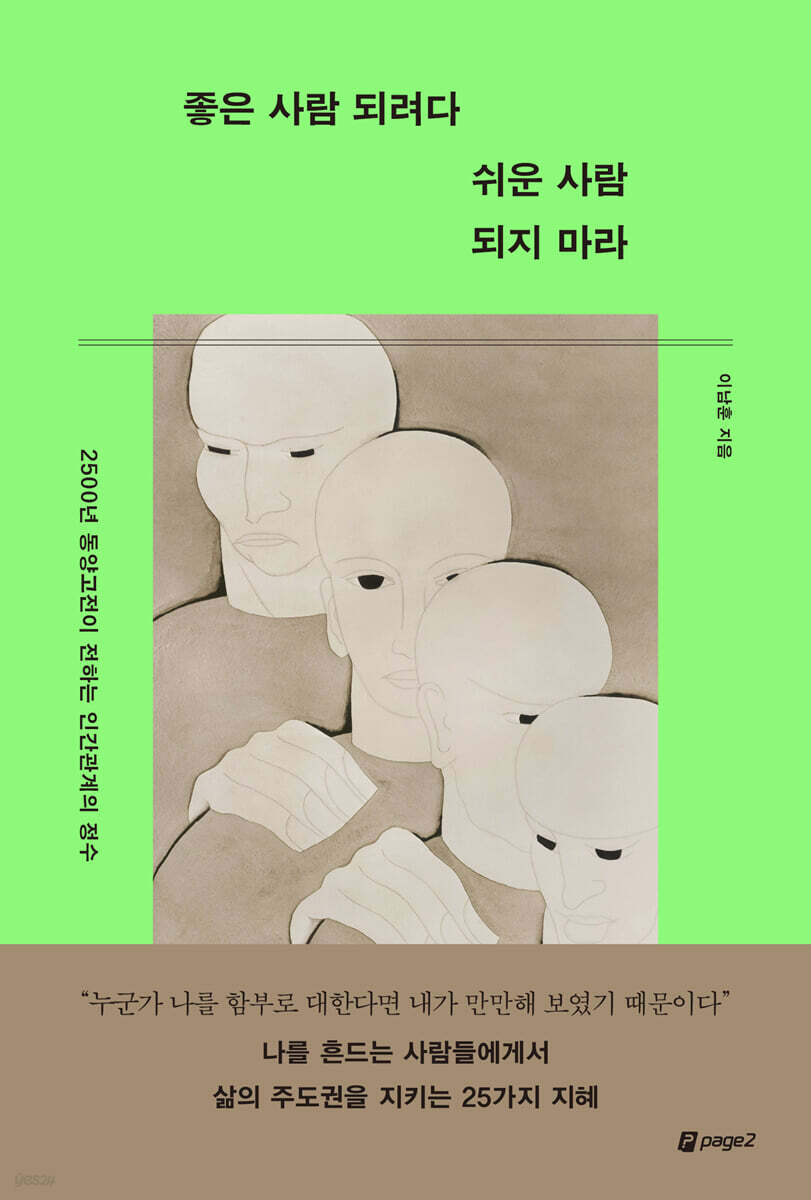
Don't become an easy person when trying to be a good person.
 |
Description
Book Introduction
- A word from MD
- The world is a battlefield.
If you don't want to lose, you have to win.
This book teaches you how to live your life and achieve your goals through various characters from Eastern classics.
In particular, attention was paid to the keyword ‘relationship’.
It shows you when to move forward and when to wait, how to understand your own heart and the psychology of others, and the path to achieving what you want.
- Son Min-gyu, humanities PD
“If someone treats me badly,
Because I looked easy.”
25 Tips for Taking Control of Your Life from Those Who Shake You Down
There are many different forces in the world.
Centrifugal force, which acts outward from the center, and centripetal force, which acts in the opposite direction.
There are forces such as acceleration that increases in proportion to speed and frictional forces that try to resist that force.
However, in the human world, there is a very unique power that does not exist in the natural world, which is the power of leadership called initiative.
This power refers to 'the right and authority to lead work and people from a proactive position.'
Life is hard for someone who has no initiative.
You may work hard at work but be in danger of being kicked out, or you may be getting good reviews but always suffer from anxiety, or you may be a 'good person' who treats others well but ends up being taken advantage of and ignored, becoming an 'easy person'.
This book covers the stories of people who lived in a time much earlier than ours and fought fiercely for dominance.
The Eastern classics, created over 2,500 years, are filled with the wisdom of great saints and heroes, genius advisors, and ordinary people who pioneered their own lives with their own wisdom.
I hope that many people who struggle and are exploited because they don't know the cause of their relationships will use the lessons of this book as a guidepost and confidently walk down the path of reclaiming their own initiative.
Because I looked easy.”
25 Tips for Taking Control of Your Life from Those Who Shake You Down
There are many different forces in the world.
Centrifugal force, which acts outward from the center, and centripetal force, which acts in the opposite direction.
There are forces such as acceleration that increases in proportion to speed and frictional forces that try to resist that force.
However, in the human world, there is a very unique power that does not exist in the natural world, which is the power of leadership called initiative.
This power refers to 'the right and authority to lead work and people from a proactive position.'
Life is hard for someone who has no initiative.
You may work hard at work but be in danger of being kicked out, or you may be getting good reviews but always suffer from anxiety, or you may be a 'good person' who treats others well but ends up being taken advantage of and ignored, becoming an 'easy person'.
This book covers the stories of people who lived in a time much earlier than ours and fought fiercely for dominance.
The Eastern classics, created over 2,500 years, are filled with the wisdom of great saints and heroes, genius advisors, and ordinary people who pioneered their own lives with their own wisdom.
I hope that many people who struggle and are exploited because they don't know the cause of their relationships will use the lessons of this book as a guidepost and confidently walk down the path of reclaiming their own initiative.
- You can preview some of the book's contents.
Preview
index
Prologue - Will you be swept away by the waves and thrown into the mud, or will you ride the waves and rise above them?
PART 1: If You Can't Bite, Don't Bark: The True Taste of Living as a Protagonist
Even if I betray the world, let the world not betray me.
Deficiency is not a deficiency, but a possibility that can be filled.
The lower classes fight in chaos, but the higher classes win silently.
Unquenchable potential ultimately creates legends.
You have to stand behind to get ahead, and you have to be able to forget to exist.
PART 2: Will Following Trends Cost You Your Style?: Maintaining Your Distance from the World by Building Your Defenses
If you are trapped in 'how I see myself', you cannot meet 'how others see me'.
I can't lose my center of gravity while aligning with the world.
Don't become weird by trying to be special.
Will you repel them with your dominance or will you attract them with your charm?
It's not the flag that's shaking, it's your heart.
PART 3: Human Relationships: Expectations are Overrated, and Courtesy is Intelligence: Why Trying to Be a "Good Person" Leads to Being an "Easy Person"
If you don't take the bait, you won't end up like a fish that's been caught.
If you ignore the discomfort of resistance, you become a pushover who deserves to be hurt.
Judgment on others: Keep it hidden until you're caught.
Don't be fooled by the praise in front of you, and beware of gossip behind your back.
Just as a river flows to the sea, so too does the human heart always flow to profit.
PART 4 It's Not Lack of Fortune, It's Lack of Vision: Maintain Initiative with Insight into People and Relationships
Doubting is painful, but not doubting is a disaster.
Will it be a sword that cuts the heart, or a lamp that divides the fire?
The words in my head are my slave, but the words that come out of my mouth are my master.
If you leave resentment in the hearts of others, resentment will return to your own heart.
Greed does not bring satisfaction, but greater deprivation.
PART 5: To Break Through Limits, You Must First Cross the Line: Overcoming the Psychological State That Blocks Initiative
Don't let the past rule the present, and don't let the future attack the present.
If it's still night after you've exited the tunnel, then light the fire in your heart.
Second bests become the best, and when the best continue, it becomes the best.
Don't let your heart be taken away while trying to fill the emptiness in your heart.
It's not that life has become boring, it's just that I've become listless.
PART 6 Lead, Follow, or Step Aside: The Wisdom of Creating the Dynamics of Social Status
If you can't change the direction of the wind, adjust the sail called 'me'.
A frog outside a well cannot know the depths within.
Humility is not a consideration for others, but a weapon for myself.
We need the porcupine's strike rather than the fox's tricks.
Renew relationships with apologies, and renew yourself with reflection.
Epilogue - The Time to Begin: Now is the Time to Begin
PART 1: If You Can't Bite, Don't Bark: The True Taste of Living as a Protagonist
Even if I betray the world, let the world not betray me.
Deficiency is not a deficiency, but a possibility that can be filled.
The lower classes fight in chaos, but the higher classes win silently.
Unquenchable potential ultimately creates legends.
You have to stand behind to get ahead, and you have to be able to forget to exist.
PART 2: Will Following Trends Cost You Your Style?: Maintaining Your Distance from the World by Building Your Defenses
If you are trapped in 'how I see myself', you cannot meet 'how others see me'.
I can't lose my center of gravity while aligning with the world.
Don't become weird by trying to be special.
Will you repel them with your dominance or will you attract them with your charm?
It's not the flag that's shaking, it's your heart.
PART 3: Human Relationships: Expectations are Overrated, and Courtesy is Intelligence: Why Trying to Be a "Good Person" Leads to Being an "Easy Person"
If you don't take the bait, you won't end up like a fish that's been caught.
If you ignore the discomfort of resistance, you become a pushover who deserves to be hurt.
Judgment on others: Keep it hidden until you're caught.
Don't be fooled by the praise in front of you, and beware of gossip behind your back.
Just as a river flows to the sea, so too does the human heart always flow to profit.
PART 4 It's Not Lack of Fortune, It's Lack of Vision: Maintain Initiative with Insight into People and Relationships
Doubting is painful, but not doubting is a disaster.
Will it be a sword that cuts the heart, or a lamp that divides the fire?
The words in my head are my slave, but the words that come out of my mouth are my master.
If you leave resentment in the hearts of others, resentment will return to your own heart.
Greed does not bring satisfaction, but greater deprivation.
PART 5: To Break Through Limits, You Must First Cross the Line: Overcoming the Psychological State That Blocks Initiative
Don't let the past rule the present, and don't let the future attack the present.
If it's still night after you've exited the tunnel, then light the fire in your heart.
Second bests become the best, and when the best continue, it becomes the best.
Don't let your heart be taken away while trying to fill the emptiness in your heart.
It's not that life has become boring, it's just that I've become listless.
PART 6 Lead, Follow, or Step Aside: The Wisdom of Creating the Dynamics of Social Status
If you can't change the direction of the wind, adjust the sail called 'me'.
A frog outside a well cannot know the depths within.
Humility is not a consideration for others, but a weapon for myself.
We need the porcupine's strike rather than the fox's tricks.
Renew relationships with apologies, and renew yourself with reflection.
Epilogue - The Time to Begin: Now is the Time to Begin
Detailed image

Into the book
The life of a person without initiative has several characteristic features.
Even though you always work hard without complaining, you end up in danger of being kicked out of the company, or you always feel anxious even though you are receiving good evaluations.
We want to be a 'good person' and treat others well, but we also end up being an 'easy person' who is used and ignored.
A person who has lived a life of sacrifice for his family all his life, but is ultimately not respected by his family, is also a typical example of a person who has lost his initiative.
Initiative is such a precious life force, but unfortunately, there is no clearly defined textbook and no one teaches it well.
Because it is one of the secrets to maintaining one's own strength, one does not feel like sharing it with those close to one.
But we have examples of people living in much earlier times who fought for dominance.
The Eastern classics, created over 2,500 years, are filled with the wisdom of great heroes, ingenious advisors, and people who pioneered their own lives with their own wisdom.
Because it has been proven over a long period of time, you can trust it and rely on it.
I hope that many people who are tired of life will find the courage and creative ideas to take initiative through this book.
--- From "Prologue: Will you be swept away by the waves and thrown into the mud, or will you ride the waves and rise to great heights?"
Among the fans of 『Romance of the Three Kingdoms』, there are quite a few who like the character Jia Xu (賈?).
Many historians evaluate Jiahou as a better strategist and master of worldly wisdom than Zhuge Liang.
The characteristic of Gahu is that he does not forcefully and directly pressure the other person, but gently stimulates them by throwing out interesting topics.
As a result, it allows the other person to solve the problem on their own.
It was when he served Cao Cao, who later became king.
Cao Cao once asked his eldest son, Cao Pi, or his second son, Cao Zhi, which one would be better to choose as his successor.
However, Gahu just stared blankly at the sky and did not answer right away.
Only when Cao Cao asked again, “What are you thinking about?” did he finally answer.
"sorry.
“For a moment, I thought about Yuan Shao and Liu Biao and their father…” Hearing this, Cao Cao burst out laughing.
Both Yuan Shao and Liu Biao did not appoint their eldest sons as successors, and so they ultimately perished due to internal strife.
The way he throws a curveball that curves slowly and curves slowly, rather than a hard, fast fastball, to let the pitcher solve the problem on his own is reminiscent of a kind of backroom politics.
It is a method of achieving what one wants through negotiation and coordination behind the scenes, although it is not revealed in front.
--- From "PART 1: If You Can't Bite, Don't Bark: The True Taste of Living as a Protagonist"
Duke Ping of Jin built a new palace and held a celebratory event.
At this time, Duke Ling of the neighboring country, Wei, also set out to participate in the celebration.
As his party reached the river and rested for a while, they heard the very unique and captivating sound of a zither from somewhere.
So Yeonggong ordered his subordinates to search for the owner of the zither sound, but they could not find him.
Younggong was in a hurry and decided to record the sound.
After a while, Duke Yeong attended the Jin Dynasty's banquet and became very drunk. Then, he remembered the sound of the zither he had heard on the way here.
He then asked Pyeonggong if he could play the geomungo, and Pyeonggong readily agreed.
But while the geomungo was being played, an official suddenly stood up and gave this warning.
“This song is a song that will ruin the country.
“You must never play to the end.” But Pyeonggong paid no attention and let him continue playing the geomungo.
But as the song drew to a close, 28 cranes suddenly flocked in, spread their wings, and began to dance.
A little while later, a violent storm blew down, and the roof tiles of the palace were blown away, turning the scene into chaos.
Those who attended the banquet were in a hurry to escape, and the event ended up being ruined.
The idiom that appears in this story is ‘Mangukjieum (亡國之樂)’, which means ‘music that ruins a country.’
Of course, it is not known why the sound of the geomungo at that time called for cranes and wind.
But the important point here is that we can learn a very meaningful lesson in that 'it was not mine to begin with, so things from outside come in, destroy the existing things, and make a mess.'
--- From "PART 2: Will Following Trends Ruin My Style?: Maintaining Distance from the World by Building My Defense Wall"
In the Han Feizi (韓非子), there is a story about a foolish farmer who ruined his precious crop by falling for the bait of expectation.
There was a farmer living in the Song Dynasty during the Spring and Autumn Period.
He was always known as a sincere and hard-working person.
But one day, a rabbit jumped out of the grass, ran as fast as it could, and crashed into a stump in the middle of the field, dying.
The farmer, feeling that he had struck it rich, took the rabbit and enjoyed it with his family. Then, he had a realization.
'The rabbit chases after me and dies on its own, but I worked hard every day. I was such a fool!' The farmer stopped working the farm the next day and just stood in front of the stump, waiting for the rabbit to die.
Then, the field he had been cultivating became overgrown with weeds and was no longer suitable for farming.
People around him who saw this started to tease him and call him foolish.
The idiom that was born from this story is sujudaeto (守株待兎), which means ‘to guard a stump and wait for a rabbit.’
The reason this farmer became foolish is simple.
Because I expected that what was once just a one-time windfall would continue to happen.
Ultimately, we must recognize that expectations of others may be 'hopeful wishes', but at the same time, they have the nature of 'bait'.
--- From "PART 3 Human Relationships, Expectations Are Overdone and Courtesy Is Intelligence: Why Trying to Become a 'Good Person' Leads to Becoming an 'Easy Person'"
There are many classic figures who advise us to be careful with our words, but among them, Lao Tzu is the one who particularly advised us to be vigilant about our words.
First, Lao Tzu compares words to 'desire', 'sharpness', and 'light'.
These are all positive functions of language.
It can reveal one's own desires and figure out the desires of others, it can point out something sharply so that it can be corrected, and it can also reveal something dark.
However, Lao Tzu saw that the harm from it was greater than the benefit.
He says this in the Tao Te Ching:
“He who knows does not speak, and he who speaks does not know.
Keep your mouth shut and close the door of desire.
Sharpen the sharpness and untangle the tangle.
Cover up the light and become like dust.
This is called original oneness.
A person like this has neither friends nor enemies, is neither beneficial nor harmful, is neither noble nor base.
Therefore, this is the most precious thing under heaven.” Lao Tzu ultimately advises to keep one’s mouth shut, close the door of desire, cut off sharpness, and block out light.
In short, the point is that if you talk less, you will have fewer problems.
And it is precisely in this state that one can reach a state where one has no friends, but also no enemies, and where one is not harmed, though not beneficial.
The idiom that originated here is “many words lead to many failures.”
It means, 'The more you talk, the more often you become awkward, so it's better to keep the middle ground.'
--- From "PART 4 It's not that you don't have luck, it's that you lack vision: Maintain the initiative with the vision to see people and relationships"
There was a scholar named Go Neung-seong who taught Baekbeom Kim Gu during his youth.
He is said to have given this teaching:
“Climbing high on a tree branch is never a strange thing.
“A true man is someone who can let go of his hand when he is hanging from a cliff.” The phrase “Hyeonaesalsu” (懸崖撒手), which means “to let go of a hand hanging from a cliff,” means to seek a new path with courageous determination.
It is also used to mean that a person who is politically at a dead end is giving up something and creating a new future.
This also helps people who are overly attached to someone.
Active indifference, the rejection of interest in them, is one of the wisest ways to regain my lost heart and take back the initiative that was lost.
--- From "PART 5: To Break Through Limits, You Must First Cross the Line: Overcoming the Psychological State That Blocks Initiative"
During the Warring States period, in the Han Dynasty, there were two princes named Gu and Gi-seul, who were the sons of the king.
The prime minister who assisted Gu at this time was Gongsuk.
After a fierce power struggle between Gu and Gisul, victory ultimately went to Gu, with Gisul being exiled abroad.
However, Gong-suk, who was helping Gu, was still concerned about the fact that Gi-seul was still alive.
Because you never know when he might come back with revenge and harm you and yourself.
So, before he was finally exiled abroad, he devised a plan to send an assassin to assassinate Giseul.
But at this time, one of Gongsuk's subjects stopped him and said this.
“The reason Prince Gu had treated Gongsuk with such respect until now was because he was afraid of Kisul.
If Gi-seul dies and the worries in Prince Gu's mind completely disappear, then from then on, he will definitely take Gong-suk lightly.
Therefore, only if Gisul is alive and not dead will he continue to rely on Prince Gudo Gongsuk.” At this, Gongsuk had a great awakening and canceled the assassination plan.
Gongsuk looked at the dynamics of relationships too fragmentarily.
He thought of himself and Prince Gu as being on the same side, completely unaware that their relationship could change dynamically.
However, the person who pointed out this very point and allowed us to look at the situation more dynamically was the minister of public order.
The idiom "shared boat, mutually beneficial" that appears in "The Art of War" also speaks of the dynamism of relationships.
There is a saying that 'The people of Wu and Yue hate each other, but when they cross the river in the same boat and encounter a storm, they help each other like the left and right hands.'
But the people of Wu and Yue did not just hate each other.
They regarded each other as enemies, as if they were sworn enemies.
But as circumstances changed, their relationship changed dynamically, as if they were old friends.
Even though you always work hard without complaining, you end up in danger of being kicked out of the company, or you always feel anxious even though you are receiving good evaluations.
We want to be a 'good person' and treat others well, but we also end up being an 'easy person' who is used and ignored.
A person who has lived a life of sacrifice for his family all his life, but is ultimately not respected by his family, is also a typical example of a person who has lost his initiative.
Initiative is such a precious life force, but unfortunately, there is no clearly defined textbook and no one teaches it well.
Because it is one of the secrets to maintaining one's own strength, one does not feel like sharing it with those close to one.
But we have examples of people living in much earlier times who fought for dominance.
The Eastern classics, created over 2,500 years, are filled with the wisdom of great heroes, ingenious advisors, and people who pioneered their own lives with their own wisdom.
Because it has been proven over a long period of time, you can trust it and rely on it.
I hope that many people who are tired of life will find the courage and creative ideas to take initiative through this book.
--- From "Prologue: Will you be swept away by the waves and thrown into the mud, or will you ride the waves and rise to great heights?"
Among the fans of 『Romance of the Three Kingdoms』, there are quite a few who like the character Jia Xu (賈?).
Many historians evaluate Jiahou as a better strategist and master of worldly wisdom than Zhuge Liang.
The characteristic of Gahu is that he does not forcefully and directly pressure the other person, but gently stimulates them by throwing out interesting topics.
As a result, it allows the other person to solve the problem on their own.
It was when he served Cao Cao, who later became king.
Cao Cao once asked his eldest son, Cao Pi, or his second son, Cao Zhi, which one would be better to choose as his successor.
However, Gahu just stared blankly at the sky and did not answer right away.
Only when Cao Cao asked again, “What are you thinking about?” did he finally answer.
"sorry.
“For a moment, I thought about Yuan Shao and Liu Biao and their father…” Hearing this, Cao Cao burst out laughing.
Both Yuan Shao and Liu Biao did not appoint their eldest sons as successors, and so they ultimately perished due to internal strife.
The way he throws a curveball that curves slowly and curves slowly, rather than a hard, fast fastball, to let the pitcher solve the problem on his own is reminiscent of a kind of backroom politics.
It is a method of achieving what one wants through negotiation and coordination behind the scenes, although it is not revealed in front.
--- From "PART 1: If You Can't Bite, Don't Bark: The True Taste of Living as a Protagonist"
Duke Ping of Jin built a new palace and held a celebratory event.
At this time, Duke Ling of the neighboring country, Wei, also set out to participate in the celebration.
As his party reached the river and rested for a while, they heard the very unique and captivating sound of a zither from somewhere.
So Yeonggong ordered his subordinates to search for the owner of the zither sound, but they could not find him.
Younggong was in a hurry and decided to record the sound.
After a while, Duke Yeong attended the Jin Dynasty's banquet and became very drunk. Then, he remembered the sound of the zither he had heard on the way here.
He then asked Pyeonggong if he could play the geomungo, and Pyeonggong readily agreed.
But while the geomungo was being played, an official suddenly stood up and gave this warning.
“This song is a song that will ruin the country.
“You must never play to the end.” But Pyeonggong paid no attention and let him continue playing the geomungo.
But as the song drew to a close, 28 cranes suddenly flocked in, spread their wings, and began to dance.
A little while later, a violent storm blew down, and the roof tiles of the palace were blown away, turning the scene into chaos.
Those who attended the banquet were in a hurry to escape, and the event ended up being ruined.
The idiom that appears in this story is ‘Mangukjieum (亡國之樂)’, which means ‘music that ruins a country.’
Of course, it is not known why the sound of the geomungo at that time called for cranes and wind.
But the important point here is that we can learn a very meaningful lesson in that 'it was not mine to begin with, so things from outside come in, destroy the existing things, and make a mess.'
--- From "PART 2: Will Following Trends Ruin My Style?: Maintaining Distance from the World by Building My Defense Wall"
In the Han Feizi (韓非子), there is a story about a foolish farmer who ruined his precious crop by falling for the bait of expectation.
There was a farmer living in the Song Dynasty during the Spring and Autumn Period.
He was always known as a sincere and hard-working person.
But one day, a rabbit jumped out of the grass, ran as fast as it could, and crashed into a stump in the middle of the field, dying.
The farmer, feeling that he had struck it rich, took the rabbit and enjoyed it with his family. Then, he had a realization.
'The rabbit chases after me and dies on its own, but I worked hard every day. I was such a fool!' The farmer stopped working the farm the next day and just stood in front of the stump, waiting for the rabbit to die.
Then, the field he had been cultivating became overgrown with weeds and was no longer suitable for farming.
People around him who saw this started to tease him and call him foolish.
The idiom that was born from this story is sujudaeto (守株待兎), which means ‘to guard a stump and wait for a rabbit.’
The reason this farmer became foolish is simple.
Because I expected that what was once just a one-time windfall would continue to happen.
Ultimately, we must recognize that expectations of others may be 'hopeful wishes', but at the same time, they have the nature of 'bait'.
--- From "PART 3 Human Relationships, Expectations Are Overdone and Courtesy Is Intelligence: Why Trying to Become a 'Good Person' Leads to Becoming an 'Easy Person'"
There are many classic figures who advise us to be careful with our words, but among them, Lao Tzu is the one who particularly advised us to be vigilant about our words.
First, Lao Tzu compares words to 'desire', 'sharpness', and 'light'.
These are all positive functions of language.
It can reveal one's own desires and figure out the desires of others, it can point out something sharply so that it can be corrected, and it can also reveal something dark.
However, Lao Tzu saw that the harm from it was greater than the benefit.
He says this in the Tao Te Ching:
“He who knows does not speak, and he who speaks does not know.
Keep your mouth shut and close the door of desire.
Sharpen the sharpness and untangle the tangle.
Cover up the light and become like dust.
This is called original oneness.
A person like this has neither friends nor enemies, is neither beneficial nor harmful, is neither noble nor base.
Therefore, this is the most precious thing under heaven.” Lao Tzu ultimately advises to keep one’s mouth shut, close the door of desire, cut off sharpness, and block out light.
In short, the point is that if you talk less, you will have fewer problems.
And it is precisely in this state that one can reach a state where one has no friends, but also no enemies, and where one is not harmed, though not beneficial.
The idiom that originated here is “many words lead to many failures.”
It means, 'The more you talk, the more often you become awkward, so it's better to keep the middle ground.'
--- From "PART 4 It's not that you don't have luck, it's that you lack vision: Maintain the initiative with the vision to see people and relationships"
There was a scholar named Go Neung-seong who taught Baekbeom Kim Gu during his youth.
He is said to have given this teaching:
“Climbing high on a tree branch is never a strange thing.
“A true man is someone who can let go of his hand when he is hanging from a cliff.” The phrase “Hyeonaesalsu” (懸崖撒手), which means “to let go of a hand hanging from a cliff,” means to seek a new path with courageous determination.
It is also used to mean that a person who is politically at a dead end is giving up something and creating a new future.
This also helps people who are overly attached to someone.
Active indifference, the rejection of interest in them, is one of the wisest ways to regain my lost heart and take back the initiative that was lost.
--- From "PART 5: To Break Through Limits, You Must First Cross the Line: Overcoming the Psychological State That Blocks Initiative"
During the Warring States period, in the Han Dynasty, there were two princes named Gu and Gi-seul, who were the sons of the king.
The prime minister who assisted Gu at this time was Gongsuk.
After a fierce power struggle between Gu and Gisul, victory ultimately went to Gu, with Gisul being exiled abroad.
However, Gong-suk, who was helping Gu, was still concerned about the fact that Gi-seul was still alive.
Because you never know when he might come back with revenge and harm you and yourself.
So, before he was finally exiled abroad, he devised a plan to send an assassin to assassinate Giseul.
But at this time, one of Gongsuk's subjects stopped him and said this.
“The reason Prince Gu had treated Gongsuk with such respect until now was because he was afraid of Kisul.
If Gi-seul dies and the worries in Prince Gu's mind completely disappear, then from then on, he will definitely take Gong-suk lightly.
Therefore, only if Gisul is alive and not dead will he continue to rely on Prince Gudo Gongsuk.” At this, Gongsuk had a great awakening and canceled the assassination plan.
Gongsuk looked at the dynamics of relationships too fragmentarily.
He thought of himself and Prince Gu as being on the same side, completely unaware that their relationship could change dynamically.
However, the person who pointed out this very point and allowed us to look at the situation more dynamically was the minister of public order.
The idiom "shared boat, mutually beneficial" that appears in "The Art of War" also speaks of the dynamism of relationships.
There is a saying that 'The people of Wu and Yue hate each other, but when they cross the river in the same boat and encounter a storm, they help each other like the left and right hands.'
But the people of Wu and Yue did not just hate each other.
They regarded each other as enemies, as if they were sworn enemies.
But as circumstances changed, their relationship changed dynamically, as if they were old friends.
--- From "PART 6 Lead, Follow, or Step Aside: The Wisdom That Shapes the Dynamics of Social Status"
Publisher's Review
“If you can’t bite, don’t bark,
“If you don’t want to be swayed, you have to keep the initiative.”
The essence of human relationships conveyed in 2,500 years of Eastern classics
Initiative has a profound impact on an individual's life.
When you start to wallow in negative emotions, get caught up in relationships, or get dragged down by work, that's when the hell of slavery begins to unfold.
So, should those who lack initiative or lack it blame their low social status and limited power? Fortunately, there's no need for that.
One of the great things about initiative is that it doesn't necessarily grow in direct proportion to the amount of force or speed it possesses.
Therefore, even if you have a low social status or no power, you can still seize the initiative.
This book is divided into six chapters that teach you how to regain, protect, strengthen, expand, and maintain control of your life.
Chapter 1, “If You Can’t Bite, Don’t Bark,” tells the story of heroes who took the initiative and lived as the protagonists of their own lives.
Cao Cao understood, accepted, utilized, and did not hesitate to eliminate betrayal when he could not tolerate it.
Empress Wu Zetian, who became emperor by finding means and infrastructure to compensate for her shortcomings.
It focuses on the cases of the leading victors in classics, such as Gahu, who wisely won with a strong cause and the ability to sway those behind the scenes.
Chapter 2, “Will Following Trends Ruin Your Style?” covers how to pursue a balanced life while maintaining your own style and not missing out on global trends.
At the age of 24, the genius Ye Heng of the late Han Dynasty was smart enough to become the 'Emperor's Advisor', but he met his death after criticizing Cao Cao as a petty person due to his excessive sense of superiority.
It's important to remember that maintaining your own style doesn't mean you have to deviate from the flow of the world.
Maintaining control requires a proper balance of strength and gentleness, dignity and generosity.
Chapter 3, “Human Relations, Expectations Are Overdone, and Courtesy Is Intelligence,” discusses the fundamental principles of seeing through the other person’s mind and taking the initiative to avoid being ignored or taken advantage of.
Confucius said, "The human heart is more rugged than mountains and rivers, and more difficult to understand than heaven."
The reason why we become 'easy people' when trying to be 'good people' is because we lack initiative.
The most effective way to take the lead in a relationship is to make the other person see you as a "beneficial person."
Just as rivers flow to the sea, people's hearts also flow to 'profit'.
Chapter 4, “It’s not that you don’t have good luck, it’s that you lack insight,” talks about how to develop an “eye for understanding people” and enjoy the benefits of rich human relationships even when interacting with a small number of people.
If you look at people who are blessed with good fortune, you will see that they use their discernment to constantly filter out bad people and make an effort to surround themselves with good people.
Thomas Jefferson, the third president of the United States, said, "If someone takes the wick from my lamp, the fire will not go out."
To create a relationship where we can influence each other positively and grow together, we need the wisdom to understand the feelings of others.
Chapter 5, “To Break Through Limits, You Must First Cross the Line,” discusses the mindset needed to overcome psychological limitations and cultivate initiative.
Wang Tae, who was as outstanding as Confucius, had many disciples even though he had his feet cut off for a crime.
When asked by his disciple why, Confucius said, “Although his foot was cut off, he did not take it to heart at all, as if it had fallen into the dirt,” and expressed his respect for his mind, attitude, and the way he spoke about the world.
We must not allow the past to dominate the present and the future to attack the present.
Rather than thinking about grandly overcoming limitations, I need to overcome the starting line right in front of me.
Forgetting the past and the future, and not losing focus on even the smallest challenges of reality, is the first step to breaking through limitations.
Chapter 6, “Lead, Follow, or Step Aside,” discusses how to secure future leadership in an ever-changing world and human relationships.
During the Warring States Period, Prince Pingyuan of the State of Zhao was given the important task of persuading the State of Chu to ally with the State of Chu.
Pyeongwon-gun decided to select 20 envoys from among the guests.
With only one person left, a man named 'Mosu' nominated himself.
Prince Pyeongwon blamed Mosu, who had no presence, for his lack of talent, but Mosu said, “I didn’t stand out because Prince Pyeongwon didn’t put me in his pocket.”
Only by putting yourself in the center of unfamiliar change can you see the world from a different perspective and take control of your future.
“If you can’t change the direction of the wind,
“Adjust the sail called ‘I’”
About the wisdom and attitude toward life that you need even as you grow older and find it difficult to live with others.
The initiative that has been discussed at length in this book ultimately begins with an attitude of mind.
Only with the determination to never live a life that is only once lived weakly, and the will to live as the protagonist of the world by drawing a proper conclusion once you have started, can you approach it with initiative.
If you are currently in a very difficult situation, exhausted, and without hope, think of today as the first day back from the future, like in a drama, movie, or webtoon.
In fact, we can generally envision our future, even if we don't think about it that hard.
Especially if you look at the past, you can see how your current situation was created, so it is not difficult to envision the future.
If today were the first day I returned from the future, nothing could be better.
It's just the beginning, it's just the starting point.
I will be able to create a turning point that will radically change the very foundation of my mind.
Think about the past 10 or 20 years of your life.
Doesn't time really fly by so fast it's almost impossible to describe? The future is rushing towards me at that very speed.
Right now, at this moment.
As you read this book, you will be confronted with moments in your life when you took control and moments when you missed it.
I hope this will be a valuable time to reflect on the choices you should have made, the attitude you should have had, and the things you shouldn't miss.
“If you don’t want to be swayed, you have to keep the initiative.”
The essence of human relationships conveyed in 2,500 years of Eastern classics
Initiative has a profound impact on an individual's life.
When you start to wallow in negative emotions, get caught up in relationships, or get dragged down by work, that's when the hell of slavery begins to unfold.
So, should those who lack initiative or lack it blame their low social status and limited power? Fortunately, there's no need for that.
One of the great things about initiative is that it doesn't necessarily grow in direct proportion to the amount of force or speed it possesses.
Therefore, even if you have a low social status or no power, you can still seize the initiative.
This book is divided into six chapters that teach you how to regain, protect, strengthen, expand, and maintain control of your life.
Chapter 1, “If You Can’t Bite, Don’t Bark,” tells the story of heroes who took the initiative and lived as the protagonists of their own lives.
Cao Cao understood, accepted, utilized, and did not hesitate to eliminate betrayal when he could not tolerate it.
Empress Wu Zetian, who became emperor by finding means and infrastructure to compensate for her shortcomings.
It focuses on the cases of the leading victors in classics, such as Gahu, who wisely won with a strong cause and the ability to sway those behind the scenes.
Chapter 2, “Will Following Trends Ruin Your Style?” covers how to pursue a balanced life while maintaining your own style and not missing out on global trends.
At the age of 24, the genius Ye Heng of the late Han Dynasty was smart enough to become the 'Emperor's Advisor', but he met his death after criticizing Cao Cao as a petty person due to his excessive sense of superiority.
It's important to remember that maintaining your own style doesn't mean you have to deviate from the flow of the world.
Maintaining control requires a proper balance of strength and gentleness, dignity and generosity.
Chapter 3, “Human Relations, Expectations Are Overdone, and Courtesy Is Intelligence,” discusses the fundamental principles of seeing through the other person’s mind and taking the initiative to avoid being ignored or taken advantage of.
Confucius said, "The human heart is more rugged than mountains and rivers, and more difficult to understand than heaven."
The reason why we become 'easy people' when trying to be 'good people' is because we lack initiative.
The most effective way to take the lead in a relationship is to make the other person see you as a "beneficial person."
Just as rivers flow to the sea, people's hearts also flow to 'profit'.
Chapter 4, “It’s not that you don’t have good luck, it’s that you lack insight,” talks about how to develop an “eye for understanding people” and enjoy the benefits of rich human relationships even when interacting with a small number of people.
If you look at people who are blessed with good fortune, you will see that they use their discernment to constantly filter out bad people and make an effort to surround themselves with good people.
Thomas Jefferson, the third president of the United States, said, "If someone takes the wick from my lamp, the fire will not go out."
To create a relationship where we can influence each other positively and grow together, we need the wisdom to understand the feelings of others.
Chapter 5, “To Break Through Limits, You Must First Cross the Line,” discusses the mindset needed to overcome psychological limitations and cultivate initiative.
Wang Tae, who was as outstanding as Confucius, had many disciples even though he had his feet cut off for a crime.
When asked by his disciple why, Confucius said, “Although his foot was cut off, he did not take it to heart at all, as if it had fallen into the dirt,” and expressed his respect for his mind, attitude, and the way he spoke about the world.
We must not allow the past to dominate the present and the future to attack the present.
Rather than thinking about grandly overcoming limitations, I need to overcome the starting line right in front of me.
Forgetting the past and the future, and not losing focus on even the smallest challenges of reality, is the first step to breaking through limitations.
Chapter 6, “Lead, Follow, or Step Aside,” discusses how to secure future leadership in an ever-changing world and human relationships.
During the Warring States Period, Prince Pingyuan of the State of Zhao was given the important task of persuading the State of Chu to ally with the State of Chu.
Pyeongwon-gun decided to select 20 envoys from among the guests.
With only one person left, a man named 'Mosu' nominated himself.
Prince Pyeongwon blamed Mosu, who had no presence, for his lack of talent, but Mosu said, “I didn’t stand out because Prince Pyeongwon didn’t put me in his pocket.”
Only by putting yourself in the center of unfamiliar change can you see the world from a different perspective and take control of your future.
“If you can’t change the direction of the wind,
“Adjust the sail called ‘I’”
About the wisdom and attitude toward life that you need even as you grow older and find it difficult to live with others.
The initiative that has been discussed at length in this book ultimately begins with an attitude of mind.
Only with the determination to never live a life that is only once lived weakly, and the will to live as the protagonist of the world by drawing a proper conclusion once you have started, can you approach it with initiative.
If you are currently in a very difficult situation, exhausted, and without hope, think of today as the first day back from the future, like in a drama, movie, or webtoon.
In fact, we can generally envision our future, even if we don't think about it that hard.
Especially if you look at the past, you can see how your current situation was created, so it is not difficult to envision the future.
If today were the first day I returned from the future, nothing could be better.
It's just the beginning, it's just the starting point.
I will be able to create a turning point that will radically change the very foundation of my mind.
Think about the past 10 or 20 years of your life.
Doesn't time really fly by so fast it's almost impossible to describe? The future is rushing towards me at that very speed.
Right now, at this moment.
As you read this book, you will be confronted with moments in your life when you took control and moments when you missed it.
I hope this will be a valuable time to reflect on the choices you should have made, the attitude you should have had, and the things you shouldn't miss.
GOODS SPECIFICS
- Date of issue: October 7, 2024
- Page count, weight, size: 276 pages | 428g | 142*210*20mm
- ISBN13: 9791169851015
- ISBN10: 1169851010
You may also like
카테고리
korean


korean

![GQ KOREA Mark (Monthly): December [2025]](http://librairie.coreenne.fr/cdn/shop/files/8ef265dbbfbf186523ed75ba7319009d.jpg?v=1765340328&width=3840)


