

Think fast and speak smart
 |
Description
Book Introduction
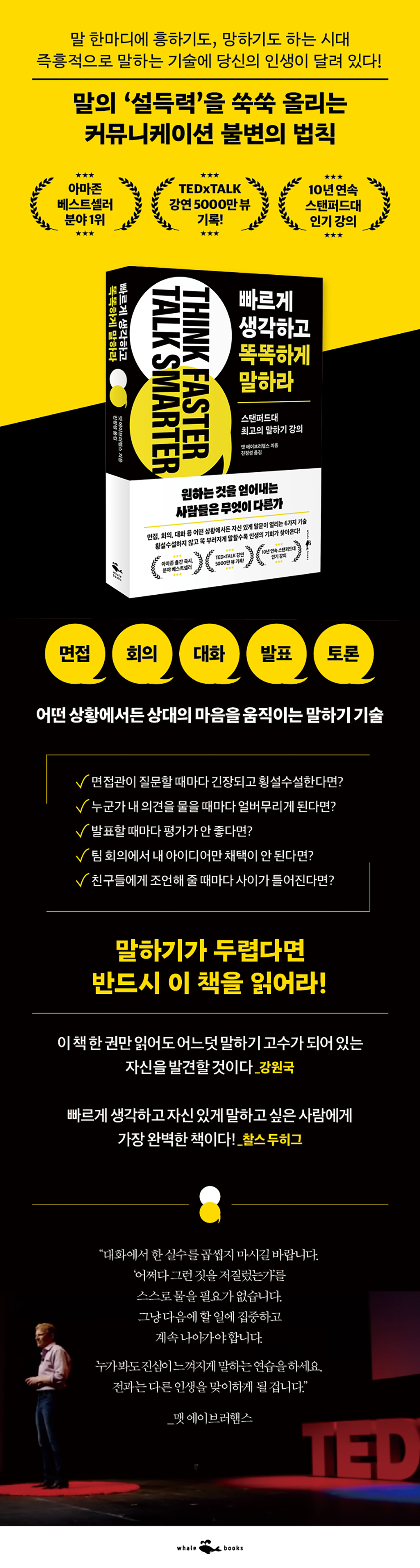
*** Amazon Bestseller #1 *** *** TEDxTALK Talk Reaches 50 Million Views! *** *** Stanford University's most popular lecture for 10 consecutive years *** “Just read this one book and you’ll find yourself a speaking expert.”_Kang Won-guk “This is the perfect book for anyone who wants to think quickly and speak confidently!” —Charles Duhigg In an age where a single word can make or break a person, Your life depends on your ability to improvise! The immutable law of communication that dramatically increases the persuasive power of speech. When asked, “What do you think?” we often feel embarrassed or at a loss for words. I can't continue a conversation, like my brain suddenly stopped working. Just having to communicate your thoughts to others is scary. In other words, the pressure to speak well in front of others makes us shrink. This has a huge impact on our work and relationships, as much as it does on the fear of speaking. Author Matt Abrahams, who has taught a popular communication course at Stanford University for 10 consecutive years and works as a speaking coach, has created a buzz with his TED Talks and podcasts on impromptu communication. In this book, the author introduces six communication techniques developed based on his experience coaching not only students at Stanford Graduate School of Business but also individuals preparing important speeches, such as World Economic Forum presentations and Nobel Prize winners. It presents the most effective way to speak intelligently without rambling in situations where you must speak spontaneously, especially in presentations, discussions, interviews, and everyday conversations. "Think Fast, Speak Smart" teaches you how to communicate your thoughts coherently in situations where you have to engage in impromptu conversations with people. The author argues that anyone can become a good speaker in any situation if they learn how to speak and practice consistently. And it teaches you how to manage your nerves, speak engagingly, and make a good impression on others in situations where you have to speak impromptu. Whether your boss asks an unexpected question in a meeting, all eyes are on you in private, or you suddenly have to make a presentation, this book will help you assess the situation and speak competently. Let go of the pressure and the thought of trying to speak perfectly and speak with a relaxed mind. Your conversational skills and persuasiveness will improve, as will your relationships with people. |
- You can preview some of the book's contents.
Preview
index
Recommendation
Prologue: How to Speak Intelligently Without Rambleing on the Spot
PART 1: Theory - Six Stanford Communication Skills
Lesson 1: Calmness: Taming the Anxious Beast
Lesson 2: Opening Your Heart: Be as Ordinary as Possible
Lesson 3: Redefining Yourself: Changing Your Perspective Can Reclaim Control of the Conversation
Lesson 4: Listening: The best communication is to say nothing.
Lesson 5: Structuring: Conversations Need Formulas, Too
Lesson 6 Focus: Grab Your Audience's Attention
PART 2: Practical Skills - Improvisational Conversation Techniques for Different Situations
Training 1: Small Talk: Conversations that Build the Foundation of Networking
Training 2: Toasts, Tributes, and Introductions: There are words that touch the heart.
Training 3: Persuasion: What is Persuasion Beyond Perfection?
Training 4 Q&A: Let's End on a Good Note
Training 5 Tip: Bitter Words That Don't Make Enemies
Exercise 6: Apologizing: Turning Phone Calls into Opportunities
Epilogue: The Secret to Successful Communication Is Practice and Preparation
Appendix ? Situational impromptu conversation formulas
Appendix? A dedicated website for "Think Fast, Speak Smart."
main
Prologue: How to Speak Intelligently Without Rambleing on the Spot
PART 1: Theory - Six Stanford Communication Skills
Lesson 1: Calmness: Taming the Anxious Beast
Lesson 2: Opening Your Heart: Be as Ordinary as Possible
Lesson 3: Redefining Yourself: Changing Your Perspective Can Reclaim Control of the Conversation
Lesson 4: Listening: The best communication is to say nothing.
Lesson 5: Structuring: Conversations Need Formulas, Too
Lesson 6 Focus: Grab Your Audience's Attention
PART 2: Practical Skills - Improvisational Conversation Techniques for Different Situations
Training 1: Small Talk: Conversations that Build the Foundation of Networking
Training 2: Toasts, Tributes, and Introductions: There are words that touch the heart.
Training 3: Persuasion: What is Persuasion Beyond Perfection?
Training 4 Q&A: Let's End on a Good Note
Training 5 Tip: Bitter Words That Don't Make Enemies
Exercise 6: Apologizing: Turning Phone Calls into Opportunities
Epilogue: The Secret to Successful Communication Is Practice and Preparation
Appendix ? Situational impromptu conversation formulas
Appendix? A dedicated website for "Think Fast, Speak Smart."
main
Detailed image
Into the book
Even Steve Jobs and Michelle Obama spend months practicing and refining their presentations.
But we often confuse these perfectly prepared stories with the spontaneous communication we often have in our daily lives.
It is wrong to apply the same standards to everyday speech as to a rehearsed story.
Instead of aiming for perfection, as you would when giving a presentation, embrace your imperfections and focus on how to best focus in the moment.
--- p.19
People generally try to do things 'right' when tackling a task.
But there is no right way, no right answer, no best way to communicate.
There are only relatively better and worse methods.
Trying to do things right can actually hinder your ability to get along with others.
The wings of my thoughts are clipped and my head becomes cluttered, preventing me from showing my true self.
To perform at your best in difficult situations, don't aim for perfect performance; rather, accept that it's okay to make mistakes.
And above all, it is important to pursue ordinariness.
--- p.61
I firmly believe that there is a great impromptu speaker hidden within each of us.
You just have to not step forward rashly and cause trouble.
Instead of covering up my unique thoughts and ideas with a facade of formality, I need to let them free and reveal my spontaneous self again.
Everyday life is inherently spontaneous.
No one lives their daily lives according to a pre-planned script and plan (except for politicians who operate on a tight schedule, but most people don't).
We already know how to live spontaneously.
The goal is simple.
Only when you master your fears and interact naturally with people can you truly face your true self.
--- p.88
When I give lectures, I often see people who misunderstand that structure is organizing information into a list.
It is believed that if you organize what you want to say into items or slides, the structure will be automatically completed.
Of course, you'll need a list when you go shopping or when Santa Claus is sorting out the good and bad kids.
But in impromptu communication, lists don't help you respond effectively and convey your message persuasively.
Because it's just a list, not a structure.
The 'structure' I'm talking about is a narrative or story that logically connects ideas according to a beginning, development, turn, and conclusion.
If you rely on lists rather than structure when speaking extemporaneously, you are unlikely to get good results.
--- p.146
A focused message is precisely tailored to have a specific effect.
Improving your accuracy means identifying what you want to achieve and tailoring your speech to reach that goal.
Then a question arises:
"What are my goals?" Surprisingly, many people don't know their goals well or set them vaguely.
In cases like this, it is difficult to even know what to say and what not to say.
The audience is left distracted, confused, and bored.
When people think of the goal of communication, many think of the information or opinion they want to convey, or what they want to say.
But it is not enough for the audience to just 'understand' the message.
You also need to consider what kind of 'emotion' you want to instill and what kind of 'action' you want to elicit.
--- p.173
As always when learning a new skill, it's best not to overwhelm yourself.
There's no need to stress about mastering communication overnight.
Just trying to improve your communication skills is very meaningful.
Most people either don't care about impromptu conversations, or if they do, they don't have the courage to take action.
You who have opened this book have both a sense of problem and courage.
Moreover, I believe that by reading this book and practicing it yourself, you will have improved your ability to relax and communicate.
Let's continue to practice the technique in the future.
Let's jump into an environment where we can test our formulas and techniques.
It is not enough to just practice occasionally, like soybeans sprouting in a drought.
Memorize the technique and practice it as often as possible.
But we often confuse these perfectly prepared stories with the spontaneous communication we often have in our daily lives.
It is wrong to apply the same standards to everyday speech as to a rehearsed story.
Instead of aiming for perfection, as you would when giving a presentation, embrace your imperfections and focus on how to best focus in the moment.
--- p.19
People generally try to do things 'right' when tackling a task.
But there is no right way, no right answer, no best way to communicate.
There are only relatively better and worse methods.
Trying to do things right can actually hinder your ability to get along with others.
The wings of my thoughts are clipped and my head becomes cluttered, preventing me from showing my true self.
To perform at your best in difficult situations, don't aim for perfect performance; rather, accept that it's okay to make mistakes.
And above all, it is important to pursue ordinariness.
--- p.61
I firmly believe that there is a great impromptu speaker hidden within each of us.
You just have to not step forward rashly and cause trouble.
Instead of covering up my unique thoughts and ideas with a facade of formality, I need to let them free and reveal my spontaneous self again.
Everyday life is inherently spontaneous.
No one lives their daily lives according to a pre-planned script and plan (except for politicians who operate on a tight schedule, but most people don't).
We already know how to live spontaneously.
The goal is simple.
Only when you master your fears and interact naturally with people can you truly face your true self.
--- p.88
When I give lectures, I often see people who misunderstand that structure is organizing information into a list.
It is believed that if you organize what you want to say into items or slides, the structure will be automatically completed.
Of course, you'll need a list when you go shopping or when Santa Claus is sorting out the good and bad kids.
But in impromptu communication, lists don't help you respond effectively and convey your message persuasively.
Because it's just a list, not a structure.
The 'structure' I'm talking about is a narrative or story that logically connects ideas according to a beginning, development, turn, and conclusion.
If you rely on lists rather than structure when speaking extemporaneously, you are unlikely to get good results.
--- p.146
A focused message is precisely tailored to have a specific effect.
Improving your accuracy means identifying what you want to achieve and tailoring your speech to reach that goal.
Then a question arises:
"What are my goals?" Surprisingly, many people don't know their goals well or set them vaguely.
In cases like this, it is difficult to even know what to say and what not to say.
The audience is left distracted, confused, and bored.
When people think of the goal of communication, many think of the information or opinion they want to convey, or what they want to say.
But it is not enough for the audience to just 'understand' the message.
You also need to consider what kind of 'emotion' you want to instill and what kind of 'action' you want to elicit.
--- p.173
As always when learning a new skill, it's best not to overwhelm yourself.
There's no need to stress about mastering communication overnight.
Just trying to improve your communication skills is very meaningful.
Most people either don't care about impromptu conversations, or if they do, they don't have the courage to take action.
You who have opened this book have both a sense of problem and courage.
Moreover, I believe that by reading this book and practicing it yourself, you will have improved your ability to relax and communicate.
Let's continue to practice the technique in the future.
Let's jump into an environment where we can test our formulas and techniques.
It is not enough to just practice occasionally, like soybeans sprouting in a drought.
Memorize the technique and practice it as often as possible.
--- p.304
Publisher's Review
The secret rules of those who speak spontaneously and intelligently
The world-renowned communication lecture is finally published as a book after 10 years!
Six Stanford-style communication formulas you can use in any situation.
In today's world where you have to appeal to yourself to survive, speaking is an essential survival tool.
It is said that the better your communication skills, the greater your chances of living a successful life.
It's easy to think that the talent to speak and act skillfully is innate.
Of course, there are people who are born with an extroverted personality, a flexible attitude, and a witty way of speaking.
But ironically, the most important thing in speaking extemporaneously is not innate talent, but practice and preparation.
What if you get nervous and start rambling every time the interviewer asks a question?
What if I end up being vague every time someone asks my opinion?
What if my idea is not accepted in a team meeting?
What if every time you give advice to your friends, you end up falling out?
The author, a top communication coach, offers six techniques that can be used in situations like the one above where you need to speak impromptu.
Even students at Stanford University's Graduate School of Business, home to some of the world's best talent, are said to be at a loss when their names are called and questions are asked, and they say "um" and "uh" excessively.
In this book, the author reveals formulas he has developed over the past decade of teaching "instant communication" to help improve the speaking skills of America's next-generation leaders.
The six formulas presented by the author are as follows:
1) Relax, and 2) try to speak as normally as possible, rather than trying to communicate perfectly.
3) Take the lead in conversation by adopting a growth mindset.
4) Sometimes the best communication is to be silent and listen, and 5) you need to practice structuring your conversations.
Also, 6) Use skills to capture the audience's attention.
In "Think Fast, Speak Smart," you can find specific and diverse examples based on formulas.
Mastering communication is like learning a sport.
If you want to be able to converse flexibly depending on the situation, practice is essential.
I hope you'll use this book as a guide to your 'communication movement'.
There are rules for communication that solve problems in work, relationships, and life!
A must-read for anyone who is afraid to speak.
Almost everything about powerful speech
Only those who can choose their words according to the space and atmosphere and understand what the audience wants can get what they want.
Most people mistakenly believe that as long as they have something good to say in a conversation, it will be accepted and others will understand.
However, no matter how good a story is, if it is said without considering the listener and the situation, it is not impressive and is just a passing remark.
“Let’s say two employees at a company come up with the same idea.
Which of these two ideas will win? Will it be the idea of the one with more experience?
No, it isn't.
Only those who express their thoughts more clearly and persuasively will be chosen.”
_From the author's note
"Think Fast, Speak Smart" introduces six Stanford-style communication techniques in Part 1 and provides practical exercises to put them into practice. Part 2 contains situation-specific conversation techniques that can be applied immediately in real-life situations.
When making small talk, which is the foundation of networking, try the formula of 'topic-explanation-expansion'; when you need to persuade someone completely, try the formula of 'problem-solution-benefit'; and when giving appropriate advice, try the formula of 'fact-influence-recommendation-result'.
This book provides formulas for small talk, congratulatory remarks, persuasion, Q&A, advice, and apologies.
“There are no right or wrong answers in communication.
“There are just slightly smoother or less smoother communications,” the author says, as countless people he has taught have shown, and that a single, consistent effort can completely transform a life.
It can help you pass interviews, secure investment funding, persuade new clients, and impress your boss.
So, if you put your mind to it, you too can 'think quickly and speak intelligently.'
The world-renowned communication lecture is finally published as a book after 10 years!
Six Stanford-style communication formulas you can use in any situation.
In today's world where you have to appeal to yourself to survive, speaking is an essential survival tool.
It is said that the better your communication skills, the greater your chances of living a successful life.
It's easy to think that the talent to speak and act skillfully is innate.
Of course, there are people who are born with an extroverted personality, a flexible attitude, and a witty way of speaking.
But ironically, the most important thing in speaking extemporaneously is not innate talent, but practice and preparation.
What if you get nervous and start rambling every time the interviewer asks a question?
What if I end up being vague every time someone asks my opinion?
What if my idea is not accepted in a team meeting?
What if every time you give advice to your friends, you end up falling out?
The author, a top communication coach, offers six techniques that can be used in situations like the one above where you need to speak impromptu.
Even students at Stanford University's Graduate School of Business, home to some of the world's best talent, are said to be at a loss when their names are called and questions are asked, and they say "um" and "uh" excessively.
In this book, the author reveals formulas he has developed over the past decade of teaching "instant communication" to help improve the speaking skills of America's next-generation leaders.
The six formulas presented by the author are as follows:
1) Relax, and 2) try to speak as normally as possible, rather than trying to communicate perfectly.
3) Take the lead in conversation by adopting a growth mindset.
4) Sometimes the best communication is to be silent and listen, and 5) you need to practice structuring your conversations.
Also, 6) Use skills to capture the audience's attention.
In "Think Fast, Speak Smart," you can find specific and diverse examples based on formulas.
Mastering communication is like learning a sport.
If you want to be able to converse flexibly depending on the situation, practice is essential.
I hope you'll use this book as a guide to your 'communication movement'.
There are rules for communication that solve problems in work, relationships, and life!
A must-read for anyone who is afraid to speak.
Almost everything about powerful speech
Only those who can choose their words according to the space and atmosphere and understand what the audience wants can get what they want.
Most people mistakenly believe that as long as they have something good to say in a conversation, it will be accepted and others will understand.
However, no matter how good a story is, if it is said without considering the listener and the situation, it is not impressive and is just a passing remark.
“Let’s say two employees at a company come up with the same idea.
Which of these two ideas will win? Will it be the idea of the one with more experience?
No, it isn't.
Only those who express their thoughts more clearly and persuasively will be chosen.”
_From the author's note
"Think Fast, Speak Smart" introduces six Stanford-style communication techniques in Part 1 and provides practical exercises to put them into practice. Part 2 contains situation-specific conversation techniques that can be applied immediately in real-life situations.
When making small talk, which is the foundation of networking, try the formula of 'topic-explanation-expansion'; when you need to persuade someone completely, try the formula of 'problem-solution-benefit'; and when giving appropriate advice, try the formula of 'fact-influence-recommendation-result'.
This book provides formulas for small talk, congratulatory remarks, persuasion, Q&A, advice, and apologies.
“There are no right or wrong answers in communication.
“There are just slightly smoother or less smoother communications,” the author says, as countless people he has taught have shown, and that a single, consistent effort can completely transform a life.
It can help you pass interviews, secure investment funding, persuade new clients, and impress your boss.
So, if you put your mind to it, you too can 'think quickly and speak intelligently.'
GOODS SPECIFICS
- Date of issue: September 10, 2024
- Page count, weight, size: 320 pages | 464g | 150*210*21mm
- ISBN13: 9791192097909
- ISBN10: 1192097904
You may also like
카테고리
korean


korean

![GQ KOREA Mark (Monthly): December [2025]](http://librairie.coreenne.fr/cdn/shop/files/8ef265dbbfbf186523ed75ba7319009d.jpg?v=1765340328&width=3840)


