

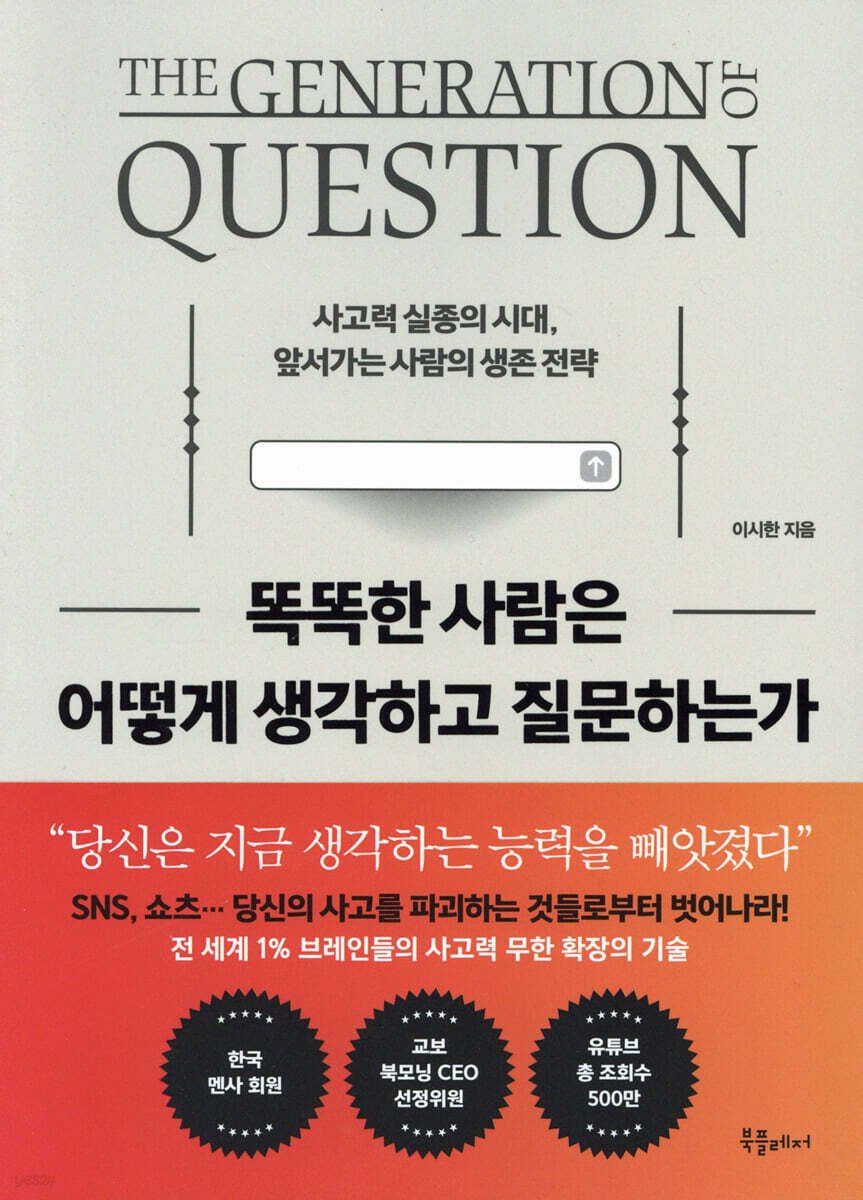
How do smart people think and ask questions?
 |
Description
Book Introduction
The book "How Smart People Think and Ask Questions" is a book that will expand your thinking.
Author Lee Si-han was a member of Korea Mensa and gave lectures at leading domestic companies such as Samsung and SK.
And currently, he is teaching at Sungshin Women's University as an adjunct professor.
The author met with Mensa members, known as the world's top 1% brains, and countless other talented individuals on the front lines, and discovered that the reason they were able to think differently from others was in 'questions.'
Smart people know how to ask the best questions and think based on those questions.
This book covers almost everything about thinking through questions, including how to ask yourself questions for the best ideas, how to ask questions between people, and how to ask questions that lead to the best productivity in AI, including ChetGPT.
Author Lee Si-han was a member of Korea Mensa and gave lectures at leading domestic companies such as Samsung and SK.
And currently, he is teaching at Sungshin Women's University as an adjunct professor.
The author met with Mensa members, known as the world's top 1% brains, and countless other talented individuals on the front lines, and discovered that the reason they were able to think differently from others was in 'questions.'
Smart people know how to ask the best questions and think based on those questions.
This book covers almost everything about thinking through questions, including how to ask yourself questions for the best ideas, how to ask questions between people, and how to ask questions that lead to the best productivity in AI, including ChetGPT.
- You can preview some of the book's contents.
Preview
index
Prologue: Back to the Age of Questions
Chapter 1: What Smart People Think Before Asking Questions
1 We haven't learned how to ask questions properly.
2 How does Mensa ask questions?
3 Things Smart People Think Before Asking Questions
4 How to set up a question mark brain
Chapter 2: The Art of Asking Questions That Get What You Want from the Other Person
1. Don't just rely on logic; ask questions with empathy.
2. The Attitude of Asking Questions That Make a First Impression
3 What questions should someone who is entering the business world for the first time ask?
4 How do you know what (the other person) wants?
5. Questioning Methods to Design Conversation Patterns
6. The reverse question method that changes the flow of air in an instant
Chapter 3: The Algorithm of Questions That Turn Knowledge into Intelligence
1 True knowledge comes from the process of asking and answering questions yourself.
2 Ask yourself questions
3. How to peel away the shell of knowledge and face the essence
4 Aristotelian Argument, Sherlock Holmes-Style Reasoning, and Tony Stark
5 Questions to Summon Knowledge
6 Questions to Grab Creativity by the Neck and Lift It Up
Chapter 4: Expanding Your Thinking Ability by 200% with AI
1 Understanding AI Properly
2 Expanding Brain Function with ChatGPT
Get smart with 3 questions
4 Two pillars of questions that elevate ChatGPT's answer quality to expert level
5 How do we ask ChatGPT questions in Open AI?
6 Expanding Creativity with AI
Epilogue: In an era where those who can get what they want through questions are considered smart
Chapter 1: What Smart People Think Before Asking Questions
1 We haven't learned how to ask questions properly.
2 How does Mensa ask questions?
3 Things Smart People Think Before Asking Questions
4 How to set up a question mark brain
Chapter 2: The Art of Asking Questions That Get What You Want from the Other Person
1. Don't just rely on logic; ask questions with empathy.
2. The Attitude of Asking Questions That Make a First Impression
3 What questions should someone who is entering the business world for the first time ask?
4 How do you know what (the other person) wants?
5. Questioning Methods to Design Conversation Patterns
6. The reverse question method that changes the flow of air in an instant
Chapter 3: The Algorithm of Questions That Turn Knowledge into Intelligence
1 True knowledge comes from the process of asking and answering questions yourself.
2 Ask yourself questions
3. How to peel away the shell of knowledge and face the essence
4 Aristotelian Argument, Sherlock Holmes-Style Reasoning, and Tony Stark
5 Questions to Summon Knowledge
6 Questions to Grab Creativity by the Neck and Lift It Up
Chapter 4: Expanding Your Thinking Ability by 200% with AI
1 Understanding AI Properly
2 Expanding Brain Function with ChatGPT
Get smart with 3 questions
4 Two pillars of questions that elevate ChatGPT's answer quality to expert level
5 How do we ask ChatGPT questions in Open AI?
6 Expanding Creativity with AI
Epilogue: In an era where those who can get what they want through questions are considered smart
Detailed image
Into the book
So now we have to learn how to ask questions.
And we need to train, practice, and develop. We need to develop ourselves by questioning not only AI but also ourselves, and we need to build relationships by asking appropriate questions to others.
Furthermore, we need to ask AI appropriate questions to obtain meaningful results.
--- p.17, from “Again, to the Age of Questions”
If we all start from a similar starting point, can train ourselves to ask questions and practice critical thinking, it means we will soon have the competitive edge to lead the future.
That's why we need to look closely at this book we're holding in our hands right now.
--- p.35, from “What Smart People Think Before Asking Questions”
Let me tell you a great way to check and improve your knowledge.
I called this the funnel technique and the speaker technique, and it was originally developed for students who had to go through interviews.
This was created to help you find a way to answer, even if it's schematically, when you need to answer quickly but can't think of a good idea.
--- p.190, from “The Algorithm of Questions That Turns Knowledge into Intelligence”
There are three prerequisites to properly asking AI questions.
It can be expressed in 3Rs. The first step is Realization.
You must recognize the direction of the result you are seeking.
The second step is reification, which is about making what you are curious about concrete.
Since ChatGPT provides vague answers to vague questions, you need to be able to specify the knowledge or insight you're seeking. The third step is "Represent," which involves expressing your curiosity in a specific yet concise manner.
And we need to train, practice, and develop. We need to develop ourselves by questioning not only AI but also ourselves, and we need to build relationships by asking appropriate questions to others.
Furthermore, we need to ask AI appropriate questions to obtain meaningful results.
--- p.17, from “Again, to the Age of Questions”
If we all start from a similar starting point, can train ourselves to ask questions and practice critical thinking, it means we will soon have the competitive edge to lead the future.
That's why we need to look closely at this book we're holding in our hands right now.
--- p.35, from “What Smart People Think Before Asking Questions”
Let me tell you a great way to check and improve your knowledge.
I called this the funnel technique and the speaker technique, and it was originally developed for students who had to go through interviews.
This was created to help you find a way to answer, even if it's schematically, when you need to answer quickly but can't think of a good idea.
--- p.190, from “The Algorithm of Questions That Turns Knowledge into Intelligence”
There are three prerequisites to properly asking AI questions.
It can be expressed in 3Rs. The first step is Realization.
You must recognize the direction of the result you are seeking.
The second step is reification, which is about making what you are curious about concrete.
Since ChatGPT provides vague answers to vague questions, you need to be able to specify the knowledge or insight you're seeking. The third step is "Represent," which involves expressing your curiosity in a specific yet concise manner.
--- p.271, from “Expanding Your Thinking Ability by 200% with AI”
Publisher's Review
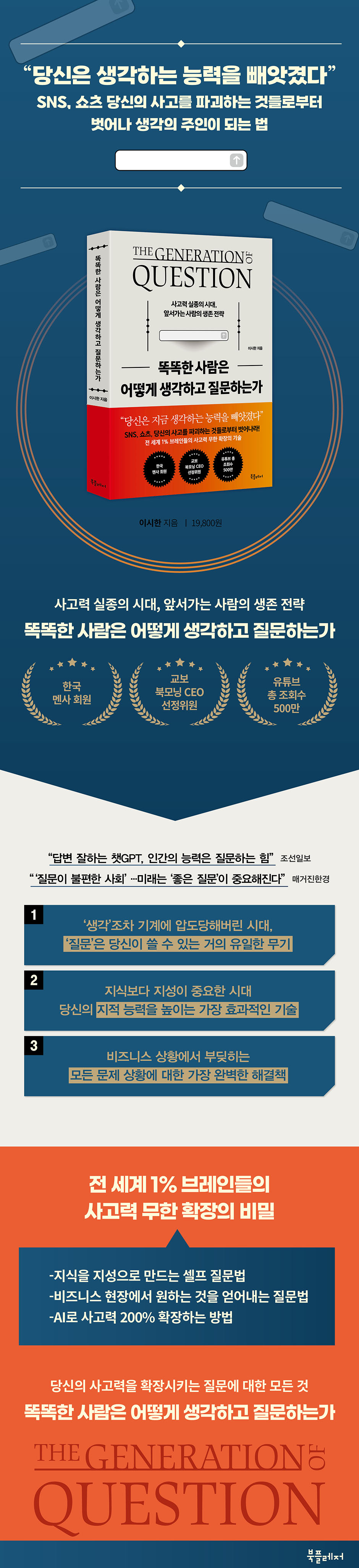
What we need now is not concentration, but thinking ability.
Why We Need to Start Thinking Again
How much time do you spend thinking in a day?
Even in those brief moments when you're riding an elevator or waiting for the crosswalk signal, aren't you spending time looking at various social media or shorts?
When you become addicted to excessive dopamine, your thinking stops.
You can concentrate even when your thoughts stop.
Haven't you often experienced being deeply immersed in a recommended video even when someone else called you?
Controlling concentration is also a thought.
You must be able to think for yourself about where, how much, and how to focus, and then put it into practice.
In that sense, I think what we need to develop first now is not concentration, but thinking skills.
The question is more important than the answer.
The Secret to Mensa Members' Infinitely Expanded Thinking Abilities
So how can we develop critical thinking skills? The author finds the foundation in "questions."
Albert Einstein, the genius of the century, said, “Questions are more important than answers.
“If I had just one hour to figure out how to save someone’s life, I would spend 55 minutes figuring out the right questions,” he said bluntly.
The so-called smart people the author met while working as a Mensa planning committee member are said to have an outstanding ability to ask this question.
They organized their thoughts by asking themselves and others pointed questions.
This book contains key secrets to thinking through questions, such as how to ask yourself questions for the best ideas, how to ask questions between people, and how to ask questions that lead to the best productivity in AI, including ChetGPT.
In an era where even ‘thought’ has been overwhelmed by machines,
Questions are pretty much the only weapon you have!
Recently, there has been a huge craze for generative AI, led by Chet GPT.
It's important to note that injecting insight into information isn't something only humans can do.
In an era where humans are no longer the only ones who can 'think', ironically, the most important factor that enables humans to utilize machines is still 'thinking'.
The recently popular generative AI is called 'narrow AI'.
For example, autonomous driving only responds to driving, and ChetGPT only responds to user questions.
Ultimately, to control and utilize them, a human being with an integrated mindset across various fields must properly ask the questions.
Therefore, if the last 20 years have been the era of search, the world will change to the 'era of questions' in the future.
A person who is only amazed by technological advancements is a bystander.
You must learn how to use it properly and become a pioneer. In an era where AI technology solves countless problems within the confines of a room, asking the right questions is practically your only weapon.
Why We Need to Start Thinking Again
How much time do you spend thinking in a day?
Even in those brief moments when you're riding an elevator or waiting for the crosswalk signal, aren't you spending time looking at various social media or shorts?
When you become addicted to excessive dopamine, your thinking stops.
You can concentrate even when your thoughts stop.
Haven't you often experienced being deeply immersed in a recommended video even when someone else called you?
Controlling concentration is also a thought.
You must be able to think for yourself about where, how much, and how to focus, and then put it into practice.
In that sense, I think what we need to develop first now is not concentration, but thinking skills.
The question is more important than the answer.
The Secret to Mensa Members' Infinitely Expanded Thinking Abilities
So how can we develop critical thinking skills? The author finds the foundation in "questions."
Albert Einstein, the genius of the century, said, “Questions are more important than answers.
“If I had just one hour to figure out how to save someone’s life, I would spend 55 minutes figuring out the right questions,” he said bluntly.
The so-called smart people the author met while working as a Mensa planning committee member are said to have an outstanding ability to ask this question.
They organized their thoughts by asking themselves and others pointed questions.
This book contains key secrets to thinking through questions, such as how to ask yourself questions for the best ideas, how to ask questions between people, and how to ask questions that lead to the best productivity in AI, including ChetGPT.
In an era where even ‘thought’ has been overwhelmed by machines,
Questions are pretty much the only weapon you have!
Recently, there has been a huge craze for generative AI, led by Chet GPT.
It's important to note that injecting insight into information isn't something only humans can do.
In an era where humans are no longer the only ones who can 'think', ironically, the most important factor that enables humans to utilize machines is still 'thinking'.
The recently popular generative AI is called 'narrow AI'.
For example, autonomous driving only responds to driving, and ChetGPT only responds to user questions.
Ultimately, to control and utilize them, a human being with an integrated mindset across various fields must properly ask the questions.
Therefore, if the last 20 years have been the era of search, the world will change to the 'era of questions' in the future.
A person who is only amazed by technological advancements is a bystander.
You must learn how to use it properly and become a pioneer. In an era where AI technology solves countless problems within the confines of a room, asking the right questions is practically your only weapon.
GOODS SPECIFICS
- Date of issue: January 24, 2024
- Page count, weight, size: 328 pages | 426g | 148*205*30mm
- ISBN13: 9791191891492
- ISBN10: 1191891496
You may also like
카테고리
korean


korean

![GQ KOREA Mark (Monthly): December [2025]](http://librairie.coreenne.fr/cdn/shop/files/8ef265dbbfbf186523ed75ba7319009d.jpg?v=1765340328&width=3840)


