

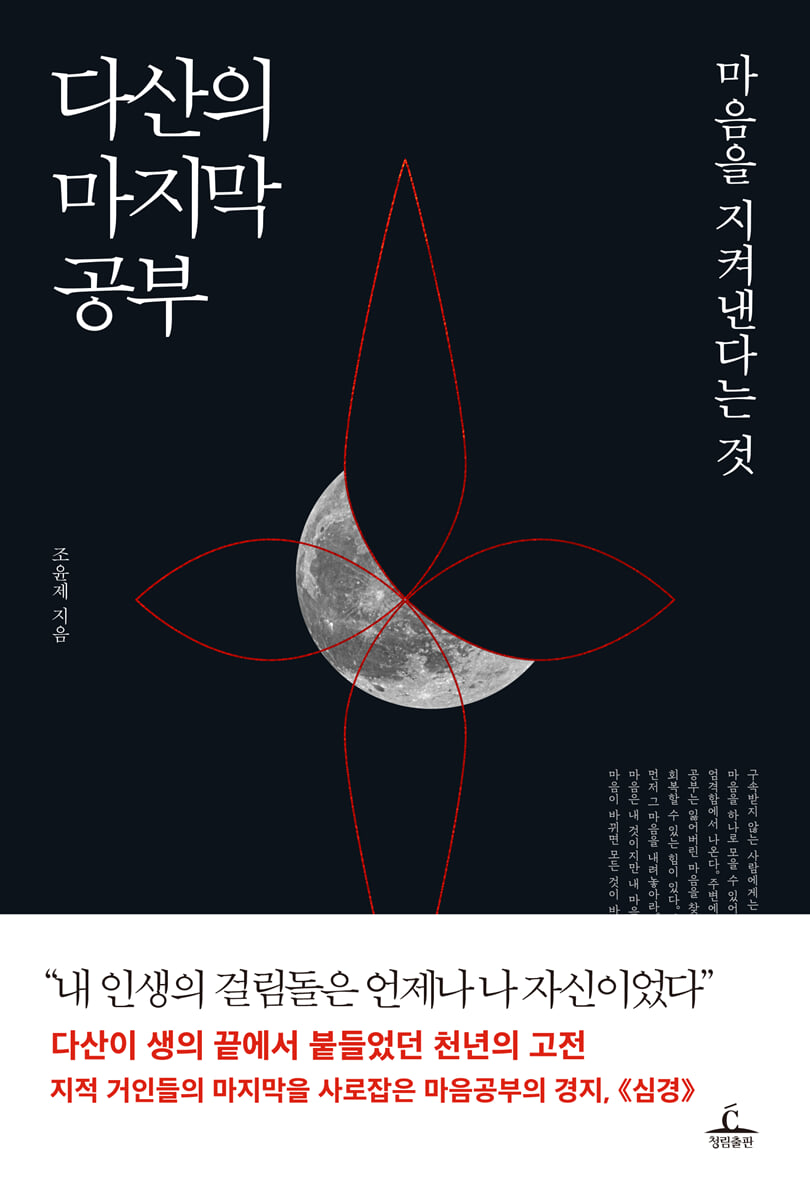
Dasan's last study
 |
Description
Book Introduction
Based on the classic 『Heart Sutra』, the essence of the classics, classical scholar Jo Yun-je once again introduces the profound insights of classic sayings, following 『Millennium of Internal Energy』.
Specifically, Jin Deok-su selected the core of 37 famous quotes related to the mind from classics and reinterpreted them in a friendly yet new way to suit modern sensibilities.
By doing so, it is structured so that readers can easily look back on the things they have missed without getting lost in difficult passages.
Specifically, Jin Deok-su selected the core of 37 famous quotes related to the mind from classics and reinterpreted them in a friendly yet new way to suit modern sensibilities.
By doing so, it is structured so that readers can easily look back on the things they have missed without getting lost in difficult passages.
- You can preview some of the book's contents.
Preview
index
Introduction: Dasan disciplined his mind with the "Simgyeong" (Heart Sutra).
Part 1 Yakdongseopcheon
: Confidence comes from restraint and reflection.
The unbound person has a center
As an adult, you must be able to gather your thoughts.
Confidence comes from being strict with yourself.
The extraordinary is the result of countless ordinarinesses accumulating.
A lion is a lion even without a mane.
If your mind is wavering, stop for a moment and collect yourself.
Break yourself down every day and start over again.
If you know how to look back, you can come back
If you can't let go of what you need to let go of, you'll end up throwing yourself away.
Benevolence means behaving properly in everyday life.
If you want to win a heart, first take out the heart.
Don't be swept away by your surroundings, and stay true to yourself.
Part 2: Go away and take this
: Don't be intoxicated by ideals, but focus on everyday life.
Self-respect begins with knowing shame.
Give yourself all your heart
If you want to organize your mind, start by organizing your body.
Make learning a habit
If you want to protect, don't build walls, fill them in.
To live like a human being, you need to be decisive.
As humans, we must know the value of others.
If you can see the bigger picture, the present is not scary.
Don't be swayed by experience, see things as they are.
If you want to protect your heart, first let it go.
Studying is the process of finding a lost mind.
When people are generous only to themselves, they become monsters.
The willingness to take a loss brings greater rewards.
Part 3: Transition from Delusion to Enlightenment
: Don't be trapped in the shell, establish your own center.
How you study is more important than how much you study.
A person should know shame.
Human perfection begins with the small, everyday things.
Studying without reflection is not studying.
The mind is not something to be discarded, but something to be nurtured.
Humans have the power to heal their hearts.
Self-confidence comes from learning.
It is none other than myself who creates me.
If you think about life as it is, you will stop being human.
Living comfortably requires a lot of effort.
My heart is mine, but it doesn't do what I want.
When your mind changes, everything changes.
Appendix: The Full Text of the Heart Sutra
Part 1 Yakdongseopcheon
: Confidence comes from restraint and reflection.
The unbound person has a center
As an adult, you must be able to gather your thoughts.
Confidence comes from being strict with yourself.
The extraordinary is the result of countless ordinarinesses accumulating.
A lion is a lion even without a mane.
If your mind is wavering, stop for a moment and collect yourself.
Break yourself down every day and start over again.
If you know how to look back, you can come back
If you can't let go of what you need to let go of, you'll end up throwing yourself away.
Benevolence means behaving properly in everyday life.
If you want to win a heart, first take out the heart.
Don't be swept away by your surroundings, and stay true to yourself.
Part 2: Go away and take this
: Don't be intoxicated by ideals, but focus on everyday life.
Self-respect begins with knowing shame.
Give yourself all your heart
If you want to organize your mind, start by organizing your body.
Make learning a habit
If you want to protect, don't build walls, fill them in.
To live like a human being, you need to be decisive.
As humans, we must know the value of others.
If you can see the bigger picture, the present is not scary.
Don't be swayed by experience, see things as they are.
If you want to protect your heart, first let it go.
Studying is the process of finding a lost mind.
When people are generous only to themselves, they become monsters.
The willingness to take a loss brings greater rewards.
Part 3: Transition from Delusion to Enlightenment
: Don't be trapped in the shell, establish your own center.
How you study is more important than how much you study.
A person should know shame.
Human perfection begins with the small, everyday things.
Studying without reflection is not studying.
The mind is not something to be discarded, but something to be nurtured.
Humans have the power to heal their hearts.
Self-confidence comes from learning.
It is none other than myself who creates me.
If you think about life as it is, you will stop being human.
Living comfortably requires a lot of effort.
My heart is mine, but it doesn't do what I want.
When your mind changes, everything changes.
Appendix: The Full Text of the Heart Sutra
Detailed image

Into the book
The book of the human heart
Jewal, Insim Yuwi, Dosim Yumi, Yujeong Yuil, Yunjip Gwoljung
Emotions and desires cannot be controlled by suppressing them with will.
We are not the wise men who left their names in history.
But even if you are an ordinary person, struggling with the world and anxious about the present, it is possible to take a moment to reflect, to step back from yourself and observe when emotions and desires are running high.
Taking a step back means briefly separating yourself from your emotions.
When you take a step back to avoid being buried, you can see yourself clearly and without reservation.
If you can see straight ahead, you can examine whether your actions are based on righteousness.
If you are ashamed of yourself, you should leave that job.
If you are not ashamed, then just continue boldly.
Even if you are not an adult, if you practice not being swayed by everyday life step by step, you can become a better person than you were yesterday.
---From "The Unbound Person Has a Center"
相在爾室 尙不愧于屋漏 無曰不顯 莫予云? God's thinking, 不可度thinking?
Sangjae-isil Sangbulgoewoookru Muwalbulhyeon Makyeowungu Sinjigyeoksa Bulgataksa Shinga Yeoksa
Jeong Yak-yong commented on Shindok as follows:
“Being cautious means being careful in matters that you know about alone, and it does not simply mean being cautious in your actions when you are alone.
When a person sits alone in a room and silently reflects on what he has done, his conscience is revealed.
It is not that shame is revealed when we reflect on ourselves in a dark place, but that we should not dare to commit evil even in places that do not appear dark.
The evil of man is always with man.
---From “Confidence comes from being strict with yourself”
子絶四毋意毋必毋固毋我
Self-destruction, no purpose, no writing, no going, no self
'No ego (no ego)' means not doing all of the above for one's own material or mental benefit.
Stubborn people are so caught up in their own thoughts that they don't care about others.
Moreover, because they prioritize their own greed and greed over the public interest, or the greater good, they fail to benefit either the nation or the smallest organization. The biggest problem with these stubborn individuals is that their own lives are empty.
A person who lives solely to satisfy his own greed may be living a life of unfulfilled longing, like Sisyphus in Greek mythology, who had to roll a rock endlessly.
It is a punishment.
---From "If you can't let go of what you need to let go of, you end up throwing yourself away"
The son of a nobleman
The journey of the nobleman, Banjeong Ihwagiji, and Biryu Iseonggi
I think that for academics, you have to do something grand.
The same goes for studying the mind.
To control my mind, I look for books to read and spend time receiving counseling.
I practice and practice again to learn how to empty my mind to free it from the clutter.
But once the bad energy takes over the mind, it is not easy to get rid of it.
Even if you manage to empty it out with great difficulty, you cannot let your guard down.
Because soon, your heart will be taken over by a stronger desire.
The first thing you must do to control your mind is to keep bad things from taking over your mind.
It's not a big deal.
It is enough to fill your daily life with little good things.
---From "If you want to protect, don't build walls, fill the inside"
A child's story, a big person, a small person, a small person, a person with a big heart
Mencius said, "A great man is a man of great virtue, but he is not a man of great virtue."
In the Mencius, in the section on Iru, it is written as follows:
“You cannot talk to someone who harms himself, and you cannot work with someone who has given up on himself.” A person who has given up on himself is not someone who has given up on himself because of someone else or some circumstances, but because of himself.
Not only winners but also losers are given the right to make excuses for why they made mistakes and what they lacked.
But those who give up on their own and don't even step into the ring and throw a punch have no excuses or anything to blame.
Jewal, Insim Yuwi, Dosim Yumi, Yujeong Yuil, Yunjip Gwoljung
Emotions and desires cannot be controlled by suppressing them with will.
We are not the wise men who left their names in history.
But even if you are an ordinary person, struggling with the world and anxious about the present, it is possible to take a moment to reflect, to step back from yourself and observe when emotions and desires are running high.
Taking a step back means briefly separating yourself from your emotions.
When you take a step back to avoid being buried, you can see yourself clearly and without reservation.
If you can see straight ahead, you can examine whether your actions are based on righteousness.
If you are ashamed of yourself, you should leave that job.
If you are not ashamed, then just continue boldly.
Even if you are not an adult, if you practice not being swayed by everyday life step by step, you can become a better person than you were yesterday.
---From "The Unbound Person Has a Center"
相在爾室 尙不愧于屋漏 無曰不顯 莫予云? God's thinking, 不可度thinking?
Sangjae-isil Sangbulgoewoookru Muwalbulhyeon Makyeowungu Sinjigyeoksa Bulgataksa Shinga Yeoksa
Jeong Yak-yong commented on Shindok as follows:
“Being cautious means being careful in matters that you know about alone, and it does not simply mean being cautious in your actions when you are alone.
When a person sits alone in a room and silently reflects on what he has done, his conscience is revealed.
It is not that shame is revealed when we reflect on ourselves in a dark place, but that we should not dare to commit evil even in places that do not appear dark.
The evil of man is always with man.
---From “Confidence comes from being strict with yourself”
子絶四毋意毋必毋固毋我
Self-destruction, no purpose, no writing, no going, no self
'No ego (no ego)' means not doing all of the above for one's own material or mental benefit.
Stubborn people are so caught up in their own thoughts that they don't care about others.
Moreover, because they prioritize their own greed and greed over the public interest, or the greater good, they fail to benefit either the nation or the smallest organization. The biggest problem with these stubborn individuals is that their own lives are empty.
A person who lives solely to satisfy his own greed may be living a life of unfulfilled longing, like Sisyphus in Greek mythology, who had to roll a rock endlessly.
It is a punishment.
---From "If you can't let go of what you need to let go of, you end up throwing yourself away"
The son of a nobleman
The journey of the nobleman, Banjeong Ihwagiji, and Biryu Iseonggi
I think that for academics, you have to do something grand.
The same goes for studying the mind.
To control my mind, I look for books to read and spend time receiving counseling.
I practice and practice again to learn how to empty my mind to free it from the clutter.
But once the bad energy takes over the mind, it is not easy to get rid of it.
Even if you manage to empty it out with great difficulty, you cannot let your guard down.
Because soon, your heart will be taken over by a stronger desire.
The first thing you must do to control your mind is to keep bad things from taking over your mind.
It's not a big deal.
It is enough to fill your daily life with little good things.
---From "If you want to protect, don't build walls, fill the inside"
A child's story, a big person, a small person, a small person, a person with a big heart
Mencius said, "A great man is a man of great virtue, but he is not a man of great virtue."
In the Mencius, in the section on Iru, it is written as follows:
“You cannot talk to someone who harms himself, and you cannot work with someone who has given up on himself.” A person who has given up on himself is not someone who has given up on himself because of someone else or some circumstances, but because of himself.
Not only winners but also losers are given the right to make excuses for why they made mistakes and what they lacked.
But those who give up on their own and don't even step into the ring and throw a punch have no excuses or anything to blame.
---From “Don’t be swayed by experience, see things as they are”
Publisher's Review
Dasan Jeong Yak-yong, Toegye Yi Hwang, Jeongjo Yi San…
Why did they read the Heart Sutra until the end?
The profound realm that intellectual giants reach at the end of their studies, the mind
The 'ultimate' classic and now forgotten Joseon's best-seller,
Rediscovering the heart that 『Simgyeong』 talks about
'Are you drinking water from the Han River?'
Words contain the worries of the times.
In fact, in Korea, 21 people per 100,000 people, or 42 people every day, take their own lives every 34 minutes.
The way Koreans chose to protect themselves from the harsh reality was to isolate themselves from the outside world and retreat into their inner selves.
It is a way of living by giving up and being given up, emptying your mind and being insensitive.
The choice to abandon my heart because I can't change the world was somewhat effective in enduring my daily life, but paradoxically, it made me even more distant from the heart I had been trying to protect.
"Dasan's Last Study: Protecting the Mind" is a profound piece of advice and comfort that can be looked at and leaned on when everything around you suddenly feels empty and you start to doubt whether you're doing well.
Jo Yun-je, author of 『Millennium of Internal Energy』 and 『Malgongbu』, interpreted 37 key passages of 『Simgyeong』, the study of the mind that Toegye and Dasan encountered at the end of their studies, in a way that suits today's sensibilities.
The final destination of study, the state of mind
As its name suggests, the Heart Sutra is a Confucian classic that deals with the ‘mind.’
The compiler was Jin Deok-su, a scholar of the Song Dynasty in China, who carefully selected the essence of mind control from Eastern classics, including the Four Books and Three Classics, and added brief commentary.
Toegye read this book every morning until his last moment after coming across it around the age of thirty.
Dasan Jeong Yak-yong considered the Simgyeong as the final stage of study while organizing his extensive academic system.
Joseon was an era dominated by books.
If I were to summarize such a Joseon book in just one volume, it would not be an exaggeration to say that it would be 『Simgyeong』.
One question may arise here.
Then why did scholars like Toegye and Dasan choose the 'mind' over anything else as the final stage of their studies?
Why did they reach the heart?
There comes a time when everyone has to face their life head on.
Jeong Yak-yong, who was in exile, was also like that.
When he lost everything and fell to the ground in an instant, to the point where he wondered if the time he had enjoyed King Jeongjo's favor and was on a roll was a dream, he began to wonder if the life he had wasted for nearly half his life had not been in vain.
When the anger in his heart threatened to consume him, Jeong Yak-yong began studying solely for himself in order to control his mind, which was wandering between the words he had to swallow.
And at the top of the great tower of learning called Dasanhak, he faces his final subject.
That was the very feeling I wanted to grasp from the beginning.
『Dasan's Last Study』 is a deep insight into a famous classical quote, based on 『Simgyeong』, and commented on by classical scholar Jo Yun-je.
Specifically, Jin Deok-su selected the core of 37 famous quotes related to the mind from classics and reinterpreted them in a friendly yet new way to suit modern sensibilities.
By doing so, it is structured so that readers can easily look back on the things they have missed without getting lost in difficult passages.
The core of the study of the mind discussed in the Heart Sutra is the realization that “the mind is mine, but I cannot do whatever I want with it throughout my life.”
When we realize that the stumbling block in life has always been ourselves, the choice we make is to let go and empty our minds.
However, in 『Heart Sutra』, it is said that such organization is not a study of the mind.
Because the heart is not something that must be abandoned in order to survive, but something that must eventually be reconciled after fighting as we live.
A time for self-reflection
The core of the 『Mindfulness』 chosen in this book is being careful and solitary.
Shindok is known for his attitude towards life, which involves being cautious and maintaining decency even when alone.
However, the Shindok interpreted by Jeong Yak-yong is not the neatness of being alone, but a time to reflect on and encourage oneself for how one has endured today in one's own cave.
Therefore, the 'Samganda' he talks about is more of a struggle and reflection, and a seriousness that constantly asks one's own mind about how one lives and what one lives for.
Jeong Yak-yong was skeptical about people who were upright and had no selfish motives.
For him, such a person was a realm he aspired to but could not reach.
Therefore, the attitude toward life that Jeong Yak-yong suggested that ordinary people can adopt is not to avoid becoming cowardly, but to reflect on one's own cowardice today and become a little less cowardly tomorrow.
It is not a process of giving up one's heart to live, but rather a process of finding the heart that has been lost while living.
That was the purpose of studying for him.
Studying is the process of finding the lost mind.
For Koreans, who had to abandon their hearts to overcome the immediate reality, the suggestion to look back on their hearts and reflect on the path they had taken was a mischievous joke and a pampering luxury.
As a result, we have now obtained most of what we wanted, but because we hastily built it up, the various knots within us today are mixed together in a chaotic manner, resulting in a divisive appearance.
This is why we need to look back at the 『Mindfulness』 here and now, when we are easily angered and quick to become cynical.
Because in order to live better from now on, we must find the heart that we have abandoned in order to live.
The Heart Sutra begins like this:
“The human mind is always wavering, so we must hold on to our center.” I hope that 『Dasan’s Last Study』 will help you approach this classic study of the mind that is on a different level.
Why did they read the Heart Sutra until the end?
The profound realm that intellectual giants reach at the end of their studies, the mind
The 'ultimate' classic and now forgotten Joseon's best-seller,
Rediscovering the heart that 『Simgyeong』 talks about
'Are you drinking water from the Han River?'
Words contain the worries of the times.
In fact, in Korea, 21 people per 100,000 people, or 42 people every day, take their own lives every 34 minutes.
The way Koreans chose to protect themselves from the harsh reality was to isolate themselves from the outside world and retreat into their inner selves.
It is a way of living by giving up and being given up, emptying your mind and being insensitive.
The choice to abandon my heart because I can't change the world was somewhat effective in enduring my daily life, but paradoxically, it made me even more distant from the heart I had been trying to protect.
"Dasan's Last Study: Protecting the Mind" is a profound piece of advice and comfort that can be looked at and leaned on when everything around you suddenly feels empty and you start to doubt whether you're doing well.
Jo Yun-je, author of 『Millennium of Internal Energy』 and 『Malgongbu』, interpreted 37 key passages of 『Simgyeong』, the study of the mind that Toegye and Dasan encountered at the end of their studies, in a way that suits today's sensibilities.
The final destination of study, the state of mind
As its name suggests, the Heart Sutra is a Confucian classic that deals with the ‘mind.’
The compiler was Jin Deok-su, a scholar of the Song Dynasty in China, who carefully selected the essence of mind control from Eastern classics, including the Four Books and Three Classics, and added brief commentary.
Toegye read this book every morning until his last moment after coming across it around the age of thirty.
Dasan Jeong Yak-yong considered the Simgyeong as the final stage of study while organizing his extensive academic system.
Joseon was an era dominated by books.
If I were to summarize such a Joseon book in just one volume, it would not be an exaggeration to say that it would be 『Simgyeong』.
One question may arise here.
Then why did scholars like Toegye and Dasan choose the 'mind' over anything else as the final stage of their studies?
Why did they reach the heart?
There comes a time when everyone has to face their life head on.
Jeong Yak-yong, who was in exile, was also like that.
When he lost everything and fell to the ground in an instant, to the point where he wondered if the time he had enjoyed King Jeongjo's favor and was on a roll was a dream, he began to wonder if the life he had wasted for nearly half his life had not been in vain.
When the anger in his heart threatened to consume him, Jeong Yak-yong began studying solely for himself in order to control his mind, which was wandering between the words he had to swallow.
And at the top of the great tower of learning called Dasanhak, he faces his final subject.
That was the very feeling I wanted to grasp from the beginning.
『Dasan's Last Study』 is a deep insight into a famous classical quote, based on 『Simgyeong』, and commented on by classical scholar Jo Yun-je.
Specifically, Jin Deok-su selected the core of 37 famous quotes related to the mind from classics and reinterpreted them in a friendly yet new way to suit modern sensibilities.
By doing so, it is structured so that readers can easily look back on the things they have missed without getting lost in difficult passages.
The core of the study of the mind discussed in the Heart Sutra is the realization that “the mind is mine, but I cannot do whatever I want with it throughout my life.”
When we realize that the stumbling block in life has always been ourselves, the choice we make is to let go and empty our minds.
However, in 『Heart Sutra』, it is said that such organization is not a study of the mind.
Because the heart is not something that must be abandoned in order to survive, but something that must eventually be reconciled after fighting as we live.
A time for self-reflection
The core of the 『Mindfulness』 chosen in this book is being careful and solitary.
Shindok is known for his attitude towards life, which involves being cautious and maintaining decency even when alone.
However, the Shindok interpreted by Jeong Yak-yong is not the neatness of being alone, but a time to reflect on and encourage oneself for how one has endured today in one's own cave.
Therefore, the 'Samganda' he talks about is more of a struggle and reflection, and a seriousness that constantly asks one's own mind about how one lives and what one lives for.
Jeong Yak-yong was skeptical about people who were upright and had no selfish motives.
For him, such a person was a realm he aspired to but could not reach.
Therefore, the attitude toward life that Jeong Yak-yong suggested that ordinary people can adopt is not to avoid becoming cowardly, but to reflect on one's own cowardice today and become a little less cowardly tomorrow.
It is not a process of giving up one's heart to live, but rather a process of finding the heart that has been lost while living.
That was the purpose of studying for him.
Studying is the process of finding the lost mind.
For Koreans, who had to abandon their hearts to overcome the immediate reality, the suggestion to look back on their hearts and reflect on the path they had taken was a mischievous joke and a pampering luxury.
As a result, we have now obtained most of what we wanted, but because we hastily built it up, the various knots within us today are mixed together in a chaotic manner, resulting in a divisive appearance.
This is why we need to look back at the 『Mindfulness』 here and now, when we are easily angered and quick to become cynical.
Because in order to live better from now on, we must find the heart that we have abandoned in order to live.
The Heart Sutra begins like this:
“The human mind is always wavering, so we must hold on to our center.” I hope that 『Dasan’s Last Study』 will help you approach this classic study of the mind that is on a different level.
GOODS SPECIFICS
- Publication date: November 29, 2023
- Page count, weight, size: 304 pages | 153*224*30mm
- ISBN13: 9788935214426
- ISBN 10: 8935214426
You may also like
카테고리
korean


korean

![GQ KOREA Mark (Monthly): December [2025]](http://librairie.coreenne.fr/cdn/shop/files/8ef265dbbfbf186523ed75ba7319009d.jpg?v=1765340328&width=3840)


