

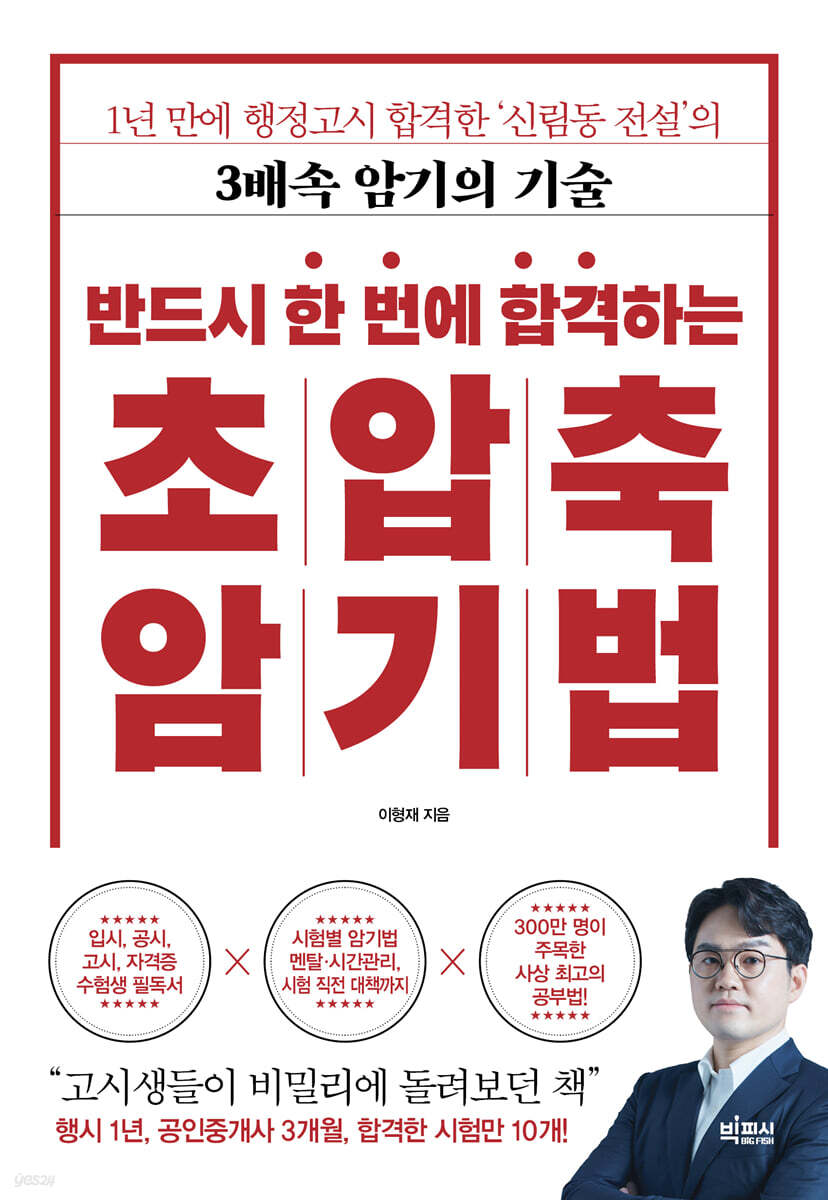
Ultra-compressed memorization technique that will ensure you pass the exam on the first try
 |
Description
Book Introduction
- A word from MD
-
The legendary memorization technique of Sillim-dongThis book contains the 'ultra-compressed memorization technique', which is the result of long-term research by author Lee Hyeong-jae of 'The Legend of Sillim-dong', who had been memorizing everything without knowing an efficient study method.
We will teach you all the memorization techniques for passing the exam in a short period of time, including 7 memorization strategies optimized for the exam, memorization techniques and routines that suit your personality and situation.
November 14, 2023. Self-Development PD Kim Sang-geun
“That’s the book that the students secretly passed around!”
Everything You Need to Know About the Ultra-Compressed Memorization Techniques That Work for Every Exam
There is only one formula for passing any exam.
The idea is to compress and memorize only the material that will appear on the exam from the vast amount of material, so that you can find the answer just by looking at the problem.
That is why the "Ultra-compressed memorization technique that ensures you pass the exam in one try" that simplifies the key points and memorizes them efficiently is the best secret to passing the exam.
This book contains all the memorization strategies learned by Lee Hyeong-jae, the "Legend of Sillim-dong," who passed the civil service examination in just one year and passed over 10 exams in a short period of time, including the International CPA, AICPA, and Certified Real Estate Agent exams, dozens of times.
We also introduce memorization techniques for each type of multiple-choice and subjective question, ultra-compressed strategies for selecting only the questions that will appear on the exam, various techniques for easy memorization, and secret techniques for raising your score right before the exam.
This book, which was very popular among test takers because it is guaranteed to be effective even when the focus is short, time is limited, or the amount of material is large, is even more reliable because it contains only methods that the author personally tried and verified while consulting with test takers.
If there's an exam you absolutely must pass, now is the time to open this book!
Everything You Need to Know About the Ultra-Compressed Memorization Techniques That Work for Every Exam
There is only one formula for passing any exam.
The idea is to compress and memorize only the material that will appear on the exam from the vast amount of material, so that you can find the answer just by looking at the problem.
That is why the "Ultra-compressed memorization technique that ensures you pass the exam in one try" that simplifies the key points and memorizes them efficiently is the best secret to passing the exam.
This book contains all the memorization strategies learned by Lee Hyeong-jae, the "Legend of Sillim-dong," who passed the civil service examination in just one year and passed over 10 exams in a short period of time, including the International CPA, AICPA, and Certified Real Estate Agent exams, dozens of times.
We also introduce memorization techniques for each type of multiple-choice and subjective question, ultra-compressed strategies for selecting only the questions that will appear on the exam, various techniques for easy memorization, and secret techniques for raising your score right before the exam.
This book, which was very popular among test takers because it is guaranteed to be effective even when the focus is short, time is limited, or the amount of material is large, is even more reliable because it contains only methods that the author personally tried and verified while consulting with test takers.
If there's an exam you absolutely must pass, now is the time to open this book!
- You can preview some of the book's contents.
Preview
index
Real Testimonials from Students Who Practiced the Ultra-Compressed Memorization Technique
prolog
The power of ultra-compression that will definitely lead you to pass any exam
Chapter 1.
Basic principles of memorization
Efficiency alone determines success.
The secret to passing the exam in just one year after being frustrated by memorization
Don't blame your brain for not being able to memorize.
There are different memorization techniques that are suitable for exams.
Memorization is a skill
Chapter 2.
The art of memorization optimization
7 Strategies to Study Less and Pass Faster
Strategies to study less and pass quickly
[Time] 5 Best Times to Study Memorization Subjects
[Order] How to strategically determine the order of memorization
[Imprint] How to engrave something deep into your mind
[Compression] A strategy to memorize only what is necessary.
[Repeat] The most efficient review cycle
[Depth] A technique for determining the level of memorization for each test
[Output] Effective Memorization Strategies for Retrieving Memories
Chapter 3.
Ultra-Compression Memorization Technique ①: Basics
When you need to remember the content and problems you encounter for the first time
[Zero Base] How to Remember Knowledge from a Blank Slate
[Structure] To you who opened the book for the first time
[Keyword] Break it down into the most important words
[Association] I didn't memorize it, but the story was already in my head.
Chapter 4.
Ultra-Compressed Memorization Technique ②: Advanced Edition
When you need to engrave an entire book into your brain
[Speed] Memorization techniques to increase speed
[Grouping] It's easier when you categorize and group things.
[Ordering] When you need to memorize in a specific order
[By Question] Optimized Memorization Techniques for Multiple-Choice Tests
[Two letters] Memorizing the first letter does not mean memorizing the two letters.
Chapter 5.
Solutions just before the exam
A one-month strategy to boost your score
Memorization Strategies to Boost Your Score One Month Before the Exam
A week before the exam, a super-efficient way to distribute your memorization volume
Five minutes before the exam, the final memorization technique that will determine your success or failure.
Chapter 6.
Memorization Optimization Routine
Memorization is not something you try to do, it happens naturally.
So that memorization can become a way of life
A useful method when you need to memorize something without thinking
Recommended memorization method for office workers
A technique that combines multiple memorization techniques to create synergy
Special and unique memorization techniques
Epilogue
You have to believe in yourself to strengthen your memorization skills.
References
prolog
The power of ultra-compression that will definitely lead you to pass any exam
Chapter 1.
Basic principles of memorization
Efficiency alone determines success.
The secret to passing the exam in just one year after being frustrated by memorization
Don't blame your brain for not being able to memorize.
There are different memorization techniques that are suitable for exams.
Memorization is a skill
Chapter 2.
The art of memorization optimization
7 Strategies to Study Less and Pass Faster
Strategies to study less and pass quickly
[Time] 5 Best Times to Study Memorization Subjects
[Order] How to strategically determine the order of memorization
[Imprint] How to engrave something deep into your mind
[Compression] A strategy to memorize only what is necessary.
[Repeat] The most efficient review cycle
[Depth] A technique for determining the level of memorization for each test
[Output] Effective Memorization Strategies for Retrieving Memories
Chapter 3.
Ultra-Compression Memorization Technique ①: Basics
When you need to remember the content and problems you encounter for the first time
[Zero Base] How to Remember Knowledge from a Blank Slate
[Structure] To you who opened the book for the first time
[Keyword] Break it down into the most important words
[Association] I didn't memorize it, but the story was already in my head.
Chapter 4.
Ultra-Compressed Memorization Technique ②: Advanced Edition
When you need to engrave an entire book into your brain
[Speed] Memorization techniques to increase speed
[Grouping] It's easier when you categorize and group things.
[Ordering] When you need to memorize in a specific order
[By Question] Optimized Memorization Techniques for Multiple-Choice Tests
[Two letters] Memorizing the first letter does not mean memorizing the two letters.
Chapter 5.
Solutions just before the exam
A one-month strategy to boost your score
Memorization Strategies to Boost Your Score One Month Before the Exam
A week before the exam, a super-efficient way to distribute your memorization volume
Five minutes before the exam, the final memorization technique that will determine your success or failure.
Chapter 6.
Memorization Optimization Routine
Memorization is not something you try to do, it happens naturally.
So that memorization can become a way of life
A useful method when you need to memorize something without thinking
Recommended memorization method for office workers
A technique that combines multiple memorization techniques to create synergy
Special and unique memorization techniques
Epilogue
You have to believe in yourself to strengthen your memorization skills.
References
Detailed image

Into the book
Even now, countless students' concerns are pouring into the classroom and on YouTube.
The biggest concern among these is the concern about ‘memorization.’
“I’m not good at memorizing.” “After all, you have to memorize things to get good grades on tests.
People like me say things like, “I think I’ll end up failing because I can’t memorize things properly.”
In times like these, I say, “Everyone has different abilities, but you can develop the memorization skills to pass the exam.”
The reason I can say this with such confidence is because I have so much experience.
Anyone can produce different results if they just know how.
--- p.11, from “Passing the exam in one year after finding a memorization technique”
After nearly 20 years of searching for the optimal memorization method for exams, the conclusion I reached was 'hyper-compression'.
Accepting the fact that you cannot memorize everything is the beginning of effective memorization, rather than thinking that you will memorize everything.
The amount of information a person can memorize is limited.
Therefore, the most important thing in memorization is to minimize the amount of memorization and ultimately eliminate the need to memorize anything.
In fact, when I lecture, I reduce the content of about 1,000 pages to less than 20 pages at the end of the exam.
There are many reviews saying that you can get a passing grade just by looking at it.
--- p.11~12, from “Ultra-compressed memorization techniques that achieve maximum efficiency in a short period of time”
The same goes for studying.
It is difficult to understand the details of something you are learning for the first time.
You have to watch it over and over again to remember the details.
So, if you look at the points differently each time you repeat it, you can understand the content more deeply.
You can get a new feeling by repeating the same content in different ways.
The memorization points according to the number of repetitions are as follows.
① 1-3 times: Understanding the overall content
② 4-6 times: Focus on detailed memorization content, keywords, etc.
③ 7 times or more: Look at even the smallest details carefully
If it's a subject you've already studied, so-called basic content, you can take it about twice less.
If you watch it 5 times, you will remember the details, and if you watch it more than that, you will feel quite proficient.
--- p.48~49, from “How many repetitions are needed for memorization?”
In order to clearly understand, you must use a 'memorization technique that can be clearly imprinted in your head'.
Going back to the previous example, in order to memorize that 'positive regulation is a principle prohibition', you should confirm that 'giving up is a principle prohibition' right before the test.
Since ‘giving up is a principle prohibition’, ‘positive’ is ‘a principle prohibition’.
I call this 'pillar driving of memory'.
① The day before the exam, compress the key content so that you can skim through the entire scope.
② Find a time when you can memorize well.
③ The key point is to properly ‘build the pillars of memory’.
This is the basic principle of memorization.
--- p.61~62, from “Even if you see one, make sure to imprint it in your mind”
One of the things that students often worry about is that they study hard and think they know everything, but when it comes to solving problems, they have trouble solving them.
You seem to know it, but when you try to solve a problem, you keep getting it wrong? If so, you don't know it accurately.
In times like these, I need to solve a lot of problems to make sure that what I know is correct.
In particular, memorize it while looking at the options and making sure you can judge each one as true or false.
In short, in the beginning, focus on problem solving.
In the end, you should focus a little more on repetition than problem solving.
Of course, when you first start studying, you won't be able to solve the problems because you don't know anything right away.
Therefore, in the initial learning stage, you should focus on the input called ‘familiarity with the content.’
(1) [First Study Stage] Mastering the Content 8: Problem Solving 2
(syncopation)
(4) [About a month before the exam] Content review 7: Problem solving 3
(5) [One week before the exam] Study the content 10 times: Solve the problems 0 or 9 times: 1
--- p.109~110, from “Problem Solving Methods Needed for Extraction”
Difficult words can be easily memorized by changing them into easier terms.
I call this 'unpacking words'.
Just like untangling a tangled thread, words need to be broken down into simpler meanings to make them easier to memorize.
The previous example is also related to this work.
For example:
(syncopation)
Have you ever heard the term "supplementary budget"? It's a term that appears occasionally in the news (often referred to as "supplementary budget"). A supplementary budget is a budget drawn up when, "after the budget is established," a "reason arises" that requires "a change to the already established budget."
It is difficult to remember with expressions like this.
To use an analogy for the supplementary budget, it's like asking for more money from your parents when you already have an allowance but need it urgently.
If I think about it in this way, connecting it to my own experiences, I can easily remember the content.
If you feel like you're not memorizing it well, definitely make stairs.
The fact that you can't remember difficult terms isn't a problem of ability, but simply because you studied in a setting that was difficult to get into.
Remember that any difficult term can be conquered by creating steps.
--- p.120~124, from “How to Make Stairs”
There is a problem that if you use too many two-letter words, you will not be able to remember the details of the two-letter words at all later on.
So, it is better to avoid using it too much.
In my case, I didn't create acronyms from the beginning, but rather, a month or two before the exam, I created acronyms based on content that I really couldn't memorize.
In conclusion, the two letters end their role as a 'trigger of memory'.
When you have to memorize the order of the Joseon kings, if you think of 'Taejeongtaesemundanse' first, you can remember 'Taejo-Jeongjong-Taejong-Sejong-Munjong-Danjong-Sejo'.
However, the period when King Taejo Yi Seong-gye became king (1392-1398) and his achievements cannot be remembered in a single word.
When you can't remember something in the exam room, think of the first two letters, and if you can remember the related content in succession, that's enough.
The biggest concern among these is the concern about ‘memorization.’
“I’m not good at memorizing.” “After all, you have to memorize things to get good grades on tests.
People like me say things like, “I think I’ll end up failing because I can’t memorize things properly.”
In times like these, I say, “Everyone has different abilities, but you can develop the memorization skills to pass the exam.”
The reason I can say this with such confidence is because I have so much experience.
Anyone can produce different results if they just know how.
--- p.11, from “Passing the exam in one year after finding a memorization technique”
After nearly 20 years of searching for the optimal memorization method for exams, the conclusion I reached was 'hyper-compression'.
Accepting the fact that you cannot memorize everything is the beginning of effective memorization, rather than thinking that you will memorize everything.
The amount of information a person can memorize is limited.
Therefore, the most important thing in memorization is to minimize the amount of memorization and ultimately eliminate the need to memorize anything.
In fact, when I lecture, I reduce the content of about 1,000 pages to less than 20 pages at the end of the exam.
There are many reviews saying that you can get a passing grade just by looking at it.
--- p.11~12, from “Ultra-compressed memorization techniques that achieve maximum efficiency in a short period of time”
The same goes for studying.
It is difficult to understand the details of something you are learning for the first time.
You have to watch it over and over again to remember the details.
So, if you look at the points differently each time you repeat it, you can understand the content more deeply.
You can get a new feeling by repeating the same content in different ways.
The memorization points according to the number of repetitions are as follows.
① 1-3 times: Understanding the overall content
② 4-6 times: Focus on detailed memorization content, keywords, etc.
③ 7 times or more: Look at even the smallest details carefully
If it's a subject you've already studied, so-called basic content, you can take it about twice less.
If you watch it 5 times, you will remember the details, and if you watch it more than that, you will feel quite proficient.
--- p.48~49, from “How many repetitions are needed for memorization?”
In order to clearly understand, you must use a 'memorization technique that can be clearly imprinted in your head'.
Going back to the previous example, in order to memorize that 'positive regulation is a principle prohibition', you should confirm that 'giving up is a principle prohibition' right before the test.
Since ‘giving up is a principle prohibition’, ‘positive’ is ‘a principle prohibition’.
I call this 'pillar driving of memory'.
① The day before the exam, compress the key content so that you can skim through the entire scope.
② Find a time when you can memorize well.
③ The key point is to properly ‘build the pillars of memory’.
This is the basic principle of memorization.
--- p.61~62, from “Even if you see one, make sure to imprint it in your mind”
One of the things that students often worry about is that they study hard and think they know everything, but when it comes to solving problems, they have trouble solving them.
You seem to know it, but when you try to solve a problem, you keep getting it wrong? If so, you don't know it accurately.
In times like these, I need to solve a lot of problems to make sure that what I know is correct.
In particular, memorize it while looking at the options and making sure you can judge each one as true or false.
In short, in the beginning, focus on problem solving.
In the end, you should focus a little more on repetition than problem solving.
Of course, when you first start studying, you won't be able to solve the problems because you don't know anything right away.
Therefore, in the initial learning stage, you should focus on the input called ‘familiarity with the content.’
(1) [First Study Stage] Mastering the Content 8: Problem Solving 2
(syncopation)
(4) [About a month before the exam] Content review 7: Problem solving 3
(5) [One week before the exam] Study the content 10 times: Solve the problems 0 or 9 times: 1
--- p.109~110, from “Problem Solving Methods Needed for Extraction”
Difficult words can be easily memorized by changing them into easier terms.
I call this 'unpacking words'.
Just like untangling a tangled thread, words need to be broken down into simpler meanings to make them easier to memorize.
The previous example is also related to this work.
For example:
(syncopation)
Have you ever heard the term "supplementary budget"? It's a term that appears occasionally in the news (often referred to as "supplementary budget"). A supplementary budget is a budget drawn up when, "after the budget is established," a "reason arises" that requires "a change to the already established budget."
It is difficult to remember with expressions like this.
To use an analogy for the supplementary budget, it's like asking for more money from your parents when you already have an allowance but need it urgently.
If I think about it in this way, connecting it to my own experiences, I can easily remember the content.
If you feel like you're not memorizing it well, definitely make stairs.
The fact that you can't remember difficult terms isn't a problem of ability, but simply because you studied in a setting that was difficult to get into.
Remember that any difficult term can be conquered by creating steps.
--- p.120~124, from “How to Make Stairs”
There is a problem that if you use too many two-letter words, you will not be able to remember the details of the two-letter words at all later on.
So, it is better to avoid using it too much.
In my case, I didn't create acronyms from the beginning, but rather, a month or two before the exam, I created acronyms based on content that I really couldn't memorize.
In conclusion, the two letters end their role as a 'trigger of memory'.
When you have to memorize the order of the Joseon kings, if you think of 'Taejeongtaesemundanse' first, you can remember 'Taejo-Jeongjong-Taejong-Sejong-Munjong-Danjong-Sejo'.
However, the period when King Taejo Yi Seong-gye became king (1392-1398) and his achievements cannot be remembered in a single word.
When you can't remember something in the exam room, think of the first two letters, and if you can remember the related content in succession, that's enough.
--- p.194~195, from “Precautions for Two-letter Memorization Method”
Publisher's Review
The 'Sillim-dong legend' who passed the civil service exam in one year
The art of 3x speed memorization!
★A must-read for students taking the CSAT, civil service exams, national exams, and certification exams.
★From memorization techniques for each exam type to mental management, time management, and last-minute exam preparation
★The best study method ever, watched by 3 million people!
‘If I could see all the material the day before the exam, I would pass…’
'I've definitely seen it all, so why am I confused?'
The ultimate goal of all tests is one thing.
"Pass!" What's the decisive factor that determines whether you pass or fail the exam? It's "memorization."
Not only subjects that require simple memorization, but also applied subjects like economics and mathematics require memorizing problem-solving methods to quickly solve problems in the exam room.
『The Ultra-Compressed Memorization Technique to Pass on the First Try』 is the ultimate secret to passing the civil service exam in just one year, and contains the memorization strategies learned by Lee Hyeong-jae, the "Legend of Sillim-dong," who passed the international CPA, AICPA, and real estate agent exams in a short period of time, dozens of times.
We have generously included a 'super-compressed memorization technique' that allows you to pass the exam quickly and in the shortest route by leaving only the most important information for each type of exam, difficulty level, and exam period.
“I want to keep the contents of this book to myself!”
A special prescription that 90% of short-term passers succeeded in
When you have an important exam coming up and you don't even want to open your book, when you forget and get confused when you turn around, when you're anxious because you don't have much time...
These inefficiency-inducing moments that you inevitably encounter while studying can be overcome through the use of "hyper-compressed memorization techniques" tailored to the situation.
The author has carefully selected only the methods he personally tested and verified through counseling with test takers, so you will be able to discover all the memorization techniques you need in any situation.
▶No background required! → A strategy for storing knowledge from scratch.
The more difficult the subject or the less foundational the content is, the more important it is to create a "step of memorization" by breaking down key words and memorizing them, and to establish the framework of the main content in your head through "structuring."
In addition, you can memorize content and problems you encounter for the first time by using 'keywordization', which breaks them down into the most important words and remembering them, and 'association', which allows you to recall them as stories without having to memorize them.
▶ No matter how much you read, it's okay! → Memorize 100 pages in just 5 minutes.
When you have to memorize a large amount of data at once, solve past exam questions first to grasp the key points, and then differentiate between what to understand and what to memorize to maximize the 'speed' of memorization.
In addition, we introduce the Daeryangheon memorization technique that helps with quick memorization, such as 'grouping', which distinguishes and groups major keywords so that they are remembered automatically, 'sequencing', which memorizes them in a specific order, and 'two-letter', which takes the first letter of each word.
By effectively combining and utilizing these methods, you will be able to easily memorize an entire book, no matter how long it is.
▶Applicable to any test → Memorization techniques for multiple-choice and subjective test types
The memorization method is completely different depending on whether the test is objective or subjective, and whether it is relative or absolute evaluation.
In addition, the scope of study varies depending on the competition rate, difficulty level, and actual study time available.
Another strength of this book is that it thoroughly explains the exam-specific question styles and how to conquer frequently appearing types of questions based on the latest past exam questions.
You'll also discover special tips, such as how to quickly read by finding the most important keywords and how to memorize all the important information like a net.
▶ Memorize notes one month, one week, and five minutes before the exam → A secret weapon to significantly boost your score right before the exam
The month before the exam, when test takers start to get anxious, is a very crucial moment that determines whether they will pass or fail.
This book provides all the secrets to effectively allocating the amount of memorization and the time to memorize a month, a week, and five minutes before the exam, thereby turning your last-minute score around.
It contains a wealth of effective strategies for passing the exam, including memorization notes to look at in the exam room and even how to deal with questions you don't know during the exam.
1,000 pages compressed into 20 pages!
The fastest way to pass the exam in the shortest amount of time
The conclusion that author Lee Hyeong-jae reached after 20 years of searching for the optimal memorization method for exams was 'ultra-compression'.
The amount of information a person can memorize is limited.
Therefore, the most important thing in memorization is to minimize the amount of memorization and ultimately eliminate the need to memorize anything.
He asserts:
“Everyone has different abilities, but it is possible to develop a memorization ability that will allow you to pass the exam.”
Memorization requires more than just study skills or repetition.
If you can pick out the key points of any subject, memorize them (input), and retrieve them immediately in the exam room (output), you will definitely pass.
If you're someone who absolutely wants to pass the exam, this is the time to learn the power of the "ultra-compressed memorization technique" that will lead you to passing the exam as quickly as possible.
The art of 3x speed memorization!
★A must-read for students taking the CSAT, civil service exams, national exams, and certification exams.
★From memorization techniques for each exam type to mental management, time management, and last-minute exam preparation
★The best study method ever, watched by 3 million people!
‘If I could see all the material the day before the exam, I would pass…’
'I've definitely seen it all, so why am I confused?'
The ultimate goal of all tests is one thing.
"Pass!" What's the decisive factor that determines whether you pass or fail the exam? It's "memorization."
Not only subjects that require simple memorization, but also applied subjects like economics and mathematics require memorizing problem-solving methods to quickly solve problems in the exam room.
『The Ultra-Compressed Memorization Technique to Pass on the First Try』 is the ultimate secret to passing the civil service exam in just one year, and contains the memorization strategies learned by Lee Hyeong-jae, the "Legend of Sillim-dong," who passed the international CPA, AICPA, and real estate agent exams in a short period of time, dozens of times.
We have generously included a 'super-compressed memorization technique' that allows you to pass the exam quickly and in the shortest route by leaving only the most important information for each type of exam, difficulty level, and exam period.
“I want to keep the contents of this book to myself!”
A special prescription that 90% of short-term passers succeeded in
When you have an important exam coming up and you don't even want to open your book, when you forget and get confused when you turn around, when you're anxious because you don't have much time...
These inefficiency-inducing moments that you inevitably encounter while studying can be overcome through the use of "hyper-compressed memorization techniques" tailored to the situation.
The author has carefully selected only the methods he personally tested and verified through counseling with test takers, so you will be able to discover all the memorization techniques you need in any situation.
▶No background required! → A strategy for storing knowledge from scratch.
The more difficult the subject or the less foundational the content is, the more important it is to create a "step of memorization" by breaking down key words and memorizing them, and to establish the framework of the main content in your head through "structuring."
In addition, you can memorize content and problems you encounter for the first time by using 'keywordization', which breaks them down into the most important words and remembering them, and 'association', which allows you to recall them as stories without having to memorize them.
▶ No matter how much you read, it's okay! → Memorize 100 pages in just 5 minutes.
When you have to memorize a large amount of data at once, solve past exam questions first to grasp the key points, and then differentiate between what to understand and what to memorize to maximize the 'speed' of memorization.
In addition, we introduce the Daeryangheon memorization technique that helps with quick memorization, such as 'grouping', which distinguishes and groups major keywords so that they are remembered automatically, 'sequencing', which memorizes them in a specific order, and 'two-letter', which takes the first letter of each word.
By effectively combining and utilizing these methods, you will be able to easily memorize an entire book, no matter how long it is.
▶Applicable to any test → Memorization techniques for multiple-choice and subjective test types
The memorization method is completely different depending on whether the test is objective or subjective, and whether it is relative or absolute evaluation.
In addition, the scope of study varies depending on the competition rate, difficulty level, and actual study time available.
Another strength of this book is that it thoroughly explains the exam-specific question styles and how to conquer frequently appearing types of questions based on the latest past exam questions.
You'll also discover special tips, such as how to quickly read by finding the most important keywords and how to memorize all the important information like a net.
▶ Memorize notes one month, one week, and five minutes before the exam → A secret weapon to significantly boost your score right before the exam
The month before the exam, when test takers start to get anxious, is a very crucial moment that determines whether they will pass or fail.
This book provides all the secrets to effectively allocating the amount of memorization and the time to memorize a month, a week, and five minutes before the exam, thereby turning your last-minute score around.
It contains a wealth of effective strategies for passing the exam, including memorization notes to look at in the exam room and even how to deal with questions you don't know during the exam.
1,000 pages compressed into 20 pages!
The fastest way to pass the exam in the shortest amount of time
The conclusion that author Lee Hyeong-jae reached after 20 years of searching for the optimal memorization method for exams was 'ultra-compression'.
The amount of information a person can memorize is limited.
Therefore, the most important thing in memorization is to minimize the amount of memorization and ultimately eliminate the need to memorize anything.
He asserts:
“Everyone has different abilities, but it is possible to develop a memorization ability that will allow you to pass the exam.”
Memorization requires more than just study skills or repetition.
If you can pick out the key points of any subject, memorize them (input), and retrieve them immediately in the exam room (output), you will definitely pass.
If you're someone who absolutely wants to pass the exam, this is the time to learn the power of the "ultra-compressed memorization technique" that will lead you to passing the exam as quickly as possible.
GOODS SPECIFICS
- Publication date: November 15, 2023
- Page count, weight, size: 268 pages | 448g | 145*210*16mm
- ISBN13: 9791193128602
- ISBN10: 1193128609
You may also like
카테고리
korean


korean

![GQ KOREA Mark (Monthly): December [2025]](http://librairie.coreenne.fr/cdn/shop/files/8ef265dbbfbf186523ed75ba7319009d.jpg?v=1765340328&width=3840)


