

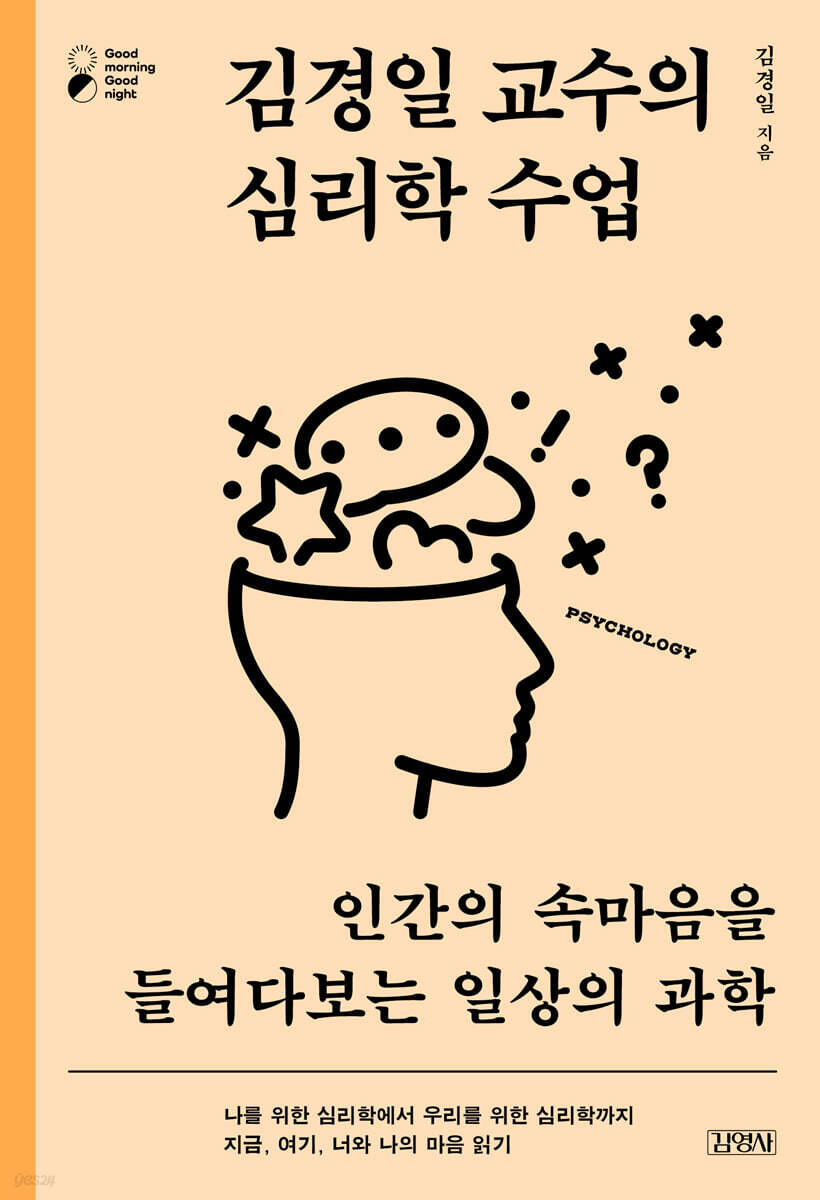
Professor Kim Kyung-il's psychology class
 |
Description
Book Introduction
Psychology that reveals the invisible nature of human nature
You and I invite you to the heart laboratory
Knowledge Library [Good Morning, Good Night] 'Psychology'
Am I really the one who knows my inner thoughts and actions best?
How can we make decisions and judgments without regret?
What are the causes and solutions to anxious mind?
What advice does psychology offer for living well with others?
What is a happy life?
A special lecture on psychology that will change your daily life by Professor Kim Kyung-il, a leading cognitive psychologist in Korea.
This book takes us into the world of psychology, which delves into and explores the mysterious human mind.
This book contains stories of psychology that can change our daily lives through small actions, including the processes that occur in our minds when we judge and decide, how to control our anxious minds, and advice for the society we live in together.
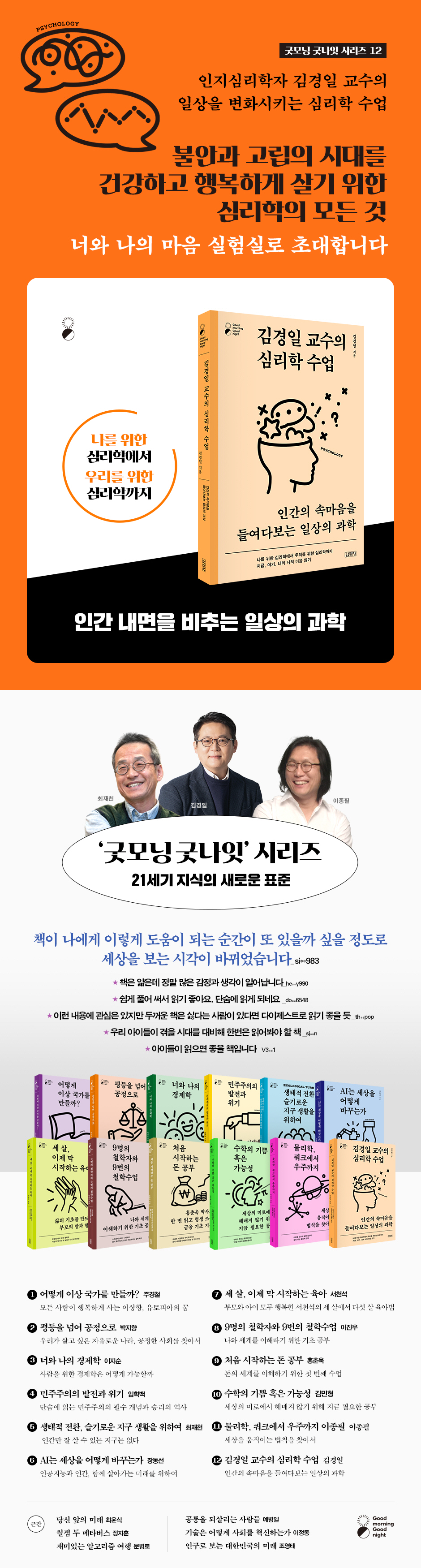
The 12th book in the [Good Morning, Good Night] series, created by leading scholars and researchers in each field for future generations.
You and I invite you to the heart laboratory
Knowledge Library [Good Morning, Good Night] 'Psychology'
Am I really the one who knows my inner thoughts and actions best?
How can we make decisions and judgments without regret?
What are the causes and solutions to anxious mind?
What advice does psychology offer for living well with others?
What is a happy life?
A special lecture on psychology that will change your daily life by Professor Kim Kyung-il, a leading cognitive psychologist in Korea.
This book takes us into the world of psychology, which delves into and explores the mysterious human mind.
This book contains stories of psychology that can change our daily lives through small actions, including the processes that occur in our minds when we judge and decide, how to control our anxious minds, and advice for the society we live in together.
The 12th book in the [Good Morning, Good Night] series, created by leading scholars and researchers in each field for future generations.
- You can preview some of the book's contents.
Preview
index
prolog
Chapter 1: What is Psychology?
1.
Psychology is a science
2.
A taste of monumental research
Chapter 2: The Psychology of Judgment and Decision-Making
1.
Are human judgments rational?
2.
An extension of psychology, behavioral economics
Chapter 3 Psychology and Me
1.
Understanding Anxiety
2.
The effects of anxiety
3.
How to Protect Your Mind in Unstable Times
Chapter 4 Psychology and Society
1.
Altruism and intellectual humility
2.
Coexisting Beyond Mental Illness
3.
Attitude toward crisis
Epilogue
annotation
Chapter 1: What is Psychology?
1.
Psychology is a science
2.
A taste of monumental research
Chapter 2: The Psychology of Judgment and Decision-Making
1.
Are human judgments rational?
2.
An extension of psychology, behavioral economics
Chapter 3 Psychology and Me
1.
Understanding Anxiety
2.
The effects of anxiety
3.
How to Protect Your Mind in Unstable Times
Chapter 4 Psychology and Society
1.
Altruism and intellectual humility
2.
Coexisting Beyond Mental Illness
3.
Attitude toward crisis
Epilogue
annotation
Detailed image
Into the book
Why, exactly, do psychologists experiment on humans? Experimentation is a continuous process of hypothesis testing, and science is the process of doing so.
And psychology must be a science.
That is the fundamental difference from philosophy.
Of course, if we look at each experiment individually, it is insignificant and insignificant compared to the philosophical thoughts and conclusions.
But psychology is a series of small experiments that pile up to form tall pillars or walls.
Now, let's take the small particles of psychology that science has gathered and try to build a mountain.
---From "Prologue, pages 8-9"
Humans are capable of not only passive learning (classical conditioning), in which behavior is triggered by recognizing the connection between events in the external world, but also active learning (instrumental conditioning), in which they manipulate the environment through their own actions to identify causal connections.
According to this view, the conditioning method corresponds to the basic principle by which humans learn new things as they live in the world.
For example, reinforcers such as “That’s right” or “Good job” increase (reinforce) the frequency with which a child expresses his or her opinion.
Growing children develop their own personality traits by continuing to behave in a way that matches the personality traits that their parents like (reinforce and reward).
---From "A Taste of Monumental Studies, pp. 33-34"
What Simon, a giant in cognitive science who won the 1978 Nobel Prize in Economics, focused on was the limitations of human cognitive ability.
In any decision situation, the number of choices is nearly infinite.
And evaluating all of those alternatives individually would be beyond human cognitive capacity.
Therefore, analyzing all alternatives and the various properties of each alternative and comparing them with other alternatives to select the optimal alternative is not very realistic for humans.
Rather, it would be more appropriate and realistic to stop judging and thinking at the moment or level where you are satisfied with that decision.
In short, Simon argued that decisions occur at the moment of satisfaction, and therefore human judgment and decision-making are oriented toward 'satisfaction' rather than 'optimality'.
---From "Is Human Judgment Rational?, pp. 58-59"
When do people feel anxious? In uncertain situations.
Death row inmates who don't know their execution date are extremely anxious.
Knowing the date of your execution can make you fearful or sad that your life will end someday.
No one would be scared watching a horror movie that counts down to when a ghost will appear.
Because if you can predict when a ghost will appear, you won't be anxious.
In other words, anxiety is amplified by unpredictability, so if even a bad outcome becomes predictable to a certain degree, anxiety is significantly alleviated.
Because once you acknowledge the situation, you can prepare for it or take precautions.
So when faced with an uncertain situation, people demand accurate facts rather than mere comfort or encouragement.
---From "Anxious Times, Mindfulness, pp. 115-116"
Psychologists have always warned:
Making a big change to escape from a major stressor only increases the likelihood of creating more stress.
(…) When I have small, casual conversations without any purpose, I feel like I am escaping from stress without even realizing it.
Of course, that feeling itself doesn't solve the problem.
But that changed feeling can motivate you to address stressors and change the situation.
In times like these, don't be afraid to meet happy people around you.
And psychology must be a science.
That is the fundamental difference from philosophy.
Of course, if we look at each experiment individually, it is insignificant and insignificant compared to the philosophical thoughts and conclusions.
But psychology is a series of small experiments that pile up to form tall pillars or walls.
Now, let's take the small particles of psychology that science has gathered and try to build a mountain.
---From "Prologue, pages 8-9"
Humans are capable of not only passive learning (classical conditioning), in which behavior is triggered by recognizing the connection between events in the external world, but also active learning (instrumental conditioning), in which they manipulate the environment through their own actions to identify causal connections.
According to this view, the conditioning method corresponds to the basic principle by which humans learn new things as they live in the world.
For example, reinforcers such as “That’s right” or “Good job” increase (reinforce) the frequency with which a child expresses his or her opinion.
Growing children develop their own personality traits by continuing to behave in a way that matches the personality traits that their parents like (reinforce and reward).
---From "A Taste of Monumental Studies, pp. 33-34"
What Simon, a giant in cognitive science who won the 1978 Nobel Prize in Economics, focused on was the limitations of human cognitive ability.
In any decision situation, the number of choices is nearly infinite.
And evaluating all of those alternatives individually would be beyond human cognitive capacity.
Therefore, analyzing all alternatives and the various properties of each alternative and comparing them with other alternatives to select the optimal alternative is not very realistic for humans.
Rather, it would be more appropriate and realistic to stop judging and thinking at the moment or level where you are satisfied with that decision.
In short, Simon argued that decisions occur at the moment of satisfaction, and therefore human judgment and decision-making are oriented toward 'satisfaction' rather than 'optimality'.
---From "Is Human Judgment Rational?, pp. 58-59"
When do people feel anxious? In uncertain situations.
Death row inmates who don't know their execution date are extremely anxious.
Knowing the date of your execution can make you fearful or sad that your life will end someday.
No one would be scared watching a horror movie that counts down to when a ghost will appear.
Because if you can predict when a ghost will appear, you won't be anxious.
In other words, anxiety is amplified by unpredictability, so if even a bad outcome becomes predictable to a certain degree, anxiety is significantly alleviated.
Because once you acknowledge the situation, you can prepare for it or take precautions.
So when faced with an uncertain situation, people demand accurate facts rather than mere comfort or encouragement.
---From "Anxious Times, Mindfulness, pp. 115-116"
Psychologists have always warned:
Making a big change to escape from a major stressor only increases the likelihood of creating more stress.
(…) When I have small, casual conversations without any purpose, I feel like I am escaping from stress without even realizing it.
Of course, that feeling itself doesn't solve the problem.
But that changed feeling can motivate you to address stressors and change the situation.
In times like these, don't be afraid to meet happy people around you.
---From "Coexisting Beyond Mental Illness, pp. 144-145"
Publisher's Review
Psychology: The everyday science that reveals the invisible nature of humanity.
Professor Kim Kyung-il's easy and fun psychology class
They say everything depends on your mindset.
They say that a person's heart is more important than his appearance.
Mindfulness is attracting attention as a way to improve quality of life.
But where does the mind reside, and how does it function? Can we understand not only our own mind, but also that of others? For thousands of years, religion and philosophy have sought to foster self-awareness and understanding of the world, yet the game of hide-and-seek between humans and the mind seems to persist.
There is a science that was born to answer the mystery of the complex and mysterious inner world.
It's psychology.
The Good Morning, Good Night series, created by leading scholars and researchers in each field for future generations.
The 12th book published this time is 'Psychology', the everyday science that looks into the inner workings of the human mind.
Professor Kim Kyung-il, a leading cognitive psychologist in Korea who actively explores ways to live a better life through various media, guides us into the interesting and informative world of psychology.
From the inner workings of our minds when we judge and decide, to ways to manage our anxious minds, to advice for living together in society, this book contains stories of psychology that help us understand the true nature of humanity and transform our daily lives, based on fascinating experiments and research results.
Psychology is a science
You and My Heart Laboratory
Chapter 1 examines the academic nature of psychology and then briefly summarizes monumental psychological experiments.
Before psychology, there was a discipline that studied the human mind.
Philosophy boasts a long history of elucidating human thoughts and minds.
How does psychology differ from philosophy? The author emphasizes that psychology is the science of quantitatively measuring the mind.
Science is experimentation.
Psychology establishes hypotheses and conducts experiments to test them in order to accurately understand the causal relationships of what happens in the mind.
Numerous psychological studies have revealed hidden truths behind the human mind and behavior.
For example, the famous 'Pavlov's dog' and 'Skinner box' are psychological experiments that answer the question 'How do humans learn?'
The topic of Chapter 2 is 'Psychology of Judgment and Decision-Making'.
We believe that reason works when we think.
But at the moment of judgment and decision-making, is the inner self truly the exclusive domain of rational reason? "When humans make decisions, a certain feeling must accompany them. Without that feeling, they cannot strongly feel the basis for their judgment at the moment of decision, and thus cannot help but hesitate." (p. 65) Emotions are more powerful than reason.
Behavioral economics, which questions the rationality of judgment and decision-making, is an academic discipline that has expanded the field of psychology.
Behavioral economics, which reveals that people think in completely different ways depending on how they create their mental accounts, is also called 'mental accounting.'
Between A, who spent 50,000 won on a basketball game, and B, who received a 50,000 won parking ticket, who is more likely to buy an exhibition ticket? B.
A is because expenditures for similar items have already occurred in the mind's account.
In this way, behavioral economics can be a practically useful tip for everyday life because it considers the mind and feelings of a decision-maker as a more fundamental basis for judgment than logical thinking.
In an age of anxiety and isolation
Psychological Advice for Living Healthy and Happy
Chapter 3 explores the causes and solutions of anxiety, a major topic in psychology.
Anxiety is the psychological state that humans hate the most, so paradoxically, it is also the most important window into the human mind.
We feel anxious in uncertain situations.
A horror movie that you watch knowing in advance that there will be a ghost scene won't be that scary.
Therefore, reducing unpredictability can be a way to manage anxiety.
Even if the outcome is bad, anxiety is significantly alleviated when there is some degree of predictability.
This is why, for anxious people, accurate facts are more important than vague comfort or encouragement.
When uncertainty is removed, anxiety actually becomes a driving force.
Things that have been neglected, small and specific tasks, actually work better when you are anxious.
The keyword of Chapter 4 is coexistence.
During the coronavirus pandemic, people were scattered across islands of isolation and disconnection.
As we've recently resumed our daily lives, the physical distance between us has become closer, but what about our emotional distance? Psychological advice for living together is to enhance our ability to "interoception" by recognizing the altruism of others (pp. 127-129).
When I witness other people's good deeds, I feel a sense of pride.
I feel like my personality is becoming more flexible and tolerant.
This kind of mental energy becomes the source of social cooperation.
The author also emphasizes the importance of purposeless conversations with loved ones.
Small interactions with people around you who make you happy may not solve the cause of your stress, but they can give you the motivation to face it.
The expression of sociality is not unrelated to an individual's psychological health.
From the absurd misunderstanding of ‘fortune-telling department’
As a central discipline in understanding humans and society
In the epilogue, the author defines psychology as “ultimately the task of uncovering what are constants and variables for humans” (p. 169).
The role of psychology is to humbly accept the innate part of our mind and to explore the nature and causes of the changeable part.
Until just a few decades ago, psychology was absurdly misunderstood as a "fortune-telling discipline." However, thanks to psychological experiments and research that illuminate the unknown inner world, we have come to understand humans and society scientifically.
This book is a smooth read, as if it were a direct transcription of a popular author's lecture, with a perfect blend of expertise and entertainment.
From the characteristics of psychology and its expansion into behavioral economics to a psychology for us and ourselves, we offer the knowledge and wisdom of psychology to help us live healthily and happily in an age of anxiety and isolation.
For readers who are curious about your and my heart, this will be a friendly psychology textbook that you cannot miss.
· Am I really the one who knows my inner thoughts and actions best?
· How can I make decisions and judgments without regrets?
· What are the causes and solutions to anxious feelings?
· What advice does psychology offer for living well with others?
· What is a happy life?
Today's culture, future wisdom, every day
The 'Good Morning, Good Night' series, a knowledge library that starts in the morning and ends in the evening.
'Good Morning, Good Night' sets a new standard for knowledge in the 21st century.
Written by the best writers, we share wisdom on how to view the world.
We take a look at where we are, what changes we are facing, and what we need to prepare for.
The world is changing.
The paradigm is shifting in all fields.
These are uncertain times, where we don't know what will happen tomorrow.
What choices will you make in the face of the great tide of change?
Will you fall into crisis because you can't read the changes, or will you actively respond to the changes and create opportunities?
Where do we stand, what changes are we facing, and what should we prepare for?
Leading scholars and researchers from each field have come together to create a comprehensive collection of knowledge and culture for future generations.
This knowledge library historically examines the changes and issues facing us in this era of transition across all fields, including the humanities, social sciences, economics, natural sciences, and the arts, and comprehensively examines phenomena and their essence to seek solutions and alternatives.
It is a paperback book that can be read by anyone of all generations, from middle school students to college students and the general public, and contains core knowledge and culture in one volume, so you can keep it close by and refer to it every day.
The 'Good Morning, Good Night' library will present a new standard for 21st century knowledge and serve as a guide to providing wisdom for viewing the world.
We await you, seeking wisdom and insight.
Professor Kim Kyung-il's easy and fun psychology class
They say everything depends on your mindset.
They say that a person's heart is more important than his appearance.
Mindfulness is attracting attention as a way to improve quality of life.
But where does the mind reside, and how does it function? Can we understand not only our own mind, but also that of others? For thousands of years, religion and philosophy have sought to foster self-awareness and understanding of the world, yet the game of hide-and-seek between humans and the mind seems to persist.
There is a science that was born to answer the mystery of the complex and mysterious inner world.
It's psychology.
The Good Morning, Good Night series, created by leading scholars and researchers in each field for future generations.
The 12th book published this time is 'Psychology', the everyday science that looks into the inner workings of the human mind.
Professor Kim Kyung-il, a leading cognitive psychologist in Korea who actively explores ways to live a better life through various media, guides us into the interesting and informative world of psychology.
From the inner workings of our minds when we judge and decide, to ways to manage our anxious minds, to advice for living together in society, this book contains stories of psychology that help us understand the true nature of humanity and transform our daily lives, based on fascinating experiments and research results.
Psychology is a science
You and My Heart Laboratory
Chapter 1 examines the academic nature of psychology and then briefly summarizes monumental psychological experiments.
Before psychology, there was a discipline that studied the human mind.
Philosophy boasts a long history of elucidating human thoughts and minds.
How does psychology differ from philosophy? The author emphasizes that psychology is the science of quantitatively measuring the mind.
Science is experimentation.
Psychology establishes hypotheses and conducts experiments to test them in order to accurately understand the causal relationships of what happens in the mind.
Numerous psychological studies have revealed hidden truths behind the human mind and behavior.
For example, the famous 'Pavlov's dog' and 'Skinner box' are psychological experiments that answer the question 'How do humans learn?'
The topic of Chapter 2 is 'Psychology of Judgment and Decision-Making'.
We believe that reason works when we think.
But at the moment of judgment and decision-making, is the inner self truly the exclusive domain of rational reason? "When humans make decisions, a certain feeling must accompany them. Without that feeling, they cannot strongly feel the basis for their judgment at the moment of decision, and thus cannot help but hesitate." (p. 65) Emotions are more powerful than reason.
Behavioral economics, which questions the rationality of judgment and decision-making, is an academic discipline that has expanded the field of psychology.
Behavioral economics, which reveals that people think in completely different ways depending on how they create their mental accounts, is also called 'mental accounting.'
Between A, who spent 50,000 won on a basketball game, and B, who received a 50,000 won parking ticket, who is more likely to buy an exhibition ticket? B.
A is because expenditures for similar items have already occurred in the mind's account.
In this way, behavioral economics can be a practically useful tip for everyday life because it considers the mind and feelings of a decision-maker as a more fundamental basis for judgment than logical thinking.
In an age of anxiety and isolation
Psychological Advice for Living Healthy and Happy
Chapter 3 explores the causes and solutions of anxiety, a major topic in psychology.
Anxiety is the psychological state that humans hate the most, so paradoxically, it is also the most important window into the human mind.
We feel anxious in uncertain situations.
A horror movie that you watch knowing in advance that there will be a ghost scene won't be that scary.
Therefore, reducing unpredictability can be a way to manage anxiety.
Even if the outcome is bad, anxiety is significantly alleviated when there is some degree of predictability.
This is why, for anxious people, accurate facts are more important than vague comfort or encouragement.
When uncertainty is removed, anxiety actually becomes a driving force.
Things that have been neglected, small and specific tasks, actually work better when you are anxious.
The keyword of Chapter 4 is coexistence.
During the coronavirus pandemic, people were scattered across islands of isolation and disconnection.
As we've recently resumed our daily lives, the physical distance between us has become closer, but what about our emotional distance? Psychological advice for living together is to enhance our ability to "interoception" by recognizing the altruism of others (pp. 127-129).
When I witness other people's good deeds, I feel a sense of pride.
I feel like my personality is becoming more flexible and tolerant.
This kind of mental energy becomes the source of social cooperation.
The author also emphasizes the importance of purposeless conversations with loved ones.
Small interactions with people around you who make you happy may not solve the cause of your stress, but they can give you the motivation to face it.
The expression of sociality is not unrelated to an individual's psychological health.
From the absurd misunderstanding of ‘fortune-telling department’
As a central discipline in understanding humans and society
In the epilogue, the author defines psychology as “ultimately the task of uncovering what are constants and variables for humans” (p. 169).
The role of psychology is to humbly accept the innate part of our mind and to explore the nature and causes of the changeable part.
Until just a few decades ago, psychology was absurdly misunderstood as a "fortune-telling discipline." However, thanks to psychological experiments and research that illuminate the unknown inner world, we have come to understand humans and society scientifically.
This book is a smooth read, as if it were a direct transcription of a popular author's lecture, with a perfect blend of expertise and entertainment.
From the characteristics of psychology and its expansion into behavioral economics to a psychology for us and ourselves, we offer the knowledge and wisdom of psychology to help us live healthily and happily in an age of anxiety and isolation.
For readers who are curious about your and my heart, this will be a friendly psychology textbook that you cannot miss.
· Am I really the one who knows my inner thoughts and actions best?
· How can I make decisions and judgments without regrets?
· What are the causes and solutions to anxious feelings?
· What advice does psychology offer for living well with others?
· What is a happy life?
Today's culture, future wisdom, every day
The 'Good Morning, Good Night' series, a knowledge library that starts in the morning and ends in the evening.
'Good Morning, Good Night' sets a new standard for knowledge in the 21st century.
Written by the best writers, we share wisdom on how to view the world.
We take a look at where we are, what changes we are facing, and what we need to prepare for.
The world is changing.
The paradigm is shifting in all fields.
These are uncertain times, where we don't know what will happen tomorrow.
What choices will you make in the face of the great tide of change?
Will you fall into crisis because you can't read the changes, or will you actively respond to the changes and create opportunities?
Where do we stand, what changes are we facing, and what should we prepare for?
Leading scholars and researchers from each field have come together to create a comprehensive collection of knowledge and culture for future generations.
This knowledge library historically examines the changes and issues facing us in this era of transition across all fields, including the humanities, social sciences, economics, natural sciences, and the arts, and comprehensively examines phenomena and their essence to seek solutions and alternatives.
It is a paperback book that can be read by anyone of all generations, from middle school students to college students and the general public, and contains core knowledge and culture in one volume, so you can keep it close by and refer to it every day.
The 'Good Morning, Good Night' library will present a new standard for 21st century knowledge and serve as a guide to providing wisdom for viewing the world.
We await you, seeking wisdom and insight.
GOODS SPECIFICS
- Date of issue: June 30, 2023
- Page count, weight, size: 176 pages | 212g | 132*193*13mm
- ISBN13: 9788934975618
- ISBN10: 893497561X
You may also like
카테고리
korean


korean

![GQ KOREA Mark (Monthly): December [2025]](http://librairie.coreenne.fr/cdn/shop/files/8ef265dbbfbf186523ed75ba7319009d.jpg?v=1765340328&width=3840)


