

Breaking away from the familiar
 |
Description
Book Introduction
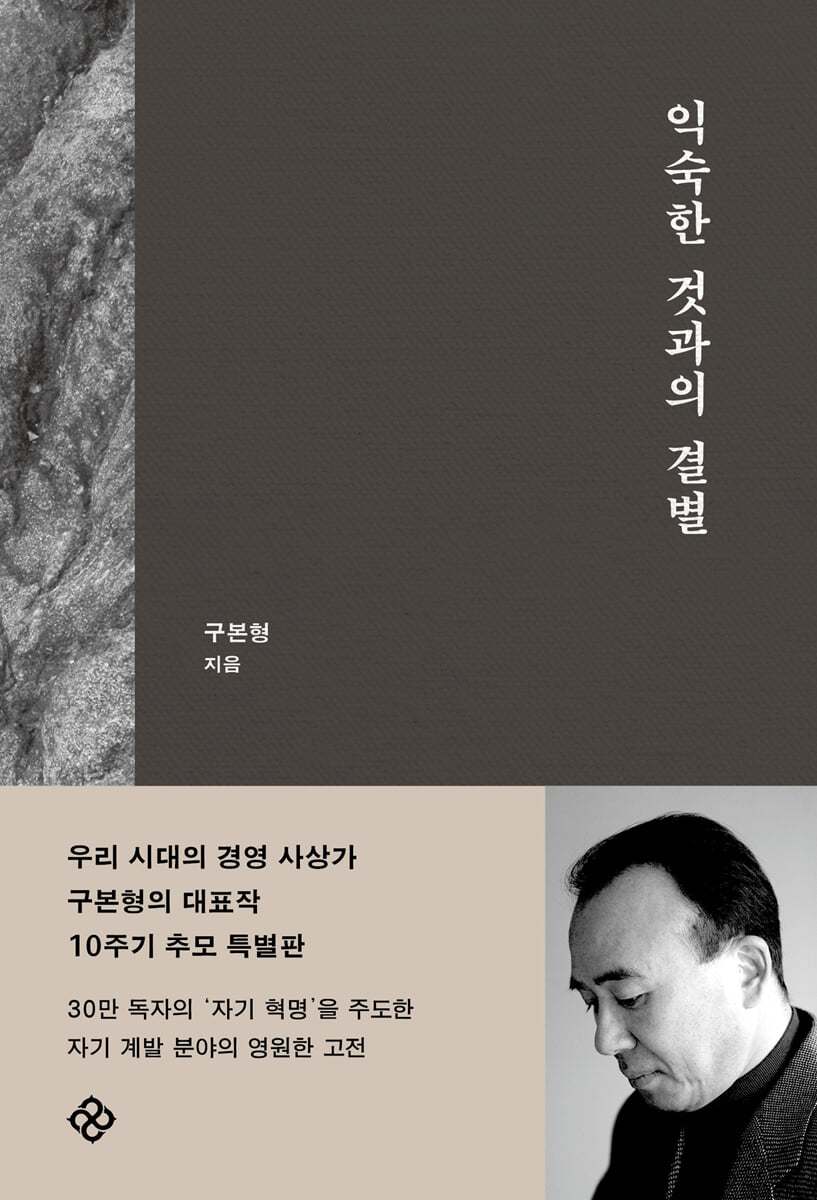
To mark the 10th anniversary of the death of change management thinker Koo Bon-hyung, a revised edition of his masterpiece, "Parting with the Familiar," has been published.
This book became a bestseller when it was first published, resonating with many who wanted change, and has gone through repeated editions, becoming a classic that is still read today.
This may be evidence that the book contains the fundamentals of life.
In this meaningful year, we are presenting a revised edition to honor the teacher and as a gift to our readers.
This revised edition preserves the wisdom of a professional manager and the humanistic insights of a thinker, and includes a new article by Moon Yo-han, a longtime student of the teacher, titled "Why Still Gu Bon-hyung?"
This book became a bestseller when it was first published, resonating with many who wanted change, and has gone through repeated editions, becoming a classic that is still read today.
This may be evidence that the book contains the fundamentals of life.
In this meaningful year, we are presenting a revised edition to honor the teacher and as a gift to our readers.
This revised edition preserves the wisdom of a professional manager and the humanistic insights of a thinker, and includes a new article by Moon Yo-han, a longtime student of the teacher, titled "Why Still Gu Bon-hyung?"
- You can preview some of the book's contents.
Preview
index
Preface to the Revised Edition
Preface to the first edition
prolog
Chapter 1 Everything Changes
Work | Today is different from yesterday
Change | Why It's Needed
Direction | There are five directions for reform in a changing company.
Chapter 2: Who Resists Reform?
Humans | Rational beings, but not rational beings
Presbytery | What Makes Us Comfortable
vested interests | temptations that can never be given up
Resistance | The Five Faces
The Reformer | What Role Should He Play?
Chapter 3: Unemployment is not a temporary phenomenon.
Restructuring | Very Painful, Permanent Measures
Competitiveness | We're Misunderstanding
Labor | The End Is Near
Self-Revolution | The Inevitability of an Era of Mass Unemployment
Employment | New principles are needed
Chapter 4: Starting Over as a Solo Entrepreneur
Lifetime employment | Now a memory
A New Beginning | Transform from Office Worker to Manager
One-Person Business | Eight Management Principles
Chapter 5: Vision is the image of a great future.
Belief | A promise to myself
Action | The more difficult it is, the more you should stick to your principles.
Imagination | Transcend practical interests
Message | Defeat in your heart
The moment when organizations become one with individuals
Vision | An ecstatic script that shines brighter the more difficult it is.
Chapter 6: A Walk to Meet Yourself
Discovery | The Ugly Duckling
Deviation | Leisure of Mind
Dream | Beautiful Desire
Hope | Shawshank Redemption
Talent | Assets Untapped in School
Managing Change | How to Overcome Negative Change
Rediscovering Time | Time Doesn't Flow into the Future
Possession of Time | Making Time Now
Managing Your Time | How to Reorganize Your Time
Moderation | Sister Jeong's Frustration
Chapter 7 Five Things You Should Start Doing Right Now
Epitaph | Open your heart and let your desires flow.
Intelligence List | You're Good at Something Too
A Curious Combination | Connecting Desire and Intelligence
Freedom in Everyday Life | Spend Two Hours a Day Just for Yourself
Skill and Record | Once you start, don't stop.
Revised Edition Review
My Self-Revolutionary Diary | Kim Hak-won
Why is it still Koo Bon-hyung? | Moon Yo-han
Preface to the first edition
prolog
Chapter 1 Everything Changes
Work | Today is different from yesterday
Change | Why It's Needed
Direction | There are five directions for reform in a changing company.
Chapter 2: Who Resists Reform?
Humans | Rational beings, but not rational beings
Presbytery | What Makes Us Comfortable
vested interests | temptations that can never be given up
Resistance | The Five Faces
The Reformer | What Role Should He Play?
Chapter 3: Unemployment is not a temporary phenomenon.
Restructuring | Very Painful, Permanent Measures
Competitiveness | We're Misunderstanding
Labor | The End Is Near
Self-Revolution | The Inevitability of an Era of Mass Unemployment
Employment | New principles are needed
Chapter 4: Starting Over as a Solo Entrepreneur
Lifetime employment | Now a memory
A New Beginning | Transform from Office Worker to Manager
One-Person Business | Eight Management Principles
Chapter 5: Vision is the image of a great future.
Belief | A promise to myself
Action | The more difficult it is, the more you should stick to your principles.
Imagination | Transcend practical interests
Message | Defeat in your heart
The moment when organizations become one with individuals
Vision | An ecstatic script that shines brighter the more difficult it is.
Chapter 6: A Walk to Meet Yourself
Discovery | The Ugly Duckling
Deviation | Leisure of Mind
Dream | Beautiful Desire
Hope | Shawshank Redemption
Talent | Assets Untapped in School
Managing Change | How to Overcome Negative Change
Rediscovering Time | Time Doesn't Flow into the Future
Possession of Time | Making Time Now
Managing Your Time | How to Reorganize Your Time
Moderation | Sister Jeong's Frustration
Chapter 7 Five Things You Should Start Doing Right Now
Epitaph | Open your heart and let your desires flow.
Intelligence List | You're Good at Something Too
A Curious Combination | Connecting Desire and Intelligence
Freedom in Everyday Life | Spend Two Hours a Day Just for Yourself
Skill and Record | Once you start, don't stop.
Revised Edition Review
My Self-Revolutionary Diary | Kim Hak-won
Why is it still Koo Bon-hyung? | Moon Yo-han
Detailed image

Into the book
Life is a serious matter.
That doesn't mean it's always nerve-wracking.
The world of insects and animals is full of healthy naturalness.
Chameleons change according to their surroundings.
To protect itself, the caterpillar tattoos itself with patterns that resemble the eyes of a bird of prey.
It is not the majestic lions that cross the desert, but the ugly, crooked-backed camels.
They change according to their environment and choose an environment to which they can adapt.
And these changes and adaptations make everyday life possible for them.
---p.25
You need to define yourself as your own manager.
This gives you the power to interpret your work from a different perspective.
Defining yourself as a nimble, one-person company allows you to redefine your relationship with your company.
This new understanding of a contractual, mutually cooperative relationship, rather than an employment relationship where one sells loyalty and time for food, liberates oneself from the workplace and enables a fresh start as a sole proprietor.
---p.168
These are the people who are always dissatisfied with reality.
They were once clerks, waitresses, and owners of shabby noodle shops who worked from dawn to dusk in shabby restaurants, and they started their lives as amateurs with uncertain futures.
However, they were people who knew the special talent within them and used it to create their own careers.
They are people who, in the midst of hardship and a miserable job that doesn't pay for their labor, drew their future according to their own principles.
They may have been struggling and discouraged by the helplessness and daily difficulties, but they are people who eventually broke free from the pressures of the situation and jumped into the work of creating their own lives.
---p.202~203
People want change, but they are also afraid of it.
It's comforting to find reasons not to change.
There are many patterns of resistance to change.
Those who turn change into opportunity always succeed.
These people do not hesitate to immerse themselves in change.
Wouldn't they be afraid? Yet, they see the future taking shape amidst the chaos.
But some people don't even know what has changed, even after the change has swept through them all.
---p.289
The first and most important question to ask myself when using the time given to me is, “What will I do with it?”
This has to do with desire, and when we dig out our true desires deep within, we can use our time for them.
The second important question is how to reorganize the 24 hours for this.
Desires must not remain mere dreams.
It requires a process that is concretized in everyday life.
That doesn't mean it's always nerve-wracking.
The world of insects and animals is full of healthy naturalness.
Chameleons change according to their surroundings.
To protect itself, the caterpillar tattoos itself with patterns that resemble the eyes of a bird of prey.
It is not the majestic lions that cross the desert, but the ugly, crooked-backed camels.
They change according to their environment and choose an environment to which they can adapt.
And these changes and adaptations make everyday life possible for them.
---p.25
You need to define yourself as your own manager.
This gives you the power to interpret your work from a different perspective.
Defining yourself as a nimble, one-person company allows you to redefine your relationship with your company.
This new understanding of a contractual, mutually cooperative relationship, rather than an employment relationship where one sells loyalty and time for food, liberates oneself from the workplace and enables a fresh start as a sole proprietor.
---p.168
These are the people who are always dissatisfied with reality.
They were once clerks, waitresses, and owners of shabby noodle shops who worked from dawn to dusk in shabby restaurants, and they started their lives as amateurs with uncertain futures.
However, they were people who knew the special talent within them and used it to create their own careers.
They are people who, in the midst of hardship and a miserable job that doesn't pay for their labor, drew their future according to their own principles.
They may have been struggling and discouraged by the helplessness and daily difficulties, but they are people who eventually broke free from the pressures of the situation and jumped into the work of creating their own lives.
---p.202~203
People want change, but they are also afraid of it.
It's comforting to find reasons not to change.
There are many patterns of resistance to change.
Those who turn change into opportunity always succeed.
These people do not hesitate to immerse themselves in change.
Wouldn't they be afraid? Yet, they see the future taking shape amidst the chaos.
But some people don't even know what has changed, even after the change has swept through them all.
---p.289
The first and most important question to ask myself when using the time given to me is, “What will I do with it?”
This has to do with desire, and when we dig out our true desires deep within, we can use our time for them.
The second important question is how to reorganize the 24 hours for this.
Desires must not remain mere dreams.
It requires a process that is concretized in everyday life.
---p.317~318
Publisher's Review
A masterpiece by Koo Bon-hyung, a management thinker of our time
10th Anniversary Special Edition
To mark the 10th anniversary of the death of change management thinker Koo Bon-hyung, a revised edition of his masterpiece, "Parting with the Familiar," has been published.
This book became a bestseller when it was first published, resonating with many who wanted change, and continues to be read consistently to this day.
This may be evidence that the book contains the fundamentals of life.
In this meaningful year, we are presenting a 10th anniversary revised edition to honor the teacher and as a gift to our readers.
This revised edition has been redesigned and printed in hardcover to enhance its collection value, living up to its reputation as a unique classic in the field of self-development that led a "self-revolution" for 300,000 readers.
In terms of content, firstly, we have preserved as much of the content as possible, including the wisdom of a professional manager and the humanistic insight of a thinker. Secondly, we have replaced and inserted some of the photographs of author Yoon Gwang-jun, which add to the aesthetic sense. Thirdly, we have included new writings by author Moon Yo-han, a long-time student of the author.
A book written for oneself
It comes from love
“I think I always wanted to be something other than myself.
But now I want to be me.
It's about believing that we can always become better people as we go through our daily lives, and that there is always a better way.
And if I always try to be better than who I am now, I will eventually come to like myself very much.”
As can be seen from his title, “Change Management Thinker,” Mr. Koo Bon-hyung has always been interested in “change.”
The reason I majored in history in college is because I believe that the West enjoys its current superior position because it experienced a radical change called revolution.
For him, change was both a crisis and an opportunity that opened up more possibilities for organizations and individuals.
He pondered what we fundamentally need to do in the face of change and sought to make today better than yesterday.
The result of that struggle is this book.
Among the important ones, we can mention the 'one-person business theory' and the 'methodology for changing life'.
The 'one-person business theory' is a proposal to define oneself not as a mere employee of a company, but as a one-person business consisting of one person, and to establish a mutually cooperative relationship with the company rather than an employment relationship.
This is also a new epistemology that will liberate us from the confines of the workplace.
'The Methodology for Changing Lives' is a concrete method to help each person change their own life, based on the realization that all change begins with the individual.
It includes everything from how to discover your true desires to how to manage your time to achieve them.
But what really matters is the heart of the man who wrote this book.
“I wrote this book for myself, as I wanted to do.
(…) I sometimes rushed through several pages at once, but I also revised a single sentence several times.
I 'wasted' time and enjoyed this extravagant waste.
“It was nice to be able to write without being chased.”
Writing that is written for fun breaks down the barriers between author and reader.
The person who most wants to read the sentences written with passionate love by the author is the author himself.
A sentence of love makes the author an eternal reader.
So the teacher said he wrote this book for himself.
The teacher put love into his writing.
People who follow Koo Bon-hyung
Love is contagious.
You can see this by looking at CEO Kim Hak-won, who wrote the recommendation for this book.
“I love books the most that make me, the reader, into an author.
That book is the greatest book for me.
“Parting with the Familiar” was that kind of book for me.”
In a time when things looked stable and prosperous from the outside, he felt more frustrated than anyone else.
I had a strong feeling of stagnation, but it was a position where I couldn't show it at home or at work.
That's when this book gave him breath again.
He boldly changed the direction of his life according to the book's advice, and those changes made him the CEO of Kim Hak-won he is today.
If you ask him why he was particularly drawn to this book, despite having encountered countless books as a publisher, it would be because of the sentences of love.
He was truly understood and was able to transform from a reader to an author.
I became someone who could convey love to someone else.
Author Moon Yo-han, who contributed new writing to the revised edition, is also an example of someone infected with love.
He sent me an objective yet affectionate article on the topic of 'Why you should still read Koo Bon-hyung'.
He analyzed the unique qualities of this book that have endured over the years, such as reflections on change and self-management as a professional, but what he really wanted to say was that the teacher gave many people the strength to start over, and that many people are walking the path he walked and will continue to do so in the future.
They know.
What did Professor Koo Bon-hyung include in this book and what did he achieve with it?
The reason why the teacher remains a respected adult even today beyond his time is because there are still people who follow the path he created.
The teacher paved the way with this book.
After all, everything started with love and continues with love.
Love is immortal.
10th Anniversary Special Edition
To mark the 10th anniversary of the death of change management thinker Koo Bon-hyung, a revised edition of his masterpiece, "Parting with the Familiar," has been published.
This book became a bestseller when it was first published, resonating with many who wanted change, and continues to be read consistently to this day.
This may be evidence that the book contains the fundamentals of life.
In this meaningful year, we are presenting a 10th anniversary revised edition to honor the teacher and as a gift to our readers.
This revised edition has been redesigned and printed in hardcover to enhance its collection value, living up to its reputation as a unique classic in the field of self-development that led a "self-revolution" for 300,000 readers.
In terms of content, firstly, we have preserved as much of the content as possible, including the wisdom of a professional manager and the humanistic insight of a thinker. Secondly, we have replaced and inserted some of the photographs of author Yoon Gwang-jun, which add to the aesthetic sense. Thirdly, we have included new writings by author Moon Yo-han, a long-time student of the author.
A book written for oneself
It comes from love
“I think I always wanted to be something other than myself.
But now I want to be me.
It's about believing that we can always become better people as we go through our daily lives, and that there is always a better way.
And if I always try to be better than who I am now, I will eventually come to like myself very much.”
As can be seen from his title, “Change Management Thinker,” Mr. Koo Bon-hyung has always been interested in “change.”
The reason I majored in history in college is because I believe that the West enjoys its current superior position because it experienced a radical change called revolution.
For him, change was both a crisis and an opportunity that opened up more possibilities for organizations and individuals.
He pondered what we fundamentally need to do in the face of change and sought to make today better than yesterday.
The result of that struggle is this book.
Among the important ones, we can mention the 'one-person business theory' and the 'methodology for changing life'.
The 'one-person business theory' is a proposal to define oneself not as a mere employee of a company, but as a one-person business consisting of one person, and to establish a mutually cooperative relationship with the company rather than an employment relationship.
This is also a new epistemology that will liberate us from the confines of the workplace.
'The Methodology for Changing Lives' is a concrete method to help each person change their own life, based on the realization that all change begins with the individual.
It includes everything from how to discover your true desires to how to manage your time to achieve them.
But what really matters is the heart of the man who wrote this book.
“I wrote this book for myself, as I wanted to do.
(…) I sometimes rushed through several pages at once, but I also revised a single sentence several times.
I 'wasted' time and enjoyed this extravagant waste.
“It was nice to be able to write without being chased.”
Writing that is written for fun breaks down the barriers between author and reader.
The person who most wants to read the sentences written with passionate love by the author is the author himself.
A sentence of love makes the author an eternal reader.
So the teacher said he wrote this book for himself.
The teacher put love into his writing.
People who follow Koo Bon-hyung
Love is contagious.
You can see this by looking at CEO Kim Hak-won, who wrote the recommendation for this book.
“I love books the most that make me, the reader, into an author.
That book is the greatest book for me.
“Parting with the Familiar” was that kind of book for me.”
In a time when things looked stable and prosperous from the outside, he felt more frustrated than anyone else.
I had a strong feeling of stagnation, but it was a position where I couldn't show it at home or at work.
That's when this book gave him breath again.
He boldly changed the direction of his life according to the book's advice, and those changes made him the CEO of Kim Hak-won he is today.
If you ask him why he was particularly drawn to this book, despite having encountered countless books as a publisher, it would be because of the sentences of love.
He was truly understood and was able to transform from a reader to an author.
I became someone who could convey love to someone else.
Author Moon Yo-han, who contributed new writing to the revised edition, is also an example of someone infected with love.
He sent me an objective yet affectionate article on the topic of 'Why you should still read Koo Bon-hyung'.
He analyzed the unique qualities of this book that have endured over the years, such as reflections on change and self-management as a professional, but what he really wanted to say was that the teacher gave many people the strength to start over, and that many people are walking the path he walked and will continue to do so in the future.
They know.
What did Professor Koo Bon-hyung include in this book and what did he achieve with it?
The reason why the teacher remains a respected adult even today beyond his time is because there are still people who follow the path he created.
The teacher paved the way with this book.
After all, everything started with love and continues with love.
Love is immortal.
GOODS SPECIFICS
- Date of issue: March 30, 2023
- Format: Hardcover book binding method guide
- Page count, weight, size: 400 pages | 492g | 128*188*27mm
- ISBN13: 9788932474861
- ISBN10: 8932474869
You may also like
카테고리
korean


korean

![GQ KOREA Mark (Monthly): December [2025]](http://librairie.coreenne.fr/cdn/shop/files/8ef265dbbfbf186523ed75ba7319009d.jpg?v=1765340328&width=3840)


