

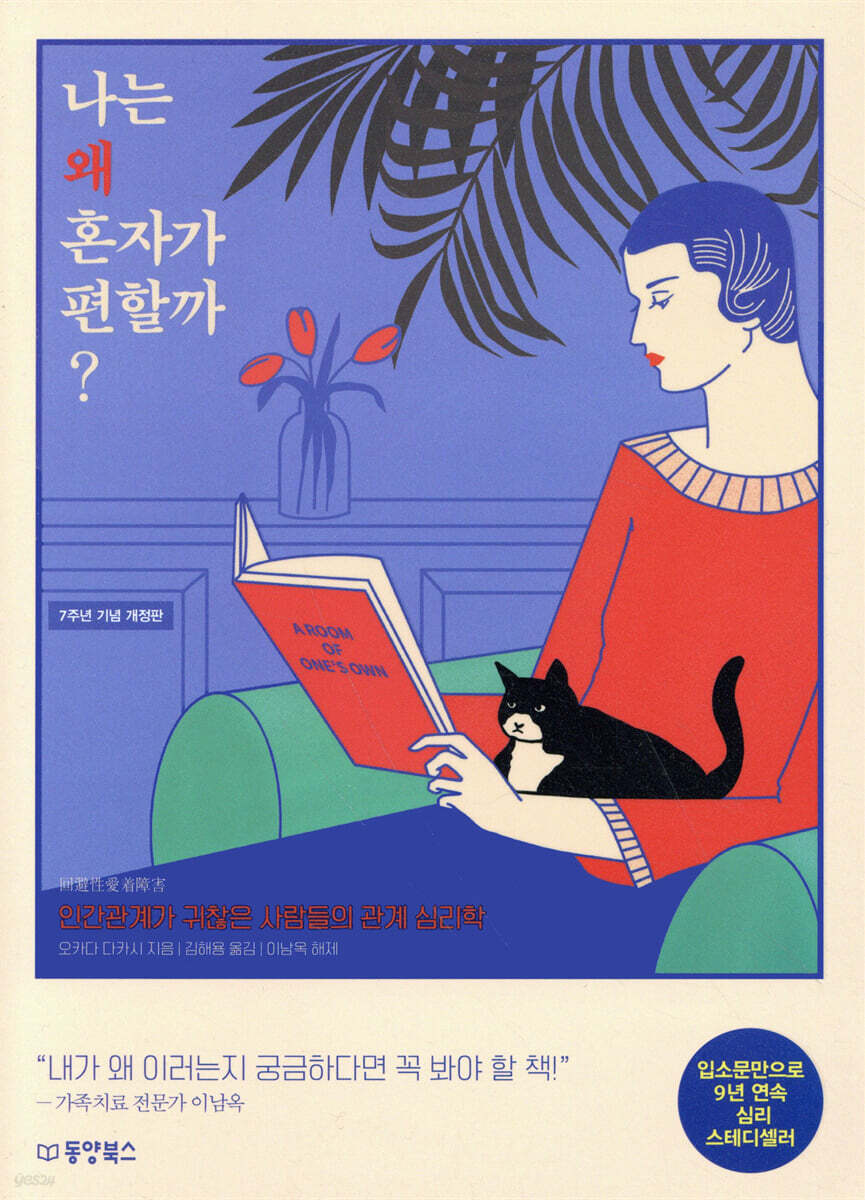
Why am I comfortable being alone?
 |
Description
Book Introduction
“Why does my heart hurt more when I rely on people?”
7th Anniversary Revised Edition
A domestic psychological bestseller for seven consecutive years
Japanese bookstore psychology steady seller
Consistently ranked best by word of mouth alone
Books recommended by family therapist Professor Nam-ok Lee
The psychology classic that created the buzzword "avoidant person"
A 7th-anniversary revised edition of Takashi Okada's masterpiece, a pioneer in attachment theory.
The latest revised edition of the human relations and psychology book 『Why Am I Better Alone?』, which has been consistently loved by countless readers since its domestic publication in 2015, coining the buzzword "avoidant person," has been published.
People who are more comfortable being alone, people who are reluctant to get married and have children, people who avoid forming intimate relationships for fear of being hurt, people who don't have a single friend they can confide in, people who don't try new things and dislike responsibility or constraints, people who suppress their emotions.
This is a characteristic of the avoidant person featured in this book, and at first glance, it seems to reflect the current trend of increasing individualism.
This phenomenon has been further accelerated by COVID-19, but we have now become a society where it is no longer strange to drink coffee alone, watch a movie alone, shop alone, or eat alone.
『Why am I comfortable being alone?』(original title: Avoidant Attachment Disorder) is a book that tells people how to live a more comfortable and happy life than they do now, as the number of avoidant people continues to increase along with the increase in single-person households.
The author says that avoidant people are not born introverted and timid, but rather have developed that personality due to an 'avoidant attachment tendency' that developed during childhood.
This is because they were unable to form an 'attachment relationship' based on empathy due to being neglected or exposed to an overly oppressive environment.
Since its publication in Japan in 2013, this book has been ranked #1 in the psychology category and the children's medicine category on Amazon. In February 2015, it received significant attention when a segment on the relationship between juvenile delinquency and attachment disorders was aired on the famous Japanese current affairs program [NHK Close-up Modern], and it is still ranked as a bestseller in the psychology category to this day.
It has been ranked as the best in the self-development and human relations categories in Korea since its introduction in 2015.
This is proof that there are quite a few avoidant people in our society.
According to Professor Nam-ok Lee, a family therapist who wrote the introduction to the 2022 revised edition, there are far more cases in clinical practice where people become avoidant due to excessive love rather than neglect, and such cases are expected to increase in the future.
Professor Nam-ok Lee, a professor at the Korea Counseling Graduate School and director of the Seoul Couple and Family Therapy Research Institute, said in the introduction, “This book will be a valuable guide not only for general readers who are curious about ‘Why am I doing this and what should I do?’ or ‘Why is that person doing that and how should I deal with it?’ but also for many professionals working in counseling, psychotherapy, and related fields.”
7th Anniversary Revised Edition
A domestic psychological bestseller for seven consecutive years
Japanese bookstore psychology steady seller
Consistently ranked best by word of mouth alone
Books recommended by family therapist Professor Nam-ok Lee
The psychology classic that created the buzzword "avoidant person"
A 7th-anniversary revised edition of Takashi Okada's masterpiece, a pioneer in attachment theory.
The latest revised edition of the human relations and psychology book 『Why Am I Better Alone?』, which has been consistently loved by countless readers since its domestic publication in 2015, coining the buzzword "avoidant person," has been published.
People who are more comfortable being alone, people who are reluctant to get married and have children, people who avoid forming intimate relationships for fear of being hurt, people who don't have a single friend they can confide in, people who don't try new things and dislike responsibility or constraints, people who suppress their emotions.
This is a characteristic of the avoidant person featured in this book, and at first glance, it seems to reflect the current trend of increasing individualism.
This phenomenon has been further accelerated by COVID-19, but we have now become a society where it is no longer strange to drink coffee alone, watch a movie alone, shop alone, or eat alone.
『Why am I comfortable being alone?』(original title: Avoidant Attachment Disorder) is a book that tells people how to live a more comfortable and happy life than they do now, as the number of avoidant people continues to increase along with the increase in single-person households.
The author says that avoidant people are not born introverted and timid, but rather have developed that personality due to an 'avoidant attachment tendency' that developed during childhood.
This is because they were unable to form an 'attachment relationship' based on empathy due to being neglected or exposed to an overly oppressive environment.
Since its publication in Japan in 2013, this book has been ranked #1 in the psychology category and the children's medicine category on Amazon. In February 2015, it received significant attention when a segment on the relationship between juvenile delinquency and attachment disorders was aired on the famous Japanese current affairs program [NHK Close-up Modern], and it is still ranked as a bestseller in the psychology category to this day.
It has been ranked as the best in the self-development and human relations categories in Korea since its introduction in 2015.
This is proof that there are quite a few avoidant people in our society.
According to Professor Nam-ok Lee, a family therapist who wrote the introduction to the 2022 revised edition, there are far more cases in clinical practice where people become avoidant due to excessive love rather than neglect, and such cases are expected to increase in the future.
Professor Nam-ok Lee, a professor at the Korea Counseling Graduate School and director of the Seoul Couple and Family Therapy Research Institute, said in the introduction, “This book will be a valuable guide not only for general readers who are curious about ‘Why am I doing this and what should I do?’ or ‘Why is that person doing that and how should I deal with it?’ but also for many professionals working in counseling, psychotherapy, and related fields.”
- You can preview some of the book's contents.
Preview
index
A book like a cool glass of water to a thirsty person!
Introduction: Am I an avoidant person?
Chapter 1.
The Birth of the Avoidant Person: “Why is it so comfortable to be alone?”
Chapter 2.
The background of the avoidant person's growth: "Why are we afraid of getting hurt?"
Chapter 3.
Modern Society and the Avoidant Human: "Why Do We Rely So Much on Machines?"
Chapter 4.
Love of Avoidant People: “Why do they reject marriage and children?”
Chapter 5.
The Workplace of an Avoidant Person: “Why is everything so bothersome?”
Chapter 6.
It all started with human relationships. “Why can’t humans live alone?”
Chapter 7.
Where does the strength to remain unharmed come from? "Find your safe base."
Break the habit of avoiding talking out loud.
Translator's Note: Why do we long for time alone?
Appendix Attachment Tendency Diagnostic Test
Detailed image
.jpg)
Into the book
Avoiding intimate relationships of trust and the ongoing responsibilities that come with them.
This is the key feature.
Intimate trusting relationships are associated with ongoing responsibility.
Avoidant people find it annoying.
--- p.29
Among the avoidant types, which have been on the rise recently, there are those who were strongly controlled by their parents during their childhood. These types of people either have an inability to rely on others or, conversely, an excessive dependence on them.
--- p.44
This avoidant human characteristic is also connected to another characteristic.
It is difficult to experience comfort or pleasure in being with other people.
The same is true for an avoidant person who is neglected, and for an avoidant person who is overly dominated.
In the former case, the circuit for enjoying human relationships does not develop, and in the latter case, the habit of being nervous about being criticized or making unreasonable demands becomes ingrained, and one ends up feeling awkward or uncomfortable when around others.
--- p.45
When reading, the amount of information is relatively small, but when you seek refuge in information media accompanied by images, your brain may become overloaded and lose strength.
--- p.88~89
However, unlike physical energy, mental energy does not decrease when used.
It is regenerated through moderate use.
In the case of avoidant people, there is also an aspect of energy depletion caused by a lack of external stimulation.
This is because the energy of the mind is created through the interaction between external stimuli and internal psychology.
--- p.157
The moment of recovery came when you decided not to run away from your life.
And through his own experience, Jung learned that mental symptoms arise from running away from pain, and therefore that there is no true overcoming of that pain other than facing it.
--- p.192
But she is truly a benefactor, having saved me from the trap of avoidance and given me back the faith I had lost in myself.
I think the greatest force that moves life is relationships with people.
This is the key feature.
Intimate trusting relationships are associated with ongoing responsibility.
Avoidant people find it annoying.
--- p.29
Among the avoidant types, which have been on the rise recently, there are those who were strongly controlled by their parents during their childhood. These types of people either have an inability to rely on others or, conversely, an excessive dependence on them.
--- p.44
This avoidant human characteristic is also connected to another characteristic.
It is difficult to experience comfort or pleasure in being with other people.
The same is true for an avoidant person who is neglected, and for an avoidant person who is overly dominated.
In the former case, the circuit for enjoying human relationships does not develop, and in the latter case, the habit of being nervous about being criticized or making unreasonable demands becomes ingrained, and one ends up feeling awkward or uncomfortable when around others.
--- p.45
When reading, the amount of information is relatively small, but when you seek refuge in information media accompanied by images, your brain may become overloaded and lose strength.
--- p.88~89
However, unlike physical energy, mental energy does not decrease when used.
It is regenerated through moderate use.
In the case of avoidant people, there is also an aspect of energy depletion caused by a lack of external stimulation.
This is because the energy of the mind is created through the interaction between external stimuli and internal psychology.
--- p.157
The moment of recovery came when you decided not to run away from your life.
And through his own experience, Jung learned that mental symptoms arise from running away from pain, and therefore that there is no true overcoming of that pain other than facing it.
--- p.192
But she is truly a benefactor, having saved me from the trap of avoidance and given me back the faith I had lost in myself.
I think the greatest force that moves life is relationships with people.
--- p.216
Publisher's Review
“Why does my heart hurt more when I rely on people?”
★7th Anniversary Revised Edition★
★Domestic Psychology Bestseller for 7 Consecutive Years★
★Japanese Bookstore Psychology Bestseller★
★Consistently ranked best by word of mouth alone★
★Books recommended by family therapist Professor Nam-ok Lee★
Relationship Psychology for People Who Find Relationships Annoying
1.
A person who is more comfortable being alone.
2.
A person who has a fundamental aversion to marriage or having children.
3.
A person who does not form close relationships for fear of getting hurt.
4.
At first glance, he seems like a sociable person, but when you get to know him better, he doesn't have a single friend he can confide in.
5.
A person who has an innate dislike of responsibility or constraint.
6.
A person who does not take on new challenges.
7.
A person who suppresses his or her emotions and does not express them.
The psychology classic that created the buzzword "avoidant person"
A 7th-anniversary revised edition of Takashi Okada's masterpiece, a pioneer in attachment theory.
The latest revised edition of the human relations and psychology book 『Why Am I Better Alone?』, which has been consistently loved by countless readers since its domestic publication in 2015, coining the buzzword "avoidant person," has been published.
People who are more comfortable being alone, people who are reluctant to get married and have children, people who avoid forming intimate relationships for fear of being hurt, people who don't have a single friend they can confide in, people who don't try new things and dislike responsibility or constraints, people who suppress their emotions.
This is a characteristic of the avoidant person featured in this book, and at first glance, it seems to reflect the current trend of increasing individualism.
This phenomenon has been further accelerated by COVID-19, but we have now become a society where it is no longer strange to drink coffee alone, watch a movie alone, shop alone, or eat alone.
Even if they are not necessarily people who enjoy being alone, most modern people are not willing to sacrifice themselves for marriage or childbirth, and prefer freedom over responsibility and bondage.
An indicator that clearly shows this social trend is the proportion of single-person households.
In Korea, the proportion of single-person households increased from 15.6% in 2000 to 17.5% in 2010 and reached 31.7% in 2020, and many scholars predict that it will continue to increase in the future.
So what's the problem? Can the shift from a collective culture to an individual culture really be considered such a major social problem? Takashi Okada, the author of this book and a clinical psychologist and psychiatrist, diagnoses this social trend as extremely dangerous, even from the perspective of social sustainability.
The logic is that if marriage and birth rates continue to decline in this manner, it will ultimately affect the survival of humanity.
He also says that it is a great loss for people who do not like to form close relationships with others and do not share their true feelings, so they do not have true friends, are easily emotionally hurt, and do not try new things because they are afraid of failure, so they become content with a life of lower quality than their abilities.
So why are the number of avoidant people on the rise? "Why Am I Better Alone?" (original title: Avoidant Attachment Disorder) analyzes the reasons and offers tips on how they can live more comfortable and happier lives.
The author says that avoidant people are not born introverted and timid, but rather have developed that personality due to an 'avoidant attachment tendency' that developed during childhood.
This is because they were unable to form an 'attachment relationship' based on empathy due to being neglected or exposed to an overly oppressive environment.
The story of war orphans who could not survive despite consuming sufficient nutrition due to lack of parental empathy and love appears as one of the evidences (see pages 32-33 of the psychological survey of war orphans conducted by British psychiatrist John Bowlby).
It is also diagnosed that modern medical birth systems, early childhood education, information overload, and the development of IT technology are having a major impact.
Since its publication in Japan in 2013, this book has been ranked #1 in the psychology category and the children's medicine category on Amazon. In February 2015, it received significant attention when a segment on the relationship between juvenile delinquency and attachment disorders was aired on the famous Japanese current affairs program [NHK Close-up Modern], and it is still ranked as a bestseller in the psychology category to this day.
It has been ranked as the best in the self-development and human relations field since it was introduced in Korea in 2015.
This is proof that there are quite a few avoidant people in our society.
According to Professor Nam-ok Lee, a family therapist who wrote the introduction to the 2022 revised edition, there are far more cases in clinical practice where people become avoidant due to excessive love rather than neglect, and such cases are expected to increase in the future.
Professor Nam-ok Lee, a professor at the Korea Counseling Graduate School and director of the Seoul Couple and Family Therapy Research Institute, said in the introduction, “This book will be a valuable guide not only for general readers who are curious about ‘Why am I doing this and what should I do?’ or ‘Why is that person doing that and how should I deal with it?’ but also for many professionals working in counseling, psychotherapy, and related fields.”
Hayao Miyazaki, Kierkegaard, Hermann Hesse, J.K. Rowling, Jung, Tolkien… …
Analyzing the interpersonal relationships of avoidant people!
The strength of this book lies not only in the diverse stories of the author's clinical experience, but also in the fascinating case studies of celebrities we are all too familiar with.
This can be said to be the specialty of the author, who is not only a psychiatrist but also a novelist.
As I read about how people who pioneered their own worlds, such as Hayao Miyazaki, Kierkegaard, Hermann Hesse, J.K. Rowling, Jung, Tolkien, Marie Curie, and Eric Hoffer, became avoidant people and how they sublimated that trait into their art or professional fields, I find myself being drawn into the story without realizing it.
Additionally, an 'Attachment Tendency Diagnostic Test' is included as an appendix, so readers can check the extent of their 'avoidant attachment tendency'.
Avoidant Person #Hermann Hesse
Hermann Hesse, who won the Nobel Prize in Literature for “The Glass Bead Game.”
Even after hearing the news that his mother was on the verge of death, he did not go to see her.
When my mother finally died, I didn't even want to go to the funeral.
Because I wanted to escape from my mother, who always imposed a sense of duty and her own standards, and even forced religion on me.
He was afraid that his world would crumble as negative words poured out from his mother.
After his mother's death, he continued to publish works as if he had been freed from a heavy burden, and became a world-renowned writer.
This may be a success that was achieved because he turned away from and rejected his mother (see pages 80-82).
Avoidant Person #Carl Gustav Jung
Carl Gustav Jung, considered one of the three greatest psychologists along with Freud and Adler.
He was a child who played alone since he was young, so much so that he could be called autistic.
Jung, who was not very sociable, did not do well in school, and was poor, had seizures because he did not want to go to school and spent time alone and daydreaming.
But one day, while living like that, he asked himself, 'Is this okay?' and decided not to run away from his life, and his life began to change.
Jung learned from experience that mental abnormalities and seizures arise from running away from pain, and therefore cannot be overcome unless that pain is faced (see pp. 189-192).
The Avoidant Human #Hayao Miyazaki
Hayao Miyazaki is recognized as a world-renowned director for masterpiece animations such as [My Neighbor Totoro] and [Princess Mononoke].
As a child, he was so sensitive to even changing his clothes every day that he would only wear the same clothes and would not express his inner feelings.
He was so anxious because his mother suffered from spinal caries for nine years during his childhood that he could not confide in anyone.
Moreover, his mother was very stingy with praise, so Miyazaki had little in the way of a "safe base."
The catalyst that helped him break his habit of avoidance was his experience participating in student movements during his college years.
He was deeply ashamed of his family, who had run a munitions factory during the war, and he became a socially engaged person who spread a message of anti-war and peace by starting to fight for the weak with a sense of solidarity (see pages 265-268).
Reader Reviews
★★★★★ This is a book I read all night long with tears in my eyes.
For people like me who have lived with questions that I could not tell anyone, this book is a good friend and a milestone.
★★★★★The only book that helped me truly understand myself was, without a doubt, "Why Am I Comfortable Being Alone?"
★★★★★A book that tells me that I am not wrong.
It gives me the courage to believe that people like me exist and that I don't need to hide or be ashamed of being this kind of person.
★★★★★I read it all in one sitting.
It's so shocking how much this applies to me.
Just realizing why it had to be so painful seems to be enough to make me feel better.
If you are someone who is awkward at getting along with people or dislikes people, this book will tell you the root cause and solutions.
★★★★★It's a psychology book, but it's also a sociology book and a philosophy of life.
It's a book that makes you think about many different aspects.
One of the things that made me realize the fundamental reasons why the problems of this era arose was that I started thinking about the future.
★★★★★ I would like to try out the psychological treatments in this book, such as creating a safe base, breaking avoidance habits, and exposure therapy, to suit myself.
I've never met this author, but just knowing that there's someone who understands me like this gives me a sense of security.
★★★★★ This book gave me an opportunity to look back on my own growth process.
It was also helpful because it was rich in various types of cases, so I could read while imagining the scenes, and the expert knowledge was explained in an easy-to-understand way.
★★★★★Deaths from loneliness, hikikomori, NEETs (voluntary unemployed), students refusing to go to school… … .
Many scholars have discussed the problems of modern people, who have little connection with others, from a social perspective, but few have delved into them from an individual perspective like this book.
_From reader reviews from domestic and Japanese bookstores
★7th Anniversary Revised Edition★
★Domestic Psychology Bestseller for 7 Consecutive Years★
★Japanese Bookstore Psychology Bestseller★
★Consistently ranked best by word of mouth alone★
★Books recommended by family therapist Professor Nam-ok Lee★
Relationship Psychology for People Who Find Relationships Annoying
1.
A person who is more comfortable being alone.
2.
A person who has a fundamental aversion to marriage or having children.
3.
A person who does not form close relationships for fear of getting hurt.
4.
At first glance, he seems like a sociable person, but when you get to know him better, he doesn't have a single friend he can confide in.
5.
A person who has an innate dislike of responsibility or constraint.
6.
A person who does not take on new challenges.
7.
A person who suppresses his or her emotions and does not express them.
The psychology classic that created the buzzword "avoidant person"
A 7th-anniversary revised edition of Takashi Okada's masterpiece, a pioneer in attachment theory.
The latest revised edition of the human relations and psychology book 『Why Am I Better Alone?』, which has been consistently loved by countless readers since its domestic publication in 2015, coining the buzzword "avoidant person," has been published.
People who are more comfortable being alone, people who are reluctant to get married and have children, people who avoid forming intimate relationships for fear of being hurt, people who don't have a single friend they can confide in, people who don't try new things and dislike responsibility or constraints, people who suppress their emotions.
This is a characteristic of the avoidant person featured in this book, and at first glance, it seems to reflect the current trend of increasing individualism.
This phenomenon has been further accelerated by COVID-19, but we have now become a society where it is no longer strange to drink coffee alone, watch a movie alone, shop alone, or eat alone.
Even if they are not necessarily people who enjoy being alone, most modern people are not willing to sacrifice themselves for marriage or childbirth, and prefer freedom over responsibility and bondage.
An indicator that clearly shows this social trend is the proportion of single-person households.
In Korea, the proportion of single-person households increased from 15.6% in 2000 to 17.5% in 2010 and reached 31.7% in 2020, and many scholars predict that it will continue to increase in the future.
So what's the problem? Can the shift from a collective culture to an individual culture really be considered such a major social problem? Takashi Okada, the author of this book and a clinical psychologist and psychiatrist, diagnoses this social trend as extremely dangerous, even from the perspective of social sustainability.
The logic is that if marriage and birth rates continue to decline in this manner, it will ultimately affect the survival of humanity.
He also says that it is a great loss for people who do not like to form close relationships with others and do not share their true feelings, so they do not have true friends, are easily emotionally hurt, and do not try new things because they are afraid of failure, so they become content with a life of lower quality than their abilities.
So why are the number of avoidant people on the rise? "Why Am I Better Alone?" (original title: Avoidant Attachment Disorder) analyzes the reasons and offers tips on how they can live more comfortable and happier lives.
The author says that avoidant people are not born introverted and timid, but rather have developed that personality due to an 'avoidant attachment tendency' that developed during childhood.
This is because they were unable to form an 'attachment relationship' based on empathy due to being neglected or exposed to an overly oppressive environment.
The story of war orphans who could not survive despite consuming sufficient nutrition due to lack of parental empathy and love appears as one of the evidences (see pages 32-33 of the psychological survey of war orphans conducted by British psychiatrist John Bowlby).
It is also diagnosed that modern medical birth systems, early childhood education, information overload, and the development of IT technology are having a major impact.
Since its publication in Japan in 2013, this book has been ranked #1 in the psychology category and the children's medicine category on Amazon. In February 2015, it received significant attention when a segment on the relationship between juvenile delinquency and attachment disorders was aired on the famous Japanese current affairs program [NHK Close-up Modern], and it is still ranked as a bestseller in the psychology category to this day.
It has been ranked as the best in the self-development and human relations field since it was introduced in Korea in 2015.
This is proof that there are quite a few avoidant people in our society.
According to Professor Nam-ok Lee, a family therapist who wrote the introduction to the 2022 revised edition, there are far more cases in clinical practice where people become avoidant due to excessive love rather than neglect, and such cases are expected to increase in the future.
Professor Nam-ok Lee, a professor at the Korea Counseling Graduate School and director of the Seoul Couple and Family Therapy Research Institute, said in the introduction, “This book will be a valuable guide not only for general readers who are curious about ‘Why am I doing this and what should I do?’ or ‘Why is that person doing that and how should I deal with it?’ but also for many professionals working in counseling, psychotherapy, and related fields.”
Hayao Miyazaki, Kierkegaard, Hermann Hesse, J.K. Rowling, Jung, Tolkien… …
Analyzing the interpersonal relationships of avoidant people!
The strength of this book lies not only in the diverse stories of the author's clinical experience, but also in the fascinating case studies of celebrities we are all too familiar with.
This can be said to be the specialty of the author, who is not only a psychiatrist but also a novelist.
As I read about how people who pioneered their own worlds, such as Hayao Miyazaki, Kierkegaard, Hermann Hesse, J.K. Rowling, Jung, Tolkien, Marie Curie, and Eric Hoffer, became avoidant people and how they sublimated that trait into their art or professional fields, I find myself being drawn into the story without realizing it.
Additionally, an 'Attachment Tendency Diagnostic Test' is included as an appendix, so readers can check the extent of their 'avoidant attachment tendency'.
Avoidant Person #Hermann Hesse
Hermann Hesse, who won the Nobel Prize in Literature for “The Glass Bead Game.”
Even after hearing the news that his mother was on the verge of death, he did not go to see her.
When my mother finally died, I didn't even want to go to the funeral.
Because I wanted to escape from my mother, who always imposed a sense of duty and her own standards, and even forced religion on me.
He was afraid that his world would crumble as negative words poured out from his mother.
After his mother's death, he continued to publish works as if he had been freed from a heavy burden, and became a world-renowned writer.
This may be a success that was achieved because he turned away from and rejected his mother (see pages 80-82).
Avoidant Person #Carl Gustav Jung
Carl Gustav Jung, considered one of the three greatest psychologists along with Freud and Adler.
He was a child who played alone since he was young, so much so that he could be called autistic.
Jung, who was not very sociable, did not do well in school, and was poor, had seizures because he did not want to go to school and spent time alone and daydreaming.
But one day, while living like that, he asked himself, 'Is this okay?' and decided not to run away from his life, and his life began to change.
Jung learned from experience that mental abnormalities and seizures arise from running away from pain, and therefore cannot be overcome unless that pain is faced (see pp. 189-192).
The Avoidant Human #Hayao Miyazaki
Hayao Miyazaki is recognized as a world-renowned director for masterpiece animations such as [My Neighbor Totoro] and [Princess Mononoke].
As a child, he was so sensitive to even changing his clothes every day that he would only wear the same clothes and would not express his inner feelings.
He was so anxious because his mother suffered from spinal caries for nine years during his childhood that he could not confide in anyone.
Moreover, his mother was very stingy with praise, so Miyazaki had little in the way of a "safe base."
The catalyst that helped him break his habit of avoidance was his experience participating in student movements during his college years.
He was deeply ashamed of his family, who had run a munitions factory during the war, and he became a socially engaged person who spread a message of anti-war and peace by starting to fight for the weak with a sense of solidarity (see pages 265-268).
Reader Reviews
★★★★★ This is a book I read all night long with tears in my eyes.
For people like me who have lived with questions that I could not tell anyone, this book is a good friend and a milestone.
★★★★★The only book that helped me truly understand myself was, without a doubt, "Why Am I Comfortable Being Alone?"
★★★★★A book that tells me that I am not wrong.
It gives me the courage to believe that people like me exist and that I don't need to hide or be ashamed of being this kind of person.
★★★★★I read it all in one sitting.
It's so shocking how much this applies to me.
Just realizing why it had to be so painful seems to be enough to make me feel better.
If you are someone who is awkward at getting along with people or dislikes people, this book will tell you the root cause and solutions.
★★★★★It's a psychology book, but it's also a sociology book and a philosophy of life.
It's a book that makes you think about many different aspects.
One of the things that made me realize the fundamental reasons why the problems of this era arose was that I started thinking about the future.
★★★★★ I would like to try out the psychological treatments in this book, such as creating a safe base, breaking avoidance habits, and exposure therapy, to suit myself.
I've never met this author, but just knowing that there's someone who understands me like this gives me a sense of security.
★★★★★ This book gave me an opportunity to look back on my own growth process.
It was also helpful because it was rich in various types of cases, so I could read while imagining the scenes, and the expert knowledge was explained in an easy-to-understand way.
★★★★★Deaths from loneliness, hikikomori, NEETs (voluntary unemployed), students refusing to go to school… … .
Many scholars have discussed the problems of modern people, who have little connection with others, from a social perspective, but few have delved into them from an individual perspective like this book.
_From reader reviews from domestic and Japanese bookstores
GOODS SPECIFICS
- Date of issue: January 20, 2022
- Page count, weight, size: 296 pages | 414g | 152*210*20mm
- ISBN13: 9791157687718
- ISBN10: 1157687717
You may also like
카테고리
korean


korean

![GQ KOREA Mark (Monthly): December [2025]](http://librairie.coreenne.fr/cdn/shop/files/8ef265dbbfbf186523ed75ba7319009d.jpg?v=1765340328&width=3840)


