

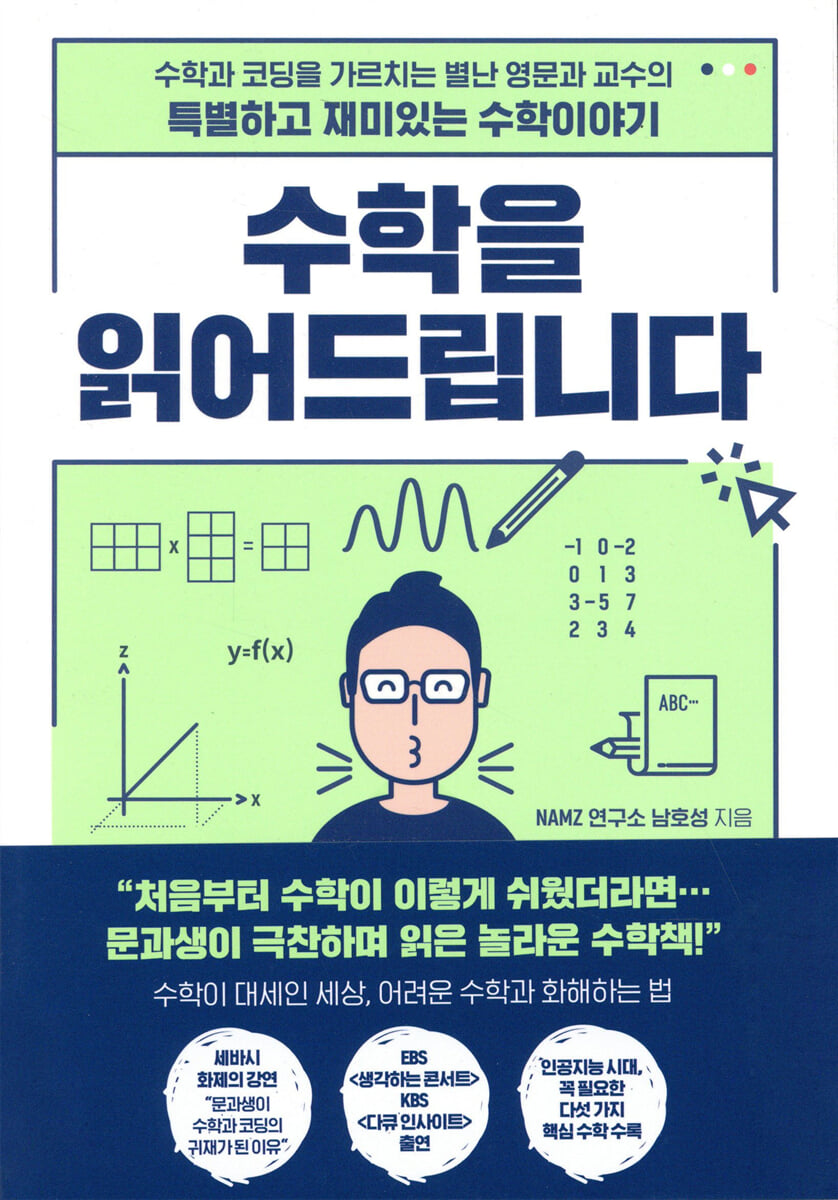
I will read math for you
 |
Description
Book Introduction
“I am an English professor who studies math every day!”
A professor of English who went from being a liberal arts dropout to becoming a language engineer
The world's easiest, most unique, and most fun math lessons
The word 'supoja' has become so familiar to most students and many people who have been through school that there is no one who does not know it.
Why did we have to become dropouts? Is it okay to live like this? Here, in a university English department, there's an unusual professor who teaches math to liberal arts students, most of whom are already infected with the dropout virus.
The author, a professor of English Language and Literature at Korea University and a senior scientist at the Haskins Institute for Advanced Study at Yale University, studies mathematics every day and teaches students mathematics such as functions, differentiation, matrices, and vectors.
How on earth did he end up doing this?
[Reading Math for You] is a unique self-help book on mathematics written by Professor Nam Ho-seong, who chose to drop out of school because he hated math, majored in English literature in the liberal arts department, and later fell in love with the charm of mathematics while studying language engineering.
Based on his own experiences to date, this book awakens many people who are struggling with math in this era, or who may become struggling in the future, to the usefulness of math and why we should study it, and points out the core math that we must know in the coming era of artificial intelligence.
Above all, it is written in an easy and fun way that even those who are not familiar with mathematics can understand, by implementing the same teaching method that fascinated math dropouts and was highly praised by liberal arts students.
After reading this book, which is structured so that anyone can understand it step by step even if they have no prior knowledge of mathematical concepts, anyone will be able to abandon the preconceived notion that mathematics is a difficult, complex, and headache-inducing subject and look at it from a new perspective.
Let's dive into an easy, special, and fun math story told through a new perspective by Professor Nam Ho-seong.
A professor of English who went from being a liberal arts dropout to becoming a language engineer
The world's easiest, most unique, and most fun math lessons
The word 'supoja' has become so familiar to most students and many people who have been through school that there is no one who does not know it.
Why did we have to become dropouts? Is it okay to live like this? Here, in a university English department, there's an unusual professor who teaches math to liberal arts students, most of whom are already infected with the dropout virus.
The author, a professor of English Language and Literature at Korea University and a senior scientist at the Haskins Institute for Advanced Study at Yale University, studies mathematics every day and teaches students mathematics such as functions, differentiation, matrices, and vectors.
How on earth did he end up doing this?
[Reading Math for You] is a unique self-help book on mathematics written by Professor Nam Ho-seong, who chose to drop out of school because he hated math, majored in English literature in the liberal arts department, and later fell in love with the charm of mathematics while studying language engineering.
Based on his own experiences to date, this book awakens many people who are struggling with math in this era, or who may become struggling in the future, to the usefulness of math and why we should study it, and points out the core math that we must know in the coming era of artificial intelligence.
Above all, it is written in an easy and fun way that even those who are not familiar with mathematics can understand, by implementing the same teaching method that fascinated math dropouts and was highly praised by liberal arts students.
After reading this book, which is structured so that anyone can understand it step by step even if they have no prior knowledge of mathematical concepts, anyone will be able to abandon the preconceived notion that mathematics is a difficult, complex, and headache-inducing subject and look at it from a new perspective.
Let's dive into an easy, special, and fun math story told through a new perspective by Professor Nam Ho-seong.
- You can preview some of the book's contents.
Preview
index
Recommendation
Prologue: Math Stories from an English Literature Professor Creating Artificial Intelligence
PART 1. I almost gave up on math.
1.
Why a Humanities Student Became a Math and Coding Genius
2.
I confess, I was actually a water buff.
3.
I was fascinated by phonetics without even knowing it was artificial intelligence.
4.
There was a 'gap' in the world
5.
Encounter with computer coding
6.
A liberal arts student with twists and turns
PART 2.
From Math Giver to Math Addict
1.
A turning point in life: Yale and Haskins
2.
Somehow I became a world-class TADA developer
3.
Finding a breakthrough in the humanities in engineering
4.
The quirky English professor who teaches math and coding
5.
The rebellion of the artificial intelligence research institute 'Namz'
6.
Writing a new drama for Namzuman
PART 3.
A world where mathematics reigns supreme is coming.
1.
Mathematics as a tool for making a living and as an eye
2.
The advent of a mathematical class society
3.
Mathematics is the foundation of convergence
4.
Math Education: What's the Problem?
PART 4.
Making peace with the mathematics we never knew about
1.
Let's face the reality of entry barriers.
2.
Let's visualize it with visible math
3.
Let's approach it with speaking mathematics.
4.
Let's apply useful mathematics
5.
Have the courage not to teach
6.
It's your fault I didn't understand, get used to the frustration
PART 5.
Mathematics essential for the future
1.
Five Essential Maths for the AI Era
2.
A world made of functions, inputs, and outputs
3.
Differentiation, the influence of input
4.
Matrices and Vectors, the Masters of Artificial Intelligence
5.
The future of probability and possibility
6.
The World of Artificial Neural Networks Revealed by Mathematics
Epilogue _ Enjoy the Right to Understand Mathematics Properly
Prologue: Math Stories from an English Literature Professor Creating Artificial Intelligence
PART 1. I almost gave up on math.
1.
Why a Humanities Student Became a Math and Coding Genius
2.
I confess, I was actually a water buff.
3.
I was fascinated by phonetics without even knowing it was artificial intelligence.
4.
There was a 'gap' in the world
5.
Encounter with computer coding
6.
A liberal arts student with twists and turns
PART 2.
From Math Giver to Math Addict
1.
A turning point in life: Yale and Haskins
2.
Somehow I became a world-class TADA developer
3.
Finding a breakthrough in the humanities in engineering
4.
The quirky English professor who teaches math and coding
5.
The rebellion of the artificial intelligence research institute 'Namz'
6.
Writing a new drama for Namzuman
PART 3.
A world where mathematics reigns supreme is coming.
1.
Mathematics as a tool for making a living and as an eye
2.
The advent of a mathematical class society
3.
Mathematics is the foundation of convergence
4.
Math Education: What's the Problem?
PART 4.
Making peace with the mathematics we never knew about
1.
Let's face the reality of entry barriers.
2.
Let's visualize it with visible math
3.
Let's approach it with speaking mathematics.
4.
Let's apply useful mathematics
5.
Have the courage not to teach
6.
It's your fault I didn't understand, get used to the frustration
PART 5.
Mathematics essential for the future
1.
Five Essential Maths for the AI Era
2.
A world made of functions, inputs, and outputs
3.
Differentiation, the influence of input
4.
Matrices and Vectors, the Masters of Artificial Intelligence
5.
The future of probability and possibility
6.
The World of Artificial Neural Networks Revealed by Mathematics
Epilogue _ Enjoy the Right to Understand Mathematics Properly
Detailed image
Into the book
All of the Namz Research Institute's members are liberal arts students, not engineering students.
Everyone was a 'loser'.
People without even a basic understanding of mathematics or coding are creating artificial intelligence systems, and mathematics is at the heart of these remarkable achievements.
Isn't that fascinating? I'm not suggesting we return to mathematics, where we become frustrated by endless problem-solving and infuriated by complex formulas.
Because the mathematics we learn and master is not the mathematics that everyone knows.
The mathematics I learned anew is not the kind that is full of formulas, that must be solved, or that I don't even know where it is used.
This mathematics is not the kind of mathematics that requires derivation and proof.
This mathematics is visible mathematics, speaking mathematics, and useful mathematics.
--- p.15
In fact, artificial intelligence is about making machines more human.
Ultimately, it is about creating ‘people’, but there are no ‘people’ in the current artificial intelligence.
People are pushed aside.
The reason is that people who study humanities are not the masters of artificial intelligence.
I firmly believe that humanists should be the ones creating artificial intelligence to make it more human.
We, as humanities researchers, must reclaim the ownership of artificial intelligence from engineers.
To do that, you have to learn skills, and to do that, you have to do math.
Namz's story could perhaps be a way to find the owner of artificial intelligence.
--- p.94
True fusion is seen as something that goes beyond simple bonding and involves a chemical reaction.
Convergence does not simply occur when many people from various fields come together, but rather when multiple disciplines are integrated into one person's mind.
Just as Da Vinci and Descartes wrote history with their expertise in various fields.
It is said that the founder of DeepMind, who created AlphaGo, also had four majors.
Perhaps this individual, a convergent talent with experience in various fields, including cognitive science, mathematics, and physics, connected and combined their knowledge to become the leader in today's AI technology. Of course, I believe the mathematics underlying this process served as a catalyst for the chemical fusion of knowledge from various fields.
Now is the time to dig many wells.
And mathematics is the foundation of true convergence.
--- p.124
So far, you may have thought that functions are expressed only as formulas, but that is not necessarily the case.
In mathematics, it is only a matter of understanding that input-output relationships can be expressed in numbers.
If it weren't for the numbers, it might have resonated more with us.
Let's recall our own function definition.
“Something that takes something as input, changes it in some way, and spits it out as output.”
So, what's the function we see most closely around us? As you might have guessed, it's ourselves, the human being.
A human being is a collection of various functions.
We eat food (input) and go to the bathroom (output).
We see things (input) and recognize what they are (output).
Hear someone's voice (input) and know what they are saying (output).
In this way, a person is made up of countless functions.
--- p.178
It seems like the Fourth Industrial Revolution has only just begun, but we already have to prepare for the Fifth Industrial Revolution.
The speed of change is beyond imagination.
If the 4th industrial revolution was about creating machines that resemble humans, the 5th industrial revolution might be about humans that resemble machines.
The world is going that way, whether I like it or not.
In this era, mathematics makes everything we have shine even brighter.
And it makes you a 'host' rather than a 'guest' anymore.
So, seeing and knowing mathematics 'properly' is no longer a duty, but a right.
I hope you realize that what we hate so much is not what mathematics really is.
Everyone was a 'loser'.
People without even a basic understanding of mathematics or coding are creating artificial intelligence systems, and mathematics is at the heart of these remarkable achievements.
Isn't that fascinating? I'm not suggesting we return to mathematics, where we become frustrated by endless problem-solving and infuriated by complex formulas.
Because the mathematics we learn and master is not the mathematics that everyone knows.
The mathematics I learned anew is not the kind that is full of formulas, that must be solved, or that I don't even know where it is used.
This mathematics is not the kind of mathematics that requires derivation and proof.
This mathematics is visible mathematics, speaking mathematics, and useful mathematics.
--- p.15
In fact, artificial intelligence is about making machines more human.
Ultimately, it is about creating ‘people’, but there are no ‘people’ in the current artificial intelligence.
People are pushed aside.
The reason is that people who study humanities are not the masters of artificial intelligence.
I firmly believe that humanists should be the ones creating artificial intelligence to make it more human.
We, as humanities researchers, must reclaim the ownership of artificial intelligence from engineers.
To do that, you have to learn skills, and to do that, you have to do math.
Namz's story could perhaps be a way to find the owner of artificial intelligence.
--- p.94
True fusion is seen as something that goes beyond simple bonding and involves a chemical reaction.
Convergence does not simply occur when many people from various fields come together, but rather when multiple disciplines are integrated into one person's mind.
Just as Da Vinci and Descartes wrote history with their expertise in various fields.
It is said that the founder of DeepMind, who created AlphaGo, also had four majors.
Perhaps this individual, a convergent talent with experience in various fields, including cognitive science, mathematics, and physics, connected and combined their knowledge to become the leader in today's AI technology. Of course, I believe the mathematics underlying this process served as a catalyst for the chemical fusion of knowledge from various fields.
Now is the time to dig many wells.
And mathematics is the foundation of true convergence.
--- p.124
So far, you may have thought that functions are expressed only as formulas, but that is not necessarily the case.
In mathematics, it is only a matter of understanding that input-output relationships can be expressed in numbers.
If it weren't for the numbers, it might have resonated more with us.
Let's recall our own function definition.
“Something that takes something as input, changes it in some way, and spits it out as output.”
So, what's the function we see most closely around us? As you might have guessed, it's ourselves, the human being.
A human being is a collection of various functions.
We eat food (input) and go to the bathroom (output).
We see things (input) and recognize what they are (output).
Hear someone's voice (input) and know what they are saying (output).
In this way, a person is made up of countless functions.
--- p.178
It seems like the Fourth Industrial Revolution has only just begun, but we already have to prepare for the Fifth Industrial Revolution.
The speed of change is beyond imagination.
If the 4th industrial revolution was about creating machines that resemble humans, the 5th industrial revolution might be about humans that resemble machines.
The world is going that way, whether I like it or not.
In this era, mathematics makes everything we have shine even brighter.
And it makes you a 'host' rather than a 'guest' anymore.
So, seeing and knowing mathematics 'properly' is no longer a duty, but a right.
I hope you realize that what we hate so much is not what mathematics really is.
--- p.234
Publisher's Review
“I almost gave up on math!”
A liberal arts student who was a dropout in school
From mathematics to becoming a language engineer and professor, an AI expert…
In a world where mathematics is the trend, how to make peace with difficult mathematics?
The world's easiest math lessons for countless adults who grew up with math disabilities.
It is almost as if we are entering a world where mathematics is the mainstream.
The Fourth Industrial Revolution is represented by the keywords technology and fusion.
And mathematics is a very important core underlying technology and convergence.
Especially in the age of artificial intelligence, where big data and AI are deeply ingrained in various industries and individuals' daily lives, understanding the vast amount of data and technology can become an essential survival skill.
However, while the importance of mathematics is growing day by day, the reality is that the number of people who hate mathematics is increasing.
Our education system remains stuck in the past, with students studying math as if it were all about solving problems and memorizing formulas, with curiosity and interest in math being replaced by test scores.
How ironic! That's why we need a fresh perspective and approach to mathematics, moving beyond the traditional math for entrance exams and the CSAT.
[Sebashi] Professor Nam Ho-seong, the author, has created a lot of buzz by confessing in a popular lecture that he was once a liberal arts major who hated and avoided math, but is now completely immersed in his love for math, studying math every day and creating artificial intelligence.
Although he is now a world-renowned language engineer and professor, he was once a liberal arts student who gave up on mathematics because he found the subject tiresome.
He became fascinated with linguistics (phonetics) in graduate school, and after accidentally encountering the world of coding, he worked as a programmer at a large company. Then, when he went to study abroad at Yale University in the United States, he began studying mathematics out of necessity.
From then on, I realized that mathematics could be the foundation of all learning. I realized that I, who had almost given up on mathematics, actually loved it, and I decided to share the true charm of mathematics with more people.
The author aims to show how to study mathematics more easily and enjoyably based on his own unique background and life experiences.
I want to share my concerns about the barriers to entry with those who want to study mathematics but are unsure of where and how to start. As someone who has faced the same challenges, I would like to share my concerns about the barriers to entry.
He shares his own tumultuous period of adaptation and teaching know-how, including how he, a liberal arts major who dropped out of college, studied mathematics again, how he later taught mathematics to his students and even developed artificial intelligence technology, and why we need convergent talents in the future and why mathematics must be included in them. Through this, he aims to lay the foundation for us to reconcile with mathematics, which we have unknowingly neglected.
“The mathematics we have known so far is not real mathematics!”
How to never lose to math, the world, or life
The author emphasizes that the mathematics we have known so far, the mathematics we have learned with dislike without even knowing why we have to learn such difficult things, is not the true form of mathematics.
I advise you to break free from the misconception that math is all about the difficult and boring things you learn in school, and the prejudice that if you get good grades, you are good at math, and if you get bad grades, you are bad at math.
In particular, as a professor of English Language and Literature, the author seeks to find a way to overcome the future crisis in the humanities in ‘mathematics.’
Rather than assuming that students in the humanities will naturally fail and avoiding mathematics, if they realize the necessity of it and study it, they will be able to find the answer to not only future jobs but also to survive as a truly interdisciplinary discipline.
Artificial intelligence originally started with making machines more human-like.
To make AI more humane, shouldn't more people in the humanities be involved and directly involved in its creation? Indeed, NAMZ, the AI voice recognition research lab led by the author, is comprised entirely of members from the humanities. It's not a group of individuals with a deep interest in IT or a particular aptitude for mathematics or engineering.
The author emphasizes that “if friends with liberal arts background and knowledge learn mathematics and coding to build their skills, they can become more competitive in the age of artificial intelligence,” and also emphasizes that liberal arts students of this era and adults who have lived their lives away from mathematics should never become dropouts.
To achieve this, rather than mathematics that is full of formulas, must be solved unconditionally, or is not used in any way, we will reveal the process of understanding and reading it as visible, speaking, and useful mathematics, in a very specific and practical way.
When we realize that the reality of artificial intelligence, which we see and hear about several times a day, is nothing more than simple mathematical concepts that we only heard about in school, many people may feel a sense of betrayal of the mathematics they have learned so far, but also new motivation. He tells the story of mathematics as an accessible, essential and practical subject that is helpful in life.
Realizing and learning new possibilities in mathematics can be more than just an effort to avoid being a failure; it can be a process of learning how to never give up on the world and your own life in the future.
“A dangerous math book that will have you immersed in it as you read!”
Five key math concepts to help you break through the AI and big data era.
This book contains the passionate autobiographical story of the author, who has personally implemented convergence education based on his own experience realizing the necessity of mathematics and coding in the era of the 4th Industrial Revolution, as well as loving criticism and advice on the problems of mathematics education in Korea, the attitude and approach we should have to study mathematics more easily, and all the stories about the useful basics of mathematics that we must know in the future.
This book is not just a simple math book, but a highly humanistic book on the theme of 'mathematics' discovered in his own way by an English professor who received a thorough liberal arts education. At the same time, it is a human story and self-help book about a successful life turnaround through the rediscovery of mathematics. That is why it is also the reason.
In particular, it includes five essential mathematics (functions, differentiation, matrices, vectors, and probability) that must be known in the age of artificial intelligence, and by rereading mathematics from a perspective and method that even people with no mathematical knowledge can understand, it has drawn rave reviews from liberal arts students who have lost confidence in mathematics.
The way it unfolds, reminding us that the function that only floated around in our heads as an equation like y=f(x) is actually the human being itself, and furthermore, artificial intelligence itself, and that differentiation, which made us pull out our hair in school, is actually the influence of a function that presupposes input and output, has an amazing charm that makes you fall in love with it as you read.
Are you struggling with the complex and difficult math of the college entrance exam, thinking that it's all about the college entrance exam? From high school students to parents who don't want to pass on the DNA of those who gave up on math, to college students who think math is something that only other people have, to adult readers who are trying to muster up the courage to open a math book in the digital age, this book will be a great guide to awaken confidence and enjoyment in math for everyone who wants to use math properly at least once.
A professor of English with a unique background shares easy, unique, and fun math lessons. Beginning with motivation and curiosity, the story of math ultimately becomes a life-changing weapon. Through these stories, let's explore the possibilities of hope as leaders of this era, able to understand and prepare for the rapidly changing world.
GOODS SPECIFICS
- Publication date: December 28, 2021
- Page count, weight, size: 236 pages | 358g | 140*200*20mm
- ISBN13: 9788947547765
- ISBN10: 894754776X
You may also like
카테고리
korean


korean

![GQ KOREA Mark (Monthly): December [2025]](http://librairie.coreenne.fr/cdn/shop/files/8ef265dbbfbf186523ed75ba7319009d.jpg?v=1765340328&width=3840)


