

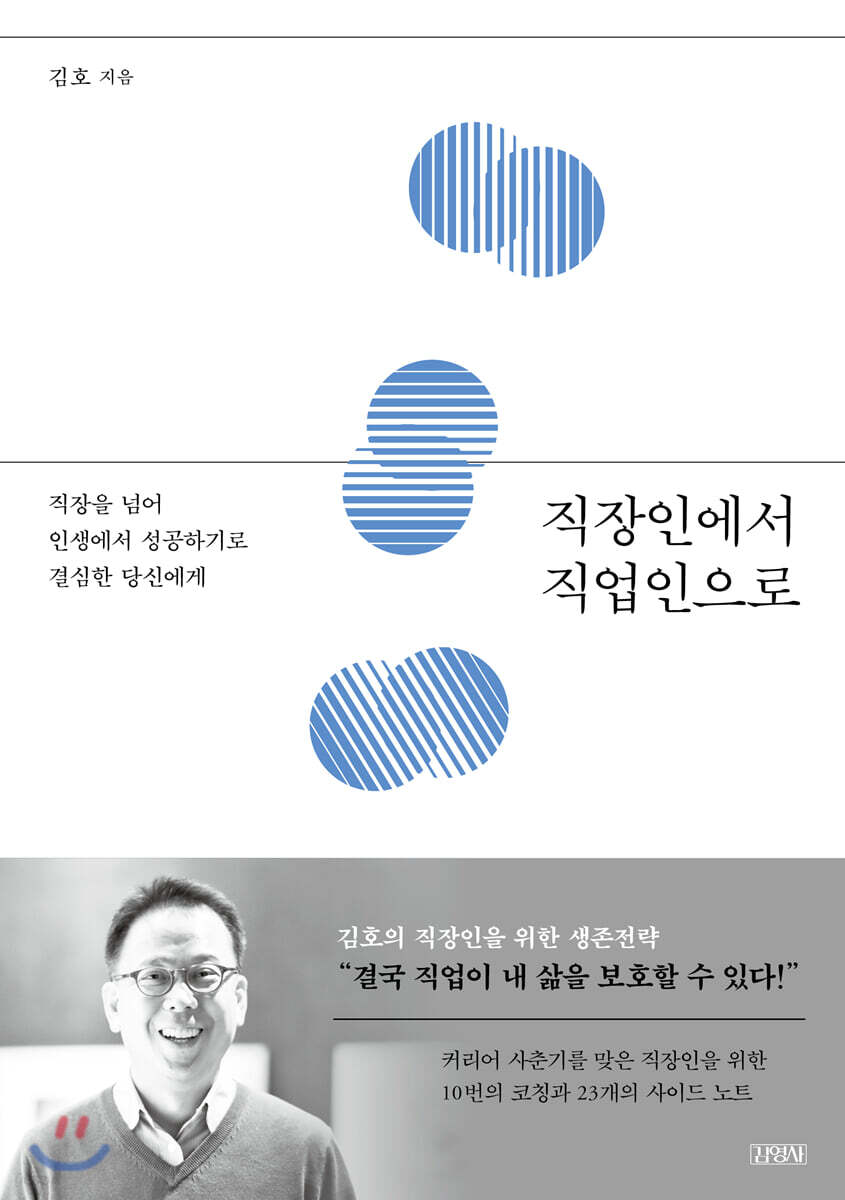
From office worker to professional
 |
Description
Book Introduction
Survival Strategies for Workers in a Jobless Era
Are you a 'working person'? Are you a 'professional'?
“The way workplaces treat their employees has already changed.
“It’s time for workers to change the way they approach their jobs.”
What will I be doing in 10 years? When is it best to leave my job? What can I do to grow, not compete, at work? Is there a way to "last the day" at work? These are the questions and concerns every working person has faced at least once.
As the shelf life of jobs gets shorter, aren't office workers spending most of their waking hours working, even cutting down on sleep?
Is that the only way to go about your work life?
Do you know what you want in life and professionally?
This is the fundamental question this book asks.
Are you a 'working person'? Are you a 'professional'?
“The way workplaces treat their employees has already changed.
“It’s time for workers to change the way they approach their jobs.”
What will I be doing in 10 years? When is it best to leave my job? What can I do to grow, not compete, at work? Is there a way to "last the day" at work? These are the questions and concerns every working person has faced at least once.
As the shelf life of jobs gets shorter, aren't office workers spending most of their waking hours working, even cutting down on sleep?
Is that the only way to go about your work life?
Do you know what you want in life and professionally?
This is the fundamental question this book asks.
- You can preview some of the book's contents.
Preview
index
Prologue: For office workers who want to create a career
Part 1: From Office Worker to Professional
Chapter 1: Am I a Worker? Or a Professional? - The Professional Mindset
“Am I living well now?”|“What if I miss out on the promotion this time?”|How to extend my ‘shelf life’|When you feel like you don’t have time to think about your life
Side Note 1 Hygiene Factors and Motivational Factors
Side Note 2: Why do companies pay higher salaries to returning employees than to long-term employees?
Chapter 2: Investing in Myself for Growth
Making a Pledge with Myself | Investing in Myself | Everyone Has Vulnerabilities
Side Note 3: How to Run Your Own Workshop
Chapter 3: To Dream of the Future, Let's Look Back on My Work Life
Don't React, Take Action | Do I Know Myself Well? | When Reflecting on and Writing About Myself Feels Daunting
Side Note 4 Professional Diagnostic Tools
Side Note 5: The Protagonist of the Novel "I" - A Question from Author Jeong Yu-jeong
Chapter 4: How to Find Out What You Really Want
Am I dreaming someone else's dream? | Can I turn what I love into a career? | "What kind of talent do I have?"
Side Note 6: The Opportunity That "If It Works, It's Good, If It Doesn't, It Can't Be Done" Brings
Chapter 5: Finding a Career at the End of Your Job
How will you leave your company?|Are you afraid of retirement someday?|Want to clarify your career and desires?
Side Note 7: Preparing for Retirement in Advance
Chapter 6 Can I make money in my own name instead of through the company?
Instead of a plain resume, the 6E resume|“Can I become independent?”
Side Note 8 “Who should I care about, others or me?”
Side Note 9: Hide, Cry, and Keeper Test
Side Note 10 Pixar Pitch and Job
Part 2: A Workplace User's Guide for Professionals
Chapter 7: Studying More Than Graduate School, Growing More Than Proving
Achieve, not compete | The standard for studying more | It's right not to keep your beginner's mind! | Take paid lectures, not free ones | How to avoid becoming a jerk | How many times have you been rejected today? | Being told you have potential is not a compliment.
Side Note 11: Sensemaking: Drawing a Map for Myself
Side Note 12 'Class 101' Test
Side Note 13 Don't Be a Yes Man
Side Note 14: Smart Habits That Will Shape Your Future
Side Note 15 Haruki's Advice
Chapter 8: Prepare to Become a Leader
The me that others see is the real me|People don't change easily|Consider what kind of leader you want to be remembered as|Feedforward instead of feedback|Don't mistake conversation for advice|"I've already said enough!"|Old-timers don't ask questions|Don't enjoy meetings|A matter of necessity, not duty: gender equality thinking and language|Don't hide your weaknesses, share them|How to apologize properly|The art of gift giving|The importance of 'you who I met by chance'
Side Note 16 Blind Side and Left Tackle
Side Note 17 What You Can Learn from 360-Degree Evaluations
Side Note 18: Why Mark Zuckerberg Wears a Gray T-Shirt Every Day
Side Note 19: Learning About Work from a Political Consultant
Chapter 9: How to Protect Yourself from Organizations
Sometimes You Need to Be a Little Naughty | Bullying Doesn't Stop on Its Own | How to Confidently Reject Unreasonable Requests | Women: Overcoming the Barriers of Marriage and Childcare | You Don't Have to Be a Good Daughter-in-Law or Son-in-Law
Side Note 20 Living Alone vs.
Living together
Chapter 10: Can we keep running like this?
“What is the balance I want?” - Reconstructing work-life balance|The courage to say ‘no’|To see the flow, you must break away from it|Quitting your job, time to face yourself|Move from the peak, not the bottom|Changing buses called work and careers|Outside the company is not hell|Trust your own choices, not those of the majority|Today is the special moment in my life
Side Note 21 If you can't study, learn a skill?
Side Note 22: The Last Decade of Preparing for Your Future at Work
Side Note 23 From Technology Company Employee to Carpenter
Epilogue
My final coaching letter to you, my readers.
10 Questions to Ask Yourself to Transition from Office Worker to Professional
Appendix: Leaving Work
Americas
Part 1: From Office Worker to Professional
Chapter 1: Am I a Worker? Or a Professional? - The Professional Mindset
“Am I living well now?”|“What if I miss out on the promotion this time?”|How to extend my ‘shelf life’|When you feel like you don’t have time to think about your life
Side Note 1 Hygiene Factors and Motivational Factors
Side Note 2: Why do companies pay higher salaries to returning employees than to long-term employees?
Chapter 2: Investing in Myself for Growth
Making a Pledge with Myself | Investing in Myself | Everyone Has Vulnerabilities
Side Note 3: How to Run Your Own Workshop
Chapter 3: To Dream of the Future, Let's Look Back on My Work Life
Don't React, Take Action | Do I Know Myself Well? | When Reflecting on and Writing About Myself Feels Daunting
Side Note 4 Professional Diagnostic Tools
Side Note 5: The Protagonist of the Novel "I" - A Question from Author Jeong Yu-jeong
Chapter 4: How to Find Out What You Really Want
Am I dreaming someone else's dream? | Can I turn what I love into a career? | "What kind of talent do I have?"
Side Note 6: The Opportunity That "If It Works, It's Good, If It Doesn't, It Can't Be Done" Brings
Chapter 5: Finding a Career at the End of Your Job
How will you leave your company?|Are you afraid of retirement someday?|Want to clarify your career and desires?
Side Note 7: Preparing for Retirement in Advance
Chapter 6 Can I make money in my own name instead of through the company?
Instead of a plain resume, the 6E resume|“Can I become independent?”
Side Note 8 “Who should I care about, others or me?”
Side Note 9: Hide, Cry, and Keeper Test
Side Note 10 Pixar Pitch and Job
Part 2: A Workplace User's Guide for Professionals
Chapter 7: Studying More Than Graduate School, Growing More Than Proving
Achieve, not compete | The standard for studying more | It's right not to keep your beginner's mind! | Take paid lectures, not free ones | How to avoid becoming a jerk | How many times have you been rejected today? | Being told you have potential is not a compliment.
Side Note 11: Sensemaking: Drawing a Map for Myself
Side Note 12 'Class 101' Test
Side Note 13 Don't Be a Yes Man
Side Note 14: Smart Habits That Will Shape Your Future
Side Note 15 Haruki's Advice
Chapter 8: Prepare to Become a Leader
The me that others see is the real me|People don't change easily|Consider what kind of leader you want to be remembered as|Feedforward instead of feedback|Don't mistake conversation for advice|"I've already said enough!"|Old-timers don't ask questions|Don't enjoy meetings|A matter of necessity, not duty: gender equality thinking and language|Don't hide your weaknesses, share them|How to apologize properly|The art of gift giving|The importance of 'you who I met by chance'
Side Note 16 Blind Side and Left Tackle
Side Note 17 What You Can Learn from 360-Degree Evaluations
Side Note 18: Why Mark Zuckerberg Wears a Gray T-Shirt Every Day
Side Note 19: Learning About Work from a Political Consultant
Chapter 9: How to Protect Yourself from Organizations
Sometimes You Need to Be a Little Naughty | Bullying Doesn't Stop on Its Own | How to Confidently Reject Unreasonable Requests | Women: Overcoming the Barriers of Marriage and Childcare | You Don't Have to Be a Good Daughter-in-Law or Son-in-Law
Side Note 20 Living Alone vs.
Living together
Chapter 10: Can we keep running like this?
“What is the balance I want?” - Reconstructing work-life balance|The courage to say ‘no’|To see the flow, you must break away from it|Quitting your job, time to face yourself|Move from the peak, not the bottom|Changing buses called work and careers|Outside the company is not hell|Trust your own choices, not those of the majority|Today is the special moment in my life
Side Note 21 If you can't study, learn a skill?
Side Note 22: The Last Decade of Preparing for Your Future at Work
Side Note 23 From Technology Company Employee to Carpenter
Epilogue
My final coaching letter to you, my readers.
10 Questions to Ask Yourself to Transition from Office Worker to Professional
Appendix: Leaving Work
Americas
Detailed image

Into the book
“With most of our waking hours spent at work, it’s easy to mistakenly believe that promotions and pay raises are what we want out of life.
But when work disappears from your life, you finally feel the emptiness of what you've been working so hard for.
And then you leave your job and find yourself with little to do.
To avoid this situation, you need to change your thinking.
“Rather than making success at work the goal of my life, how can I use my job to become successful in life?”
--- p.20
“Like fingerprints, people have their own unique colors and appearances.
However, as we go about our work lives, we are seen as part of a large organization, subordinates who receive instructions from their superiors, and people with certain positions in certain departments.
“Just holding up a mirror to my own life and writing down what kind of person I am, from memory, without worrying about showing it to anyone, helps me understand myself.”
--- p.72
"Do I know what I desire? Is what I desire truly my own, or am I simply following the desires of my colleagues and friends? Here, I unexpectedly got an idea for how the direction of my self-development would change.
Many self-help books of the past have told us how we can get what others desire, faster.
Go to a good school, get a job at a big company, get promoted at work, earn more (of course, money), and become more famous.
Even after over 20 years of working, we often find ourselves unable to answer the question, "What do I really want from life or work?"
Or, they may feel uncomfortable with these questions and avoid them altogether.
“Considering it as a luxury.”
--- p.97
“We are afraid that one day our business cards will disappear.
This is because they only view themselves in terms of the company and position they belong to.
First, let's create a specialty, a field of expertise that describes me.
And over the next few years, let's invest the time, money, and effort to make sure that people naturally think of me when they talk about issues related to that field.
The most powerful calling card is not a high title, but a sellable expertise.
“Let’s build that kind of expertise while we’re at work.”
--- p.145
“You may worry, ‘It’s no use trying,’ or ‘What if I do it and it goes wrong?’
So if you don't take any action, that's your choice too.
But I also want you to consider that you may have other choices, that you may have the strength and wisdom within you to deal with that person in a different way than before.
We have more control and power than we think.
It's just that I'm used to not using it in front of powerful people.
“My life is too precious to let him continue to harass me.”
--- p.257
“I’m really curious.
Readers of this book, how do you truly want to live? How often have you considered your own unique personality, talents, values, and energy? And is your current job truly reflecting the life and work you want to do? I'm not suggesting you just quit your job.
Rather, the message I want to convey in this book is that you should find a job while working.”
--- p.328
“In terms of how we change as professionals while working, work is more like a transfer station than a final destination.
As you read this book, I hope you'll consider that as a working person, your "shelf life" isn't long, and that you may not have as much time left to make changes as you think.
The best life is the life you want to live.
To do that, you need to know what you want in life and live your life working towards that goal.
“Am I going in that direction now?”
But when work disappears from your life, you finally feel the emptiness of what you've been working so hard for.
And then you leave your job and find yourself with little to do.
To avoid this situation, you need to change your thinking.
“Rather than making success at work the goal of my life, how can I use my job to become successful in life?”
--- p.20
“Like fingerprints, people have their own unique colors and appearances.
However, as we go about our work lives, we are seen as part of a large organization, subordinates who receive instructions from their superiors, and people with certain positions in certain departments.
“Just holding up a mirror to my own life and writing down what kind of person I am, from memory, without worrying about showing it to anyone, helps me understand myself.”
--- p.72
"Do I know what I desire? Is what I desire truly my own, or am I simply following the desires of my colleagues and friends? Here, I unexpectedly got an idea for how the direction of my self-development would change.
Many self-help books of the past have told us how we can get what others desire, faster.
Go to a good school, get a job at a big company, get promoted at work, earn more (of course, money), and become more famous.
Even after over 20 years of working, we often find ourselves unable to answer the question, "What do I really want from life or work?"
Or, they may feel uncomfortable with these questions and avoid them altogether.
“Considering it as a luxury.”
--- p.97
“We are afraid that one day our business cards will disappear.
This is because they only view themselves in terms of the company and position they belong to.
First, let's create a specialty, a field of expertise that describes me.
And over the next few years, let's invest the time, money, and effort to make sure that people naturally think of me when they talk about issues related to that field.
The most powerful calling card is not a high title, but a sellable expertise.
“Let’s build that kind of expertise while we’re at work.”
--- p.145
“You may worry, ‘It’s no use trying,’ or ‘What if I do it and it goes wrong?’
So if you don't take any action, that's your choice too.
But I also want you to consider that you may have other choices, that you may have the strength and wisdom within you to deal with that person in a different way than before.
We have more control and power than we think.
It's just that I'm used to not using it in front of powerful people.
“My life is too precious to let him continue to harass me.”
--- p.257
“I’m really curious.
Readers of this book, how do you truly want to live? How often have you considered your own unique personality, talents, values, and energy? And is your current job truly reflecting the life and work you want to do? I'm not suggesting you just quit your job.
Rather, the message I want to convey in this book is that you should find a job while working.”
--- p.328
“In terms of how we change as professionals while working, work is more like a transfer station than a final destination.
As you read this book, I hope you'll consider that as a working person, your "shelf life" isn't long, and that you may not have as much time left to make changes as you think.
The best life is the life you want to live.
To do that, you need to know what you want in life and live your life working towards that goal.
“Am I going in that direction now?”
--- p.332
Publisher's Review
Why do we work, how do we work, what do we work for?
After all, my job can protect my life!
“A job is not something you just have to keep going to.
It's not even possible.
It's there to come out eventually.
“My job can’t protect me, but my career can protect my life.”
What's the difference between an office worker and a professional? "Office workers" see their workplace as their entire world.
An 'office worker' identifies with his or her workplace.
A person who finds his or her own value only within the workplace is an 'office worker'.
On the other hand, 'professionals' see themselves as independent beings, separate from their workplace.
A 'professional' leads his or her life outside of work.
Transitioning from an office worker to a professional is the process of honestly finding my desires as the master of my own life.
It is a process of discovering my strengths, individuality, desires, and talents from an organization-dependent person accustomed to the role assigned by the organization.
So, how can you transition from being an office worker to a professional? You need to be able to utilize your job effectively and prepare accordingly while you're at it.
I'm not saying you should do more work.
This is a story about rethinking the purpose and attitude of going to work and changing the allocation of time and energy.
It's not easy to switch jobs when you're close to retirement.
Because once you get off the 'bus' called work, there are no jobs left for you.
This book is about an interesting journey of discovering my own unique individuality and abilities, rather than looking at myself based on my organizational affiliation.
Because I'm working 'crazy' hard at work
Aren't you making excuses for not preparing for the future?
This book is largely divided into two topics.
Part 1 tells you what you need to prepare to change from an office worker to a professional.
The more important question than 'Should I quit my job or not?' is 'What should I prepare for at work?'
If you are working hard at your job but are having doubts about what you are doing, you should take a look at what cards you have.
I explore the differences between office workers and professionals, understand my desires, and discover what my competitive edge is.
Part 2 is a 'Workplace User Manual for Professionals'.
By knowing the four things you need to prepare for in your work life and how to put them into practice while working at your job every day, you can prepare for independence as a 'professional'.
It covers how to study and grow to become a professional, what kind of reputation to build to become a leader in the workplace, how to protect yourself in the organization, and when and how to quit or change jobs.
In addition, it provides side notes with sparkling insights and practical tips for work life.
If you gradually accumulate tips such as 'sites that will help you develop your expertise', 'diagnostic tools that objectively understand yourself', 'tests that determine your competitiveness', 'how to create small habits', 'the art of rejection', and 'creating listeners who will listen to your concerns', you will enrich your work life and create your own competitiveness as a 'professional'.
From office worker to professional
10 Questions to Ask Yourself Before Switching
1.
Am I a working person? Am I a professional? The mindset of a professional.
What if I miss out on a promotion this time? Are you mistaking a means like "job promotion" for the goal you want in life or career?
Even if you get promoted to an executive position (just look at the average number of years people who get promoted to an executive position at your current company stay there), that's no longer a goal once you leave the job; promotion is just a means to an end.
The goals you want in life or career should be something you can consistently pursue whether you are at work or not.
2.
Do you intentionally take time for yourself?
Let's make a promise with me.
Don't react, take action.
For office workers who go to work at sunrise and leave work looking at the night sky covered in spiderwebs, the most important thing is to have some time alone.
For office workers who automatically 'react' every day, time alone is a time of 'action' to find the real me without being swept away by the world.
3.
Are there 10 instances where you were satisfied with the process and outcome while working?
Think back to the best moment you've experienced in your career.
Conversely, let's also think about what the worst moment was.
Finding my talents and strengths doesn't start from scratch, but rather has clues from my past work experience.
Writing down the best moments of your career will help you figure out what you're good at and what you enjoy doing.
4.
What is the life and work that I truly desire, not others?
Am I dreaming someone else's dream? Reflect on your own history and imagine your future.
Let's organize 'your history' into a chronology and write down the best experiences you've had in your work life.
Also, let's imagine future history.
You will be able to discover a new side of yourself that you never knew existed, and at the same time, check whether you are living properly.
5.
How do you want to end your working life?
Deciding when to quit your job.
Many employees quit when they fail to get promoted.
It's the worst timing.
You should quit your job when you feel most valuable and when you can receive applause.
Leaving your job when it's at its peak, not its lowest, gives you the option to move on to another job, take a break, or challenge yourself in a different field.
6.
Do you have individual skills that you can sell without relying on the organization?
Can I make money in my own name rather than through the company?
We often mistake our jobs or our titles for our abilities.
But that's more of an organization's ability than mine.
I need to develop my own skills that I can sell outside of work.
And that must be discovered in work life.
It is necessary to refine my own individual skills based on the experiences that I had the most fun and achieved the best results.
7.
Am I studying for growth, not competition, at work?
Achieve rather than compete.
Listen to paid lectures, not free ones.
How to develop your expertise to become a professional.
There are people who want to show that they work tirelessly.
He is a 'working person' who wants to prove himself to others.
A 'professional' seeks to improve himself for his professional goals.
So instead of competing to beat others, we want to grow and achieve.
Paradoxically, to become more competitive as a 'professional', you need to achieve rather than compete.
8.
What kind of leader will my coworkers remember me as?
Reputation Management to Grow as a Leader.
A leader should prepare not when he or she takes the leadership position, but from now on.
One thing that becomes even more important when you leave your job is the power of recommendations and referrals from colleagues who know you.
Because many opportunities come through recommendations and introductions.
The leadership of a ‘professional’ is created from the workplace.
9.
What are the barriers to my growth and am I looking for ways to overcome them?
How to protect myself from the organization.
Sometimes you need to be a little naughty.
We don't really know how powerful we are.
To protect myself, I must step forward.
Listening to one's superiors is no longer a virtue.
Injustice requires being 'spoiled'.
10.
Am I proactive in taking breaks and leaving?
Can we keep running like this? To see the flow, we have to break away from it.
Timing is also important when resting.
The moment you are forced out of the organization, it is too late.
I need to take the initiative to take breaks to see if I'm going in the right direction.
In an unfamiliar place, among unfamiliar people, I can finally enjoy the leisure of looking at my familiar life in a new way.
After all, my job can protect my life!
“A job is not something you just have to keep going to.
It's not even possible.
It's there to come out eventually.
“My job can’t protect me, but my career can protect my life.”
What's the difference between an office worker and a professional? "Office workers" see their workplace as their entire world.
An 'office worker' identifies with his or her workplace.
A person who finds his or her own value only within the workplace is an 'office worker'.
On the other hand, 'professionals' see themselves as independent beings, separate from their workplace.
A 'professional' leads his or her life outside of work.
Transitioning from an office worker to a professional is the process of honestly finding my desires as the master of my own life.
It is a process of discovering my strengths, individuality, desires, and talents from an organization-dependent person accustomed to the role assigned by the organization.
So, how can you transition from being an office worker to a professional? You need to be able to utilize your job effectively and prepare accordingly while you're at it.
I'm not saying you should do more work.
This is a story about rethinking the purpose and attitude of going to work and changing the allocation of time and energy.
It's not easy to switch jobs when you're close to retirement.
Because once you get off the 'bus' called work, there are no jobs left for you.
This book is about an interesting journey of discovering my own unique individuality and abilities, rather than looking at myself based on my organizational affiliation.
Because I'm working 'crazy' hard at work
Aren't you making excuses for not preparing for the future?
This book is largely divided into two topics.
Part 1 tells you what you need to prepare to change from an office worker to a professional.
The more important question than 'Should I quit my job or not?' is 'What should I prepare for at work?'
If you are working hard at your job but are having doubts about what you are doing, you should take a look at what cards you have.
I explore the differences between office workers and professionals, understand my desires, and discover what my competitive edge is.
Part 2 is a 'Workplace User Manual for Professionals'.
By knowing the four things you need to prepare for in your work life and how to put them into practice while working at your job every day, you can prepare for independence as a 'professional'.
It covers how to study and grow to become a professional, what kind of reputation to build to become a leader in the workplace, how to protect yourself in the organization, and when and how to quit or change jobs.
In addition, it provides side notes with sparkling insights and practical tips for work life.
If you gradually accumulate tips such as 'sites that will help you develop your expertise', 'diagnostic tools that objectively understand yourself', 'tests that determine your competitiveness', 'how to create small habits', 'the art of rejection', and 'creating listeners who will listen to your concerns', you will enrich your work life and create your own competitiveness as a 'professional'.
From office worker to professional
10 Questions to Ask Yourself Before Switching
1.
Am I a working person? Am I a professional? The mindset of a professional.
What if I miss out on a promotion this time? Are you mistaking a means like "job promotion" for the goal you want in life or career?
Even if you get promoted to an executive position (just look at the average number of years people who get promoted to an executive position at your current company stay there), that's no longer a goal once you leave the job; promotion is just a means to an end.
The goals you want in life or career should be something you can consistently pursue whether you are at work or not.
2.
Do you intentionally take time for yourself?
Let's make a promise with me.
Don't react, take action.
For office workers who go to work at sunrise and leave work looking at the night sky covered in spiderwebs, the most important thing is to have some time alone.
For office workers who automatically 'react' every day, time alone is a time of 'action' to find the real me without being swept away by the world.
3.
Are there 10 instances where you were satisfied with the process and outcome while working?
Think back to the best moment you've experienced in your career.
Conversely, let's also think about what the worst moment was.
Finding my talents and strengths doesn't start from scratch, but rather has clues from my past work experience.
Writing down the best moments of your career will help you figure out what you're good at and what you enjoy doing.
4.
What is the life and work that I truly desire, not others?
Am I dreaming someone else's dream? Reflect on your own history and imagine your future.
Let's organize 'your history' into a chronology and write down the best experiences you've had in your work life.
Also, let's imagine future history.
You will be able to discover a new side of yourself that you never knew existed, and at the same time, check whether you are living properly.
5.
How do you want to end your working life?
Deciding when to quit your job.
Many employees quit when they fail to get promoted.
It's the worst timing.
You should quit your job when you feel most valuable and when you can receive applause.
Leaving your job when it's at its peak, not its lowest, gives you the option to move on to another job, take a break, or challenge yourself in a different field.
6.
Do you have individual skills that you can sell without relying on the organization?
Can I make money in my own name rather than through the company?
We often mistake our jobs or our titles for our abilities.
But that's more of an organization's ability than mine.
I need to develop my own skills that I can sell outside of work.
And that must be discovered in work life.
It is necessary to refine my own individual skills based on the experiences that I had the most fun and achieved the best results.
7.
Am I studying for growth, not competition, at work?
Achieve rather than compete.
Listen to paid lectures, not free ones.
How to develop your expertise to become a professional.
There are people who want to show that they work tirelessly.
He is a 'working person' who wants to prove himself to others.
A 'professional' seeks to improve himself for his professional goals.
So instead of competing to beat others, we want to grow and achieve.
Paradoxically, to become more competitive as a 'professional', you need to achieve rather than compete.
8.
What kind of leader will my coworkers remember me as?
Reputation Management to Grow as a Leader.
A leader should prepare not when he or she takes the leadership position, but from now on.
One thing that becomes even more important when you leave your job is the power of recommendations and referrals from colleagues who know you.
Because many opportunities come through recommendations and introductions.
The leadership of a ‘professional’ is created from the workplace.
9.
What are the barriers to my growth and am I looking for ways to overcome them?
How to protect myself from the organization.
Sometimes you need to be a little naughty.
We don't really know how powerful we are.
To protect myself, I must step forward.
Listening to one's superiors is no longer a virtue.
Injustice requires being 'spoiled'.
10.
Am I proactive in taking breaks and leaving?
Can we keep running like this? To see the flow, we have to break away from it.
Timing is also important when resting.
The moment you are forced out of the organization, it is too late.
I need to take the initiative to take breaks to see if I'm going in the right direction.
In an unfamiliar place, among unfamiliar people, I can finally enjoy the leisure of looking at my familiar life in a new way.
GOODS SPECIFICS
- Date of issue: June 1, 2020
- Page count, weight, size: 356 pages | 566g | 148*210*30mm
- ISBN13: 9788934991250
- ISBN10: 8934991259
You may also like
카테고리
korean


korean

![GQ KOREA Mark (Monthly): December [2025]](http://librairie.coreenne.fr/cdn/shop/files/8ef265dbbfbf186523ed75ba7319009d.jpg?v=1765340328&width=3840)


